
Westermeier R., Naven T., H?pker H.-R. Proteomics in Practice: A Guide to Successful Experimental Design
Подождите немного. Документ загружается.


1 Electrophoretic Techniques120
Method Advantages Disadvantages
Coomassie brilli-
ant blue staining
(alcohol free, hot,
monodisperse)
Steady state method, fast,
good quantification, inexpen-
sive, very environment
friendly, mass spectrometry
compatible
Low sensitivity: LOD only
ca. 100 ng of BSA, back-
ground destaining necessary
Zinc imidazol
reverse staining
Medium sensitivity: LOD
ca. 15 ng of BSA, fast, very
good compatible with mass
spectrometry
Bad for quantification, nega-
tive staining not easy for
documentation
Silver staining
(silver nitrate)
High sensitivity: LOD
ca. 0.2 ng, can be made
mass spectrometry
compatible
Poor dynamic range, limited
quantification possibilities,
poor reproducibility because
of no endpoint, multistep
procedure
Silver staining
(silver diamine)
High sensitivity: LOD
ca. 0.2 ng, stains basic
proteins better than the
protocol above
Poor dynamic range, limited
quantification possibilities,
poor reproducibility because
of no endpoint, multistep
procedure, high silver nitrate
consumption
Fluorescent
staining with
RuBPS
Medium to high sensitivity:
LOD ca. 0.4 ng of BSA,
very good for quantification,
wide dynamic range
Overnight procedure, fluor-
escence imager necessary,
dye particles can cause pro-
blems in image analysis, is-
sues with mass spectrometry
Fluorescent
staining with
Deep Purple
Medium to high sensitivity:
LOD ca. 0.4 ng of BSA,
very good for quantification,
wide dynamic range, mass
spectrometry compatible
Fluorescence imager neces-
sary
DIGE:
Fluorescent
minimal
labeling
High sensitivity: LOD
ca. 0.5 ng, direct comparison
of up to three samples in one
gel, good for quantification,
wide dynamic range, mass
spectrometry compatible
Fluorescence imager
necessary
DIGE:
fluorescent
saturation
labeling
Very high sensitivity: LOD
below pg, direct comparison
of up to two samples in one
gel, good for quantification,
wide dynamic range, mass
spectrometry compatible
Labeling protocols must be
optimized for different sam-
ple types, fluorescence ima-
ger necessary
Jochen Heukeshoven, personal
communication.
Fernandez-Patron C, Castel-
lanos-Serra L, Hardy E, Guerra
M, Estevez E, Mehl E, Frank
RW. Electrophoresis 19 (1998)
2398–2406.
Heukeshoven J, Dernick R.
Electrophoresis 6 (1985)
103–112.
Rabilloud T. Electrophoresis 13
(1992) 429–439.
Rabilloud T, Strub J-M, Luche
S, van Dorsselaer A, Lunardi J.
Proteomics 1 (2001) 699–704.
Mackintosh JA, Choi H-Y, Bae
S-H, Veal DA, Bell PJ, Ferrari
BC, Van Dyk DD, Verrills NM,
Paik Y-K, Karuso P. Proteomics
3 (2003) 2273–2288.
nl M, Morgan ME, Minden
JS. Electrophoresis 18 (1997)
2071–2077.
Sitek B, Lttges J, Marcus K,
Klçppel G, Schmiegel W, Meyer
HE, Hahn SA, Sthler K
Proteomics 5 (2005) 2665–
2679.

1.5 Two-dimensional Electrophoresis 121
Method Advantages Disadvantages
Radioactive
labeling
High sensitivity: LOD below
pg, good quantification, very
wide dynamic range with
phosporimager
Limited to living cells, gels
have to be dried, phosphor
imager necessary, radioactiv-
ity needed
Stable isotope
labeling
High sensitivity: LOD below
pg, wide dynamic range,
good quantification
Methods still under develop-
ment also for 2-D electro-
phoresis, expensive, mass
spectrometer needed
Western blotting Ideal for highly sensitive and
selective detection of specific
proteins, general protein
staining is also possible,
proteins are well accessible
on the blotting membrane
Additional electrophoresis
step, uneven transfer of pro-
teins, limited mass spectro-
metry compatibility because
of membrane material, spe-
cific detection works only
when antibodies are available
In practice the mostly applied techniques in proteomics labora-
tories are Coomassie brilliant blue, silver and fluorescence labeling
and staining.
1.5.5.2 Staining with Visible Dyes
It is very important to know that different staining techniques attach
to proteins differently. There are proteins, which do not stain at all
with Coomassie brilliant blue, but with silver and vice versa. Also dif-
ferent silver staining protocols deliver different patterns of the same
sample.
Zinc imidazol negative staining When image analysis of the pattern
is not an issue, and mass spectrometry analysis of some spots is the
major goal, this procedure can be recommended.
Coomassie blue staining The “classic” alcohol/acetic acid Coomassie
blue staining recipes should not be used for 2-D electrophoresis,
because during destaining with the alcohol-containing solution the
protein spots are partly destained as well. Some proteins – for
instance collagen – lose the dye before the background of the gel is
destained. Because no steady state is reached, quantification is not
reliable and not reproducible.
Colloidal Coomassie blue staining
Colloidal Coomassie blue staining
according to Neuhoff et al. (1988) contains also alcohol, but in pre-
sence of ammonium sulfate. Ammonium sulfate increases the
strength of hydrophobic interactions between proteins and dye. The
Johnston RF, Pickett SC, Barker
DL. Electrophoresis 11 (1990)
355–360.
Smolka M, Zhou H, Aebersold
R. Mol Cell Proteomics 1
(2002) 19–29.
Dunn MJ. In. Link AJ. Ed. 2-D
Proteome analysis protocols.
Methods Mol Biol 112 (1999)
319–329.
The alcohols used are:
methanol, ethanol, and isopro-
panol.
Anderson NL, Esquer-Blasco R,
Hofmann J-P, Anderson NG.
Electrophoresis 12 (1991)
907–930.

1 Electrophoretic Techniques122
methanol allows a much faster staining process. Coomassie G-250 is
used. Repeated staining overnight alternated by fixing during the day
with 20% ammonium sulfate in water for several times gives a sensi-
tivity approaching that of silver staining. But this procedure takes a
very long time and needs many steps; it is not ideal for high through-
put. An easier “walk-away” protocol has been developed by Anderson
et al. (1991), but it is not quicker.
Hot Coomassie blue staining
Much quicker results are achieved with
a direct fixing/staining procedure using alcohol-free Coomassie R-
350 in 10% acetic acid at elevated temperature. The easiest way is to
heat the solution to 80–90 C on a heating stirrer and to pour this
solution over the gel, which lies in a stainless steel tray placed on a
rocking platform. Staining takes 10 minutes. The gel has to be
destained with 10% acetic acid at room temperature for several hours.
Staining as well as destaining solutions can be used repeatedly. The
dye can be removed from the destainer by adding paper towels to the
destainer or filtering it through activated carbon pellets.
No loss of sensitivity has been observed, when glass- or film-backed
gels are stained with Coomassie blue. Coomassie blue also exhibits
fluorescence. It is possible to scan Coomassie blue-stained gels with a
fluorescence imager, when all emission filters are removed.
Silver staining The silver nitrate protocol is mostly preferred to the
silver diamine protocol, because it needs only 10% of the amount of
silver nitrate, and it is less dangerous to get a silver mirror on the gel
surface. When glass- or film-backed gels are stained, the staining
steps have to be prolonged, and, unfortunately there is a loss of sensi-
tivity, because the backing blocks one side of the gels for the solu-
tions.
Silver staining often produces a pattern different from the pattern
achieved with Coomassie blue and other staining procedures like
with Sypro
Ruby (Gçrg et al. 2000). Prestaining a gel with Coomas-
sie blue intensifies the signal of silver staining, resulting in improved
detection sensitivity. Another advantage is that double staining
obviously prevents negative silver staining. When the Coomassie blue
staining is fast, it can almost compete with a conventional fixing pro-
cedure for silver staining.
1.5.5.3 Detection with Fluorescence
Fluorescence labeling
Several fluorescent pre-labeling procedures
have been proposed, for instance, the method using monobromobi-
mane according to Urwin and Jackson (1993). However the most suc-
cessful approach is the DIGE technique, which employs different
This is the most environment
friendly staining procedure, and
it is well compatible with mass
spectrometry analysis.
Colloidal Coomassie staining
shows the same pattern like the
hot staining procedure.
Gçrg A, Obermaier C, Boguth
G, Harder A, Scheibe B, Wild-
gruber R, Weiss W. Electrophor-
esis 21 (2000) 1037–1053.
Note: the best silver staining
results are obtained when fixing
is performed overnight.
Urwin V, Jackson P. Anal.
Biochem 209 (1993) 57–62.

1.5 Two-dimensional Electrophoresis 123
charge and size matched fluorescent tags and allows multiplex detec-
tion of co-migrated proteins. This method is described in detail in
Chapter 1.5.2 Pre-labeling of proteins for difference gel electrophoresis on
page 68 ff and page 132 ff.
Uniquely fluorescent dyes can be scanned while the gels are still in
the cassette. Sometimes the work cycle does not allow immediate
scanning. In this case it is recommended to place the cassettes into a
cold room or refrigerator. The diffusion of spots will be only minor.
Although it has been proposed in some publications to open the cas-
settes and fix the gels with an acidic solution, this procedure is not
advised, because this will reduce the strength of the fluorescent sig-
nal.
As already mentioned above, in the low molecular weight area the
spots of minimal labeled and non-labeled proteins are resolved.
When low molecular weight spots have to be picked from the gel, the
gel needs to be post-stained with a fluorescent dye in order to pick the
spots containing the 97% non-labeled proteins.
Fluorescence staining A number of fluorescence dyes are available.
They exhibit a wide dynamic range of about four orders of magnitude,
and they are therefore very well suited for quantification of proteins.
The most sensitive dyes are Sypro Ruby, RuBPS solution, Flamingo
Pink, and Deep Purple. All these stains can be used in gels as well
as on blots. While the first four dyes are chemically synthesized and
based on heavy metal atoms, Deep Purple is a natural occurring fluor-
ophor produced by the fungal species Epicoccum nigrus, and it is fully
biodegradable. Because its attachment to proteins is reversible, it is
highly compatible with downstream analysis like mass spectrometry
(Coghlan et al. 2005).
Specific staining of post-translational modifications Two types of post-
translational modified proteins can be visualized by staining the gel
or a blot membrane with specific fluorescent dyes: “Pro-Q
-Dia-
mond” and Phos-Tag for specific detection of phosphorylated pro-
teins (Steinberg et al. 2003), and “Pro-Q
-Emerald” for glycosylated
proteins (Hart et al. 2003). Because the dyes exhibit different excita-
tion and emission wavelengths, multiplex detection can be performed
in a gel or a blot (Wu et al. 2005). Pro-Q-Emerald is based on the peri-
odic acid Schiff’s reagent procedure according to Zacharius et al.
(1969), thus wrong positive detections cannot be completely excluded.
For specific determinations of glycoproteins blotting and detection
with lectins in various glycan kits is still the more reliable way.
All other gel-staining methods
require a fixing step.
Coghlan DR, Mackintosh JA,
Karuso P. Org Lett 7 (2005)
2401–2404.
Steinberg TH, Agnew BJ, Gee
KR, Leung W-Y, Goodman T,
Schulenberg B, Hendrickson J,
Beechem JM, Haugland RP,
Patton WF. Proteomics 3
(2003) 1128–1144.
Wu J, Lenchik NJ, Pabst MJ,
Solomon SS, Shull J,
GerlingIC. Electrophoresis 26
(2005) 225–237.
Hart C, Schulenberg B, Stein-
berg TH, Leung WY, Patton
WF. Electrophoresis 24 (2003)
588–598.
Zacharius RM, Zell TE,
Morrison JH, Woodlock JJ. Anal
Biochem 30 (1969) 148–152.

1 Electrophoretic Techniques124
1.5.5.4 Mass Spectrometry Compatibility
Coomassie brilliant blue-stained gels are usually compatible with
mass spectrometry analysis, because the dye can be completely
removed from the proteins. It is important to use a dye with good
quality to avoid contaminants showing up in the mass spectrogram.
For hot staining, shown in the two figures above, a very pure Coomas-
sie brilliant blue R-350 dye was used, which is available in tablet
form.
A spot, which is visible with Coomassie blue staining, contains
enough protein for identification and characterization with mass
spectrometry. Therefore many proteomics laboratories use this stain-
ing procedure in their routine work.
Silver staining can be modified for mass spectrometry compatibility
by omitting glutardialdehyde from the sensitizing solution, and for-
maldehyde from the silver solution (Shevchenko et al. 1996, Yan et al.
2000). The detection sensitivity decreases to about one-fifth of the
non-modified procedure. The silver–protein complexes are located
only on the surface of the gel, the remaining proteins inside the gel
layer can be further analyzed.
In practice, however, it happens very frequently that silver stained
spots show no signals in mass spectrometry. There might be many
reasons for this, for instance too long development time resulting in
too much contact of proteins with formaldehyde, or the protein
amount in the spot is simply too low.
Fluorescent dyes are becoming more important for protein detec-
tion. The CyDye fluors used in the DIGE approach do not interfere
with mass spectrometry: when minimal dyes are used, the high
majority of the proteins are not modified at all; for cysteine labels the
molecular mass of the added molecule has to be entered into the
search software like it is done for alkylated cysteines. However, it has
been reported that heavy metal-containing fluorescent dyes can inter-
fere with mass spectrometry analysis (Laane and Panfilov, 2005).
Tannu et al. (2006) have directly compared the effect of staining
reagents on peptide mass fingerprinting from in-gel trypsin diges-
tions and conclude that the DeepPurple stain can result in increased
peptide recovery compared to heavy metal containing dyes.
They use usually colloidal
staining.
Shevchenko A, Wilm M, Vorm
O. Mann M. Anal Chem 68
(1996) 850–858.
Yan JX, Wait R, Berkelman T,
Harry RA, Westbrook JA,
Wheeler CH, Dunn MJ. Electro-
phoresis 21 (2000) 3666–3672.
At the present state of develop-
ment it is a fact that you are on
the safe side with Coomassie
blue staining, whereas spot
analysis of silver stained spots is
still an adventure.
Laane B, Panfilov O. J
Proteome Res 4 (2005)
175–179.
Tannu NS, Sanchez-Brambila
G, Kirby P, Andacht TM.
Electrophoresis 27 (2006)
3136–3143.

1.6 Image Analysis 125
1.6
Image Analysis
The evaluation and comparison of the complex 2-D patterns with the
eye is impossible. Therefore, the gel images have to be converted into
digital data with a scanner or camera, and analyzed with a computer.
Modern imaging systems such as the Typhoon create very wide
dynamic range images of 0–100,000 levels of signal resolution. How-
ever, the most commonly used file for images is a 16 bit TIFF (tagged
image file format), which corresponds to 65,536 levels. For a conver-
sion the image analysis “.gel” format uses a square root algorithm to
compress the possible 100,000 levels of an image into the levels avail-
able. The square root compression provides higher signal resolution
at the low end where changes in signal are more critical. Thus, with a
“.gel” file it is possible to differentiate between more subtle differ-
ences in low activity samples. Software packages like ImageMaster
Platinum, DeCyder and ImageQuant TL take this conversion into
account.
Usually a pixel format of 100 mm is applied for scanning. Higher
pixel resolution does not improve image analysis.
& Note: If the resolution is too high, the image files
will become too big to become processed in a
reasonable time and take up a lot of space on
the hard disk.
Preparing the gels for spot picking When the gels should be placed
into an automatic spot picker after image analysis, the gels must be
fixed to a glass plate with Bind-Silane or to a plastic film support.
Two self-adhesive reference markers – available also with fluorescence
and radioactive signals – are glued to the bottom of this support. The
positions of these markers are roughly predetermined to make it
easier for the spot picker camera to find them automatically. The
reference markers are scanned together with the spots. Picking after
the spot coordinates acquired with image analysis is the most accu-
rate procedure. But it requires gels, which are fixed to glass or film
surfaces.
1.6.1
Image Acquisition
1.6.1.1 Still CCD camera systems
Chemoluminescence detection on blot membranes requires accumu-
lation of the signal, therefore a fixed CCD camera in a dark cabinet is
employed.
Picking from unbacked gels is
described on page 140 in
Section 1.7 Spot handling.
For high sensitivity the CCD
cameras must be cooled.

1 Electrophoretic Techniques126
Scanners for visible dyes Gels with visible spots have to be scanned
in transmission mode. Otherwise quantification of spots would be
incorrect. This is possible with high-end, liquid-insulated desktop
line scanners. For appropriate image analysis it is important to scan
the gels in grayscale mode with at least 16 bit signal depth. Blot mem-
branes are scanned in reflectance mode. It is usually the scanning
area, which sets the limit for the 2-D gel sizes. An A3 format scanner
costs considerably more than a standard A 4 format instrument.
The scanner must be calibrated using a gray step tablet. The mea-
sured dimensionless intensity is converted into OD values (or absor-
bance units, AU).
New desktop scanners afford quick scanning with wide linear
range from 0 OD to 3.6 OD in transmission mode and with high spa-
tial resolution. In practice the offered resolution of down to 20 mm
cannot be applied, because the image file would become too big.
Scanning a 2020 cm gel with 300 dpi takes 30 seconds to 1 minute.
Film- or glass-plate backed gels are placed on the scanning area
with the gel surface down, with a thin layer of water in between.
Therefore the standard desktop scanners have to be modified by seal-
ing the scanning area against liquid leakage.
For accurate picking of spots according to the data of image analy-
sis the x/y positions need to be absolutely correct in the mm tolerance
range. Usually the x/y data have to be calibrated for each scanner
with the help of a grid. These calibration data have to be imported
into the spot picker computer for each scanner used.
Fluorescence imagers As already mentioned above, the signals of
fluorescent dyes exhibit a wide linearity and wide dynamic range, up
to four orders of magnitude. This advantage should, of course, be uti-
lized to the full extent. But this is only possible, when the dynamic
range of the imager can cope with it. The selection of an adequate
imager is therefore important.
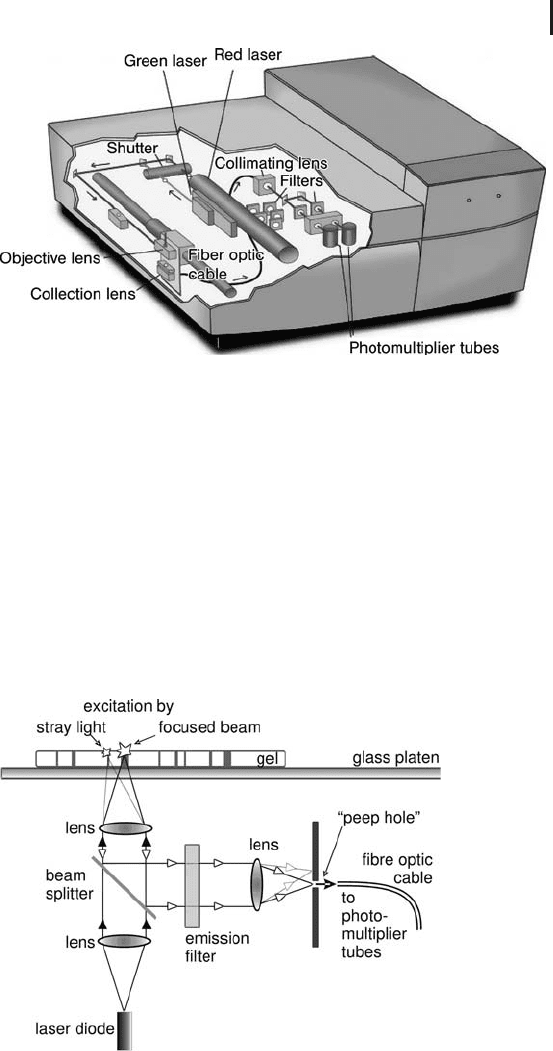
Laser scanners The functions for storage phosphor imaging and
multicolor fluorescence detection can be combined in one instru-
ment. Lasers with different wavelengths are combined with different
filters for the various scanning modes. The detectors are usually very
sensitive photomultipliers. The dynamic range of such an instru-
ment, shown in Figure 1.46, extends to five orders of magnitude.
Radiolabeling provides the most sensitive signals. Storage phos-
phor screen scanners have a much wider linear dynamic range than
X-ray films. The detection is much faster. After the exposure of a
dried gel or a blotting membrane, the storage screen is scanned with
a HeNe laser at 633 nm. For reuse, the screen is exposed to extra-
bright light to erase the image.
For the definition of OD see
glossary.
Differentially labeled samples
can be analyzed in the
following way: with direct expo-
sure both
35
S and
32
P signals
are recorded; with a second
exposure through a thin copper
foil only
32
P labeled proteins
are detected.
1.6 Image Analysis 127
Fig. 1.46: Variable mode laser scanner Typhoon.
Staining or labeling proteins with fluorescent dyes shows similar
or even higher sensitivity than silver staining and a much wider lin-
ear dynamic range. Modern instruments have a confocal scan head to
cancel signals from scattered excitation light, and to reduce fluores-
cence background coming from glass plates and other supporting
material. The laser light excites the fluorescent label or bound fluor-
escent dye; the emitted light of an offset wavelength is bundled with
a collection lens and transported to the detector through a fiber optic
cable (see Figure 1.47). Signals emitted from bands or spots, which
are excited by stray light, are focused out, they will not hit the “peep
hole”, and will thus not be conducted by the fiber optic cable.
Fig. 1.47: Schematic diagram of the principle of fluorescence
detection with confocal optics.
A second feature of confocal
optics is the adjustment of the
focusing depth. For instance,
when gels are scanned as inside
their cassettes, the scan head is
adjusted to focus at 3 mm
above the platen. For scanning
blot membranes it is switched
to the platen level.
1 Electrophoretic Techniques128
State of the art instruments are equipped with up to three lasers
with wavelengths of, for instance, 532 nm (green), 633 nm (red), and
457 nm and 488 nm (blue). Many aspects of fluorescence imaging
are described in detail in the fluorescence imaging handbook by GE
Healthcare (2002).
The scanning sensitivity is adjusted by modifying the voltage of the
photomultiplier tubes after a quick prescan. In order to facilitate the
imaging of DIGE gels in cassettes, hardware accessories and little
software tools are available to facilitate scanning and organizing the
images for subsequent image analysis. The glass platen is big enough
to accommodate two large gel cassettes.
Scanners with confocal optics deliver very exact geometric data,
therefore x/y calibration for accurate spot picking is not required.
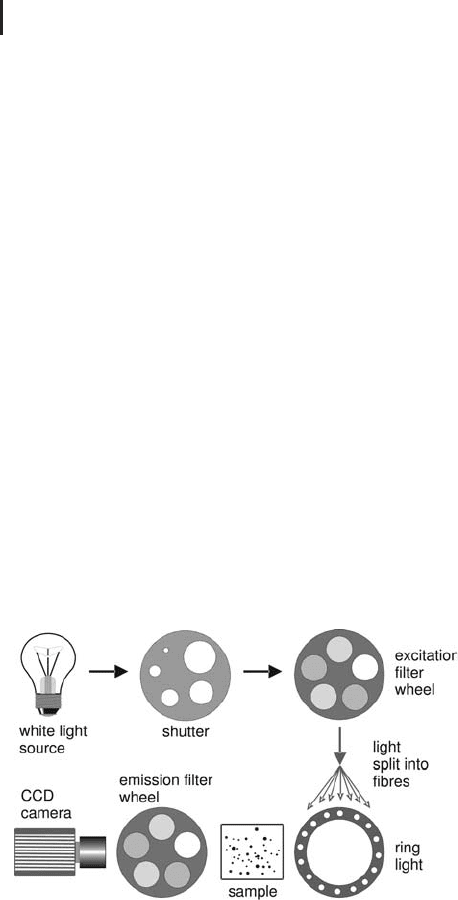
Scanning CCD cameras Scanning CCD cameras with white light
source can also provide adequate quantitative and qualitative mea-
surements. Figure 1.48 shows a schematic diagram of such a system.
By filtering the white light with an excitation filter monochromatic
light is created for selectively exciting just one of the fluorophores.
For an even distribution of the light on the sample it is divided by
glass fibers and guided into a ring light. A particular low band pass
emission filter is used to avoid crosstalk between the sample chan-
nels, which are recorded by a CCD camera.
Fig. 1.48: Schematic representation of the mode of functioning of a
multi-fluorescence imager based on white light and scanning CCD camera.
The CCD camera should scan and read out on the fly. Conventional
systems with CCD cameras, which needed to stop for the readout,
have delivered the images in patches, which had to be stitched
together with special computer programs. Novel systems use a time
delay integration technique, which precisely synchronizes image
GE Healthcare Handbook:
Fluorescence imaging: Princi-
ples and Methods GE Health-
care Life Sciences (2002) 63-
0035-28.
Instruments of this type are less
expensive than laser multifluor-
escence scanners.

1.6 Image Analysis 129
acquisition and CCD readout rate. The sensitivity can be adjusted by
selecting the optimum scanning velocity. Such new systems are avail-
able with a dynamic range of 3.5 orders of magnitude.
Practical hints for imaging DIGE gels Because fluorescence is tem-
perature dependent, the gels should be scanned at room temperature.
Gels from the refrigerator or cold room should be allowed to warm to
room temperature prior to scanning (Rozanas and Loyland, 2006).
It is important to crop the DIGE images with the scanner software
tool to exclude the poorly resolved marginal areas and to achieve per-
fect pattern overlays. The CyDyes have different signal strengths. In
order to obtain comparable patterns, the images are normalized with
the DeCyder software after the definition of spot and area exclusions
parameters has been carried out.
1.6.2
Image Analysis and Evaluation
The evaluation of the spot patterns is the most demanding part of the
2-D electrophoresis technique. The application and control of the
image analysis software tools take a lot of time. And manual spot edit-
ing, spot splitting and other human interventions are influenced by
bias of an individual. Ideally the images would be analyzed and com-
pared fully automatically.
Image analysis of 2-D gels has to deliver various types of informa-
tion:
.
Comparison of 2-D pattern of treated with non-
treated samples;
.
Interpolation of isoelectric points and molecular
sizes;
.
Detection of novel, missing, or modified pro-
teins;
.
Quantification of protein spots;
.
Detection of up- or down-regulated proteins;
.
Definition of spot positions for spot cutting;
.
Detection and characterization of protein
families and pathways;
.
Statistical analysis of experimental results;
.
Enabling database queries;
.
Linkage of 2-D data to mass spectrometry data;
.
Integration of the image data with a laboratory
workflow system.
Rozanas CR, Loyland SM. In:
Liu BCS, Ehrlich JR, Eds. Tissue
Proteomics: Approaches for
Pathways, Biomarkers, and
Drug Discovery. Humana
Press, Totowa, NJ (2006) in
press.