
Westermeier R., Naven T., H?pker H.-R. Proteomics in Practice: A Guide to Successful Experimental Design
Подождите немного. Документ загружается.


2 Liquid Chromatography Techniques170
.
Metal ions: selective enrichment of phosphory-
lated peptides and proteins, native proteins with
histidine, cysteine and/or tryptophan residues
on their surfaces (IMAC).
2.1.3.2 Immuno-affinity Chromatography
Immuno-affinity chromatography utilizes antigens or antibodies as
ligands (sometimes referred to as adsorbents, immunoadsorbents or
immunosorbents) to create highly selective media for the depletion of
e.g. the most high-abundant plasma proteins. Antibodies, immobi-
lized to a column are also extremely useful as ligands and can be
used as baits for the isolation of special proteins.
Especially for the depletion of albumin, immuno-affinity columns
are superior compared to immobilized Cibacron blue, which is less
selective and also binds other classes of proteins rather than albumin.
Albumin, as a transporter protein, also has a strong affinity to the
proteins to be transported. It is assumed that these proteins remain
bound to albumin and will at least partially get lost during the deple-
tion step.
Recently, a new discipline called “Albuminomics” was founded,
which deals with the analysis of proteins and peptides that are bound
to albumin.
The availability of commercial products is growing constantly. User
of these products for the depletion of high-abundancy proteins gener-
ally state a good performance but at the same time criticize high pur-
chase and running costs as well as too low a capacity.
Occasionally a leakage of the immobilized antibodies is reported,
which results in high amounts of peptides leading to identification of
immunoglobulins after MS analysis and affecting the analysis of low-
abundant proteins.
2.1.3.3 Lectin Affinity Chromatography
Glycoproteins and polysaccharides react reversibly, via specific sugar
residues, with a group of proteins known as lectins (see Table 2.6). As
ligands for separation columns, lectins are used to isolate and sepa-
rate glycoproteins, as well as other glycosylated molecules. Glycopro-
teins bound to the lectin column are resolved by using a gradient of
ionic strength or of a competitive binding substance.
The high selectivity of affinity
chromatography enables many
separations to be achieved in a
single, simple step.
Gundry RL, Fu Q, Jelinek CA,
Van Eyk JE, Cotter RJ. Proteo-
mics Clin Appl 1 (2007) 73–
88.

2.1 Basic Principles of Important Liquid Chromatography Techniques 171
Tab. 2.6: Specificity of selected lectins.
Lectin Specificity
Mannose/glucose binding lectins
Con A,
Canavalia ensiformis
Branched mannoses, carbohydrates with terminal
mannose or glucose (aMan > aGlc > GlcNAc).
Lentil lectin,
Lens culinaris
Branched mannoses with fucose linked a(1,6) to
N-acetyl-glucosamine, (aMan > aGlc > GlcNAc).
N-acetylglucosamine binding lectins
Wheat germ lectin,
Triticum vulgare
Chitobiose core of N-linked oligosaccharides,
[GlcNAc(b1,4GlcNAc)1–2> bGlcNac].
In addition to the phosphoproteins, glycoproteins represent
another important group of proteins for the study of post-transla-
tional modifications. Although the basics and theory of using lectins
to selectively isolate glycoproteins is known since decades, its applica-
tion proteome analysis is still underdeveloped. The study of post-
translational modifications in glycoproteins is hampered by the lack
of well established methods. Recently a paper was presented that
applied a multilectin affinity column for the enrichment of plasma
and serum proteins coupled prior to digestion and LC-MS.
2.1.3.4 Immobilized Metal Affinity Chromatography
Immobilized metal affinity chromatography (IMAC is a special kind
of affinity chromatography that is not based on biospecific recogni-
tion. A metal-chelating group [e.g. iminodiacetic acid, nitrilotriacetic
acid (NTA)] is immobilized to the stationary phase of the column.
Originally used for the purification of proteins and peptides with
exposed amino acids, His, Cys, Trp, and/or with affinity for metal
ions, IMAC today is an indisputable tool for the purification of
recombinant poly-His fusion proteins.
Proteins and peptides that have an affinity for metal ions can be
separated using immobilized metal affinity chromatography. The
metals are immobilized onto a chromatographic medium by chela-
tion. Certain amino acids, e.g. histidine and cysteine, form complexes
with the chelated metals around neutral pH (pH 6–8) and it is pri-
marily the histidine content of a protein which is responsible for its
binding to a chelated metal. Metal chelate affinity chromatography is
excellent for purifying recombinant (His)
6
fusion proteins as well as
many natural proteins. Before use the column is loaded with a solu-
tion of divalent metal ions such as Ni
2+
,Zn
2+
,Cu
2+
,Ca
2+
,Co
2+
or
Fe
2+.
The binding reaction between the ligand and the target protein
Yang Z, Hancock WS, Chew
TR, Bonilla L. Proteomics 5
(2005) 3353–3366.
Recently IMAC has been
applied successfully in proteo-
mics for the isolation of phos-
phorylated peptides and
proteins in order to study the
nature of post-translational
modifications (PTM).

2 Liquid Chromatography Techniques172
is based on coordination chemistry (chelate) and therefore pH depen-
dent. Bound sample is, most commonly, eluted by reducing the pH
and increasing the ionic strength of the buffer or by including EDTA
or imidazole in the buffer.
The study of post-translational modifications is complicated by the
lack of appropriate methods for a group-selective enrichment of intact
phosphoproteins and -peptides. Today, IMAC can be applied success-
fully for their isolation at high recovery. Furthermore, this technique
is both compatible with 2D electrophoresis and liquid chromatogra-
phy as well as MS and can be applied to cell cultures, tissues and
other samples.
Any continuative general recommendations as binding conditions,
like metal ion selection, and elution conditions cannot be given here,
because it would go beyond the aim of this book. These have to be
customized depending on the nature and origin of the sample during
the method-development phase.
2.1.4
Gel Filtration
For more than forty years since the introduction of Sephadex, gel
filtration (GF) has played a key role in the purification of enzymes,
polysaccharides, nucleic acids, proteins and other biological macro-
molecules.
This technique is also known as size exclusion chromatography
(SEC) or gel permeation chromatography (GPC).
The technique can be applied in two distinct ways:
.
Group separations: the components of a sample
are separated into two major groups according to
size range. A group separation can be used to
remove high- or low-molecular-weight contami-
nants (such as phenol red from culture fluids) or
to desalt and exchange buffers after tryptic diges-
tion.
.
High-resolution fractionation of proteins: the
components of a sample are separated according
to differences in their molecular size. High-reso-
lution fractionation can be used to isolate one or
more components or to separate monomers
from complexes or randomly formed aggregates.
Gel filtration separates molecules according to differences in size as
they pass through a gel filtration medium packed in a column.
Unlike ion exchange or affinity chromatography, molecules should
not bind to the chromatography medium. Consequently, a significant
Dubrovska A, Souchelnytskyi S.
Proteomics 5 (2005) 4678–
4683.
Phosphoprotein Purification
Handbook, Qiagen, 2002
Morrice N. In: The Encyclo-
pedia of Mass Spectrometry,
Volume 8, Hyphenated
Methods in The Encycopedia of
Mass Spectrometry, (Niessen
WMA, Ed), Elsevier,
Amsterdam, Netherlands
(2006) 930–939.
In practice immobilized NTA is
reported to be superior over
other groups.
Gel filtration is the simplest
and mildest of all the chroma-
tography techniques and sepa-
rates molecules on the basis of
differences in size.
2.1 Basic Principles of Important Liquid Chromatography Techniques 173
advantage of gel filtration is that conditions can be varied to suit the
type of sample or the requirements for further purification, analysis
or storage without altering the separation.
Gel filtration is well suited for proteins that may be sensitive to
changes in pH, concentration of metal ions or co-factors and harsh
environmental conditions. Separations can be performed in the pre-
sence of essential ions or cofactors, detergents, urea, guanidine
hydrochloride, at high or low ionic strength, at 37 C or in the cold
room according to the requirements of the experiment. Purified pro-
teins can be collected in any chosen buffer.
To perform a separation, gel filtration medium is packed into a col-
umn to form a packed bed. The medium is a porous matrix in the
form of spherical particles that have been chosen for their chemical
and physical stability, and inertness (lack of reactivity and adsorptive
properties). The packed bed is equilibrated with buffer, which fills the
pores of the matrix and the space in between the particles. The liquid
inside the pores is sometimes referred to as the stationary phase and
this liquid is in equilibrium with the liquid outside the particles,
referred to as the mobile phase. It should be noted that samples are
eluted isocratically, i.e. there is no need to use different buffers dur-
ing the separation. However, a wash step using the running buffer is
usually included at the end of a separation to facilitate the removal of
any molecules that may have been retained on the column and to pre-
pare the column for a new run.
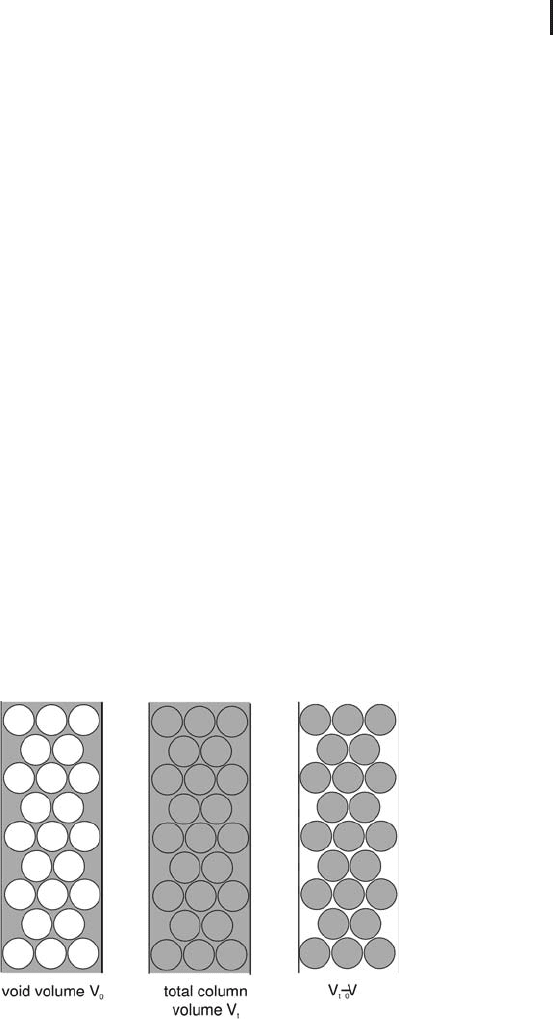
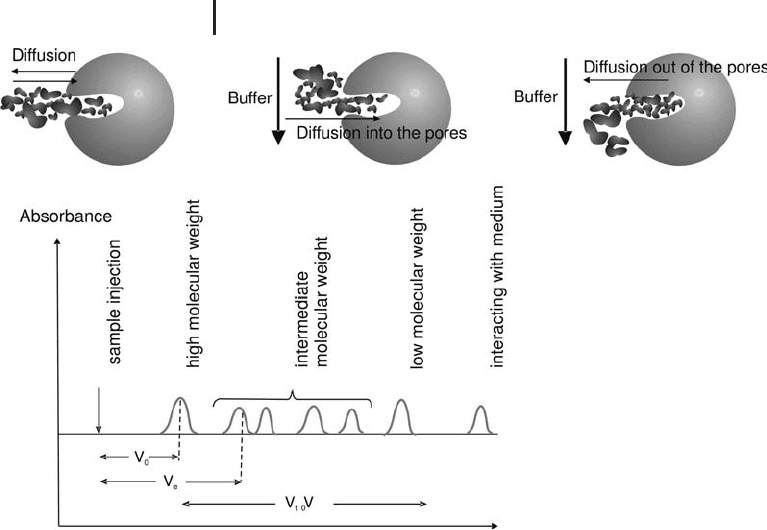
Figure 2.6 shows the most common terms used to describe the
separation and Figure 2.7 illustrates the separation process of gel fil-
tration.
Fig. 2.6: Common terms in gel filtration.
V
e
: elution volume is measured from the chro-
matogram and relates to the molecular size
of the molecule; V
o
: void volume is the elution
volume of molecules that are excluded from
the gel filtration medium because they are
larger than the largest pores in the matrix and
pass straight through the packed bed; V
t
:
total column volume is equivalent to the
volume of the packed bed (also referred to as
CV).
Gelfitration is not the first
choice of technique in protein
pre-fractionation as resolution
and loading capacity is limited
and the initial sample is diluted
significantly.
2 Liquid Chromatography Techniques174
Fig. 2.7: Separation process of gel filtration.
2.2
Strategic Approach and General Applicability
It is undisputable that proteomics would not be possible without the
major achievements in mass spectrometry during the last decade.
Nevertheless, it is unfair to call the high-performance separation tech-
niques further up-stream in the workflow as just sample preparation.
The separation performance prior to MS has a very significant impact
to the overall success rate in proteome analysis.
A remarkable simulation by computer modeling, performed by
Eriksson and Fenyo (2007), disclosed some of the secrets of success-
ful proteome analysis. Factors influencing the success rate of pro-
teome analysis (listed in order of importance):
.
Initial sample amount;
.
Number of proteins in mixture (ideally ~30 to
<300);
.
Power of protein and peptide separation;
.
Mass spectrometric dynamic range.
Surprisingly, the three most important success factors are not related
to sensitivity, resolution and dynamic range of the MS instrumenta-
Eriksson J, Fenyo D. Nature
Biotech 25 (2007) 651–655.
2.2 Strategic Approach and General Applicability 175
tion. Reducing sample complexity, loading more sample amount – if
available – and better separation performance on protein and peptide
level are the most crucial elements in the workflow. Implementing all
these factors can ideally be achieved with state-of-the-art separation
tools like e.g. liquid chromatography alone, but also in combination
with electrophoretic techniques.
Since the mid nineties of the last century, especially in North Amer-
ica, LC methods like two-dimensional liquid chromatography
(2DLC), an intelligent combination of ion exchange (IEX) and
reversed phase chromatography (RPC), also described as MudPIT
began to catch more and more attention, while the majority of Eur-
opean scientists continued to rely more or less exclusively on 2DE.
Today the majority of scientists worldwide take advantage from LC-
based methods in order to obtain more complete information com-
plementary to 2DE. It was just logical and consequent that research-
ers started to compare 2DE with 2DLC.
2D or not 2D? Is that the question? In fact it is not, as it is compar-
ing apples and oranges; because 2DE separates intact proteins,
whereas 2DLC separates peptides (digested proteins).
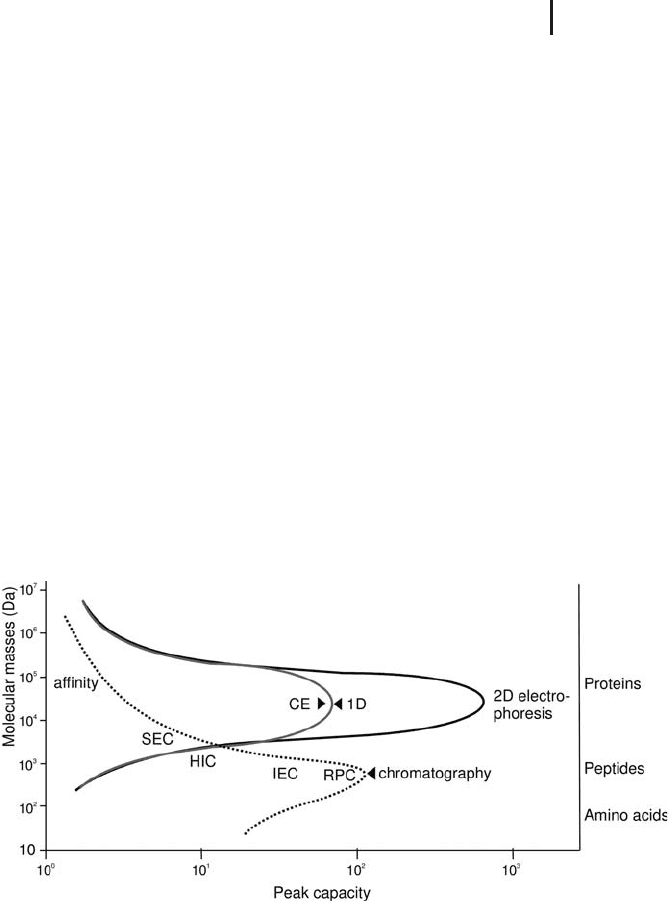
The picture below (Figure 2.8) clearly illustrates where the
strengths of the various separation techniques –electrophoresis and
liquid chromatography – are.
Fig. 2.8: Separation capacity of different methods
depending on the molecular mass of the analytes.
Modified from Lottspeich and Engels (2007).
Occasionally, there have been attempts to use LC-based methods for
the separation at protein level in order to replace 2DE as well. How-
ever, until today, protein chromatography techniques cannot compete
with 2DE in terms of resolution, peak capacity, and last but not least,
2D or not 2D? Is that the ques-
tion?
Lottspeich F, Engels JW (Eds.)
Bioanalytik, 2. Auflage, Else-
vier, Spektrum Akademischer
Verlag (2006)

2 Liquid Chromatography Techniques176
the visualization of the separation, post translational modifications
and protein isoforms included.
However, for sample preparation purposes, such as depletion of
high-abundant proteins, concentration of low-abundant proteins,
group-specific enrichment, or any other type of sample de-complexifi-
cation or pre-fractionation, LC is the method of choice, even for sam-
ple preparation prior to subsequent electrophoretic separations. It is
obvious that reversed phase chromatography and ion exchange chro-
matography – or the combinations of both – are the methods of
choice for the separation of digested proteins: peptides.
2.3
Liquid Chromatography Techniques and Applications in Proteome
Analysis
2.3.1
Peptide Separation
For more than 20 years reversed phase chromatography (RPC) has
been the most frequently used technique for peptide separations;
playing a key role in protein identification and characterization. Dur-
ing the zenith of Edman sequencing, a technique called peptide map-
ping routinely used chromatography to aid protein identification and
characterization. However, the development of two powerful mass
spectrometry (MS) ionization techniques and subsequent instrument
evolution (see Chapter 3), meant mass spectrometry and not Edman
Sequencing became the key tool for proteomics applications. Along
side this MS evolution, chromatography did not stand still either. The
miniaturization of LC and the availability of robust, commercially
available columns and instrumentation enabled peptide separation to
be performed at a very high sensitivity (<100 fmol with UV detection).
The reduction in column internal diameter (i.d.) to sub 100 mm speci-
fications and the availability of nano LC systems, which could be
coupled with nano electrospray sources, have been the main drivers
towards higher sensitivity (see Table 2.7). This level of performance
enabled the detection of much smaller amounts (<<1 fmol) of sam-
ple.
Peptide separation on-line to tandem mass spectrometry equipped
with electrospray for peptide sequence analysis is routine, but appli-
cation and sample dependent. The incorporation of a chromatogra-
phy step has been key to achieving this and the commonly used pep-
tide chromatographic technique is a single dimension of RPC. In
recent years it has also been possible to combine an RPC peptide
separation with MALDI ToF (see Section 3.1.1 on pages 220 f).

2.3 Liquid Chromatography Techniques and Applications in Proteome Analysis 177
Tab. 2.7: Relationship between column i.d. and sensitivity.
Scale Column i.d.
(mm)
Typical flow rate
(mL/min)
Theoretical gain in
sensitivity
Analytical 4.6 1,000 1
Narrow 2.1 200 5
Micro 1 40 21
Capillary 0.3 4 237
Nano 0.075 0.2 3,322
If the sample of interest is rather simple, e.g. a tryptic digest of a
gel spot, ideally containing a single or a few proteins, successful pro-
tein identification with a very high sequence coverage can be routi-
nely achieved with a single dimension of RPC separation prior to MS.
However, as a sample becomes more complex the required resolu-
tion of the RPC separation prior to tandem mass spectrometry
sequence analysis also needs to increase. In this instance, a single
RPC separation prior to MS analysis may still generate a significant
number of protein identifications, but the sequence coverage may
drop considerably (for instance an immunoaffinity pull down experi-
ment, followed by digestion of the 1DE gel bands – see introduction
and figure 4). The question becomes, does the MS have sufficient
time to analyze the peptides (i.e. perform sequence analysis) as they
co-elute from the column? One possibility to address the co-elution is
to employ extra high-resolution RPC with very long columns, where
the system pressure approaches 10,000 psi (700 bar; 6,895 kPa). In
one such publication, Shen et al. (2001) demonstrated that a single
high-resolution RPC separation prior to tandem mass spectrometry
with an FT-ICR instrument, yielded the identification of over 1,000
yeast proteins. Instead of following the approach with very long col-
umns, which has never got a wide acceptance, one could use shorter
columns packed with very small particles (1–2 mm) instead. Such a
strategy, marketed as UPLC, is more promising and is currently gain-
ing some popularity. Both, columns and dedicated instrumentation,
are commercially available.
If the sample complexity exceeds a certain level, such as with a
sample deriving from of a whole cell lysate digest, the ability to effi-
ciently separate the mixture into manageable fractions with one
dimension only becomes effectively impossible. This is critical as the
ability of the MS to analyze the co-eluting peptides will be seriously
impaired; not only will the sequence coverage of identified proteins
be reduced, but insufficient peptides will be detected and analyzed to
deliver unambiguous protein identifications, significantly reducing
Ideally, such a simple sample
could be analyzed with nano-
spray alone.
A high-speed MS analyzer is
beneficial.
Shen Y, Zhao R, Belov ME.
Anal Chem 73 (2001) 1766–
1775.
Alternatively, the resolution of
an RPC step can be enhanced
by simply increasing the length
of the RPC gradient within
certain limits (0.25% acetoni-
trile/min increase should be the
flattest gradient).
This is particularly important
for the analysis of peptides
deriving from low-abundant
proteins.
2 Liquid Chromatography Techniques178
the number of proteins identified. Consequently, a second dimension
of peptide separation is required to increase the resolution of the
given sample, effectively giving the MS more time to analyze the pep-
tides as they elute from the column.
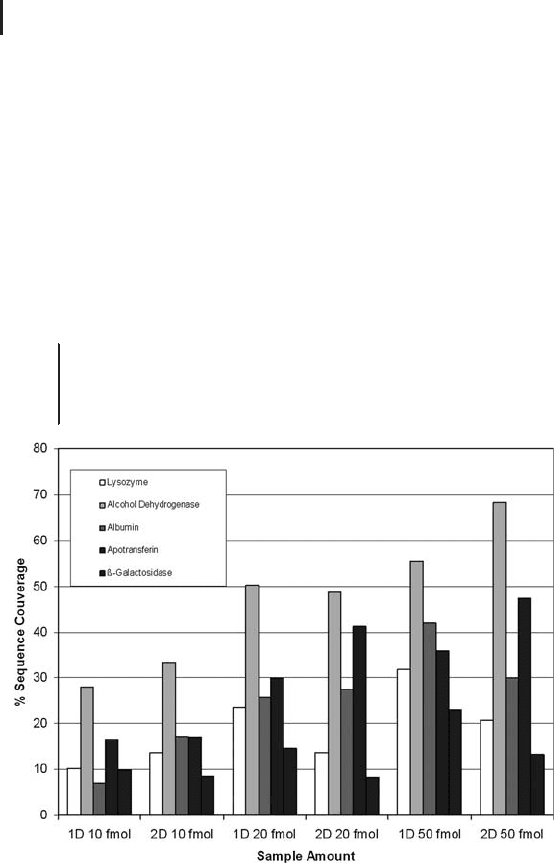
An example of how varying the LC conditions can impact on the
MS performance is given in Figure 2.9. The figure represents how
the sequence coverage obtained for a particular protein in a mixture
of six proteins can vary according to the LC configuration used. The
summary of this exercise is that increasing the resolution of the chro-
matographic separation, aids the MS performance, which ultimately
translates to increased sequence coverage obtained for a particular
protein.
& The appropriate chromatographic separation
reduces sample complexity, which resultantly has
a positive impact on protein identification success
rates i.e. more proteins can be identified.
Fig. 2.9: Graph representing how the sequence coverage obtained
for a particular protein in a mixture of six proteins can vary according
to the LC configuration used. Courtesy of M. Berg, M-Scan.
The commonly used additional separation dimension is ion exchange
chromatography (IEX), specifically strong cation exchange (SCX) and
the coupling together of these two techniques is routinely known as
2DLC (IEX/RPC). The technique utilizes a peptide's unique physical
properties of charge and hydrophobicity to enhance separation. The
2.3 Liquid Chromatography Techniques and Applications in Proteome Analysis 179
following rule of thumb can be used to calculate the required degree
of separation power:
.
1DLC (RPC) (1–50 proteins) 50–2,500 peptides
.
2DLC (IEX/RPC) (10–500 proteins) 500–25,000 peptides
2.3.2
2DLC Peptide Separation
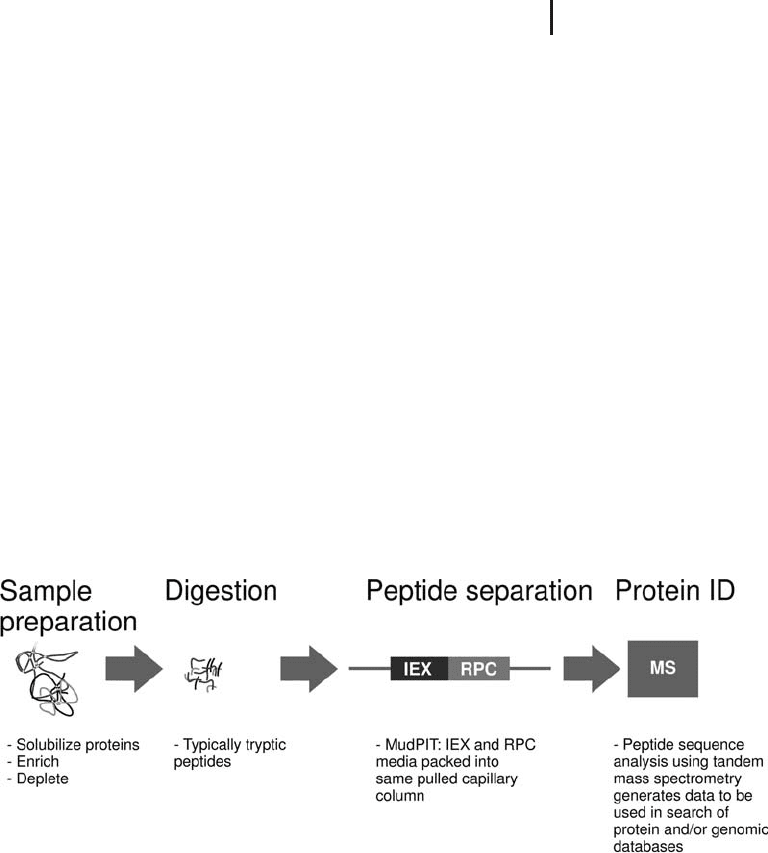
Peptide 2DLC is the key component of MudPIT (Multidimensional
Protein Identification Technology), a strategy for protein identifica-
tion whereby an non-separated complex protein mixture is digested
prior to LC-MS/MS analysis. The technique was pioneered for proteo-
mics applications by Yates and co-workers (Link et al., 1999). The
group initially described the combination of IEX and RPC media
sequentially packed into a pulled capillary column on-line to an MS
equipped with ESI (see Figure 2.10). The chromatography proceeded
in steps, each step consisting of an increasing, specific salt concentra-
tion, which eluted peptides off the strong cation exchange media onto
the RPC compartment. In one reported example 1,484 proteins were
identified in a single experiment (Wasburn et al. 2001).
Fig. 2.10: A schematic of the MudPIT technique reported by
Link et al. for the analysis of complex mixtures.
The technique is a non-gel based approach, and it has often been
argued that it can be used as a replacement for 2DE. In reality, the
technique is a powerful complementary tool to the 2DE approach as
they both allow the detection of different subsets of the proteome.
A key advantage of the technique being once the sample was loaded
onto the column, no manual sample handling was required. Essential
method developments included identifying salt containing buffers
Link AJ, Eng J, Schieltz DM,
Carmack E, Mize GJ, Morris
DR, Garvik BM, Yates JR 3
rd
.
Nat Biotechnol. 7 (1999) 676–
682.
Washburn MP, Wolters D,
Yates JR 3
rd
. Nat Biotechnol. 3
(2001) 242–247