
Westermeier R., Naven T., H?pker H.-R. Proteomics in Practice: A Guide to Successful Experimental Design
Подождите немного. Документ загружается.

2 Liquid Chromatography Techniques180
that were compatible with MS analysis, typical IEX buffers such as
sodium chloride and potassium chloride are not. Ammonium chlor-
ide, which is volatile, was identified as a compatible buffer.
Following its introduction, the technique has evolved and a number
of commercial systems have been developed, the key difference being
that separate SCX and RPC columns are used. Still, the technique is
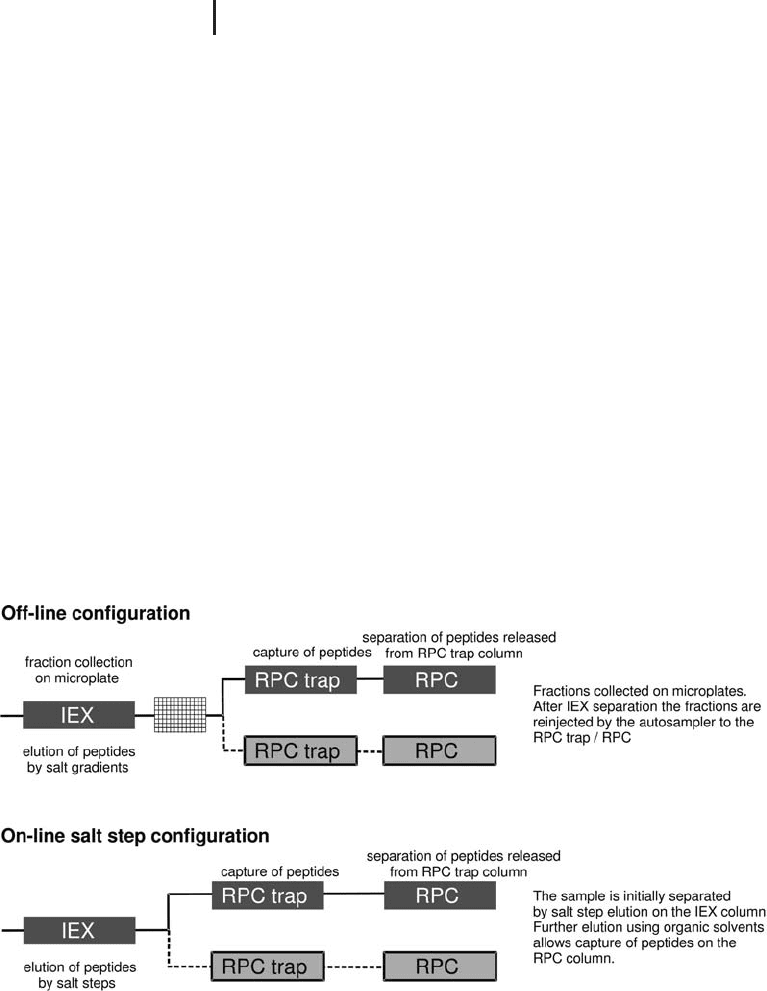
relatively straightforward (see Figure 2.11). The complex protein sam-
ple is denatured, (cysteine residues) reduced and alkylated and the
proteins digested, typically, with trypsin. The peptide mixture is sub-
sequently acidified and loaded onto the SCX column. As in a typical
IEX separation, positively charged peptides bind to the IEX column
and the uncharged and negatively charged peptides pass in the flow
through and bind to a reversed phase trap column. The peptides are
subsequently eluted onto a nano (75 mm i.d.) RPC column, separated
and eluted into a tandem mass spectrometer for peptide sequence
analysis. Subsequently, the salt concentration is increased, either in a
series of steps or via a salt gradient (see below), displacing further
peptides from the IEX column onto the RP trap column and then
onto the nano RPC column for elution into the MS. Each RPC separa-
tion generates multiple protein identifications in the MS analysis.
Two common variations have evolved (and supported commer-
cially), each with its own benefits and drawbacks (see Figure 2.11),
which are discussed below.
Fig. 2.11: Schematics of the two common methods for 2DLC
separation of complex peptide mixtures prior to MS analysis.
From GE Healthcare application note: Comparison of methods
for two-dimensional liquid chromatography of peptides using
Ettan microLC System. (2003) 18-1170-93.

2.3 Liquid Chromatography Techniques and Applications in Proteome Analysis 181
2.3.2.1 On-line 2DLC with Salt Plugs
This configuration offers convenient, easy-to-use, and automated ana-
lysis of moderately complex protein mixtures. On-line salt-plug injec-
tion employs a combination of SCX in the first-dimension separation
with RPC in the second dimension. Elution from the SCX column is
performed using discrete salt plugs of increasing salt concentration.
Eluted proteins are bound to the RPC trap column (while efficient
desalting and concentration takes place) and subsequently separated
on the second-dimension RPC column using a nanoflow gradient
elution with organic solvent. Unfortunately, optimal SCX separation
of peptides requires a certain concentration of acetonitrile in the buf-
fer (as high as 30%). However this level of acetonitrile is incompatible
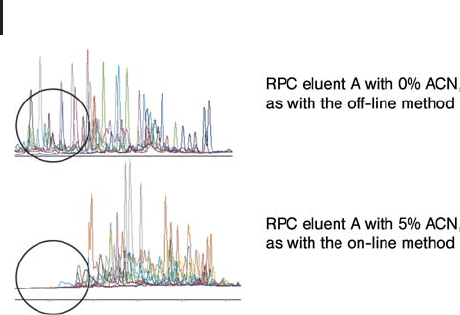
with the RPC second dimension as the more hydrophilic peptides
will not bind to the column (see Figure 2.12). As a compromise, the
acetonitrile concentration in SCX is reduced to 5%, which is more
compatible – by no means perfect – not for SCX nor for the subse-
quent RPC step. One major drawback of this method is often that the
same peptide(s) elute in subsequent fractions, which generates
redundant data in the MS as the same peptide is analyzed repeatedly.
This observation has been made and reported by numerous labora-
tories.
.
Advantages:
– Fully automated operation;
– On-line desalting and sample concentration;
– Potentially greater sensitivity due to reduced
sample loss.
.
Disadvantages:
– Sub-optimal running conditions for both SCX
and RPC;
– Binding behavior of peptides to SCX column
unpredictable as strongly influenced by unspe-
cific side effects;
– Loss of small, hydrophilic peptides as they do
not bind to the RPC trap column;
– Distribution (smearing) of one and the same
peptide to several runs;
– Difficult to consolidate data;
– Need to perform always a combined analysis
of all runs to get a picture from a particular
protein.
2 Liquid Chromatography Techniques182
Fig. 2.12: The effect of acetonitrile used in the IEX gradient for
retention and recovery of peptides in 2DLC analysis. Note that hydrophilic
peptides get lost if starting with 5% acetonitril in eluent A, because
they will not be bound by the RPC trap column. From GE Healthcare
application note: Comparison of methods for two-dimensional liquid
chromatography of peptides using Ettan microLC System. (2003) 18-1170-93.
2.3.2.2 Off-line 2DLC
This semi-automated off-line method gives the best overall perfor-
mance in terms of protein ID and sequence coverage. This method
allows greater flexibility in terms of total amount of sample loaded,
column dimension, and flow rate in the first-dimension SCX step.
Separation under optimal conditions for each dimension with no
losses of small hydrophilic peptides. Fractions are collected after SCX
prior to the RPC step. The off-line SCX/RPC method enables greater
freedom to choose selected fractions of interest for further analysis by
MS/MS. The key advantages of this configuration are that the SCX
and RPC separations can be optimized individually, not compromised
and there is minimal overlap of peptides between fractions which
results in less redundant data.
.
Advantages:
– Best conditions for maximum resolution and
peak capacity at both dimensions;
– Free choice of buffer system and sample
volume can be adapted to RPC;
– Higher resolution compared to salt step or
dual-gradient elution;
– Fast method despite being an off-line method,
SCX is a single, continuous run;
– Minimal overlap of peptides between frac-
tions;
2.3 Liquid Chromatography Techniques and Applications in Proteome Analysis 183
– Store SCX fraction for re-analysis;
– Higher sample load on the SCX dimension,
allows for higher sensitivity.
– When the first dimension SCX is finished,
priority fractions can be selected (e.g. through
visual inspection of the UV trace) and moved
forward to LC-MS
.
Disadvantages:
– Not fully automated, requires an acetonitrile
evaporation (e.g. SpeedVac
) or dilution step
prior to the injection on to the second dimen-
sion RPC trap column.
A comparison between high-throughput 1D RPC and the two com-
mon 2D-LC variations has been performed in the analysis of rat sper-
matozoa. The rat spermatozoa proteome is estimated, from the num-
ber of spots observed in 2D-PAGE analysis, to consist of about 2,000
proteins.
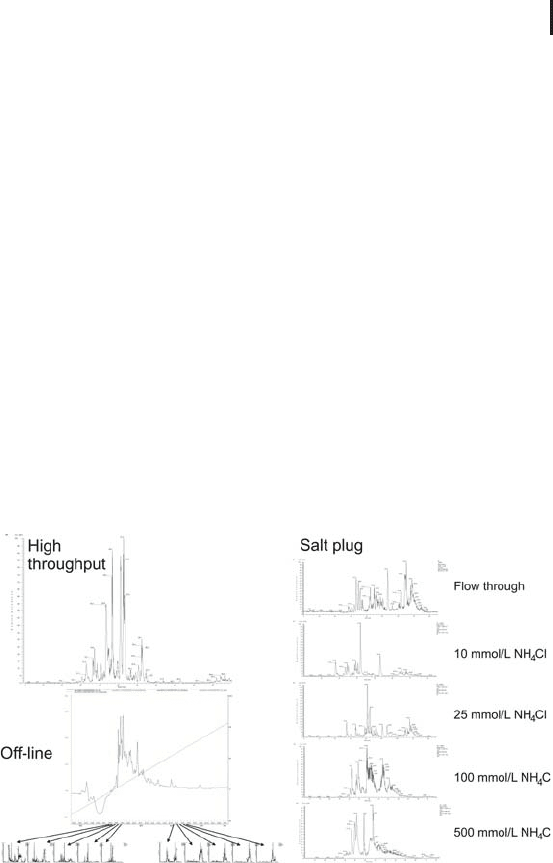
Chromatograms from the three configurations are shown in Figure
2.13.
Fig. 2.13: Chromatograms obtained for the analysis of rat
spermatozoa using high-throughput 1D RPC, on-line 2DLC,
and off-line 2DLC. Courtesy of GE Healthcare.
By adding an orthogonal separation technique (typically IEX) to RPC,
the separation power of the method increases substantially. One way
to describe separation power is to use peak capacity.
Peak capacity for a one-dimensional separation is defined as:
PC = ( t
last
– t
first
)/w
1/2
Orthogonal means the combi-
nation of consecutive separa-
tion techniques according to
different independent physico-
chemical properties of proteins
/ peptides.

2 Liquid Chromatography Techniques184
where t
last
is the retention time of the last eluting peak, t
first
is the
retention time of the first eluting peak, and w
1/2
is the width of a typi-
cal peak at half height.
The theoretical peak capacity for an orthogonal, multi-dimensional
separation can be calculated as follows:
PC
total
=PC
column a
xPC
column b
xPC
column c
...xPC
column z
The peak capacity of an LC run in the experiments described in Sec-
tion 2.3.2.2 (see Figure 2.13) is approximately 70, assuming a separa-
tion window of 30 min and an average peak width of 30 s. Conse-
quently, the peak capacity for on-line salt-step 2DLC is five times
higher than for 1DLC, i.e. 350. As shown in Table 2.8, the number of
identified proteins increased by approximately 25% when using on-
line salt-step 2DLC, compared with high-throughput 1DLC. The
increase in identifications was relatively small considering the high
peak capacity. This is mainly due to overlapping peptides between
successive salt steps.
Tab. 2.8: The number of proteins identified from the rat spermatozoa
identified using the three different chromatographic methods.
LC configuration Proteins identified from
soluble sample*
Proteins identified from
insoluble sample*
High-throughput 1DLC 113 69
On-line salt step 2DLC 142 91
Off-line 2DLC 457 233
* = X!Tandem search algorithm, expectation value 0.05
For the on-line salt step method, many of the peptides were found
in more than one salt step. A more prominent increase in protein
identifications, more than 200%, was shown when using off-line
2DLC compared with on-line salt-step 2DLC. The theoretical increase,
calculated from the increase in peak capacity, is about 350%.
The superiority of off-line 2DLC is driven by two factors:
.
Optimal SCX conditions are used, including a
linear salt gradient for elution and 20 to 30%
organic modifier in the mobile phase to sup-
press unspecific interactions.
.
A narrow-bore SCX column (2.1 mm i.d.) is
used in the first dimension. Therefore, at least
40 times more sample can be injected.
2.3 Liquid Chromatography Techniques and Applications in Proteome Analysis 185
At first glance the off-line configuration seems to be time consuming
as it is not fully automated. The total analysis time for the three differ-
ent configurations, not including data analysis and sample prepara-
tion, is 60 min for high-throughput 1DLC, 300 min for on-line salt-
step 2DLC, and 2000 min for off-line 2DLC. However, the productiv-
ity, expressed as time/positive identification ratio is by far superior
for the off-line approach.
In total, a large number of proteins, approximately 600, were iden-
tified in rat spermatozoa using the off-line configuration. The types
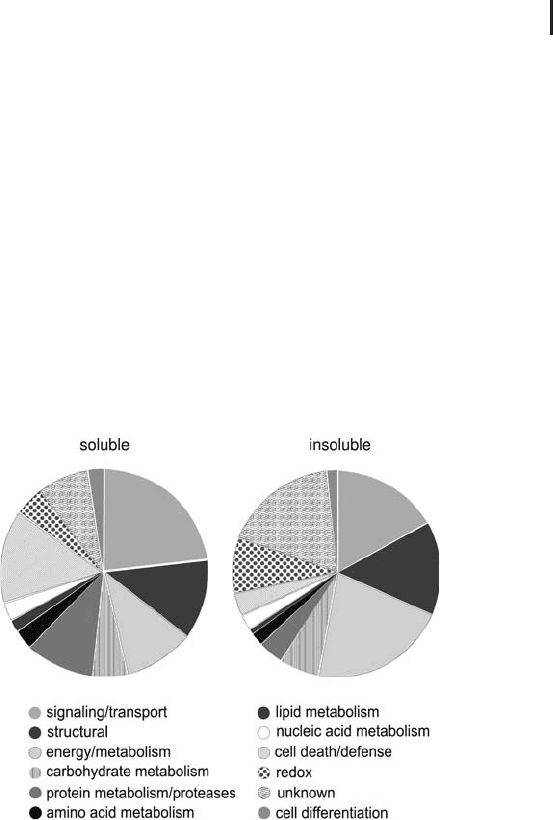
of proteins that were identified are shown in Figure 2.14. Soluble pro-
teases were found in higher number in the soluble sample compared
with the insoluble sample, whereas the opposite was true for redox
and structural proteins, which are often hydrophobic/membrane pro-
teins. Table 2.8 shows the top score proteins when the off-line 2DLC
configuration was used.
Fig. 2.14: Functional classification of proteins identified by the
2DLC analysis of rat spermatozoa. Courtesy of GE Healthcare.
In summary, the rat spermatozoa proteome was analyzed using the
three preprogrammed LC configurations: high-throughput 1DLC, on-
line salt-step 2DLC and off-line 2DLC. The combination of a large
sample load, optimal SCX conditions, and sensitive nanoscale LC-
MS/MS using the off-line 2DLC–MS/MS approach resulted in nearly
600 identified proteins.
The off-line 2DLC method
features superior productivity in
terms of number of protein
identifications

2 Liquid Chromatography Techniques186
& For in-depth proteome profiling of a complex
sample, the off-line 2DLC–MS/MS configuration
is recommended. If the sample is less complex,
and analysis time and automation are issues,
1DLC with lengthened gradient time or on-line
salt-step 2DLC is recommended.
Type of instrumentation
Compared to the general HPLC supply the
number of vendors offering dedicated nanoLC systems is more
clearly arranged. In the majority of cases a nanoLC system is used
exclusively front-end to a nano electrospray mass spectrometer or,
with increasing popularity, to a spotter which collects fractions for
MALDI MS analysis on a MALDI target. In the past, flow rates in the
range of a few hundred nano-liters per minute, typically 200 nL/min
for a 75 mm I.D. column, could only be generated with the help of a
flow splitter. Still today, most of the commercially available nano LC
systems are using this somewhat outmoded operation principle.
Once such systems are well run-in they offer a very acceptable degree
of reliability and performance. However, troubleshooting on a splitter
based system can be a time-consuming challenge.
Today, splitter-less systems are entering the market.
Elimination of flow-splitting overcomes the inaccuracies and
plumbing problems caused by splitter-based systems. Consequent
miniaturization leads to the complete absence of check valves and the
reduction of moveable parts to the absolute minimum and makes
nanoLC more rugged and reliable. The spread of splitter-less systems
has already begun and will continue. Such state-of-the-art instru-
ments are very likely to dominate the market in the near future.
During the purchase process of a nanoLC system it is recom-
mended to define the current and future needs carefully as it prevents
from frustrations and from spending too much money for features
and extras that are not needed in real life.
Quite frequently, UV detection appears on the wish list, however, it
is very rarely used in practice as it contributes to additional and
unwanted dead volumes and delay times and results in broader
peaks. As nanoLC systems in proteomics are normally working at
extreme sensitivity, UV detection will hardly detect any peak of inter-
est as it far too insensitive to generate a useful UV chromatogram.
In practice the most suitable nanoLC system consists of an auto-
sampler to allow unattended operation of a larger set of samples and
a valve arrangement that provides the use of two alternating trap col-
umns in order to optimize the time per analysis and productivity.
Besides a gradient pump that generates the nano flow an additional
pump that facilitates the transfer of the sample from the autosampler

2.3 Liquid Chromatography Techniques and Applications in Proteome Analysis 187
to the trap column is strongly recommended. Real-time flow and gra-
dient monitoring is absolutely essential.
All nanoLC systems are small in flow rate, but some of them are
large in weight and footprint. A big and heavy cabinet is not necessa-
rily a quality feature, rather than concealing outdated technology.
From time to time, e.g. for troubleshooting or maintenance, the
nanoLC system has to be disconnected from the mass spec and
moved away. In such cases a small light-weight with a low balance
point is desired.
Last, but not least, the nanoLC system of choice should be capable
of communicating with the control software of all major MS systems
around, in order to maintain a smooth and seamless single-point con-
trol of the entire nanoLC-MS system.
COFRADIC In this “COmbined FRActional DIagonal Chromato-
graphy” (COFRADIC) approach, according to Gevaert et al. (2003),
the complex peptide mixture of a tryptic digest of the protein sample
is first separated in reversed phase chromatographic run and col-
lected in fractions. In every fraction a subset of peptides is modified
by the use of a specific reaction, for instance by oxidizing the methio-
nine-containing peptides with a H
2
O
2
solution. The modified pep-
tides show altered properties, when they are rerun in the same chro-
matographic system, and elute at a different time than the unmodi-
fied peptides. Only the modified peptides are further analyzed by
mass spectrometry.
2.3.3
Affinity Chromatography and LC-MS/MS
Increasing numbers of studies demonstrate that proteins involved in
cell mechanisms rarely act on their own, but in complexes of two or
more proteins. The yeast two-hybrid technology has enabled the
detection of interactions between two proteins (Fields and Song,
1989) and the technology has been applied to the comprehensive ana-
lysis of Saccharomyces cerevisiae (Uetz et al. 2000; Ito et al. 2001). Addi-
tional method developments have enabled the efficient affinity based
isolation of multiple interactions and subsequent analysis of the pro-
tein interactions by mass spectrometry (Neubauer et al. 1998; Rigaut
et al. 1999; Husi et al. 2000).
Gevaert K, Goethals M,
Martens L, van Damme J,
Staes A, Thomas, GR, Vande-
kerckhove J. Nature Biotech-
nology 21 (2003) 566–569.
Diagonal means using the
same physico-chemical property
of a protein / peptide for
separation on the same media
with a modification step of the
analyte in between (in contrast
to orthogonal).
Fields S, Song O. Nature 340
(1989) 245–246; Uetz et al.
Nature 403 (2000) 623–627.
Ito et al. Proc Natl Acad Sci
USA. 98 (2001) 459–474.
Neubauer G, King A, Rapp-
silber J, Calvio C, Watson M,
Ajuh P, Sleeman J, Lamond A,
Mann M. Nature Genet 20
(1998) 46–50.
Rigaut G, Shevchenko A, Rutz
B, Wilm M, Mann M, Seraphin
B. Nature Biotechnol 17
(1999) 1030–1032.
Husi H, Ward M, Choudhary
JS, Blackstock WP, Grant
SGN. Nature Neurosci 3
(2000) 661–669.
2 Liquid Chromatography Techniques188
Two publications have combined the affinity isolation approach
with on-line LC-MS/MS for the systematic identification of protein
complexes in Saccharomyces cerevisiae (Gavin et al. 2002; Ho et al.
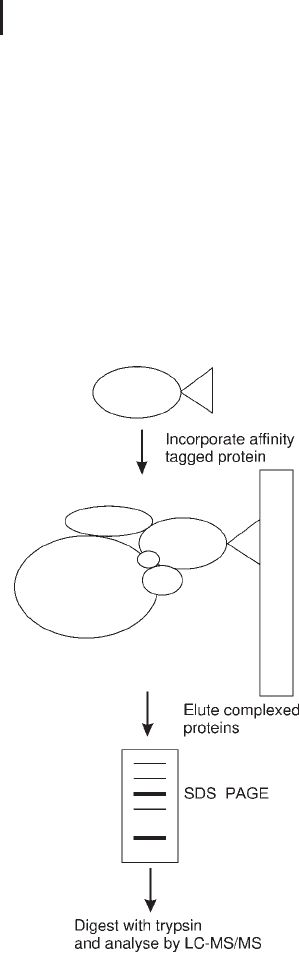
2002). Both groups employed a similar approach (see Figure 2.15).
Firstly, affinity tags were bound to a wide variety of proteins. Sec-
ondly, the DNA encoding the affinity tagged proteins was introduced
into yeast cells. Thirdly the affinity tag, and subsequently the protein
and those complexed to it, were isolated by affinity chromatography.
Finally, the eluted proteins were separated by 1D SDS PAGE,
digested with trypsin and analyzed by LC-MS/MS. The former publi-
cation identified 232 distinct multiprotein complexes, whilst the latter
identified over 3600 associated proteins under the given experimental
conditions.
Fig. 2.15: Workflow for the affinity interaction,
LC-MS/MS approach to proteomics.
The combination of MudPIT technology with tandem affinity purifi-
cation (TAP) has been used to study protein interactions in yeast
(Graumann et al., 2004). The proteins identified by the TAP-MudPIT
Gavin et al. Nature 415 (2002)
141–147.
Ho et al. Nature 415 (2002)
180–183.
Graumann J, Dunipace LA,
Seol JH, McDonald WH, Yates
JR, Wold BJ, Deshaies RJ. Mol
Cell Proteomics. 3 (2004)
226–237.

2.3 Liquid Chromatography Techniques and Applications in Proteome Analysis 189
technique were involved in 102 previously known and 279 potential
physical interactions.
For some applications, it will be true that a 2DLC peptide separa-
tion is still insufficient to provide the resolution necessary for the MS
analysis. At this level of complexity, a tier of protein level separation
is needed in addition to the peptide separation; this tier if often
referred to as protein pre-fractionation.
For slightly complex samples with a total number of a few thou-
sand of proteins proteomics investigations can start directly at the
digested protein – peptide – level. However, if sample complexity
exceeds a certain level, it is essential to start the separation on the
basis of intact proteins and not at peptide level alone.
2.3.4
Protein Pre-fractionation
If sample complexity exceeds a certain level, it is essential to start the
separation at intact protein level.
& From recent studies we know that the complexity
of a resulting peptide mixture after protein
digestion can be much higher (ten-fold) than
expected, due to miscleavages, truncations, etc.
Presumably, after tryptic digestion of an average protein the peptide
mixture does not only contain 60 but 600 peptides. For reasons of
comprehensive planning it might be useful to make a rough calcula-
tion in order to match sample amount, complexity and realistically
expected recovery with the general performance and sensitivity of the
entire workflow, including the MS system in use.
Random or specific protein and peptide losses during separation,
unavoidable intermediate steps and digestion have to be considered,
too. For that reason it is essential to start the separation on the basis
of whole proteins [protein pre-fractionation (PPF)] and not straight at
peptide level. If sample complexity exceeds a certain level, 2DLC
(IEX/RPC) on peptide level is no longer sufficient. It becomes neces-
sary to add more dimensions at protein level prior to digestion.
A kind of resurgence of LC approaches is happening right now.
& Note: Starting at protein level offers the
advantage to correlate an identified peptide
with the intact protein with all its post-
translational modifications or at least with the
fraction where it has been collected.
Proteomics studies of complex
samples such as plasma/serum
or cell tissue require an intelli-
gent protein pre-fractionation.
This is very much in line with
the statement of a famous
pioneer in proteomics who
believes that the challenge in
proteomics it is not the mass
spec rather than the chemistry
and the separations.