
Westermeier R., Naven T., H?pker H.-R. Proteomics in Practice: A Guide to Successful Experimental Design
Подождите немного. Документ загружается.

3 Mass Spectrometry220
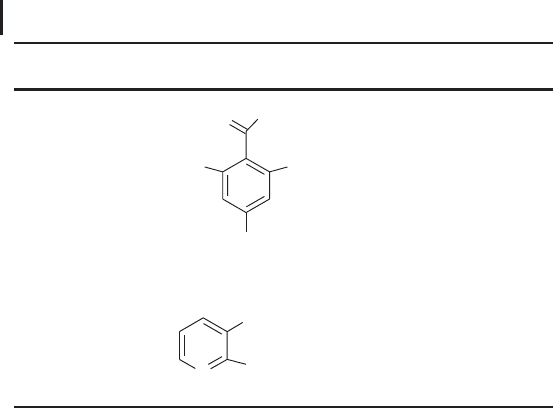
Matrix Matrix Structure Application
2,4,6-Trihydroxyaceto-
phenone (THAP)
CH
3
O
OH
OH
OH
UV laser: oligo-
nucleotides <3 kDa
3-Hydroxy picolinic
acid
N
COOH
OH
UV laser: Oligo-
nucleotides >3 kDa
Due to the pulsed nature of MALDI, it has been predominantly
coupled with the pulsed, time-of-flight (TOF) analyzer or configura-
tions thereof. This combination, with its simple operation, ease of
automation and robust performance has meant that MALDI-TOF
instruments are common place for routine protein identification
such as in the 2D PAGE-MS workflow where protein spots are picked
from a 2DE gel (see Section 1.7.1). The use of MALDI-TOF for pep-
tide mass fingerprinting (PMF) is more than sufficient for protein
identification from these simple samples.
However, MALDI PMF is not a suitable method for protein identifi-
cation when a complex mixture is under investigation. For the analyis
of more complex samples, tandem mass spectrometry (MS/MS) is
almost exclusively required and there is an absolute need to couple a
chromatographic step with MS. MALDI has long been incompatible
with liquid chromatography and as such a chromatographic step has
typically been coupled with electrospray ionization equipped mass
spectrometers for MS/MS applications. However, the innate features
of MALDI still make it a very attractive and accessible technique.
Thus, the introduction of the MALDI TOF/TOF configuration with
its high performance MS/MS specifications and recent developments
in liquid handling systems enabling nano-scale chromatography pep-
tide separations to be coupled with MALDI system capable of
MS/MS, have been a welcome addition to the proteomics toolbox.
Importantly, this configuration supports both high performance PMF
and MS/MS in a single system.
In this offline method, LC-MALDI, peptides are eluted from a
nano-LC column in the standard fashion, but are then mixed with a
matrix prior to spotting onto a MALDI plate. In a standard configura-
Pieles U, Zurchner W, Schar
M, Moser HE. Nucleic Acids
Res 21 (1993) 3191–3196.

3.1 Ionization 221
tion, such an LC-MALDI spotter will consist of a T-piece, syringe
pump, and micro fan. A low dead-volume PEEK-T and mixer (dead
volume <50 nL) connect the capillaries from the syringe pump and
UV cell to the sample needle, providing reproducible mixing before
spotting. The syringe pump delivers the matrix solution with contin-
uous flow rates down to a few nanoliters per minute. Different syr-
inge barrel sizes can be employed, eliminating the need for frequent
refilling of small syringes. The length of the capillary connections
from the UV cell and the syringe pump are short, resulting in a delay
time as short as 3 minutes. Commercial LC-MALDI spotters are pro-
vided by a number of vendors.
& An LC-MALDI spotter is significantly different to
the conventional MALDI spotter available as part
of the 2D PAGE-MS workflow for MALDI PMF.
LC-MALDI affords some attractive benefits to the researcher:
.
Fixation of samples to the MALDI target, allows
longer data collection and sample re-interroga-
tion at any time, removing the temporal con-
straints of the LC dimension.
.
An RPC separation will reduces the complexity
of the sample as discussed previously, which will
aid minimization of ion suppression.
.
Conservation of samples.
.
Probable separation of isobaric peptides (i.e. pep-
tides with the same apparent molecular weight),
which might have different hydrophobicities and
would therefore be resolved by LC.
.
Increased sequence coverage for higher confi-
dence in protein identification.
The LC-MALDI technique is a powerful adjunct to ESI based mass
spectrometers, with MALDI and ESI often providing complementary
protein identification information; Bodnar WM et al. 2004. This pub-
lication reported a “significant degree of overlap” (63%) was observed
between the proteins identified in the LC/ESI/MS/MS and LC/
MALDI/MS/MS data sets in the analysis of mammalian mitochron-
drial ribosomes. However, unique peptides and proteins were identi-
fied by each method; indicating that improved proteome coverage can
be obtained using a combination of these ionization techniques.
The technique has been applied to a number of challenging and
topical proteomics applications including the identification of mem-
brane proteins (Zhang et al. 2004); identification and quantification
Bodnar WM, Blackburn RK,
Krise JM, Moseley MA. J Am
Soc Mass Spectrom 14 (2003)
971–979.
Zhang N, Li N, Li L. J
Proteome Res 3 (2004)
719–727.
3 Mass Spectrometry222
using differential stable isotope labeling (Ji and Li 2005) and the
incorporation of high speed, high-resolution monolithic capillary col-
umns into the technique. In this publication, 384 unique peptides
were identified in a single 10 minute LC run from 2000 resolved com-
ponents (Chen et al. 2005).
3.1.2
Electrospray Ionization
Fenn et al. (1989); described the use of electrospray ionization (ESI)
for ionizing large biomolecules in 1989.
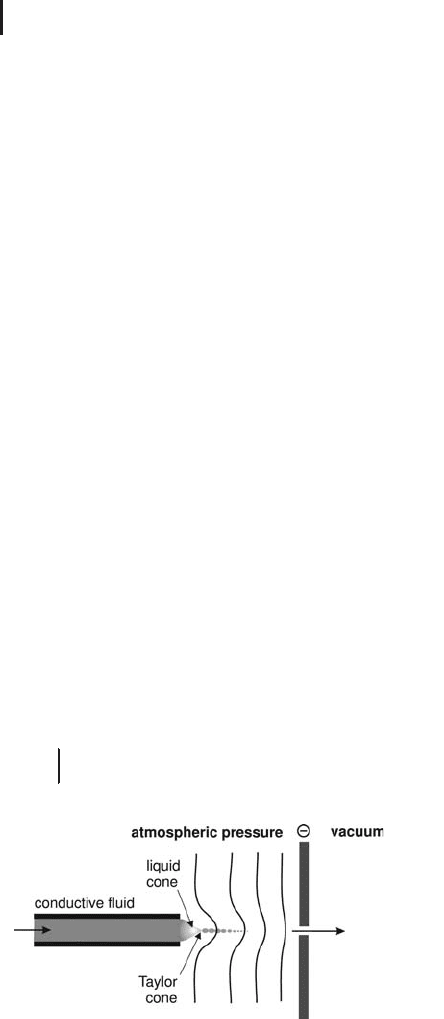
Electrospray (ESI) ions are produced at atmospheric pressure by
applying sample dissolved in solvent to a narrow capillary tube, which
is under the influence of an electric field. A potential difference is cre-
ated between the capillary and the inlet of the mass spectrometer gen-
erating a force extending the liquid to form a cone from the capillary
tip, from which a fine mist of droplets will emerge (Taylor cone; Tay-
lor 1964). The cone is formed as a result of repulsive coulombic forces
between the like charges. Subsequently, evaporation of the droplets
reduces droplet size whilst the charge on the droplet remains con-
stant. Eventually, the surface coulombic forces exceed the surface ten-
sion and the droplets fission into smaller droplets (the Rayleigh
limit). This process continues until nanometer-sized droplets are pro-
duced (Figure 3.4).
The charges are statistically distributed over the analyte’s potential
charge sites, enabling the formation of multiply charged ions. Each
multiply charged ion can be termed a charge state, and a distribution
of charge states is characteristic of large macromolecules during ESI
analysis.
& ESI produces predominantly multiply charged
ions.
Fig. 3.4: Schematic of ESI.
Ji C, Li L. J Proteome Res 4
(2005) 734–742.
Chen HS, Rejtar T, Andreev V,
Moskovets E, Karger BL. Anal
Chem 77 (2005) 2323–2331.
Fenn JB, Mann M, Meng CK,
Wong SK, Whitehouse CM.
Science 246 (1989) 64–71.
Taylor G. Proc R. Soc Lond
A280 (1964) 383–397.
3.1 Ionization 223
This unique feature of ESI, multiple charging of analyte molecules,
yields an effectively reduced mass for the analyte of interest. Simply,
the observable mass range is lowered offering significant advantages
for the analysis of large molecular weight analytes, particularly pro-
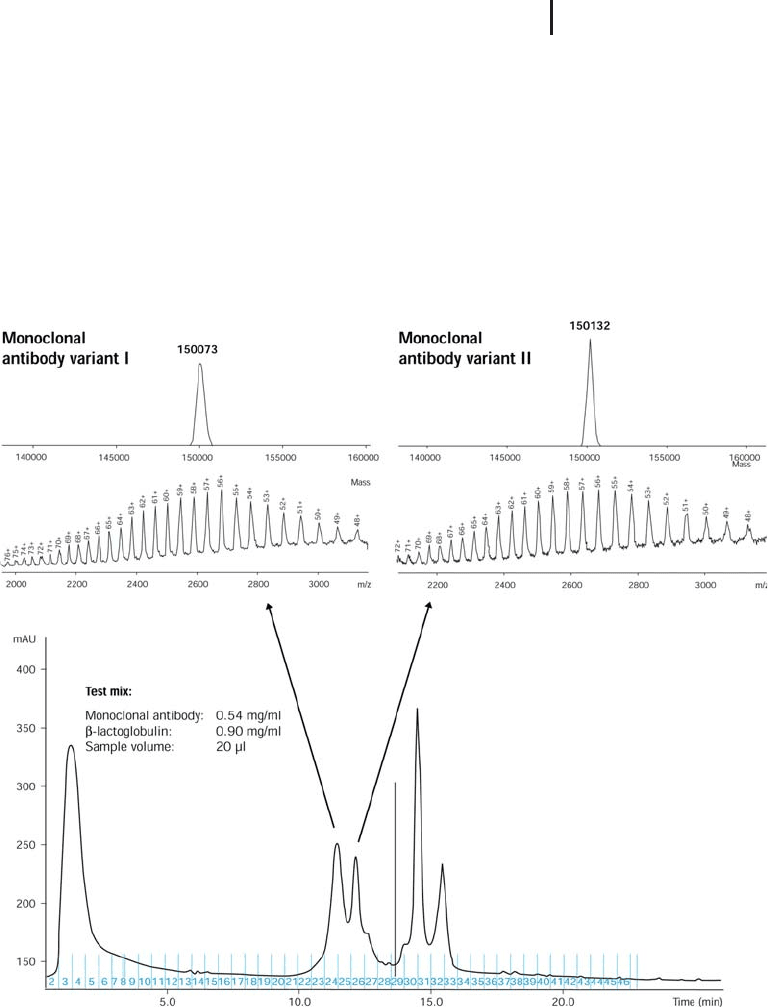
teins. Figure 3.5 demonstrates the multiply charging of 150 KDa pro-
tein. With respect to proteins the resolution of each multiply charged
ion is insufficient to determine the number of charges the ion pos-
sesses, from which can be determined its true mass. Therefore, the
masses of at least two of the multiply charged ions in the envelope
are used in a deconvolution algorithm to give the mass of the whole
protein (lower panel).
Fig. 3.5: Characteristic multiple charging of a full-length protein
acquired using ESI. Upper panel: true mass of protein after deconvolution.
Lower panel: multiple-charged spectrum. Note the number of charge
states observed for this 150 kDa protein.
Note the mass range and the
number of charges (z value in
m/z) on the protein in the spec-
trum).
Its mass is known from the
spectrum, but without knowl-
edge of the charge state, the
real mass of the analyte
remains unknown.
3 Mass Spectrometry224
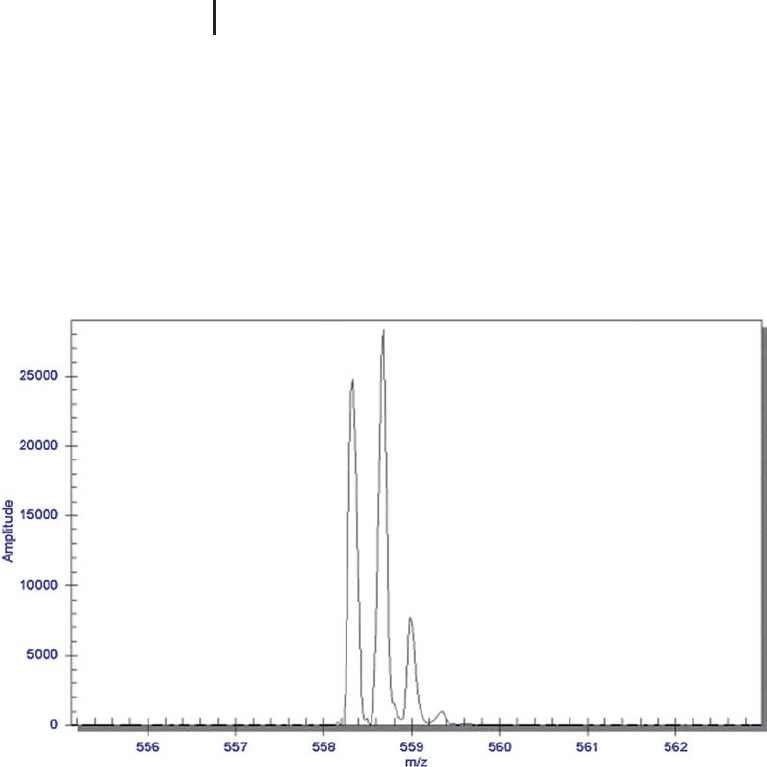
With respect to peptides, the charge state of the multiple-charged ion
can be readily determined due to the resolution capability of current
mass spectrometers, see Figure 3.6. The mass difference between the
adjacent
12
C and
13
C isotopes is indicative of the charge state. For a
single-charged ion, the mass difference between the
12
C and
13
C iso-
topes of a peptide isotopic envelope will be 1 Da. In the case of a dou-
ble-charged peptide ion (m/z = m/2) the mass difference between the
12
C and
13
C isotopes will be 0.5 Da, for a triple-charged peptide (m/z
= m/3) the mass difference between the
12
C and
13
C will be 0.33 Da
and so on. With knowledge of the charge state, an accurate mass of
the peptide can be determined.
Fig. 3.6: Characteristic multiple charging of tryptic peptides:
triple-charged neurotensin protein acquired using ESI.
Electrospray generates flow rates ranging from tens of microliters to
hundreds of microliters per minute. The resultant high consumption
rate was problematic for proteomic applications with respect to sensi-
tivity and analysis time (high amount of sample is consumed in a
short amount of time). In the early nineties, reductions in ESI low
rates were reported; sub-microliter flow rates using continuous infu-
sion affording significant increases in sensitivity (Emmett and
Caprioli 1994). Wilm and Mann reported the use of a nanospray ioni-
zation source. (Wilm and Mann 1996) This miniaturization of electro-
spray generated flow rates in the order of tens of nanoliters per min-
ute (typically 25–40 nL/min), by spraying the solvent from a narrow
3.2 Ion Separation 225
bore coated needle (sub 10 mm tip diameter). This was a crucial devel-
opment; delivering higher sensitivity and longer analysis times,
enabling multiple MS/MS experiments to be performed per run.
Though nanospray generates flows of 25–40 nL/min, nanoLC (at
least 75 mm i.d columns) only generates flow rates of 200 nL/min.
3.2
Ion Separation
A wide range of analyzers, compatible with both MALDI and ESI, are
used for proteomics applications
3.2.1
Time-of-Flight Analyzer
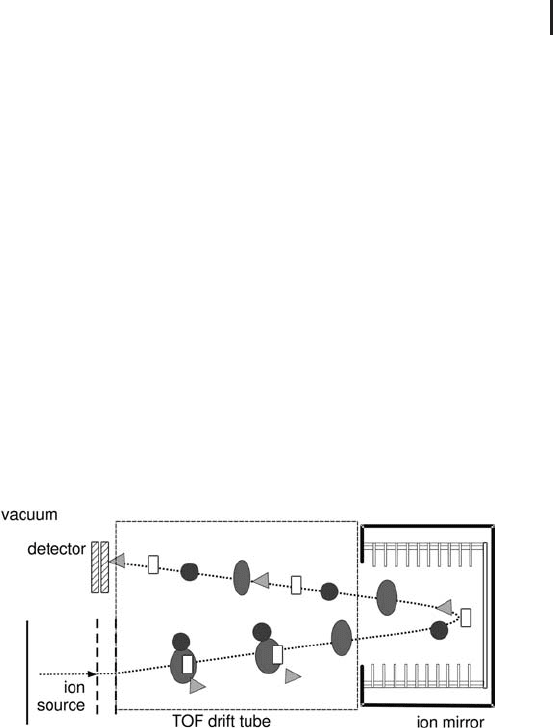
The time-of-flight (TOF) analyzer is a pulsed analyzer and as such is
routinely coupled with a MALDI ion source. (see Figure 3.7).
Fig. 3.7: Schematic of a reflectron TOF analyzer. This analyzer is
typically coupled with MALDI to perform peptide mass fingerprinting.
Mass measurement is determined by measuring the time-of-flight of
an ion in the analyzer region; the time-of-flight of an ion is propor-
tional to the square root of its mass/charge ratio, given a constant
accelerating voltage: Time of flight k
ffiffiffiffiffiffiffiffiffi
m=z
p
.
The linear TOF analyzer is the simplest form and exhibits the lower
performance with respect to resolution and mass accuracy. A linear
TOF instrument is incapable of resolving the
12
C and
13
C isotopes of
the peptide isotopic envelope across the range of the protein digest,
700–3500 Da, subsequently mass accuracy is poorer as the average
mass, not the mono-isotopic mass, tends to be used for database
searching.
Emmett MR, Caprioli RM. J
Am Soc Mass Spectrom 5
(1994) 605–613.
Wilm M, Mann M. Anal Chem
68 (1996) 1–8.
Thus, the smaller the molecule
the faster it will travel the
distance of the flight tube to
the detector.

3 Mass Spectrometry226
The performance of TOF analyzers with respect to resolution and
mass accuracy was vastly improved following two developments in
the 1990s: delayed extraction and incorporation of a reflectron.
Delayed extraction Resolution is improved by delaying the extraction
of ions from the source for a short period of time. Wiley and McLa-
ren, 1953; reported the method time lag focusing and noted the
increased resolution. This was revisited by Brown and Lennon, Vestal
et al. Whittal and Li in 1995 by applying it to MALDI. They observed
that by delaying the extraction of ions from the source, a much tighter
packet of ions arrive at the detector giving significantly higher resolu-
tion and mass accuracy.
Incorporation of a reflectron A reflectron (Mamyrin 2001) improves
resolution in two ways: (1) by acting as an ion mirror reversing the
trajectory of the ions in the flight tube, effectively increasing the
length of the flight tube; (2) by reducing an ion’s kinetic energy
spread. Ions of the same mass formed in the source can have differ-
ent kinetic energies when they leave the source depending upon their
position in the source when the accelerating voltage was applied, con-
sequently, ions of the same mass arrive at the detector at different
times, thus reducing resolution and mass accuracy. A reflectron can
accommodate these small differences in kinetic energy with the
result that ions of the same mass are better time-focused at the detec-
tor, greatly improving resolution and subsequently mass accuracy.
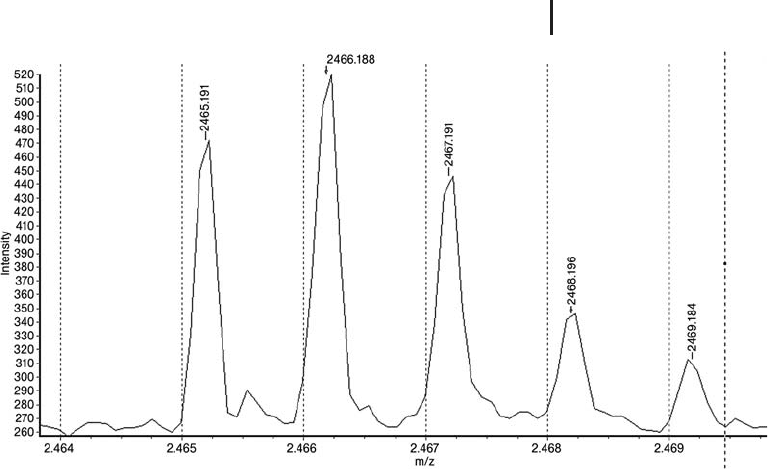
Delayed extraction coupled with a reflectron can routinely achieve
resolutions greater than 10,000 (FWHM; Figure 3.8). This level of
performance enabled MALDI-TOF to become established as the
principle method of protein ID in the 2D PAGE-MS workflow (Sec-
tion 1.7).
Reflectrons are incorporated as standard in most commercial TOF
mass spectrometers and the different configurations include a con-
ventional linear field reflectron, the curved field reflectron (Cornish
and Cotter, 1994) and the harmonic or quadratic field described by
Anderson et al. 1998.
Although a TOF analyzer is commonly coupled with a pulsed
MALDI source it has also been combined with electrospray, in the
ESI-TOF instrument (Boyle and Whitehouse 1992; Mirgorodskaya
et al. 1994; Verentchikov et al. 1994).
A reflectron TOF instrument is typically used in MS mode, though
a technique called post source decay (PSD) has been considered a
pseudo MS/MS technique (see Section 3.3.4.4).
Wiley WC , McLaren IH. Rev
Sci Instrum. 26 (1955) 1150–
1157.
Brown R, Lennon JJ. Anal
Chem. 67 (1995) 1998–2003.
Whittal RM, Li L. Anal Chem
67 (1995) 1950–1954.
Vestal ML, Juhasz P, Martin
SA. Rapid Commun Mass
Spectrom 9 (1995) 1044–
1050.
Mamyrin BA. Int J Mass Spec-
trom 206 (2001) 251–266.
Protein database search confi-
dence using MALDI TOF PMF
data is improved with increased
mass accuracy
Cornish TJ, Cotter RJ. Rapid
Commun Mass Spectrom 8
(1994) 781–785.
Anderson UN, Colburn AW,
Makarov AA, Raptakis EN,
Reynolds DJ, Derrick PJ, Davis
SC, Hoffman AD , Thomson S.
Rev Sci Instrum 69 (1998)
1650–1660.
Boyle JG, Whitehouse CM.
Anal Chem 64 (1992)
2084–2089.
Mirgorodskaya OA, Shev-
chenko AA, Chernushevich IV,
Dodonov AF, Miroshnikov AI.
Anal Chem. 66 (1994)
99–107.
Verentchikov AN, Ens W,
Standing KG. Anal Chem 66
(1994) 126–133.
3.2 Ion Separation 227
Fig. 3.8: Delayed extraction coupled with a reflectron can
routinely achieve resolutions greater than 10,000 (FWHM).
3.2.2
Triple Quadrupole Analyzer
The quadrupole analyzer consists of four parallel hyperbolic rods,
through which the gas phase ions have to achieve a stable trajectory.
The analyzer is operated by the application of a voltage (DC) and an
oscillating voltage (radio frequency, rf) to one pair of rods and DC vol-
tage of opposite polarity and rf voltage of different phase to the oppo-
site pair of rods. The alternating electric field helps to stabilize and
destabilize the passing ions. The ions traverse through the space
between the rods, and only at specific voltages applied to the rods will
certain m/z values be allowed to pass through the rods and reach the
detector. The voltages are scanned to allow a wide mass range to be
observed.
A single quadrupole analyzer has negligible benefits for proteomic
analysis, but if three quadrupoles are arranged in sequence, the sub-
sequent triple quadrupole analyzer coupled with ESI has been
demonstrated to be very useful for proteomics (von Haller et al. 2001)
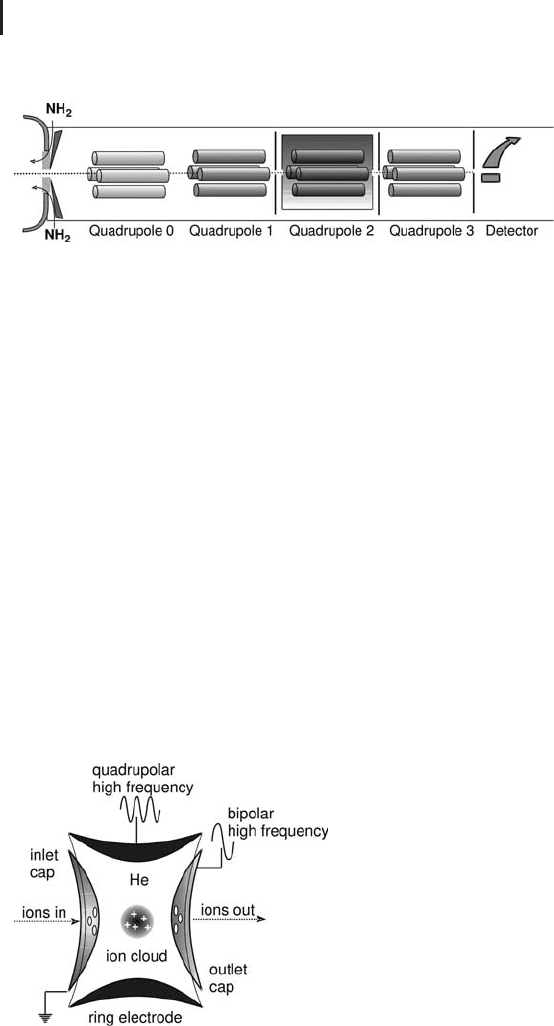
This configuration is almost exclusively used to provide structural
information by tandem mass spectrometry (see Section 3.3.4). Here
the first and third quadrupoles operate as the mass filters described
above, with the second quadrupole operating as a collision cell (where
the structural information is produced). The analyzer can be operated
von Haller PD, Donohoe S,
Goodlett DR, Aebersold R,
Watts JD. Proteomics 1 (2001)
1010–1021.
3 Mass Spectrometry228
in three different ways to perform MS/MS experiments (see Section
3.3.4.1) and is typically used in MS/MS mode (see Figure 3.9).
Fig. 3.9: Schematic of a triple quadrupole analyzer. Coupled with
ESI, it can perform a range of MS/MS techniques including product
ion, precursor ion and neutral loss scans.
3.2.3
Quadrupole Ion Trap
The quadrupole ion trap is based on the same theory as the quadru-
pole analyzer, with the quadrupole field generated within a three
dimensional trap. The ion trap itself is filled with helium and com-
prises a ring electrode and two end cap electrodes, creating the three
dimensional electric field by applying a large RF voltage to the ring
electrode. The orbiting motion of the ions in the trap is governed by
the large rf voltage and the cooling effects of collisions with the
helium gas (the helium gas reduces the kinetic energy of the ions
and helps focus the ions in the center of the trap). A mass spectrum
is acquired by sequentially ejecting fragment ions from low m/z to
high m/z. This is performed by scanning the rf voltage to make ion
trajectories sequentially become unstable, the mass selective instabil-
ity mode developed by Stafford et al. (1984). Ions are ejected and
detected at the detector (see Figure 3.10).
Fig. 3.10: Schematic of the fundamental operation of a 3D ion
trap analyzer. Commonly coupled with ESI for proteomics applications.
Stafford GC, Kelley PE, Syka
JEP, Reynolds WE, Todd, JFJ.
Int J Mass Spectrom Ion Proc
60 (1984) 85–98.

3.2 Ion Separation 229
A product ion MS/MS spectrum is obtained via resonance excitation.
The precursor ion is isolated by the application of a waveform signal
to the endcap electrodes. Fragmentation of the precursor ion is
caused by the application of a small voltage across the endcap electro-
des and collisions with helium gas. The resultant fragmentation is
similar to that observed from a triple quadrupole mass spectrometer;
a low-energy collisional regime with fragmentation predominantly at
the peptide amide bonds (see Section 3.3.4.1). A drawback of the
instrument for the acquisition of product ion MS/MS spectra is that
the fragment ions in the lower third of the mass range (approximately
1/3
rd
of the mass of the precursor ion) will not be detected.
An additional advantage of quadrupole ion traps and FT-ICR MS
(see Section 3.2.7) is the unique ability to perform multiple stages of
mass spectrometry (MS
n
) (see Section 3.3.4.5). For a detailed review
see Jonscher and Yates (1997).
The performance characteristics of a quadrupole ion trap make it a
highly attractive instrument for proteomic applications, particularly
for tandem mass spectrometry applications, either interfaced with
nanospray (Hoess et al. 1999) LC-MS/MS (Ho et al. 2002) 2DLC-
MS/MS (Washburn et al. 2001) or MALDI (Qin et al. 1996). The ion
trap is predominantly used in MS/MS mode.
Developments in ion trap technology have delivered the linear
quadrupole ion trap, where ions are trapped in a two-dimensional
quadrupole field, instead of a three-dimensional quadrupole field.
Such a configuration affords significant benefits for protein ID and
characterization including rapid cycle time which enables more infor-
mation to be obtained from a sample in less time with high sensitiv-
ity (Yates et al. 2006). The linear ion traps also offer additional tandem
mass spectrometry functionality (Macek et al. 2006). In addition, to
MS
n
, commercial ion trap systems are available that can perform a
novel fragmentation technique, electron transfer dissociation or ETD
(Thermo LTQ and Bruker Esquire HCT Ultra), see section 3.3.4.6.
ETD, a peptide and protein fragmentation technique that preserves
modifications, has found applications in PTM analysis such as phos-
phorylation or glycosylation and in top down proteomics. The techni-
que extends the capability of the user with respect to protein sequen-
cing and identification of type and location of various PTMs. The
common approach is to use both collision induced dissociation and
ETD, generating non-redundant sequence information.
Jonscher KR, Yates JR III. Anal
Biochem 211 (1997) 1–15.
Hoess M et al. 1999; Washburn
MP, Wolters D, Yates JR.
Nature Biotech 19 (2001)
242–247.
Qin J, Steenvorden RJJM, Chait
BT. Anal Chem. 68 (1996)
1784–1791.
Hoess M, Robins P, Naven TJP,
Pappin DJC, Sgouros T, Lindahl
T. EMBO J 18 (1999)
3868–3875.
Macek B, Waander L, Olse, JV,
Mann M. Mol Cell Proteomics
5 (2006) 949–958.
Yates JR, Cociorva D, Liao J,
Zabrouskov V. Anal. Chem. 78
(2006) 493–500.