
Westermeier R., Naven T., H?pker H.-R. Proteomics in Practice: A Guide to Successful Experimental Design
Подождите немного. Документ загружается.

3 Mass Spectrometry230
3.2.4
Quadrupole Time-of-Flight
Initially described in 1996 (Morris et al. 1996) for oligosaccharide ana-
lysis and more recently by Lobada et al. (2000), these quadrupole
time-of-flight (QTOF) instruments rapidly became the instrument
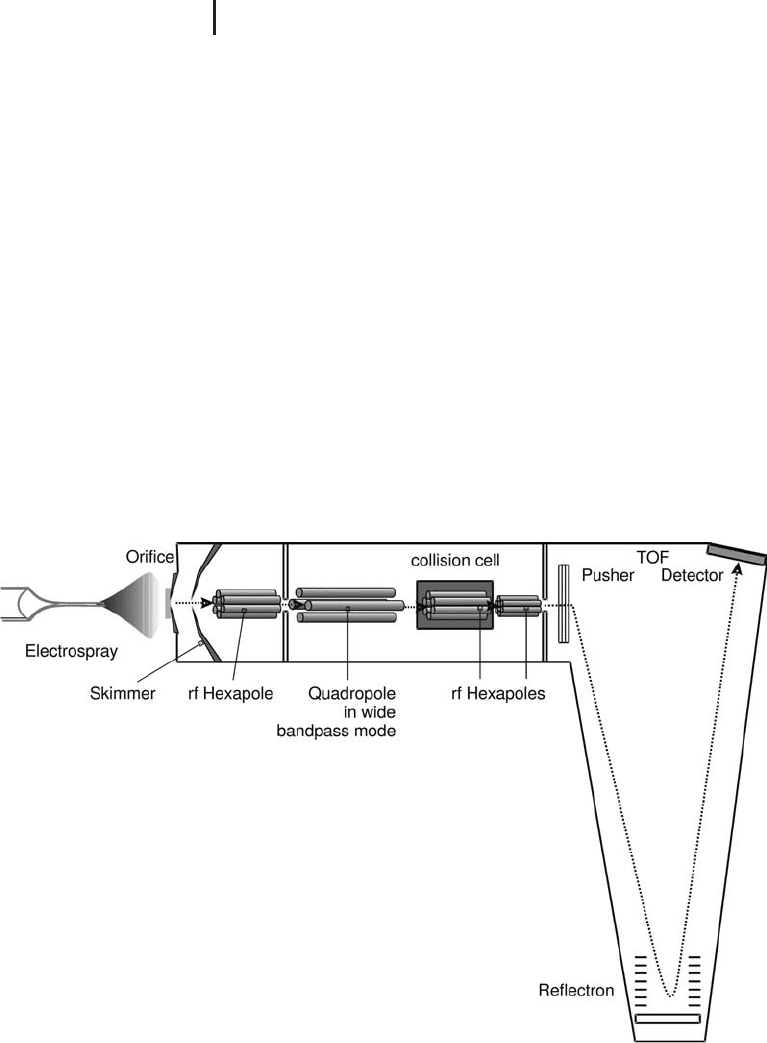
standard for MS/MS applications within proteomics. By combining a
mass filtering quadrupole analyzer and a collision cell (rf-only quad-
rupole) with a non-scanning reflectron TOF analyzer, the user is able
to acquire MS and, most notably MS/MS data with high mass accu-
racy, resolution and sensitivity. The instrument is typically coupled
with HPLC (Bell et al. 2001; Gavin et al. 2002) and is predominantly
used in MS/MS mode (see Figure 3.11).
Fig. 3.11: Schematic of a quadrupole TOF hybrid analyzer.
It is commonly coupled with ESI for proteomics applications.
Morris HR, Paxton T, Dell A,
Langhorne J, Berg M, Bordoli
RS, Hoyes J, Bateman RH.
Rapid Commun Mass Spec-
trom 10 (1996) 889–896.
Shevchenko A, Chemushevich
IV, Ens W, Standing KG,
Thomson B, Wilm M, Mann
M. Rapid Commun Mass Spec-
trom 11 ( 1997) 1015–1024.
Bell AW, Ward MA, Blackstock
WP, Freeman HNM,
Choudhary JS, Lewis AP,
Chotai D, Fazel A, Gushue JN,
Paiement J. J Biol. Chem 276
(2001) 5152–5165.
Gavin et al. Nature 415 (2002)
141–147.

3.2 Ion Separation 231
Later developments have seen a MALDI ion source coupled with a
hybrid instrument enabling similar MS/MS performance to be
attained from singly charged ions produced by MALDI. (Lobada et al.
2000; Shevchenko et al. 2000; Baldwin et al. 2001).
This configuration enables a peptide mass fingerprint and MS/MS
data with high resolution and mass accuracy to be acquired using the
same instrument. A similar approach has been developed with the
TOF/TOF analyzer.
3.2.5
Hybrid Triple Quadrupole Linear Ion Trap
As the name suggests, the hybrid triple quadrupole linear ion trap
(QTRAP) instrument combines the features of a triple quadrupole
and a linear ion trap analyzer. For proteomics applications, this
equates to fast scans with high sensitivity, accurate quantification and
complete product ion, precursor ion and neutral loss tandem mass
spectrometry functionality. The additional scan functionality has
been shown to be useful for post translational modification analysis
(Sandra et al. 2004).
The QTRAP is predominantly used in MS/MS mode.
3.2.6
TOF/TOF Analyzer
A TOF/TOF analyzer coupled with a MALDI ion source (Medzih-
radszky et al. 2000) enables the generation of peptide mass finger-
print data and peptide sequence data in a single instrument. Basi-
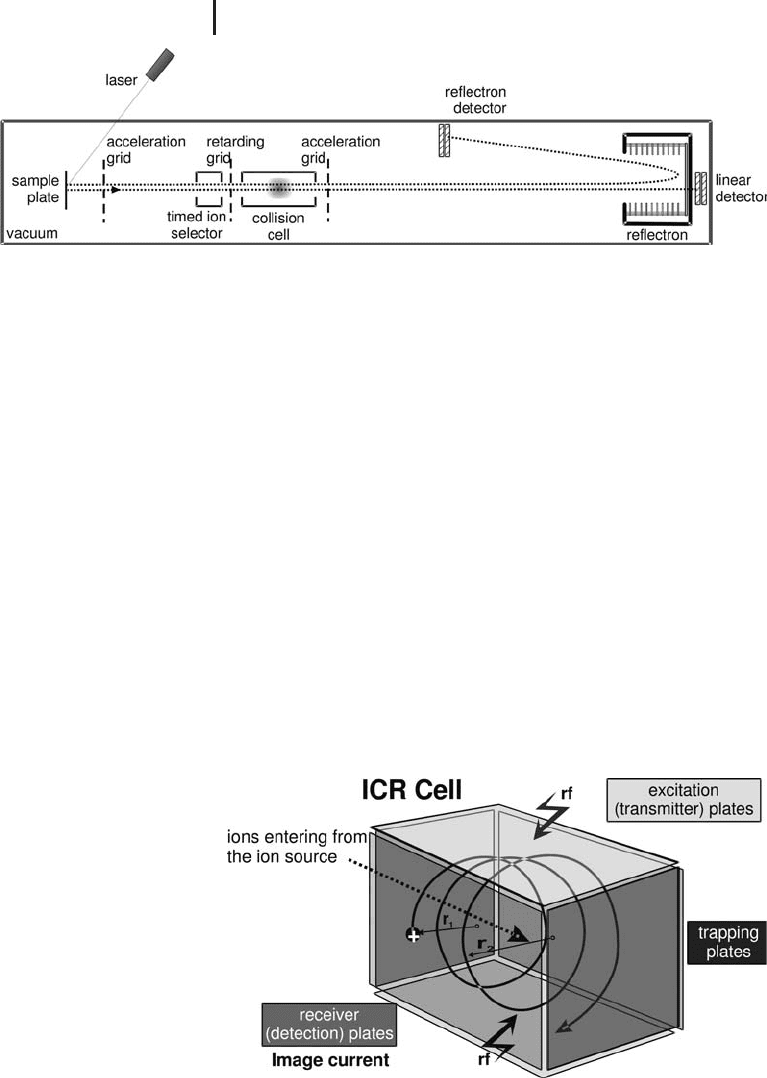
cally, two TOF analyzers are separated by a collision cell, with the first
TOF analyzer, used for precursor ion selection. (see Figure 3.12).
High energy collisions occur within the collision cell, and the second
TOF analyzer resolves the ions. The configuration allows for high
sensitivity and high resolution in both MS and MS/MS modes, and is
capable of reducing protein identification to a one tier process. When
coupled with nano-LC using an LC-MALDI spotter, this configuration
is a powerful tool for the proteomics researcher.
Lobada A, Krutchinsky A,
Bromirski M, Ens W, Standing
KG. Rapid Commun Mass
Spectrom 14 (2000)
1047–1057.
Shevchenko A, Loboda A,
Shevchenko A, Ens W,
Standing KG. Ana. Chem 72
(2000) 2132–2141.
Baldwin MA, Medzihradszky
KF, Lock CM, Fisher B, Setti-
neri TA, Burlingame AL. Anal
Chem 73( 2001) 1707–1720.
Sandra K, Devreese B, Van
Beeumen J, Stals I, Claeyssens
M. J Am Soc Mass Spectrom
15 (2004) 413–423.
Medzihradszky KF, Campbell
JM, Baldwin MA, Falick AM,
Juhasz P, Vestal ML, Burlin-
game AL. Anal Chem 72
(2000) 552–558.
3 Mass Spectrometry232
Fig. 3.12: Schematic of a TOF/TOF analyzer. Coupled with MALDI
to perform peptide mass fingerprinting and peptide sequence analysis
by MS/MS. Often coupled with a nanoLC spotter in LC-MALDI.
3.2.7
Fourier Transform Ion Cyclotron
Similarly to an ion trap, a Fourier transform ion cyclotron (FT-ICR)
instrument is capable of trapping and storing ions (see Figure 3.13).
The ICR cell resides in a strong magnetic field and consists of three
parallel plates arranged in a cube. In the cell, ions of a given m/z ratio
have a given cyclotron frequency of a given orbit radius. On applying
an rf voltage at the same frequency as the cyclotron frequency, the
respective ions absorb energy and are accelerated to a larger orbit
radius. When the rf voltage is removed the energized, accelerated
ions still rotate at a constant radius. Ions which have a different cyclo-
tron frequency remain unexcited and hence ions of differing mass
can be separated. As the cyclotron frequency of an ion is determined
by its mass to charge ratio, a Fourier transform can be performed on
the signal to determine the mass of the ion. FT-MS affords high sen-
sitivity and exceptional resolution and thus mass accuracy.
Fig. 3.13: Schematic of the fundamental operation of an FT ICR mass
spectrometer. It is commonly coupled with ESI for proteomics applications.

3.3 Generating MS Data for Protein Identification 233
3.2.8
Orbitrap
The Orbitrap analyzer is the most recently of developed analyzers
(commercially available from Thermo Scientific since 2005). It is not
a conventional ion trap, in that there is no RF or magnet to hold the
ions in the cell. The analyzer traps ions in an electrostatic field, with
the attraction towards a central electrode. The electrode confines the
ions so that they move or orbit in complex spiral patterns (Makarov
2002, and Hardman and Makarov, 2003). A Fourier Transform is
used to extract the masses accurately from the oscillation frequencies
This type of analyzer affords high resolution, high mass accuracy and
an increased dynamic range, similar in performance to an FT-ICR
instrument and high sensitivity (Olsen et al. 2005). This type of mass
spectrometer can be used in both MS and MS/MS modes.
The Orbitrap has recently been coupled with a linear ion trap
(Finnigan LTQ-Orbitrap, Thermo) (see Figure 3.14). This config-
uration is a hybrid consisting of the two mass analyzers, both capable
of detecting ions and recording spectra: the two analyzers can be
used independently or in conjunction. The instrument can be used
for both bottom up (peptide based approach to protein ID) and top
down (protein based approach to protein ID) approaches (see Section
3.6.2).
Fig. 3.14: Schematic of the hybrid LTQ-Orbitrap analyzer.
3.3
Generating MS Data for Protein Identification
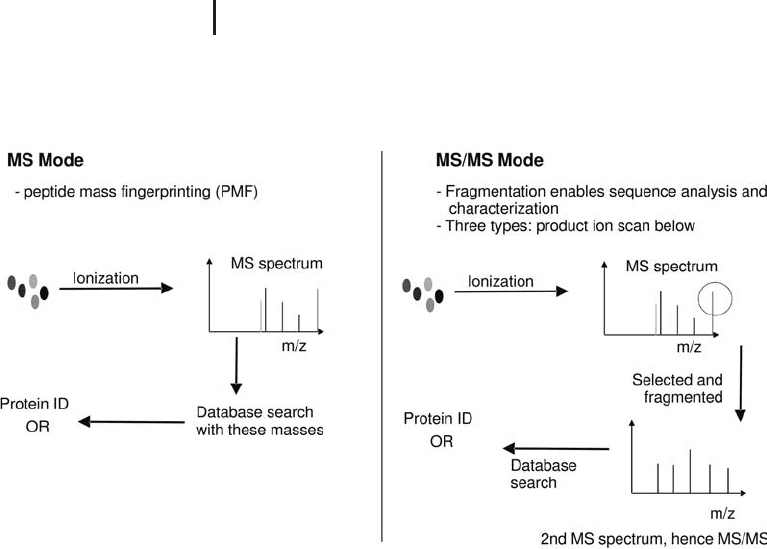
Generally, two different approaches, or combinations thereof, can be
used for protein identification (ID): peptide mass fingerprinting and
tandem mass spectrometry (MS/MS). In the first instance, the mass/
charge ratio (m/z) of the analytes are measured and the calculated
masses are indicative of the composition of the individual analytes.
Hardman M, Makarov A. Anal
Chem 75 (2003) 1699–1705.
Makarov A. Anal Chem 72
(2000) 1156–1162.
Olsen JV, de Godoy LMF, Li G,
Macek B, Mortensen P, Pesch
R, Makarov A, Lange O,
Horning S, Mann M. Mol Cell
Proteomics 4 (2005) 2010–
2021.
3 Mass Spectrometry234
In the second instance, tandem mass spectrometry (MS/MS) is used
to acquire peptide sequence information, which is used to identify
and characterize proteins with high specificity (see Figure 3.15).
Fig. 3.15: Schematic of the methods of protein identification
using a mass spectrometer: Peptide mass fingerprinting is performed
in MS mode and peptide sequence analysis in MS/MS mode.
3.3.1
Peptide Mass Fingerprint
The technique originally described in 1993 comprises protein diges-
tion, MALDI TOF analysis and sequence database search algorithms.
(Pappin et al. 1993; Henzel WJ et al. 1993; Mann et al. 1993; Yates et
al. 1993; James et al. 1993).
Simply, every protein in the protein database (or in the genome
under investigation) is theoretically digested with the cleavage
reagent used in the digestion reaction, generating many hundreds of
thousands of theoretical peptides. The experimental peptide masses
derived from the MS spectrum, the peptide mass fingerprint (PMF)
is then compared to the theoretical peptide masses and a score is cal-
culated and assigned. The score reflects the match between the theo-
retically and experimentally determined masses; the protein identi-
fied as the most probable is the one that gives the best match between
the experimental and the theoretical peptides. The number of pep-
tides observed in the PMF and the accuracy to which they are mea-
sured determines the confidence of the protein identification.
Pappin DJC, H jrup P, Bleasby
A. Curr Biol 3 (1993) 327–332.
Henzel WJ, Billeci TM, Stults
JT, Wong SC, Grimley C, Wata-
nabe C. Proc Natl Acad Sci
USA 90 (1993) 5011–5015.
Mann M, Hojrup P, Roepstorff
P. Biol Mass Spectrom 22
(1993) 338–345.
Yates JR III, Speicher S, Griffin
PR, Hunkapiller T. Anal
Biochem 214 (1993) 397–408.
James P, Quadroni M, Carafoli
E, Gonnet G. Biochem Biophys
Res Commun 195 (1993)
58–64.

3.3 Generating MS Data for Protein Identification 235
The incorporation of reflectron technology and delayed extraction
(timed delay ion extraction) into MALDI-TOF instrumentation has
enhanced the performance of peptide mass fingerprinting consider-
ably. The
12
C isotope of the peptide isotopic envelope, the mass used
in a PMF search, can be unambiguously assigned across the peptide
mass range of interest, significantly enhancing mass measurement
of this peak (sub 50 ppm mass accuracy is routine). The improved
mass accuracy further constrains the database search, reducing the
potential for ambiguous protein identifications (Jensen et al. 1996;
Clauser et al. 1999).
Several programs are available to perform this type of search, vary-
ing in the execution of the task (including MASCOT at www.matrix-
science.com; and Phenyx at http://phenyx.vital-it.ch/pwi/login/
login.jsp). Accuracy, reliability and speed determine the program of
choice. Regardless which program is used, four user variables are
important for a PMF search:
.
Peptide mass list.
.
Specification of the cleavage agent.
.
Error tolerance. The accuracy of mass measure-
ment is determined by the calibration, the
higher the mass accuracy the greater the specifi-
city.
.
Knowledge of peptide modifications i.e. methio-
nine oxidation.
For this approach to give an unambiguous result, a significant num-
ber of experimentally determined peptide masses have to match the
experimental masses, the peptides have to be a result of the correct
cleavage specificity of the cleavage agent used and the protein in
question has to exist in the protein database. As a result, the PMF
approach is highly suited to highly characterized genomes and has
been a core proteomics technique. Shevchenko et al. (1996) demon-
strated that up to 90% of proteins selected from a 2D gel of an E coli
lysate were identified by peptide mass fingerprinting.
Although an unambiguous match may be returned from a database
search, not all the peptides within the peptide mass fingerprint may
be identified. It is important to identify the remaining unidentified
peptide peaks, which may arise from:
.
The presence of other digested proteins within
the sample (in the case of 2D gel, comigration to
the same spot);
.
Peptides arising from the simultaneous diges-
tion of contaminant proteins such as keratin;
Jensen ON, Podtelejnikov A,
Mann M. Rapid Commun
Mass Spectrom 10 (1996)
1371–1378.
Clauser KR, Baker P, Burlin-
game AL. Anal Chem 71
(1999) 2871–2882.
Shevchenko A, Jensen ON,
Podtelejnikov A, Sagliocco F,
Wilm M, Vorm O, Mortensen
P, Shevchenko A, Boucherie H,
Mann M. Proc Natl Acad Sci
USA 93 (1996) 1440–1445.
Though many keratin peaks are
commonly known and these
peptides, if present, can be
subsequently omitted from the
search.

3 Mass Spectrometry236
.
Incorrect cleavage, protease acting in a non-pre-
dicted fashion;
.
Post-translationally modified peptides, altering
the mass of the native peptide rendering it
unrecognizable in the database search;
.
The identified protein may be (highly) homolo-
gous to the protein under study, but not exactly
the same and thus unmatched peptides will
exist.
MALDI-TOF PMF is fast and simple method of protein identification,
but the success of the method can be compromised in a number of
ways:
.
Insufficient peptides are observed in the peptide
mass fingerprint to submit to a database search,
i.e. insufficient information to identify the pro-
tein.
.
The sample maybe a mixture of proteins.
Although it is possible to analyze simple mix-
tures (Axelsson et al. 2001) there may not be a
significant number of peptides from each pro-
tein component in the mixture to yield a success-
ful identification. As several peptides are
required to give a statistical match, this approach
is not readily suited to complex mixtures
.
Excessive post-translational modifications of the
protein can result in masses, which are not pre-
dicted in the theoretical digestion of the proteins
in the database as well as precluding peptides
from the fingerprint.
.
Very little homology can be found with another
protein in the database or the protein in question
may not actually exist in the protein database.
.
If the above is true, peptide mass fingerprinting
cannot be used with confidence for searching
against the EST databases (which is the next
stage of protein identification if a search of the
protein database is unsuccessful). The probabil-
ity that a significant number of peptides from
the peptide mass fingerprint will find matches
with a single EST yielding an unique protein
identification is small.
If any of these situations arise, then more specific information is
required to identify the protein.
Common for small molecular
weight proteins, basic proteins
if digested with trypsin low
abundant proteins.
Axelsson J, Boren M, Naven
TJP, Fenyç D. Proceedings of
the 49
th
ASMS conference on
mass spectrometry and allied
topics, Chicago ( 2001).

3.3 Generating MS Data for Protein Identification 237
3.3.2
Peptide Mass Fingerprint Combined With Composition Information
Historically, it has been possible to combine PMF information with
compositional information. This was a common technique prior to
the introduction of delayed extraction and reflectron technology. The
composition information provided orthogonal information which
provided additional specificity for a database search by enabling
further constraints on that search (Fenyç et al. 1998). For instance,
this publication demonstrated that with the knowledge of the pre-
sence of a cysteine residue in a tryptic peptide of mass 2000 Da (mea-
sured to 0.5 Da mass accuracy) the number of matching proteins in S
cerevisiae was reduced by a factor of five. A number of approaches
have been employed to gain compositional information. In one exam-
ple reported by Pappin, a PMF is acquired and the peptide masses
noted. A subsequent methyl esterification reaction is performed on a
small aliquot of the sample esterifying the carboxyl side-chain of the
acidic residues, glutamic and aspartic acid, and the carboxylic group
of the C-terminal residue present in each peptide of the digest. A
PMF spectrum is re-acquired. The subsequent mass changes between
corresponding peptides are indicative of the number of acidic groups
each peptide contains. This information was combined with the origi-
nal PMF using a MOWSE composition search potentially increasing
search discrimination by orders of magnitude (Pappin et al. 1995).
The number of exchangeable hydrogens within a peptide offers
composition information. Again, this procedure requires the acquisi-
tion of a PMF, subsequent labeling of the mixture with a deuterium
solution (D
2
O) and finally re-acquisition of a second spectrum. The
mass increase of each peptide by the number of exchangeable hydro-
gens is indicative of amino acid composition (Sepetov et al. 1993;
James et al. 1994).
Moreover Goodlett et al. (2000) demonstrated composition informa-
tion and high mass accuracy can be very specific information for
unambiguously identifying proteins. By labeling cysteine residues
with a specific isotopic label, IDEnT (the tag contained chlorine,
which has a specific isotopic profile owing to the relative abundance
of
35
Cl and
37
Cl) the distinctive isotopic pattern of the labeled peptide
could be simply recognized. With this specific composition informa-
tion and mass accuracy measured to within 1 ppm using an FT-ICR
MS, the mass of a single peptide was sufficient to unambiguously
identify a protein from the whole yeast database (1 peptide from a
possible in ~345,000 peptides).
Fenyç D, Qin J, Chait BT. Elec-
trophoresis 19 (1998) 998–
1005.
Pappin D, Rahman D, Hansen
HF, Bartlet-Jones M, Jeffrey W,
Bleasby AJ. Methods in Biolo-
gical Sciences (1996) 135–150.
Sepetov NF, Issakova OL, Lebi
M, Swiderek K, Stahl DC, Lee
TD. Rapid Commun Mass
Spectrom. 7 (1993) 58–62.
James P, Quadroni M, Carafoli
E, Gonnet G. Protein Sci 3
(1994) 1347–1350.
Goodlett DR, Bruce JE,
Anderson GA, Rist B, Pasa-
Tolic L, Fiehn O, Smith RD,
Aebersold R. Anal Chem 72
(2000) 1112–1118.
Cysteine was chosen as the
labeled residue because it is one
of the rarest amino acid resi-
dues, allowing constrained
database searching.

3 Mass Spectrometry238
The isotopical labeling of cysteine residues has also been exploited
for extra composition information. Sechi and Chait (1998) reported a
method for the modification of the cysteinyl thiol group with isotopi-
cally labeled acrylamide.
Additionally, composition information can be inferred from immo-
nium ions contained within a MALDI PSD spectrum, this is particu-
larly discriminating information. Immonium ions present in a
MALDI PSD spectrum indicate the presence of certain amino acid
residues; again this can be included in a composition search as
described above. (Clauser et al. 1999). This information is also avail-
able in a product ion MS/MS spectrum acquired with a MALDI
QTOF or TOF/TOF instrument.
However, with the ubiquitous MS/MS functionality available in
many laboratories, these approaches are seldom used today.
3.3.3
Peptide Mass Fingerprint Combined With Partial Sequence Information
Again, historically, supplementing PMF data with some partial
sequence has been an attractive approach; PMF and sequence infor-
mation can be used in the same search using the sequence query
function with the MASCOT search engine. An unsuccessful search of
the protein database with the peptide mass fingerprint data may be
overturned with some partial sequence if the protein exists in the pro-
tein database.
The data required for this type of database search can be obtained
with a MALDI-TOF instrument capable of post-source decay. Post-
source decay (PSD) is a technique performed on a MALDI TOF
instrument equipped with a reflectron, though not genuine MS/MS,
it can generate stretches of peptides sequence which can be used in a
search engine querry of a protein database. A worked example is
demonstrated below whereby a PMF is acquired prior to the chemical
derivatization of the peptide digest with chemically assisted fragmen-
tation (CAF; see Section 3.3.4.4) reagent and subsequent CAF-PSD is
performed.
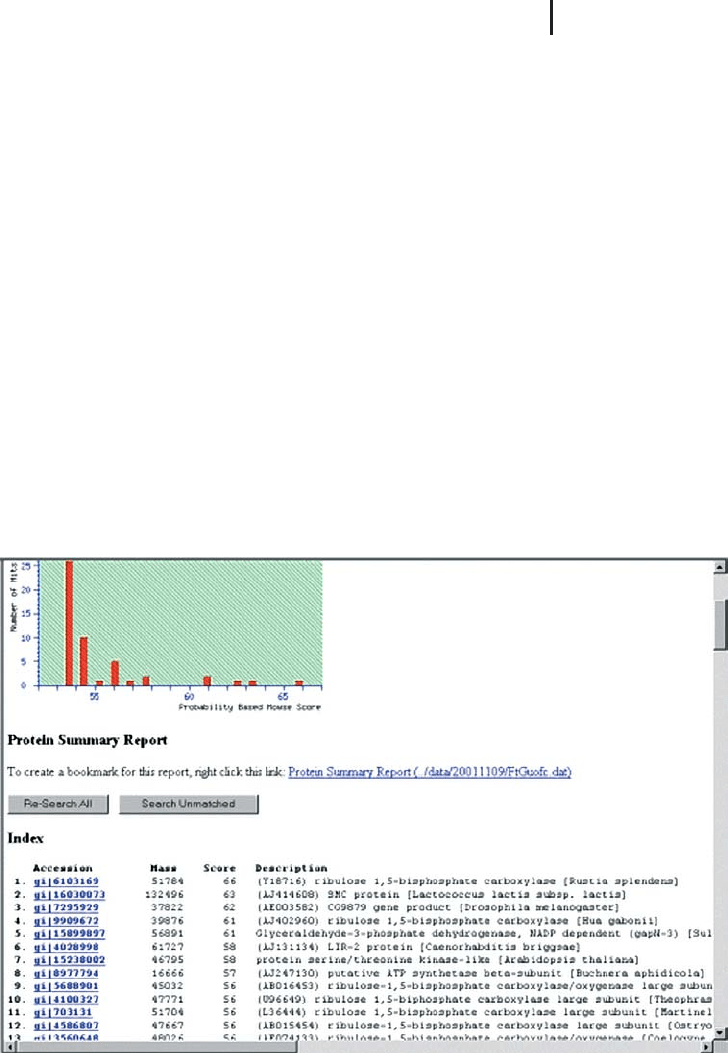
An unsuccessful result was obtained from the PMF search (Figure
3.16). Following chemical derivatization, PSD was performed on two
of the derivatized peptides. The spectra of each peptide include sev-
eral sequence specific C-terminal fragment ions (Figures 3.17a,
3.18a), which is indicative of partial amino acid sequence can be
inferred for both peptides from. Each sequence is combined with the
peptide mass fingerprint in a sequence query search using MASCOT.
Sechi S, Chait BT. Anal Chem
70 (1998) 5150–5158.
Clauser KR, Baker P, Burlin-
game AL. Anal Chem 71
(1999) 2871–2882.
3.3 Generating MS Data for Protein Identification 239
Combining the interpreted sequence derived from the PSD spectrum
of peptide m/z 1569.79 with the original PMF in a database sequence
query search, yields an unambiguous match (Figure 3.18b). Similarly,
an unambiguous match is returned when the determined sequence
from the second peptide (peptide m/z 1157.57) is combined with the
PMF in a sequence query search (Figure 3.18c). When both sets of
sequence data are combined with the peptide mass fingerprint the
confidence in the match returned from the database search increases
dramatically (Figure 3.18c). Close inspection of the PSD spectra
demonstrated that the sequence can readily determined using the
CAF chemistry. The CAF reagent generates only C-terminal fragment
ions (see Section 3.3.4.4), which makes the sequence relatively simple
to interpret. In the case of the second peptide, there is some ambigu-
ity whether the residue is a glutamine or a glutamic acid (experimen-
tally measured difference 128.7 Da) in part of the determined
sequence. However, the MASCOT search query allows both amino
acid residues to be inputted into the search query (see Step 15 on
page 407). As the figures demonstrate a short stretch of determined
sequence combined with the PMF is a powerful approach for re-
ducing ambiguous protein identifications; particularly if genuine
MS/MS analysis is not an option.
Fig. 3.16: An unsuccessful PMF search of the protein database.