
Woodward D. Lloyd George and the Generals
Подождите немного. Документ загружается.

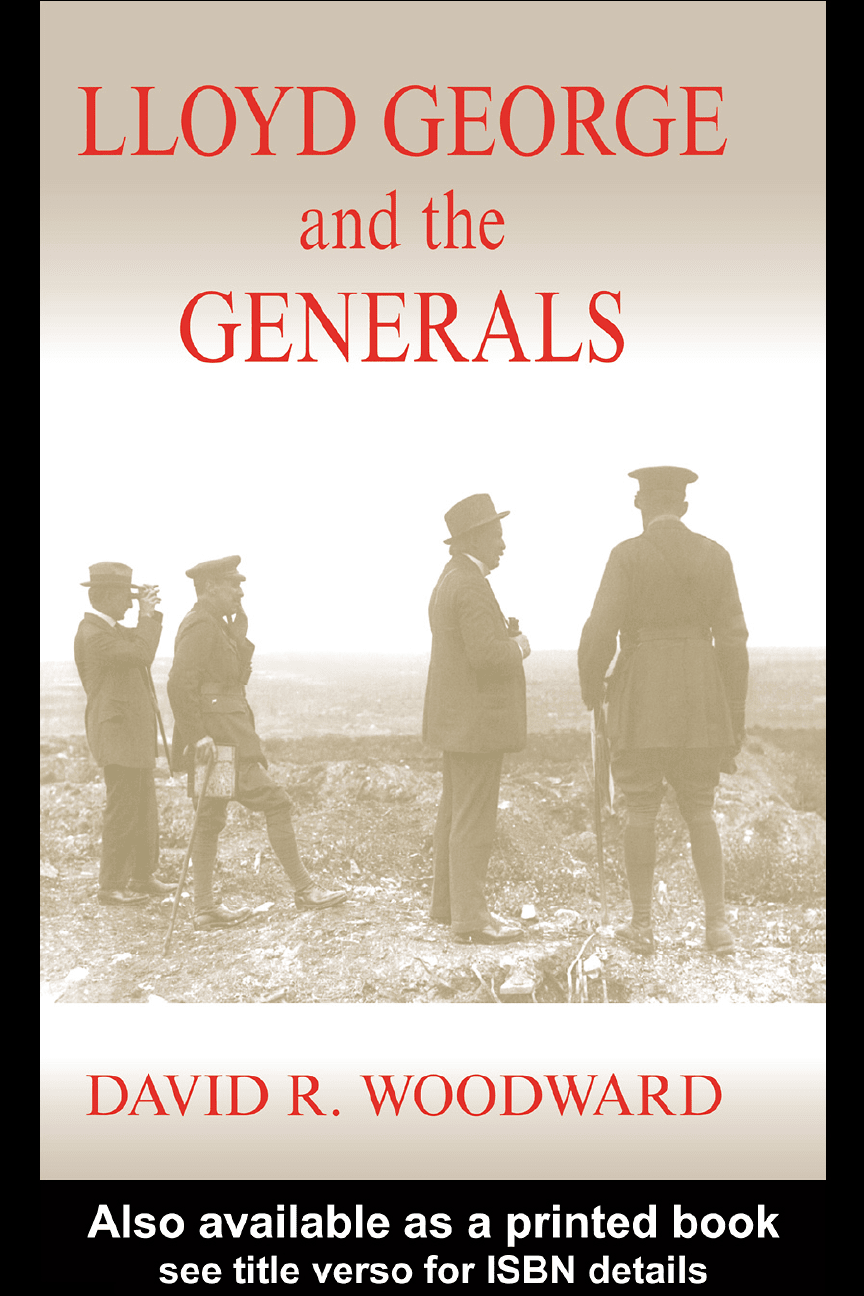
LLOYD GEORGE AND THE GENERALS
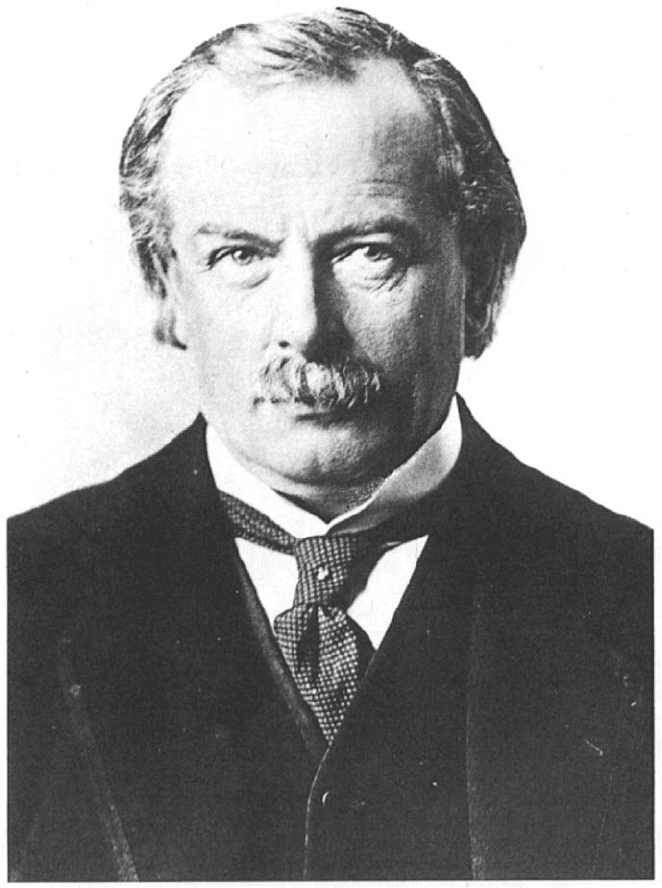
Frontispiece. David Lloyd George: his hair, which he allowed to grow long, rapidly
turned white during the war.
ii

LLOYD GEORGE AND THE
GENERALS
David R.Woodward
Marshall University, Huntington, West Virginia
FRANK CASS
LONDON AND NEW YORK
First published in 2004
by Frank Cass
11 New Fetter Lane, London EC4P 4EE
Simultaneously published in the USA and Canada
by Frank Cass
29 West 35
th
Street, New York, NY 10001
This edition published in the Taylor & Francis e-Library, 2005.
“To purchase your own copy of this or any of Taylor & Francis or Routledge’s collection of thousands
of eBooks please go to www.eBookstore.tandf.co.uk.”
Frank Cass is an imprint of the Taylor & Francis Group
Copyright © 1983, 2004 David R.Woodward
British Library Cataloguing in Publication Data
A catalogue record for this book is available
from the British Library
ISBN 0-203-01013-2 Master e-book ISBN
ISBN 0-7146-5507-4 (Print Edition)
ISSN 1465–8499
Library of Congress Cataloging-in-Publication Data
a catalog record for this book is available
from the Library of Congress
All rights reserved. No part of this publication may be reproduced, stored in or
introduced into a retrieval system or transmitted in any form or by any means,
electronic, mechanical, photocopying, recording or otherwise, without the prior
written permission of the publisher of this book.
Contents
List of Illustrations vi
Preface vii
Preface to the New Edition x
Series Editor’s Preface xii
1 Birth of an “Easterner” 1
2 Balkanite 13
3 Munitions, Compulsion, and the Fall of Serbia 34
4 “Westerners” in the Ascendancy: The Somme Offensive 60
5 Wizard in the War Office 85
6 Lloyd George Attempts to Overthrow the Generals 104
7 The Nivelle Offensive 122
8 Passchendaele: The Rack of Choice 150
9 Strain 182
10 The Supreme War Council and British Military Plans for 1918 214
11 Command of the Allied General Reserve and the Fall of Robertson 248
12 The German Offensive and the Maurice Debate 278
13 The Uncertain Road to Victory 307
Bibliography 342
Index 350
List of Illustrations
Frontispiece. David Lloyd George ii
A section of the Hindenburg Line 8
Lloyd George watching the operation of a wire-cutting tractor 40
George V.Queen Mary, and Sir Douglas Haig in Abbeville, 1917 64
Sir Douglas Haig and General Sir Henry Rawlinson at Fourth Army
headquarters on the eve of the Somme offensive
80
Albert Thomas looks on as Lloyd George expresses his doubts to Sir
Douglas Haig and General Joffre about the use of cavalry in trench warfare
93
Lloyd George and Lord Reading watch a bombardment during the Somme
offensive
94
Lloyd George in the trenches 95
Lloyd George inspects the grave of a British soldier 164
Sir William Robertson and Major-General Sir Frederick Maurice at the
Paris inter-Allied conference in July 1917
184
Passchendaele in October 1917 207
“Ugly” Wilson and the British section of the Supreme War Council at
Versailles in January 1918
237
Preface
The British victory in World War I, achieved at immense human and material cost,
failed to create a better world and led to widespread disillusionment. Had victory
been worth the ghastly slaughter, and of equal importance, had the war been
conducted along right lines? Scapegoating flourished in Britain as both civil and
military leaders censured their rivals about their alleged blunders. Chief among
the combatants were David Lloyd George and the generals, who resumed their
wartime disputes in the publishing houses. This war of paper bullets had begun
almost as soon as the guns fell silent, with the liberal editor A.G.Gardiner initiating
the fray on November 30 with an article in the Daily News headlined “MR.
LLOYD GEORGE AND UNITY OF COMMAND: A LEGEND AND THE
TRUTH,” which attempted to strike down the notion that Lloyd George had “won
the war.” The generals and their sympathizers soon followed Gardiner into print
with polemical accounts of Lloyd George’s role in the war. The view that the
generals had won the war in spite of Lloyd George was canonized in the British
official history of the war compiled by BrigadierGeneral James E.Edmonds. To
be sure, Lloyd George had his defenders. None proved more one-sided than the
Welshman himself, who portrayed the generals in his memoirs as inept and stupid.
Nor has time stilled the passions aroused by Britain’s deadliest war. Witness the
angry reaction to the simplistic musical, Oh, What a Lovely War, which
characterized the military authorities as callous butchers, and the running battle
between John Terraine, the staunch defender of the “Westerner” Sir Douglas Haig,
and the late Captain Liddell Hart and his disciples, apostles of indirect strategy.
Too rarely have these often partisan accounts added to our understanding of the
how and why of decisions affecting the lives of tens of thousands of British
soldiers. Considerable literature exists on both Lloyd George and the higher
direction of the Great War, yet access to many private and official papers sealed
until the mid-1960s or later permits a fresh and more balanced look at Lloyd
George’s controversial role in military affairs and his frequently antagonistic
relationship with the British high command, which his “Eastern” or indirect
strategy exacerbated. The wealth of new material makes possible a detailed
description of how civil and military authorities grappled with the problems of
fighting a world war which centered around a great land war against Germany.
That misjudgments abounded is understandable. The magnitude and complexity
of events often overwhelmed the participants. Lloyd George, his civilian
colleagues, and the generals were no exception. The record underscores their
fallibility and reaffirms that the war posed few questions with simple, easy
answers.
That record has largely been reconstructed from diverse primary sources: the
contemporary press, Parliamentary Debates, the private papers, published diaries
and memoirs of those involved in formulating and executing military policy, and
the voluminous records of the Cabinet Papers. For the first time, an important
chapter in the distinguished and often turbulent career of one of Britain’s greatest
prime ministers can be given the comprehensive study it deserves. Also, new
evidence unearthed either clarifies or answers persistent questions concerning the
Calais conference, the Maurice debate, Lloyd George’s Balkanite strategy, the
government’s commitment to the Somme and Passchendaele offensives, Sir
William Robertson’s downfall, the government’s manpower policies, the creation
of a Supreme War Council and generalissimo, and other important topics. The
story, as it unfolds, examines the influence of the monarchy and press on the
decision-making process, and, from a wider perspective, weighs the difficult
relationship between the civil and military authorities in a democracy at war.
Where did the responsibility of the British civil authorities end in the conduct of
a total war which involved all elements of the nation? Where did the authority of
the soldiers begin?
This is narrative history for which I make no apologies. As A.J.P.Taylor once
observed, “After all, the distinguishing mark of history is that events happen in
order of time. How else can you present them?”
I am very much in the debt of the many individuals who assisted me in the
researching and writing of this book. The staffs of British libraries and archives
in which I worked and Miss Josephine Fidler, the acquisitions librarian of Marshall
University library, could not have been more helpful. Mrs. Margaret Gerke and
Mrs. Juanita Harold assisted me in typing the manuscript. Dr. Alan Gould, Dr.
Robert Maddox, Dr. Donna Spindel, and Dr. Michael Galgano, colleagues of mine
in the History Department at Marshall University, read and commented on some
of the chapters. Dr. Trevor Wilson of the University of Adelaide must be singled
out for special recognition. His extensive comment on my manuscript saved me
from some embarrassing gaffes and prodded me to rethink some of my
conclusions. The same can be said of Dr. Stuart Kaufman of the University of
Maryland, who read the entire manuscript. Fred Woodward, the director of the
Regent’s Press of Kansas, counseled me in various important ways. Any errors in
fact or interpretation, of course, are my responsibility. I am also most appreciative
of the summer grants-in-aid, sabbatical, and funds for typing given me by Marshall
University. Finally, I am grateful to my wife, Martha, for her encouragement,
understanding, and keen proofreading eye, and to my daughter, Catherine, for her
ready acceptance of a new environment in an English school and a flat in
Wimbledon while I completed my research.
viii
Facets of the manuscript have previously been published in Albion, The
Historian, and the Canadian Journal of History and appear here by permis sion.
I have made every effort to avoid infringing upon the copyright of any individual
or institution and regret any possible oversight in this regard. For permission to
quote materials to which they hold copyright, I wish to thank the following: the
government archives, Pretoria, South Africa; the British Library; the Public
Record Office; the India Office Library and Records; the Trustees of the Liddell
Hart Centre for Military Archives; the New College Library; the House of Lords
Record Office; the Imperial War Museum; the Beaverbrook Foundation; the
Bodleian Library; A.J.P.Taylor; representatives of the Spears and Robertson
families; Lord Scarsdale; Her Majesty Queen Elizabeth II; Mark Bonham Carter;
Vice Admiral Sir lan Hogg; Lord Hankey; Lord Haig; Lord Esher; Andrew
Rawlinson; Lord Derby; and Major C.J.Wilson.
I also acknowledge my indebtedness to Anthony Sheil Associates, Ltd., in
respect of quotations from The Fifth Army by General Sir Hubert Gough; to David
Higham Associates, Ltd., in respect of quotations from Lloyd George: A Diary by
Frances Stevenson, edited by A.J.P.Taylor; to Wells Gardner, Darton & Co., Ltd.,
which currently holds the copyright for Ivor Nicholson & Watson, Ltd., in respect
of quotations from Lord Riddell’s War Diary, 1914–1918; and to William Collins
Sons & Co., Ltd., in respect of quotations from Politicians and the War, 1914–
1916 and Men and Power, 1917–1918 by Lord Beaverbrook.
Finally, I thank the Imperial War Museum for permission to reproduce the
photographs that appear on these pages.
ix