
Woodward D. Lloyd George and the Generals
Подождите немного. Документ загружается.

its great attraction, did not seem promising. A conference in the Foreign Office
on May 12 attended by Curzon, Cecil, Lord Hardinge, the permanent under-
secretary for foreign affairs, Hankey, and Leopold S. Amery, the assistant
secretary to the War Cabinet, concluded that there was “no sufficient reason” that
any of Germany’s allies “should sever themselves from an alliance which has
already proved to be so successful.”
28
Both Curzon and Amery, however, agreed
with Lloyd George that the conquest of Palestine was vital to the security of Egypt
and Mesopotamia. As Amery, an imperialistic braintruster who had influence far
beyond his position in the government because of his close relationship with Lloyd
George, Milner, and Smuts, wrote: “The collapse of Russia has, in fact, made
Palestine, of the issues still left undecided by the war, one of the most vital for the
whole of the British Empire.”
29
It is significant, however, that these imperial strategists, despite their zeal for
the conquest of Palestine, supported Robertson’s view that Britain had no choice
but to continue to concentrate her military power in the West.
30
“By no other
means,” Curzon emphasized, “does it appear likely that the complete liberation
of Belgium, and the evacuation of France, will, if the war continues as long, be
secure. For, if these two objects were made the subject of an offer by Germany at
an earlier date, while her military strength and that of her Allies is still unbroken,
it could only be at the price of conditions which Great Britain alone would have
to pay and which would purchase the safety of our Allies by the acceptance of a
grave peril to the future of the British Empire.”
31
In short, as long as Britain sought
the destruction of German militarism, it was unsound to lessen Britain’s military
commitment to her Continental allies and concentrate on peripheral operations
which were so dear to Lloyd George’s heart. Thus Lloyd George’s most important
source for his “Eastern” strategy—the imperialist-minded members of his
government—deferred to the general staff.
For the moment Lloyd George had to be satisfied with strengthening the
Egyptian Expeditionary Force. This was achieved through a rare compromise with
Wully. By mid-May, after it was obvious that Sarrail had achieved no important
success against the Bulgarians, Lloyd George agreed to support in Allied councils
the general staff’s effort to get British troops away from Salonika. But he had his
price. These troops were to be sent to Egypt rather than France.
32
Under the terms
of this bargain, Robertson was able to pry two divisions away from Salonika, but
four still remained at the end of the year.
As Lloyd George prepared the way for a big push against the Turk in Palestine,
Haig moved to implement his great offensive. Whatever criticisms may be directed
against Haig’s plan, and there are many, it cannot be argued that it did not have
clear and important strategical objectives. As we have seen, the clearing of the
Belgian coast had long held an attraction for British military thinkers ranging from
Hankey to Sir John French to Churchill. With German submarines operating from
the Belgium coast being responsible for about one third of the British ships lost
to the torpedo,
33
many British civilians saw a special British interest in this military
operation. Jellicoe also expressed concern about the Belgian ports being used by
LLOYD GEORGE AND THE GENERALS 157
German destroyers.
34
Furthermore, enemy aircraft on the way to blast and burn
London would have to fly over additional anti-aircraft defenses if the coast were
in British hands. Also, if the German lines could be ruptured, the liberation of
much of Belgium (Britain’s major war aim in Europe) and the control of the
enemy’s vital communications system with its northern front might follow.
Even if the Germans did not give way, they might suffer terrible losses
attempting to hold ground that they could not afford to give up.
Haig’s plan to achieve these important strategic goals, as he outlined them to
Nivelle, Robertson, and his commanders, ran as follows. He would continue the
Arras attack to wear down the enemy. Meanwhile, British forces and material
would continue to be massed in the north in Ypres, where the main attack would
be launched in stages. First the Messines Ridge would be secured for observation
and to protect the right flank of his army. A few weeks later the other shoe would
drop—the operation to take the Belgian coast. This attack would proceed one step
at a time to secure Passchendaele Ridge, Staden Ridge, Clercken Ridge, etc. To
reassure Robertson and the civilians, Haig emphasized that “my arrangements
commit me to no undue risks and can be modified to meet any developments in
the situation.”
35
Despite the deliberate nature of his tactics, Haig was confident that ultimately
the German line would be broken, with his cavalry sweeping across western
Belgium, conquering Ostend and Zeebrugge, and mopping up the German forces.
Since the British generals Herbert Plumer and H.S.Rawlinson, who were involved
in the preparations, were not so optimistic as Haig, he chose a fellow cavalryman,
the dashing and aggressive General Herbert Gough who was imbued with the
“cavalry spirit,” to lead the assault with his Fifth Army.
This grandiose plan was questioned by leading French generals. Pétain,
although he refused to criticize Haig’s plan to his face, continued to oppose “any
operations with such distant objectives” and in a conversation with Sir Henry
Wilson he emphasized that “with the amount of assistance he could give,” Haig
was embarking upon “an impossible task.”
36
Ferdinand Foch was more blunt,
telling Wilson that “he wanted to know who was the fool who wanted Haig to go
on ‘a duck’s march through the inundations to Ostend & Zeebrugge.’” “As Wilson
noted in his diary, “He thinks the whole thing futile, fantastic & dangerous, and I
confess I agree & always have.”
37
Robertson, who shared Lloyd George’s concern that the French might not give
Haig adequate support and that the British army might consequently be bled white
in its attack, was also leery of Haig’s plan of a series of consecutive offensives to
gain grandiose strategic objectives. At the Paris conference he and Pétain had
stressed limited and wearing-down tactics which ran counter to Haig’s ultimate
objectives. As Robertson’s biographer astutely observes:
The difficulty lay, of course, in limiting each step in a continuous offensive.
Messines had been correct for it had been complete in itself. Third Ypres
would depend on the success of each component step. What would happen
158 PASSCHENDAELE: THE RACK OF CHOICE
to the battle if one of the components failed? If it was broken off, according
to the book, then the campaign would halt without completing its strategic
purpose, and a lot of lives and effort would have been expended for nothing.
If it was kept going, then Wully feared it might degenerate into a second
Somme, a human holocaust that he was concerned as the Prime Minister to
avoid.
38
Another concern of Robertson’s was Haig’s blind faith in Brigadier-
General J.Charteris, the head of the intelligence section at general headquarters,
who fed Haig a steady diet of unrealistic reports about the exhaustion of the
German army. Intelligence furnished Robertson by George Macdonogh, the
director of military intelligence at the War Office, painted a much truer picture of
the condition of the German army. Robertson, moreover, was apparently
impressed by Repington’s warning about fighting in the Low Countries. “I said
[to Robertson] that you can fight in mountains and deserts,” Repington writes on
May 21, “but no one can fight in mud and when the water is let out against you,
and, at the best, you are restricted to the narrow fronts on the higher ground, which
are very unfavourable with modern weapons.”
39
On May 18, prompted by Lloyd George and Robertson, Haig put the essential
question to Pétain.” ‘Did the French intend to play their full part as promised at
the Paris Conference? Could I rely on his wholehearted co-operation?’”
40
Pétain’s
misleading response was entirely reassuring as was the French government’s reply
to Derby’s inquiries.
41
On June 2, only five days before the British attack on the Messines Ridge was
scheduled to begin, Pétain was a bit more candid about the exhaustion of the French
army, sending his chief of staff, General Debeney, to Haig’s headquarters to
inform the British commander in chief that he would be unable to launch his
supporting attack as promised on June 10. “The French Army is in a bad state of
discipline,” Debeney ominously told Haig. On the other hand, Pétain’s messenger
assured Haig that he could count on the French army fulfilling its role in his
Flanders operation in the summer.
42
Whether Haig really believed that he could
expect wholehearted French support in the future is open to serious question.
Debeney emphasized that the French attacks during the next month were to be
essentially assaults by artillery and airplanes (a preview, in fact, of Pétain’s tactics
for the rest of the year). When Sir Henry Wilson saw the notes of the Haig-Debeney
conference, he wrote in his diary: “This endorses and underlines all that I have
been saying for the last month or more, and I think, and hope, that it will finally
dispose of Haig’s insane idea of taking Ostend and Zeebrugge.”
43
What is certain
is that Haig ignored Robertson’s s persistent pleas for any scrap of evidence that
would indicate that the French were not prepared to do their part.
44
Neither
Robertson nor the War Cabinet were informed of Debeney’s revelation about the
exhaustion of the French army. With Lloyd George (and Robertson) insisting that
the full cooperation of the French army was the essential requirement for any great
British attack, Haig apparently feared that his Messines Ridge attack and, more
LLOYD GEORGE AND THE GENERALS 159
importantly, his main Flanders offensive would be vetoed by the civilians if he
passed on this vital information to London.
In May and early June the War Office and general headquarters were out of
step for the first time since Robertson had become C.I.G.S. Unlike Haig, Robertson
did not now believe that the German army could be defeated in 1917 or perhaps
even in 1918.
45
Within the War Office Charteris was considered “a dangerous fool
because of his ridiculous optimism.”
46
With Britain’s manpower chips dwindling,
Robertson was reluctant to raise the ante. Under the circumstances, Lloyd
George’s policy of “knocking away the props” found some favor in the War
Office. Macdonogh told Wilson that he agreed with “the obvious necessity of
cutting out the Turk & Bulgar and believes it could be done.”
47
Even the apostle
of the “Western” school of thought, Robertson, momentarily looked toward the
Italian theater, where Cadorna was winding down the Tenth Battle of the Isonzo.
On June 7 he met with Foch at Abbeville and stressed a theory that he had held
since becoming C.I.G.S.: diplomacy was not supporting the military by detaching
the minor powers. Foch then raised an obvious point. A diplomatic offensive
without adequate military support was usually doomed to futility. “He said that
the French information from Austria was both recent and good. Austria was very
anxious to treat for peace, but would only treat when she was beaten. She was, in
fact, asking to be beaten, in order to get out of the war with a good face.”
Robertson’s response to this statement was remarkable: “This information raised
the whole question of our military policy. Ought we now to concentrate against
Austria?” Foch’s answer, it must be noted, was that “theoretically, that sounded
very well, but there were many practical difficulties.”
48
Two days later Robertson tentatively raised this point with Haig, who recorded
the following in his diary: “He wished me to realise the difficult situation in which
the Country would be, if I carried out large and costly attacks without full
cooperation by the French. When Autumn came round, Britain would then be
without an Army! On the other hand it is possible that Austria would make peace,
if harassed enough. Would it not be a good plan, therefore, to support Italy with
guns?” Haig, of course, viewed such sentiments as being heretical and attempted
to bring Wully back into the bosom of “Western” orthodoxy.
49
After his meeting with Haig, Robertson suppressed his misgivings about the
Flanders operation and loyally supported Haig in the great debate which was about
to begin over his offensive. Why was this rugged and strongwilled individual, who
feared no man, willing to defer to Haig? The answer can be found in his fear that
any disagreement between himself and Haig would be immediately exploited by
Lloyd George to undermine the “Westerners” and perhaps even to depose Haig.
He had always argued that the soldiers must support each other to keep the civilians
from interfering in strategy. This had been Robertson’s position, it should be
emphasized, long before Lloyd George’s underhanded tactics at Calais. In early
1916, he had stressed in a letter to Haig that the success of the British army
depended largely upon “the extent we at the top stick together and stand firm.”
50
160 PASSCHENDAELE: THE RACK OF CHOICE
The tragic result of Robertson’s s deference to Haig was that the government’s
adviser on grand strategy was reduced to the status of Haig’s cipher.
When Robertson returned to London he discovered a fresh challenge to the high
command’s direction of the war. On June 8, the War Cabinet, prompted it seems
by a paper written by Milner, had established the War Policy Committee “to
investigate the facts of the Naval, Military, and Political situations, and present a
full report to the War Cabinet.”
51
The War Policy Committee consisted of the
prime minister, Curzon, Milner, and Smuts (who had joined the War Cabinet after
turning down the opportunity to replace Murray as commander in chief of the
Egyptian Expeditionary Force). Bonar Law was not an official member but he
might as well have been because of his involvement in the committee’s
deliberations.
The origins of this committee can be found in the growing realization on the
part of the ministers that the situation had changed since the Paris conference,
when Lloyd George had supported a continuation of the offensive throughout
1917. Given the apparently irreversible decline of the Russian army and the
uncertain state of the French army, how much longer should the British go on
using up its declining manpower by attacking in the West? On June 6, the War
Cabinet had received its first official indication that something was wrong with
the French army. Macdonogh had “reported that there was serious trouble
practically amounting to mutiny, in a number of French regiments, partly as the
result of Socialist propaganda, partly on the ground that native troops had been
allowed to fire on strikers in the neighbourhood of Paris. It was hoped that this
disaffection would be set right in five or six days.”
52
This report (apparently
through no fault of Macdonogh’s) minimized the French mutiny. Hence, for the
moment the collapse of the Russian army continued to provoke the greatest
anxiety. On June 7, Milner stressed in a paper that “the defection of Russia” had
completely derailed Allied military plans, both in the West and in the East. “On
the other hand,” he wrote, “the entrance of America into the war has introduced
a new factor, of great ultimate promise but small immediate value. What are we
going to do to fill up the time before the weight of America can be thrown into
the scale?” It would not do “to go on without any plan at all. How do we now
stand about Palestine, about the Balkan campaign, about the continuance of the
offensive on the Western Front? I don’t know that we have made up our minds
about any of them. I feel as if we were just drifting, and as if there was some danger
that, in view of the preoccupation of a number of grave but nevertheless minor
domestic questions, we might continue to drift.”
53
The military was none too encouraging about America’s capacity to assist the
French and British on the western front in the near future. In May the general staff
had warned the civilians that an American army would not “be in the field in any
theatre of war for a long time to come.”
54
And within the next few days, General
I.M.Bridges, who had accompanied Balfour’s mission to the United States in
April, presented a disquieting report on American preparedness. In what Curzon
called the “most depressing statement that the Cabinet had received for a long
LLOYD GEORGE AND THE GENERALS 161
time,” Bridges informed the ministers that Washington might only be able to send
between 120,000 and 150,000 men to France by January 1, 1918. Moreover, by
the end of 1918, the American Expeditionary Force in Europe might number only
half a million men.
55
Waiting for America, then, might be a risky policy. On the
other hand, these figures suggested that it was more important than ever to keep
Haig from exhausting the British army in attack, for the Americans might not be
able to fill his depleted ranks. Furthermore, men must be kept out of the army to
build the ships to accelerate the transportation of the Americans across the Atlantic.
Lloyd George was clearly delighted with the shift in the mood of the ministers
since early May, when he had been pledged by them to support the offensive in
the West. At this time he was excited about news that he had just received from
the British embassy in Rome. Cadorna, behind the back of his government, had
motored to Rome to meet secretly with a member of the British embassy, E.Capel
Cure. The Italian general’s clandestine movements were probably explained by
his government’s lack of enthusiasm for the offensive. Cadorna told Cure that his
attack on the Isonzo, which was now stalled, would have resulted in a “vital blow”
to the enemy if he had had the guns which he had turned down at the Rome
conference. Moreover, he expressed the conviction that he could “go right
through” to Trieste on the Austrian front between Carso and the sea if the British
provided him with 300 or more guns.
56
Fearing that the continued drift of the government would leave the initiative
with Haig, Lloyd George welcomed the creation of the War Policy Committee,
which gave him the chance to ventilate thoroughly his view that Austria and Turkey
—not Germany—should be the chief targets of the Allies in 1917. One facet of
Lloyd George’s personality that has clearly emerged thus far in these pages is his
extraordinary patience. Stalled by opposition at home or abroad, he returned again
and again to his peripheral strategy.
On the same day the War Cabinet created the War Policy Committee, he
launched a campaign to deny Haig his cherished Flanders campaign. A report
delivered by Sir Henry Wilson gave him some leverage. Wilson “confessed grave
doubts as to whether we could count on the continued resistance of the French
army and nation until such time as effective military assistance could be received
from the United States of America.” Despite this admission, Wilson refused to
break ranks with Haig in other respects. He would not confirm “the rumours which
had reached the War Cabinet [Macdonogh’s report of the sixth] that an incident
had occurred in the French army amounting almost to a mutiny.” He also
emphasized that “Pétain could not hold the French army together through another
winter without some real success, whether military or diplomatic.” When pressed
by the War Cabinet for his personal views on where a great victory might be won,
he said “that he could see no reasonable prospect of this in Mesopotamia, or Egypt,
or on the Western front, with the possible exception of Flanders, where he
understood that Field-Marshal Sir Douglas Haig was hopeful.” On the other hand,
he admitted that the prospect of Haig’s offensive “would be considerably reduced
162 PASSCHENDAELE: THE RACK OF CHOICE
if the French would not develope [sic] an attack on a large scale in concert with
the British offensive.”
57
Although Wilson had been guarded, even deceptive, in his remarks, his
comments had a considerable impact on the ministers, and it was agreed that his
views “strongly reinforced the arguments given by Lord Milner in his
Memorandum of June 7 in favour of a fresh stock-taking of the whole war
situation.” Conveniently overlooking his support of Nivelle, Lloyd George stressed
that up to the present time the Government had been guided in their war
policy entirely by the views of their naval and military experts. He himself
had always felt some misgivings about this course owing to the fact that in
a large number of instances all through the war the advice of the
experts proved to be wrong. Recent events had confirmed the view that, like
everyone else, they were not infallible. He pointed out that. at the Paris
Conference on May 4 & 5 he and Lord Robert Cecil, after prolonged
discussion, had supported the naval and military experts without hesitation,
although it involved forcing on the French Government an unpalatable
decision. Now the position had changed.
Lloyd George then came to the nub of the problem. The French were showing
signs of exhaustion, but in the weeks ahead Haig planned a “gigantic operation.”
The attack underway at the moment—the Messines Ridge assault—was just a
preliminary. Yet Robertson, Lloyd George noted, “did not believe that the main
British operation could be attended with success unless the French would
undertake an offensive on a corresponding scale.”
58
The prime minister allowed no defeatism to creep into his assessment of the
military situation. With the strain great in every quarter this was not the time for
hand-wringing or loss of faith in eventual victory. The ministers, in fact, were so
concerned about preventing a peace atmosphere from developing that two days
earlier they had rejected Hankey’s practical suggestion that “detailed secretarial
arrangements” be made for the “eventual Peace Conference” which might take
place “within months or years.” The ministers agreed that nothing must be done
to “create a peace atmosphere or give the impression that the Government were
making preparations for a Peace Conference.”
59
“Personally,” Lloyd George noted, “he inclined to the view that General Wilson
had probably been too pessimistic [about the exhaustion of the French]…. He
himself believed, however, that we could achieve both a military and diplomatic
success, and he shared General Wilson’s view as to the importance of this.”
60
Any
discussion of strategy, however, had to await the return of Robertson from France.
It would soon be obvious to all, if it was not already, that Lloyd George believed
only in the possibility of winning a major victory over the Austrians or Turks.
The stage was now set for the greatest and most intense debate of the war
between the “Easterners” and “Westerners.” In the next weeks the War Policy
Committee held sixteen meetings, usually in the morning, but twice at dinner
LLOYD GEORGE AND THE GENERALS 163
meetings which went on late into the evening, before the committee’s report was
ready to be laid before the War Cabinet for its approval on July 20.
Lloyd George viewed the question as the most important yet before his
government. With the losses on the Somme burned in his memory, he was obsessed
with limiting British casualties. If Haig were allowed to take on the German army
practically singlehandedly before the Americans arrived on the scene, the British
army might be destroyed by the formidable and, to Lloyd George, impassable
German defenses. This was consistent with his views on how the war should be
waged. Although his Liberal colleagues in Asquith’s government thought him an
extremist on compulsion, a common denominator of his strategic views was to
limit British losses. He had lobbied for guns for Russia to allow the colossus of
the East to wear down the Germans, intervention in the Balkans to involve Balkan
soldiers in the anti
German coalition, attacks against the Turks, in which British casualties were
often relatively light, and Nivelle’s offensive, which assigned a secondary role to
the British army. Now, if the ministers accepted his plan to attack Austria,
assuming that Rome would not reject the dubious honor bestowed upon it, the
Italians would do most of the killing and dying.
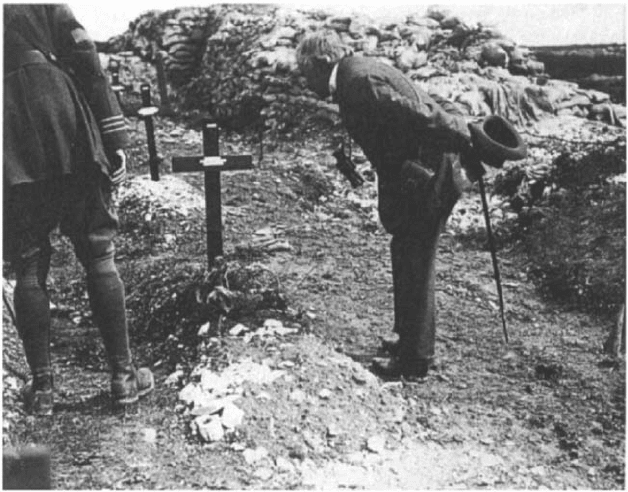
The trustee of his nation’s manpower inspects the grave of a British soldier.
164 PASSCHENDAELE: THE RACK OF CHOICE
Unable to divert the generals away from the West during the first months of his
premiership, Lloyd George and his colleagues in the War Cabinet had used
manpower as a means to force Haig to adopt less wasteful tactics. There is a
revealing discussion of the War Cabinet’s policy in a memorandum by Hankey,
dated April 18, 1917. It must be quoted at some length.
41. Man-Power is now the most difficult of the problems which the War Cabinet
has to face under the economic head. Their policy has never been very explicitly
defined and may in time lead to a difficult parliamentary situation…with the
probability of a prolongation of the War, the Government feel it to be more and
more dangerous to mortgage the future by reducing our man-power by any drastic
steps….
42. Although is has never been formulated in the War Cabinet Minutes it is
understood that the policy of the Government is first, by keeping the War Office
short to compel the soldiers to adopt tactics that will reduce the waste of man-
power. The French are alleged to have accomplished their successes in 1916 with
losses about half those incurred by the British army. Some British Generals are
known to be far more careful of human life than others, and these are not the least
successful leaders. The War Cabinet, it is understood, intend to force this fact upon
the Higher Command, in order that they in turn may compel subordinate leaders
to exercise great care in this matter. Further, they desire the War Office to work
out their own salvation by a careful substitution of elderly and partially fit men
and coloured men for fit men in all services behind the lines. The Government
would also like to see the adoption of a system of reduced numbers of battalions
in divisions. Although this would undoubtedly reduce the total numerical strength
of the army, it would not reduce the effective strength in anything like the same
proportion for the reason that the effective strength is largely dependent on
mechanical means, such as guns, machine-guns, trench mortars, and tanks; all
these latter are continually increasing, so that the effective strength of a division
of 9 battalions in 1917 would be incomparably greater than that of a division of
12 battalions in 1914.
43. If this is the policy of the Government it might be as well to place it on
record in the War Cabinet Minutes at an early date.
61
Although the War Cabinet’s policy of keeping the army short of men was never
formally recorded in the minutes, the government refused to support universal
national service or the further combing out of war-related occupations. As Derby
lamented in June, “it seems clear that, practically, the Army is now provided with
men after all other needs of the Nation have been cared for.”
62
The War Cabinet,
however, enjoyed no success in attempting to get Haig to reduce British divisions
from twelve to nine battalions.
63
With the burden of fighting the German army shifting to the British after
Nivelle’s failure, the civilians’ approach to the manpower question changed.
Preserving Britain’s s staying power rather than forcing Haig to change his tactics
became their primary concern. Haig’s growing anger over the government’s
refusal to supply him with all of the men he demanded is understandable. When
LLOYD GEORGE AND THE GENERALS 165
Robertson, after conferring with Lloyd George in late May, informed him with
some exaggeration that he would receive “only scraps” in future drafts, Haig’s
frustration boiled over: “For the last two years most of the soldiers have realised
that Great Britain must take the necessary steps to win the war by herself, because
our French Allies had already shewn that they lacked both the moral qualities &
the means for gaining the victory. It is thus sad to see the British Govt. failing at
the XIIth hour!”
64
Haig’s belief that Britain was “at the XIIth hour” was at the
heart of general headquarters’s differences with the War Cabinet over manpower.
Haig thought that he might defeat Germany in 1917; the civilians did not. Hence,
Lloyd George and others were determined to maintain Britain’s ability to fight
on. Men were needed to plow, build ships, and turn out munitions as well as man
the trenches on the western front. Furthermore, the government was worried about
the impact of further compulsion on the mood of Labour. Maintaining home
morale might mean the difference between victory or defeat as the war continued
into 1918 or even 1919.
The War Policy Committee meetings need not be described in exhaustive detail
because the reader is already well acquainted with most of the arguments of the
“Easterners” and the “Westerners.” The battle lines were drawn at its first meeting
on June 11. Robertson argued that Britain had no choice but to continue the
offensive in the West and noted that the British army was confident that it could
“beat the Germans by themselves.”
65
The prime minister countered with his view
that the Italian front offered the British greater opportunities than the formidable
German defenses in the West. He read a private letter from Sir Rennell Rodd, the
British ambassador in Rome, which described a secret interview that Cadorna had
with a member of the British embassy. The Italian commander in chief had asked
for more guns from the British and had expressed the conviction “that the Italian
front provided the enemy’s most vulnerable point on the Western Front.”
66
Robertson immediately demurred. If the Italians had to have more guns, let them
come from the guns allotted to the Palestine expedition rather than from Haig’s
army.
Just before the committee adjourned for the day, Lloyd George begged the
military and civilian leaders to consider his strategy with an open mind:
In his view the great defect of the War had been that we have always hit the
enemy at his strongest instead of his weakest side. If we had concentrated
against Austria earlier in the War we might have knocked her out and
isolated Germany. In his opinion, our strategy must be considered again
without any preconceived ideas. This was the only chance of rescuing
ourselves from a tight place. The news from Russia was very discouraging
and Colonel Spiers [the way Sir Edmund Spears, the head of the British
Military Mission in Paris, spelled his name in 1917], an officer of great
knowledge of the French, actually talked of the possibility of a Revolution
in France. On the other hand, he could see no serious indication of cracking
166 PASSCHENDAELE: THE RACK OF CHOICE