
Yam, Kit L. (ed.). The Wiley encyclopedia of packaging technology
Подождите немного. Документ загружается.

Dispersion Forces. These intermolecular forces exist
between nonpolar molecules. They are forces between
temporary dipole molecules as a result of positive nuclei
of one molecule attracting the electrons of another mole-
cule. Although dispersion force is the weakest intermole-
cular force, it plays an important role in many nonpolar
packaging polymers because of their long molecular
chains. For example, the molecular weight of PE is
typically larger than 100,000; along the chain of this large
molecule many dispersion forces exist, and the summation
of these many forces can significantly affect the properties
of the polymer.
SPATIAL ARRANGEMENTS
The fourth level is to consider spatial arrangements,
which includes how molecules are arranged in the mate-
rial. In addition to chemical bonds, the spatial arrange-
ment of atoms in the molecule and the molecular weight
are also important factors determining the chemical and
physical properties, particularly for polymeric materials
including plastics and paper. The fine structure of mate-
rial observed by microscopy resulting from chemical com-
position, molecular arrangement, and crystalline degree is
sometimes referred to as morphology.
Tacticity. The atomic arrangement in three-dimen-
sional molecular configuration is called stereochemistry
or tacticity. The way the molecular or ionic units are
geometrically organized distinguishes between crystalline
and amorphous solids: the former has symmetric, period-
ical, and well-ordered structural organization, and
the latter is asymmetric, not periodical, and unsettled
(Figure 4).
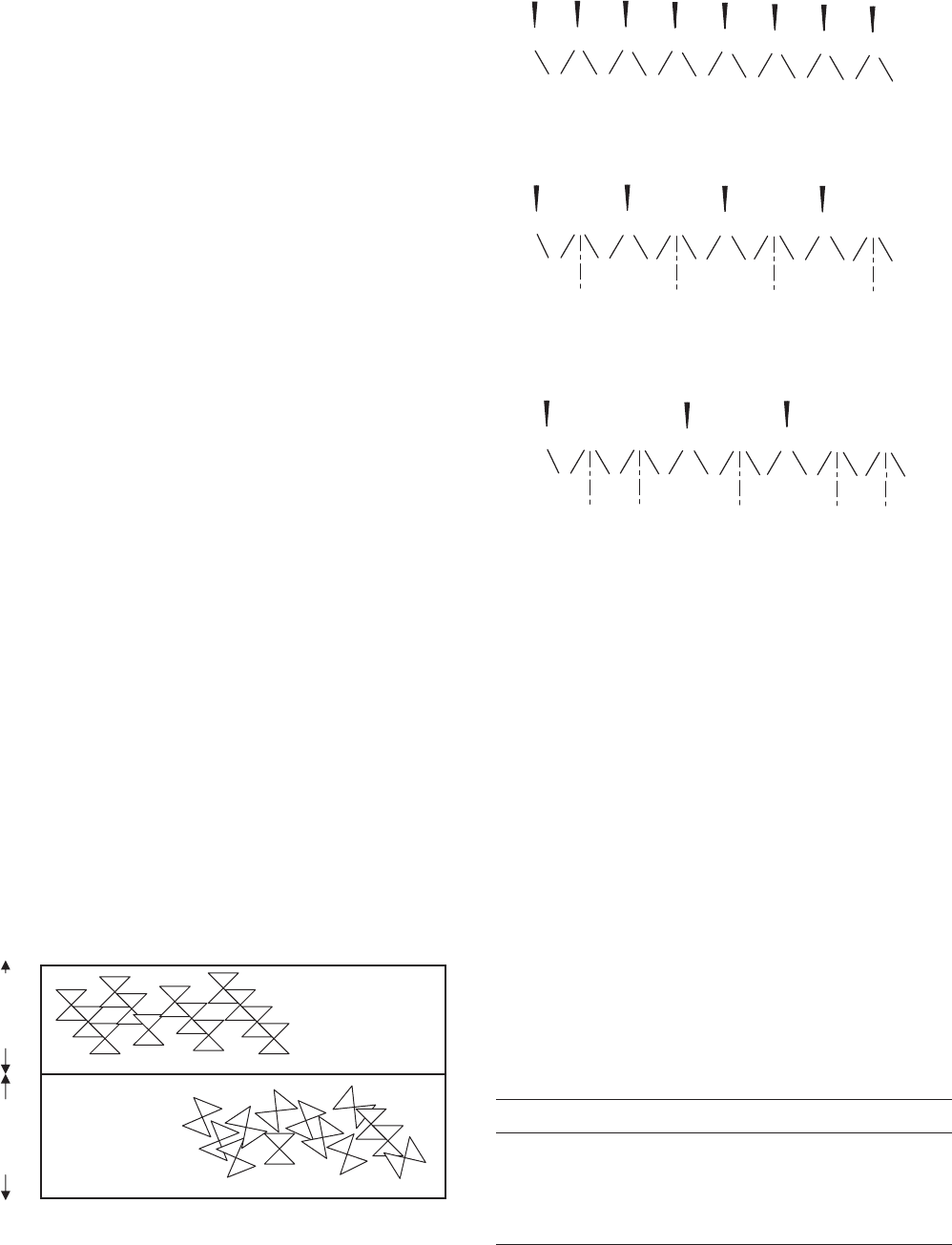
For example, methyl groups in polypropylene (PP) may
be positioned in three different ways: Isotactic PP has all
the methyl groups on the same side of the chain; syndio-
tactic PP has the substitute group alternately above and
below the chain plane, and atactic PP is with random
sequence (Figure 5). The tacticity or steroregularity is
important in determining the ability of the solid material
to crystallize: Regular atomic arrangement in the mole-
cular structure makes the molecules easily pack together
into rigid crystals. Therefore, isotactic and syndiotactic
PPs are crystalline, whereas atactic is amorphous.
Crystalline Versus Amorphous State. The crystalline
structural organization of solids applies to structures
composed of repeating identical units that orderly dis-
posed with a fixed geometric relation between each other.
The framework derived from such a symmetric organiza-
tion of units may be more or less complete and homo-
geneous (with vacancy or impurities), but it always has
the lowest energy, and therefore is the most favored one.
Stereochemistry, kinetics of solidification from a liquid
state, and presence of crystallization promoters are factors
that determine the degree of crystallinity. The perfor-
mances of the packaging materials are greatly affected
by the crystalline or amorphous structure (Table 5). Glass
is typically a noncrystalline, amorphous material. Cera-
mic material may be in different degrees of crystallinity
Crystalline
Amorphous
Figure 4. A schematic representation of the crystalline and
amorphous spatial configuration of solid constituents.
CH
2
CH
CH
3
CH
CH
3
CH
CH
3
CH
CH
3
CH
CH
3
CH
CH
3
CH
CH
3
CH
CH
3
CH
2
CH
2
CH
2
CH
2
CH
2
CH
2
CH
2
(1) Isotactic
CH
2
CH
CH
3
CH
CH
2
CH
CH
3
CH
3
CH
2
CH
CH
2
CH
CH
3
CH
3
CH
2
CH
CH
2
CH
CH
3
CH
3
CH
2
CH
CH
2
CH
3
(2) Syndiotactic
CH
2
CH
CH
3
CH
CH
2
CH
CH
3
CH
2
CH
CH
2
CH
CH
3
CH
3
CH
2
CH
CH
2
CH
CH
2
CH
CH
2
CH
3
CH
3
CH
3
CH
3
(3) Atactic
Figure 5. Different tacticities in polypropylene.
Table 5. The crystalline and amorphous state for general
categories of materials used for packaging
Material Spatial organization
Glassy Amorphous
Ceramic Crystalline/amorphous
Cellulosic Crystalline (pure cellulose)
Metallic Crystalline
Plastic Amorphous/crystalline
1168 STRUCTURE/PROPERTY RELATIONSHIPS OF PACKAGING MATERIALS
depending on the chemical composition and manufactur-
ing conditions. Most plastic materials are composed of
crystalline and amorphous regions. It is possible to mod-
ulate their degree of crystallinity by processing of the
packaging materials.
Important consequences of the crystalline state are
high density, good mechanical properties, reduced free
volume, and low gas transmission throughout. Some
solids can crystallize in different forms (this behavior is
called polymorphism), and each form has its definite set of
chemical and physical properties. This, for instance, is an
important point in understanding different resistance to
corrosion or mechanical strength of different types of
stainless steel or aluminum alloys. The potential of the
crystalline structural organization, in establishing several
and even unusual properties, is well exemplified by the
fullurenes, discovered in the mid-mid-1980s, which show
carbon atoms arranged in hollow spheres (that can be
possibly filled with functional molecules) or in the recent
‘‘nanotubes’’ or ‘‘nanogears,’’ which appeared in the most
advanced metallic nanotechnologies.
Solid structure that lacks orderly arrangement is of an
amorphous state. Amorphous materials like glass do not
have a definite melting point as crystalline materials do.
The structural organization of amorphous materials can
be explained well by that of liquids, which are deprived of
any order or symmetric organization. Amorphous solids
also behave like solidified liquids, which have properties of
flowing, ductility, and transparency. An amorphous solid
is formed when the molecular chains have little orienta-
tion and regularity throughout the bulk structure.
Most plastic materials are semicrystalline, and the
controlled combination of crystalline and amorphous
structures can attain a material with advantageous prop-
erties of strength and stiffness. Generally, an increase in
crystallinity causes increased density, increased tensile
and compression strength, increased gas and moisture
barrier, increased sealing temperature, decreased trans-
parency, decreased tearing resistance, decreased impact
strength, decreased toughness, and decreased elongation.
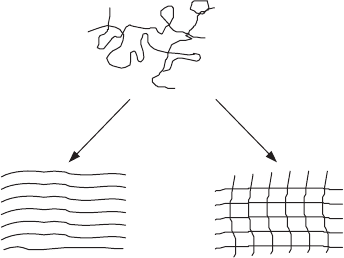
Molecular Orientation. As shown in Figure 6, this in-
volves stretching an unoriented thermoplastic below T
m
(melting temperature) but above T
g
(glass transition
temperature) either uniaxially (in machine direction
only) or biaxially (in both machine and transverse direc-
tions), to induce alignment of polymer chains and then
retain the acquired molecular structure thereafter, for the
purpose of achieving better optical, mechanical, barrier, or
other properties. The oriented films have a tendency to
shrink with heating and are used for shrink packaging.
When dimensional stability is required, the oriented film
is heated even more to relax or set the structure.
Stretching of thermoplastics to induce molecular orien-
tation typically occurs in processes such as blown film
extrusion, injection stretch blow molding, and cast film
extrusion (when a tenter frame is used). Molecular orien-
tation is achieved with proper control of temperature and
rate of stretching to develop and retain the desirable
molecular orientation.
STYRENE–BUTADIENE COPOLYMERS
D. L. HARTSOCK
Phillips 66 Company,
Houston, Texas
Updated by Staff
INTRODUCTION
The styrene–butadiene copolymers (SB) that are suitable
for packaging applications are those resinous block copo-
lymers that typically contain a greater proportion of
styrene than butadiene and that are predominantly poly-
modal with respect to molecular weight distribution.
These copolymers, produced by solution polymerization
processes using sequential multiple additions of an orga-
nolithium initiator, styrene, and butadiene (1, 2), are
amorphous in nature and transparent. Compared to other
transparent styrenic polymers (e.g., general-purpose poly-
styrene and styrene–acrylonitrile copolymers), the styr-
ene–butadiene copolymers offer outstanding shatter
resistance (3). Physical properties are dependent on mo-
lecular weight distribution, styrene:butadiene ratio, and
the nature of the block structure. Since all three of these
parameters are a function of the polymerization recipe,
grades having different properties can be produced:
Grades tailored for injection molding (see Injection mold-
ing) and for extrusion. (see Extrusion) are commercially
available (see Table 1). Current producers are listed in
Table 2.
APPLICATIONS
One of the major applications for SB is single-service cups
and lids, but a combination of good mechanical and visual
properties, low density compared to other transparent
Unoriented polymer chains
Uniaxial orientation Biaxial orientation
Stretching in machine
direction only
Stretching in both machine
and transverse directions
Figure 6. Stretching polymer chains to induce molecular
orientation.
STYRENE–BUTADIENE COPOLYMERS 1169

polymers, and ease of fabrication by the typical molding
and extrusion techniques make styrene–butadiene copo-
lymers a good choice for many packaging applications.
These include bottles and jars, hinge boxes (ball-and-
socket or integral-living hinges) (see Boxes, rigid plastic),
tubs and lids, blisters, medical devices, packaging, and
many film applications (see Carded packaging; Films,
plastic).
Styrene–butadiene copolymers are often blended with
other polymers. If transparency is a requirement, the
blending polymer must have a refractive index very near
that of the styrene–butadiene copolymer. This includes
styrenic polymers such as general-purpose polystyrene
(GPPS) (see Polystyrene), styrene–acrylonitrile copoly-
mers (SAN) (see Nitrile polymers), and styrene–methyl
methacrylate copolymers (SMMA). GPPS is used exten-
sively as a blending polymer for applications requiring
sheet extrusion and thermoforming (see Thermoforming)
(e.g., carded packaging). Blends with SAN or SMMA are
mainly used for injection molded applications (e.g., hinged
boxes, videocassette cases). The impact strength of SBR
can be either enhanced or reduced when blended with
other styrenic polymers. For example, a significant loss of
impact strength occurs with the addition of even low levels
of GPPS. In contrast, certain blends of SBR and SMMA
have synergistic impact strength. Therefore, the suitable
blend ratio for a given application depends on the required
combination of stiffness, toughness, and economics. Blend
ratios typically range from 40:60 to 80:20 SB: styrenic
polymer. If clarity is not a requirement, blends with
polymers such as high-impact polystyrene (HIPS), poly-
propylene (PP), and polycarbonate (PC) can provide sy-
nergistic enhancement of certain physical properties,
unusual aesthetics such as gloss and pearlescence, or
reduced cost. Bottles and jars can be produced from
nonblended SB by extrusion or injection blow molding
(see Blow molding). Blown and cast films can be produced
from nonblended SBR or blends of SBR/GPPS.
SPECIFICATIONS
Some U.S.-produced styrene–butadiene resinous copoly-
mers meet FDA specifications (CFR 177.1640). Finaclear
complies with European 89/109/EC and FDA require-
ments (4) Styroflex also has FDA food clearance. Certain
grades are fully documented to qualify for U.S. Pharma-
copoeia Class VI-50 medical applications and blood con-
tact uses, and they have been shown to be nonmutagenic,
nonirritants to sensitive tissues, and nondestructive to
living cells. In view of these qualifications and because
they can be sterilized by both gamma irradiation and
ethylene oxide (ETO) procedures, these copolymers are
widely used in medical packaging applications.
TOXICITY
Most significant environmental issues with respect to
styrene–butadiene copolymers relate to the manufac-
tuirng process, taste and odor issues in end-use, and solid
waste in final disposal of these polymers. Manufacturing
process issues relate to industrial hygiene, exposure, and
volatile organic emissions. In end-use, block copolyer/
polystyrene blends tend to have taste and odor issues,
especially sensitive in food packaging applications (5). As
with most hydrocarbon-based polymers, SBs burn under
the right conditions of heat and oxygen supply. Combus-
tion products of any hydrocarbon based material should be
considered toxic.
BIBLIOGRAPHY
D. L. Hartsock, ‘‘Styrene–Butadiene Copolymers’’ in The Wiley
Encyclopedia of Packaging, 2nd edition, John Wiley & Sons,
New York, 1997, pp. 863–864.
Cited Publications
1. A. G. Kitchen and F. J. Szalla, U.S. Patent 3,639,517 (to Phillips
Petroleum Company), February 1, 1972.
2. A. G. Kitchen, U.S. Patent 4,091,053 (to Phillips Petroleum
Company), May 23, 1978.
3. L. M. Fodor, A. G. Kitchen, and C. C. Baird, ‘‘K-Resin BDS
Polymer: A New Clear Impact-Resistant Polystyrene in New
Industrial Polymers, ACS Symposium Series 4, D. Deanin, ed.,
American Chemical Society, Washington, DC, 1972, pp. 37–48.
4. Finaclear 521-SBC Technical Data Sheet, Total Petrochem-
icals, Belgium, www.totalpetrochemicals.com, accessed July
2008.
Table 1. Styrene–Butadiene Copolymer Physical
Properties
Process
Injection
Molding and
Extrusion
Injection
Molding
Specific gravity 1.01 1.01
Flow rate, condition
G, g/10 min
7.5 8.0
Tensile yield strength,
psi (MPa)
3700 (26) 4400 (30)
Elongation, % 160 20
Flexural yield strength,
psi (MPa)
4900 (34) 6400 (44)
Flexural modulus, psi (MPa) 205,000 (1413) 215,000 (1483)
Hardness, shore D 75 75
Heat-deflection temperature,
264 psi (1.8 MPa), 1F(1C)
163 (73) 170 (77)
Vicat softening point, 1F(1C) 188 (87) 200 (93)
Light transmission, % 90 90
Table 2. Producers of Styrene–Butadiene Resinous
Copolymers
Company Location Tradename
Chevron Phillips United States K-Resin
BASF Germany Styrolux
Denka-Kaguku Japan Clearene
Total Petrochemicals Belgium Finaclear
1170 STYRENE–BUTADIENE COPOLYMERS
5. M. Demirors, ‘‘Styrene–Butadiene Copolymers’’ in The Ency-
clopedia of Polymer Science and Technology, John Wiley &
Hoboken, NJ, 2001.
SUPPLY CHAIN ENGINEERING
H. H. SCHUENEMAN
San Jose State University,
San Jose, California
The globalization of the world economy started in earnest
in the last half of the 20th Century and has had profound
effects on the distribution of the world’s goods. In parti-
cular, most manufacturing has exited technologically ad-
vanced countries, largely in the West, and has relocated to
countries with large pools of inexpensive labor. Most of
these countries were physically removed up to half a world
away from the primary markets for the goods they were
now producing. To make this situation viable, efficient
logistics, distribution, shipment, and supply chain man-
agement are absolutely essential.
To understand the situation better, it is helpful to
define the primary terms, including packaging, logistics,
and supply chain management.
P ackaging , in the context used here, implies a protective
device designed and tested to provide physical protection,
containment, identification of the contents, and utility dur-
ing the distribution and storage process. Physical protection
is provided primarily by cushion materials to prevent
damage from impact and vibration, which are common
during distribution, and polymeric films for moisture and
dust protection. For containment, corrugated containers
provide an inexpensive method to contain the product and
its associated pieces and parts . The same container or box
easily can be printed to provide the identification of the
contents in both readable format and scannable or machine-
read format. The same shipping container also provides
utility primarily in the means to stack the product on pallets
or in warehouses without product damage.
It must also be recognized that the product and pack-
age system must work together to survive the often harsh
and harmful elements of the physical distribution envir-
onment. This cooperation is a natural outcome of the
systems approach for efficient and safe product protection
during delivery. The concept holds that it may be much
more feasible, from a cost standpoint, to ruggedize a
product than to design and purchase an overly expensive
package system to protect a physically weak product.
Often, the cost trade-off of these two options favors
product ruggedization over expensive protective packa-
ging. Remember also that packaging is an expense and
rarely adds to the value of the product as it is normally
discarded after safe product delivery. When the product/
package systems approach is used effectively, delivered
cost is normally minimized and customer satisfaction is
normally maximized.
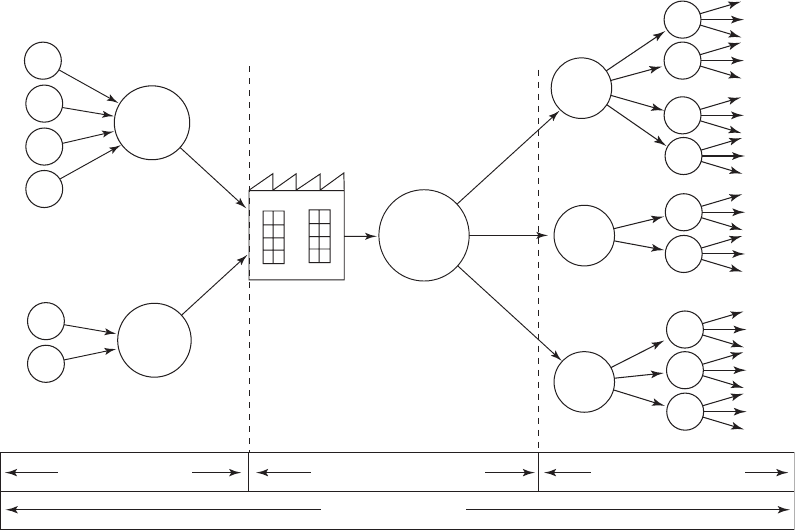
Logistics defines the entire process of materials
and products moving into, through, and out of the firm.
This process is often broken down into inbound logi-
stics, materials management, and physical distribution
Raw materials,
parts, and
components
Initial
processing
or creation of
subassemblies
Distribution
to warehouses
and wholesalers
Retailers
Factory
Finished
goods
inventory
C
u
s
t
o
m
e
r
s
Inbound logistics Materials management Physical distribution
Business logistics
Figure 1. Typical logistics concept diagram. Source: (1) Contemporary Logistics.
SUPPLY CHAIN ENGINEERING 1171
(see Figure 1). The Council of Logistics Management
(CLM) defines logistics as ‘‘a process of planning, imple-
menting, and controlling the efficient, effective flow and
storage of goods, services, and related information from
the point of origin to the point of consumption for the
purpose of conforming to customer requirements.’’ The
word logistics was first associated with the military and is
attributed to Major Chauncey B. Baker, who described it
as ‘‘the art of war pertaining to the movement and supply
of armies.’’
Most authors today believe that logistics is a much
broader concept that includes functions such as demand
forecasting, documentation flow, interplant movements,
inventory management, order management and proces-
sing, packaging, production scheduling, purchasing, traf-
fic management, and recycling. A popular concept in
logistics management occurred in the 1980s with the
introduction of just-in-time (JIT) delivery. This concept
held that total cost could be minimized by reducing the
size of component inventory at the manufacturing location
to the absolute minimum, which is typically enough for
one shift. Although other costs such as transportation
likely would increase because of this concept, total cost
could be minimized. Although some manufacturing opera-
tions still use this concept, most firms agree that a
balanced approach of cost-effective delivery combined
with prudent warehousing provides the best overall bal-
ance and the least overall costs.
Supply Chain Management (SCM) is a somewhat lar-
ger concept than logistics in that it deals with managing
both the flow of materials and the relationships among the
channel intermediaries from the point of origin of raw
materials through to the final customer. In this context,
supply chain management is essentially an integration of
suppliers, manufacturers, storage facilities, and retail
outlets in such a fashion that products are produced and
distributed in the right quantities, in the proper locations,
at the correct time, to minimize costs while providing
maximum customer satisfaction (illustrated in Figure 2).
The concept of supply chain management reached
maturity at a rapid rate when the global distribution of
goods demanded an efficient system to handle all of the
various processes necessary for supplying worldwide mar-
kets from distant production sources. The systems ap-
proach was the concept that made the whole process work.
In times past, the transportation manager would try to
minimize transportation costs while the packaging engi-
neer would try to minimize packaging costs and the
warehouse supervisor would try to minimize costs by
stacking containers higher, for example. The systems
approach, by contrast, attempted to look at the total cost
of the finished product safely delivered to the customer.
Thus, it could be possible for higher transportation costs to
result in even greater savings in packaging, which would
result in net cost savings to the firm.
WELL-DESIGNED PACKAGING IS THE KEY TO EFFECTIVE
LOGISTICS
For both incoming raw materials and outgoing finished
products, the key to effective logistics is always efficient
cube use during transportation and warehousing. In
the globalized economy, long-distance shipping is com-
monplace. This shipping often uses ocean-going contain-
ers or similar structures with defined interior dimensions.
Whether or not the distribution cycle uses ships on the
ocean, it is very likely that the most efficient manner for
shipment is to use as much of the interior cube of the
container as possible. For most products and shipping
situations, the cube of the container is maximized long
before the allowable weight limits are reached. With few
exceptions, the cost for shipping a loaded container is
normally fixed up to its maximum weight limit. Thus,
Suppliers
Manufacturers
Warehouses and
distribution centers
Customers
Inventory costs
Transportation costs
Manufacturing costs
Transportation costs
Material costs
Figure 2. Typical SCM concept dia-
gram. Source: (2): Designing &
Managing the Supply Chain.
1172 SUPPLY CHAIN ENGINEERING
if 10% more raw materials or finished goods can be placed
into a shipping container, the cost for those additional
items is essentially free, and thus, the overall transporta-
tion efficiency is greatly increased.
Historically, most of the elements of logistics have been
well optimized in most distribution cycles. That is to say, if
demand forecasting, purchasing, packaging, or production
scheduling were improved by 10%, then the results may be
gratifying but probably not overly significant cost wise. If,
however, delivered transportation costs were lowered by
10% because of more compact product design and packa-
ging, then the results would be both gratifying and
significant cost wise.
Recently, the manufacturer of computer peripheral
equipment started removing products from pallets and
placing them on slip sheets prior to loading them into
ocean-going containers. Those customers who demanded
products on pallets at the receiving end then would have
their products re-palletized at the end of the distribution
cycle. This process resulted in an increase of approxi-
mately 12% in cube use on ocean-going containers. The
cost savings were in the multimillion-dollar range.
For many consumer products distributed globally, the
cost of delivery can exceed the cost of the product, some-
times by a factor of two or more. This expense indicates
that cost reducing the product by 10%, for example, would
not result in substantial savings, whereas increasing
distribution efficiency by 10% would result in much
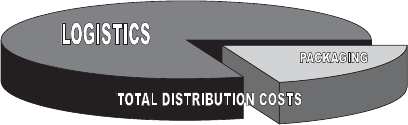
more significant cost reductions. A study conducted by
a well-known electronics firm concluded that packaging
materials made up less than 20% of the total delivery
cost for their products. Logistics made up 80% or more
(illustrated in Figure 3). It doesn’t take a genius to
figure out where they spent most of their cost-reduction
efforts.
Commercially available software often is used to deter-
mine the exact shape and configuration of product/pack-
age systems that fit most efficiently and maximize cube
use during distribution. Information from these programs
can be best used by close cooperation between product
design and package design functions. For example, trade-
offs between product ruggedness and package cushion
thickness can be easily quantified in terms of delivery
cost and, thus, can be weighed against the anticipated cost
of the necessary product ruggedization to achieve this
efficiency level. Sadly, this type of close cooperation be-
tween product and package design functions is the excep-
tion rather than the rule.
The bottom line is that smart product/package system
design is the key element to cost effective logistics through
efficient cube use during storage and distribution.
LOGISTICS IS THE KEY ELEMENT IN SUPPLY CHAIN
MANAGEMENT
Supply chain management, in all its various forms, always
requires the smooth and efficient flow of goods, materials,
and information throughout a normally complex network.
Goods and materials will always move more efficiently
and effectively throughout this process if they are pack-
aged and unitized in a fashion that makes them easy to
handle, identify, store, and ship. Unitization by means of
pallets is the most popular method, although other uni-
tization methods such as slip sheets and clamp loads are
gaining popularity.
The important point is that good logistics will enhance
supply chain management, and some authors even sug-
gest that good logistics makes supply chain management
actually work. However, poor logistics or even insufficient
attention to logistic requirements in the supply chain will
cause disruptions and inefficiencies that may lead to total
abandonment of the supply chain concept. The more
globalized companies’ operations are, the more dependent
they are on efficient logistics to make supply chain man-
agement a viable concept. All of these factors are a
recognition of the fact that transportation and distribution
costs are a very high percentage of the total cost of
producing a product. This issue was not the case a gen-
eration ago but is certainly very true today. The near
future promises more of the same as companies strive to
take advantage of cost-effective production in more remote
parts of the world. As these production sites become more
and more remote, the critical value of good packaging,
logistics, and supply chain management becomes more
apparent.
PRODUCT/PACKAGE SYNERGY
At this point, it is clear that logistics is the key element in
good supply chain management and that packaging is the
key element in good logistics. Thus, it would seem that the
global distribution of goods is highly dependent on effi-
cient and effective (smart) packaging. As is often the case,
packaging is one of the last elements to be recognized as
important or crucial in this area. But the simple fact
remains that, without smart packaging, the global dis-
tribution of goods, and therefore, our current lifestyle
would be impossible.
Typical elements that go into a product design focus
would include things like product aesthetics, safety, func-
tionality, weight, dimensions, materials, and many other
considerations. Rarely, if ever, is the idea upheld that
efficient distribution is one of the key elements in a
successful design for globally distributed products. How-
ever, the lessons of global logistics tell us that the trans-
portation and storage costs may be the largest cost item in
the entire product. What product designer in his or her
right mind would ever consider designing a product with-
out paying close attention to the largest cost item in the
product? Yet, that is almost exactly what happens over
and over again when the cost of distribution is ignored.
80%
20%
Figure 3. Total distribution cost.
SUPPLY CHAIN ENGINEERING 1173
Several forward-thinking companies have examined
this topic and have determined that efficient product
distribution is one of the primary determinants of the
actual product dimensions. If changing the dimensions
of a product by a relatively small amount will yield a
potentially large savings in distribution costs, then smart
companies change product dimensions and use the
savings to help increase their competitive advantage.
The companies that ignore this—simple, but vital—prin-
ciple are doomed to higher costs and competitive disad-
vantage throughout the entire lifecycle of the product.
In addition, this spiral will only increase in intensity as
fuel costs increase because of scarcity, and distribution
cycles get longer because of more remote production
facilities. It is important for companies to determine
the most optimal and efficient dimensions of the product
and package system together before the product is even
conceived.
In conclusion, it has been shown that product and
package synergy is the best possible method to enhance
logistics in the distribution of goods and materials,
primarily through optimum cube utilization. This process,
in turn, results in the greatest efficiency available through
focus on supply chain management throughout the
distribution cycle. Because distribution costs can consti-
tute a major overall cost of the product itself, this ap-
proach will result in the minimization of cost and in the
maximization of efficiency simultaneously. Anyone re-
sponsible for efficient product distribution should pay
close attention to this relatively simple message; optimize
packaging and product/package synergy first. Efficient
logistics and effective supply chain management will
result.
BIBLIOGRAPHY
J. C. Johnson, D. F. Wood, D. Wardlow, and P. R. Murphy Jr.,
Contemporary Logistics, 7th edition, Prentice-Hall, Inc., New
York, 1999.
D. Simchi-Levi, Kaminsky, and E. Simchi-Levi, Designing &
Managing the Supply Chain, 2nd edition, McGraw-Hill
Higher Education, New York, 2003.
Marcondes and Schueneman, Packaging Dynamics in a Global
Economy, unpublished manuscript, 2004.
SUPPLY/DEMAND CHAIN MANAGEMENT
CHRIS DOMINIC
STFI-Packforsk AB, Lund
University, Packaging Logistics,
Stockholm, Sweden
SUPPLY/DEMAND CHAIN MANAGEMENT
Emergent structures in Supply/Demand Chain Manage-
ment (SDCM) are the interaction of logistics activities
leading to material flow, thereby satisfying the consumer’s
demand. The logistics area is rapidly developing to create
individualized value for the consumer as well as a sustain-
able growth for the actors involved in the Supply/Demand
Chain. Ericsson in Waters (1) maintains that creating
customer value has been discussed ever since the 1940s,
but distribution channels are often organized by supply
activities that have resulted in supply push rather then
demand pull. Development in this area has improved with
the implantation of new technologies that have provided
the actors with real-time information that has resulted in
enhanced competitiveness. The use of the information
and communication technology (ICT) has increased the
awareness of the need to satisfy the consumers’ specific
requirements. This development can be also seen in the
packaging area. Packaging is assumed to have a major
influence on logistics in general and on physical distribu-
tion in particular. The packaging plays an active role in
protecting and creating value from when it is filled at the
packer/filler* until the product is emptied by the end-user.
This in logistics terms means that the actors involved in
packaging must play an important and proactive part in
maintaining efficiency in logistics.
The key elements applied in Supply/Demand Chain
(2) are Packaging Logistics and e-logistics. For each of
these constitutive elements, the current theoretical foun-
dation is described below.
The work is done to bridge the theoretical gaps in
Supply/Demand Chain Management. The theories dis-
cussed here are based on the material flow in the distribu-
tion channels as well as on the actor’s point of view.
CONCEPTS APPLIED IN LOGISTICS
Logistics can be an array of activities generating a physi-
cal flow of supplies from the refiners of material through
to the packaging supplier, the packer/filler, and distribu-
tor and all the way to the end-users (i.e., consumers).
Postconsumption and reverse logistics activities are also
considered. The logistics activities are driven by aggre-
gated demands generated by the consumers. The demands
(end-user information) flow in a direction opposite to the
physical flow. Frohlich and Westbrook (3) have divided the
concept of integration into the integration of supply and
demand. The demand data from the consumer is the
driving force for planning, production, packing/filling,
distribution, storing, and sales. Also, post-sales activities
regarding packaging are also included here.
DISTRIBUTION CHANNEL
The distribution channel is undergoing changes; new
techniques (e.g., e-business) have an influence on the
design of packaging (4). The development toward control-
ling the customers’ inventory solutions are growing. The
concept of Vendor Managed Inventory (VMI) is used to
integrate a cross-functional process by allowing, for
* A company that takes empty packaging and then packs or fills it
with products.
1174 SUPPLY/DEMAND CHAIN MANAGEMENT
example, the packaging suppliers to own that part of the
process that has traditionally belonged to the customer.
Many authors [e.g., Waller et al. ((5), p. 186)] stress that
VMI can lead to better planning and help to bridge the
information gaps and contribute to forward integration
with the actors in the distribution channels. These devel-
opments can also be seen in the packaging area where the
packaging actor is using, for example, Shelf-Ready Packa-
ging (SRP) and Retail-Ready Packaging (RRP) concepts
presented by ECR Europe (6). According to Greaver (7),
there is an increasing amount of subcontractors who
deliver certain functions, services, or parts of the produc-
tion process externally, instead of the company carrying
out these tasks internally. Dominic (8) has identified
packing services, storage, and distribution as examples
of services with which some major packaging suppliers are
familiar and that have served as natural links in the
distribution channel.
For backward integration, many actors have started to
look into the theories of reverse logistics (9), which is a
physical flow moving in the most efficient and cost-effec-
tive way possible. In an ideal world, the logistics flow goes
in the direction towards the consumer. However, as the
world we work in is not ideal, packages often have to move
against the stream in the flow.
Processes related to these activities, which companies
have contracted to carry out, are often regarded as un-
wanted and resource demanding. Here the greatest pro-
blem is the lack of good information systems capable of
handling the reverse logistics functions.
PACKAGING LOGISTICS
The subject of Packaging Logistics is defined as an
approach with the purpose of developing packaging and
packaging systems
w
that support the logistics process and
meet customer demands. In logistics, a well-functioning
packaging system creates time, place, form, and owner-
ship benefits in the product in relation to the customer—
that is, an undamaged product in an easy-to-handle
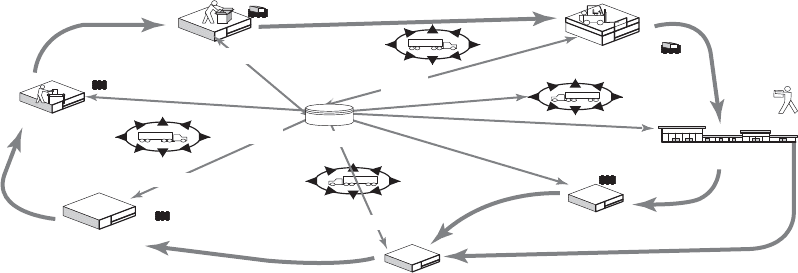
package which is easily disposed of. Figure 1 illustrates
packaging logistics activities and the actors involved.
Dominic (8) has identified the actor Network Integrator
(plotted in the middle), who plays the role in integrating
the supply flow and with the demand flow.
Packaging systems can be either one-way or reusable.
Reusable packaging is collected at a centralized return
handling central (CRC), where it is cleaned, stocked, and
distributed for refilling. The used packaging is shipped for
waste management.
THE PACKAGING AND THE ACTOR
A package should be designed to provide optimal efficiency
in storage, sales, and subsequent waste management.
Good packaging affects material, handling in terms of
load stability, stackability, and compatibility with differ-
ent forms of mechanization and automation. The choice of
a packaging system is a complicated task, and it should be
based on market considerations, actors involved in the
process logistics, and environmental requirements. Small
changes in a packaging system affect the distribution
channel in many different ways. In general, the following
factors are involved (10, 11): product protection, available
packaging technology and functionality, economics and
costs, marketing considerations, product properties, en-
vironmental considerations, legal constraints, and infor-
mation transfer. Normally, the package properties are
adapted to the product, but sometimes the product proper-
ties are modified in order to facilitate more practical
packing/filling. Packaging is also important for shippers
and for materials managers who are closely tied to func-
tions dealing with warehouse and transportation effi-
ciency. Good packaging can have a positive impact on
layout and design and overall warehouse productivity.
With the need for a holistic approach and a trend toward
longer and more complex Supply/Demand Chain, a
method called Packaging Scorecard (PSC) (12) is intro-
duced in Packaging Logistics. PSC helps to evaluate the
performance of the packaging system in the SDC and to
reduce packaging waste. Lately, the concepts of PSC are
widely used by the distributor and in retail.
The role of a packaging supplier in logistics is often
limited to interaction with the packer/filler in the distri-
bution channel. The nearest interface for the packaging
Centralised returnable
centres (CRC)
Distribution
Empty packaging
Material manufacturer
Point of sale
Material converter
Consume
r
Waste mana
g
ement
Product filler/packer
Filled packaging
Filled packaging
Empty packaging
Network Integrator
Figure 1. Activities in packaging logistics.
w
The packaging system is based on four identified levels: primary,
secondary, tertiary, and load carrier.
SUPPLY/DEMAND CHAIN MANAGEMENT 1175
supplier in the distribution channel is with the packer/
filler. Today, packaging suppliers are challenged to de-
velop solutions aimed at both commercial and logistical
upgrading throughout the flow. The packaging suppliers
should aim at looking beyond the immediate users of
packaging (8). They have to anticipate and integrate the
specific demands of subsequent distribution phases such
as retail and logistics management through to the con-
sumer. They also have to minimize the use of hazardous
substances and ensure the environment-friendly disposal
of the packaging after use.
e-LOGISTICS
According to Ericsson (13) e-logistics has been the natural
development in the subject of logistics in the past few
years. Information and Communication Technology (ICT)
is one of the legs of e-logistics which bridges the inter-
organizational gaps. The second leg is traditional logistics
comprising material management, warehousing, trans-
port, and Just-In-Time theories. Business processes is
the third leg, where the actors in logistics play an im-
portant part in creating efficiency in the distribution
channel.
Together with ICT, packaging can play an active part in
e-logistics by integrating the three legs. By increasing
knowledge in packaging logistics and adapting to new
technologies, the actors in packaging can increase logistics
efficiency and add value for their customers.
DISCUSSIONS
During the 1990s the Supply Chain Management concept
noticeably started to spread broadly. The physical flow in a
Supply Chain (SC) composed of a number of companies,
buyers, and sellers, who communicate directly with the
nearest actor is forward for sales and backward for
purchases. The relations often consist of finding a partner
who can offer the right product price and, in an estab-
lished cooperation, share information about logistics is-
sues including stock levels, delivery, and product
development issues. The relations are based on the crea-
tion of contact between two individuals, namely, a seller
and a buyer.
Information about consumer requirements passes from
the point of sale via the distribution to the packer/filler
and then to the packaging supplier. This puts an emphasis
on relevant information being brought from the packer/
filler to the packaging producers. The process is further
complicated when several enterprises are involved in the
flow. Betts and Heinrich (14) give an example of how ‘‘ICT-
fication’’ can be used to create adaptations. ICT-fication
means that electronic aids give access to the customer’s
and sometimes the flow’s database and consumer
demands.
The development in ICT-fication has reorganized the
distribution channels, which are becoming increasingly
nonstatic in order for companies to gain a competitive
edge. Instead of developing specialized departments in
companies, one could outsource the value-creating activ-
ities and focus on the core business. The basis of Supply
Chain Management is to command and have control over
value-creating activities. According to Ericsson (13), Sup-
ply Chain (SC) is a supply push construction rather than a
construction driven by demand-pull conditions. In tradi-
tional SC, the focus is on the physical flow resources. ICT
is used as a tool for the individual companies to help them
fulfill their tasks, and non-interorganizational functions
will lead to inefficiencies. For example, a package moving
from the supplier of packaging to the packer/filler and
then to the point of sale involves arms-length transac-
tions, leaving gaps between the actors involved in the
distribution channel. When there are many competing,
parallel distribution channels, the system will become
demand-driven, which should not be mistaken for a
demand chain (DC). A DC is largely about managing the
information flow. The driving force is information rather
than the actual physical flow. The goal is to substitute the
information for inventory among the actors involved in
the flow. Here, as mentioned above, a new actor called
Network Integrator (8) enters the marketplace with
the function of integrating the information flow and the
physical flow. This development can be adapted to packa-
ging theory by introducing packaging integration, and the
actor involved is the Packaging Integrator.
BRIDGING THE GAPS IN LOGISTICS THEORIES
In this article, the concepts of packaging logistics and
e-logistics create an interesting logical element for creat-
ing efficiency in logistics. The theory of Supply/Demand
Chain Management is supporting the concept of demand-
pull. There is relatively modest research supporting the
packaging suppliers’ roles in the logistics. But the work
done in the field of Supply/Demand Chain Management
adds the theory of Packaging Logistics as an important
element that will create efficiency in logistics.
In conclusion, this work looks for answers in the
literature to the questions of how the packaging suppliers
can contribute in logistics to create efficiency and how the
theoretical discussion about Network Integration can
contribute to develop the logistics theory.
BIBLIOGRAPHY
1. D. Waters, Supply Global Logistics and Distribution Plan-
ning: Strategies for Management, Kogan Page, London, 2003.
2. C. Dominic, ‘‘Integrating Packaging Suppliers into the Sup-
ply/Demand Chain,’’ Packag. Technol. Sci. 18, 151–160, 2005,
DOI: 10.1002/pts.684.
3. M. T. Frohlich and R. Westbrook, ‘‘Demand Chain Manage-
ment in Manufacturing and Services: Web-Based Integration,
Drivers and Performance,’’ J. Oper. Manag. 20(6), November
2002, pp. 729–745(17).
4. P. Schary and T. Skjott-Larsen, Managing the Global Supply
Chain, Handelshojskolens Forlag, Ko
¨
penhamn, 2001.
5. M. Waller, M. Eric Johnson, and T. Davis, ‘‘Vendor-Managed
Inventory in the Retail Supply Chain,’’ J. Bus. Logist. 20(1),
183–203 (1999).
1176 SUPPLY/DEMAND CHAIN MANAGEMENT
6. X. Hua and B. Fradin, Shelf Ready Packaging (Retail Ready
Packaging), www.ecrnet.org/04-publications/blue_books/srp/
ecreurope_srp_bluebook_executive_summary.pdf (read 2008-
02-20).
7. M. Greaver, Strategic Outsourcing: A Structured Approach to
Outsourcing Decisions and Initiatives, AMACOM, New York,
1999.
8. C. Dominic, Packaging Networks—a framework for Integrat-
ing packaging Suppliers in the Demand Chain, Studentlitter-
atur, Lund, 2006, pp. 13–21.
9. D. Rogers and R. Tibben-Lembke, Going Backwards: Reverse
Logistics Trends and Practices, RLEC Press, Pittsburgh, PA,
1999.
10. C. Dominic, K. Johansson, A. Lorentzon, C. Olsmats, L.
Tiliander, and Westro
¨
m, P. Fo
¨
rpackningslogistik — 2: A
Utga
˚
van, Packforsk, Kista, 2000.
11. D. M. Lambert, M. C. Cooper, and J. D. Pagh, Supply Chain
Management: Implementation Issues and Research Opportu-
nities, Int. J. Logist. Manag. 9(2), 1–19 (1998).
12. C. Dominic and C. Olsmats, Packaging Scorecard – A Method
to Evaluate Packaging Contribution in the Supply Chain,
Packforsk research report No 200, Kista. ISSN 1402-5809.
13. D. Ericsson, in C.D.J. Waters, ed., Supply/Demand Chain
Management—the Next Frontier for Competitiveness in Glo-
bal Logistics and Distribution Planning, Kogan Page, Lon-
don, 2003.
14. B. Betts and C. Heinrich, Adapt or Die: Turning Your Supply
Chain into an Adaptive Business Network, John Wiley &
Sons, New York, 2003.
SUSTAINABLE PACKAGING
ANNE JOHNSON
Sustainable Packaging
Coalition, Charlottesville,
Virginia
INTRODUCTION TO SUSTAINABILITY
Sustainability is a systems concept that is simple common
sense. We need a healthy planet to provide resources for
our basic needs and to support the needs of our economies.
People need robust commerce for employment and require
a healthy and productive environment in which to live.
Effective economies need healthy employees to work and
stable societies in which to operate.
For millennia, our planet has provided the material
resources that both societies and business require. We are
entering an unprecedented era where the demands of
humanity exceed the biocapacity of the planet, and in a
short hundred years we have depleted finite geological oil
resources on which we have grown to depend. Through the
mounting evidence in the form of global changes like
climate change, we are receiving clear signals that the
cumulative impacts of mankind are leaving a swath of
unintended environmental consequences. Our current
industrial and consumptive practices are leaving a tragic
legacy of degraded and limited resources for future
generations.
In 1987, the UN World Commission on Environment
and Development issued a report entitled Our Common
Future that established a definition for sustainable devel-
opment. This definition is commonly used for what is
now referred to as simply sustainability: ‘‘Development
that meets the needs of the present without compromising
the ability of future generations to meet their own
needs.’’ (1) The principles elucidated in this statement
strive to balance the demands of society and the produc-
tion of goods and services with consideration for the
environment.
In 2007, it is clear that sustainability is hitting the
mainstream. For 15 years or more, a handful of leading
CEOs and companies have recognized the leading indica-
tors of a shifting business climate and started to consider
how the future might impact their businesses. To these
companies, many of whom are global brands, the concepts
implicit in the term ‘‘sustainable development’’ have taken
on greater meaning and bottom-line significance as sus-
tainability has attracted widespread consideration.
Globalization, demand for accountability and transpar-
ency, rising energy prices, and escalating environmental
degradation are just some of the issues driving interest in
sustainability on the part of business and advocacy
groups. With the entrance of Wal-Mart into the arena in
2005, along with the announcement of the company’s
sustainable packaging initiative, sustainability is cur-
rently impacting almost all businesses in the packaging
value chain.
While packaging is often not the overwhelming con-
tributor to an environmental footprint compared to a
product, it does have a uniquely personal relationship to
consumers. When the product is gone, consumers are often
left with the packaging and need to figure out what to do
with it. For this reason, along with the fact that it
represents a significant use of materials and resources,
places a burden on communities, and is a very visible
source of waste or litter, packaging ranks high on corpo-
rate sustainability agendas.
It is clear that careful stewardship of the planet and its
resources are essential for a sustainable future for society
and business. Sustainability represents a tremendous de-
sign opportunity—that is, to design chemicals, materials,
products, buildings, cities, transportation, and packaging
systems that contribute meaningfully to a positive, sus-
tainable future.
One of the sustainability frameworks that has proved
valuable for envisioning sustainable material systems is
the language of cradle to cradle design found in the book
Cradle to Cradle: Remaking the Way We Make Things by
William McDonough and Michael Braungart (2). In Cra-
dle to Cradle, McDonough and Braungart ask us to
imagine industrial systems modeled on the effectiveness
of natural ecosystems. Cradle-to-cradle design envisions a
world powered by the sun where growth is good, waste is
nutritious, and productive diversity enriches human and
natural communities.
The application of cradle-to-cradle design creates an
opportunity to cycle industrial materials in a sustainable
SUSTAINABLE PACKAGING 1177