
Yam, Kit L. (ed.). The Wiley encyclopedia of packaging technology
Подождите немного. Документ загружается.

way. Each material in a product is designed to be safe and
effective, as well as to provide quality resources for sub-
sequent generations of products. Like the earth’s nutrient
cycles, the flow of materials eliminates the concept of
waste.
THE DEFINITION OF SUSTAINABLE PACKAGING
A formal definition of sustainable packaging is needed to
provide a common platform of understanding against
which the packaging supply chain can measure their
efforts. This was the objective of articulating the ‘‘Defini-
tion of Sustainable Packaging,’’ released in October 2005
by the Sustainable Packaging Coalition. The Sustainable
Packaging Coalition, a project of GreenBlue, is an indus-
try working group dedicated to creating a more robust
environmental vision of packaging. Drawing on funda-
mental eco-efficiency concepts and sustainability princi-
ples articulated by cradle to cradle, the definition outlines
a framework for sustainability in the context of packaging
and its related materials systems.
Encompassing the entire life cycle of packaging and
more, the definition presents a vision for the packaging
industry in eight criteria—all of which must be addressed
if sustainable packaging is to become a reality. The
definition is ambitious and comprehensive. It presents a
challenge to the status quo while offering guidance to
identify opportunities and strategies to move forward.
Sustainable packaging (3) has the following char-
acteristics:
A. It is beneficial, safe, and healthy for individuals and
communities throughout its life cycle.
B. It meets market criteria for performance and cost.
C. It is sourced, manufactured, transported, and re-
cycled using renewable energy.
D. It maximizes the use of renewable or recycled
source materials.
E. It is manufactured using clean production technol-
ogies and best practices.
F. It is made from materials healthy in all probable
end-of-life scenarios.
G. It is physically designed to optimize materials and
energy.
H. It is effectively recovered and utilized in biological
and/or industrial cradle to cradle cycles.
A. Beneficial, Safe, and Healthy for Individuals and
Communities Throughout Its Life Cycle
In addition to profitability, social equity and the environ-
ment are growing areas of corporate focus. As part of
globalization, companies are expanding operations and
increasingly are held accountable for actions resulting in
negative social or environmental consequences. The emer-
gence of the corporate social responsibility reporting
reflects the growing focus on corporate citizenship, ac-
countability, and transparency.
The global packaging industry is conservatively esti-
mated at $417 billion and employs more than five million
people all over the world (4). The benefits of packaging to
individuals and communities vary from (a) the creation of
meaningful, stable employment to (b) the protection, pre-
servation, safety, and transport of products and foodstuffs.
Packaging allows key marketing and product differentia-
tion and educates and informs the consumer. At the same
time, the procurement, production, transport, and dispo-
sal of packaging can have negative consequences for both
the environment and societies around the globe. Through
intelligent packaging and system design, it is possible to
‘‘design out’’ the potential negative impact of packaging on
the environment and societies.
Cradle-to-cradle principles offer strategies to improve
the material health of packaging and close the loop on
packaging materials, including the creation of economically
viable recovery systems that effectively eliminate waste.
These strategies support communities through the creation
of gainful employment and improvements to the environ-
ment. Corporate social responsibility, accountability, and
equitable wages are all part of creating a sustainable
system.
B. Meets Market Criteria for Performance and Cost
Economic growth and prosperity are essential components
of sustainable development. The United Nations esti-
mates that the population of the planet will grow from
6.4 billion in 2005 to 9.0 billion by 2050, roughly a 40%
increase in global population (5). An efficient and produc-
tive industry engaged in truly sustainable practices is
essential to meet the increasing demand for goods and
resources that this growth implies. Historically, increased
packaging use has accompanied economic growth. A goal
of sustainable packaging is to facilitate economic growth
by delivering benefits of packaging without the negative
impacts associated with traditional packaging designs.
Ongoing profitability is a fundamental element of sus-
tainable business practice. Managing the cost of packaging
procurement, production, and product delivery with the
desired functionality and appearance is fundamental to a
profitable business. The true cost of packaging is becoming
more complicated as costs that have traditionally been
borne by society (e.g., disposal) are being redirected to
producers through legislation and levies. Sustainable
packaging design considers the full life cycle of the pack-
age, recognizes the principle of Shared Product Responsi-
bility (6), and consequently seeks to minimize the total
packaging system cost through efficient and safe package
life cycle design.
Sustainable
packaging initiatives offer
multiple strate-
gies to meet and even exceed market criteria for perfor-
mance and cost, including improved package design,
resource optimization, enhanced material selection, and
source reduction (7). Education of business colleagues,
suppliers, consumers, and regulators is also an important
vehicle to connect a sustainable packaging strategy to
existing market needs.
Collaboration across the packaging supply chain facil-
itates understanding, helps identify opportunities to im-
prove materials and packaging systems, and enables
sustainable alternatives to be developed with zero or little
1178 SUSTAINABLE PACKAGING
additional cost. Experience from other sectors that are
beginning to embrace the principles of sustainable busi-
ness indicates that improvements in product quality and
profitability are often realized. Other benefits of sustain-
able packaging include (a) brand enhancement and new
sources of materials made available through reuse and (b)
mechanical and chemical recycling.
Innovative new packaging materials from renewable
resources and advances in recovery/recycling systems,
while still on the horizon for many materials, are actively
being used in other parts of the world. While there may be
costs associated with the transition to new packaging
materials or recovery strategies, there also will be savings.
Experience has shown that some of these direct savings
could include reduced regulatory and tipping fees and
reduced environmental management costs.
C. Sourced, Manufactured, Transported, and Recycled
Using Renewable Energy
The wide-scale use of fossil fuels as the primary source of
energy is the principal factor contributing to many local,
regional, and global pollution issues including climate
change, acidification, ozone depletion, mercury buildup,
photochemical ozone, and particulates. Renewable energy
potentially offers a solution to many of the environmental,
social, and economic issues central to the development of a
sustainable world. The most common types of renewable
energy include solar energy (passive and active), wind
power, hydroelectric energy, biomass (biofuels and bio-
power) energy, tidal energy, and geothermal energy.
Today most packaging materials and conversion pro-
cesses rely on fossil fuel-based energy to a greater or lesser
extent. The transition from fossil fuels to renewable
energy throughout the packaging supply chain will re-
quire changes at many levels over a significant timeline. It
is not possible, in the short to medium term, to migrate all
materials and processes to renewable energy sources; the
limiting step will be the availability of an economic and
sustainable supply of renewable energy.
Companies are beginning to address the need to shift to
renewable energy through a variety of strategies. In the
near term, making fossil fuel-based systems as efficient as
possible is an effective strategy for moving toward sus-
tainability with very real economic and environmental
return. At the same time, there must be a dedicated effort
to diversify the energy mix and build momentum behind
the transition to renewable energy sources. This transi-
tion is being encouraged through the direct investment or
purchase of renewable energy, through carbon credits, or
through tradable renewable allowances (RECS).
Transportation is a significant source of fossil fuel
consumption associated with packaging. Companies ex-
perience direct cost benefit from improving fleet perfor-
mance through optimized distribution or better fuel
efficiency. Companies are also encouraging the use of
bio-based fuels, hybrid vehicles, and other innovative
technologies through internal measures or by acknowl-
edging the efforts of suppliers. These types of activities
help develop markets for renewable energy and offer
alternatives to fossil fuel as strategies toward a more
sustainable energy future.
D. Maximizes the Use of Renewable or Recycled Source
Materials
The use of renewable or recycled materials can contribute
to the creation of sustainable material flows and thus
provide materials for future generations. Using recycled
materials (renewable or nonrenewable) encourages waste
reduction and the conservation of resources. The use of
renewable materials reduces dependence on nonrenew-
able resources, uses current solar income to create raw
materials (greenhouse gas neutral), and encourages sus-
tainable management of resources.
The use of renewable or recycled materials supports the
development of sustainable packaging by improving its
environmental profile and providing a source of future
packaging materials. Yet the physical deterioration of
some materials through mechanical reprocessing (i.e., re-
cycling) currently poses a limit to effective and economic
reutilization of some packaging materials. Under cradle-to-
cradle principles, materials should be recovered through
either biological or industrial cycles or both. Many renew-
able or bio-based materials are suitable for recovery
through either mechanism. Materials from nonrenewable
resources should be recycled. Since the value of these
materials cannot be recovered by natural processes, it
requires a high degree of stewardship throughout their
life cycle to ensure that they are recovered and reused.
Specifiers and designers striving for sustainable packa-
ging should ensure the recyclability of materials, espe-
cially if they are made from nonrenewable resources.
Environmentally preferable procurement and prescriptive
regulations regarding the environmental characteristics
of packaging are expanding and often incorporate recycl-
ability (8) and recycled content requirements.
A key strategy for improving the sustainability of
packaging is maximizing the use of renewable and re-
cycled materials. The availability, performance, and price
of some renewable or recycled materials affect the feasi-
bility of incorporating them into new packaging designs.
Material and technological advances that positively influ-
ence these factors for renewable and recycled materials
can substantially improve the practicality of their use.
The sourcing of recycled materials is closely linked to
end-of-life issues. From experience to date, it is clear that
demand for recycled materials and the creation of market
pull is a key driver for strengthening the recovery and
recycling industry needed to provide them.
Encouraging the use of sustainable management prac-
tices through credible certification systems is an essential
component of specifying renewable materials and an
increasingly common strategy to address concerns asso-
ciated with the production of virgin bio-based packaging
materials
. This tactic
is used currently to address forestry
and agricultural practices. While there is some focus on
the sourcing of nonrenewable resources through clean
production, there is not a comparable set of well-accepted
sustainability practices or certifications directed toward
sourcing nonrenewable resources. Because the extraction
SUSTAINABLE PACKAGING 1179
of both petroleum and mineral resources has great impact,
steps need to be taken to address the sourcing of these
materials.
E. Manufactured Using Clean Production Technologies and
Best Practices
Clean production refers to the continuous application of
an integrated environmental strategy to increase overall
efficiency and reduce risks to human health and the
environment. This includes conserving raw materials,
water, and energy, eliminating toxic and dangerous raw
materials, and reducing the quantity and toxicity of all
emissions and waste at source during production pro-
cesses (9).
Clean production represents environmentally respon-
sible practice and applies to any industrial activity, in-
cluding the production of packaging. Packaging uses
significant quantities of energy, water, and materials in
manufacturing and production processes. Clean produc-
tion seeks to reduce and ultimately eliminate the environ-
mental impact of any emissions and toxins emerging from
these production processes.
Eco-efficiency strategies are currently pursued to mini-
mize emissions, energy use, and waste. Some examples
include voluntary emission reduction or elimination pro-
grams and the use of cleaner technologies.
Encouraging companies and suppliers to ensure that
their production processes meet clean production best
practice standards and support responsible manufacturing,
worker safety, and sustainable packaging can ultimately
reduce costs, thereby improving quality and long-term
profitability.
New approaches and technologies are on the horizon.
Advances are being made on closed-loop systems and
beneficial reuse to eliminate wastes. Green Chemistry
(10) and Green Engineering (11, 12) represent encoura-
ging signs that the technical and scientific intelligence
that created the technological transformation of the 20th
century is now being directed toward solutions to unin-
tended consequences.
F. Made from Materials Healthy in All Probable End-of-Life
Scenarios
Human and ecological health is a basic requirement of
sustainable development. Material health is a cradle-to-
cradle principle that addresses the use, presence, and
release of harmful substances to the environment. The
accumulation of problematic substances in the biosphere
and in our bodies is the subject of increasing concern for
consumers, health professionals, and governments.
Packaging may contain certain chemicals that result in
the unintended release of harmful substances during the
life cycle of the package, particularly at the end of life.
While these chemicals are typically utilized in small
amounts, the scale and quantity of packaging waste can
render them significant. Ensuring all ingredients—in-
cluding additives, inks, adhesives, and coatings—are
safe for human and environmental health throughout
their life cycle is a vital aspect of sustainable packaging
design.
Careful selection and specification of the safest materi-
als available to meet the package performance require-
ments is the preferred strategy. Currently, companies
continuously monitor materials bans, restricted sub-
stances lists, and legislation prohibiting the use of certain
substances within packaging. There is also a need for
an ongoing dialogue to examine what is in packaging
materials and to encourage the optimization of material
formulations for human and environmental health. The
development of tools and methodologies to assess material
health is underway and will allow more transparent
communication of material characteristics throughout
the value chain.
G. Physically Designed to Optimize Materials and Energy
Seventy percent of the overall impact of a product is
determined in the design phase (13). By thinking about
the entire life cycle of a product during the design phase
and identifying critical aspects, it is possible to anticipate
impacts and eliminate problems and waste up front. For
this reason, anticipatory design is a fundamental best
practice for sustainable products and packaging.
Typically companies design packaging to meet critical
cost, performance, and marketing requirements. Sustain-
able packaging design adds consideration of life cycle
impacts including: energy use over the life of the package,
impact of materials in end-of-life scenarios, and appropri-
ateness of the design/materials to facilitate material re-
covery. Other factors that should be considered in the
design phase are consumer behavior and the variation of
established recovery systems by market.
Several methodologies are currently used to support
sustainable design including Design for Environment,
Design for Disassembly, and Source Reduction. Corporate
strategies to address packaging design include developing
sustainable design guidelines and embedding them within
product development processes. It is important to note
that sometimes the adoption of one design strategy over
another may result in tradeoffs. One design may focus on
minimizing energy impacts over the life of the package
and another may focus on the use of recycled content.
Internal corporate sustainability objectives may influence
the weighting of specific life cycle impacts and thus
influence ultimate internal design strategies. In general,
sustainable packaging design calls on designers to weigh
these factors against each other and optimize their use as
a whole. Standardization and communication of sustain-
able design strategies and their adoption by the packaging
industry will create significant advances toward more
sustainable packaging.
H. Effectively Recovered and Utilized in Biological and/or
Industrial Cradle-to-Cradle Cycles
Currently, economic expansion and the related growth in
resource use are considered to be inconsistent with sus-
tainable
development. Creating sustainable
flows of ma-
terials will reduce the overall use of finite natural
resources and minimize waste. Effective recovery means
creating the collection and recycling infrastructure
1180 SUSTAINABLE PACKAGING
necessary to close the loop on materials in order to provide
valuable resources for the next generation of production.
The greatest challenge to the development of sustain-
able packaging is the creation of economically viable and
effective systems to collect and recover value from materi-
als. The recovery phase of the packaging life cycle is the
recipient of the cumulative impacts of all upstream
decisions.
Effective recovery implies the significant collection and
recovery of material at the highest value that is economic-
ally feasible. As suggested by the discussion under pre-
vious criteria, effective recovery can be achieved through
supply chain collaboration, by the coordinated efforts of
the packaging system to create healthy and recyclable
materials, by packaging designed for recovery, and by
establishing appropriate collection and recovery infra-
structure with the combined support of end users—brand
owners, retailers, and consumers.
There are many methods of collecting and recycling
packaging materials to recover their intrinsic value to
society. In reality, the established recovery infrastructure
in the country in which the product is sold/used, together
with market dynamics, will ultimately determine the
method through which a package will be recovered.
Some of the more common recovery methods are discussed
below.
Biological Recovery (Managed Composting). The earth’s
biosphere effectively recovers the nutritive value of basic
biological materials. The conditions for effective biological
degradation do not exist in landfills and the release of
problematic substances is a further concern. It is neces-
sary to engineer and manage biological recovery systems
to ensure safe and effective recovery of value from biolo-
gical materials. Managed composting and anaerobic diges-
tion with energy recovery are examples of managed
biological recovery systems; landfills are not.
Technical Recovery (Recycling). Because nature cannot
effectively recover many man-made packaging materials,
engineered recovery systems are necessary to avoid their
accumulation in the environment and to recapture their
value. Some examples of technical recovery include me-
chanical and chemical recycling of plastics and thermal
recycling of metals and glass. It is also possible to recover
biological materials in technical systems (e.g., paper re-
cycling). The ability to economically recover value varies
by material, regional variations in infrastructure and
technology, and consumer behavior.
Energy Recovery (14) (Waste to Energy). Energy recov-
ery increasingly is used as a method to recover value from
packaging materials. Safe incineration with energy recov-
ery, waste to energy facilities, and the use of plastic and
paper as an alternative fuel are all energy recovery
methods. These technologies represent conversion of ma-
terial to energy.
While energy recovery does not represent a sustainable
use of nonrenewable packaging materials (e.g., fossil fuel
based plastics), it is a preferable interim alternative to
landfills, litter, or uncontrolled burning.
For bio-based materials, energy recovery has different
implications. Bio-based materials are a preferred alter-
native to fossil fuels because they are renewable and are
considered carbon neutral with respect to climate change.
However, they are not without other pollution impacts like
particulate or nitrous oxides. The best efforts to meet
many of the criteria outlined in this definition (e.g.,
performance and cost, renewable energy, safe materials,
optimally designed packaging) will only result in sustain-
able packaging if it is collected and recovered. Ideally,
materials and recovery options should be introduced at
the same time, which requires coordination along the
entire value chain.
IMPLEMENTING THE VISION
As they stand now, conventional definitions of design
quality are typically limited to cost, technical perfor-
mance, appearance, and, in certain cases, regulatory
compliance. When sustainability is added to the mix, it
introduces an expanded set of criteria that may include
optimizing resources, responsible sourcing, material
health, and resource recovery. This means the ability to
design packaging that strives for total life cycle quality. A
survey of Sustainable Packaging Coalition members
showed that several companies have started to make steps
toward sustainability through innovative redesign.
Origins Natural Resources, Inc. (Origins), a subsidiary
of The Este
´
e Lauder Companies, Inc., recently created a
new line of products in collaboration with integrative
health specialist Dr. Andrew Weil. Origins wanted to use
this product launch to strengthen the environmental ethic
embedded in its mission. The new line consists of 50%
post-consumer-recycled-content paperboard, and it is
manufactured, printed, and folded using 100% renewable
wind energy. Environmental savings include reductions in
greenhouse gases and other pollutants associated with
coal-powered electrical generation.
Michelman, Inc., a leading coatings manufacturer,
developed a polymeric emulsion coating for corrugated
boxes that allows them to replace nonrecyclable expanded
polystyrene (EPS) boxes typically used for long-term
grape storage. These coated boxes are priced comparably
to EPS boxes. They offer an end-of-life revenue opportu-
nity for end users through recycling and eliminate the cost
associated with the disposal of EPS. In addition, the
polymeric emulsion coated boxes replace the use of styr-
ene, the monomer used to make EPS and a known
respiratory irritant and possible human carcinogen.
Starbucks
Coffee Company set
out to redesign its
packaging boxes for its line of bite-sized chocolate-covered
nuts, espresso beans, dried fruit, and grahams. Although
the redesign had aesthetic goals, the Starbucks design
team set out to mitigate environmental impacts as well.
The company reduced the number of layers and thinned
the paperboard used in the packaging. By critically ana-
lyzing the package’s weaknesses including size, weight,
recyclability, number of component parts, and sourcing
locations, Starbucks has produced a more effective pro-
duct. In addition to reducing materials and environmental
SUSTAINABLE PACKAGING 1181
impact, the new smaller design resulted in costs savings
through reduced material input and labor and more
efficient transport and storage.
While these and many other companies have taken
significant steps to improve their packaging, according to
the criteria outlined by the Sustainable Packaging Coali-
tion, currently no packaging can be defined as sustainable.
Yet each of these sustainability objectives opens up nu-
merous opportunities for a solutions that improve on
existing packaging approaches. This is the challenge for
packaging professionals: to continue to innovate, meet,
and exceed performance in the new categories of excel-
lence introduced by sustainability. In the new world of
sustainable packaging, design is a critically important
leverage point.
BIBLIOGRAPHY
1. G. Bruntland, editor, Our Common Future: The World Com-
mission on Environment and Development, Oxford University
Press, Oxford, 1987.
2. W. McDonough and M. Braungart, Cradle to Cradle: Remak-
ing the Way We Make Things. North Point Press, New York,
2002. Cradle-to-cradle design is based on principles of Indus-
trial Ecology and Design for Environment (DfE). Similar to
Industrial Ecology, materials and energy flows are conceived
as ‘‘metabolism’’; and like DfE, it proposes that we design with
the environment in mind, considering all phases of the
product life cycle.
3. No ranking is implied in the order of criteria.
4. PRIMEDIA Business Magazine & Media, Inc. Global Packa-
ging Market, February 1, 2003. Online. Paper, Film & Foil
Converters. July 22, 2005, http://pffconline.com/mag/paper_
global_packaging_market/.
5. Population Division of the Department of Economic and
Social Affairs of the United Nations Secretariat. World Popu-
lation Prospects: The 2004 Revision and World Urbanization
Prospects: The 2003 Revision, 2005. Online. United Nations,
July 22, 2005, http://esa.un.org/unpp.
6. OECD defines Shared Product Responsibility as a voluntary
system that ensures responsibility for the environmental
effects throughout a product’s life cycle by all those involved
in the life cycle. The greatest opportunity for extended product
responsibility rests with those throughout the commerce
chain—designers, suppliers, manufacturers, distributors,
users and disposers—that are in a position to practice resource
conservation and pollution prevention at lower cost. http://
www.biac.org/statements/env/FIN97-12_biac_discussion_
paper_epr.pdf.
7. Definition of Source Reduction from U.S. EPA: ‘‘Source Re-
duction refers to any change in the design, manufacture,
purchase, or use of materials or products (including packa-
ging) to reduce their amount or toxicity before they become
municipal solid waste. Source reduction also refers to the
reuse of products or materials.’’
8. The presence of infrastructure to collect and recycle materials
is incorporated into some definitions of recyclability. These
definitions pose a significant barrier to material innovation
because it continues to favor the use of existing materials
versus the development of optimized materials that may not
currently have infrastructure for collection and recovery.
9. United Nations Environmental Programme. Cleaner Produc-
tion—Key Elements, May 11, 2001. Online. UNEP Production
& Consumption Branch, July 22, 2005. Available at http://
www.uneptie.org/pc/cp/understanding_cp/
home.htm#definition.
10. Definition of Green Chemistry: the design of chemical pro-
ducts and processes that reduce or eliminate the use and
generation of hazardous substances. http://www.epa.gov/
greenchemistry/whats_gc.html.
11. Definition of Green Engineering: the design, commercializa-
tion, and use of processes and products, which are feasible
and economical while minimizing (1) generation of pollution
at the source and (2) risk to human health and the environ-
ment. Available at http://www.epa.gov/opptintr/
greenengineering/index.html.
12. ‘‘Green Engineering transforms existing engineering disci-
plines and practices to those that promote sustainability.
Green Engineering incorporates development and implemen-
tation of technologically and economically viable products,
processes, and systems that promote human welfare while
protecting human health and elevating the protection of the
biosphere as a criterion in engineering solutions. Available at
http://enviro.utoledo.edu/Green/SanDestin%20summary.pdf.
13. The Natural Step. Design, 2004. Online. The Natural Step,
July 22, 2005. Available at http://www.naturalstep.org/
services/design.php.
14. These comments are only valid for incinerators that do not
emit dioxins and other pollutants into the atmosphere (i.e.,
they are equipped with appropriate waste air scrubbing and
cleaning processes. The latter is referred to ‘‘safe incineration
with energy recovery’’).
SUSTAINABLE PACKAGING: CONCEPTUAL
FRAMEWORK
KIT L. YAM
Department of Food Science,
Rutgers University, New
Brunswick, New Jersey
In 1987, the World Commission on Environment and
Development defined the term ‘‘sustainable development’’
as the guiding principles for meeting the needs of the
present without compromising the ability of future gen-
erations to meet their own needs. Similarly, the European
Union defined sustainable development as a vision of
progress that integrates immediate and longer term
needs, local and global needs, as well as regards social,
economic, and environmental needs as inseparable and
interdependent components of human progress. In these
definitions, the general terms, guiding principles, and
vision of progress are used, because sustainable develop-
ment is a complex process with no specific steps applicable
to every situation.
Today interest is growing from organizations, govern-
ments, and companies around the world to give sus-
tainable development useful and practical meanings.
Although the concept of sustainable development is im-
portant to virtually all industries, this article is focused on
sustainable packaging.
1182 SUSTAINABLE PACKAGING: CONCEPTUAL FRAMEWORK
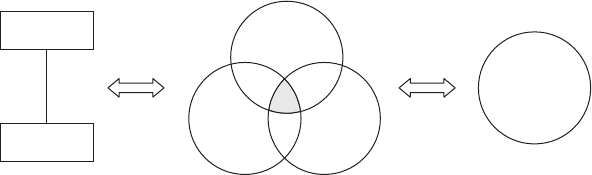
The Sustainable Packaging Coalition, a leading orga-
nization for sustainable packaging, defines sustainable
packaging as a target vision for creating ‘‘a world where
all packaging is sourced responsibly, designed to be effec-
tive and safe throughout its life cycle, meets market
criteria for performance and cost, is made entirely using
renewable energy, and once used is recycled efficiently to
provide a valuable resource for subsequent generations’’
(see also Sustainable Packaging).
CONCEPTUAL FRAMEWORK
The framework below describes substance packaging as a
holistic concept that consists of three interrelated com-
ponents.
The first component is related to time and perpetuality.
Sustainable packaging is aimed at not only meeting the
needs of the present generation, but also meeting the
needs of future generations. It requires a cradle-to-cradle
flow of packaging materials in which the materials can be
used repeatedly without depleting resources.
The second component is related to striking a healthy
balance to meet the needs of the environment, society, and
economy—a packaging system is not truly sustainable until
all these elements are addressed in an equitable manner. For
example, a packaging system with the sole purpose of
maximizing profits is irresponsible if it fails to address the
needs of the environment and society. Similarly, a packaging
system with the sole purpose of minimizing the negative
impacts to the environment is unrealistic if it fails to address
the needs of the society and economy. In Figure 1, sust ain-
ability occurs only in the shaded area where the circles of
environment, society, and economy meet.
The third component is related to the packaging func-
tions, which are as follows: containment, protection, conve-
nience, communication [see Packaging Functions and
Environments; Intelligent Packaging]. Unless a package
can perform some useful functions, the justification of its
existence is questionable. F or example, a package may be
considered environmentally friendly because it is biodegrad-
able; however, if it fails to protect the product, the product
will likely be discarded and not used by the consumer. The
packaging functions, unfortunately, are largely overlooked
in the literature when sustainable packaging is discussed.
Many articles in this encyclopedia fit under and sup-
port the conceptual framework in Figure 1. For example,
the impacts on the environment are addressed in articles
such as Biobased Materials, Environment, and Life Cycle
Assessment. The socioeconomic factors are addressed in
articles such as Economic of Packaging, Laws and Regula-
tions, and Tamper-Evident Packaging. The packaging
functions are addressed in articles such as Packaging
Functions and Environment, Food Packaging Develop-
ment, and Packaging of Food. In fact, many articles in
this encyclopedia describe packaging materials, processes,
products, or technologies for achieving certain desirable
packaging functions.
GUIDELINES FOR DEVELOPING SUSTAINABLE
PACKAGING
How best to develop sustainable packaging to meet the
needs of the present without compromising the ability of
future generations to meet their own needs? Although no
straightforward answer exists to this complex question,
below are some useful guidelines:
. Consider the conceptual framework in Figure 1 and
strike a healthy balance to meet the needs of the
packaging functions, environment, society, and econ-
omy (see Packaging Functions and Environment).
. Avoid over-packaging by using minimal, but ade-
quate, amount of materials to meet safety, quality,
and market needs.
. Avoid toxic constituents and use energy efficient
technologies whenever possible for manufacture
and distribution of product.
. Whenever feasible, use packages that are made of
renewable, environmentally friendly, or recycled ma-
terials, without compromising product safety and
quality or greatly increasing cost.
. When developing packaging system or technologies,
it is important to strike a healthy balance to meet the
needs of the environment, society, and economy.
. Use methodologies such as life cycle assessment
(LCA) to aid the development of sustainable
packaging.
Environment
Society Economy
Package
functions
Future
Present
Figure 1. Conceptual framework of sustainable
packaging.
SUSTAINABLE PACKAGING: CONCEPTUAL FRAMEWORK 1183

T
TAGS
LINDA L. BUTLER
National Business Forms
Association
INTRODUCTION
Tags have been used in all areas of business and industry
for centuries. The more progressive merchants of the
1800s used tags in the same manner and for the same
reasons as merchants today: to inform, instruct, identify,
and inventory (see Figure 1). Traditional cloth and paper
materials have been joined by nonwoven and film-based
synthetics (see Nonwovens; Plastic Paper).
Tags used in retail environments are generally pro-
duced from cast-coated paperboard stocks ranging in
thickness from 8 to 10 points (0.008–0.010 in., 203–
254 mm). Type stands out and colors are brilliant on the
smooth surface of cast-coated stocks. Cloth tags are fre-
quently called ‘‘law labels.’’ This term describes labels
generally sewn onto mattresses and furniture to comply
with government regulations regarding the identification
of stuffing materials. Tags manufactured of synthetics
such as nonwoven Tyvek (DuPont Company) are gradu-
ally replacing cloth tags because they exhibit an extremely
high tear strength, are insensitive to moisture, and have a
smoother, more uniform printing surface than cloth.
Plastic tags are generally used for advertising or instruc-
tional purposes in the retail industry.
Many fastening methods are available, but the most
common in the retail industry for product identification is
a knotted string (see Figure 2a). Plastic barbs are gen-
erally used for price marking in retail garment applica-
tions. Manufactured from an ultrathin plastic, these barbs
affix price tags to ready-to-wear merchandise to prevent
price-tag switching. Plastic barbs can also be combined
with a hook (see Figure 2b) to hang merchandise such as
socks.
In manufacturing, processors, converters, and fabrica-
tors have a variety of uses for tags. Tags play an important
part in tracking serially numbered goods such as electro-
nic components. The simple tag shown in Figure 3a uses
transfer tape on two of the three stubs to enable the tag to
Figure 1. Price marking tags from the 1800s. Figure 2. (a) Knotted-string fastener. (b) Plastic barb with hook.
1185
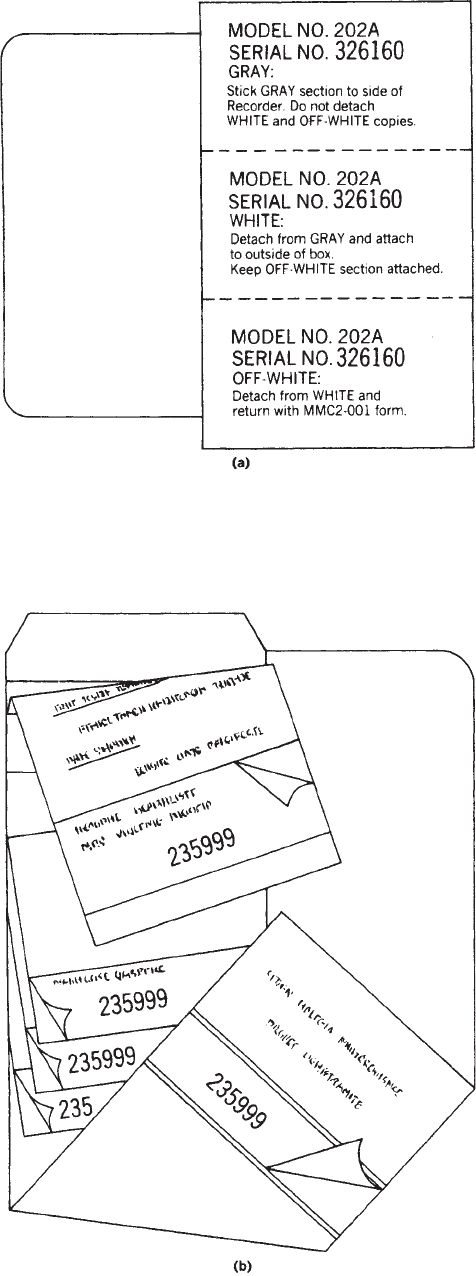
travel with the component throughout the entire packa-
ging cycle without losing track of the serial numbers.
Color coding minimizes the need for processing instruc-
tions. The entire tag is affixed to the component at the end
of the assembly line, using the transfer tape on the gray
stub first. Prior to boxing the product, stubs two and three
(white and off-white) are detached and affixed to the
outside of the box. On receipt of shipping instructions,
the off-white portion is detached and forwarded with a
copy of the shipping document to inventory control.
Tags and pressure-sensitive labels are frequently com-
bined to create unusual tag products. The tag in Figure 3b
includes four pressure-sensitive labels, each carrying the
serial number of the component, in addition to the name-
plate, which in this case is affixed to the product after
delivery by the installer. The tag is attached to the
component with string or transfer tape, depending on
the surface or characteristics of the component. The
shipping department lifts up part 1 to reveal part 2 of
the set, which consists of a small-face slit label containing
the serial number of the component and the instructions
‘‘put on shipping document.’’ Part 2 is torn at the perfora-
tion along the top and reveals three additional labels with
instructions for distribution (warehouse copy, distributor
copy, installer copy). This unusual tag and label combina-
tion provides a simple solution to the often difficult task of
tracking serially numbered products and components
from assembly through shipping to their ultimate
destination.
Tag applications in the retail packaging industry in-
clude, but are not limited to, product description, content
identification (i.e., materials used in production), care and
use instructions (i.e., operating and care directions, iden-
tification of potential hazards), guarantee and warranty
information, decoration and promotion, inventory control,
and price marking (frequently combined with inventory
control when using magnetic stripes, OCR, or bar codes)
(see Bar Code; Code Marking and Imprinting).
Product marking tags, also called ‘‘hang tags,’’ are
printed in up to eight colors on a variety of stocks and
include many features designed to get the attention of the
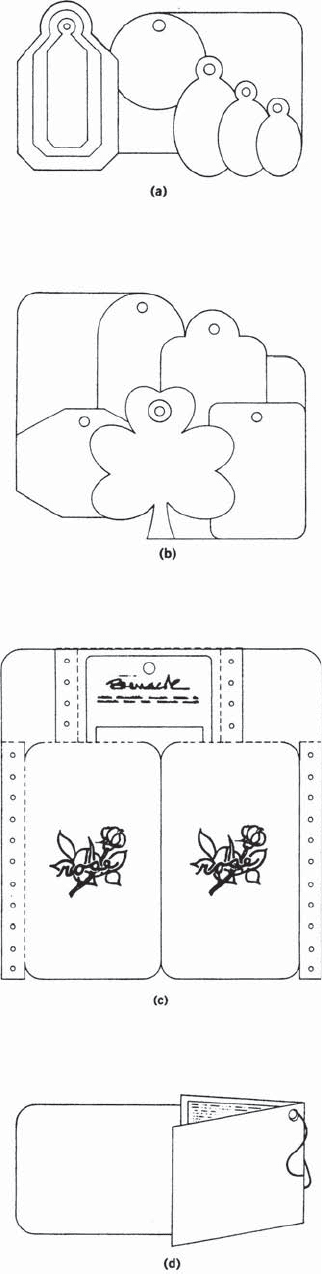
potential consumer. Sizes range from small jewelry mark-
ing tags (see Figure 4a) to oversized tags used to identify
major appliances.
Hang tags are generally shear-cut, die-cut, or contin-
uous, and they offer maximum versatility for product
identification, sales promotion, and advertising. The three
basic tag styles found in retail tagging applications are
shear-cut, die-cut, and continuous tags.
SHEAR-CUT TAGS
Shear-cut tags, also called ‘‘shipping tags,’’ are the oldest
and most common of all tag styles. Shear-cut tags are
simply sheared off the end of the web from the bindery
section of the press after all manufacturing processes are
completed. These tags may be simple, printed on one side
with black ink, with a standard 3/16-in. (4.8-mm) punched
hole. They may also be very complex, with such features
as multicolor printing on both sides. Eyelets in tags used
Figure 3. (a) A three-stat tag. (b) Tag-and-label combination.
1186 TAGS
for product identification are rarely reinforced because the
life expectancy of the tag is short.
DIE-CUT TAGS
Die-cut tags are cut out of the web at the end of the
bindery section of the printing press using either stock or
custom-manufactured dies. Die cutting produces tags that
are round, have rounded or scalloped corners, or have
unusual shapes as shown (see Figure 4b). Die-cut tags
may have all or most of the features of shear-cut tags, but
usually do not require features such as large patches or
jumbo numbers. They are used primarily as promotional
pieces or to convey information regarding a specific pro-
duct, and they are usually not subjected to a great deal of
rough handling.
CONTINUOUS TAGS
These are used in applications where variable information
is imprinted by a computer printer. Many possibilities
exist for the number of perforations and form depths since
stop-and-go presses are used in their manufacture. Con-
tinuous tags are generally used for retail price marking
(see Figure 4c). Special features are frequently incorpo-
rated to create hang tags that are used effectively as
promotional pieces.
Booklet tags are shear-cut tags, scored vertically to
form a fold, providing four surfaces for copy instead of
two (Figure 4d). Special effects can be added to further
enhance the image of these versatile tags. Die cuts on one
of the pages, generally the first, can be used to highlight
the company logo or trademark or provide a representa-
tion of the product (Figure 5a). Die cuts are also used on
the front cover to create a window on the cover panel or to
create a three-dimensional effect. The die cut is generally
backed up with a solid color block or printed design which
shows through the die cut (Figure 5b). Gatefold tags are a
special variety of booklet tag featuring two vertical scores
to form three separate double-sided surfaces for a total of
six surfaces available for printing (Figure 5c). Accordion-
fold tags have three vertical scores that create a total of
four ‘‘pages’’ with eight surfaces for printing. Accordion-
fold tags also may be produced with additional scores to
add pages and sides (Figure 5d).
Many applications require that tags not only carry a
message regarding the product but also serve as a carrier
for the product itself. In instances where merchandise (e.g.,
jewelry) is hung on racks for display or when merchandise
is seasonal and only temporarily displayed, this type of tag
is very effective. Figure 6a shows a tag with die cuts and
additional punches to hold stick pins in a retail jewelry
application. The center punch is used to hang the merchan-
dise on a display rack. The tag shown in Figure 6b uses two
die-cut triangles to hang gloves on display racks in order to
conserve space because of the product’s seasonal nature.
The tag is folded at the score over the cuff and stapled to
fasten it to the merchandise. The die-cut triangle is then
used to hang the gloves on the display rack. Figure 6c
Figure 4. (a) Jewelry tags. ( b) Die-cut tags. (c) Continuous tags.
(d) Booklet tag.
TAGS 1187