
Yam, Kit L. (ed.). The Wiley encyclopedia of packaging technology
Подождите немного. Документ загружается.

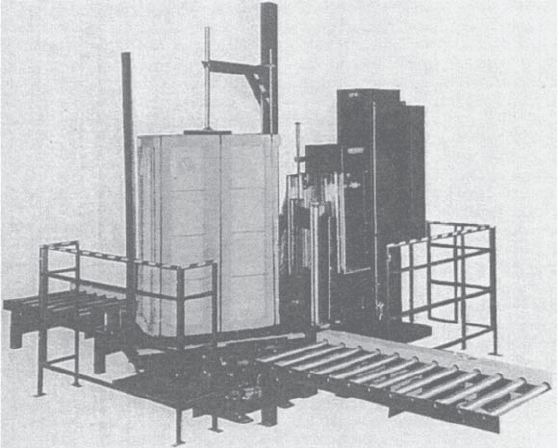
The orbital wrapper is also advantageous for wrapping
long products either singularly or in bundles. Examples of
such products would be rolls of carpet, PVC pipe, fencing,
and shovel or rake handles. The orbital wrapper is avail-
able in several ‘‘ring’’ sizes to accommodate even small
bundling applications such as a stack of blue jeans, bags of
dog food, and like products. Orbital wrappers are largely
manufactured as automatic equipment, although semiau-
tomatic and manually operated orbital wrappers are
available for low-production and individual-product-size
applications.
Wrappers have been designed for stretch wrapping
doors, windows, and similar products in the vertical plane.
In most cases, the stretch wrapper of choice is a standard
semiautomatic, low-profile model with power prestretch
for maximum film economy. Wrapping doors on a pallet,
however, requires an air-loaded clamp that locks the doors
together at the very top of the load. Wrapping windows
requires a top-compression stabilizer with an adjustable
clamp and a similar adjustable clamp mounted on the
turntable. Both clamps hold the window stationary during
the wrap process.
Explosion-proof wrappers are required for many hazar-
dous materials, flour, and similar powder-type products
packaged in cartons, multiwall paper, or polyethylene
bags. The manufacturing environment for such products
demands that the stretch wrapper be designed as spark-
free as possible. Static eliminators (for the stretch film)
are often used on this type of equipment.
Produce and perishable wrappers have been designed
to use stretchable and rigid stretch net that allows the
wrapped load to ‘‘breathe.’’ Produce items such as bana-
nas, melons, peppers, and tomatoes are shipped in venti-
lated cartons so that damage causing gases generated
from certain fruits and vegetables can escape from the
carton during the cooling and shipping process.
Stretch net (used in the same way as stretch film on the
wrapper) wraps the produce load securely and permits the
ventilation to occur. Net, however, cannot be prestretched,
and actual stretch is limited to 5–35%.
The product wrapper itself is usually a semiautomatic
wrapper and is fitted with a brake-tension delivery sys-
tem. This same wrap method is being used for perishable
products such as cartoned meat, poultry, yogurt, and
frozen foods.
A recent innovation to the wrapper is the roper/bander,
an option that allows somewhat less expensive stretch film
to be reduced in web size (from 20 to 3 in.) by having the
film travel through a mechanical fixture as it is being
dispensed from the feed roll under tension to the product
load. Thus, a 3-in. rope (or band) of film is created that
unitizes the load in the standard up/down, crisscross fash-
ion yet does not inhibit the ventilation process. A standard
brake tension system or a power prestretch system can be
utilized with the roper/bander unitizing method.
Luggage wrappers have recently been designed to
stretchwrap standard luggage at airport departure term-
inals. The stretch wrap acts as a theft deterrent as well as
a preventive measure for tightening airport security.
FUTURE WRAPPING SYSTEM
The appearance and performance of the future stretch
wrapper will likely be driven by specific product package
designs as many regions of the world further their concept
of source reduction:
Less packaging materials per package
Less actual labor involved per package
Less time to prepare the package
Less packaging materials to recycle
Less materials going to landfill
Less factory floor space consumed by packaging mate-
rial inventory
Figure 4. A down-sized fully automatic (IPM Bantam 88)
wrapping F-Pack prepared file cabinets.
1278 WRAPPING MACHINERY, STRETCH-FILM
Packaging engineers are working closely with stretch-
wrapper manufacturers to marry the two concepts of
source reduction in packaging and the stretch-wrapper
design.
A primary example would be the development of the
‘‘clear-view’’ package (acronym for F-Pack) for products
such as file cabinets, bedroom furniture, entertainment
centers, and armoires. Driven by consignee resistance to
the disposal problem of large corrugated cartons along
with the increasing cost of corrugated cartons, product
manufacturers have had to develop ‘‘abbreviated’’ package
designs.
The F-Pack package design eliminates the use of the
corrugated carton and replaces it with a stretch-wrap
package utilizing protective corrugated corner posts and
corrugated caps and trays. Polyethylene strapping is also
used in some cases.
For low-volume producers, the standard semiautomatic
stretch wrapper has been modified to accept and wrap F-
Pack type packages. For moderate- to high-volume man-
ufacturers, fully automatic stretch-wrapper models have
been down-sized and significantly modified to accept the
high-production volume and the specific individual pack-
age design. A down-sized Bantam 88, conveyorized fully
automatic stretch wrapper (Figure 4) can be placed in-line
to accept F-Pack prepared products like file cabinets. It is
likely that additional products such as small appliances,
air-conditioning units, and heat pumps will also shed their
corrugated carton in favor of a clear-view package in the
future.
Material improvments in terms of strength and stretch
percentages will stimulate gains as greater stretchability
and lower costs by enabling pallets and other products to
be wrapped with less film. Stretch hoods will exhibit the
fastest growth of all product categories due to their
significant higher throughput compared to conventional
unitization methods. In recent years, the stretch hood
wrapping system (Cover-Pal 6000) manufactured by Ar-
pack using Thimon patented technology offered reliable
five-sided stretch wrapping of pallet load. Their machine
covers pallet-held products on the top and sides, allowing
for pallet load storage with strong environmental protec-
tion against dust, water, and shipping damage that occur
during storage and transportaion. The packaging system
is ideal for products for home centers, construction sites,
and freight yards.
The Arpack COVER-PAL 6000
s
STRETCH, a stretch
hood pallet covering system, offers numerous advantages
over standard pallet wrapping, including:
. Higher production capacity—wraps pallets at speeds
up to 120 pallets per hour with less film changeovers.
. Brand messaging can be printed directly onto the
film, enhancing product recognition.
. Transparent pallet cover enables labels to be read
without removing the film.
. Ensures stable pallet loads for transportation.
. Unlike stretch film used by conventional stretch
wrap equipment, stretch hood films are recyclable.
A stretch hood pallet covering system can be a viable
replacement of conventional stretch-wrapping machine
for the specific product groups using corrugated contain-
ers in various industries in the near future. The challenge
for the success is to make sure that the cost per pallet load
offered by the stretch hood method is more cost competi-
tive in terms of film material usage, capital investment,
and operation efficiency compared to conventional uniti-
zation methods.
A few major stretch-wrapping equipment suppliers to
the United States market are Arpac, Lantech, ITW Mima,
and Seal-O-matic.
SUMMARY
The stretch wrapper continues to be the unitizing medium
of choice for (a) palletized product loads, (b) slip-sheeted
product loads, and (c) for products having new, lower-cost
package designs. The use of stretch film (particularly
prestretched) and stretch net offers significant savings
for the shipper, carrier, and consignee. New stretch-film
resins such as metallocene may enhance prestretch film
yield and allow ‘‘down-gauging’’ for many applications.
Stretch-wrapper design and performance function
should continue to be refined in the areas of manufactur-
ing cost, prestretch assemblies, and ergonomics, resulting
in additional benefits to the end user. Stretch hoods will
exhibit the fastest growth of all product categories due to
their significant higher throughput compared to conven-
tional unitization methods.
BIBLIOGRAPHY
R. F. Nunes,‘‘Wrapping Machinery, Stretch-Film’’ in A. J. Brody
and K. S. Marsh, The Wiley Encyclopedia of Packaging, 2nd
edition, Wiley, New York, 1997, pp. 973–978.
General References
NMFC F-Pack numbers: 132-F, 138-F, 141-F, 142-F, 145-F, 146-F,
2418, 2512, 2514 Furniture Packaging; published by Bohman
Industrial Traffic Consultants, Inc. P.O. Box 889, Gardner, MA
01440.
‘‘A Change to See-Through Packaging,’’ Inst. Packag. Prof. Techn.
J. (Spring issue, 1991). (IPP address: 481 Carlisle Drive,
Herndon, VA 22070).
National Motor Freight Classification Rule 180, effective January
21, 1995 (National Motor Freight Traffic Association, Inc.,
2200 Mill Road, Alexandria, VA 22314).
R. F. Nunes (Director of Marketing & Sales, International Packa-
ging Machines, Inc.), New Developments in Stretch Wrapping
of Case Goods, Furniture and Small Appliances; Including
High Speed Automated Wrapping,’’ International Safe Transit
Association (ISTA), 1995 (paper on source reduction).
Arpac Group, Cover-Pal 6000 Stretch—Stretch Hood Cover Sys-
tem, Schiller Park, IL.
Food Master, equipment, supplies & services, Food Engineering
Network, Cahners, published annually.
‘‘Stretch and Shrink Film,’’ Freedonia Group, 1997, Rockville,
MD.
WRAPPING MACHINERY, STRETCH-FILM 1279

Appendix A
CONVERSION FACTORS, ABBREVIATIONS, AND UNIT SYMBOLS
Selected SI Unite (Adopted 1960)
Quantity Unit Symbol Acceptable equivalent
BASE UNITS
length meter
w
m
mass
=
kilogram kg
time second s
electric current ampere A
thermodynamic temperatures
y
kelvin K
DERIVED UNITS AND OTHER ACCEPTABLE UNITS
*absorbed dose gray Gy J/kg
acceleration meters per second squared m/s
2
*activity (of ionizing radiation source) becquerel Bq I/s
area square kilometer km
2
square hectometer hm
2
ha (hectare)
square meter m
2
density, mass density kilograms per cubic meter kg/m
3
g/L; mg/cm
3
*electric potential, potential difference, electromotive force volt V W/A
*electric resistance ohm O V/A
*energy, work, quantity of heat megajoule MJ
kilojoule kJ
joule J N m
electronvolt
x
eV
x
kilowatthour
x
kW h
x
*force kilonewton kN
newton N kg m/s
2
*frequency megahertz MHz
hertz Hz 1/s
heat capacity, entropy joules per kelvin J/K
heat capacity (specific), specific entropy joules per kilogram kelvin J/(kg K)
heat-transfer coefficient watts per square meter kelvin W/(m
2
K)
linear density kilograms per meter kg/m
magnetic field strength amperes per meter A/m
moment of force, torque newton-meter N m
momentum kilogram-meters per second kg m/s
*power, heat flow rate, kilowatt kW
radiant flux watt W J/s
power density, heat-flux density, irradiance watts per square meter W/m
2
*pressure, stress megapascal MPa
kilopascal kPa
pascal Pa
sound level decibel dB
specific energy joules per kilogram J/kg
specific volume cubic meters per kilogram m
3
/kg
surface tension newtons per meter N/m
thermal conductivity watts per meter kelvin W/(m K)
1281

velocity meters per second m/s
kilometers per hour km/h
viscosity, dynamic pascal-second Pa s
millipascal-second mPa s
volume cubic meter m
3
cubic decimeter dm
3
L (liter)
cubic centimeter cm
3
mL
In addition, there are 16 prefixes used to indicate order of magnitude, as follows:
Multiplication factor Prefix Symbol Note
10
18
exa E
10
15
peta P
10
12
tera T
10
9
giga G
10
6
mega M
10
3
kilo k
10
2
hecto h
a
10 deka da
aa
Although hecto, deka, deci, and centi are SI prefixes, their use
should be avoided except for SI unit-multiples for area and
volume and nontechnical use of centimeter, as for body and
clothing measurement.
10
1
deci d
a
10
2
centi c
a
10
3
milli m
10
6
micro m
10
9
nano n
10
12
pico P
10
15
femto f
10
18
atto a
*The asterisk denotes these unite having special names and symbols.
wThe spellings ‘‘metre’’ and ‘‘litre’’ are preferred by ASTM; however, ‘‘-er’’ is used in the Encyclopedia.
=‘‘Weight’’ is the commonly need term for ‘‘mass.’’
yWide use is made of ‘‘Celsius temperature’’ (t) defined by t=TT
0
where T is the thermodynamic temperature, expr essed in kelvins, and T
0
= 273.15 by
definition. A temperature interval may be expressed in degrees Celsius as well as in kelvins.
x
This non-SI unit is recognised by the CIPM as having to be retained because of practical importance or use in specialised fields.
Factors For Conversion to SI Units
To convert from To Multiply by
acre square meter (m
2
) 4.047 10
3
angstrom meter (m) 1.0 10
10w
atmosphere pascal (Pa) 1.013 10
5
bar pascal (Pa) 1.0 10
5
barn square meter (m
2
) 1.0 10
28w
barrel (42 U.S. liquid gallons) cubic meter (m
3
) 0.1590
Btu(thermochemical) joule (J) 1.054 10
3
bushel cubic meter (m
3
) 3.524 10
2
calorie (thermochemical) joule (J) 4.184
w
centipoise pascal-second (Pa s) 1.0 10
3
cfm(cubic feet per minute) cubic meters per second (m
3
/s) 4.72 10
4
cubic inch cubic meter (m
3
) 1.639 10
5
cubic foot cubic meter (m
3
) 2.832 10
2
cubic yard cubic meter (m) 0.7646
dram (apothecaries’) kilogram (kg) 3.888 10
3
dram (avoirdupois) kilogram (kg) 1.772 10
3
drain (U.S. fluid) cubic meter (m
3
) 3.697 10
6
dyne newton(N) 1.0 10
5
dynes per centimeter newton per meter (N/m) 1.0 10
3
fluid ounce (U.S.) cubic meter (m
3
) 2.957 10
5
foot meter (m) 0.3048
w
(Continued)
1282 CONVERSION FACTORS, ABBREVIATIONS, AND UNIT SYMBOLS

To convert from To Multiply by
gallon (U.S. dry) cubic meter (m
3
) 4.405 10
3
gallon (U.S. liquid) cubic meter (m
3
) 3.785 10
3
gallons per minute (gpm) cubic meter per second (m
3
/s) 6.308 10
5
cubic meter, per hour (m
3
/h) 0.2271
grain kilogram (kg) 6.480 10
5
horsepower (560 ft Ibf/s) watt (W) 7.457 10
2
inch meter (m) 2.54 10
2w
inch of mercury (321F) pascal (Pa) 3.386 10
3
inch of water (39.21F) pascal (Pa) 2.491 10
2
kilogram-force newton (N) 9.807
kilowatt hour megajoule (MJ) 3.6
w
liter (for fluids only) cubic meter (m
3
) 1.0 10
3w
micron meter (m) 1.0 10
6w
mil meter (m) 2.54 10
5w
mile (statute) meter (m) 1.609 10
3
mile per hour meters per second (m/s) 0.4470
millimeter of mercury (01C) pascal (Pa) 1.383 10
2
ounce (avoirdupois) kilogram (kg) 2.835 10
2
ounce (troy) kilogram (kg) 3.110 10
2
ounce (U.S. fluid) cubic meter (m
3
) 2.957 10
5
ounce-force newton (N) 0.2780
peck (U.S.) cubic meter (m
3
) 8.810 10
3
pennyweight kilogram (kg) 1.555 10
3
pint (U.S. dry) cubic meter (m
3
) 4.732 10
4
pint (U.S. liquid) cubic meter (m
3
) 5.506 10
4
poise (absolute viscosity) pascal-second (Pa s) 0.10
pound (avoirdupois) kilogram (kg) 0.4536
pound (troy) kilogram (kg) 0.3732
pound-force newton (N) 4.448
pound-force per square inch (psi) pascal (Pa) 6.895 10
3
quart (U.S. dry) cubic meter (m
3
) 1.101 10
3
quart (U.S. liquid) cubic meter (m
3
) 9.464 10
4
quintal kilogram (kg) 1.0 10
2
rad gray (Gy) 1.0 10
2
square inch square meter (m
2
) 6.452 10
4
square foot square meter (m
2
) 9.290 10
2
square mile square meter (m
2
) 2.590 10
6
square yard square meter (m
2
) 0.8361
ton (long, 2240 lb) kilogram (kg) 1.016 10
3
ton (metric) kilogram (kg) 1.0 10
3
ton (short, 2000 lb) kilogram (kg) 9.072 10
2
torr pascal (Pa) 1.333 10
2
yard meter (m) 0.9144
ABBREVIATIONS AND ACRONYMS
A ampere
AAMI Association for the Advancement of Medical
Instrumentation
ABS acrylonitrile–butadiene–styrene
ac alternating current
adh adhesive
AF aluminum foil
AFR Air Force Regulation
AGV automated guide vehicle
AM aluminum metallization
AN acrylonitrile
AN/MA acrylonitrile–methacrylate copolymers
ANS acrylonitrile–styrene copolymers
ANSI American National Standards Institute
API American Paper Institute
ASME American Society of Mechanical Engineers
ASP asphalt
ASQC American Society for Quality Control
ASTM American Society for Testing and Materials
avg average
BATF Bureau of Alcohol, Tobacco and Firearms
B&B blow-and-blow
BBP butyl benzyl phthalate
BCL British Cellophane Limited
BHEB tert-butylated hydroxyethylbenzene
BHT tert- butylated hydroxytoluene
BIB bag-in-box
BK bleached kraft
BMC bulk molding compound
CONVERSION FACTORS, ABBREVIATIONS, AND UNIT SYMBOLS 1283
BON biaxially oriented nylon film
BOPP biaxially oriented polypropylene film
bpm bottles per minute; bags per minute
BSP British standard pipe thread
Btu British thermal unit
BUR blowup ratio
1C degree Celsius
CA controlled atmosphere
ca approximately (circa)
CAD computer-aided design
CAE computer-aided engineering
cal calorie (4.184 J)
Cal food calorie (1000 cal)
CAP cellulose acetate propionate; controlled
atmosphere packaging
CELLO cellophane
CFR Code of Federal Regulations
CGMP Current Good Manufacturing Practice
CGPM Conference Generate des Poids et Mesures
(General Conference on Weights and
Measures)
CI central impression
CIPM Comite
´
International des Poids et Mesures
(International Committee on Weights and
Measures)
cm centimeter
CMA Closure Manufacturers Association
CNC computer numerical control
coex coextruded
COF coefficient of friction
COFC Container on Flat Car
COREPER Committee of Permanent Representatives
(EEC)
CPE chlorinated polyethylene
cpm cans per minute
cPs centipoise (10
3
Pa s)
CPSC Consumer Product Safety Commission
CPU central processing unit
CR child-resistant
CRC child-resistant closure
CRT cathode-ray tube
CT continuous thread
D & I drawing and ironing (cans)
dB decibel
dc direct current
DEHP di(2-ethylhexyl)phthalate
DEG diethylene glycol
DGT diethylene glycol terephthalate
dia diameter
DINA diisononyl adipate
DIAM Defense Logistics Agency Manual
DME dimethyl ether
DMF Drug Master File
DMT dimethyl terephthalate
DOA dioctyl adipate
DOD U.S. Department of Defense
DOP dioctyl phthalate
DOT U.S. Department of Transportation
DOZ dioctyl azelate
DPM double package maker
DR double-reduced
DRD draw-redraw (cans)
DSAM Defense Supply Agency Manual
DWI drawn and ironed (cans)
EAA ethylene-acrylic acid
ECOSOC Economic and Social Committee (EEC)
ECCS electrolytic chromium-coated steel
EEA ethylene-ethyl acrylate
EEC European Economic Community
eg for example (est gratia)
EG ethylene glycol
EHMW extra-high-molecular-weight
EIA Electronic Industries Association
ELC end-loading construction
EMA ethylene methacrylate
EMAA ethylene-methacrylic acid
EMI/RFI electromagnetic interference/radio frequency
interference
EPA Environmental Protection Agency
EPC expanded-polyethylene copolymer
EPE expanded polyethylene
EPR ethylene-propylene rubber
EPS expanded polystyrene
ESC environmental stress cracking
ESCR environmental stress-crack resistance
ESD electrostatic discharge
ESO epoxidized soybean oil
est estimated
ETO ethylene oxide
ETP electrolytic tinplate
EVA ethytene-vinyl acetate
EVOH ethylene-vinyl alcohol
F
50
value at which 50% of the specimens have failed
1F degree Fahrenheit
FDA U.S. Food and Drug Administration
FD&C Food, Drug, and Cosmetic
FEP fluorinated ethylene-polypropylene
ffs form/fill/seal
FI flow index
ft oz fluid ounce (29.57 mL in United States)
FPMR Federal Property Management Regulations
FRH full-removable head
FEP fiberglass-reinforced plastics
ft foot
ft Ibf foot-pound force (1.366 J)
G specific deceleration: gravitational acceleration;
specific acceleration: gravitational acceleration
g gravitational acceleration (9.807 m/s
2
)
g gram
gf gram-force (0.0098 N)
ga gauge
gal gallon (3.785 L in United States)
GMA Grocery Manufacturers Association
GMP Good Manufacturing Practice
GNP gross national product
GPPS general-purpose polystyrene
Gy gray (10
2
rad)
h hour; height
HBA health and beauty aids
HCP healthcare packaging
HD head diameter
HDPE high-density polyethylene
HDT heat-deflection temperature
HF high-frequency
HFFS form/fill/seal, horizontal
HIMA Health Industry Manufacturers’ Association
HIPS high-impact polystyrene
1284 CONVERSION FACTORS, ABBREVIATIONS, AND UNIT SYMBOLS
HLMI high-load melt index
HM hot melt
HMW high-molecular-weight
HNR high-nitrile resin
hp horsepower (746 W)
HP high-pressure
HPP homopolymer polypropylene
HRC Rockwell hardness (C scale)
HRM Rockwell hardness (M scale)
HRR Rockwell hardness (R scale)
HTST high-temperature–short-time
Hz hertz (cycles per second)
IBC intermediate bulk containers
ICAO International Civil Aviation Organization
ie that is (id est)
IM intramuscular
IMDG International Maritime Dangerous Goods
IML in-mold labeling
IMO International Maritime Organization
in. inch (2.54 cm)
I/O input/output
IPA isophthalic acid
IS individual section
ISO International Standards Organization
ITRI International Tin-Research Institute
IV intrinsic (or inherent) viscosity; intravenous
J joule (energy)
k kilo (10
3
)
K degree Kelvin
k.d. knocked-down
kgf kilogram-force (9.806 N)
kJ kilojoule
km kilometer
kPa kilopascal (0.145 psi)
L liter (volume)
lb pound (mass) (453.6 g)
Ibf pound force (4.448 N)
LCB long-chain branching
LCD liquid-crystal display
L:D length:diameter
LDPE low-density polyethylene
LED light-emitting diode
LLDPE linear low-density polyethylene
LMW low-molecular-weight
LSI large-scale integration
L:T length:thickness
LVP large-volume parenteral
M mega (10
6
)
M
N
number-average molecular weight
M
W
weight-average molecular weight
m meter, milli (1/1000)
MA modified atmosphere; methyl acrylate
MAN methacrylonitrile
max maximum
MBS methacrylate–butadiene atyrene
m/c cylinder mold
MD machine direction
MDPE medium-density polyethylene
MET metallized
MF mechine-finished
MFR melt-flow rate
mg milligram
MG mill-glazed; machine-glazed
MGBK machine-glazed bleached kraft
MGNN machine grade natural Northern
mi mile
MI melt index
MIL military
min minute; minimum
MIR multiple-individual-reward
MMA methyl methacrylate
MMW medium molecular weight
mn millinewton (2.25 10
4
Ibf)
MN meganewton (224,909 Ibf)
MOE modulus of elasticity
MOR modulus of rupture
MP microprocessor; melting point
MPa megapascal (145 psi)
ms millisecond
MSW municipal solid waste
MTB Materials Transportation Bureau
MVTR See WVTR
MW molecular weight
MWD molecular-weight distribution
mm micrometer
N newton (force)
N/A not available
NASA National Aeronautics and Space Administration;
National Advertising Sale Association
NBS National Bureau of Standards
NC nitrocellulose
NCB National Classification Board
NDA New Drug Application
NEC not elsewhere classified
NF National Formulary
NK natural kraft
nm nanometer (10
9
meter)
NMFC National Motor Freight Classification Committee
NODA n-octyl n-decyl adipate
NPIRI National Printing Ink Research Institute
NSTA National Safe Transit Association
NWPCA National Wooden Pallet and Container
Association
O ohm (resistance)
OD optical density
OL overlacquer
ON oriented nylon
OPET oriented polyester
OPP oriented polypropylene
OPS oriented polystyrene
OSHA Occupational Safety and Health Administration
OTC over-the-counter
OTR oxygen transmission rate
Pa pascal (pressure)
PA Proprietary Association
PAN polyacrylonitrile
P&B press-and-blow
PBT poly(butylene terephthalate)
PC personal computer; polycarbonate
PCTFE poly(chlorotrifluoroethylene)
PE polyethylene
PEPS Packaging of Electronic Products for Shipment
PET poly(ethylene terephthalate); polyester
phr parts per hundred of resin
PIB polyisobutylene
PLI pound force per lineal inch
CONVERSION FACTORS, ABBREVIATIONS, AND UNIT SYMBOLS 1285
PM Packaging Materials
PMMA Poly(methyl methacrylate)
PMMI Packaging Machinery Manufacturers Institute
PP polypropylene
ppb parts per billion (10
9
)
ppm parts per million (10
6
)
PPP poison-prevention packaging
PPPA Poison-Prevention Packaging Act
PR printing
proj projected
PS polystyrene
psi pound (force) per square inch (6.893 kPa)
psig psi gauge pressure
PSTA Packaging Science and Technology Abstracts
PSTC Pressure-Sensitive Tape Council
PTFE polytetrafluoroethylene
PVAc poly(vinyl acetate)
PVC poly(vinyl chloride)
PVDC poly(vinylidene chloride)
PVF poly(vinyl fluoride)
PVF
2
poly(vinylidene fluoride)
PVOH poly(vinyl alcohol)
PX postexchange
Q
10
change in reaction rate for a 101C temperature
increase
QA quality assurance
QAI quaternary ammonium inhibitor (nitrite)
qt quart (946 mL in United States)
R&D research and development
RCF regenerated cellulose film
RCPP random-copolymer polypropylene
RD root diameter
RDF refuse-derived fuel
rf radiofrequency
rh relative humidity
RIM reaction injection molding
RM-HNR rubber-modified high-nitrile resin
rpm rotations per minute
RSC regular slotted container
RVR rim-vent release
s second
SAN styrene–acylonitrile
SB styrene–butadiene
SBS solid bleached sulfate
SCB short-chain braching
SCF Scientific Committee on Food (EEC)
SCR Semicondutor
SIC Standard Industrial Classification
SMC sheet molding compound
SMMA styrene–methyl methacrylate
SP special packaging
sp gr specific gravity
SPPS solid-phase pressure forming
SR single-reduced
SUS solid unbleached sulfate
sq square
SVP small-volume parenteral
TA thread angle
TAPPI Technical Association of the Pulp and Paper
Industry
TD thread-crest diameter
TE tamper-evident
tffs thermoform/fill/seal
TFS tin-free steel
T
g
glass-transition temperature
TH tight head
T
m
melting temperature
TIS Technical Information Service
TOFC trailer on flatcar
TPA terephthalic acid
TR tamper-resistant
UCB Union Chimique Belge
UCC Uniform Clarification Committee
UKJ Uniform Freight Classification Committee
UHMW ultra-high-molecular-weight
UN United Nations
UPS United Parcel Service
USDA United States Department of Agriculture
USP US Pharmacopeia
uv ultraviolet
V volt
VA vinyl alcohol
VC vinyl chloride
VCI volatile corrosion inhibitor
VCM vinyl chloride monomer
VDC vinylidene chloride
VFFS form/fill/seal, vertical
vol volume
vs versus
W watt (J/s)
WD wire diameter
wk week
wt weight
WVTR water-vapor transmission rate
XD cross-direction
XKL extensible kraft linerboard
yr year
ZCC zero-crush concept
1286 CONVERSION FACTORS, ABBREVIATIONS, AND UNIT SYMBOLS

Appendix B
GLOSSARY OF PACKAGING TERMINOLOGY
AND DEFINITIONS
PAUL ZEPF
Zarpac, Inc.
Oakville, Ontario, Canada
GLOSSARY
The attempt of this glossary is to communicate, define,
and clarify common words used in the packaging industry
as they relate to machines and processes. This glossary
has evolved over time and will continue to evolve and
refine these definitions and terms and add new definitions
and terms as required. Just because someone uses the
same word or term as another individual does not mean
that person understands it the same way. It has been
found that miscommunication and misunderstandings are
common in the packaging industry even when using the
same word. The reader is encouraged to contact the author
pertaining to clarifying an existing definition and/or add-
ing more terms.
Wherever possible, definitions from other sources or
associations have been maintained, such as terms and
definitions from the canning trade, to achieve as much
alignment as possible with the large diversity in the
packaging industry.
Absolute humidity The actual weight of water vapor
contained in a unit volume or weight of air. See Relative
humidity.
Absorbent A substance that has the ability to soak up
or retain other substances, such as sugar or salt absorbing
water, when exposed to high relative humidity
atmospheres.
Acid A substance, usually a liquid, that increases the
concentration of hydrogen ions (H
+
) in water and reacts
with a base to form a salt. On a pH scale, an acid has a pH
value of o5; a pH value of 7 indicates a neutral substance.
As the pH value declines from pHo5, the substance
becomes more acidic and is generally more corrosive.
Accumulation An accumulation apparatus is a device
that deliberately amasses inputs or products into one
place for the next required operation or process. Taking
a single line of product and collating the products into
multiple rows to go into an oven, cooler, or similar opera-
tion is an example of accumulation. Accumulation should
not be confused with buffers. The definition of buffer is to
shield or cushion (via conveyor length or off-loading areas
such as tables or conveyors to let the inputs gather) an
upstream machine from a downstream machine that
stops. Generally, a buffer is a technique used as a positive
modulating effect on utilization. The two definitions
should not be used interchangeably.
Achievable run speed That speed or rate as tested
during commissioning (which also verifies the packaging
line design criteria of needs) to be the needed sustainable
steady-state speed on a per minute or per hour basis with
a wastage factor ofo0.01. It is generally 20% less than the
packaging line capacity and 50–70% less than the packa-
ging line capacity for a true just-in-time (JIT) packaging
line. The proposed run speed, the achievable run speed,
and the design run speed can be used interchangeably,
although the achievable run speed is the phase used in
this book.
Action steps Specific, tactical activities you take to
accomplish goals and objectives.
Activity An individual step or piece of work that is part
of the total job being scheduled.
Activity-based costing The use of cost accounting
tools that attempt to allocate indirect or overhead costs
on the basis of related activities, rather than using
surrogate allocation bases such as direct labor or machine
hours, floor space, or material costs.
Actual set run speed That target speed or rate as set
or fixed for a given package run cycle on a per minute or
per hour basis that is subjectively set by the operator or
management. It is generally equal to (ideal) or less than
the achievable run speed (usually). It is the dialed run
speed set by the operator or management. On dynamically
controlled automated packaging lines, it is the instanta-
neous steady-state target output rate. Note that the
effects of wastage rework and stoppages have not been
considered.
Additive Any substance, the intended use of which
results or may reasonably be expected to result, directly
or indirectly, in its becoming a part of or otherwise
affecting the characteristics of any input.
Adsorbent The material on whose surface adsorption
takes place.
Adsorption The adhesion of a substance to the surface
of a solid or liquid.
Adulterant (adulteration) Foreign materials in the
product, especially substances that are aesthetically ob-
jectionable, hazardous to health, or indicate that unsani-
tary handling or manufacturing practices have been
employed.
Aeration The bringing about of intimate contact be-
tween air and a liquid by bubbling air through the liquid
or by agitation of the liquid.
Aerator A device for promoting aeration.
Aerosol The colloidal suspension in which gas is the
dispersant. Dispersion or suspension of extremely fine
particles of liquid or solid in a gaseous medium.
Affordable capital limits (ACLs) The specified cost or
‘‘cap’’ for a project to achieve maximum value. The ACL is
1287