
Yam, Kit L. (ed.). The Wiley encyclopedia of packaging technology
Подождите немного. Документ загружается.

secondary extruder connected in series for allowing the
extrudate to cool and expand. Whereas a single extruder
may be used, large commercial operations use tandem
systems for a better quality sheet. The blowing agent is
injected into the primary extruder. The melt then passes
into the secondary extruder, which is usually one third
larger in diameter (78% larger in volume), primarily for
cooling. The extrudate then exits through an annular die,
expands, and flows over a mandrel. The resulting tube is
slit to make a flat sheet. Sometimes it is slit twice to form
two sheets. The diameter of the mandrel determines the
sheet width and provides biaxial orientation. The sheet
is then pulled through a series of two to three rollers
(S-wraps) to remove the curl, make the thickness uniform,
and cool it for winding.
A typical commercial extrusion setup is 4.5 in. (115 mm
in nominal size) in diameter for the primary extruder and
6.0 in. (150 mm) for the secondary extruder for 500–1000 lb
(275–450 kg) per hour. A common configuration for output
of 800–1500 lb (350–700 kg) involves a 6.0 in. (150-mm)
primary and 8.0 in. (200-mm) secondary. The resulting
foam has fine, closed cells with a density of 2–10 lb/ft
3
(32–
160 g/L). For packaging applications, the resulting sheet
typically has a basis weight of 3–25 g/100 in.
2
(50–400 g/m
2
with a thickness of 30–200 mils (0.75–5.00 mm). The width
typically ranges from 20 to 52 in. (500 to 1325 mm).
A variety of blowing agents may be used. Most produ-
cers used chlorofluorocarbons until 1988 (see below).
Others used butane, pentane, or other hydrocarbon gases.
Although hydrocarbons are much less expensive, they are
highly flammable. Extreme precautions had to be taken to
prevent fires and explosions. As noted below in the ‘‘En-
vironmental Issues’’ section, all these gases are being
reduced or eliminated for environmental concerns. A
leading replacement candidate is carbon dioxide (CO
2
).
Dow has developed technology for using 100% CO
2
that it
is licensing. Other gases are being investigated.
During the extrusion process, special finishes and
laminates may be applied for graphics, gloss, thickness
reduction without loss in strength, gas barrier, or other
purposes. As the foam exits the extruder, it may be hit
with a stream of air from completely around the tube.
Called an air-ring coating, the foam cells near the surface
are collapsed, which a forms thin glossy skin on one side of
the sheet. Some producers have also developed a techni-
que of coextruding a thin (o1 mil or 25 mm) layer of
polymer (usually polystyrene) through the same annular
die that produces the foam. At the S-wraps, a premade and
sometimes preprinted film (oriented polystyrene or bar-
rier) may be laminated in the nip. One producer accom-
plishes the same feat by extruding a thin-impact
polystyrene film onto the foam sheet in the nip.
After the foam has been extruded and wound onto rolls
60–84 in. (1.5–2.1 m) in diameter, it is placed in a storage
area for 1–3 days to allow the blowing agent to partially
escape, for optimal expansion in thermoforming. After
aging, the foam is taken and placed on an unwind stand
for thermoforming.
Thermoforming a foam sheet into trays is somewhat
more complex than forming a plastic sheet. Because foam
is an insulator, heating the sheet to forming temperatures
requires more time. Distribution of heat is also critical.
During the heating process, the foam reexpands to nearly
twice its stating thickness. The expansion needs to be as
uniform as possible to produce a good part. Thus on
production machines, ovens are much longer than typical
thermoformers. When the sheet enters the mold platen,
the male and female molds close to a thickness slightly
less than the starting sheet thickness. This technique
provides uniform wall thickness throughout the part.
This helps provide the same strength as a much heavier
comparable plastic part. Although foam trays can be
trimmed in place, most large commercial equipment uses
a separate trim station. Punch-and-die trimming is nor-
mally used for large commercial operations for higher
speed and more durability, although steel-rule dies may
be used for lower volume situations.
After molded parts are trimmed, the remaining sheet
‘‘skeleton’’ is ground up immediately to be stored in a silo
for reuse. Because the unused scrap sheet is as much as
50% of sheet area, reusing scrap is critical to producing
parts economically. While the ground-up foam or ‘‘fluff’’
may be reused directly, it is difficult to blend and feed
properly with virgin resin pellets. Thus, most producers
have a reclaim operation that remelts the fluff and
extrudes it as pellets.
Key builders for foam-extrusion equipment are Batten-
feld Gloucester (Gloucester, MA) and Berstorff of Ger-
many. Davis Standard (Pawtucket, RI) and Egan
(Somerville, NJ) also produce foam lines. Most foam
thermoformers are built by Irwin (Yakima, WA) and
Brown (Beaverton, MI). The typical resin used is a high-
heat grade of crystal polystyrene. Dow Chemical (Mid-
land, MI) is the largest supplier worldwide. Others include
BASF (Frankfurt, Germany), Huntsman (Salt Lake City,
UT), and Chevron (Houston, TX).
The cost of an extruded-polystyrene foam tray plant is
more than double the cost of a thermoformed solid-plastic
tray plant for comparable output in trays. A typical setup
of an extrusion line, reclaim line, silos, two thermofor-
mers, and tooling as of 1994 would cost about $3–$5
million. In addition, a foam plant requires more land
and building for equipment, roll storage, and finished-
goods storage. As a tradeoff, however, raw materials are a
much lower proportion of manufacturing costs (30–50% vs
50–80%).
KEY PRODUCERS
The major producer of foam trays by far is Tenneco
Packaging (Evanston, IL) with five plants around the
country, which purchased Mobil Chemical Company’s
foam business in October 1995. Amoco Foam Products
Company (Atlanta, GA), with nine plants, is the next
largest and is expected to be sold before this article is
published. Both of these companies offer a broad line of
both disposables and packaging products. Four other
manufacturers have also recently changed ownership.
Tekni-Plex (Somerville, NJ) was bought in 1994 by MST,
a financial group, which then also purchased Dolco Packa-
ging (Studio City, CA) in February 1996. Sweetheart Cup
1248 TRAYS, FOAM

(Owings Mills, MD), primarily a disposable manufacturer,
was acquired in 1993 by American Industrial Partners
Capital Fund (San Francisco) from Morgan Stanley (New
York). Elm Packaging, (Memphis, TN) management-led
financial group acquired Fripp Fibre’s operations in 1994.
Other foam producers Genpak (Glens Falls, NY), Linpac
(Wilson, NC), Solo Cup (Highland Park, IL), Dart Con-
tainer (Mason, MI), and W. R. Grace (Reading, PA) have
not changed ownership since 1993. All producers except
Amoco and Tenneco specialize in one or two market
segments and often compete within a limited geographic
area.
Because foam is lightweight and parts are generally
three or more times thicker than parts made from compet-
ing materials, storage and transportation costs represent
a much higher proportion of costs. Shipping products
within one day’s drive (400–500 m or 600–800 km) from
the manufacturing facility can hold transportation costs
under 5% of the selling cost. Some makers have been able
to offset this somewhat by the use of laminates. In some
applications, such as fast-food or carryout packaging,
where retail storage is minimal, the value of this thickness
reduction more than compensates for its increased cost.
For the most part, however, foam producers have found it
generally more cost effective to locate near key markets.
This easily offsets economies of scale from larger produc-
tion facilities. Only in the case of specialized products can
manufacturers ship products farther than a day’s drive.
PRODUCTS, USES, AND APPLICATIONS
The primary packaging applications for foam trays are
fresh meat, poultry, and eggs. There is also considerable
usage for packaging carryout foods in restaurants,
although that market segment has dropped considerably
since McDonald’s discontinued using clamshells for ham-
burgers. McDonald’s still uses large quantities for packa-
ging breakfasts. There are minor quanitites used for a
variety of industrial packaging applications, primarily as
cushioning. Because disposable tableware is used for
immediate food consumption and is not meant to protect
food for transit to another location, it will not be discussed
here.
The major application is for packaging fresh meat, with
about 8 billion trays. These trays are sold to supermarkets
and grocery stores, which cut and package meat in the
back room to display in self-service cases. Because a red,
watery fluid called ‘‘purge’’ oozes out of the meat, an
absorbent pad is placed in the tray just prior to placement
of the meat. The entire package is wrapped with a clear
film, usually poly(vinyl chloride) (PVC). Wrapping is now
done on manual or semiautomatic equipment. The pack-
age is placed on display in a self-service case for a
maximum of 2–5 days depending on the freshness life of
the meat cut.
The industry has developed fairly standard sizes and
colors, although there is some variation by producer. Most
supermarket foam trays are white, although there is
growing interest in other colors. Rose has been used for
pork more frequently, blue for fish or seafood, green for
produce, and yellow for poultry. Within the past 5 years,
the use of black has grown dramatically, especially for
upscale or niche products such as natural beef, low-fat
meats, or marinates. Even though nearly any shape or size
is possible, most of the industry has standardized on a set
of shallow, square trays, partly for merchandising and
partly for cost savings (see Table 1). Most meat and
seafood trays are about
1
2
in. (13 mm) deep, which allows
most cuts to be observed from three sides. Poultry trays
are typically Z1 in. deep (25 mm), because of greater
purge and typical practice of packing more product in
each tray. Product trays are often as much as 3 in. (75 mm)
deep because of the greater height of the product.
In the mid-1960s, many supermarkets began to dis-
continue cutting chicken for sanitation and cost reasons in
favor of purchasing it already cut and packed in foam
trays. Holly Farms (now Tyson) led the industry with its
‘‘deep chill’’ technique of crust-freezing the chicken with a
quick blast at 401F(401C), usually after packing it in
the tray. This technique gave chicken up to 18 days’ shelf
life for travel to the retail store and sale. The poultry
industry also began using high-speed wrapping machines
to gain efficiency. The deep-chilling, longer life, and high-
speed wrappers were too demanding for lightweight
supermarket trays, so Amoco, Grace, and Tekniplex devel-
oped heavier gauge trays (150–200 mils or 3–5 mm) to
address this market. Increasing demands from wrapping
machines have led to not only increased tray weights but
also design changes such as gussets and bowed sidewalls.
The processor segment now accounts for about 3 billion
trays and has grown much faster than the total market as
a result of increasing poultry consumption.
Because of environmental pressures and easy substitu-
tion, pulp has regained considerable market share in the
3-billion-unit egg-carton market, where the wet strength
of foam is less of an advantage. The primary size are for
one dozen large eggs, although half-dozen and 18-count
packages are available. Colors are primarily white or
yellow. Most packages are printed off-line with the pack-
er’s name. Dolco is the major producer in this market.
Although produce uses almost 2 billion trays, less than
a quarter are foam, with the remainder being pulp,
oriented polystyrene, and injection molded. Trays are
sold to both supermarkets and packers for packing toma-
toes, mushrooms, corn, and a variety of other items. A
small number goes to various berry packers. Cut fruits
and vegetables are sometimes packed in supermarket
trays. Because of consumer preferences for bulk produce,
industry fragmentation, environmental pressures, and
questionable need for rigid packages for many items,
foam trays have made little progress gaining usage in
produce. Seafood is similarly fragmented. Tray usage is
confined largely to frozen items, with fresh products sold
over the counter wrapped in paper. Miscellaneous other
foods such as pasta, deli meats and cheeses, and prepared
foods are also wrapped foam trays using typical processor
or supermarket sizes.
A new development in foam trays is the barrier-foam
trays (see the Trays, barrier-foam article). This product is
a composite of a barrier film laminated to foam sheet then
formed into trays. This tray can be evacuated and/or gas
TRAYS, FOAM 1249

flushed and sealed with a barrier-film lid to make an
extended-shelf-life modified-atmosphere package. It is
used for precooked chicken, fresh turkey, and fresh sau-
sage in the United States. Beef and prok are also packed in
them, mostly in the United Kingdom.
Other Packaging. Hinged-lid or clamshells for carryout
packaging address a market of 4–5 billion trays. These
trays are only designed to hold food for 1–2 h, or long
enough to protect it from the kitchen to the point of
consumption. They are popular for this application be-
cause of low cost, wet strength, and ability to hold food hot
or cold for up to 30 min.However, they are not leakproof,
and the tab holding the lid closed does not stand up well to
transport abuse. The primary users are fast-food chains,
restaurants, and institutional feeders. These customers
also use large quantities of foam trays, plates, and bowls.
Protective packaging has been a minor market for foam
trays. Volumes per part are much lower; thus, mold costs
become a significant expense. In addition, thermoforming
generally cannot do the vertical sidewalls and intricate
details required to hold a product in plate for transit. For
these reasons, bead molding of expandable polystyrene
beads has been the preferred material for these
applications.
ENVIRONMENTAL ISSUES
Polystyrene foam containers came under aggressive at-
tack by environmental groups in the late 1980s and early
1990s. They were fingered for a variety of enviornmental
ills, from creating holes in the ozone to filling landfills to
over capacity to litter problems to choking water animals.
Although the industry began a vigorous lobbying and
public relations campaign to show that these notions
were greatly exaggerated or erroneous, much damage
could not be prevented. Several local governments, nota-
bly Suffolk County, New York on Long Island; Berkeley,
California; and Portland, Oregon, placed outright bans on
the product’s use. Even though Suffolk’s law was later
rescinded, others are still in place. Other locales such as
Minneapolis and the State of California have passed
sweeping recycling mandates that foam and other plastic
containers will have difficulty meeting.
Table 1. Common Meat and Poultry Tray Sizes
in. mm
Tray Width Length Height Width Length Height
Supermarket
15
1
4
5
1
4
1 133 133 25
1S 5
1
4
5
1
4
1
2
133 133 13
25
3
4
8 1 146 203 25
2S 5
3
4
8
1
2
146 203 13
47
1
8
9
1
4
1 181 235 25
4S 7
1
8
9
1
4
1
2
181 235 13
7S 5
3
4
14
3
4
1
2
146 375 13
8S 8
1
4
10
1
2
210 254 13
10S 5
1
2
10
3
4
1
2
140 273 13
12S 9
1
4
11
1
4
1
2
235 286 13
16S 7 12
1
2
178 305 13
17S 4
3
4
8
1
2
121 203 13
20S 6
1
2
9
1
2
165 229 13
23S 8 18 1 203 457 25
24S 8 16 1 203 406 25
25S 8 14
3
4
1 203 375 25
1014 10 13
3
4
1 254 349 25
1216 12 16 1 305 406 25
Processor
2P 5
3
4
8 1
1
8
146 203 29
3P 6
5
8
8
5
8
1
1
4
167 219 32
4P 7
1
8
9
1
4
1
1
4
181 235 32
8P 8
1
4
10 1
1
4
210 254 32
10P 5
1
2
10
3
4
1
1
4
140 273 32
11 7
5
8
11
5
8
1
1
4
194 295 32
24P 8 15
5
8
1
3
8
203 397 35
25P 8 14
3
4
1
1
3
203 375 33
Source: Amoco Foam Products Company. Sizes and designations may differ somewhat by producer and location.
1250 TRAYS, FOAM
Most producers used a blowing agent called CFC,
which is also known by the DuPont trade name
Freon 12. In 1987, the Montreal protocol established a
timetable for halving CFC use by 1999, because these
compounds react with ozone in the upper atmosphere,
which reduces the filtering of ultra violet rays provided by
the ozone layer. Then, McDonald’s placed a moratorium on
using packages with CFCs in 1988, forcing users to seek
alternatives. Although foam was actually a very small
consumer of CFCs relative to air conditioning, refrigera-
tion, and electronics manufacturing, its visibility with
McDonald’s caused it to receive an inordinate share of
the blame for ozone depletion. Many foam producers
switched to a hydrochlorofluorocarbon (HCFC), which
had less than 5% of the ozone-depletion potential of a
CFC but at a much higher cost. But in 1990, the Montreal
protocol was updated to eliminate all CFCs. Now, most
producers have been forced to switch to hydrocarbon
blowing agents, although Dow’s CO
2
process is used by a
few.
One main issue with foam trays is its supposed con-
tribution to the solid-waste problem. Whereas the indus-
try convincingly proved that polystyrene foam accounted
for less than 0.5% of landfill weight, again visibility
caused it to be a target. The package was also faulted for
lack of biodegradability, although it was clearly shown
that nothing degrades in a landfill. The industry, particu-
larly Amoco, Mobil, and Dart, countered this with lobby-
ing, public-relations efforts, and developing three
recycling plants, which now operated by the National
Polystyrene Recycling Company, a joint venture. McDo-
nald’s even participated briefly in a recycling program,
prior to its decision to discontinue using foam.
Even though the industry gradually recovered from the
CFC and solid-waste issues, it slowly began to face a new
one. The hydrocarbon blowing agents are volatile organic
compounds (VOCs), which most states are restricting to
protect air quality. In many states, it is virtually impos-
sible to expand, others require an environmental impact
study before issuing a permit, and California is demand-
ing outright reductions. Thus, most producers are vigor-
ously pursuing new blowing-agent technologies that will
allow for expansion.
BIBLIOGRAPHY
General References
I. E. Cavallo, Amoco Foam Products Company (retired), interview,
Feb. 1995.
R. Ramirez, Dolco Packaging Corporation, interview, Feb. 1995.
R. E. Skochdopole and G. C. Welsh ‘‘Polystyrene Foams’’ in
Styrene Polymers, E. R. Moore, ed., Dow Chemical Company,
Midland, MI, 1989, pp. 193–205. Reprinted from the Encyclo-
pedia of Polymer Science and Engineering, Vol. 16, Wiley, New
York, 1989, pp. 1–246.
P. A. Wagner, ‘‘Foam, Extruded Polystyrene’’ in M. Bakker, ed.,
Encyclopedia of Packaging Technology, Wiley, New York, 1986,
pp. 345–346.
For more information, contact the companies mentioned in the
article.
TUBE FILLING
THOMAS MILLER
T. J. BOEDEKKER
IWKA,
Fairfield, New Jersey
Industrial production of collapsible tubes in two processes
that include the following:
1. The manufacture of an empty tube.
2. Filling and closing of the tube.
Most tube-filling and tube-closing machines can handle
different tube shapes, materials, and a large variety of
filling products by means of versatile accessories. Differ-
ent tube shapes such as round, oval, conical, and cylind-
rical can be handled with the use of size parts. Cylindrical
tubes range within 10–52 mm in diameter and 50–250 mm
in skirt length. Tubes are made from metal (aluminum,
lead, tin) or laminates (foil laminates, plastic laminates).
Filling materials range from thin products (shampoo), or
cremes (toothpaste, ointment), to extremely viscous ma-
terials such as caulking compounds.
Depending on the different materials, production speeds
range from within 30–200 tubes per minute. A speed of
r120 min
1
single-lane machines are used, where as two-
lane machines are common for higher speeds . All tube fillers
are using an intermittent production process in which
tubes, positioned in tube holders or pucks, are indexed at
consistent speed and spacing through the workstations.
TUBE FUNCTIONS
The working process of a tube-filling/closing machine can
be divided into four main functions.
Tube Handling. For lower speed, tubes are fed manually
by infeed conveyors or chutes into the machine. Medium-
speed machines are typically fed by cassettes or maga-
zines. High-speed machines are normally equipped with
their own tube loader that picks up tubes row by row from
the case and feeds them on to conveyors to the first
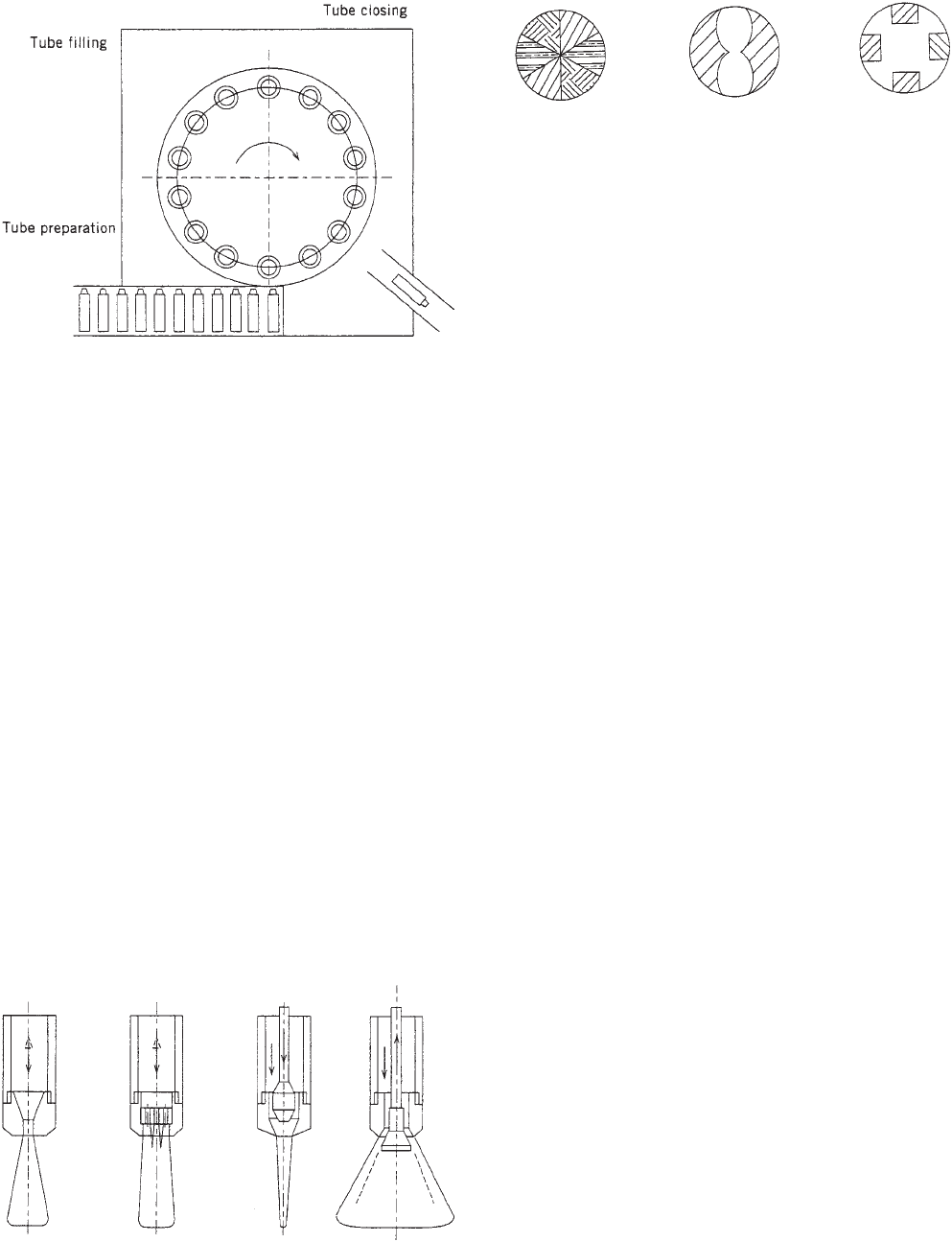
workstation (Figure 1). The tube is put into vertical
position and pushed into the tube holder. For safe opera-
tion, the tube should not be dropped by gravity. The
preferred method is tipping of the tube by suction blocks
into the tube holders and vacuum cups for tube discharge.
A rotary turret, driven by a Ferguson-type indexing gear,
which runs in an oil bath ensures precise positioning of
the tube through the workstations. This method guaran-
tees safe and maintenance-free operation for many years.
Tube Preparation. Several machine stations perform
different functions prior to filling and are as follows:
. Checking for presence of cap and cap tightening by
means of sensors and adjustable clutches or torque-
controlled motors.
TUBE FILLING 1251
. Checking for damage to the open end of the tube by
mechanical or photoelectric sensors.
. Cleaning of the tube by clean-air blast and vacuum;
also purging of the tube with inert gas to reduce the
amount of residual oxygen in the filled tube.
. Printing registration and code verification by means
of photoeyes and scanners. Tubes are rotated and
adjusted by means of clutch brakes or servomotors.
Ink-jet coding of the tube can be done while the tube
is rotating.
Tube Filling. The tubes are filled by a filling nozzle that
dives into the tube before the filling process. As the
material is discharged from the nozzle, the nozzle is
retracted out of the tube, keeping a constant distance
between the nozzle outlet and the rising level. This
relative movement between the tube and the filing system
ensures continuous filling without air entrapment. After
the predetermined amount of filling material has been
discharged, the filling material, which in most cases tends
to string, has to be cut off and—depending on the behavior
of the material—several different nozzle-cutoff systems
are available (Figure 2).
Most tubes are filled with a single product. But more
applications have developed, mostly in the toothpaste
industry, where two or three different components arranged
in stripes over the whole tube length have to be filled. This
so-called deep-stripe filling system is becoming more popu-
lar than the conventional surface stripes (Figure 3).
Although filling nozzle systems depend mostly on the
filling product, a basic common design for the dosing
system is used, which comprises a volumetric pump dos-
ing system consisting of cylinder and piston with two
valves or a three-way rotary valve. One of the most critical
parts of this system is the seal between the piston and the
cylinder. For abrasive products such as toothpaste, the
necessary sealing materials must be carefully selected.
The typical cup seals made from polyurethane, Viton,
PTFE, or polyethylene are subject to wear and have to
be replaced at regular intervals. As an alternative, cera-
mic components can be used. Unlike ceramic coatings,
solid ceramic parts (e.g., aluminum oxide) have absolutely
no pores and combine very high hardness and resistance
to wear with excellent chemical resistance and food-grade
characteristics.
Parts in contact with the filling material in tube fillers
easily can be dismantled, cleaned, and sterilized. To avoid
any risk of microbiological contamination during assembly
of a clean system, the assembled unit can be sterilized in
place. These so-called clean-in-place (CIP) systems are
used more and more in the pharmaceutical industry.
Tube Closing. Different materials require different
types of closure. Normally, most tube fillers are equipped
for one type of tube closure.
TUBE TYPES
Metal Tubes. Metal tubes are closed by folding, which
means that the tube end is flattened and folded over.
Various types of fold are possible: double fold, four fold,
and saddle fold (Figure 4).
The actual folding process is carried out by two folding
jaws and a hinged folding tool. For the required precision
and speed, the system is cam-driven. In many cases, a
latex or heat-sealable lacquer is applied inside the fold
area for a hermetic seal.
Foil Laminate Tubes. The safest method of sealing plas-
tic tubes with a thin aluminum foil layer is high-frequency
sealing. High frequency generates an eddy current in the
aluminum layer, which heats up the aluminum and the
neighboring plastic layers (Figure 5).
Plastic Tubes. Today the most common tube material is
plastic. Originally polyethylene was used in a single layer
and the tubes were sealed between heated jaws as shown
in Figure 6. The system applies heat on the outside of the
Figure 2. Different types of nozzle systems.
Figure 3. Cross sections of deep-striping.
Figure 1. Tube handling.
1252 TUBE FILLING
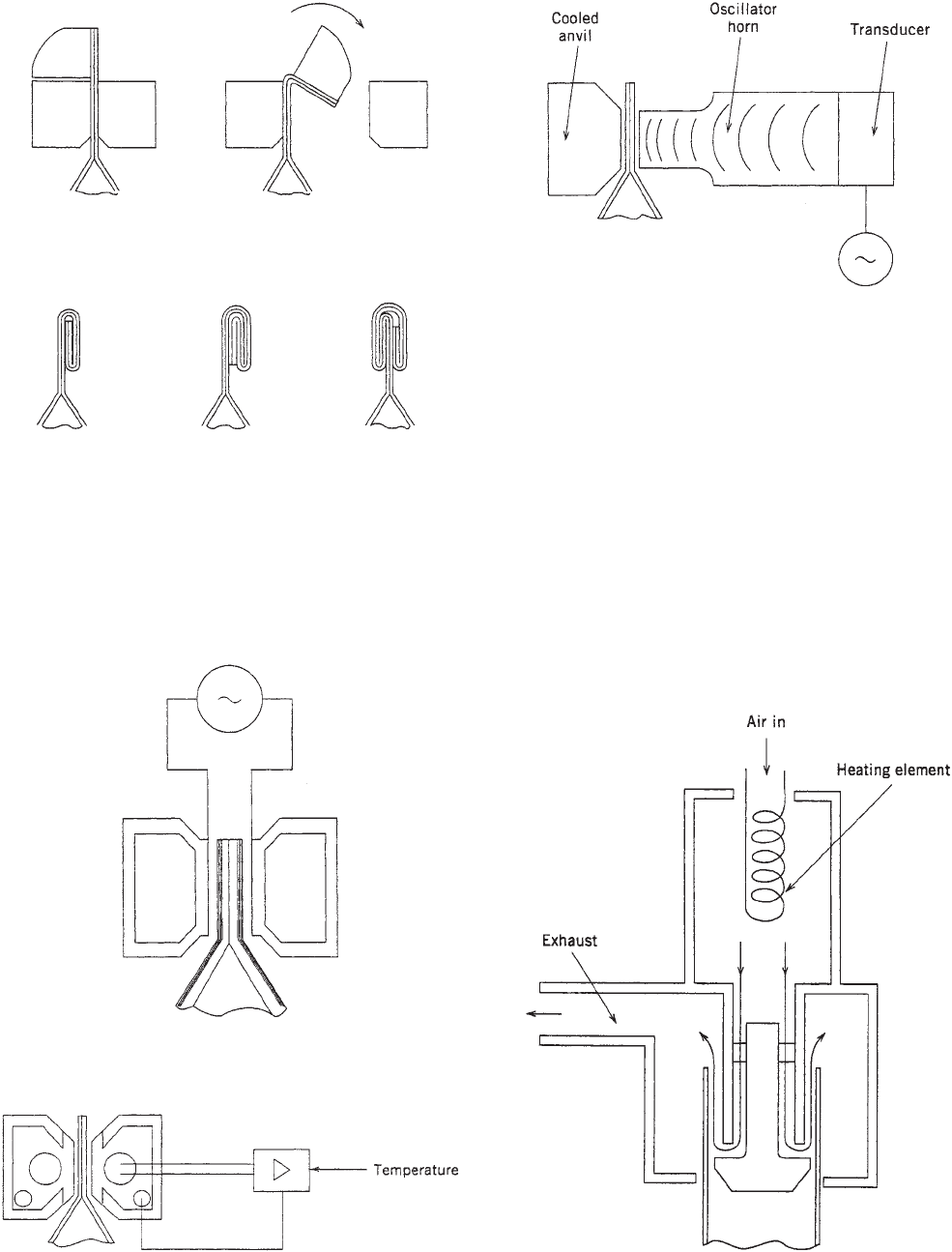
tube to heat to the inside for sealing. This process is less
efficient than high-frequency sealing, where the heat is
generated directly at the inside layer to be sealed. Conse-
quently, the hot-jaw system requires a longer heating time
and, therefore, a reduced cycling speed. This reason is why
this system is hardly used today in new machines.
Another method for closing plastic tubes is ultrasonic
sealing (Figure 7). This system applies mechanical vibra-
tion to the outside of the tube, which induces friction,
which—in turn—generates heat to seal the tube. This
sealing method is suitable only for moderate speeds.
Because of the above-mentioned restrictions, the pre-
ferred method for sealing laminated and plastic tubes
today is hot-air sealing. This system heats the seal area
inside the tube by hot air. In a subsequent station, the
tube is then pressed and chilled (Figure 8). The system is
suitable for speeds well in excess of 100 min
1
.
The pressing station for the hot air system is also
necessary for the other types of tube closure. It provides
a tight seal and improves the aesthetics of the tubes, it
Figure 5. High-frequency sealing system.
Figure 7. Ultrasonic sealing system.
Figure 4. Metal tube folds.
Figure 6. Hot-jaw sealing system. Figure 8. Hot-air sealing system.
TUBE FILLING 1253

also is used to apply a code (i.e., batch number or expira-
tion date).
All modern packaging machines are equipped with
programmable logic controllers (PLCs) to control and
monitor all machine functions. Clear text displays are
used to guide the operator and to provide information
about the production process, such as machine speeds and
number of packs produced. Interface for data link for
central line controls are available.
TUBES, COLLAPSIBLE
CHRISTOPHER WHITE
The Tube Council of
North America
The collapsible tube, be they aluminum, plastic, or lami-
nate, is a most unique package allowing the user ease of
dispensing and, where necessary, application of product
directly to the area of use. The tube is a perfect package for
viscous products such as dentifrice, pharmaceutical
creams and ointments, cosmetic creams and gels, and
household and industrial products.
The tube definitely is a package for food products where
the contents can be conveniently used in precise amounts
when required. Examples of food products contained in
tube abound in the European and Asian markets. Exam-
ples such as tomato paste, fish and meat pate
´
, garlic paste,
and dessert toppings can be found in gourmet shops
around the world. But other food products in tubes may
include preserves, mustards, chocolate sauces, mayon-
naise, mustard, and cheese spreads. In short, the tube is
ideal for delivering the product to the consumer’s tooth-
brush or dinner table, given creative application and
packaging technology.
The Tube Council of North America reported that
Americans purchased nearly 15.0 billion tubes in 2003.
The market for products packaged in tubes continues to
grow fueled by new materials and the consumers hunger
for convenience in their life.
The first tubes, manufactured back in the mid-1800s,
were for artist colors. Shortly thereafter, in 1893, a dentist
by the name of Dr. Sheffield saw the convenience his
patients could enjoy if the tube could contain dental
cremes, replacing powders and the use of a rather un-
sanitary common jar—hence, the toothpaste tube with all
the benefits. The original tubes were produced from soft
metals, mostly tin or lead or an alloy of these. The
aluminum tube was introduced in the mid-1950s and
has been consistently improved in the years that followed.
Today, the metal tubes are predominantly aluminum. The
only tin tubes are for special pharmaceutical applications,
mostly ophthalmic. The 1170 Aluminum Alloy used by
tube manufacturers in North America is the highest
purity available. The 99.7% pure aluminum is virtually
free of trace substances and extrudes a seamless package.
New, high barrier internal liners and specially sealed
necks made the aluminum tube the package of choice for
products requiring an absolute oxygen barrier. Addition-
ally, aluminum tube decorations utilizing the metallic
surface add unsurpassed luster to the appearance of the
package (see also Decorating).
In the 1950s, metal tubes were joined by the plastic
tube. The immediate appeal of plastic was obvious to every
manufacturer of cosmetics and hair care products. The
plastic tube kept its ‘‘just home from the store’’ look
through its life in the bathroom or vanity. It could be
extruded in clear or colored resins to enhance the package
aesthetics. The plastic tube perfectly complemented the
aluminum tube and allowed the launch of a whole new
range of products not previously found in tubes.
In the early 1970s, laminate tubes joined their metal
and plastic cousins. The barrier properties of laminate,
coupled with the limited suck back of air accomplished by
the inclusion of an aluminum foil layer, gave laminate
greater product appeal for products such as toothpaste. In
the ensuing years the laminate tube effectively captured
the dentifrice market. It has now been selected to package
products as diverse as mayonnaise and vaginal cream.
The laminate tube surface may be printed on the web,
allowing an eye-catching graphic presentation, even in-
cluding scenic images or the human likeness.
THE METAL TUBE
The aluminum tube production process starts with an
aluminum slug roughly varying in size from a dime to a
silver dollar. The slug will be the approximate diameter of
the tube and the slug thickness predetermined to mini-
mize trimming to the length prescribed by the customer.
The slug will either be a donut, having a center hole, or a
solid. The solid slug is most often used to extrude a one-
piece tube with an integral diaphragm forming the tam-
per-evident sealed neck feature. The tube manufacturer
may elect to use flat or dished slugs, depending upon the
design of their production equipment and tooling.
State-of-the-art aluminum tube production line com-
monly run at speeds varying from 200 to 500 tubes per
minute. The slug is impact extruded one up; that is,
one tube is made one at a time, three times per second.
Aluminum tube lines are readily available from machin-
ery suppliers in Europe, including Polytype and
Hinterkopf.
The aluminum tube is formed by impact extrusion
accomplished horizontally. The tube slug is first tumbled
with a lubricant, generally zinc stearate, USP. It is then
fed into position in from of the shaft, and the press moves
forward with an impact forces of 80–100 tons, depending
upon the diameter and, to a lesser extent, the thickness of
the slug, which prescribes the length of the tube. A section
of the typical tooling setup is shown in Figure 1. The male
tool head matches the inside profile of the final tube. The
largest diameter is only
1
32
1
16
in. (0.8–1.6 mm) long, after
which it tapers back to a diameter that runs around 0.008
in. (0.2 mm) smaller than the tip. The clearance between
the male tool and the female cavity establishes the wall
thickness of the tube sleeve.
1254 TUBES, COLLAPSIBLE
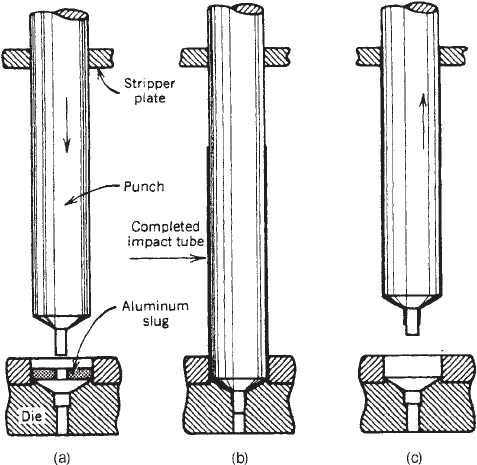
The slug is automatically fed into the cavity and is
compressed by the male tool as it moves down. The first
portion of the stroke seats the slug and takes up the
bearing slack of the press. The balance of the stroke
cold-works the slug, forming the head of the tube. As the
plunger continues moving down, the excess metal is
extruded out around the sides of the plunger, forming
the body. Since the metal never reaches its melting point,
the body is cold enough to maintain its shape and addi-
tional support from the tooling beyond the head area is not
required. As the plunger moves back at the end of the
stroke, the completed tube is stripped off, falling into a
transfer conveyor, which takes it to the trimming opera-
tion. Here, the body is trimmed to exact length, cap
threads are rolled onto the neck, and the mouth of the
tube is trimmed.
By now the tube has been severely work-hardened and
has the feel of an aluminum can. To relieve this hardness,
it is annealed in an 11001F (593 1C) oven and cooled, after
which a spray application of a product-resistant lining is
applied. A number of tough epoxy–phenolic or acrylic
lacquers are available that not only resist the attack of
the product but can be creased without chipping or peeling
from the ???. ‘‘After the internal lining has been cured, ???
with either a white or colored base coat, usually enamel or,
optionally, an acrylic, polyurethane, ??? gives an opaque
printing base to the tube sidewalls. The shoulder of the
tube may also be coated to complete the look desired.
Another base sidewall coating involves the use of clear or
translucent lacquers that utilize the aluminum surface to
achieve a metallic appearance.’’
Metal tubes are printed by a dry offset process (see
Decorating; Printing) using either thermally or UV-cured
inks (see Curing; Inks). The tube is pushed on a mandrel
and rolled past a curved printing blanket, which applies
up to six colors simultaneously. The tube now goes
through a final drying cycle to cure the ink, after which
the cap is applied and the tube is automatically packed in
boxes for shipment, usually nested in a dividerless tray,
for shipment to the customer.
PLASTIC TUBES
The first practical plastic-tube patent was issued in 1954
(1). The patent covered the process of making a thin plastic
sleeve by an extrusion method (see Extrusion) and then
injection-molding (see Injection molding) a head on one end
to produce a tube. Modern equipment has improved but
has not changed the basic Strahm concept.
Many plastics can be used to make plastic tubes; LDPE,
MDPE, HDPE, LDPE are the primary materials used
today (see Polyethylene, Low-Density). It has high-moist-
ure-barrier properties, low cost, and good appearance. Its
lack of oxygen and flavor barrier have been improved with
barrier coatings. It was the development of a barrier
coating by American Can Co. that made the plastic tube
a practical container for general packaging.
HDPE (see Polyethylene, High-Density) is used for
packaging some hydrocarbon-based products such as
grease, and PP (see Polypropylene) is used for applications
requiring nonstraining, better perfume barrier, or higher
temperature resistance. Both HDPE and PP are much
stiffer than LDPE for tube sidewalls and are not as
popular.
COEX tubes, a coextrusion of EVOH and polyethylene,
has been demonstrated to have excellent barrier proper-
ties enabling manufacturers of products that are ad-
versely affected by air or moisture transmission the
option of using the plastic tube. It was quickly adopted
by toothpaste manufacturers where flavor loss in conven-
tional plastic tubes was unacceptable. The COEX tube is
often specified with a stand-up hinged cap. The COEX
tube, otherwise, has all the functions of plastic.
The selection of a suitable plastic for producing a tube
is critical to its performance. DuPont Alathon 2020T, a
0.92-g/cm
3
-density resin with a melt index of 1.0, is the
primary LDPE resin used by all tube manufacturers in the
United States. It has good processibility, excellent stress-
crack resistance to product attack, and an extremely low
gel content, which reduces surface irregularities that
would affect printing quality.
Plastic tubes are produced by two principal methods in
the United States: the Strahm method and the Downs
method. Both processes make excellent tubes.
Production of the tube begins with the extrusion of
continuous thin-walled tubing (2). This has a wall thick-
ness of 0.014–0.018 in. (0.35–0.46 mm), depending on the
diameter. A standard extruder is used with a thin-walled
tubing die. As the hot plastic emerges, it is corona-treated
(2) (see Surface Modification) for later printing-ink adhe-
sion. At the same time, it is drawn over a chilled internal
forming mandrel and cooled on the outside with cold
water. The tube cools and shrinks to an accurately con-
trolled diameter as it is drawn off. After it has passed
Figure 1. Impact extrusion of a metal tube: (a) beginning impact
stroke; (b) bottom of stroke, (c) beginning to strip. (Courtesy of
Herlan & Co.)
TUBES, COLLAPSIBLE 1255
through the drive rolls of the haul-off unit, it is cut to exact
length with a rotary knife cutter. This piece is called a
sleeve to differentiate it from the completed container,
which is called a tube.
Printing can be done before or after heading. The
location is based on the layout and the relative scrap
generated in printing and heading. All tubes are printed
by dry offset printing. The same type of printer used for
metal tubes is used for plastic sleeves. Thermally dried
and UV-dried inks are available in a full range of colors.
Good-quality process printing is possible, and for cosmetic
applications, postdecoration with hot-stamp foils or silk
screening is popular (see Decorating).
After the ink has cured, the sleeves are roller-coated
with a high-gloss, oxygen- and flavor-barrier coating.
High-barrier, two-component amine-cured epoxy coatings
are available that reduce the overall tube permeability by
a factor of 10. Special coatings more resistant to product
staining or having lower coefficients of friction are also
used. Most coatings are thermally cured, but UV-curable
coatings are beginning to be used. These provide equally
high barriers to oxygen and essential oils and cure more
quickly. After the coating is cured, the completed sleeves
are headed.
The head of a plastic tube must be compatible with the
sleeve in order to produce a good bond. Sleeves made of
LDPE can be headed with LDPE or HDPE, but PP sleeves
must have a PP head. Head thickness is 0.030–0.065 in.
(0.76–1.65 mm), depending on tube diameter and
application.
The Strahm heading process traps the top end of the
sleeve in an injection mold and injects plastic into the
cavity to form the head and bond it to the sleeve. The
process is done with multiple tools at each station. Slower
machines have a female tool that remains in the injection
station, and the tube is held there until it has cooled
sufficiently before moving to the next position. The higher-
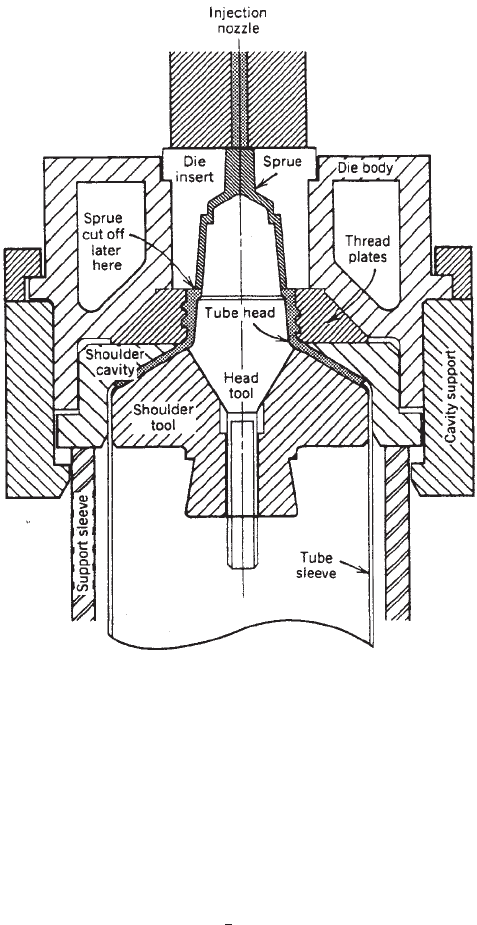
speed machines have locked-die tooling, as shown in
Figure 2. The male tool containing the sleeve is pushed
up into the shoulder cavity. The end of the sleeve enters
the shoulder cavity, rolling in slightly as it touches the
radius of the shoulder. At the same time, the support
sleeve, which moves with the male tool, contacts the
shoulder cavity, lifting it up against the thread plates.
This forces the plates together in the position shown in
Figure 2. The injection nozzle now closes on the assembly,
and molten plastic from a small reciprocating-screw ex-
truder is injected to form the head and bond it to the
sleeve. Injectioncavity pressures are low since excessive
pressure causes ‘‘blowby,’’ forcing plastic past the head
area and down the sleeve wall. Melt temperature of the
plastic is generally over 5001 F (260 1C), high enough to
ensure a good fusion seal to the sleeve wall. After the
injection cycle, the nozzle retracts. The tooling remains
locked together and continues to the next station. After
the head cools, the male tool drops, the thread plates open,
and the completed tube is released, remaining on the male
tool. The die body and cavity support move off to one side
to allow the completed tube to be extracted. A new sleeve
is then placed on the tool, the female tooling moves over
the top of the male tools, and the cycle is repeated.
After cooling, the completed tube is transferred to a
snipper-capper. Here, the sprue is removed and a cap is
applied, after which the tube is packed in unpartitioned
trays for shipment to the customer.
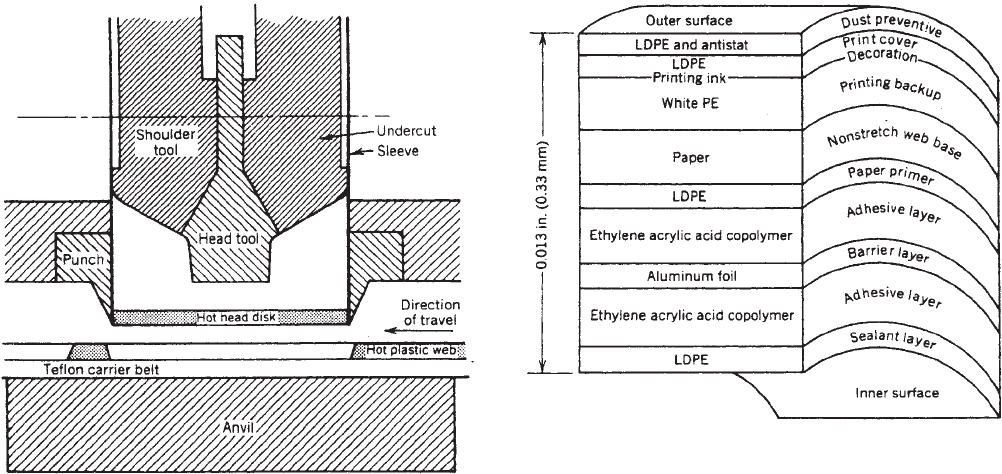
In the Downs process (3, 4), the sleeve production is the
same but the heading process is considerably different. As
shown in Figure 3, the sleeve on its male tool enters a
punch, which is placed just above a continuous strip of
LDPE heated to well above its softening point. This strip
is ~2 in. (51 mm) wide and
1
8
in. (3.2 mm) thick. When the
leading edge of the sleeve is about flush with the cutting
edge of the punch, both parts move down into the semi-
molten mass below. The punch forms a disk of plastic the
diameter of the sleeve, and the sleeve inside the punch
immediately adheres to it. The tool moves up, carrying the
sleeve bonded to the hot plastic disk and indexes to the
next station. Here, the female tool closes on the sleeve and
head disk, compression-molding the head into its final
shape. The compression-molding method eliminates the
sprue and the snipping operation necessary with the
Strahm process.
More recent commercial Downs machines have multi-
ple heads at each station to make a number of tubes
simultaneously.
A third process, developed by KMK (Karl Magerle AG
Hinwil, Switzerland) (5), injects a ‘‘donut’’ of molten plastic
in the female cavity before it closes on the male cavity. The
head is formed by compression molding. The Magerle
Figure 2. Strahm heading method.
1256 TUBES, COLLAPSIBLE
machines are small, with only one tool per station, but they
also incorporate capping on the same turret.
Although these are the most common methods, other
processes have been developed. In Europe, the Valer Flax
process (6) uses a premolded head that is spin-welded to
the sleeve. Several companies have developed blowmold-
ing methods (7) where the tube is blown as a bottle and the
bottom is trimmed off. This approach generates a high
amount of scrap that must be put back into the process,
and care must be taken to maintain uniform wall thick-
ness for the later printing step.
LAMINATED TUBES
In 1971 Procter & Gamble switched their Crest dentifrice
to a laminate tube. The laminated material (see Laminat-
ing Machinery) consisted of seven layers with paper,
plastic, and foil acting as the barrier. The foil was far
superior to the plastic tubes then available and minimized
flavor loss to acceptable levels. The laminate replaced the
lead tube then being used by P & G for Crest.
The chief difference between this package and the
plastic tube is the sleeve, made from preprinted laminate
web (8, 9). It contains up to 10 layers, each contributing to
the function of the structure. Figure 4 shows the material
in each layer and describes its use. The complete laminate,
0.013 in. (0.33 mm) thick, is produced on an extrusion
laminating line (10). This web is made in large rolls that
are slit into the proper width for the tube being made. The
slit rolls are shipped to the tube plant, where they are
formed into sleeves. The sleeve has an impermeable
aluminum layer, so the only permeation is along the
seam overlap.
The seaming process takes the flat web, folds it into
cylindrical form, and seams it to form a continuous
tube (11). The seam must protect the raw edge of the
foil; this is achieved by overlapping the edges of the sleeve,
then heating and compressing the overlapped portion
to squeeze some of the plastic out around the raw edge
of the foil and paper. After the sleeve has been seamed,
it is cut to length using the print registration marks on
the web.
The presence of aluminum foil in the sleeve permits use
of rf energy for induction heating (12). This is preferred in
the seaming process because it permits better control of
heat distribution.
To take full advantage of the vastly improved barrier
properties of the laminated sleeve, an oxygen and flavor
barrier is necessary in the head area. This is accomplished
with a premolded insert (13) of polybutylene terephthalate
(PBT), which has good oxygen- and flavor-barrier proper-
ties, can withstand the injection pressures and tempera-
tures of the heading plastic, and does not crack in the
head. Urea inserts are also used. The insert is placed on
the heading tool before the sleeve is placed in position, and
the head plastic locks the insert in position as it bonds to
the sleeve. The resultant tube has some permeation
windows along the sleeve seam and the area where the
head bonds to the sleeve, but the result is still a very low
gas and flavor permeability.
Alternative methods of producing laminated stock and
tubes have also been developed, as well as alternative
materials.
The American Can approach for seaming requires the
axis of the tube to be parallel with the length of the
laminated web (11). KMK has developed another system
(14), where the axis of the tube is perpendicular to the
web. In this process, the blank is cut from the web and
wrapped around a fixed mandrel and sealed. KMK uses
the heading process described under the plastic tube
section above.
Another Swiss manufacturer, AISA (Automation In-
dustrielle SA), has produced a machine using premoled
Figure 4. Typical structure of a laminate toothpaste tube.
Figure 3. Downs process; head disk just after blanking out.
TUBES, COLLAPSIBLE 1257