
Yam, Kit L. (ed.). The Wiley encyclopedia of packaging technology
Подождите немного. Документ загружается.

heads that are bonded to the sleeve with rf induction (15).
To ensure a good bond, a foil laminate disk, called a
rondelle (16), is placed over the shoulder of the tube.
The sleeve is butted against the rondelle, and the rf
bond is made. This approach still requires a urea or PBT
insert to act as a flavor barrier.
NEW TUBE CONCEPTS
The relatively recent appearance of ethylene–vinyl alcohol
(EVOH) (see Ethylene–vinyl alcohol) as a clear barrier
plastic has made possible the development of an all-plastic
barrier tube (see Barrier Polymers). Coextrusion methods
are available for producing laminates, and the Japanese
have produced coextruded sleeves and blow-moled barrier
tubes (7). The latter tubes have a continuous barrier; that
is, there are no higher permeation areas such as side
seams or head bonds. At present, the all-plastic barrier
tube is not economically competitive with a laminated
structure. EVOH costs about the same as aluminum foil,
so there are no material cost savings involved. The
advantage of being able to print flat web is an important
factor in the cost of the laminated tube which would
appear to limit the appeal of this new concept. However,
a significant drop in the price of EVOH relative to
aluminum foil or the development of a new market where
higher-barrier properties are required could quickly
change its importance. As well as the newest tube, poly-
foil, made by Plastube of Canada.
BIBLIOGRAPHY
1. A. Strahm, U.S. Patent 2,673,374, March 30, 1954 (to Amer-
ican Can Co.). (Describes basic heading concept.)
2. R. Brandt and J. Piltzecker, U.S. Patent 3,849,286, November
19, 1974 (to American Can Co.). (Details the sleeve extrusion
process.)
3. M. Downs, U.S. Patent 3,047,910, August 7, 1962 (to Plasto-
mer Development Corp.). (Offers good description of basic
Downs heading machine.)
4. R. Tartaglia, U.S. Patent 3,591,896, July 13, 1911 (to Peerless
Tube Co.). (Contains good drawings of the basic commercial
machine using the Downs process.)
5. K. Magerle, U.S. Patent 4,352,775, October 5, 1982 (Shows
Magerle heading process.)
6. V. Flax, U.S. Patent 3,824,145, July 16, 1984 (to Continental-
plastic AG). (Contains good drawings of spin-welding method
of heading.)
7. M. Yamada, T. Sugimoto, and J. Yazaki, U.S. Patent 4,261,482,
April 14, 1981 (to Toyo Seikan Kaisha, Ltd. and Lion
Hanigaki Kabushiki Kaisha). (Describes blow-molded tube
with EVOH barrier.)
8. R. Brandt and R. Kaercher, U.S. Patent 3,260,410, July 12,
1966 (to American Can Co.). (Shows basic laminate structure.)
9. R. Brandt and N. Mestanas, U.S. Patent 3,347,411, October
17, 1967 (to American Can Co.). (Basic article patent of
laminated tube.)
10. D. Haas, U.S. Patent 3,505,143, April 7, 1970 (to American
Can Co.). (Shows laminating process.)
11. A Grimsley and C. Scheindel, U.S. Patent 3,388,017, June 11,
1968 (to American Can Co.). (Describes side seaming of
laminated sleeves.)
12. W. Gillespie and H. Inglis, U.S. Patent 4,210,477, July 1, 1980
(to American Can Co.). (Illustrates rf induction seaming coil
design.)
13. A. Grimsley, U.S. Patent 3,565,293, February 23, 1971 (to
American Can Co.). (Describes head inserts.)
14. U.S. Patent 4,200,482, April 29, 1980 (to KMK AG). (Shows
Magerle side seamer.)
15. G. Schmid and R. Jeker, U.S. Patent 4,123,312, October 31,
1978 (to Automation Industrielle SA). (Shows AISA seaming
and heading process.)
16. A. Kohler, U.S. Patent 4,448,829, May 15, 1984 (to Automa-
tion Industrielle SA). (Shows AISA rondelle.)
General References
N. L. Ward, ‘‘Cold (Impact) Extrusion of Aluminum Alloy Part,’’ in
T. Lyman, ed., Metals Handbook, Vol. 4, 8th edition, American
Society for Metals, Metals Park, OH, 1969, pp. 490–494.
(Discusses impact extrusion of aluminum in general, with
little specific information on tubes.)
ASTM Committee on Aluminum and Aluminum Alloys, ‘‘Intro-
duction to Aluminum’’ in Metals Handbook, Vol. 2, 9th edition,
American Society for Metals, Metals Park, OH, 1979, pp. 3–23.
(Briefly refers to aluminum alloys.)
Packaging in Plastic and Glaminate Tubes, Washington Technical
Center, American Can Co., Washington, NJ. (A nontechn-
ical presentation of the manufacture of tubes and a good
write-up on the problems of packaging in tubes and what to
look for.)
Patents Describing the Strahm Process Of Heading, All
Ultimately Assigned to American Can Co.
A. Strahm, U.S. Patent 2,713,369, July 19, 1955 (Illustrates
sections of tube head and sleeve.)
A. Quinche and E. Lecluyse, U.S. Patent 2,812,548, November 12,
1957 (Shows the concept of split-thread plates.)
A. Quinche, U.S. Patent 2,994,107, August 1, 1961 (Describes first
stationary-die heading machine.)
1258 TUBES, COLLAPSIBLE
V
VACUUM PACKAGING
RICHARD PERDUE
Taylor, South Carolina
From World War II came plastics, the wide commercial
application of mechanical refrigeration, self-service super-
markets, the superhighway system, and a growth econ-
omy. During the late 1940s, Dewey and Almy Chemical
Company purchased the patent and brought a new and
unique French packaging development to the United
States. The first significant commercial application of
this concept was for vacuum packaging of whole turkeys
using rubber stretch bags. These were soon replaced with
PVDC shrink bags. The concept led to the wide commer-
cial use of vacuum packaging for perishable (refrigerated
and frozen) food: the Cryovac (registered trademark)
vacuum-packaging process. In the Z45 years since,
many individuals and companies have contributed to the
technical advancement and wide successful commercial
use of vacuum packaging for the preservation, distribu-
tion, and marketing of perishable foods. In future annals
of history, vacuum packaging of perishable foods in flex-
ible and semirigid plastic films should be ranked right up
there with canning, pasteurizing, and quick-frozen foods
as a technological breakthrough that contributed greatly
to improving the quality of life for humankind!
Vacuum packaging involves the placing, either manu-
ally or automatically, of a perishable food inside a plastic
film package and then, by physical or mechanical means,
removing air from inside the package so that the packa-
ging material remains in close contact with the product
surfaces after sealing.
Packaging in this manner, depending on the product
being packaged the barrier properties of the packaging
material, the level of air removal, and storage tempera-
ture, can substantially retard chemical and/or microbial
deterioration of the food product. In many instances, this
dramatically extends eating quality life.
AIR-REMOVAL SYSTEMS AND PACKAGING EQUIPMENT
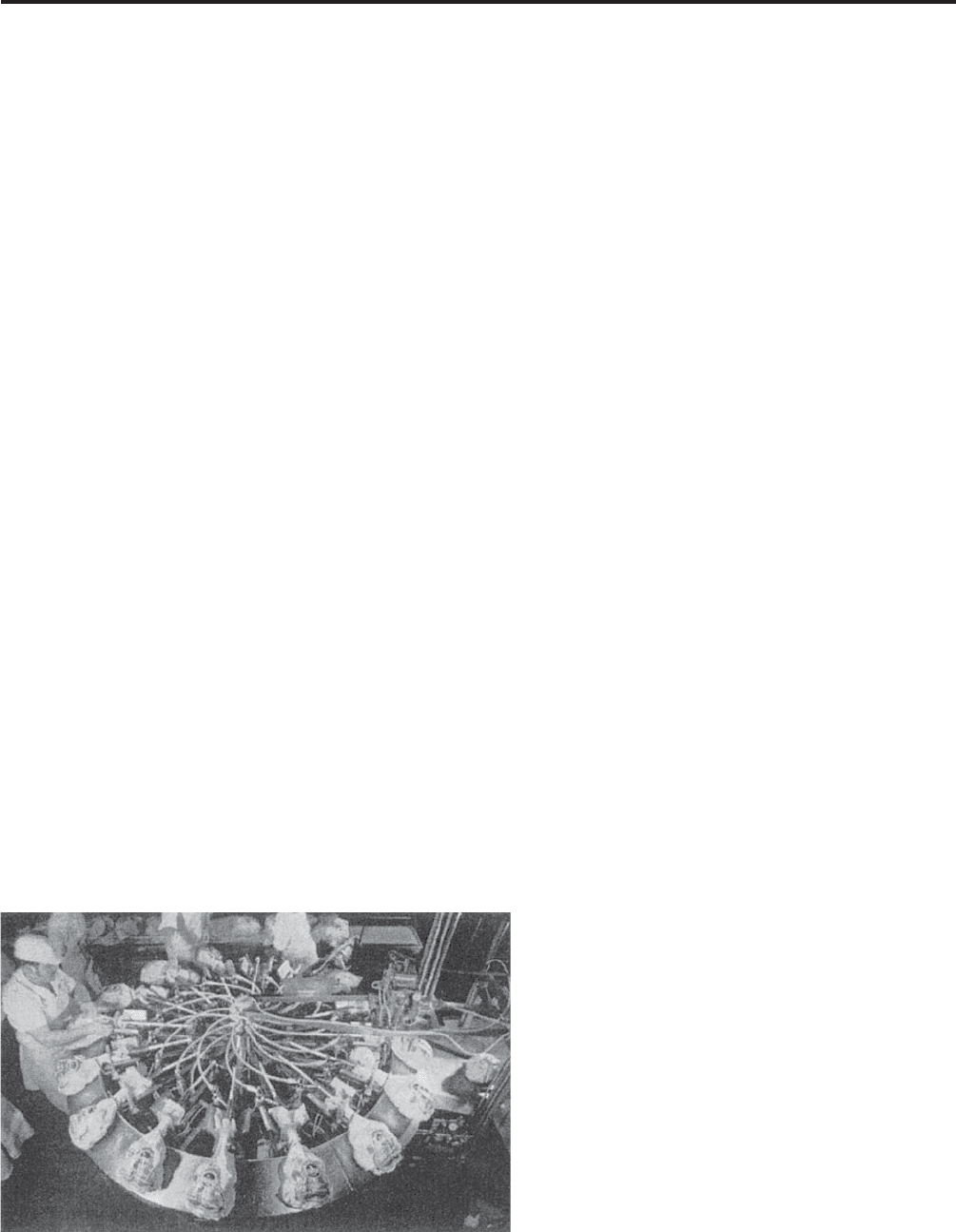
Nozzle Vacuuming. Using this method of air removal,
a nozzle connected to a vacuum pump is inserted inside
the open end of a preformed bag or pouch (see Figure 1).
The vacuum or air removal level using the nozzle system
is seldom high, as the packaging material (depending on
its modulus) quickly collapses onto the product surface
and blocks significant air removal. Today, nozzle vacuu-
mizing is widely used for packaging whole fresh and
frozen poultry, fresh-cut vegetables and bulk packaging
of fresh meats, poultry, fish, processed meats, nuts, and
so on.
For whole poultry, manual and high-speed rotary noz-
zle machines that provide an aluminum clip closure are
used. The twisting of the bag neck and clipping provides
for good whole-bird shaping and sealing under high-
moisture conditions. Nozzle vacuumizing provides for
good bag to product (bird) cling, without collapsing the
body cavity as can happen with high-vacuum-chamber
systems.
For cut vegetables and bulk packaging, manual and
semiautomatic nozzle vacuumizing combined with heat
sealing predominates.
Chamber Vacuumizing. Using this method, the product
is placed inside the flexible plastic film package, which is
loaded into the bottom section of a vacuum chamber
(Figure 2). Such systems usually consist of a top chamber
and a bottom chamber. The chamber is closed, and a high
vacuum is [in both cubic feet per minute (cfm, i.e., mL/
min) and inches of mercury (in. Hg)] drawn on the
chamber both inside and outside the package. Some
chambers are usually vacuumized to Z29 in. Hg.
Figure 1. Nozzle vacuuming.
1259
Chamber vacuumizing machines generally employ
heat-seal closures and are available from manual through
fully automatic rotary high-speed units. Such equipment
uses shrink bags and laminate pouches. They are widely
used to package fresh primal and subprimal meat cuts,
smoked and processed meats, and natural cheeses. Some
chamber units are also available that provide an alumi-
num clip closure inside the chamber.
Two other widely used chamber vacuumizing systems
use rollstock films rather than preformed bags and
pouches: thermoforming and vacuum skin packaging
(VSP).
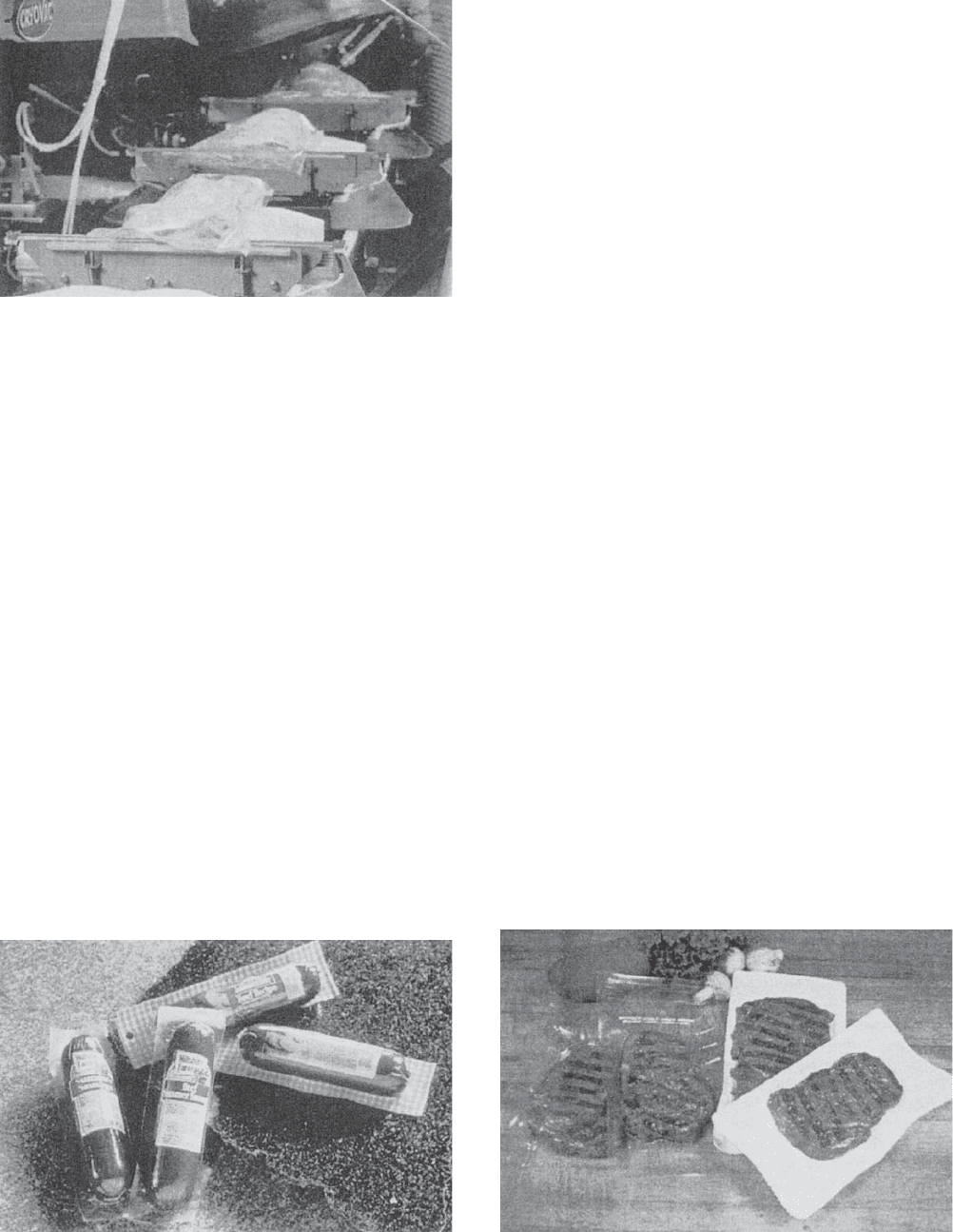
Thermoforming. Thermoforming vacuum-packaging
machines dominate the packaging of consumer units of
wieners, sliced luncheon meats, sliced bacon, smoked
sausages, and some natural cheeses (Figure 3). Such
machines operate using two rolls of multilayer (usually
high-O
2
-barrier) plastic film (top and bottom webs). The
operation of a thermoforming machine involves feeding
the bottom web into the machine by clamping the web by
its edges and indexing it either (a) over a continuously
moving train of thermoforming dies (pockets) or (b) in a
parallel set of clamping chains that first indexes
the bottom web over a thermoforming station. In both
web-handling modes, the bottom web is heated, then
vacuum and/or pressure formed.
The product is manually or automatically loaded into
the formed pockets. The top web is then fed down over the
bottom web between the two halves of the vacuum-sealing
chamber. The two halves of the chamber close and a high
vacuum ( Z29 in. Hg) is drawn on both sides of both webs
and around the product. When the desired vacuum level is
reached, the webs are heat-sealed together. The cham-
ber(s) is (are) vented to atmosphere, opened, and the
packages indexed out the machine and slit into individual
units (see the Thermoforming article).
Vacuum Skin Packaging. There are great similarities
between VSP (Figure 4) and thermoforming machines,
with the primary differences involving how the forming
web (bottom web in thermoforming and top web in VSP)
is thermoformed and the plastic film structures used.
Like thermoforming in an automatic VSP machine, the
bottom web is fed through the machine by a parallel set
of clamping chains. The bottom web may or may not be
thermoformed slightly. It can be an oxygen barrier,
nonbarrier flexible, or semirigid web. Again, as with
thermoforming, the product is loaded onto the bottom
web, a top web is fed down over the bottom web, and
both are indexed between the two halves of a vacuum
(skin) packaging chamber (see the Skin packaging
article).
As the top web is fed down and into the VSP chamber, it
is heated and may be partially thermoformed to fit over
the product. When the chamber closes, the bottom web is
pulled against the bottom of the VSP chamber with a high
vacuum. The top web is either (a) suspended over the
product by drawing an equal vacuum over both sides of
the web and around the product or (b) is drawn against the
heated surfaces of the upper half of the VSP chamber by a
high vacuum, and the area around the product between
the top and bottom webs is vacuumized. When the desired
vacuum level is reached, the vacuum to the top of the
chamber is vented to the atmosphere, and the heated top
web instantaneously thermoforms to the shape of the
product. At the same time, the two webs heatseal to
each other wherever they come in contact. The bottom
Figure 2. Chamber vacuumizing.
Figure 3. Thermoforming. Figure 4. Vacuum skin packaging.
1260 VACUUM PACKAGING
chamber half is then vented, and the packages index out;
they are slit into individual units as they do so.
Pressure. Probably the most simple means of producing
a vacuum or negative-pressure package is through apply-
ing pressure to the outside of a bag or pouch that contains
a product. Two methods have been used commercially. In
the early days of fresh-red-meat vacuum packaging, a
system of air removal involved holding a bag (with pro-
duct) by its open end and lowering it into a tank of water
so that the product was completely submerged with the
open end of the bag still above the water, which forced air
out. The open end of the bag was then gathered and closed
with an aluminum clip.
Another pressure method used with bags and laminate
pouches and today in packaging fresh cut vegetables is to
squeeze the air out with sponges and heat seal the
package prior to releasing the squeezing action of the
sponges.
Hot Fill. This process is used to package pumpable
prepared foods in flexible, oxygen-barrier plastic film
packages. By hot filling, usually above 1801F, steam is
present, which helps to exhaust air from the product and
headspace of the package just prior to sealing. Such
packages are then rapidly chilled, which creates a package
with a negative pressure inside (Figure 5).
Following is a discussion of each perishable-food cate-
gory with emphasis on why specific vacuum-packaging
systems are used to preserve, distribute, and market each.
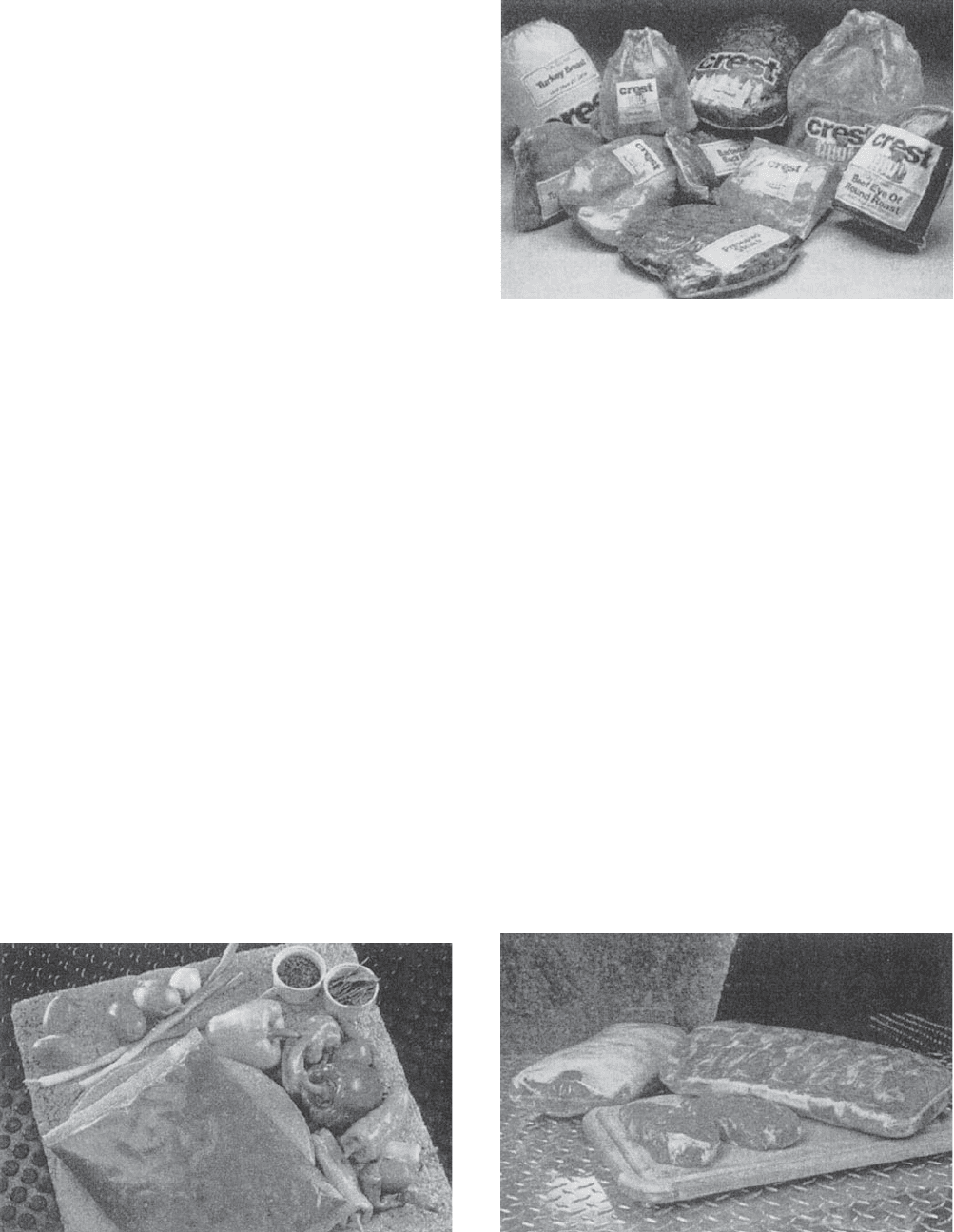
Poultry. Vacuum packaging of fresh poultry is done
primarily to retard the growth of aerobic spoilage bacteria,
and to provide an attractive leakproof (moisture) package
(Figure 6). When packaging fresh poultry, care must be
taken to avoid establishing conditions that support
the growth of H
2
S-producing bacteria. These bacteria
are commonly present on fresh poultry and grow best
above 341F and under low-O
2
conditions. Therefore, fresh
whole Rock Cornish, roasters, and turkeys are vacuum
packaged using O
2
-permeable shrink bags. Some cut-up
fresh poultry is now being vacuum-packaged using
thermoforming and O
2
-permeable structures. Some bone-
less/skinless parts are being vacuum-skin packaged.
As for frozen whole and portioned fresh poultry, va-
cuum packaging in O
2
permeable shrink bags dominates.
The bags are coextruded, multilayer polyolefin structures
with a modified polypropylene (PP) outer layer to provide
high gloss and freezer-case scuff resistance, and an
electron-beam crosslinked polyethelene (PE) inner layer.
This PE layer provides cold-abuse toughness, high hot-
water shrinkability, and both heat and clip sealability.
Good wrinkle-free film-to-product cling provided by the
vacuumized shrink bag is essential for attractive, frost-
free packages. A high oxygen barrier is not required as
frozen fresh poultry does not develop significant oxidative
rancidity during typical storage and distribution.
Fresh Red Meats (Beef, Pork, Veal, Lamb, and Venison).
Today about 90% of the fresh beef primal and subprimal
cuts shipped to food service and retail are vacuum-pack-
aged in high-oxygen-barrier shrink bags (Figure 7). Such
bags are made of coextruded materials consisting of an
outer EVA or linear low-density polyethylene (LLDPE)
layer, a PVDC barrier layer, and an electron-beam
crosslinked EVA or LLDPE heat-sealable/clipable inner
layer.
Figure 5. Hot fill.
Figure 6. Vacuum packaging for poultry.
Figure 7. Vacuum packaging for red meat.
VACUUM PACKAGING 1261
Most fresh-red-meat (FRM) vacuum packages are pro-
duced on high-speed, high-vacuum, heat-sealing rotary
chamber packaging machines. For bone-in FRM cuts, bags
are available with bone-puncture-resistant patches lami-
nated to the outside. Veal and lamb cuts are also vacuum
packaged in this manner. The application of this technol-
ogy was slow to develop for fresh pork. Several years ago
the industry did start using this technology for boneless
loins and tenders. With the advent of the ‘‘boneguard’’
shrink bag, bone-in loins were successfully packaged. The
industry is now rapidly converting to shrink-bag vacuum
packaging of bone-in pork loins for retail distribution.
The ‘‘aging’’ of beef is a tenderizing process that takes
place as a result of naturally present enzymes. Vacuum
packaging was first applied to beef by purveyors to age
steaks and roasts for the food-service industry. Beef could
be ‘‘aged’’ for up to 30 days without any significant shrink
or trim loss. It was then applied to beef (later to veal, lamb,
and pork) for retail, which dramatically improved the
distribution and marketing. In fact, this development
ultimately resulted in a total restructuring of the beef
industry. The preservation aspects of FRM barrier shrink
packaging are threefold: (a) retard the growth of aerobic
spoilage microorganisms, (b) prevent the chemical degra-
dation of myoglobin, and (c) minimize the loss of moisture.
As FRM is chemically alive and using some oxygen,
oxygen permeability below 200 mL/m
2
will shift the micro-
bial population from aerobes to facultative anaerobes
(lactic acid producing). To minimize myoglobin degrada-
tion and provide adequate red-color (oxymyoglobin) re-
generation and stability for retail display, oxygen
permeabilities below 50 mL/m
2
are required. Most of the
barrier shrink bags used today have O
2
permeabilities
below 30 mL/m
2
. As shrink bags are excellent moisture
barriers, the moisture loss of major concern is ‘‘purge’’
(free liquid that separates from the meat). The cut of FRM
packaged, temperature, and other product factors influ-
ence moisture separation.
From the package standpoint, the absence of minute
negative pressure voids or cavities is critical. The applica-
tion of high package vacuum to maximize film to product
surface cling, and excellent hot-water shrink to minimize
film wrinkles, provides for the least purge development.
Fresh ground beef and pork sausage are major FRM
product categories. Although not truly vacuum packaged,
they are pressure packaged in tubular oxygen-barrier
packages. Today, most packages for these products are
produced on vertical form/fill/seal machines that provide
metal clip closures. The films used are coextruded struc-
tures. For ground beef: PE or EVA/nylon/EVOH, nylon/PE,
or EVA with appropriate tie layers. For pork sausage: EVA/
PVDC/EVA.
For individually cut fresh and frozen steaks distributed
primarily to food service, thermoforming vacuum packa-
ging and vacuum skin packaging are widely used.
For fresh steaks, oxygen-barrier structures are required:
Thermoforming: nonforming web-biaxially oriented
nylon or PET/PVDC/LLDPE or Surlyn (DuPont)
Forming web: cast nylon/EVOH/LLDPE or Surlyn
Vacuum skin packaging: forming web—PVDC/Surlyn
or coextruded, electron-beam crosslinked LLDPE/
EVOH/LLDPE
Nonforming web, similar to the nonforming web used
in thermoforming
For frozen steaks, structures are similar to those used
for fresh except the PVDC or EVOH layers are left out.
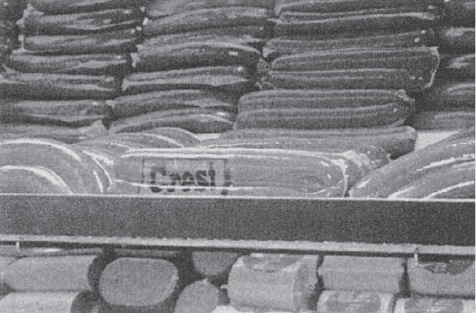
Cured, Smoked, and Processed Meats. This category
includes such products a wieners, bacon, hams, loaves,
smoked sausages, sliced luncheon meats, and corned beef.
Today such products are manufactured using both red
meats and poultry. These products are vacuum packaged
in high-oxygen-barrier materials to retard aerobic micro-
bial growth, prevent cured color degradation, and loss or
degradation of the cooked and smoked flavors and devel-
opment of fat rancidity (Figure 8). As chemical changes
are of greatest preservation concern, products in this
category are chamber vacuumized to minimize residual
O
2
within the packages. Wieners, sliced bacon, and sliced
luncheon meats are packaged using materials with O
2
permeabilities below 15 mL/(m
2
24 h). To prevent curing-
induced color degradation, they are generally packaged
using high-speed laminate rollstock thermoforing ma-
chines. The forming web is a coextruded or extrusion
structure consisting of nylon/PVOC or EVOH/Surlyn or
LLDPE with appropriate tie layers if coextruded. The top
layer will be polyester or oriented-nylon PVDC coated and
reverse-printed if desired; also it could be adhesive or
extrusion laminated to Surlyn or LLDPE sealant.
The larger units such as loaves, hams, and corned beef
are usually packaged using high-barrier shrink bags—
coextruded EVA, LLDE/PVDC/EVA, LLDPE (electron-
beam crosslinked). The packages are vacuumized and
heat sealed using high-speed rotary chamber machines.
Natural Cheeses. Vacuum packaging of cheeses for cur-
ing and for loaves and consumer units of cured cheeses
(Figure 9).
Figure 8. Vacuum packaging for cured, smoked, and processed
meat.
1262 VACUUM PACKAGING
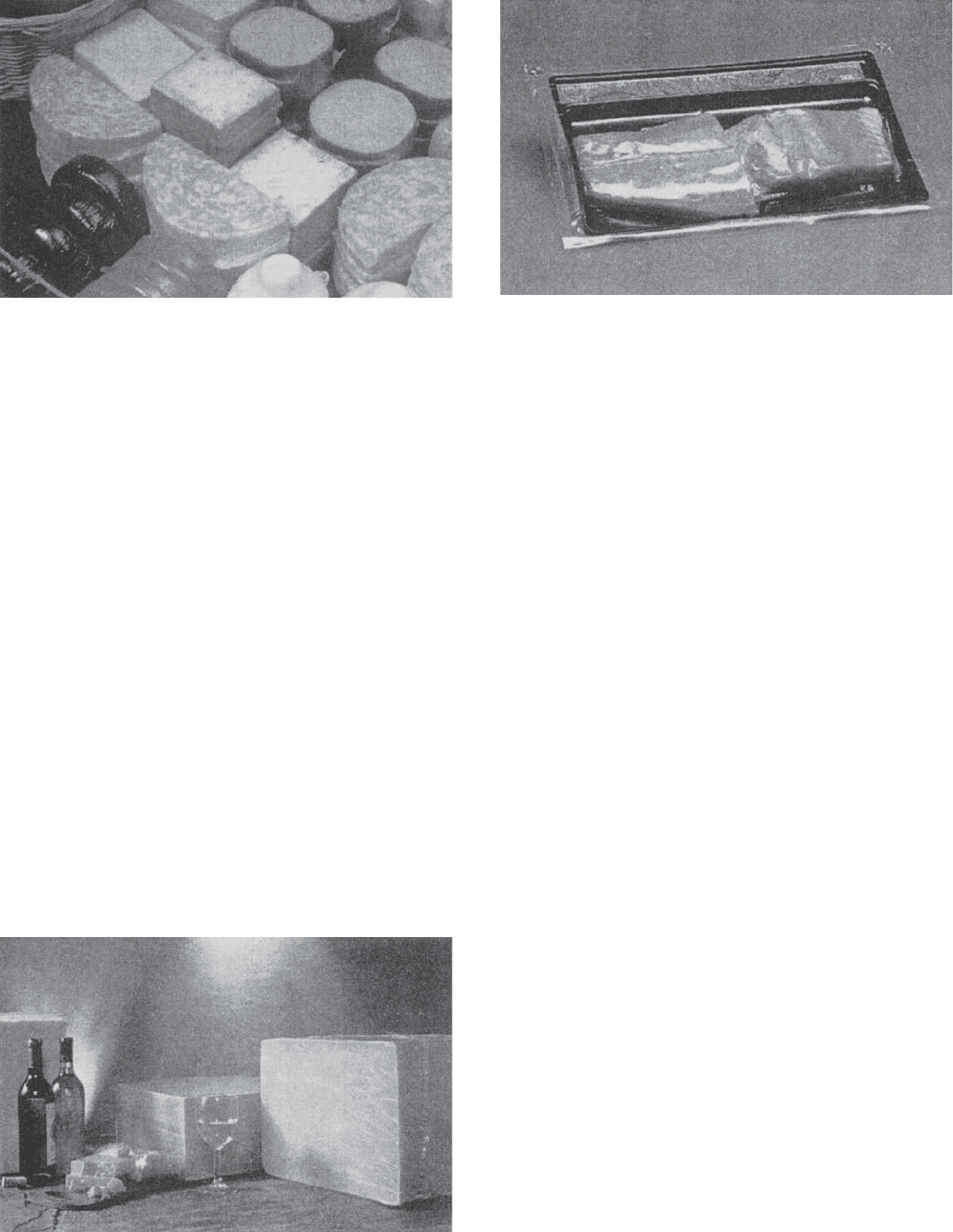
Curing. Cheddar cheese is formed into 40-lb rectangu-
lar blocks and vacuum packaged (chamber/heat sealed)
using oxygen-barrier shrink bags and laminate pouches
(nylon/LLDPE), then placed in strong, tight-fitting corru-
gated cartons for curing 90 days and longer. The vacuum
packaging inhibits mold growth and moisture loss while
allowing the non-gas-forming microbial curing to take
place. After curing, the 40-lb blocks are cut into consumer
units or used as manufacturing cheeses. Other non-gas-
forming cheese varieties such as Gouda are also cured in
this manner. More traditional shapes such as wheels,
horns, and sticks of non-gas-producing varieties including
Italian cheeses are cured using high-O
2
-barrier shrink
bags (see Figure 10).
For gas-producing cheeses (during curing) such as
Swiss, high-CO
2
-permeability shrink bags and nylon-
based pouches are used. The O
2
permeability has to be
kept below 250 mL/(m
2
24 h) to retard mold growth dur-
ing curing.
A unique application of shrink-bag vacuum packaging
is for curing of wheels of Blue and Roquefort cheeses. After
vacuum packaging and shrinking the barrier bag tightly
around the uncured cheese wheel, which has been inocu-
lated with the desired mold, long needles are forced
through the wheel and removed to provide air channels
to allow the mold to grow and develop the blue color.
Retail Units. Chunks, sticks, blocks, loaves, and half
moons of natural cheeses are vacuum packaged using O
2
-
barrier shrink bags and laminates using material struc-
tures and equipment systems very similar to previously
described for smoked, cured, and processed meats. For
cheese, such packaging is used to prevent mold growth,
retard light-catalyzed oxidation of the butter fat on the
surface, prevent surface color fading under display lights,
and minimize moisture loss.
Fresh and Frozen Fish. With the growth of spoilage,
bacteria can be retarded by vacuum packaging fresh fish
in oxygen-barrier films. In the United States, doing so is
looked on with disfavor by the U.S. Food and Drug
Administration (FDA). Clostridium botulin type C, which
is commonly found on fish, can grow under anaerobic
conditions at temperatures as low as 391F. This is well
within the refrigerated distribution temperature ranges
especially if abused. A vacuum-packaging system using
O
2
-permeable plastic films has been approved for im-
proved shelf-life packaging of fresh fish.
Vacuum packaging using O
2
-barrier shrink bags is
being used successfully for frozen Alaskan salmon to
replace ice glazing, to eliminate moisture loss (freezer
burn) and rancidity, and for frozen tuna loin storage and
transport to tuna-canning plants (Figure 11).
Fresh Produce. A new and rapidly growing end use for
vacuum packaging is fresh-cut vegetables. Much of the
food-service industry is on a fast track to remove the
preparation of fresh vegetables from the back of the
restaurant to central plants. The processing and ex-
tended-shelf-life packaging technology is now being ap-
plied to consumer packaging of such vegetables for retail
supermarket sales. When the natural skin is removed
from a vegetable or is cut in smaller segments (sliced,
diced, etc.), extended shelf life can be provided through
properly designed protective packaging. As fresh-cut ve-
getables are still alive and respiring, concern must be
given to providing adequate O
2
and for release of the CO
2
produced. Fresh vegetables have been classified according
to their respiration needs into three general groups as
shown in the following table.
Figure 9. Vacuum packaging for natural cheeses.
Figure 10. Curing.
Figure 11. Vacuum packaging for fresh and frozen fish.
VACUUM PACKAGING 1263
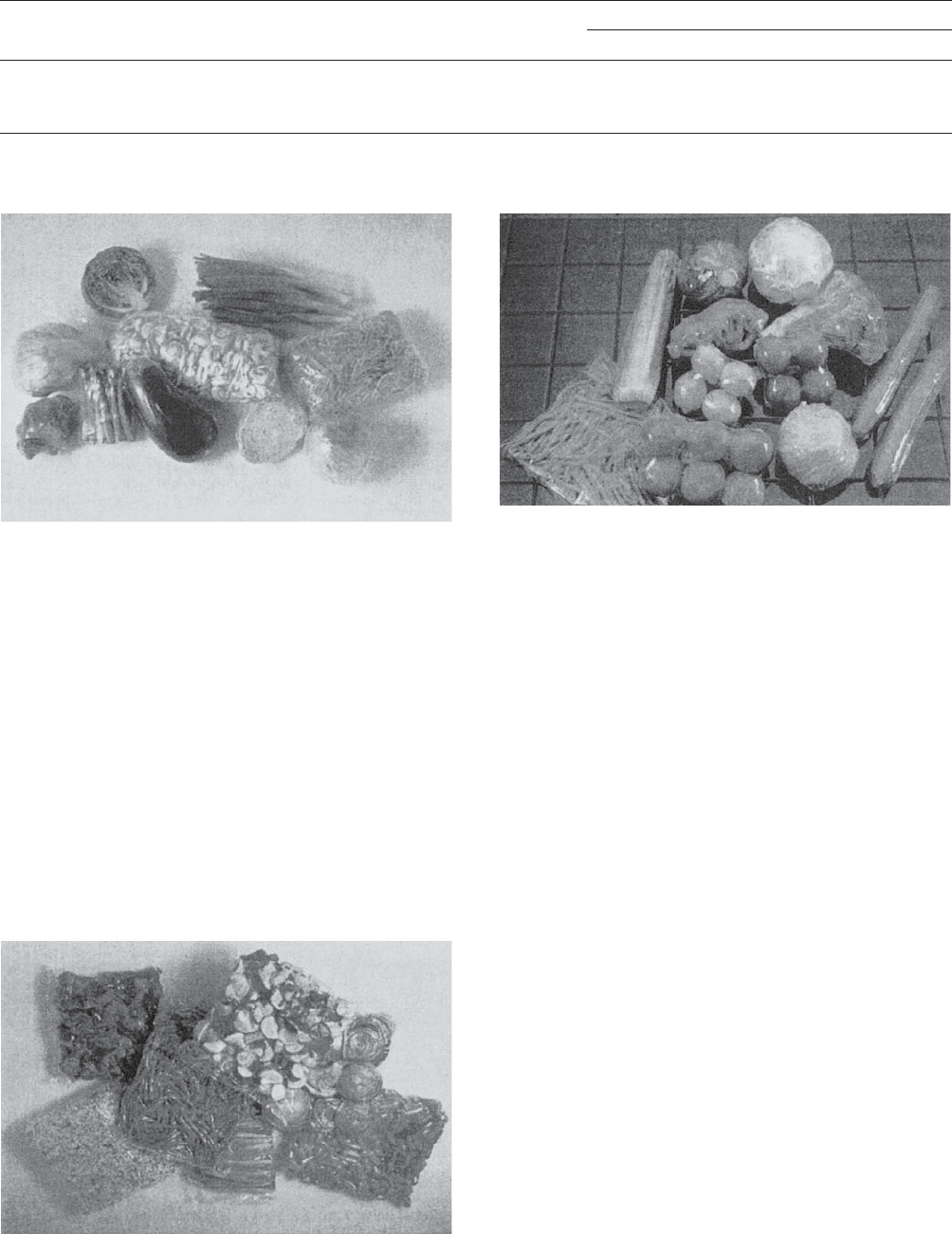
Such cut vegetables are packed in permeability modified
polyolefin bags or film or vertical form/fill/seal machines
(see the Form/fill/seal, vertical article). Bags are typically
nozzle vacuumized and pressure squeezed to remove
residual air from the package prior to heat sealing. For
the various vegetables group, the polyolefin films are
modified through resin variations and additives to achieve
the desired O
2
/CO
2
permeability.
The polyolefin films are adequate barriers to prevent
significant moisture loss. The removal of the air from the
package provides for the package quickly becoming a
modified atmosphere. Under adequate refrigerated condi-
tions, the O
2
will be maintained below 5% and the CO
2
in
the 8–12% range. This slows down respiration and will
significantly extend the eating-quality life of the cut
vegetable. Large volumes of chopped lettuce, broccoli,
and cauliflower florets are now being distributed to food
service and retail in this manner. The vacuum or negative-
pressure package also provides a good visual-quality
measure of the package and product for both the producer
and end user (Figures 12–14).
BIBLIOGRAPHY
General References
‘‘Advances in Fish Science and Technology,’’ in Proceedings, Torry
Research Station Conference, Aberdeen, Scotland, 1979.
Chilled/Refrigerated Foods Conference, Proceedings, The Packa-
ging Group, Inc., 1988.
A. L. Brody, Controlled/Modified Atmosphere Packaging of Foods,
Food and Nutrition Press, Turnbull, CT, 1989.
E. Karmas, Meat, Poultry and Seafood Technology—Recent Devel-
opments, Food Technology Review No. 56, Noyes Data Corpora-
tion, Parkridge, NJ, 1982.
F. Kosikowski, Cheese and Fermented Milk Foods, published by
the author, Ithaca, NY, 1966.
R. Lawrie, Developments in Meat Science—1, Applied Science
Publishers, London, 1980.
R. Lawrie, Developments in Meat Science—4, Elsevier Applied
Science, London, 1988.
F. A. Paine and Heather Y. Paine, A Handbook of Food Packaging,
Blackie Academic and Professional, London, 1992.
M. E. Rhodes, Food Protection Technology II, Lewis Publishers,
Chelsea, MI, 1990.
S. Sacharow and R. C. Griffin, Jr., Principles of Food Packaging,
AVI Publishing Company, Westport, CT, 1980.
F. M. Terlizzi, R. R. Perdue, and L. L. Young, ‘‘Processing and
Distributing Cooked Meats in Flexible Films,’’ Foods Technol.
p. 38 (March 1984).
Figure 12. Vacuum packaging for fresh produce.
Figure 13. Vacuum packaging for fresh produce.
Figure 14. Vacuum packaging for fresh produce.
Film permeabilities [mL/(m
2
24 h)]
Respiration group Vegetables O
2
CO
2
Light breathers Carrots, potatoes, turnips 1000–3000 10,000–20,000
Medium breathers Lettuce, celery, pepper 6000–7000 30,000–35,000
Heavy breathers Broccoli, cauliflower, asparagus 15,000–20,000 75,000–100,000
1264 VACUUM PACKAGING
VACUUM-BAG COFFEE PACKAGING
The concept of vacuum-bag packaging for ground coffee
was introduced in the U.S. market years ago. It had been
developed in Europe years before, but except for nonher-
metic paper bags still used in the southeastern states,
ground coffee in the United States has remained in the
three-piece sanitary can with plastic covercap that re-
placed the key-opening can about 40 years ago. The new
vacuum-bag package has been described as a ‘‘flexible can,’’
because it delivers the same vacuum-packed fresh coffee
that the consumer buys in the can, but that is where the
similarity stops. The ‘‘vac-bag’’ is rectangular rather than
round, and it can be shelved standing up, or lying on its
side like a ‘‘brick,’’ which is one of its less-glamorous names.
Coffee Characteristics. Coffee has some unique charac-
teristics. After coffee beans are roasted, they slowly evolve
CO
2
amounting to over 1000 cm
3
/lb (2200 cm
3
/kg) of pro-
duct depending on the blend and roasting color. During
grinding, the volume of CO
2
is reduced to about half, and
depending on the grind size, it requires varying holdup
times before packing. Grind size varies greatly depending
on the type of coffee-brewing equipment used and indivi-
dual taste preference. Typical fine grind for most Eur-
opean countries is 500–600 mm; North American coarser
grinds are 800–1000 mm. Vacuum-bag packaging of coarser
grinds present more of a problem because of slower
degassing. At 6–8 in. Hg (20–27 kPa), a vac-bag becomes
soft and it can even balloon like a football (positive
pressure) if it has insufficient degassing. Because rigid
metal cans are capable of withstanding full vacuum as
well as positive pressure, they require a relatively short
holdup time even for coarse grinds. Because ground coffee
also varies in density, the height of fixed-cross-section
bags varies as well. This variation means that the equip-
ment and materials must be adaptable to a limited auto-
matic height change during a production run. In addition,
coffee must be protected from oxygen to maintain the
freshness. Vacuum packing eliminates most of the oxygen
from the package by the nature of the process.
The Vacuum Bag. The first commercial ‘‘vac-bag’’
packages were made in the early 1960s, probably in
Sweden. At that time the package was a bag-in-box style
(see Bag-in-box, dry product) that later evolved to a lower
cost, bag-in-bag style, which is still the most widely used
type in Europe and Canada. A still lower cost style, the
single-wall bag, is being used to some extent in Europe and
by the major coffee producers in the United States. The
bag-in-bag style and the single-wall style function equally
well in protecting the product, but they differ in appear-
ance. High-quality graphics on the paper or foil/paper
outer wrap of a bag-in-bag package gives a smooth sur-
face appearance. Most single-wall bags have a rough or
‘‘orange peel’’ surface when under full vacuum. As with
any package concept with more than one style, there are
pros and cons for each, but the current U.S. market is
predominately single-wall vac bag and is likely to stay that
way.
Equipment. Because Europe spawned the vac-bag’s po-
pularity, it is no surprise that all the automatic high-speed
equipment is made there. There are three major equip-
ment suppliers who compete in the coffee-packaging area
and are as follows: SIG, Hesser, and Goglio (1–3). All have
automatic high-speed (40–120-boxes-per-minute (bpm)],
1-lb (0.45-kg)-size machines capable of forming bags from
roll stock material, filling, evacuating, sealing, and folding
the top of the bag to deliver a finished vac-bag. Bags can
be made in different ways from rollstock. Mandrel- and
tubeforming machines form the bag, which is carried
horizontally into the filler. After filling it is transferred
into a vacuum chamber where it is evacuated and sealed.
It is then transferred out of the vacuum chamber to a
trimmer and final folding of the top. Tape or hot-melt
glue are two methods used to hold the top folds in place.
The sealing of the bag is what keeps it hard and under
vacuum.
Materials. Each of the major equipment suppliers pro-
vides basic information on what packaging material prop-
erties are essential for efficient vac-bag production. Some
differences exist, but many similarities also are present
for achieving a low level of defects from the machine. Each
vac-bag must be durable enough to survive the rigors
of transportation, warehousing, and retail distribution to
remain vacuum-packed at point of purchase. Although
many European packers use a three-ply structure made of
48-gauge polyester film (OPET)/35-gauge aluminum foil
(AF)/300-gauge sealant (see Film, polyester; Foil, alumi-
num; Sealing, heat), most U.S. coffee roasters employ a
more durable four-ply structure. This structure can be
accomplished by the addition of one of several films, such
as biaxially oriented polypropylene (BOPP) (see Film,
oriented polypropylene) or biaxially oriented nylon
(BON) (see Nylon). These structures can be constructed
in various ways but most typically as follows:
48-ga OPET/75 ga BOPP/35 ga AF/300 ga sealant
48-ga OPET/35 ga AF/60 ga BON/300 ga sealant
When these structures are designed for a single-wall
bag, the OPET is reverse-printed. Gravure printing (see
Printing) on OPET provides excellent graphics, high gloss,
and a scuff-resistant package. Vacuum-metallized films
(see Metallizing vacuum) have been used successfully in
Europe and Canada as lower-cost foil replacements. Be-
cause their oxygen barrier may be lower than foil, each
coffee packer must determine if nonfoil structures provide
adequate barrier.
Currently, the best method to joint these materials
into a finished structure is by adhesive lamination
(see Laminating; Multilayer flexible packaging). To pro-
duce a finished structure with uniform-gauge control,
high internal bond strength, minimum curl, and a
controlled coefficient of friction, adhesive lamination
has proven to be an excellent converting system. Both
VACUUM-BAG COFFEE PACKAGING 1265

solvent- and solventless-type adhesive laminators (see
Adhesives; Coating equipment) are now converting mate-
rials in the United States and Canada for coffee packers.
These new high-speed automatic packaging machines
require consistently high-quality materials to operate
efficiently. All of the material converters acknowledge
the sometimes difficult learning experience on vac-bag
films and the need to set up a very thorough quality-
control system.
Valves and Sorbents. Gas-off of CO
2
from ground coffee
is a problem for vac-bag packagers that can be handled in
several ways. The simplest solution is to grind the coffee
beans very fine, as in Europe. The fine grind evolves gas
more quickly and requires only a short holdup time (1
1
2
–
2 h). The North American markets require coarse grinds,
however, that need up to 24 h of holdup time and con-
siderable storage capacity. Two methods exist to eliminate
all holdup time. One is the one-way coffee valve, which
allows CO
2
out of the bag without allowing O
2
into the bag
(see Valves). The bag, however, is soft. This concept was
tested in the United States by two major roasters, but it
was abandoned in favor of the hard vac bag that consu-
mers seem to prefer. The other method involves a new
technology from Canada, whereby a CO
2
-sorbent pouch is
placed in the coffee bag much like a desiccant pouch is
used for moisture-absorbing applications. This new coffee
vac-bag technology allows the roaster to package freshly
ground coffee without any holdup time and still obtain a
hard vacuum bag. This benefit is not possible with any
other system.
A growing coffee market has been found in specialty
and gourmet stores where whole beans are purchased.
The beans are generally not hermetically packaged, so
CO
2
gas-off is not an issue. In this case, the use of a one-
way valve is an excellent way to achieve an air-
tight package and keep the beans fresh. The valve can
be heat-sealed into the bag film as done by Goglio and
SIG. It also can be attached to the outside surface
using a pressure-sensitive valve concept developed by
Hesser.
Advantages. Vac-bag is seen as a low-cost package
compared with metal cans. For some coffee packers, this
low-cost advantage may be true if bag packing line speeds
are equal to or greater than those for cans. For others,
where the reverse is true, the material-cost advantage is
not as large. Current 1-lb-size (0.45-kg-size) metal cans
that include plastic overcap cost about $0.17–$0.19. A
high-quality four-ply vac bag costs about $0.08–$0.10,
which provides a material-cost advantage of about 9 cents
per 1-lb (0.45-kg) package. Additionally, advantages are
present in storage, handling, and shelving a vac-bag
because of its compact shape. The reduction in cube is
dramatic (35%). This cube reduction is beneficial to both
manufacturer and retailer, because warehousing and
shelving space is always a premium. As vac-bags become
more widely distributed, consumers will determine the
future for this new package.
BIBLIOGRAPHY
‘‘Vacuum-Bag Coffee Packaging’’ in F. J. Nogent, ed., The Wiley
Encyclopedia of Packaging Technology, 1st ed., by General
Foods Corp., pp. 690–691.
1. Product literature, SIG Swiss Industrial Company, Repre-
sented by Raymond Automation Company, Inc., Norwalk, CT.
2. Product literature, Hesser Division of Bosch Package Machin-
ery, S. Plainfield, NJ.
3. Product literature, Goglio, represented by Fres-co System
USA, Inc., Telford, PA.
VIBRATION
JORGE MARCONDES
San Jose State University,
San Jose, California
Vibration describes oscillation in mechanical systems.
Packages, products, pallet loads, vehicles, machinery,
and equipment are mechanical systems. They are sub-
jected to vibration whenever there is movement. In packa-
ging applications, vibration can be either desirable or
undesirable, although often it is undesirable, because it
can damage products. Examples of packaging applications
of desirable vibrations are a filling machine and an ultra-
sonic heat sealer. Filling machines may have a vibratory
tray feeder to dispense the product into a package; an
ultrasonic heat sealing uses high-frequency mechanical
vibrations to produce localized heat that melts the inter-
face between the sealing materials only, without affecting
the product or the rest of the package. However, vibrations
encountered in vehicles during distribution are always
undesirable. This article concentrates on vibrations in
distribution only, or those that are undesirable.
Vibration always occurs in distribution because the
operations of transport and handling always move goods.
It can influence products to the point of causing physical
damage or product spoilage. Studies have shown that
vibration in vehicles can cause, for example, phase separa-
tion to emulsified products, bruising in fruit and vegeta-
bles, physical damage in mechanical and electronic
products, and damage to labels because of friction (1, 2).
Both external and internal sources originate vehicle
vibrations. Examples of external sources include road
pavements, rail tracks, and ocean waves; internal sources
include rotating parts such as unbalanced wheels and the
engine itself (3). In a truck, for example, the wheels of the
vehicle pick up the pavement up-and-down oscillations as
mechanical vibrations; the suspension and structure of
the vehicle transmit these, along with other internal
vibrations, to the vehicle floor. Packaged products placed
on the vehicle floor will then receive the vibrations.
Vibrations that occur in a vehicle floor may be decom-
posed in three perpendicular directions: vertical, lateral,
1266 VIBRATION
and longitudinal. Several studies investigated the direc-
tions and locations in vehicles where highest vibration
levels occur. On the basis of these studies, it is commonly
accepted today that in trucks and semitrailers the highest
vibrations occur on the rear axle and in the vertical
direction (4, 5). Product damage caused by vibration is
more likely to occur if packages are placed over the rear
axle in trucks and trailers.
The role of the packaging engineer is to design packages
that reduce vibrations. Cushions and other flexible-packa-
ging systems are engineered in such a way that the
package attenuates the vibrations that occur in vehicles.
No package can completely eliminate vibration. Although
still transmitted to products, a package designed for vibra-
tion attenuation may virtually eradicate the potential for
damage.
FORCED VERSUS FREE VIBRATION
Vibrations are generally classified into two categories:
forced (when there is a continuous input source) and free
(input source discontinued). The type of vibration that
occurs in packaging machinery is a forced vibration
because a source continuously drives the system to vi-
brate. The vibration that occurs without external excita-
tion is called free vibration (6). Both types, free and forced,
occur in all vehicles during transport. As an example, the
pavement roughness is a source of vibration that forces
the wheels of a vehicle to move up and down, generating
vibration. If the source of vibration stops, then the system
will continually decrease its vibration level (free vibration
now) until a full stop, when the energy is totally dissi-
pated. Similarly, when the vehicle hits an obstacle such as
a pothole, the vibration will be forced while the obstacle is
in contact with the vehicle and free thereafter until the
effect of that particular input ends. An example of free
vibration occurs when a mass, placed on top of a spring, is
pushed down and released, and then vibrates ‘‘freely’’
after its release. Whenever a system is vibrating freely,
the movement will decrease and the vibration will even-
tually cease, because of damping. Damping is always
present in mechanical systems (7), and it dissipates the
energy that keeps the system vibrating.
FREQUENCY AND ACCELERATION
A state of vibration can be characterized by a frequency
and an amplitude. The simplest harmonic motion of a
mechanical system, such as of a mass placed on a spring
that oscillates up and down, is defined by a frequency and
a peak acceleration. The frequency is the number of times
a cycle repeats itself in a unit of time, and the peak
acceleration is the maximum value of the acceleration in
the entire cycle. If a system is vibrating freely, it vibrates
at its natural frequency (8). The natural frequency is
mainly a function of the mass and the stiffness of the
system. The relationship between peak acceleration, max-
imum displacement from the position of equilibrium, and
frequency of a vibrating system is
a
pk
¼
d
max
ð2pf Þ
2
g
ð1Þ
where a
pk
= peak acceleration in g (where 1 g is equal to
the gravitational acceleration), d
max
= maximum displace-
ment of the oscillating mass from the equilibrium position,
f = frequency of oscillation, and g = gravitational accelera-
tion, or 9.81 m/s
2
. In applying equation (1) to ideal, or
linear systems, the equation shows that the peak accel-
eration is directly proportional to the maximum displace-
ment and to the square of the frequency of vibration. In
other words, if the maximum displacement is doubled,
then the peak acceleration will also double (frequency
kept constant); if the frequency is doubled (maximum
displacement kept constant), the peak acceleration will
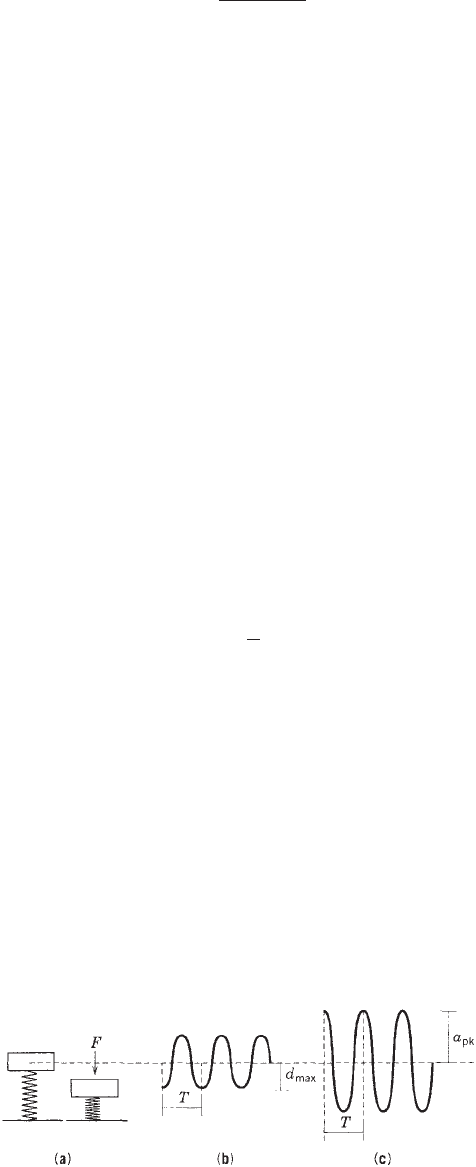
quadruplicate. Figure 1 shows the relationship repre-
sented by equation (1), as applied to a spring-mass system
undergoing free vibration. Equation (1) does n ot take into
account the direction of vibration (up or dow n). In Figure
1, the mass is pushed d own with the force F and then
released. The situation depicted in Figure 1 does not
sho w the effect of damping. For further information on
damping effects on free vibration, the reader may consult
Refs. (7–9).
The duration of one cycle of oscillation is shown as the
period T. The frequency of oscillation f representing the
number of cycles that occur in a unit of time is related to
the period by
f ¼
1
T
ð2Þ
For example, if the period T = 0.2 s, and d
max
= 0.5 cm
(0.005 m), the frequency is 1/0.2 s = 5 Hz (using equation
2) and a
pk
= 0.005 m (2p5 Hz)
2
/9.81 m/s
2
= 0.5 g [using
equation (1)]. This means that the system is vibrating
with a peak acceleration of 0.5 g and the mass is oscillat-
ing at five cycles per second (5 Hz). If the peak acceleration
is 0.5 g, the acceleration at any instant will be somewhere
between + 0.5 g and 0.5 g, inclusive.
When vibration levels in vehicles reach values above
1 g (acceleration due to gravity) packages will start to
bounce. Because packages are seldom attached to the
vehicle floor, if the vertical vibration of the vehicle floor
is higher than 1 g, the package would not follow the
Figure 1. Spring-mass system in free vibration without damp-
ing: (a) force F causes displacement d
max
and releases mass to
vibrate freely; (b) displacement of mass varying with time; and (c)
acceleration of mass varying with time.
VIBRATION 1267