
Yam, Kit L. (ed.). The Wiley encyclopedia of packaging technology
Подождите немного. Документ загружается.

vehicle floor when it is moving down and will be left
suspended in the air momentarily, hitting the floor mo-
ments after. This will cause packages to receive impacts
rather than only the vibration that occurs at the vehicle
floor. Impacts have acceleration levels (G levels) much
higher than vibrations (impact accelerations can get up
100 g very easily) and are much more likely to cause
damage to products during distribution.
SINUSOIDAL VERSUS RANDOM VIBRATION
Regarding the mode of vibration, there are two ways it can
occur: sinusoidal and random. The displacement of the
mass shown on the spring in Figure 1 characterizes a
sinusoidal motion and it can be expressed mathematically
as a function of the time only. For example, when time
t = 0, the displacement is at its minimum, when t = T/4, the
displacement is zero, and when t = T/2, the displacement is
at its maximum. This pattern repeats itself every interval
of duration T. Vibration encountered in distribution such
as in a truck when it travels on the road is not like the
periodic or sinusoidal vibration of a spring-mass system as
represented in Figure 1; rather, it is complex (10). Vehicles
vibrate at several frequencies simultaneously, with the
displacement, and therefore the acceleration, varying at
each instant and never repeating itself again in the same
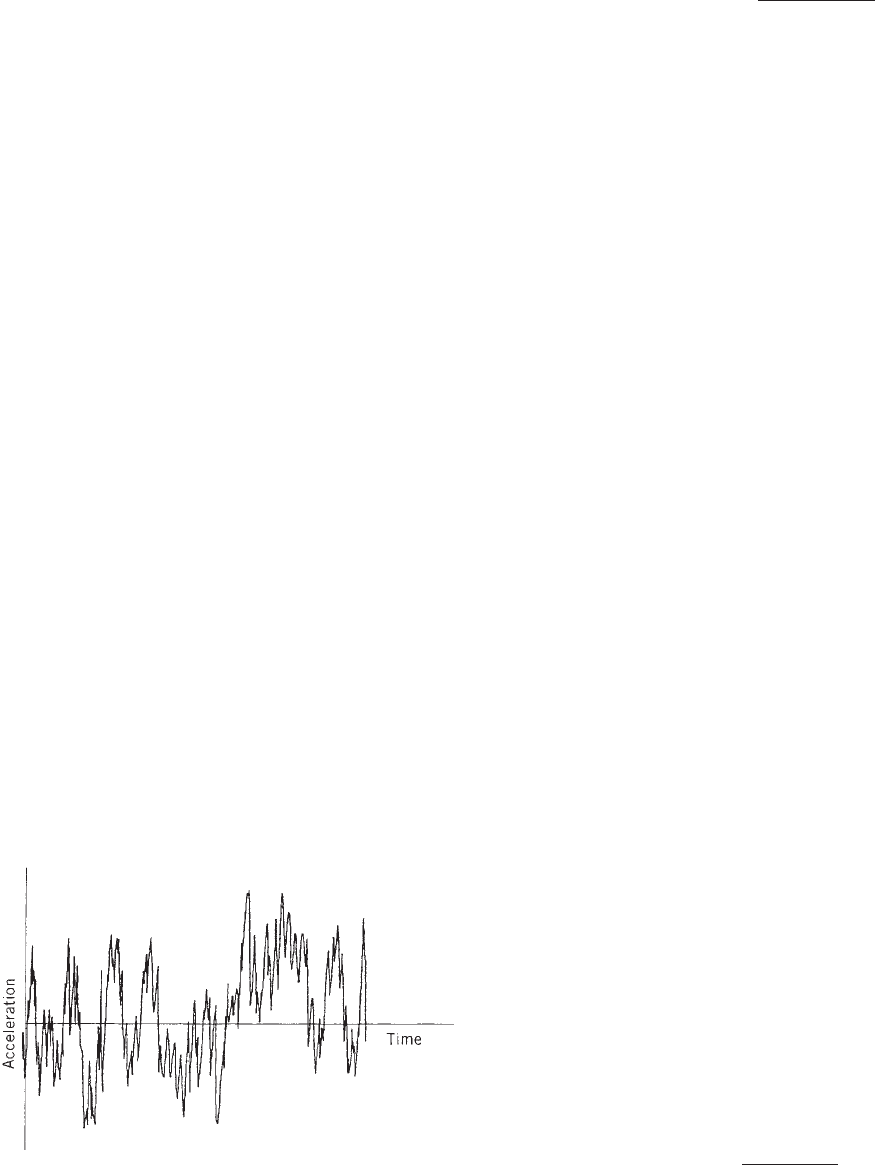
pattern. Figure 2 shows an example of a typical random
signal measured on a truck floor.
Because of this complex characteristic, random vibra-
tion cannot be described in a deterministic manner, i.e.,
one cannot write an equation of acceleration versus time
to describe this motion. Therefore, a statistical technique,
or spectral analysis, is used to study such vibrations and
to interpret the motions of the vehicle (9), which are
covered in the next sections.
VIBRATION MEASUREMENT AND ANALYSIS
Most packaging-dynamics applications use accelerometers
for measuring vibration. Accelerometers are sensors
that produce an electrical output signal proportional to
acceleration. These sensors are rigidly mounted on the
surface of a truck floor or package item and are connected
to data-recording devices. Manufacturers of acceler-
ometers supply a calibration certificate with each sensor.
One important information in this certificate is the accel-
erometer sensitivity (in output units per g). The sensitivity
and the output voltage relate to the acceleration by
Acceleration ¼
voltage output
sensitivity
ð3Þ
For example, consider an accelerometer with a 10 mV/g
sensitivity. If it senses a vibration with peak amplitude
output of 6 mV, the acceleration is 6 mV/(10 mV/g) = 0.6 g.
Accelerometers should be calibrated regularly to ensure
accuracy of results acquired (11).
There are two basic ways to measure and store vibra-
tion data: continuous (or analog) and intermittent (or
digital). The recording equipment defines the type of
measurement and data storage.
In continuous recording, accelerometers are installed
in strategic places in the vehicle and vibration data are
recorded, without interruption, on a magnetic tape. A
voice channel may be used to record a description of the
events as they occur, such as the crossing of a rail track,
the vehicle speed, or any other occurrence that may be of
value for subsequent data analysis and interpretation.
This technique requires the continuous presence of an
operator, and the instrumentation used can be cumber-
some, occupying as much space in a vehicle as one whole
pallet load. After stored in the magnetic tapes, the accel-
eration recordings are transferred to additional instru-
mentation for analysis, interpretation and use.
Intermittent monitoring has grown substantially in the
last few years with the availability of digital recording and
storage instrumentation. Intermittent recording uses self-
contained recording units to obtain and store acceleration
either at predetermined intervals or above a preset trig-
gering level. Recording units used for intermittent mon-
itoring are usually small and contain a real-time clock and
a battery to provide the operating power. After stored, the
vibration is downloaded to a computer, analyzed, and
summarized for subsequent use.
In random-vibration analysis, the complex signal is
first decomposed into component sine waves of various
frequencies either mathematically using Fourier decom-
position (8) or electronically using bandpass filters. What-
ever the technique used, the complex signal is analyzed
in individual component frequency intervals determined
by the bandwidth. For most packaging applications, the
bandwidth has been traditionally set at 1 Hz.The random
signal of a vehicle vibration has component sine waves
that vary over time but have a zero average, and their
peak amplitudes are distributed normally over time so
that the Gaussian distribution and all its properties may
be used to describe the process.
The acceleration level of any component frequency
analyzed is represented by the power density (PD), which
is calculated as
PDðf Þ¼
P
n
i¼1
ðGrms
i
Þ
2
n BW
ð4Þ
Figure 2. Acceleration versus time in random vibration.
1268 VIBRATION
where PD(f) = power density at the frequency f, n = num-
ber of samples at the frequency f, Grms
i
= root mean
square acceleration of the ith sample at the frequency f,
BW = bandwidth (normalized to 1 Hz).
A power-spectrum density (PSD) represents the results
of random-vibration analysis. The PSD is a graphic re-
presentation of the vibration intensity at each frequency.
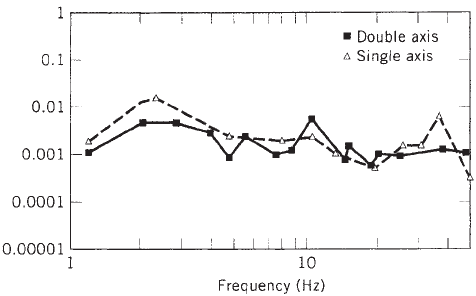
As an example, Figure 3 shows the results, in PSD format,
of vibrations encountered in semitrailers in urban-area
traffic at 60 km/h. This example shows that the single-axle
trailer has an overall higher vibration force than the
double-axle trailer, except for the frequencies in the range
9–22 Hz (12). Notice that the graphs are in a log–log scale
for better clarity at the low-frequency range.
The PSD plots show the component frequencies in the
horizontal axis and an indication of their amplitude in the
vertical axis. High power-density levels at particular fre-
quencies may indicate problems with the vehicle. This
occurs because there are resonant reactions between the
vehicle structure and the road surface in this frequency
range. For example, for both vehicles represented in Figure
3, there are high power-density levels between 2 and 3 Hz.
For the double-axle vehicle, there is another high power-
density level at just above 10 Hz; for the single-axle
vehicle, a high power density also occurs at 35 Hz.
The PSD plot is interpreted as a ‘‘signature’’ of the
random vibration and is used to statistically represent
vibrations that occur in vehicles. It can be used to deter-
mine the quality of the road or the vehicle, or both. The
PSD plots of vehicles are important in the design of
protective packages to attenuate how products receive
the vibrations that occur in these vehicles. They are also
widely used in the execution of laboratory vibration tests
to simulate the transportation hazards encountered in
these vehicles.
VIBRATION TESTS
In a laboratory, it is typical to perform two types of vibration
tests: sinusoidal and random. Sinusoidal tests are used to
identify resonant frequencies of a product, a packaging
material, or a complete package. Random-vibration tests
are usually performed to test finished-packages prototypes
and packaging systems (13) but can also be used to test
vibration transmissibility of cushioning materials using a
frequency analysis technique (14).
Sinusoidal vibration tests should define (a) the upper
and lower frequency of the test, (b) the level to be main-
tained at each frequency, (c) the rate at which frequency will
sweep and whether it is logarithmic or linear, and (d) the
number of sweeps or duration of the test. Random-vibration
tests should define (a) the PSD to be used, (b) the duration
of test at each PSD, and (c) the level sequences of each PSD.
Both test types are performed using an electrohydraulic
vibration tester mounted on a seismic mass (15), although
mechanical shakers are still widely used, mainly for sinu-
soidal vibration tests with a narrow frequency range.
The purpose of a finished-package vibration test is to
recreate in the laboratory the damage potential that
the packages would encounter in distribution. These tests
determine how effective a package system can be in
providing product protection (2). ASTM standard D4169
recommends specific PSDs for each transportation mode
(truck and rail). It also recommends that random-vibra-
tion tests last 3 h (13), although studies have shown that
tests with durations as short as 20 min produce valid
results (16). There is generally a tradeoff between test
severity and test duration (17). Ideally, a test should be
only long enough to impose on the packages events that
have the same damage potentials of the events the test is
supposed to reproduce.
TERMINOLOGY
The application of mechanical vibrations in packaging
involves many terms that may not be familiar to some
readers. For a definition of common terms used in vibra-
tion, refer to Harris and Crede (18). In addition, more
specific terminology on distribution packaging may be
found in ASTM standard D996-90a (19).
BIBLIOGRAPHY
1. J. P. Mackson and S. P. Singh, ‘‘The Effect of Temperature
and Vibration on Emulsion Stability of Mayonnaise in Two
Different Package Types.’’ Packag. Technol. Sci. 4, 81–90
(1991).
2. S. P. Singh, G. J. Burgess, and M. Xu, ‘‘Bruising of Apples in
Four Different Packages Using Simulated Truck Vibration,’’
Packag. Technol. Sci. 5, 145–150 (1992).
3. T. D. Gillespie, Heavy Truck Ride, Society of Automotive
Engineers, Warrendale, PA, 1985.
4. J. A. Marcondes, S. P. Singh, and G. J. Burgess, ‘‘Dynamic
Analysis of a Less Than Truckload Shipment,’’ ASME Winter
Annual Meeting, paper 88-WA/EEP-17, Chicago, IL, 1988.
5. S. P. Singh, J. R. Antle, and G. J. Burgess, ‘‘Comparison
Between Lateral, Longitudinal, and Vertical Vibration Levels
in Commercial Truck Shipments, Packag. Technol. Sci. 5, 71–
75 (1992).
6. W. Weaver, Jr., S. P. Timoshenko, and D. H. Young, Vibration
Problems in Engineering, Wiley, New York, 1990.
Figure 3. PSDs comparing vibration in single- and double-axle
trailers (12). (Originally published in IPENZ Transactions.)
VIBRATION 1269
7. R. E. Blake, ‘‘Basic Vibration Theory’’ in C. M. Harris, ed.,
Shock and Vibration Handbook, 3rd edition, McGraw-Hill,
New York, 1988.
8. W. T. Thomson, Theory of Vibration with Applications,
Prentice-Hall, Englewood Cliffs, NJ, 1988.
9. D. E. Newland, An Introduction to Random Vibrations and
Spectral Analysis, 2nd edition, Longman, New York, 1984.
10. S. P. Singh and D. E. Young, ‘‘Measurement and Analysis
Techniques Used to Simulate the Shipping Environments,’’
ASME Winter Annual Meeting, paper 88-WA/EEP-18,
Chicago, IL, 1988.
11. H. Schueneman, ‘‘Calibrating Issues in Packaging Testing,’’
Test Eng. Manage. 57(2), 6–7 (1995).
12. J. A. Marcondes and W. H. Feather, ‘‘Assessment of Vibration
Levels on Truck Shipments’’ in Trans. Inst. Prof. Eng. New
Zealand (Wellington, NZ) 19(1), 22–27 (1992).
13. ASTM, Selected ASTM Standards on Packaging, 4th edition,
ASTM, Philadelphia, PA, 1994.
14. J. A. Marcondes, M. Sek, and V. Roulliard, ‘‘Testing Foamed
Polymeric Materials for Mechanical Protection of Packaged
Goods’’ in Anais do 2nd Congresso Brasileiro de Polimeros,
Volume 2, Sao Paulo, Brazil, 1993, pp. 1126–1128.
15. P. J. Vergano and R. F. Testin, ‘‘An Inside Look at Seismic
Mass Design for Vibration Test System,’’ Packag. Technol.
Eng. 3(4), 38–43 (1994).
16. S. P. Singh and J. A. Marcondes, ‘‘Accelerated Lab Simulation
of Truck Transport Environment Using Random Vibration,’’
ASME Winter Annual Meeting, paper 89-WA/EEP-17, San
Francisco, CA, 1989.
17. D. Charles, ‘‘Derivation of Environment Descriptions and
Test Severities from Measured Road Transportation Data,’’
J. Inst. Environ. Sci. 37–42 (Jan./Feb. 1993).
18. C. M. Harris and C. E. Crede, ‘‘Introduction to the Handbook’’
in C. M. Harris, ed., Shock and Vibration Handbook, 3rd
edition, McGraw-Hill, New York, 1988.
19. ASTM, ‘‘D996-90a Standard Terminology of Packaging and
Distribution Environments’’ in Selected ASTM Standards on
Packaging, 4th edition, ASTM, Philadelphia, PA, 1994.
General References
R. K. Brandenburg and J. J.-L. Lee, Fundamentals of Packaging
Dynamics, LAB, Skaneatles, NY, 1991.
R. M. Fiedler, Distribution Packaging Technology, Institute of
Packaging Professionals, Herndon, VA, 1995.
PCB Piezotronics, Vibration and Shock—Sensor Selection Guide,
PCB Piezotronics, Depew, NY, 1993.
C. E. Crede and J. E. Ruzicka, ‘‘Theory of Vibration Isolation’’ in C.
M. Harris, ed., Shock and Vibration Handbook, 3rd edition,
McGraw-Hill, New York, 1988.
K. Unholtz, ‘‘Vibration Testing Machines’’ in C. M. Harris, ed.,
Shock and Vibration Handbook, 3rd edition, McGraw-Hill,
New York, 1988.
J. Curtis, ‘‘Concepts in Vibration Data Analysis’’ in C. M. Harris,
ed., Shock and Vibration Handbook, 3rd edition, McGraw-Hill,
New York, 1988.
1270 VIBRATION

W
WAXES AND WAX-COATED FOLDING
CARTONS
HARRY KANNRY
GARY LATTO
Dussek-Campbell, Skokie,
Illinois
Updated by Staff
INTRODUCTION
Historically, in the United States, the use of wax-coated
folding cartons to provide proper product protection has
been a popular concept within the food-packaging indus-
try. A wide assortment of refrigerated and frozen-food
entre
´
es have been packaged in this manner since the
1920s.
However, in the late 1950s, a new concept in the
manner in which the wax coatings were applied to the
folding-carton blank was commercialized. Coupled with
the new, commercialized folding-carton waxers, a large
number of new wax-based folding-carton formulations
emerged. From the 1960s to the present, a large number
of new wax-based folding-carton formulation concepts
have been successfully commercialized and refined in
order to fulfill the ever-changing packaging requirements
of the specialty market.
Over the years, wax-based folding carton formulations
have improved to provide the following properties:
1. Adequate protection against loss or gain of moisture
by the food to the ambient environment
2. Effective bond strengths during heat-seal closing
operations on packaging equipment
3. Ability to retain good bonds at low-temperature
storage conditions
4. High initial gloss and excellent gloss retention
5. Adequate scuff and abrasion resistance
6. Adequate slip properties for high-speed handling on
packaging equipment
7. Good grease resistance
8. Tamper-proof closures before sale, yet open easily at
point of use
9. Economical costs commensurate with product
protection
Today, a wide variety of specialty foods are now being
packaged in wax-coated folding cartons. Wax-blend-coated
folding cartons are especially suited for butter, margarine,
ice cream, frozen vegetables, frozen pizzas, frozen shrimp,
and frozen-dinner entre
´
es, and prepared food specialties,
to mention just a few of the limitless applications.
This article focuses on the past, present, and future
applications of wax-based coated folding cartons. Waxes,
in particular paraffin wax, are used in a great many
packaging applications. The folding types include corru-
gated containers and folding cartons; the flexible types
include wrappers, labels, bags, sacks, and pouches; the
rigid types include bottles, jars, drums, and tubes. Accord-
ing to the paper and paperboard industry, container board
is the largest single grade of paper produced and remains
a growing grade. Corrugated containers for shipping
manufactured goods make them one of the largest grade
forms of packaging.
HOT-MELT WAX CARTON COATERS
From the early 1920s to the late 1950s there were two
commercially accepted methods of coating folding carton
blanks with wax: (a) the hot-wax method, which imparted
a limited amount of protection and release to the carton—
the wax coating did not enhance the appearance of the
carton itself and, therefore, had very little shelf appeal;
and (b) the cold-water waxer, which gave added surface
protection and a reasonably glossy finish that increased
the shelf appeal of the carton.
The coating used for both of these methods, wax, was
initially nothing more than fully refined paraffin wax. As
years went by, it was discovered that additives such as
microcrystalline wax and small amounts of low-molecular-
weight polyethylene could be added to the fully refined
paraffin wax, slightly increasing the appearance and
protective functional properties of the carton.
The hot-wax method and the cold-water waxer pre-
sented one major problem with the overall wax coating.
With the exception of mechanically locked and tuck car-
tons, and except for those cartons where a dry strip could
be left in the waxing operation, the other cartons had to be
dewaxed before gluing. The dewaxing operation was time-
consuming, very costly, and generated a large volume of
wax waste.
In the late 1950s, recognizing the wax coating problem
within the folding carton industry, the Oakland Paper Box
Company developed the Oakland Hi-Gloss Pattern Coater.
The Oakland Hi-Gloss Pattern Coater allowed wax coat-
ings to be applied in any desired pattern, leaving voids in
areas to be glued or printed.
The section where the wax is applied has two rubber-
covered cylinders: One cylinder coats the underside of a
carton blank, while the second waxes the top.
The waxing blanket favored is brass-backed 30–40
durometer neoprene. Like the cutting die or the printing
plates, the blanket must be prepared to the needs of a
specific carton. Like the cutting die or the printing plate,
the blanket will be saved if repeats of the job are
anticipated.
A rubber waxing blanket is prepared by stretching an
uncut sheet over a cylinder of the same size as the cylinder
on which it will be mounted. A template of the specific
carton design is cut, and this serves as a pattern for
1271
cutting the blanket. Wherever wax is not to be applied, the
rubber will be cut away. The result is a pad that is
identical to a reverse-printing plate.
With the inception of the Oakland Hi-Gloss Pattern
Coater, other machine manufacturers began to market
similar wax coaters. In the United States, the majority of
the carton coaters in operation are the IPBM GM Carton
Coater and the 88-B Carton Center. The two IPBM wax
coaters are capable of applying wax coating with viscos-
ities approaching 1000 cP at 3001F (148.91C).
The IPBM GM Carton Coater has two coating stations.
The first station coats the inside (bottom) surface of the
carton. The second station coats the outside (top) surface.
This arrangement permits the application of different
blends on the inside and outside surfaces, if desired. The
wax coating weights are controlled by adjustment of the
metering roll nip and the reverse or burnishing roll at
each coating station. The second coating station is
equipped with a weir-type curtain feed to ensure uniform
distribution of the wax coating across the applicator roll.
This is particularly important in applying high-viscosity
wax coatings. Silicone rubber back-up rolls are used to
prevent carton blanks sticking to the rolls.
The wax-coated cartons pass through a remelt section
consisting of gas-fired infrared heaters. The temperature
of the gas-fired infrared heaters is typically 2501F
(137.11C), and these heaters are rated at about
500,000 Btu. This exposure to the heat gives a smoother,
more evenly dispersed flow to the wax coating and pro-
duces a high-gloss finish.
The wax-coated cartons are then passed through a
refrigerated, chilled-water curtain and into a water-
immersion tank. The temperature of the chilled water
must be carefully controlled within a temperature range of
34–401F (1.1–4.41C). The purpose of the chilled water is to
facilitate the setting of the wax coating without disturbing
the surface. This process also enhances the high-gloss
finish. If the chilled water is at a temperature above
401F (4.41C), the wax coating does not set properly and
will produce a carton with a dull, uneven surface. The
position of the heaters and the distance to the water-
immersion section can be adjusted to obtain the maximum
gloss for the particular wax coating being applied.
The waxed cartons are then passed through a set of
squeeze rolls to remove the excess water. The waxed
cartons are then deposited onto a slow-speed stacker
apron.
The ideal wax-coating weight, per carton side, is ap-
proximately 3 lb/1000 ft
2
(14.6 g/m
2
).
The machines are usually installed with three channels
or lanes that automatically feed the folding carton blanks
through the wax coater. Each single lane is capable of
waxing 15,000 cartons per hour.
HOT-MELT WAX CARTON COATINGS
In the late 1950s, coupled with the development and
commercialization of the ‘‘new’’ folding-carton coaters,
new developments and refinements were also taking place
in the area of ‘‘new’’ hot-melt wax carton-coating
formulations. Specialty wax blends were being researched
and developed for exclusive use with the ‘‘new’’ folding-
carton coaters. The simple formulations are as follows:
1. Straight, fully refined paraffin-wax blend
2. Fully refined paraffin-wax/microcrystalline wax
blend
3. Fully refined paraffin-wax/low molecular weight
polyethylene blend
These gave way to sophisticated blends of carefully
selected petroleum-derived waxes with carefully selected
wax additives. Because of the significant changes made in
the area of folding-carton coaters, a new era in formulat-
ing wax-based coatings for this specialty packaging in-
dustry began.
In early 1960, another series of products became com-
mercially available that created an entirely new concept
in hot-melt wax-based coatings. This new series of pro-
ducts were termed copolymers and consisted of various
percentages of ethylene and vinyl acetate, or simply EVA.
Other wax additives that became commercially available
around the time of the EVA copolymers were polyterpene
resins, stabilized ester gums, and a wide product diversi-
fication of low-molecular-weight and high-molecular-
weight polyethylenes. The commercialization of these
new wax additives gave compounders the tools to manu-
facture an almost limitless number of combinations or
formulations of hot-melt wax-based folding carton
coatings.
On the basis of the requirements of the folding carton
industry, hot-melt wax-based folding-carton coatings are
classified into the following two categories:
1. Non-heat-sealable folding-carton waxes
2. Heat-sealable folding-carton waxes
Non-heat-sealable folding-carton waxes are usually ap-
plied in a defined pattern onto the folding-carton blank,
leaving unwaxed areas where a hot-meal adhesive (HMA)
is applied to seal the folding carton closed. The wax
coating is applied to both the outside (printed side) and
the inside (unprinted side) of the folding carton.
Heat-sealable folding-carton waxes are applied onto
the entire surface area of the folding carton blank, and
they will seal the folding carton without the use of a HMA.
The wax coating is applied to both the outside (printed
side) and the inside (unprinted side of the folding carton).
The use of a heat-sealable folding-carton coating is ad-
vantageous because the gluing operation is eliminated.
As the folding-carton industry developed, it became
apparent that only four wax-based folding-carton coatings
were necessary to fulfill the requirements of the industry.
The wax-based coating product line consisted of the
following:
1. Non-heat-sealable folding-carton waxes
a. One economical coating
b. One general-purpose coating
c. One heavy-duty coating
1272 WAXES AND WAX-COATED FOLDING CARTONS
2. Heat-sealable folding-carton wax
a. One premium heat-sealable coating
The selection of the proper folding carton coating
depends on the physical specifications of the formulation
as well as the functional properties that the formulation
must impart to the folding carton. Functional properties
such as gloss, creased vapor barrier, grease resistance,
scuff resistance, freezer-burn resistance, and heat seal-
ability are some of the points to be considered in the
section of the proper folding-carton coating. In most
instances, the folding-carton coating must be nonflaking,
exhibit no ruboff, and exhibit a high antiblock character-
istic. These three properties are important when the
waxed folding carton is processed through the folder/gluer.
The wax coating cannot build up on the runners of the
folder/gluer. When the wax coating builds up on the
runners of the folder/gluer, subsequent waxed folding
cartons stick and jam on the runners. The folder/gluer
must then be shut down and cleaned (see also Sealing,
heat).
The economical non-heat-sealable folding-carton coat-
ing provides minimal functional properties. The econom-
ical formulation is used in applications of generic folding
cartons where minimum functional properties are re-
quired and the low cost of the wax coating is an important
consideration. With a hot-melt wax carton coater contain-
ing two separate wax-coating stations, the economical
formulation can be used on the inside (unprinted) of the
folding carton, while the general-purpose formulation or
the heavy-duty formulation can be used on the outside
(printed) of the folding carton. This procedure is used for
monetary consideration.
The general-purpose non-heat-sealable folding-carton
coating offers improved functional properties over the
economical coating. The general-purpose coating may be
used on the outside (printed) area of the folding carton as
well as the inside (unprinted) area of the folding carton.
The heavy-duty non-heat-sealable folding-carton coat-
ing imparts the optimum appearance, protection, and
functional properties of the non-heat-sealable coatings.
The heavy-duty coating may be used on the outside
(printed) area of the folding carton as well as the inside
(unprinted) area of the folding carton.
The premium heat-sealable folding-carton coating
imparts the optimum appearance, protection, and func-
tional properties to the folding and will seal the folding
carton closed without the use of a HMA. This product will
give a fiber-tearing seal over a wide range of sealing
temperatures.
An additional consideration for all four products is that
all ingredients and final products must fully comply with
FDA (Federal Drug Administration) regulation as suitable
for use in food packaging. The regulation cited most often
is Paragraph 21, CFR 176.170 for ‘‘components of paper
and paper-board in contact with aqueous and fatty foods.’’
With the new generation of hot-melt wax-based coat-
ings and the commercialization of the new generation of
hot-melt carton coaters, the folding-carton industry was
well on its way to establishing itself as a strong specialty
market within the food-package industry.
CURRENT USE
Many changes have occurred in the folding-carton indus-
try since its modern conception in the early 1960s. A
newer variety of boardstock required newer blends of
wax coatings. At present, the most widely used of the
petroleum waxes is paraffin wax, also called macrocrystal-
line wax. More than 50 companies produce petroluem
waxes worldwide (1). It is extremely unreactive at normal
temperatures. It remains cost-effective as a moisture and
gas barrier. It can also be blended with microcrystalline
wax or combined with polyethylene or ethyl vinyl acetate
(EVA) to improve performance. The use of refined grades
of petroleum wax are regulated by the FDA (21 CFR
172.886 and 21 CFR 178.3710) (2).
Petroleum waxes are now used to coat corrugated board
as well. The most common methods used for applying wax
are saturating or cascading and curtain coating. In satur-
ating or cascading, a thick layer of wax is flushed or
sprayed onto the finished board. The board will pick up
40–50% of its weight in wax. The wax is normally low
melting. In curtain coating, the corrugated board is al-
lowed to pass horizonatally through falling wax. The
coating formulations contain paraffin wax, microcrystal-
line wax, and additves such as EVA copolymers, tackifier
resins, and antioxidants. EVA increases the viscosity to
produce a stable curtain. Tackifiers increase flexibility and
antioxidants prevent the formation of odor and discolora-
tion (3).
Folding cartons are made from heavy paper or pape-
board. The carton is printed, folded into the basic carton
shape, sealed and glued, and shipped to the user. The
carton usually goes into an automatic filling line where it
is popped open and filled with product. Waxing allows the
board to sustain ply separation without splitting or failing
when bent back.
FUTURE OUTLOOK
The current awareness of the environmental impact of
products has consumers and manufacturers re-evaluating
their existing materials. This is true for the packaging
industry because much of its end product requires
disposal.
Petroleum waxes have many properties that make it a
barrier to gases and vapors. This is very desirable for the
actual packaging, but makes it very difficult to recycle.
Closed-loop
recycling of paper
products is called repulp-
ing. Packaging containing petroleum waxes requires spe-
cial handling at recycling mills. The most severe problem
is that the waxes combine with other contaminants, and
clog the wires and felts of the paper machine, forming
‘‘stickies.’’ Waxes can also delay the defibering in the
pulper. Most existing plants are not equipped to remove
the contaminants (4).
The International Group, Inc., a world leader in refin-
ing and marketing of petroleum waxes, is working with
paper and equipment suppliers to develop new products
that improve pulpability and to modify technologies to
better handle contaminants (5). The industry is now
WAXES AND WAX-COATED FOLDING CARTONS 1273
developing wax alternatives, many of which have become
commercial.
BIBLIOGRAPHY
H. Kannry and G. Latto, ‘‘Waxes’’ in A. J. Brody and K. S. Marsh,
eds., The Wiley Encyclopedia of Packing Technology, 2nd
edition, Wiley, Hoboken, NJ, 1997, pp. 962–964.
Cited Publications
1. M. Malveda, M. Blagoev, and M Yoneyama, ‘‘Waxes’’ in Che-
mical Economics Handbook, SRI Consulting, Menlo Park, CA,
2006.
2. C. Leray, ‘‘Waxes’’ in the Kirk–Othmer Encyclopedia of Chemi-
cal Technology, Vol. 26, 5th edition, Wiley, Hoboken, NJ, 2007,
pp. 203–226.
3. ‘‘Corrugated Waxes’’, The International Group, Inc., 2006,
www.igiwax.com.
4. ‘‘Environmental Awareness’’, The International Group, Inc.,
2006, www.igiwax.com/.
5. ‘‘Wax Alternatives,’’ Corrugated Packaging, www.corrugate-
d.org/, accessed April 2008.
General References
I. N. Davie, ‘‘Compostability of Petroleum Wax Based Coatings,’’
TAPPI J. February 167–170 (1993).
R. J. Hamilton, ed., Waxes: Chemistry, Molecular Biology, and
Function, Oily Press, Dublin, 1995.
WRAPPING MACHINERY, STRETCH-FILM
EDWIN HO
OSI Industries
Lisle, Illinois
HISTORICAL OVERVIEW
The stretch-wrapper industry is over 30 years old in 2008.
In 1976 there were only four or five manufacturers
producing a wide-web model used to wrap standard-height
pallet loads with a large 60-in. roll of stretch film. Soon
after that the demand to wrap variable pallet load heights
produced the spiral model, which used a smaller 20-in. roll
of stretch film. Unlike the large roll of film, which was
stationary when wrapping the entire pallet load, the
smaller 20-in. roll traveled up and down on a motorized
carriage, wrapping the entire load in a crisscross fashion.
The spiral wrapper offered the primary advantage of
wrapping a wide variety of load heights at minimal cost
and dramatically reduced the use of the wideweb model.
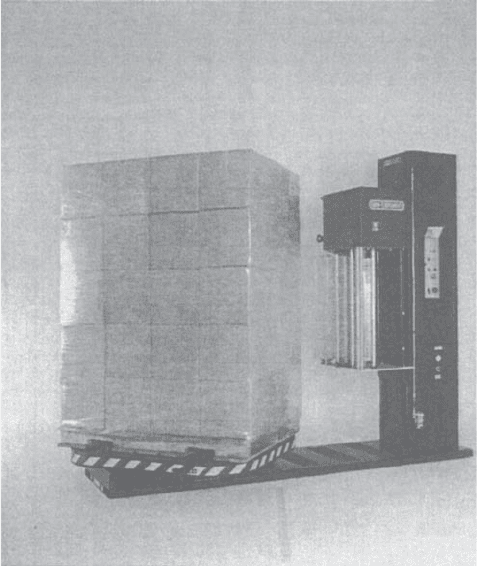
Today the spiral wrapper (Figure 1), in both semiauto-
matic and fully automatic formats, represents approxi-
mately 90% of all wrapper production. Wrapper
manufacturers in the United States now number over
20, ranging from small producers of lower-cost models to
major producers offering a complete line of wrapper
models to accommodate virtually every stretch-wrap ap-
plication known.
THE DEMAND FOR STRETCH WRAPPERS
Prior to the energy crisis of 1974, the use of shrink film to
unitize pallet loads of product was an increasingly popular
packaging medium. The costly and excessive use of heat
energy (gas, electric, or propane) to shrink film, however,
along with the rising cost/availability of shrink resins,
placed industry of all types in a cost-prohibitive situation.
Another unitizing method, using strapping (steel, ny-
lon, polyethylene, or polypropylene) to unitize pallet loads,
was recognized as labor-intensive; and an average pallet
load could take up to 7 min to strap, depending on the
nature of the product and the acceptable strapping pat-
tern desired.
Still other unitizing mediums such as pressure-
sensitive tape, twine, or spot adhesives did not provide
inherent protection from the elements and would tend to
loosen while in transit.
Stretch film offered a lower cost advantage of being
applied by equipment that used only ‘‘on/off’’ electricity as
a source of power and could be applied by a semiautomatic
stretch wrapper. Significantly less labor time was involved
and an average size product load could be wrapped in less
than 2 min. As a result, many of the initial products
Figure 1. A semiautomatic, spiral wrapper (IPM 55UTS30F)
equipped with Uni-Tension power prestretch. For unitizing up
to 35 pallet loads per hour.
1274 WRAPPING MACHINERY, STRETCH-FILM

stretch-wrapped were packaged in multiwall paper bags,
polyethylene bags, or cartons. The following is a list of
very early stretch film product applications:
Product
Kitty (cat) litter
Dog and cat food
Detergent
Chemicals
Printed forms
Injection-molded bottles
Mortar mix
Concrete block and brick
Potting soil and mulch
Seed
Canned and jarred food
Liquids in polyethylene/
glass bottles
Shipped in
Multiwall paper bags
Multiwall paper bags and
cartons
Corrugated cartons
Multiwall paper bags and
steel drums
Corrugated cartons
Corrugated cartons
Multiwall paper bags
Strapped (steel)
Polyethylene bags
Polyethylene bags
Corrugated cartons
Corrugated cartons or
trays
It should be noted that, even in 30 years later, these
products are still being shipped on pallets and in some
cases corrugated slip sheet via the stretch-wrap medium.
Thus, the demand for stretch film continues to grow with
over 2.2 billion pounds being produced annually in the
United States. The demand for stretch film is projected to
rise 4.7% annually for the next few years. It is estimated
that more than 40,000 stretch wrappers are sold annually
in the United States as this type of machinery continues to
replace conventional packaging methods. In addition,
virtually every type of product shipped today in a carton,
paper/polyethylene bags, drums, or polyethylene contain-
ers is being stretch-wrapped. Products having been con-
sidered marginal as a stretch-wrap application are now
being packaged or unitized with stretch film. Some of the
once considered marginal product applications are as
follows:
Aluminum/steel coils
Tires
Engine castings
Expanded styrofoam
sheets
Doors
Coils of copper tubing
Batteries
Signatures
Perishable foods (produce
and meat)
Windows
Furniture
File cabinets
Frozen fish in ice
Frozen foods
Recycled rubber in
polyethylene bags
Hazardous chemicals and
powders
PRESTRETCHING FILM
Wrapping a pallet product load with stretch film is gen-
erally accomplished by first placing the load on the turn-
table of the stretch wrapper. The turntable is activated,
and rotates and draws film from the supply roll.
Originally, film stretch was created by the film roll being
gradually retarded from turning while the load pulled the
film from the roll. Retarding the film roll was affected by
an electromagnetic brake fixed to the film core or through
a series of rollers bars. The effective maximum stretch,
however, was no more than 120% and in most cases
averaged 50–60%. Higher percentages of stretch would
generally cause product cartons to crush and could even
pull the load from the turntable unless otherwise held in
place by an optional top compression platen (electric or
air-operated).
Prestretching film, however, became instantly popular
in the late 1970s as moderate-to high-volume shippers
took advantage of the higher film yields offered by im-
proved stretch films coming into the marketplace. These
improved films utilized linear low-density polyethylene
(LLDPE) resins either alone or combined with ethyl vinyl
acetate (EVA) to enhance puncture resistance, reduce
tear propagation, and extend film yield up to 400%. The
prestretch method of stretching such films was found
to reduce stretch film cost per pallet load by 20–45% as
sophisticated prestretch machine assemblies became part
of an upscale trend in stretch wrappers in the 1980s.
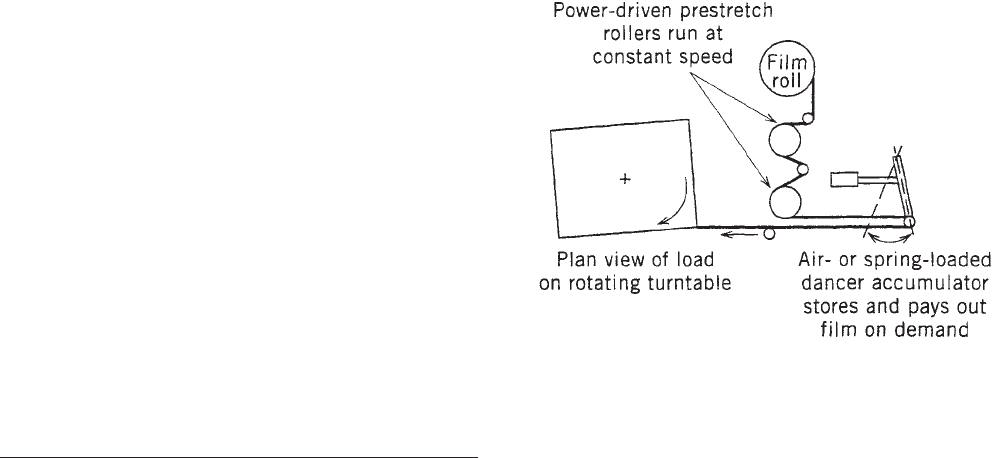
Unlike a stretch wrapper equipped with brake tension,
a prestretch assembly stretches the film at the machine by
routing the stretch film between two powered rollers prior
to its application to the load. Because the two powered
rollers are moving mechanically or electrically at different
speeds, the film stretches between the rollers.
The percentage of stretch that can be attained through
a fixed-ratio or variable-prestretch assembly can reach
300%
with the appropriate
film quality and gauge. Com-
mon or the most desirable level of prestretch is 200–225%,
which allows for maximum film recovery (holding force) at
an economical level of film usage. Excessive prestretch can
cause stretch film to thin, reduce puncture/abrasive re-
sistance, and diminish the ‘‘cling’’ or self-adhering prop-
erty of the film. Without a reasonable amount of ‘‘cling,’’
the trailing segment of the film wrap (pressed against the
side of the load at the end of the wrap cycle) can release
itself allowing the wrapped load to partially unwrap.
Another advantage of prestretch is that most manu-
facturers have a method to apply tension of the film to the
load immediately after the prestretch process occurs.
Generally, an adjustable spring or air operated dancer
bar is utilized to regulate film tension to the product load.
One such system is the patented IPM Uni-Tension system
(Figure 2), which provides constant and consistent film
tension (adjustable) to the product load. As a result, many
product loads, which could normally not be stretch-
wrapped without the use of a top stabilizer platen, can
be wrapped with power prestretch. Examples of these
types of loads are as follows:
Mixed-Product Loads
Partial-pallet loads
Tall-pallet loads
Empty drums
Empty plastic bottles
Load weights of 150–500 lb
WRAPPING MACHINERY, STRETCH-FILM 1275
Prestretch is preferred by many volume shippers be-
cause it reduces the amount of stretch film received by
their customers. Although stretch film is recyclable, pre-
stretch minimizes the film disposal process.
WRAPPER MODELS AVAILABLE
The stretch-wrapper industry has come a long way since
the original wide-web machine was introduced. The sin-
gle-turntable wide-web machine (using a 45- to 80-in. film
roll size) has been expanded to at least several additional
models to include wide web prestretch. The spiral wrapper
model has evolved into multiple models designed to ac-
commodate a wide variety of applications and user pre-
ferences. The following is a list of the most popular models
currently available—also noted is the average production
rate for which that model would be applicable:
Wrapper Model
Hand wrapper
Power turntable with hand
wrapper
Powered-turntable machine
with manually operated
film carriage (has me-
chanical powered
carriage)
Semiautomatic, powered-
turntable machine with
adjustable programmable
controls for number of
wraps, speeds of turnta-
ble, film carriage, etc.,
and brake tension
Semiautomatic, powered-
turntable machine with
adjustable programmable
controls for number of
wraps, speeds of turnta-
ble, film carriage, etc.,
and fixed-ratio powered
prestretch
Production Rate
0–10 pallets/day
0–10 pallets/day
r20 pallets/day
r35 pallets/h
r35 pallets/h
(Note: These powered-turntable machines are available in
a high-platform turntable design (for forklift use only) or a
low-profile design with a loading ramp for hand/electric
pallet jack and forklift use. These machines are also
available in wide-web or spiral-type models.).
The machine models listed above continue to withstand
the test of time, being the most popular and often manu-
factured with the following most common options to
enhance the stretch-wrapping process, increase the pro-
duction rate, or improve operator efficiency:
. Photoelectric height sensor (for semiautomatic spiral
models)—located on the film carriage to automati-
cally seek the top of the pallet load, halt the film
carriage, and permit the top wrap cycle to occur.
. Mast extension to permit pallet loads in excess of 85
in. in height to be wrapped.
. Top-compression platen (electric or air-operated)—
exerts an adjustable amount of stabilizing pressure
on the top of a lightweight or unstable product load.
. Additional turntable (dual-turntable model)—in-
creases production rate by 33%.
. Conveyorized turntable (gravity roller)—for in-line
capability; that is, machine is installed into existing
or new gravity roller production line.
. Pit mount—machine is installed into the floor with
turntable virtually flush with floor; enhances use of
pallet jacks.
. Scale—5,000- to 10,000-lb capacity scale integrated
with and under the wrapper turntable eliminates
double
handling of pallet
loads.
FULLY AUTOMATIC CONVEYORIZED MODELS
Shippers with moderate to high production (15–85
pallets/h) have generated an increased demand for fully
automatic stretch wrappers. The most popular fully auto-
matic has a powered conveyorized turntable for in-line
powered-conveyor systems or for multiple forklift opera-
tions. Unlike a semiautomatic wrapper, the fully auto-
matic wrapper eliminates the operator, who necessarily
would first attach the stretch film to the load and then
press a
START button. At the completion of the wrap cycle,
the operator would cut the film and adhere the trailing
edge of the film to the side of the load. The automatic,
however, operates through an electric programmable logic
controller (or microprocessor) and a series of electronic
photoelectric load sensors. The stretch film is held in a
mechanical clamp between load wrap cycles and is cut and
brush-wiped onto the pallet load automatically at the
completion of the wrap cycle.
A fully automatic wrapper equipped with a power infeed
and discharge conveyor can be integrated with an auto-
matic load palletizer (which feeds loads to the wrapper).
This same system can be used effectively by having a
Figure 2. Powered prestretch.
1276 WRAPPING MACHINERY, STRETCH-FILM
forklift operator set a load on the power infeed conveyor
and then activate that conveyor with an overhead remote
pendant control. As that load would feed into the wrapper
module, the forklift operator would drive over to the
discharge conveyor section to remove a completely wrapped
load and place it into storage or a shipping vehicle. Auto-
matics are generally equipped with a prestretch assembly
for maximum utilization of the stretch film.
Common optional equipment to enhance higher-speed,
fully automatic systems are as follows:
. Top-compression platen exerts an adjustable amount
of stabilizing pressure on the top of a lightweight or
unstable product load.
. Automatic top-sheet dispenser that automatically
places a 2- to 3-mil polyethylene top sheet on top of
the pallet load prior to the load being conveyed to the
wrapping module. A top sheet is usually desirable to
prevent the elements from damaging the product.
. The 901 index turntable is used primarily to direct
the discharge of the pallet load 901 from which it was
accepted onto the machine. This option is usually
desired if there is a floor-space restriction.
. Mast extension to permit pallet loads in excess of
85 in. in height to be wrapped.
OTHER WRAPPER MODELS
In recent years, new stretch-wrapper designs have been
created by different manufacturers to accommodate either
the end user’s specific product application or existing
packaging line. One such model is the increasingly popu-
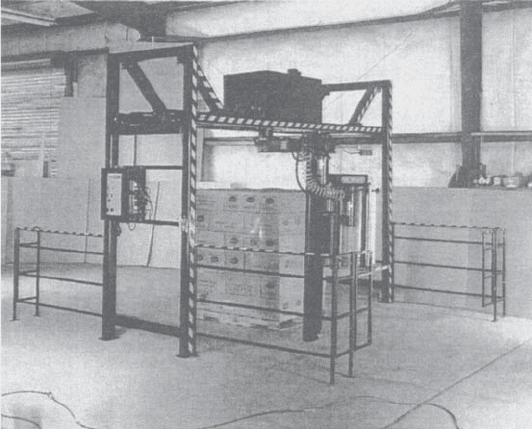
lar overhead rotary-arm-type stretch wrapper (Figure 3).
With this model, the product load does not rotate on a
turntable. The load sits on the floor or on conveyor, and the
roll of stretch film travels on the overhead arm around the
load wrapping it in a spiral fashion. The film stretch
delivery system can be either the brake tension type or
the powered prestretch type.
The overhead rotary-arm-type machine is advanta-
geous for wrapping pallet loads when
. Loads are extremely heavy.
. The product on the pallet is subject to damage if
rotated.
. Loads are unstable and not easily moved by forklift,
pallet jack, or conveyor.
. Washdown is required—that is for use in poultry
plants or facilities where the machinery and general
work areas must be washed down periodically for
sanitation reasons.
The overhead-arm-type machine is currently manufac-
tured as a wall- or floor-mounted semiautomatic or can be
upgraded and incorporated into a fully automatic con-
veyorized system for high-production use.
The semiautomatic robotic wrapper is a battery-oper-
ated, wheeled vehicle with a vertical mast and film-stretch
delivery system. This wrapper is placed next to a product
load and, when activated, travels around the perimeter of
the load while the film carriage travels up and down
stretch wrapping the load. A sensing device signals the
wrapper to turn as it senses the corner of the load. This
type of wrapper has been used to wrap longer-than-
average product loads and requires ample floor space in
which to operate.
Orbit stretch wrapping has become a popular method
to stretch wrap large flat panels such as office dividers,
locker-room partitions, and so on, in which the panel is
conveyorized through a large ringlike assembly and a 10-
to 30-in. roll of stretch film travels in a vertical plane with
a circular motion around the entire panel wrapping it as it
moves through the ring on the conveyor.
Figure 3. A semiautomatic overhead rotary-arm-type stretch
wrapper.
WRAPPING MACHINERY, STRETCH-FILM 1277