
Yam, Kit L. (ed.). The Wiley encyclopedia of packaging technology
Подождите немного. Документ загружается.

The major advantage of straight-line (vs. rotary) cappers
is that they generally do not require change parts, and cap
and container sizes can be changed with little downtime.
Rotary Continuous-Motion Cappers. Rotary cappers use
many heads in combination in a rotary arrangement that
permits high speeds: 40–700/min (see Figure 7). The speed
of application of one cap by one head is limited, but rotary
cappers can achieve 700/min through the use of 24 heads.
(Production speeds are always related to the size of
container and cap. Rotary machines are available with
more than 24 heads, but 700/min is a rough upper limit.)
Extra Features. Most of the automatic machines can be
supplied with optional equipment for flushing with inert
gas. A time existed when application torque could be
measured only by testing removal torque, but today’s
capping machinery is equipped with sensors that provide
continuous measurement and constant readouts.
CAPPERS FOR VACUUM CLOSURES
Three basic types of vacuum closure exist and are as
follows: pryoff side-seal; lug; and presson twistoff. The
pryoff side-seal closure, the earliest type of vacuum clo-
sure, has a rubber gasket to maintain the vacuum in the
container. This type of closure has been displaced in the
United States by the other two types. The vacuum is
generally achieved by a steam flush (2), which also softens
the plastisol to facilitate sealing.
Lug Closures. Lug closures have 4–6 lugs that grip onto
special threads in the bottle finish as well as a flowed-in
plastisol liner (gasket). The lugs mate with the threads
with a half turn. This process is almost always done by
straight-line machinery that incorporates two belts mov-
ing at different speeds. Maximum production speed with
this type of closure and machinery is about 700/min.
Press-On Twist-Off Closures. These closures are used
primarily on baby-food jars, but they now are being used
on other products as well. One of the reasons for their
increasing popularity is the very high production speeds
attainable. Like lug closures, they have a plastisol liner,
but the liner is molded for high precision. Unlike lug
closures, the skirt of the closure is straight. The seal is
achieved when the plastisol softens and conforms to the
bottle threads. Unlike threaded closures—which require
multiple turns—and lug closures—which require a half-
turn—presson twistoff closure require no turn at all. They
are applied by a single belt that presses the closure onto
the bottle at very high speed (e.g., over 1000/min on baby
food jars). These closures are held on by vacuum, which is
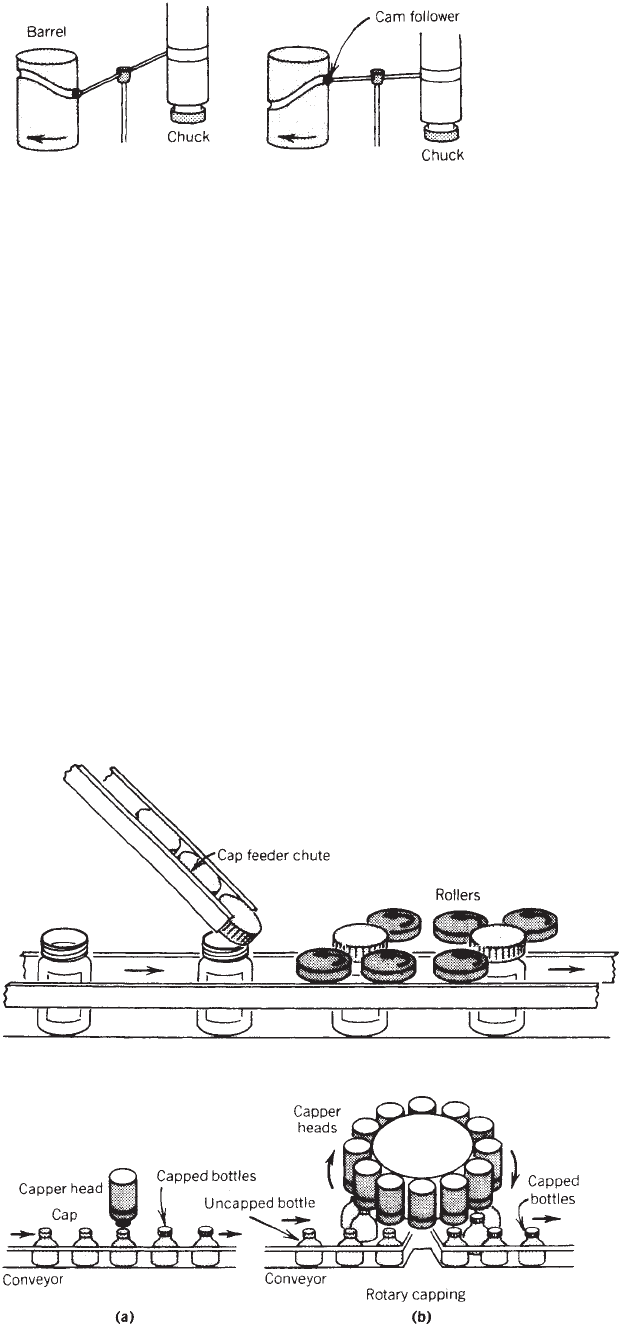
Figure 5. Barrel cam arrangement (1).
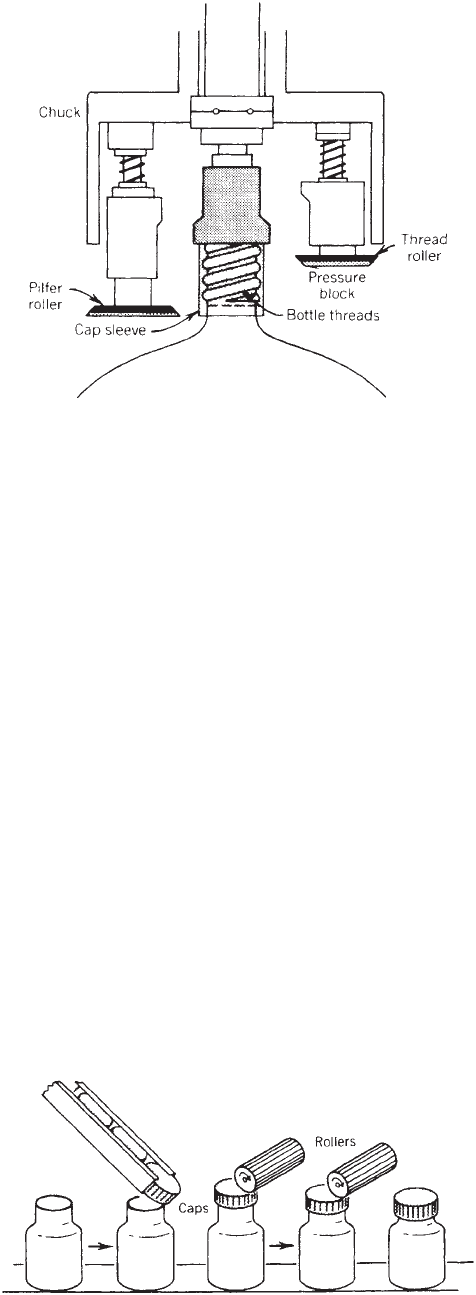
Figure 6. Roller screw capping (1).
Figure 7. (a) Straight-line and (b) rotary capping (1).
218 CAPPING MACHINERY
achieved by sweeping the headspace with steam. The use
of these closures was limited at one time by a requirement
of reduced pressure of at least 22 in. of mercury (74.5 kPa)
to hold them on. Not all products benefit from that degree
of vacuum. A recent development is the ability to use these
closures with a much lesser degree of vacuum.
CAPPERS FOR ROLLON CLOSURES
A rollon closure has no threads before it is applied. An
unthreaded (smooth) cap shell (sleeve) is placed over the
top of the bottle, and rollers in a chuck (see Figure 8) form
the threads to conform with the threads on the bottle
finish. The chucks are raised and lowered by capper
heads. These closures are available with and without a
pilferproof band that is a perforated extension of the skirt.
If such a band exists, it is rolled on by a special roller in
the chuck. Operating speeds of the machines are in
roughly the same range as rotary cappers for CT closures:
up to 700/min.
CAPPERS FOR PRESSON CLOSURES
The familiar crown closure for carbonated beverage bot-
tles is one type of presson closure. The cap is applied by
rotary machines that can operate with production rates of
over 1000/min (see Figure 9). Other types of presson
closures are snap-fit caps, with or without a tamper-
evident band; dispensing caps, which are often secondary
closures; and overcaps.
Like screw caps, press-on caps can be applied by
chucks or rollers, but the chucks and rollers do not need
twisting action, nor clutches for torque control. Several
approaches exist for controlling the amount of pressure
applied by chuck-type cappers. The capper head can be
spring operated, with tension controlled by a collar
adjustment; or a pneumatic clutch can control it with
air pressure; or a barrel cam can be used. On a roller-
type presson capper, the cap passes under one (shallow
cap) or more (deeper cap) rollers that press the cap on
tight.
BIBLIOGRAPHY
1. C. Glenn Davis, ‘‘Bottle Closing’’ Packaging Machinery Opera-
tions, Vol. 6, Packaging Machinery Manufacturers Institute,
Washington, DC, 1981.
2. Lisa M. Wedding, Canned Foods: Principles of Thermal Process
Control, Acidification, and Container Closure Evaluation, The
Food Processors Institute, Washington, DC, 2007.
CARBONATED BEVERAGE PACKAGING
A. L. G RIFF
Edison Technical Services
Updated by Staff
INTRODUCTION
Carbonated beverages represent the biggest single packa-
ging market, with over 100 billion (10
9
) beer and soft-
drink containers filled each year in the United States.
According to beverage marketing, every person in the
United States consumes about 192 gallons of liquid per
year. This translates to 3.7 gallons per week or 2 liters/day.
Nonalcoholic drinks comprise 87% of the total, and carbo-
nated soft drinks account for 28% of the nonalcoholic types
(1). The packages cost substantially more than the con-
tents and are actually the beverage producer’s largest
expense item. Performance requirements are quite severe:
Because the contents are under pressure, they must hold
their carbonation and must withstand summer storage
and (for beer) pasteurization temperatures that may reach
55–601C. Furthermore, the highly competitive nature of
this business has brought container design and manufac-
turing to a highly refined level in order to keep cost to a
minimum. Even $0.001 per container becomes big busi-
ness when multiplied by the billions (10
9
) of containers
made and used.
Figure 8. Applications of roll-on closures (1).
Figure 9. Roller application of presson closures (1).
CARBONATED BEVERAGE PACKAGING 219
PACKAGE TYPES
There are four major categories of carbonated beverage
container: plastic bottles, nonreturnable glass, refillable
glass, and metal cans.
Plastic Bottles
These are mainly 2-L soft-drink bottles, which first
appeared in the mid-1970s and in just a few years took
over around one-third of the soft-drink sales volume. The
bottles are stretch-blowmolded (see Blow molding) from
PET polyester (see Polyesters, thermoplastic). The
stretching (orientation) is needed to get maximum tensile
strength and gas barrier, which in turn enables bottle
weight to be low enough to be economical. Because mate-
rial cost is about two-thirds of total manufacturing cost,
such weight savings are essential. Typical 2-L bottle
weights are around 60 g PET, with some as low as 50 g,
plus a high-density polyethylene base cup (18–24 g), a
label (3 g), and a closure. One design uses no base cup;
instead, the bottle itself forms five petal-like feet at the
base. It uses slightly more PET (65–70 g), but total weight
is less because of the absence of the base cup.
A 3-L PET bottle has been used, with weights around
80–85 g PET plus 22–28 g for the base cup, or around 90 g
without the base cup. Although the 3-L may not be as
popular as the 2-L bottle in terms of size (too large for
most refrigerator-door shelves), it is more economical.
Half-liter PET has been offered since 1979 but has
never caught on because it does not provide enough
economic incentive to change; and in small sizes, the
advantages of safety and light weight are not as signifi-
cant. Instead of 0.5-L, 16-oz (473-mL), PET is now offered
to compete more directly with 16-oz (473-mL) glass and to
save a gram or two of bottle weight because of the smaller
volume (6% less than the half-liter). Typical bottle weights
for these small PET containers are 28–30 g plus a 5-g base
cup. Some cupless designs have been developed but have
only minor commercial use thus far.
In the deposit-law states, small plastic bottles are more
successful because come consumers do not like the hand-
ling and return of glass and are unwilling to pay more for
metal cans. In these 11 states, however, which represent
over 20% of the population, the 2-L PET bottle has been
the real winner, because many people prefer to pay one
deposit instead of six (see Recycling).
It is believed that an improved plastic barrier to CO
2
loss (see Barrier polymers) would allow lighter (hence
cheaper) bottles and thus spark the large-scale use of
single-service sizes for soft drinks and also open up the
beer market to plastic. Such containers are the object of
much development, both in can and bottle forms (see
Cans, plastic).
Plastic bottles of all sizes usually carry full wraparound
labels, either a shrunk polyolefin sleeve or a glued poly-
propylene/paper laminate (see Labels and labeling). Some
plastic bottles have foamed plastic labels, which have a
desirable nonslip feel and offer a little thermal insulation.
These used to be very large, extending down over the
base cup for maximum advertising effect (Owens-Illinois
Label-Lite) but lately have been in conventional wrap-
around form and size (Owens-Illinois Plasti-Grip).
Nonreturnable Glass
These are mainly 10- or 16-oz (296- or 473-mL) size, with a
Plastishield (Owens-Illinois and licensees) foam-plastic
protective label or a paper/polyolefin rollfed or an all-
plastic shrink sleeve (see Bands, shrink). Typical bottle
weights are around 130–140 g and 180–185 g, plus 3–4 g
for the label. The glass industry has strongly promoted
these containers in competition with metal cans, both in
retail markets and in vending machines. Glass has an
apparent cost advantage, which carries through to retail
level and has managed to hold onto its market share in
this size. However, the advantage in container cost is
eroded by labels, closures, secondary packaging, filling
speeds, and occupied space, plus the possibility of break-
age and costs of clean-up. In all of these aspects, cans have
an edge.
Prelabeling has become standard. The labels are pre-
printed and come to the bottler with no need for a further
printing operation. Patch labels are cheaper and better
for short runs, but are disliked by retailers because the
bottles can be turned to obscure the labels.
The old crown closure that had to be pried off has all
but disappeared for nonreturnables and is seen only on
refillable glass to allow use of bottles with corresponding
threadless necks (see Closures). The nonreturnables and
even some refillables use roll-on aluminum screw caps on
threaded necks, with a tamper-evident ring (see Tamper-
evident packaging). The threaded screw-off crowns that
are crimped over a fine-threaded neck remain, but in
diminishing numbers despite low cost. They are harder
to open and are thus used mainly for beer (stronger
hands), and their lack of tamper protection has discour-
aged their use.
The use of plastic closures for both glass and plastic
bottles increased in 1984 after a decade of trial use and
design refinement. The two most popular designs use a
separate liner, but there are linerless designs as well.
These closures weigh around 3 g in standard 28-mm size
and are slightly more expensive than competitive alumi-
num roll-ons. All unscrew and fit over the same threads as
the roll-ons and have some visible indication of tampering.
Initial successes have been with soft drinks; a few have
been tried for beer, but they have not been accepted due to
their inability to withstand pasteurization.
Refillable Glass
The refillable glass bottle is still used is some markets. O-I
Global is the primary supplier of glass bottles to the beer
industry and produces returnable beer bottles (3). The
main sizes are 16-oz (473-mL) for soft drinks and 12-oz
(355-mL) for beer, with some soft drinks also in sizes
around a quart. It is usually the cheapest way to buy
soft drinks on a unit price basis (except where 2-L bottles
are being discounted), but most consumers prefer to pay a
little more for convenience. In deposit states, refillables do
better but remain a minor factor, after 2-L PET and metal
cans. Typical bottle weight is around 300 g for the 16-oz
220 CARBONATED BEVERAGE PACKAGING
(473-mL) soft-drink bottle and is 250 g for a 12-oz (355-
mL) beer bottle that is used in bars and hotels where
economy is foremost and delivery/return is not a problem.
Labels on major-brand soft drink refillables may be
permanently silk-screened. Paper/plastic patch labels
are used on most refillable beer bottles. Full wraparound
labels are seldom seen because the containers are usually
sold in six-packs or cases that cover most of the label area.
The economics of refillables is very different from that
of other containers, because the bottler must support a
‘‘float’’ of containers and cases (which may cost as much
as the containers themselves), as well as a larger fleet of
delivery trucks (less compact, must stop to pick up as well
as deliver), and the appropriate cleaning and washing
machinery. For this reason, soft-drink franchises have
been a classic home for local investor/entrepreneurs, and
this spirit persists in the soft-drink industry today despite
the predominance of nonreturnable packaging.
Refillables are often promoted for their environmental
benefits. The concept of refill/reuse may be laudable as it
supports a resource conservation ethic, but the actual
use of refillables brings its own environmental problems:
water pollution from washing, air pollution from less
efficient truck usage, and sanitation problems in both
shops and homes.
Proponents of nonreturnables also point to the success
of aluminum recycling. Opinions and emotions are very
strong in these areas, but an impartial examination of the
facts leads to no firm conclusion. In fact, much depends on
locality—that is, the nature of the water supply, the extent
of recycling possible, the degree of urbanization, and the
number of trips made by each refillable. There is no easy
answer to this question, and neither refillables nor non-
returnables offer a clear advantage on environmental
grounds.
Metal Cans
The 12-oz (355-mL) aluminum can with easy-open end is
the primary small carbonated-beverage package, despite
apparently higher container costs and retail price com-
pared to either glass or plastic (see Cans, aluminum).
Container weight and design have been the subject of
much development work, with the weight of a modern can
now down to around 15 g including the end. There is at
least one necked-in ridge at the seam to allow wall-to-wall
contact, which helps on the filling lines, makes firm six-
packs, and uses smaller, cheaper ends. Double- and triple-
necked cans are sold to get even smaller ends, and a new
spin-neck design has a conical top section which achieves
the same effect.
Nondetachable ends with a ring-like tab to pull, but
without the ring coming off to create litter and a safety
hazard, have replaced the pull tab almost completely in
the United States. Pull tabs are still common in China and
the Middle East. Nondetachable rings are mandatory in
certain states and are often used in other areas to avoid
manufacture and stocking of both types and to present an
environmentally supportive image. A reclosable end for a
flat-topped can has been announced but is not yet on the
open market. Another reclosable metal can had a special
polypropylene bottle-sized closure. It was introduced in
1983, but later withdrawn.
Steel cans were much more common than aluminum
before the early 1960s, but their use has declined, espe-
cially for beer, and the old three-piece can with soldered
side seam and separate top and bottom ends is seldom
seen any more in this market (see Cans, steel). There are
some three-piece cans with welded side seams and even
more two-piece steel cans, drawn from steel much as
aluminum cans are made (see Cans, fabrication). These
may weigh as little as 37 g (with 5 1/2 g aluminum end).
Although the steel can is heavier, the material is cheaper
and the steel industry had expected to keep more of the
beverage market than it did with the two-piece cans. But
fabrication is more expensive, coatings are more critical
(to prevent rust), and aluminum did a fine job of selling its
recyclability on a consumer level. (Steel can be recycled,
too, of course, and is easy to separate from solid waste
streams by magnets. However, the economics are not
favorable, and it does not always pay to get the cans
back into the new-material stream, which is what really
counts.) Formerly, the need for short runs of preprinted
cans for house brands and other low-volume products kept
three-piece steel in the running, but the growth of coop-
erative large-volume canning, improved machinery to coat
and print finished cans, and the disappearance of many
smaller brands have all contributed to steel’s decline.
Approximately 55% of drink cans made in Europe and
Asia are steel. It still is the main can material for foods,
juices, coffee, and many other products because the inter-
nal pressure of carbonated beverages stiffens the filled
container and makes steel’s great advantage in rigidity of
little importance. For the other products, this advantage
counts, and it makes aluminum more costly on an equal-
performance basis.
Metal Bottles
Coca-Cola has announced that it will bottle some of its
products in aluminum bottles in 2008. Coke joins Budwei-
ser and Pepsico in this new cutting edge form of packa-
ging. Aluminum bottles offer enhanced graphic capabiities
and the ability to keep the beverage colder. These bottles
cost three times more than the ones made of glass. Coke
will scale back on the graphics on its bottles. Moutain Dew
will present splashy designs created by contemporary
artisits. Budweiser is credited for being the first company
to offer aluminum bottles in 2005. The aluminum bottles
keep the beer at 221F Glass would expode at this tem-
perature. Sales of beer in aluminum bottles rose 33% in
2007 (4).
BEER
VERSUS SOFT DRINKS
P
ackaging beer into bottles and cans is an immensely
expensive process. Packaging must be rapid, B2000 units
per minute, so that large volumes of beer can be broken
down to consumer units in a reasonably short time.
Second, oxygen must be rigorously excluded. The market
for large-size containers such as the 2-L PET bottle is very
CARBONATED BEVERAGE PACKAGING 221

small for beer, and it will remain so because beer quickly
goes stale once the container is opened and exposed to the
oxygen in the air. Thus, it must be consumed quickly and
cannot be reclosed and finished later, and the large-size
market is limited to parties where rapid consumption can
be expected. But even at these occasions, there is some
preference for cans and small bottles (what one does not
drink now, one can drink later). On the other end, there is
some competition from kegs and even a plastic sphere that
is set in a waterproof carton surrounded with ice. These
bulk packages are also used in bars.
Almost all soft-drink cans are actually 12 oz (355 mL) in
capacity, as are most beer cans; but some beer is sold in 8-,
10-, and 16-oz (237-, 296-, and 473-mL) sizes, and even a
32-oz (946-mL) size has been used. The nonreturnable
glass includes 12 oz (355 mL) and 32 oz (946-mL) for beer
and includes 16 oz (473 mL) and 28–32 oz (829–946 mL) for
soft drinks. Refillables are 12 oz (355 mL) for beer and are
16 and 32 oz (473- and 946-mL) for soft drinks.
Another addition to both beer and soft-drink marketing
was the 12-pack of cans (and bottles), boxed in carry-home
secondary packaging and offering an economical compro-
mise between the six-pack and the 24-unit case (see
Carriers, beverage). Secondary packaging is an important
aspect of beverage packaging, with shrink-film, plastic
can-holding rings, paperboard carriers, molded-plastic
bottle carriers, and corrugated and molded-plastic cases
all vying for their share and making their contribution to
the total system price of the primary package.
Plastic containers have entered the huge single-service
beer market. These bottles must be able to withstand
pasteurization conditions, with a good-enough oxygen
barrier to assure desired shelf-life under the most unfa-
vorable storage conditions. The shelf-life problem is made
worse by the presence of some oxygen in the beer as
brewed and in the headspace of the container. In effect,
any oxygen permeability at all puts pressure on the
brewing operation to tighten their oxygen-excluding pro-
cedures even more. For a high barrier one-trip bottle,
people are looking to multilayer or coated bottles to reduce
oxygen permeability.
Despite these problems, many companies are working
to develop a plastic beer container, because the sheer size
of this market gives these efforts a huge potential.
Already 10% of the beer consumed in Europe is in PET
bottles. In Korea, the Hite Brewery Company claims that
15% of all beer consumed in South Korea comes in 1.6-L
multilayer PET bottles with a shelf life of 26 weeks.
In the United States, first steps have been taken by
Anheuser Busch and Coors in supplying their beers in
16-oz (453.3-g) multilayer bottles (2). Brewers in Denmark
introduced their beer in returnable poly(ethylenea-
naphthalene-2,6-dicarboxylate) (PEN) copolymers in
1999, and a 1.25-L beer bottle was offered for sale in
Norway. In both countries, there is recycling and bottle
return is widely practiced. Plastic beer cans have also
been tested in Great Britain. Elsewhere in Europe, PVC
bottles have been used at soccer games and institutions
where breakage and cleanup are serious problems. In
Japan, 2-L and 3-L elaborate beer bottles are made from
PET, but they are virtually gift items and far too
expensive for any mass market. The Japanese also have
small (11.5-oz 340-mL) PET beer bottles on the market on
a limited scale.
Beer and soft drinks differ in carbonation content,
which affects pressure requirements and rate of CO
2
loss. Pressure is typically expressed in volumes or in g/L
of carbon dioxide. One volume equals approximately 2 g/L.
At room temperature, each volume produces about one
atmosphere (0.1 MPa) of internal pressure, but this
changes with temperature, so that a 4-volume beverage
such as a cola rises to 7 atmospheres (0.7 MPa) pressure at
1001F (381C) and to 10 atmospheres (1 MPa) at maximum
storage/pasteurization temperatures. The carbonation
levels of some common beverages are
Club soda and ginger ale
Common cola drinks
Beer
Citrus and fruit soft drinks
Volumes of CO
2
5
4
3
1.5
g/L
10
8
6
3
The beer industry differs from the soft-drink industry
in still another, very important way: There is no franchise
system. In the franchise system, a parent company li-
censes a large number of local bottlers, who run indepen-
dent businesses under the supervision of the parent and
buy their flavor concentrate from that parent. In the beer
industry, on the other hand, there is great concentration,
with 90% of the beer made by the top 10 companies. Most
of these have some captive container capacity, so that
introducing a new container may mean idling of existing
capacity and not just a simple cost comparison. The
distribution systems also differ greatly. Soft drinks are
much more local, and even the big franchises and coop-
erative canning plants are still regional. Brewers, how-
ever, distribute over wider areas, and some ship to more
than half the country from a single location. Such dis-
tances make container compactness important, discou-
rage breakable glass and less-than-perfect closures, and
make refilling (but not recycling) less economical.
DEPOSIT LAWS
No discussion of carbonated beverage packaging would be
complete without comment on the deposit laws which are
in effect in 11 states and 12 Canadian provinces as of 2008.
All beverage containers carry a deposit, typically 5b or
10b. Despite many complaints, the industry and the
public have learned to live with such laws, and they argue
over the relative merits and troubles that they bring. It is
fairly well agreed, however, that the cash value for
discarded containers does keep most of them off the high-
ways and gets more of them into the recycle streams.
Seven states have reported a reduction of beverage bottle
litter by 73–83%. The aluminum-can industry, which has a
widely publicized recycle system in operation in both
deposit and nondeposit states, now claims that more
than 53% of all aluminum beverage cans are recovered
222 CARBONATED BEVERAGE PACKAGING
in this way. There were some attempts to repeal the
deposit laws in a few states, all unsuccessful (5).
On a national scale, in November 2007 Senator E.
Markey of Massachusetts proposed a deposit law that
would require a refund for certain beverage containers.
This was proposed as an amendment to the Solid Waste
Disposal Act as the Bottle Recycling Climate Protection
Act. It is meant not only to reduce litter, but to protect
natural resources through recycling and reduction of solid
waste into landfills. This amendment would apply to all of
the United States. States with high recycling rates would
be exempt.
BIBLIOGRAPHY
A. L. Griff, ‘‘Carbonated Beverage Packaging’’ in The Wiley
Encyclopedia of Packaging Technology, 1st edition, Wiley
& Sons, New York, 1986, pp. 519–522; 2nd edition, 1997,
pp. 158–161.
Cited Publications
1. ‘‘Fact Sheets,’’ American Beverage Association, Washington,
DC, http;//www.ameribev.org, accessed May 2008.
2. A. J. East, ‘‘Polyesters, Thermoplastics’’ in Kirk–Othmer En-
cyclopedia of Chemical Technology, John & Sons, Wiley, Hobo-
ken, NJ, 2006.
3. ‘‘North America Beer Markets,’’ O-I Global, www.o-i.com.
Accessed May 2008.
4. ‘‘Coke, Pepsi, A-B Attracted to Metal,’’ Brandweek, December
17, 2007.
5. Bottle Bill Resource Guide, Container Recycling Institute,
Glastonbury, CT, www.bottlebill.org. Accessed May 2008.
CAREER DEVELOPMENT, PACKAGING
BURTON R. L UNDQUIST
Armour Food Company,
Conagra (retired), Cave Creek,
Arizona
Career planning and development should be a lifetime
occupation. Without a plan or specific development activ-
ities, one’s career will tend to drift. There must be a
conscious effort to set and achieve goals. Planning and
implementation of your plan are probably the most im-
portant things you can do to maximize your capability and
realize the success you desire. It should be noted that
plans should be flexible and should be changed and refined
to fit new goals.
One of the most important steps in career development
is a career book to document the plan and keep a record of
accomplishments. This book should be started as early in
the career as possible in order to maintain a complete
record of all important accomplishments. Most packaging
professionals who have been active for 10 or 20 years have
forgotten many of their most important accomplishments.
They have no records to show how or what was accom-
plished. Even recent graduates cannot remember all their
important activities. I personally believe that every packa-
ging student should have a career book to keep copies of
the results of important projects. There is also an oppor-
tunity for packaging directors to give each new employee a
career book. I personally required each of my packaging
engineers to maintain their book and keep it current. With
each annual review they had to present their up-to-date
book. There is great satisfaction for everyone in reviewing
all that has been accomplished during the year. It should
be noted that the career book is a great tool to present your
credentials when interviewing for a new job or even for a
new position with your current employer.
Your career will span many years and possibly many
different jobs and companies. Therefore, you can expect to
have more than one volume. Be sure to buy a high-quality
book because it must last a lifetime. Have your name
embossed in gold, and use plastic inserts to protect your
documents and specimens. Some of the most important
things to include in your book are your college degree;
certificates from continuing education; Institute of Packa-
ging Professionals Certification; copies of patents; awards,
letters of recommendation, and congratulations; samples
of packages that you developed or were involved with;
ads and promotional material for new products with
new packages; copies of papers that you presented, pub-
lications, proposals, and prototypes of new packages;
photographs of projects, co-workers, employees, family
members, and so on. Your book is a personal record, so
the types of record put in the book may vary with different
individuals. The important part is to maintain as complete
a record as possible. In addition to the book, the docu-
ments may also be scanned and stored electronically in the
computer.
BUILDING RELATIONSHIPS
The author has worked as a packaging professional for
over 40 years and has learned that it is impossible to make
any meaningful accomplishments by working alone. Real
accomplishments are made by people working together,
and working together builds relationships. Relationships
should be built with all the people with whom you
interact: your manager, employees, co-workers, suppliers,
members of professional organizations, universities and
educators, and packaging professionals in other compa-
nies, including your competitors. Use these relationships
to make things happen. The success of most projects is
dependent on using the right people. Use this resource to
explore new ideas, help solve problems, identify new
contacts and new relationships, organize new projects,
implement new systems, and bring projects to a successful
conclusion. Relationships are of tremendous value when
you network to make a job change. The same networking
can be used to identify candidates for a position you may
wish to fill. It is the best way to identify speakers for
professional seminars, authors to contribute to publica-
tions, and candidates for professional organizations. Re-
lationships will bring richness to a career.
CAREER DEVELOPMENT, PACKAGING 223
Active participation in professional organizations is
one of the most important places to build relationships.
Professional organizations provide an important opportu-
nity for association with many people who share common
interests and goals. Membership is not enough. The max-
imum benefit is obtained only with active participation.
This may be at the national level or at the local chapter
level. The Institute of Packaging Professionals (IOPP) is
the primary organization for packaging professionals.
There are 41 Chapters across the country and 10 Techni-
cal Committees. The Packaging Digest lists 138 packa-
ging-related trade and professional organizations. This
list includes The Institute of Food Technologists, which
has a packaging committee. There are 49 international
associations for professionals outside the United States.
All of these professional organizations provide the packa-
ging professional to interact and build relationships with
other professionals and establish lifelong friendships.
CONTINUING EDUCATION
This is probably the most important part of career devel-
opment. It is essential for continued growth and expan-
sion of your knowledge base and overall capability. We all
start with a base to build on, and how we build and expand
on that base determines the extent of growth of our overall
capability. Recognizing that packaging technology utilizes
many different disciplines, there are many different re-
sources we can use to expand our knowledge and also to
learn how to develop new disciplines. Many universities
provide continuing education. These may be in the form of
night school courses or short courses. Other sources are
seminars at Packaging Expositions, Institute of Food
Technology and other professional meetings, regularly
scheduled seminars by the Institute of Packaging Profes-
sionals and other professional organizations, and semi-
nars by suppliers. The professional journals are a source of
information on current developments.
Some other types of training that will support career
development are public speaking, assertive training, re-
port writing, writing patent disclosures, and learning
management skills. An important skill to consider is to
learn a second language. Next to English, Spanish is the
most commonly used language in the United States.
NAFTA will expand the need for people who can speak
Spanish.
A development area few professionals have recognized
is the need to learn to use the right side of the brain. Most
of us primarily use the dominant left side of the brain. Dr.
Betty Edwards, in her book Drawing on the Right Side of
the Brain, states ‘‘The left side of the brain analyzes,
abstracts, counts, marks time, plans step-by-step proce-
dures, verbalizes, and makes rational statements based on
logic. It is said to be more closely linked to thinking,
reasoning, and the higher mental functions.’’ It is recog-
nized that most of our training and education has been
directed at the dominant left side. The right side is the
creative side. ‘‘It uses imagination, the dreamer, the
artificer, the artist. Using the right side, we dream and
create new combinations of ideas.’’ Most of the training on
the use of the right side of the brain appears to be directed
at learning to draw. This does provide a means for self-
expression. It is said that learning to use the right side of
the brain will release you from stereotypic expression.
This release in turn will open the way for you to express
your individuality in all aspects of your career. Seek out
art training that teaches how to draw using the right side
of your brain. If you are lucky, you may find courses in
imagination, visualization, perceptual or spatial skills, or
inventiveness. The right and left sides of the brain do
communicate. You can develop your capability to the
maximum when both sides of your brain are working
together. There are techniques, such as brainstorming
and mindmapping, to stimulate creative thinking and
generate ideas, Mind mapping software is also available
commercially to create diagrams of relationships between
ideas or other pieces of information.
SHARING KNOWLEDGE
Sharing knowledge with others is very important to career
development. It provides a means for dialog with your
peers about what you have learned, new research and
development, unique ideas and patent disclosures, and
areas you want to explore. Sharing leads to better orga-
nization and understanding of ideas. Sharing is also an
important part of learning. If we don’t share with others,
we do nothing to expand the information base. Take every
opportunity to share through publications and presenta-
tions at professional meetings, by participating in IOPP
and other groups such as the American Society of Testing
and Methods (ASTM) and Technical Association of Pulp
and Paper. You can be one of the continuing education
resources for new professionals starting their career.
This sharing will provide another opportunity to build
relationships.
MANAGER’S RESPONSIBILITY
Managers and supervisors have a special responsibility to
assist their staff in developing their career to the max-
imum of their capability. They need to be involved with
career books, helping their staffs build professional rela-
tionships, and providing opportunities for continuing edu-
cation and sharing. They should support programs that
will help all aspects of career development. In many cases
the supervisor is the key to the entire career development
process.
BIBLIOGRAPHY
General References
B. Edwards, Drawing on the Right Side of the Brain, Putnam
Publishing Group, New York, 1989.
T. Buzan, The Ultimate Book of Mind Maps, HarperCollins
Publishers, New York, 2006.
A. F. Osborn, Applied Imagination: Principles and Procedures of
Creative Problem Solving, 3rd edition, Charles Scribner’s
Sons, New York, 1963.
224 CAREER DEVELOPMENT, PACKAGING
D. MacCrimmon MacKay, Behind the Eye, Basil Blackwell, Cam-
bridge, MA, 1991.
Institute of Packaging Professionals, 481 Carlisle, Herndon, VA
22070.
Institute of Food Technology, 221 N. LaSalle Street, Chicago, IL
60601.
American Society of Testing and Methods, 1916 Race Street,
Philadelphia, PA 19103.
Technical Association of Pulp and Paper, P.O. 105113, Atlanta, GA
30348.
CARRIERS, BEVERAGE
OCTAVIO ORTA
Coated Board Systems Group,
Riverwood International
Corporation,
Atlanta, Georgia
Updated by Staff
INTRODUCTION
Beverage carriers have traditionally been designed to
group primary beverage containers into retail units of
sale, as well as to protect the primary containers and
merchandise or market the liquid contained.
The grouping function is important, because it must
securely provide easy portability of a plurality of single
cans, bottles, cups, tubs, or paperboard containers of
beverages in units of sale that meet the needs of consu-
mers. Typically, multiples of 4, 6, 8, 10, or 12 are com-
monly found; but larger multiples of 15, 18, 20, 24, 30, and
even 36 have grown in popularity.
The protection function has developed to mean protection
to the primary container against breakage, leakage, denting
or disfigurement; protection to the beverage as in the case of
providing a barrier against ultraviolet-ray degradation of
beer; and protection to the consumer against personal injury
from accidents while carrying or using the package.
The merchandising or marketing function has also
evolved because of the development of brand proliferation
and flavor segmentation in all beverages. The introduction
of ‘‘new-age beverages,’’ teas, microbrewed beers, and so
on, established a need for the secondary package to
establish brand identity, have on the shelf point-of-pur-
chase appeal, establish differentiation among brands and
flavors, and evoke media advertising.
The beverage carrier also provides a means of display-
ing retail unit Universal Product Codes (UPCs) reading
through modern laser scan checkout machines while
masking UPCs from the individual primary containers.
As beverages have been formulated to appeal to differ-
ent tastes, primary containers have changed, and so have
beverage carriers. The following have resulted in an
evolution of the various types of carriers used as beverage
secondary packages: metal cans with thinner wall
thicknesses; glass bottles with thinner wall thicknesses;
poly(ethylene terephthalate) (PET) and other plastic bot-
tles in various sizes and shapes; plastic tubs, cups, and
containers of various configurations; and paperboard
‘‘boxes’’ of various sizes and shapes.
CAN MULTIPACKS
Several different raw materials are used in the multiple
packaging of cans. Since over 55% of beverages in the
United States are sold in cans, these various multipacks
are the most commonly purchased today.
Plastic Ring Carriers
The Hi-Cone (Illinois Tool Works) plastic ring carrier is
still widely used to package beverage and food cans into
4 s, 6 s, 8 s, and other multiples. This carrier consists of a
series of plastic rings that carry cans by the rim and grips
them throughout the distribution and retail cycles. The
rings are equipped with cutout ‘‘finger holes’’ for gripping
and have tearout strips in order to access the cans
themselves. These rings are applied by a machine furn-
ished by Illinois Tool Works and applied in line at the
canning line between the filler and the palletizers (see
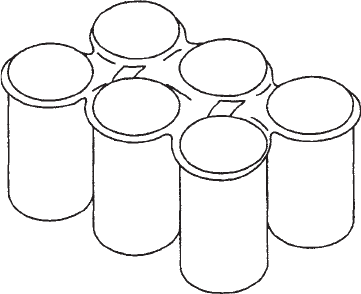
Figure 1).
Paperboard Carriers
Paperboard carriers for cans are used in two different
varieties, the wraps and the fully enclosed sleeves. In the
United States, fully enclosed sleeves are used for the
majority of the can multipacks. Sold in 12, 15, 18, 24, 30,
and even 36 multipacks, the popularity of these has grown
significantly. Originally sold in 3 4upto46 can
configurations, these carriers have recently developed to
be double layered stacks of cans with an interstitial pad
between the cans. Thus, multiples of 2 3 4, 2 3 5,
and 2 3 6 have been growing as a percent of the total
retailed cans (see Figure 2).
Typically, these fully enclosed sleeve packs are formed
from a preglued sleeve of paperboard that is then removed
from a magazine in a packaging machine, and collated
single or double layers of cans are packed inside these
sleeves in a parallel and continuous motion at speeds of
Figure 1. Plastic ring carriers.
CARRIERS, BEVERAGE 225
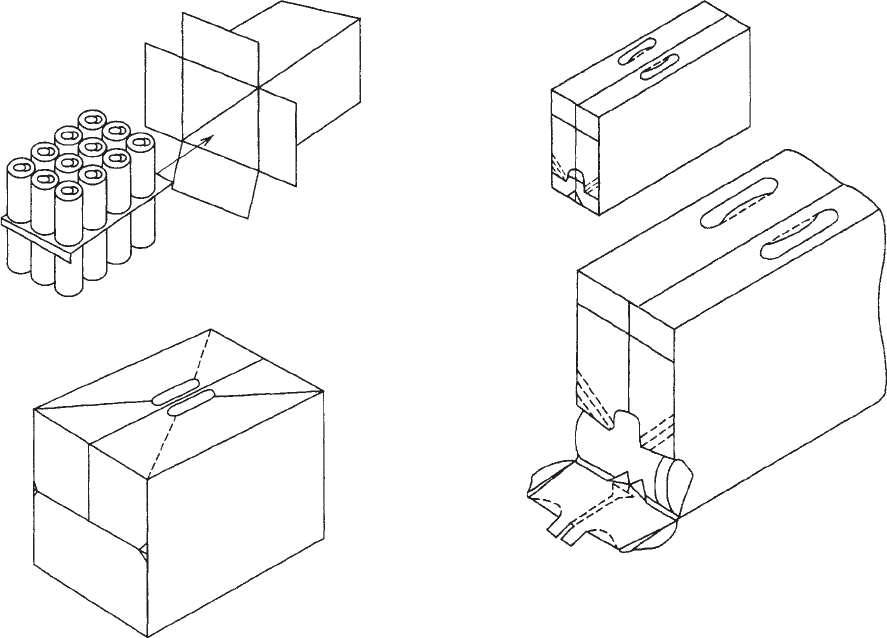
r3000 cans per minute. The ends of the sleeves are then
folded and glued or locked in place (see Figure 3).
While the fully enclosed sleeves are the most popular
form of secondary packaging for beverage cans in the
United States, can wraps continue to be popular in
Europe, Asia, and other parts of the world. Paperboard
can wraps are printed and die-cut blanks of paperboard,
which are removed from a magazine in a packaging
machine, brought over the cans in line and in continuous
motion; then the side wing panels are folded down, the
bottom flaps are folded in, and the cartons are locked or
glued in line (see Figure 4)(1).
Both the fully enclosed sleeves and the can wraps
are formed principally from paperboard formulated with
70–80% virgin fiber and 20–30% recycled fiber and con-
taining high resistance against wet tear.
The most common machinery used for forming fully
enclosed sleeves is supplied by Riverwood International,
The Mead Westvaco Corporation, and R. A. Jones Com-
pany, while the majority of the wet-strength carrierboard
used in manufacturing these packages is supplied by
Riverwood International and/or The Mead Westvaco
Corporation.
Other forms of can multipackaging are (a) paperboard
‘‘clips,’’ which grip the rims of cans, holding them by this
rim through distribution and retail, and (b) shrink film,
utilizing thermoplastic films that shrink around the cans
with the application of heat. Both of these forms of can
multipackaging have been tried in applications in the
United States, but have not been able to sustain measur-
able shares of the total can packaging market segment
(see Figure 5).
BOTTLE MULTIPLE PACKAGING
Basket-style carriers are a popular form of multipacka-
ging nonreturnable or one-way glass bottles (and for some
returnables), especially in smaller multiples such as 4, 6,
or 8 packs, and particularly in premium brands. Basket-
style carriers have also been chosen by the Coca-Cola
Company to package their proprietary PET contour-
shaped bottle with special die-cut designs registered to
make their design proprietary to the Coca Cola Company.
Thus, the popularity of basket-style carriers continues
regardless of whether they are used to package returnable
or nonreturnable glass bottles or to package plastic bottles
(see Figure 6).
Basket-style carriers traditionally are die-cut and preg-
lued from virgin or recycled paperboard, and all provide
cells for each bottle, sides and ends that are attractively
printed for merchandising and brand identification, and a
central handle panel that rises above the necks of the
bottles and provides for convenient and easy portability.
Riverwood International, Mead Westvaco Packaging, In-
ternational Paper, and Zumbiel are the primary suppliers
of these carriers.
Outside the United States, nonreturnable bottles are
more commonly multipacked in paperboard wraparound
carriers, which, similar to can wraps, are formed, wrapped,
Figure 2. Paperboard carriers.
Figure 3. Fully enclosed sleeve packs.
226 CARRIERS, BEVERAGE
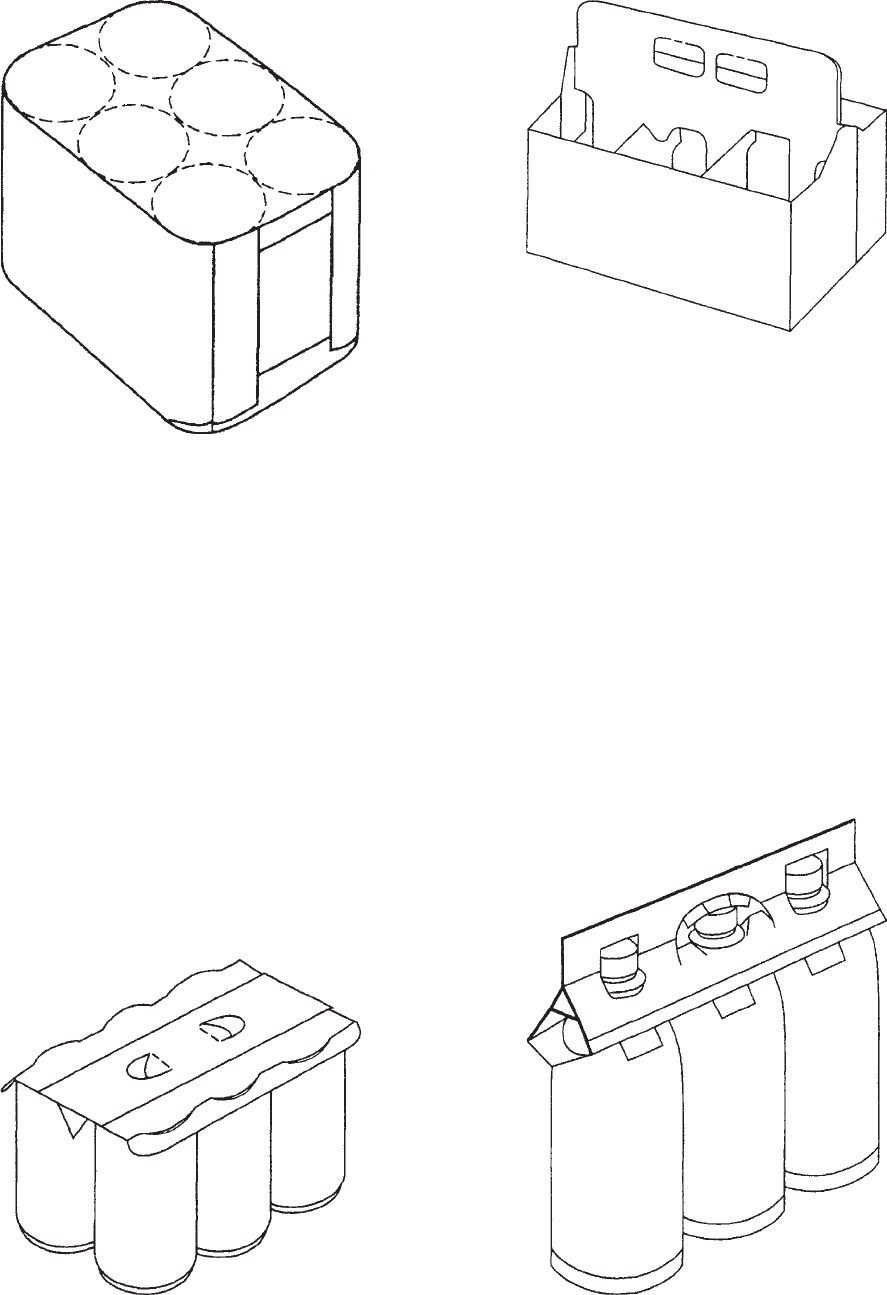
and glued or locked in place by in-line wrap machines.
These wraps, most commonly used to form 4-, 6-, and
8-packs, are applied by in-line machines supplied by
various companies such as Riverwood International, The
Mead Corporation, and Certipak, a division of Kliklok.
Plastic bottles are also multipacked in plastic rings
supplied by Illinois Tool Works. In the case of bottles, the
rings fit snugly around the middle portion of the bottles
and provide a handle protruding from one side in order to
carry the bottles. These rings commonly form 6 or 8 packs
of bottles.
Other forms of multipackaging nonreturnable bottles
appear in the form of clips that grip the bottles by the neck
or under the crowns and provide a handle with which to
carry the bottles (see Figure 7).
These clips are commonly used in countries of the
European Union (EU), where the concern for environmental
wastes has driven retailers and consumers alike to seek
minimal packaging while offering portability and some
merchandising possibilities. Clips can be formed from virgin
paperboard and are also available in plastic.
Finally, for larger multiples of glass bottles, the fully
enclosed paperboard sleeve is still the most widely utilized
multipack, particularly in the brewing industry. In
this package, the preglued sleeve, die-cut from wet-
tear-strength board, is applied in-line and in a continuous
motion by a packaging machine in an operation similar
to the can fully enclosed package machines previously
described. Operating at speeds of up to 1800 bottles per
minute, these machines can operate with or without
inserts that provide separations between the bottles.
These fully enclosed packs are commonly used for
premium brand product and serve as an ultraviolet-ray
Figure 5. Paperboard clips.
Figure 6. Bottle basket.
Figure 7. Bottle grips.
Figure 4. Can wrap.
CARRIERS, BEVERAGE 227