
Yam, Kit L. (ed.). The Wiley encyclopedia of packaging technology
Подождите немного. Документ загружается.

End Closures
In addition to strength and versatility, the composite
canister is also known for its numerous opening and
closing systems. Consumers prefer easy-opening and dis-
pensing features that provide resealability to maximize
freshness. Paper, aluminum, steel, or plastic membrane
closures are fitted on cans by single or double seaming,
gluing, pressure inserting, or heat sealing.
A critical process in the manufacture of a composite can
is double seaming the metal end (see Can Seamers). Since
a composite can body is typically thicker than a metal can
for any given package size, metal-can specifications for
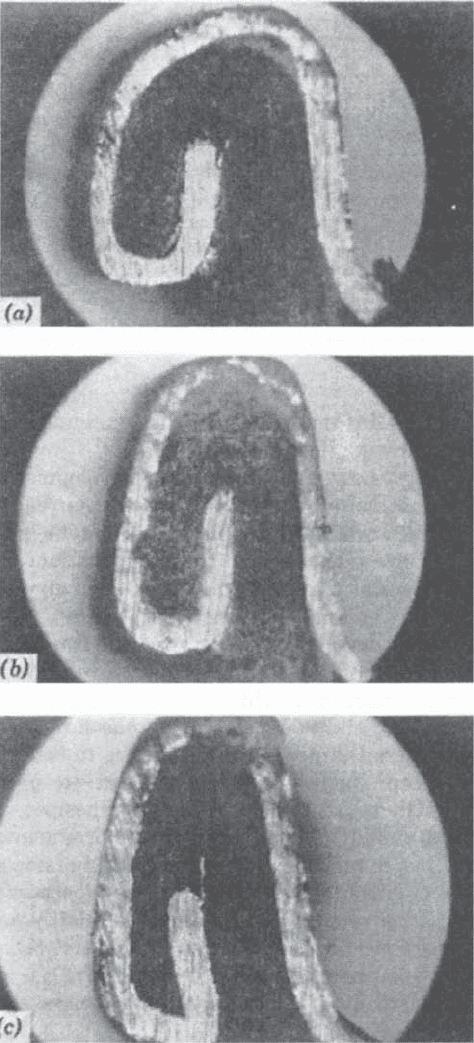
finished seam dimensions cannot be followed. Figure 4
shows composite double-seam profiles that are correctly
and incorrectly made. Careful attention should be given to
compound placement, selection of first- and second-stage
seamer rolls, seamer setup, chuck fit, and base plate
pressure if a satisfactory double seam is to be achieved.
Closures depend on the product to be packaged as well
as the ease of use, protection needed, dispensing require-
ments, the opening and reopening ability, and necessary
hermetic properties (1). Bottom end clsoures are primarily
coated with steel although plastic, paper, and aluminum
are sometimes used. The strength of the steel end is
generally correlated with basis weight and temper. Coat-
ings may also be applied to the end clsoure. Examples
of coatings include tinplate, vinyl, epoxy, or phenolics. If
maximum protection is needed, a sealing compound is
applied to the end.
A variety of steel and aluminum ends with solid panel,
removable tape, or other easy-opening features are avail-
able, as well as plastic-end closures with easy-opening and
sifter tops. In composites, the most expensive components
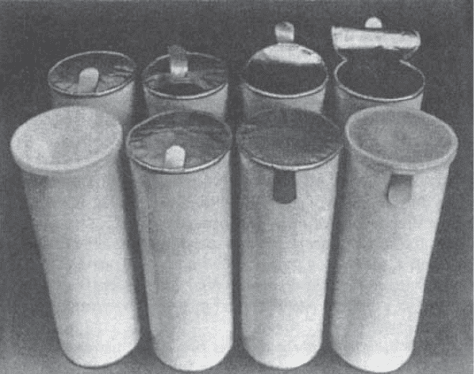
are usually the metal ends. With this in mind, gastight,
puncture-resistant membrane closures for composite have
been test marketed and evaluated by several companies
(see Figure 5). They are considerably less expensive than
aluminum full-panel removable ends, and they eliminate
the cut-finger hazard posed by both the center panel and
score residual on rigid ends. In addition, the membrane
end eliminates the metal fines that can be produced by can
openers.
Labels
The outer label on a composite can supplies additional
package protection and, more importantly, enhances the
can’s aesthetic appeal and provides required consumer
educational–instructional information. Composite labels
include coated papers, foil/kraft laminates, and film con-
structions based on polyethylene or polypropylene. Flexo-
graphic, rotogravure, or offset printing (see Printing) are
used, depending on cost and quality requirements.
Nitrogen Flushing
The materials and methods of constructing a composite
can depend on its end use and desired performance
characteristics. When composite cans were being devel-
oped for the snack industry, the concept involved creating
a hermetically sealed containers that could replace the
vacuum-packed steel can. Nitrogen flushing was devel-
oped to accomplish the removeal of oxygen from the
container. It is based on the principle of flooding the
container with a nonreactive gas just before it is filled.
Powders have a tendency to stick together so several
stages of purge are necessary. First the container is
purged prior to filling, to purge the product in the filler,
and finally to purge after filling. prior to seaming. For
Figure 4. Composite-can double seams. (a) Loose, (b) correct,
and (c) tight.
198 CANS, COMPOSITE
snacks, it may be necessary only to flush the filled can
prior to seaming (1).
RECYCLING
The package’s body plies are made from recovered and
recycled fiber and can have a post-consumer waste ccntent
of over 50%. In many communities, this qualifies the
composite can for placement in the material flow stream
of curbside recycling programs. In addition to the body,
the metal lids are recyclable. An introduction of a paper
bottom end can increase the amount of recycled post
consumer content up to 70% and enhances the can’s ability
to be recycled (1).
NEW DEVELOPMENTS
While dry-food packaging is the most common application
for today’s composite cans, more and more retailers are
seeing its value as a customizable option for vendable and
nonfood products. Packaging engineers are focusing on
ways to increase performance and convenience by enhan-
cing existing features and materials, reducing costs, and
redesigning of closure systems. Another way of using
sorbents is being researched. Sorbents provide high moist-
ure and odor absorbing capability. Generally, sorbents are
included in the products as a nonedible packet consisiting
of silica gel or clay. Research is focused on ways to build
the sorbent into the liner structure. By continung to
absorb oxygen, the product inside the can will remain
fresher before and after opening (1).
Valved membrane ends are also being studied. These
are designed for coffee. The one-way release valve allows
for packing and sealing immediately after roasting. This
eliminates the need for extended hold times for degassing
and at the same time maximizes flavor and aroma. A
vacuum is no longer necessary. Because the end is peel-
able, a can opener is not needed.
The resealable plastic overcap offers great promise for
providing increased shelf life after opening. Redesign of
the overcap will feature the addition of a gasket that will
snap to the opening of the composite can.
BIBLIOGRAPHY
M. B. Eubanks, ‘‘Cans, Composite’’ in M. Bakker, ed., The Wiley
Encyclopedia of Packaging Technology, 1st edition, John Wiley
& Sons, New York, 1986, pp. 94–98: 2nd edition, A. J. Brody
and K. S. Marsh, eds., 1997, pp. 134–137.
Cited Publication
1. C. Romaine, ‘‘Composite Cans’’ in M. J. Kirwan, ed., Paper and
Paperboard Packaging Technology, Blackwell Publishers,
London, 2005.
CANS, CORROSION
DAVID REZNIK
Raztek Corporation, Sunnyvale,
California
Corrosion in food cans, manifested in failure phenomena
such as detinning, hydrogen swell, and enamel delamina-
tion, has troubled the food industry ever since canning
was practiced. Much research work has been invested in
this subject, but problems still exist with only little relief.
The major reason for this fact is that the mechanisms
involved in the corrosion phenomena are not well known.
Molecular hydrogen is well known as a product of the
corrosion process, but its origins and its role along the
corrosion process in atomic form is not well established or
even considered (1, 2).
The existing theory cannot explain various corrosion
phenomena, and therefore it cannot provide solutions to
corrosion problems. There are many indications that all
corrosion phenomena involve hydrogen activity. The source
of the hydrogen is from water HOH, in which the radicals
H and OH are interdependent, similar to the ions H
+
and
OH
. All the four species are involved in the oxidation and
reduction reactions in nature. The state-of-the-art corro-
sion theories consider mainly the activity of the ions H
+
and OH
, but ignore the major role of the radicals H and
OH. The glass electrode that measures the pH defining
the H
+
and OH
activity is very common, but the redox
potential defining the ratio of H and H
+
activities is rarely
measured and considered. The pH indicates the degree of
acidity or alkalinity of the liquid. The redox indicates to
what degree the liquid is oxidizing or reducing.
Both H and H
+
, and perhaps OH and OH
, have some
qualitative dimension, as expressed, for example, by the
NMR (nuclear magnetic resonance) of the hydrogen. This
energetic property differentiates hydrogen atoms based
on its source. Hydrogen atoms and ions from different
sources may have a different effect on corrosion and many
Figure 5. Composite with peelable membrane closure.
CANS, CORROSION 199

other phenomena. This may be why different acids have a
different corrosive effect, and the pH alone is far from
providing an explanation to corrosion failures.
The source of corrosion is water, which contains the
four species participating in the corrosion process. These
are H and OH radicals as well as the well-known H
+
and
OH
ions. Corrosive materials affect some qualitative
dimension of the hydrogen atoms of the water. This is
why extremely small quantities of some material added to
the water may have a dramatic effect on corrosion, as well
as on many biological reactions. A simple known example
for such an additive is sulfur dioxide, which in trace
concentration may lead to detinning of fruit cans in a
matter of days or even hours. The effect of such traces on
pH are negligible.
These observations led to the conclusion that water is
not just a solvent or carrier. It is the corrosive agent itself
but is affected, however, by materials dissolved in the water
and even by materials that the water was in contact with.
The major tool used for corrosion studies in the food
packaging industry is still the test pack, by which a
product or medium is packed, stored, and evaluated.
This method should have been used to verify a mechan-
ism, rather than as the research tool. In fact, very little
was learned from test packs to ameliorate the theories of
corrosion mechanisms. In many cases the conclusions
from test packs were inconclusive and misleading.
Many analytical methods in corrosion studies (3) are
actually based on oxidation–reduction reactions where
specific hydrogen is involved (4). Hydrogen in molecular
form was detected on the external wall of cans during
storage (1, 5), but its origin and permeability (6, 7), as well
as its reactions in the bulk of the metal (8, 9) have not been
considered in can corrosion studies.
Enamel adhesion is based on hydrogen bonds (10), and
reactions affecting the hydrogen bonding (11) affect the
performance and the shelf life of enameled cans.
The corrosion mechanism involves oxidation–reduction
reactions (12). In the case of detinning in plain cans (13),
where the food is in contact with the tin-coated steel, the
tin and some iron are oxidized. This is the tangible
bottom-line result, but it can be shown that the active
element leading to this result is the atomic hydrogen from
water. The oxidation of the food product in enameled cans,
manifested in color and flavor changes, can be explained
by hydrogen loss (12).
Oxidation of organic matter is caused by loss of hydro-
gen atoms. Organic matter that gains hydrogen atoms is
reduced. Oxidation of metals is usually defined as loss of
electrons. Metallic ions can gain electrons and deposit as
metals. It can be shown that the hydrogen atom, in water
or in the food compounds, is the element that is trans-
ferred or gives and takes electrons, and in its absence
there will be no changes in organic and inorganic matter.
THE CORROSION MECHANISM
The basic reaction of oxidation reduction is
H2H
þ
þ e
The reaction to the right expresses the oxidation of
the hydrogen atom to H
+
(15). The reversible reaction to
the left is the reduction of the hydrogen ion H
+
to H atom.
The Nernst equation derived from this equation is
E ¼ E
0
þ
RT
F
ln
½H
þ
½H
where E is the electrochemical potential of the hydrogen
electrode, E
0
is the standard hydrogen potential, R and F
are constants, and T is the temperature. The expression
[H
+
] is the activity of H
+
, and [H] is the activity of atomic
hydrogen. The means to measure this potential is basi-
cally a platinum surface, to which the atomic hydrogen is
absorbed, and a reference electrode, such as a calomel
half-cell.
Replacing platinum with tin, the reading will be differ-
ent, because of the very different activity of hydrogen on
tin. In conclusion, the redox potential measurement in-
dicates the potential of hydrogen on the electrode at the
conditions of the measurement. The galvanic cell, there-
fore, expresses the difference of hydrogen activity on the
two metals.
The reaction on the cathode in a galvanic cell is known
to be H
+
+ e
-H, but it is not common consideration that
the opposite reaction takes place on the anode, where H
from the solution, gives its electron to the anode and turns
into H
+
. The latter may take an electron from the metal
and turn back into H, and the metal will dissolve as
positively charged ions. If the anode cannot lose electrons,
the solution will be oxidized, because it lost hydrogen that
turned into H
+
. The net result is hydrogen formation on
the cathode and H
+
or metal ions formation at the anode.
According to the above, the hydrogen in its different forms
is the major player in transferring electrons, or in oxida-
tion reduction reactions.
In a corrosion process in plain tinplate cans, the metal
is usually oxidized, and the product is reduced. In the case
where hydrogen is formed on the cathode and there is no
metal dissolution from the anode, the product itself is
oxidized, because it lost atomic hydrogen.
On the cathode : 2H
þ
þ 2e ! H
2
On the anode : 2H ! 2H
þ
þ 2e
Sn þ2H
þ
! Sn
2þ
þ H
2
The oxidation, therefore, can affect the solution as well as
the metal. Loss of H from water creates excess OH radicals
that may oxidize the product. Pears packed in plain cans
will be slightly bleached, and some tin will dissolve. The
product is reduced, and the tin is oxidized. In enameled
cans, pears will darken because there is no metal
dissolution.
Water is the source of H, which is in equilibrium with
H
+
and the respective counter groups OH and OH
.His
therefore the major parameter in the corrosion mechan-
ism. Any additive to water will somehow affect the activity
of the above four species, thus indirectly contributing to
200 CANS, CORROSION
the corrosion process, through the effect of the additives
on the water.
Radical and Ionic Reactions
Electrons can also be given to the anode by negative ions,
such as chloride and hydroxyl ions. The chloride at the
anode gives an electron to the anode and turns into
chlorine radical, which attacks the water and forms HCl
and OH radicals. The OH radicals may attack the metal,
take electrons, and turn into hydroxyl ions OH
.
Cl
!Cl þe
Cl þHOH !H
þ
Cl
þ OH
Me þOH !Me
þ
OH
or
H þOH ! HOH
The reaction of chlorine with water is not an ionic reac-
tion; it is a radical reaction, similar to the attack of OH on
the metal. Indeed, dry chlorine can attack metals directly
in absence of water, but such reactions are out of the scope
of the common corrosion in food cans.
The common approach in corrosion research is that the
mechanism is ionic only and that the water is just the
solvent and the carrier. This approach is incorrect and
misleading. In fact, corrosion of metals in distilled water
may be more severe than in tap water. The biochemical
and pharmaceutical industries realize severe corrosion of
stainless steel piping in distilled water.
The Electrochemical Potential
The galvanic corrosion has been explained on the basis of
potential difference between two dissimilar metals. This is
the driving force of the electrical current and therefore of
the corrosion process. The electrochemical potential of a
metal has been defined in textbooks as the tendency of
the metal to dissolve, or to give electrons. Actually, the
potential is not of the metal, but of the hydrogen on
the metal. The potential difference of the galvanic cell or
the bi-metal is therefore the difference of the hydrogen
potential on the two metals. The potential of hydrogen
depends on the solid to which it is adsorbed and the
solution in which the solid is immersed. Also, the pressure
above the solution has an effect on the potential (15). This
is another indication that the potential of a metal has to do
with hydrogen activity. The reactivity of the hydrogen with
the metal will determine the type and extent of the corro-
sion. If the two metals are noble, the solution will be
oxidized near the anode, where hydrogen gives its electron.
Potential difference does not require two different
metals. Nonuniform mechanical and chemical composition
leads to nonuniform absorption of hydrogen atoms to the
metal and thus to potential differences. The potential of
hydrogen on a stressed site on the metal is different than
on a nonstressed area. The stressed metal site will usually
serve as the anode, by accumulating hydrogen atoms that
turn into ions by donating their electrons to the cathodic
sites. The next step, as explained above, is the loss of
electrons from the metal to the hydrogen ions. As a result,
the metal dissolves as ions and the hydrogen atoms are
reformed. Trapped hydrogen atoms in the bulk of the
metal may lead to corrosion at the traps. It is well known
that stresses in steel lead to trapping of hydrogen and that
stressed areas tend to corrode. The type and rate of the
corrosion will also depend on the metal composition and
the distribution of the impurities on the surface and in the
bulk of the metal.
A good indication that the electrochemical potential of
metals is actually the potential of hydrogen on the metal is
that an enameled metal surface has a potential very close in
value to that of the uncoate d metal. Coated tinplate has a
different potential than coated TFS (tin-free steel). This
means that hydrogen and protons, which can migrate
through organic coatings , may reach the metal, where also
electrons may flow. The fact that metal does not dissolve
into the food does not mean that oxidation reduction reac-
tions do not occur. A possible result of such potential
difference is hydrogen swell and food discoloration.
Polarization
The activity of the hydrogen species in the solution is
changing in the course of the corrosion process. Near the
anode there is a depletion of H atoms, and near the
cathode there is a depletion of H
+
and formation of H
atoms. This leads to a decrease of the anode potential and
increase of the cathode potential, which means a decrease
in the potential difference and the driving force for
electrons flow. This phenomenon is termed polarization.
Oxidizing materials, which tend to combine with hydrogen
atoms, will counteract polarization on the cathode. Redu-
cing materials, which provide H atoms, will counteract the
anodic polarization. Materials that counteract polariza-
tion are called depolarizers.
The Role of Oxygen
The term oxidation is perhaps the most misleading term
in science. It has misled everyone, including scientists
to relate oxidation to oxygen. While the combination of
matter with oxygen is an oxidation process, most oxidation
processes do not involve molecular oxygen. Oxygen is
perhaps the mildest oxidizer in nature; however, its
combination with hydrogen is forming the OH radical,
which is the oxidizer in nature.
It can be shown that rust formation requires water or
moisture and not oxygen, as it is commonly thought. Steel
will rust under vacuum and high moisture, but it will not
rust in dry air. Oxygen can enhance rust formation, by
combining with hydrogen atoms adsorbed to the metal
surface, and form OH radicals. Hot steel surface, charged
with hydrogen under vacuum, will immediately form a
layer of rust on exposure to air.
Oxygen is a mild cathode depolarizer, but in the pre-
sence of atomic hydrogen and a suitable catalyst, oxygen
can form OH radicals that are strong oxidizers, because
these tend to combine with hydrogen atoms to form water.
Four hydrogen atoms are oxidized to water by one
CANS, CORROSION 201
molecule of oxygen. Such activity, however, depends on the
ability of the metal to catalyze the combination of mole-
cular oxygen with atomic hydrogen. A good illustration of
the mild oxidizing nature of oxygen can be demonstrated
by the fact that bubbling air into orange juice for a few
hours does not lead to discoloration. On the other hand,
orange juice discolors in enameled cans sealed under
vacuum. A food product that has lost hydrogen is oxidized.
The hydrogen can be lost to solids, such as coated tinplate,
that absorb hydrogen atoms. The oxygen may combine
with these absorbed hydrogen atoms to form OH radicals
that will directly oxidize the product. Oxidation of metals
is defined as loss of electrons. It is quite well established
that the electrons are lost in the corrosion process to H
+
or
to OH radicals, rather than oxygen.
On the basis of these observations, the oxygen is a
secondary player, which enters into the game at a later
phase in the corrosion mechanism, when the depolariza-
tion is the governing mechanism. The combination of
molecular oxygen and hydrogen requires a suitable cata-
lyst. Steel seems to be a good catalyst for such a reaction,
but it also is a strong absorber of hydrogen atoms.
Hydrogen Activity in Metals
Hydrogen embrittlement and stress corrosion are formed
by absorption of hydrogen into the metal. Hydrogen
trapped in steel can form extremely high pressures in
the metal, leading to cracking, blistering, and pitting. The
hydrogen trapped in the steel can react with many of the
noniron elements, such as carbon, sulfur, and phosphor.
The result is pitting corrosion, decarbonization, and loss of
strength.
Redox Potential of Water and Aqueous Solutions
The quality parameters of water in contact with the metal
should include its redox potential that takes into considera-
tion not only the pH, but also the hydrogen activity. Water
is composed from H and OH radicals. The multiplication of
the activities of the H and OH radicals is constant, similar
to the relationship of H
+
and OH
from which the pH
values are derived. When the H activity is higher than the
OH activity, the water is reducing, and when the activity of
OH is higher, the water is oxidizing. In neutral water the
activity of the H and the OH is the same. Neutral water
with respect of redox is not the same as neutral water at pH
7, and vice versa. Water at pH 7 can be very oxidizing and
canbemadeveryreducingbybubblinghydrogeninthe
water. Orange juice, for example, is acidic and reducing.
Tap water may be at pH 7 and very oxidizing. The redox
potential, as defined by the Nernst equation given above,
includes the effect of the pH, but the pH does not include
the redox. Many materials added to the water may affect
the redox but not the pH. A good example is the addition of
ozone and hydrogen peroxide to water, which will affect the
redox but not the pH. The corrosivity of the water may
sharply change by such additives. It is very important to
consider the redox potential as well as the pH of the water
used for the product and the process, in order to minimize
internal corrosion, and that of the cooling water to avoid
external corrosion.
THE SPECIFICITY OF HYDROGEN
The empirical corrosion research clearly indicates that the
pH alone can neither explain nor predict corrosion phe-
nomena. The corrosivity of various food products having
the same pH may be very different. Acetic acid, for
example, is much more corrosive than citric acid in contact
with steel, but the opposite is true for tin that is not
attacked by acetic acid. In lack of a scientific explanation
to these facts, this phenomenon is explained by the term
‘‘affinity.’’ Even the consideration of the redox potential
does not enable prediction of corrosion. Two solutions at
the same pH and the same redox may exhibit different
corrosion effects on the same type of can.
Haggman (2) showed that steel with high sulfur con-
tent is attacked by foods containing sulfates. Similarly,
foods containing phosphates are corrosive to steel contain-
ing high phosphor levels. All of these confusing facts,
which cannot be explained by the common theories of
corrosion mechanisms, are indicative that some para-
meter, having a major effect on corrosion, is not known
and therefore not considered.
Researching the mechanism of biological oxidation
reduction provides a clue that might point out a possible
direction for explaining the puzzling phenomena de-
scribed above.
The specificity of enzymes is well known. Enzymes are
responsible for the oxidation reduction reactions in biolo-
gical systems. Each biological reaction requires a specific
enzyme. The catalyst for the reduction of carbon dioxide
into sugar in the photosynthesis reaction is the chloro-
phyll. No other catalyst in nature will do it. This reaction
also requires very specific light energy, at a very specific
narrow range of wavelength or frequency. The physicist
relates to energy also through its qualitative properties,
while others usually consider energy quantitatively only.
Energy has a dimension of intensity, but also a qualitative
dimension expressed in wavelength or frequency.
Antioxidants donate hydrogen atoms, thereby serving
as reducers. However, such reducing activity is quite
specific. Vitamins C and E are antioxidants, but each
one is responsible for the reduction of specific systems.
This means that the hydrogen donated by vitamin E is
qualitatively different from that of vitamin C, or other
antioxidants. In other words, if antioxidants had not have
this specificity, there would have been only one antiox-
idant in nature.
The summary of all these facts leads to the conclusion
that hydrogen atoms and ions differ in their qualitative
energetic properties. This is the source of the multiple
forms of corrosion, and this must be the explanation for
the lack of understanding and control of some corrosion
phenomena.
Nuclear magnetic resonance (NMR) spectroscopy is
based on the theory that the active hydrogen atom in an
organic molecule has a specific energetic property. This
property is specific to every material and therefore can be
used for the purpose of identification of materials. This
knowledge is applied in medicine to identify, for example,
cancerous cells in biological tissues. Applying NMR spec-
troscopy to corrosion research may lead to explanations as
202 CANS, CORROSION
to why atomic and ionic hydrogen from different sources
have a different corrosion effect on a certain metal.
COMMON CORROSION PROBLEMS
The mechanisms explained above can be used to enlighten
some of the common corrosion failures.
Pitting Corrosion
Microscopic examination of the metal in cans exhibiting
‘‘hydrogen swell’’ and sulfide black reveals pits in the steel.
This type of corrosion is common in cans with foods
containing sulfur. It has been realized that the pits occur
more on stressed areas, in steels containing sulfur.
Hydrogen atoms that had been in contact with a sulfur-
bearing compound permeate into steels and are trapped
at preferred specific points. Such points contain extra
amounts of sulfur, which is irregularly distributed in the
steel. The permeation and trapping of hydrogen in such
sites is enhanced, if the sites are mechanically stressed.
The hydrogen trapped in the steel develops very high local
pressures in the steel. The trapped hydrogen reacts
with the nonmetallic components of the steel, and it also
recombines to form molecular hydrogen gas. Such activity
in the steel occurs mainly in enameled cans. This process
requires permeation of hydrogen into the steel, and it is
therefore more common in enameled tin-free steel and
low-tin-coated tinplate. The permeating hydrogen may
leave to the atmosphere, unless trapped by nonuniform
distribution of impurities and mechanical stresses.
Sulfide Black
The trapping of hydrogen in the steel depends on the steel
and the food composition. The gas emanating from the pits
may be only hydrogen, but usually, in case of pit forma-
tion, it is composed of a mixture of compounds containing
iron, sulfur, and other elements from the steel. These
erupting compounds appear as black spongy lumps,
termed by canners as ‘‘sulfide black.’’ This phenomenon
occurs mainly in enameled cans, and the sulfide black
appears mainly on the coated side seam and along beads
and scratches, where irregular stresses are formed. The
food product triggers the formation of the sulfide black,
but the steel composition and mechanical stresses are the
controlling factors in the mechanism of sulfide-black
formation.
Enamel Peeling and Under Film Corrosion
The bonding between the enamel and the metal is based
on hydrogen bonds. These bonds are formed by hydrogen
atoms shared by the metal and the coating. The H atom,
coming usually from the organic coating, shares its elec-
tron with the metal and the coating. For example, the
hydrogen atom of an OH group in the coating may share
its electron with an oxygen atom on the metal surface. The
hydrogen bond can be described as
Metal2O H O2polymer
Such bonds can be destroyed by addition of a hydrogen
atom to the bond. By that, two OH groups that repel each
other will be formed, and the metal will repel the polymer.
This means that the delamination is caused by a reduction
mechanism. A complete delamination, with or without any
corrosive attack on the metal, can occur when the food
product is very reducing, the polymer is very permeable to
hydrogen atoms, and the metal surface is extremely im-
permeable to the hydrogen. This excess of atomic hydrogen
will be formed between the tin and the polymer, leading to
reduction of the metal and the loss of the hydrogen bond.
Such complete delamination was frequent when heavy hot-
dipped tin coatings were coated with phenolic and other
types of polymer. Partial delamination, followed by corro-
sion under the enamel in tomato cans, is still a common
phenomenon. It appears usually near scratches and on
stressed areas, such as beads and side seams.
The hydrogen bond can also be destroyed by oxida-
tion—that is, by removing the hydrogen atom that is
forming the bond. Pulling the hydrogen out chemically
or electrochemically may lead to loss of the bonding
hydrogen from the polymer. The loss of adhesion in such
cases is expressed in small blisters to the enamel, pit
formation, and some metal dissolution, and it is frequently
indicated by formation of hydrogen gas in the container.
The latter leads to vacuum loss and even hydrogen swell.
Hydrogen Swell
The formation of hydrogen gas and severe tin dissolution
in plain cans is well known. This is usually explained
as the attack of H
+
on the tin. The mechanism is much
more complicated, and it involves the redox potential
of the food and the specificity of the hydrogen in relation-
ship to the tin and steel composition. The pH alone is
far from explaining why a few parts per million (ppm)
of sulfite, which have no significant effect on the pH,
will lead to very rapid detinning. The tin is attacked by
H
+
, which, as mentioned above, has also a qualitative
dimension besides its concentration in the food. The H
+
could also be formed from atomic hydrogen that entered
the bulk of the tin. The fact that large quantities of
hydrogen gas are formed may indicate that the atomic
hydrogen in the tin delivers the electrons to cathodic sites
in the steel. Analysis of cases of such failure supports the
conclusion that the interaction of the tin with specific
hydrogen is the controlling factor in rapid detinning. The
redox potential of the product and the specificity of the
hydrogen of the product, as well as depolarization agents
in the product, are the important parameters to be con-
sidered in such failure studies.
Hydrogen swell occurs also in enameled cans. The
mechanism is commonly attributed to the porosity of the
enamel. The enamel coverage and its thickness affect
the resistance to hydrogen permeation into and out of
the enamel. The resistance is only one of the factors
affecting hydrogen permeability. At zero driving force,
the resistance is meaningless. The formation of the hydro-
gen pressure and its permeability depend mostly on the
characteristics of the metal and the food product. There is
a certain optimal enamel coating that should be applied.
CANS, CORROSION 203
This optimum depends on a few factors related mainly to
the metal and the product but not related to the enamel.
Hydrogen atoms can diffuse through the enamel and
dissolve and accumulate in the metal, but they can also
migrate to the external wall. They can then react with the
impurities in the steel, form pits, recombine to form
molecular hydrogen, and diffuse through the enamel. It
is possible to have hydrogen swell without significant or
equivalent metal dissolution.
Darkening of Light-Colored Fruit
Corrosion in cans refers to the oxidation of the metal. The
role of hydrogen in its atomic and ionic form in this
corrosion process was explained above. Oxidation of the
food product may be regarded as the corrosion of the
product, and it is explained as loss of atomic hydrogen.
In many cases the hydrogen that was lost from the food is
the hydrogen that has led to the corrosion. In other words,
the metal can, enameled or plain, can lead to oxidation of
the food product by absorbing atomic hydrogen from the
product.
Darkening of the food is the result of oxidation of some
compounds in the food. The oxidation is due not to addi-
tion of oxygen, but rather to hydrogen loss. The composi-
tion and the physiochemical properties of the food, the
organic coating, and the metal, with respect to hydrogen
activity, are the factors involved in the mechanism of the
oxidation of both the metal and the food.
CONCLUSION
Hydrogen in its atomic, ionic, and molecular form partici-
pates in any corrosion process. There is no corrosion
without hydrogen. The electrochemical potential of the
metal is the potential of hydrogen. The redox potential of
the food defines the hydrogen activity of the food and its
tendency to lose or gain hydrogen atoms.
The specific energetic properties of the active hydrogen
will determine the rate of corrosion. The hydrogen activity
and its effects have to do with the composition of the
materials involved. The interaction of the materials with
hydrogen determines the type and rate of corrosion. The
properties of materials, such as hydrogen permeability
through the polymers and the metals, should be studied
and correlated with performance.
The source of hydrogen is water that acts through its H
and OH radicals. The redox potential of water, together
with the pH and the specificity of the hydrogen, have to be
considered in order to understand and control corrosion.
The water used for processing and the product water
should be considered along the above parameters.
The food product composition and any additive will
have an effect on the corrosivity of the product. The
packaging materials should be studied in view of their
interactions with hydrogen, taking into account the spe-
cific properties of the hydrogen atoms in the product and
the affinity of the specific hydrogen with the specific
packaging materials.
This article is a summary of the author’s research
through a new approach to corrosion studies. The research
is based on the well-verified assumption that hydrogen
activity is the major parameter controlling corrosion. The
research is far from being complete and may not offer
immediate solutions to all corrosion phenomena and fail-
ures. It may serve as a new direction for researchers in
this field who seek better understanding of the corrosion
mechanisms and means to avoid failures.
Corrosion failure analysis through the presented the-
ory can spread light on many unexplained corrosion
phenomena, such as detinning, enamel peeling, and un-
derfilm corrosion, as well as sulfide black and pitting
corrosion. The key to understanding and solving corrosion
problems is thinking hydrogen.
BIBLIOGRAPHY
1. J. Haggman and Oy G. W. Sohlberg, in Proceedings, 2nd
International Tinplate Conference, International Tin Re-
search Institute, London, 1980, pp. 400–405.
2. J. Haggman and Oy G. W. Sohlberg, in Proceedings, 4th
International Tinplate Conference, 1988, pp. 294–304.
3. S. C. Britton, Tin versus Corrosion, ITRI Publication 510, 1975.
4. D. Reznik, ‘‘Porosity of Coatings,’’ The Canmaker February,
(1990).
5. G. Serra and G. A. Perfetti, Food Technol. March, 57–61 (1963).
6. N. V. Parthasaradhy, Plating January, 57–61 (1974).
7. D. Reznik, Proceedings, 4th International Tinplate Confer-
ence, 1988, pp. 286–294.
8. I. M. Bernstein and A. W. Thompson, Hydrogen Effects in
Metals, 1981.
9. T. Zakroczymski, Hydrogen Degradation of Ferrous Alloys,
Noyes, NJ, pp. 215–250.
10. G. Pimental and A. L. McClellan, The Hydrogen Bond, 1960.
11. W. C. Hamilton and J. A. Ibers, Hydrogen Bonding in Solids,
1968.
12. D. Reznik, ‘‘Oxidation of Foods in Enameled Cans,’’ The
Canmaker March, 32–33 (1993).
13. D. Reznik, ‘‘Corrosion of Tinplate,’’ The Canmaker July,(1991).
14. D. Reznik, ‘‘Recent Research on Side Seam Striping,’’ The
Canmaker September, 47–48 (1990).
15. A. White, P. Handler, et al., Principles of Biochemistry,
McGraw-Hill, New York, 1959, pp. 35–37.
CANS, PLASTIC
Updated by Staff
INTRODUCTION
Cans are defined here as open-mouthed cylindrical con-
tainers, usually made of aluminum (see Cans, aluminum)
or tinplated steel (see Cans, steel). This form can also be
made of plastics, by injection molding (see Injection mold-
ing), blow molding (see Blow Molding), or forming from
sheet (see Thermoforming). Such cans have been made for
many years and have taken small shares of some markets,
204 CANS, PLASTIC
but are not dominant in any. Plastics are much less rigid
than metals, thicker walls are needed for equivalent
performance, and container weight and cost can become
excessive. For carbonated beverages (see Carbonated bev-
erage packaging), cans are rigidified by internal pressure,
but other properties such as burst strength, creep, and gas
barrier become more critical.
Tensile strength is needed, especially in beverage cans,
and can be achieved through selection of appropriate
plastics plus orientation (stretching). Orientation in the
circumferential (hoop) direction is hardest to do, and this
explains why blow molding from a narrow parison may
give better performance than thermoforming or direct
injection to size. Heat resistance may be needed: either
around 1221F (50 1C) to resist extreme warehousing con-
ditions; or 1401F (60 1C) for 30 min (pasteurization); or
185–2121F (85–100 1C) for a few seconds (hot filling); or
2571F (125 1 C) for 20–40 min (retort sterilization cycle). A
can for processed foods must withstand the internal
pressure generated when a closed can is heated. In a
sterilizing retort, compensating overpressure may be
needed outside the can to prevent failure. Not all retorts
are capable of such overpressure (see Canning, food). Gas
and/or moisture barrier and chemical resistance are
needed for most packages. The can shape is advantageous
for barrier, because it offers a low surface-to-content ratio,
but it also introduces the possibility of failure from
chemical attack in some places, particularly the stressed
flange area and the bottom edge.
Product-design centers on these two features: the
flange and the base. A precise flange is needed to guaran-
tee a perfect seal, which is absolutely critical for sterilized
cans and is certainly desirable for contained liquids,
especially under pressure. If a plastic end is used, heat-
sealing is possible, but the plastic end will be less rigid and
may require a heavier flange. Common metal ends may be
used, but flanges must be very flat. Also, no matter what
end is used, stresses and later stress cracking in that
region must be anticipated and avoided.
Vertical sidewalls are desired for easy transport in
filling lines. Tapered walls do allow nesting, which has
storage advantages, but for mass applications the filling
speed is more important. Another design concern is the
necked-in end now customary for beverage cans, which
allows tighter six-packing and cheaper ends. This can be
done with plastics, but mold design is more complicated to
permit the undercut needed.
APPLICATIONS
Thermofolded 250-mL PET cans have been used in Great
Britain (Plastona), but they are nonvertical (they nest),
and they are not coated to enhance barrier properties. In
the United States, Coca-Cola was working with ‘‘Petai-
ners,’’ which are cans drawn in solid phase from molded
PET cups developed in Europe by Metal Box and PLM A.B.
The term Petainers now refers to bottles. In Italy, some
beverage cans are made by thermoforming, whereas some
are made by blowing bottles and cutting/flanging the tops.
The latter should give the best properties for given weight
because of more orientation.
For heat-processed foods, polypropylene is the pre-
ferred material because it has the highest heat resistance
of the commodity thermoplastics. Polycarbonate (see Poly-
carbonate) and other engineering plastics have been sug-
gested, but are much more costly. Both PP and PC are poor
oxygen barriers, however, and would need a barrier layer
for many foods. Metal Box also worked with extruded
tubes with top and bottom flanged ends, and resin suppli-
ers have made cans on pilot lines, but there is still no
large-scale commercial use. One of the problems is that
other forms of plastic (e.g., trays, bottles, pouches and
bowl shapes) are competing for the same markets. For
frozen juice, composite cans have most of the market (see
Cans, composite), although Tropicana has injection molds
its own polystyrene cans, and some injection-molded
HDPE cans appeared in the market as well. Injection-
molded HDPE cans are used for cake frostings, and dry
beverages are sometimes seen in plastic cans, notably the
heavy injected PP cans used in Italy for coffee.
The Plastic Can Company (PCC) has patented a two-
stage PET paint container. The technology that has been
used for bottles is now available for cans. The technology
allows preforms and lids to be manufactured centrally and
economically shipped and stored at the paint filling plant
before being blow molded into finished cans on site. The
plastic can replaces the traditional metal lever lid contain-
ers used for paints and dry goods with a single plastic
molding. Its benefits include: use of environmentally
friendly plastics such as PET to be used for the first time
for oil and solvent-based paints and for water-based paint;
transparent cans allowing consumer to see color of paint;
ai
r tigh
t on resealing; rustproof. Also, PET is cheaper and
lighter than steel. PCC is now developing cans intended for
kitchen/home use with hand-openable and resealable air-
tight lids for dried and preserved foods (1).
BIBLIOGRAPHY
‘‘Cans, Plastics’’ in The Wiley Encyclopedia of Packaging, 2nd
edition, John Wiley & Sons, New York, 1997, p. 144.
Cited Publication
1. ‘‘The First Ever Two-Stage Plastic Paint Can,’’ The Plastic Can
Company, www.plastic-can.com. Accessed July 2008.
CANS, STEEL
FRED J. KRAUS
GEORGE J. TARULIS
Crown Cork & Seal Company,
Inc., Alsep, Illinois
In 1975, France not only was involved in a revolution but
also was at war with several hostile European nations.
CANS, STEEL 205
The French people as well as the armed forces were
suffering from hunger and dietary diseases. Consequently,
a prize of 12,000 francs was offered by the government to
any person who developed a new means for the successful
preservation of foods. Napoleon awarded this prize to
Nicholas Appert in 1809. Mr. Appert’s discovery was
particularly noteworthy because the true cause of food
spoilage was not discovered until some 50 years later by
Louis Pasteur. Appert had nevertheless recognized the
need for utter cleanliness and sanitation in his operations.
He also knew or learned the part that heat played in
preserving the food, and finally, he understood the need
for sealed containers to prevent the food from spoiling.
The containers he used were wide-mouthed glass bottles
that were carefully cooked in boiling water (1, 2).
A year after the recognition of Appert’s ‘‘canning pro-
cess,’’ in 1810, Peter Durand, an Englishman, conceived
and patented the idea of using ‘‘vessels of glass, pottery,
tin (tinplate), or other metals as fit materials.’’ Thus, the
forerunners of modern food packages were created. The
original steel cans had a hole in the top end through which
the food was packed. A disk was then soldered on to the
top end. The disk had a small hole in it to act as a vent
while the can was cooked. The vent hole was soldered and
closed immediately after cooking (2).
Durand’s tinplate containers were put together and
sealed by soldering all the seams. The techniques were
crude but nevertheless, with good workmanship, afforded
a hermetic seal. A hermetically sealed container is defined
as a container that is designed to be secure against the
entry of micro-organisms and to maintain the commercial
sterility of its contents after processing. Commercial steri-
lity is the inactivation of all pathogenic organisms and
those spoilage organisms that grow in normal ambient
distribution and home-storage temperatures. No techno-
logical advance has exerted greater influence on the food
habits of the civilized world than the development of heat
treatment and the use of hermetically sealed containers
for the preservation of foods (1, 3).
Foods canned commercially by modern methods retain
nearly all the nutrients characteristic of the original raw
foods. Several investigations showed that good canning
practices as well as proper storage and consumer prepara-
tion improve the retention of the nutritive value of canned
foods (4–6).
The steel container provided a reliable lightweight
package that could sustain the levels of abuse that were
common in packing, distributing, and selling of products.
It has also been necessary to improve and develop new
concepts to keep up with the advances in packing proce-
dures, materials handling, and economic pressures.
EVOLUTION OF THE CAN
A four-track evolutionary road developed. One uses solder
to seal all the can seams. This process evolved from the
hole-in cap container to one that holds evaporated or
condensed milk. These ‘‘snap-end cans’’ retain the vent
hole in the top that permits filling the can with a liquid.
They are then sealed with a drop of solder or solder
tipping. The second track combines the soldering of the
side seam with the mechanical roll crimping the ends onto
the body. The attachment procedure known as double
seaming was patented in 1904 by the Sanitary Can
Company. This invention significantly improved opportu-
nities to increase the speeds of can manufacture and
packing operations. Today, double seamers or closing
machines seal cans in excess of 2000 cans per minute
with filling equipment that can match this task. The third
track uses a press operation that stamps out cuplike
structures with an integrated body and bottom, with the
lid or top attached by double seaming. These began as
shallow containers like sardine cans. These drawn or two-
piece cans evolved into taller cylindrical cans that are
popular for many food products and carbonated beverages.
The primitive shallow cans are fabricated on simple
presses. The taller two-piece cans go through multiple
press operations like the draw–redraw technique or
through a drawn press and wall iron operation. The fourth
track is the incorporation of a welded side seam for three-
piece cans, which provided greater body strength and
more double seaming latitude in comparison to the sol-
dered side seam.
The growth of the steel can caused the manufacturing
function to change. At first, the packers manufactured
their own cans. This was understandable, because the
same craftspersons and equipment were necessary to seal
the can as well as to make them. When the double-seamed
can or ‘‘sanitary can’’ was accepted, the can manufactur-
ing function coalesced into large manufacturing organiza-
tions. This came about because the double-seamed can
lent itself to mechanized production whereas the all-
soldered can remained a manual operation. Hence, it
was economically attractive to invest large sums of money
for improving the sanitary can. A few large packers could
afford to be self-manufacturers, and they invested large
sums to keep up with the developing technology. However,
their attempts to produce cans was often short lived
because of economic changes that forced them to become
dependent on the can companies for their container needs.
Today some packaging companies still make their own
containers.
SHAPES AND SIZES
A wide variety of styles and sizes have grown out of the
tremendous
usage of steel
containers (see Tables 1 and 2).
The first figures of the container dimension represent
the diameter of the container measured overall across
the double seam; the second figure is the height, which is
the vertical overall height measured perpendicular to the
ends of the can. The first digit in each number represents
inches; the second two digits represent sixteenths of an
inch. Thus, a 307 113 can is 37/16 in. in diameter and
113/16 in. high. For rectangular cans, the first two sets of
digits refer to base dimensions; the third set refers to can
height.
Some can sizes are given various ‘‘names’’ by which the
can is known. Some of these names that are identified in
Table 2 are very old, dating back to the early history of
206 CANS, STEEL

Table 1. Steel Can Styles and Sizes
Style Dimensions in. (cm) Capacity Some Uses Convenience Features
Aerosol cans (1) 202 214–300 709
(5.4 7.3–7.6 19.2)
3–24 oz (85–680 g) Foods, nonfoods Designed for fit of
standard valve cap
Beer-beverage cans (2) 209.211 413 (6.5/
6.8 12.2)
12 or 16 fl oz (355 or
473 cm
3
)
Soft drinks, beer Easy-open tab top, unit-
of-use capacities
209.211 604 (6.5/
6.8 15.9)
207.5/209 504 (6.3/
6.5 13.3)
Crown-cap, cone-top can 200 214–309 605
(5 7.3–9 16)
4–32 oz (113–907g) Chemical additives Tamperproof closure,
easy pouring
Easy-open oblong can 405 301 (11 7.8) #1/4
oblong
4 oz (113 g) Sardines Full-paneled easy-open
top
Flat, hinged-lid tins (3)112104.5 004–
212 205 003.75
(4.4 104.5 0.64–
7 5.9 0.6)
12–30 tablets Aspirin Easy opening and
reclosure
Flat, round cans 213 013 (7.1 2.1) 11/2 oz (43 g) Shoe polish Friction closure
Flat-top cylinders (4) 401 509–610 908
(10.3 14.1–16.8 24)
1–5 qt (946–4730 cm
3
) Oil, antifreeze Unit-of-use capacities;
tamperproof since it
cannot be reclosed
211 306 (6.8 8.6) 8 fl oz (237 cm
3
) Malt liquor
211 300 (6.8 7.6) 8 oz (227 g) Cat food
300 407 (7.6 11.3) 15 oz (425 g) Dog food
Hinged-lid, pocket-type
can
Tobacco, strip bandages Firm reclosure
Key-opening,
nonreclosure can (5)
Sardines, large hams,
poultry, processed
meats
Contents can be removed
without marring
product
Key-opening, reclosure
cans (6)
307 302–502 608
(8.7 7.9–13 16.5)
1/22 lb (0.2–0.9 kg) Nuts, candy, coffee Lugged cover reclosure
401 307.5–603 712.5
(10.3 8.8–
15.7 19.8)
1–6 lb (0.45–2.7 kg) Shortening Lid is hinged
211 301–603 812
(6.8 7.8–15.7 22.2)
1/45 lb (0.11–2.2 kg) Dried milk Good reclosure
Oblong F-style cans (7) 214 107 406–
610 402 907
(7.3 3.7 11.1–
16.8 10.5 24)
1/161 gal (237–
3785 cm
3
)
Varnish, waxes,
insecticides,
antifreeze
Pour spout and screw-
cap closure
Oblong key opening can
(8)
314 202 201–
610 402 2400
(9.8 5.4 5.2–
16.8 10.5 61)
7 oz–23.5 lb (0.2–10.7 kg) Hams, luncheon meat Wide range of sizes,
meat-release coating
available
Oval and oblong with
long spout (9)
203 014 112–
203 014 503
(5.6 2.2 4.4–
5.6 2.2 13.2)
1–4 fl oz (30–118 cm
3
) Household oil, lighter
fluid
Small opening for easy
flow control
Pear-shaped key-
opening can (10)
512 400 115–
1011 709 604
(14.6 10.2 4.9–
27.1 19.2 15.9)
1–13 lb (0.45–5.9 kg) Hams Easy access through key-
opening feature, meat-
release coating
available
Round truncated Waxes Screw-cap simple
reclosure
Round, multiple-friction
cans (11)
208 203–610 711
(6.4 5.6–16.8 19.5)
1/321 gal (118–
3785 cm
3
)
Paint and related
products
Large opening, firm
reclosure, ears and
bails for easy carrying
of large sizes
Round, single-friction
cans
213 300–702 814
(7.1 7.6–18.1 22.5)
r10 lb (4.54 kg) Paste wax, powders,
grease
Good reclosure
Sanitary or open-top can
(three-piece) (12)
202 214–603 812
(5.4 7.3–15.7 22.2)
4 fl oz–1 gal (118–
3785 cm
3
)
Fruits, vegetables, meat
products, coffee,
shortening
Tamperproof, ease of
handling, large
opening
Slip-cover cans Lard, frozen fruit, eggs Simple reclosure
(Continued)
CANS, STEEL 207