
Yam, Kit L. (ed.). The Wiley encyclopedia of packaging technology
Подождите немного. Документ загружается.

the areas of filling, handling, storage, and shipping.
There are presently standards for the 55-, 30-, and 16-
gal open-head and tight-head drums, as well as for the
20-L and 5-gal tight-head, nesting-lug cover, and
straight-sided lug cover pails. The ANSI standard also
includes a thorough glossary of terms related to
packaging. The ANSI Committee is presently in the
process of revising the current edition of the standard,
ANSI MH2-1991 (2), to incorporate the construction
requirements set forth under the Department of Trans-
portation’s Performance-Oriented Packaging Standards,
published in 1990 (see under ‘‘Regulations’’ below).
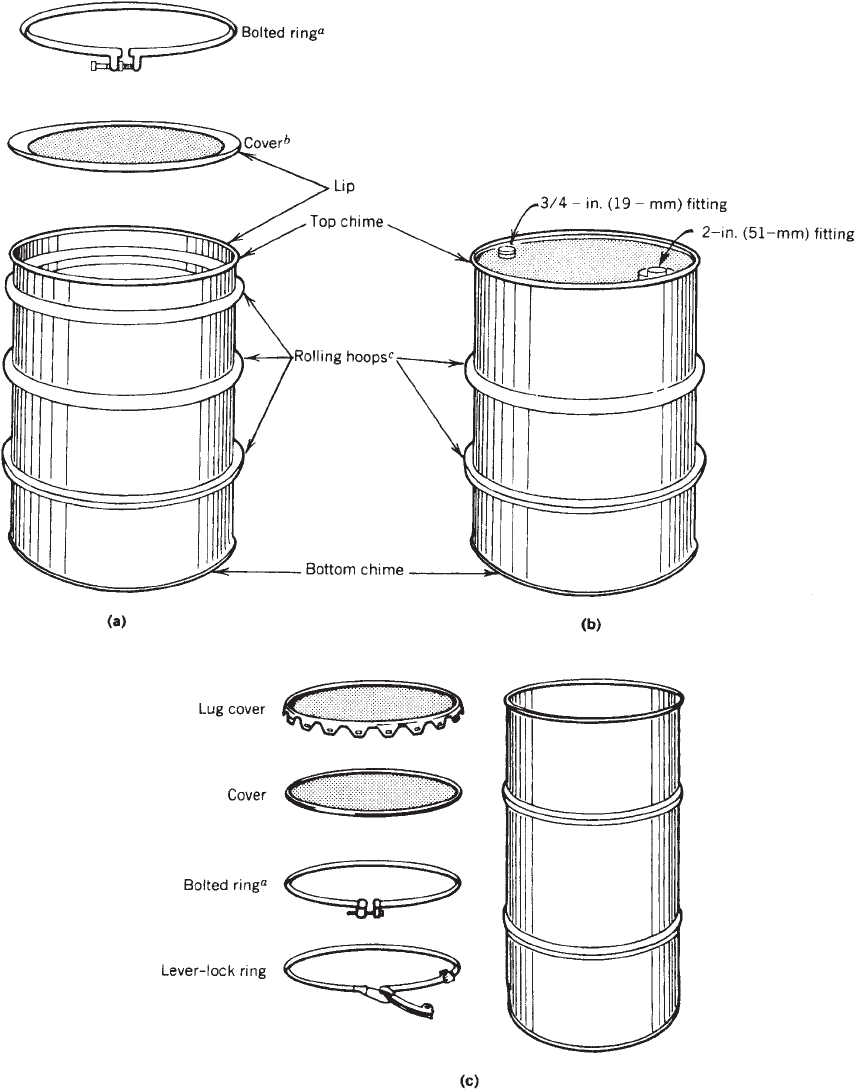
Figure 1. Steel drum designs: (a) open-head 55-gal (208-L) drum; (b) tight-head 55-gal (208-L) drum; (c) open-head 16-gal (606-L) drum.
In part a, lever-lock ring may be used; in part b, lip of cover is turned down to fit over lip of drum; in part c, two or three rolling hoops may
be used, depending on size and material packaged. Hoops are equally spaced horizontally. Actual drum dimensions may vary.
378 DRUMS/PAILS, STEEL
REGULATIONS
All-steel pails and drums used in the United States for the
transport of hazardous materials must comply with the
Department of Transportation’s Hazardous Materials
Regulations (DOT) (4). For nonhazardous products, these
containers usually comply with the minimum require-
ments of the specifications set forth in the railroads’
Uniform Classification Committee (UCC) (5) and the
highway carriers’ National Classification Committee
(NCC) (6). Noncompliance with these latter two organiza-
tions’ specifications, known respectively as the Uniform
Freight Classification (UFC) (5) and the National Motor
Freight Classification (NMFC) (6), may lead to higher
insurance costs for the packager and/or shipper.
Significant regulatory changes have taken place at the
DOT. Hazardous materials, governed by DOT, include
flammable liquids, gases, and solids; oxidizing agents
and organic peroxides; poisons; explosives; radioactive
materials; corrosive materials; and certain marine pollu-
tants and hazardous wastes. Decades-old DOT design
specifications (such as the DOT-17E, -17 H, and -17C
containers) have been replaced by new Performance-
Oriented Packaging Standards (also known as HM-181
for its DOT docket number), based on the United Nations’
Recommendations on the Transport of Dangerous Goods.
The reasons for this shift were harmonization of packa-
ging requirements with international regulations and
development of package safety criteria based on the
performance of the container rather than on its design.
This has entailed a complete restructuring of the way
packagings are specified. The SSCI’s manual Understand-
ing HM-181 for Steel Drums (3) summarizes the DOT
regulations found in Title 49 of the Code of Federal
Regulations (4) as they pertain to steel drums and pails.
Packagers must now provide their drum and pail
suppliers with the following information: Packing Group,
product vapor pressure (if liquid), net mass (if solid), and
specific gravity (if liquid). The SSCI Buyer’s Guide (7)
provides a checklist for the packager. The steel drum and
pail manufacturer marks the container, after having
performed the following tests: drop, leakproofness, stack-
ing, hydrostatic pressure (if liquid), and vibration. These
tests are meant to minimize the risk of leakage that might
result from normal handling, shipping, storage, and
accidents.
A sample mark for an open-head steel drum of 1 mm
thickness manufactured in 1994 by manufacturer M1234
and authorized to carry a Packing Group II or III solid
with a gross mass of 300 kg (or less) is
UN 1A2=Y 300 =S=94=USA=M1234 1:0
where UN = United Nations, 1 = drum, A= steel, 2 = open
head, Y = Packing Group II or III, 300 = maximum gross
mass in kilograms (net mass of solid plus mass of drum),
S = solid, 94 = year of manufacture, USA = country of man-
ufacture, M1234 = manufacturer’s number of symbol, and
1.0 = thickness in millimeters.
A tighthead drum with a nominal 1.1-mm-thick head
and bottom and 0.8-mm body manufactured in 1994 and
authorized to carry a Packing Group II or III liquid with a
specific gravity of 1.8 or less and with a product vapor
pressure of 230 kPa (or less) at 551C is marked
UN 1A1=Y1:8=230=94=
USA=M1234
1:1=:8=1:1
where UN =
United Nations, 1 = drum, A = steel, 1 = tight-
head, Y = Packing Group II or III, 1.8 = specific gravity
(relative density of material to water), 230 = maximum
hydrostatic pressure tested in kilopascals, 94 = year of
manufacture, USA= country of manufacture, M1234 =
manufacturer’s number of symbol, and 1.1/.8/1.1 = thick-
ness of top, body, and bottom in millimeters.
Steel drums of 1.0-mm thickness or more (also 1.1/.8/
1.1) are permitted to be reconditioned and reused to
transport hazardous materials, thereby extending the
life of the container. Title 49 of the Code of Federal
Regulations (CRF), Parts 100–199, gives the full details
of DOT hazardous materials regulations. These regula-
tions govern shipment by land, sea, and air. It is the
responsibility of the shipper to ensure that they are using
containers tested and marked in accordance with the
minimum requirements for the material to be transported.
International
As stated above, the DOT’s new POP standards are based
on the Recommendations of the United Nations Committee
of Experts on the Transport of Dangerous Goods, acting
under the direction of the United Nations Economic and
Social Council (8). Chapter 9 contains ‘‘General Recom-
mendations on Packing,’’ which details packaging require-
ments, types of packagings, and marking and testing
requirements.
Members of the UN Committee are committed to adopt
these recommendations into their respective nation’s
transportation regulations as closely as possible to the
original, although differences are permitted. The UN
recommendations are not regulations per se, but guide-
lines for regulations. Yet they are usually part of the law
in the country of export or import, if not both. For
example, Canada has adopted the UN recommendations
into its Transportation of Dangerous Goods Act and
Regulations and Related Performance Packaging Stan-
dards, while Mexico has nearly completed the process of
writing the POP standards required under its hazardous
materials transportation law of 1993.
Two international codes do have the force of law for
member states: the International Maritime Organiza-
tions’ (IMO) International Maritime Dangerous Goods
Code (IMDG Code) governing hazardous materials trans-
portation by water and the International Civil Aviation
Organization’s (ICAO) Technical Instructions for the Safe
Transport of Dangerous Goods by Air. These two codes
have adopted the UN recommendations.
As of January 1, 1995, European road and rail regula-
tions (ADR and RID) conform to the most recent revisions
of the UN recommendations.
DRUMS/PAILS, STEEL 379
STEEL PAILS
About 73 million new steel pails are currently produced in
the United States each year; sizes range from 1 to 12 gal
(3.8 to 45.4 L).
About 80% is accounted for by the popular 5-gal (18.9-L)
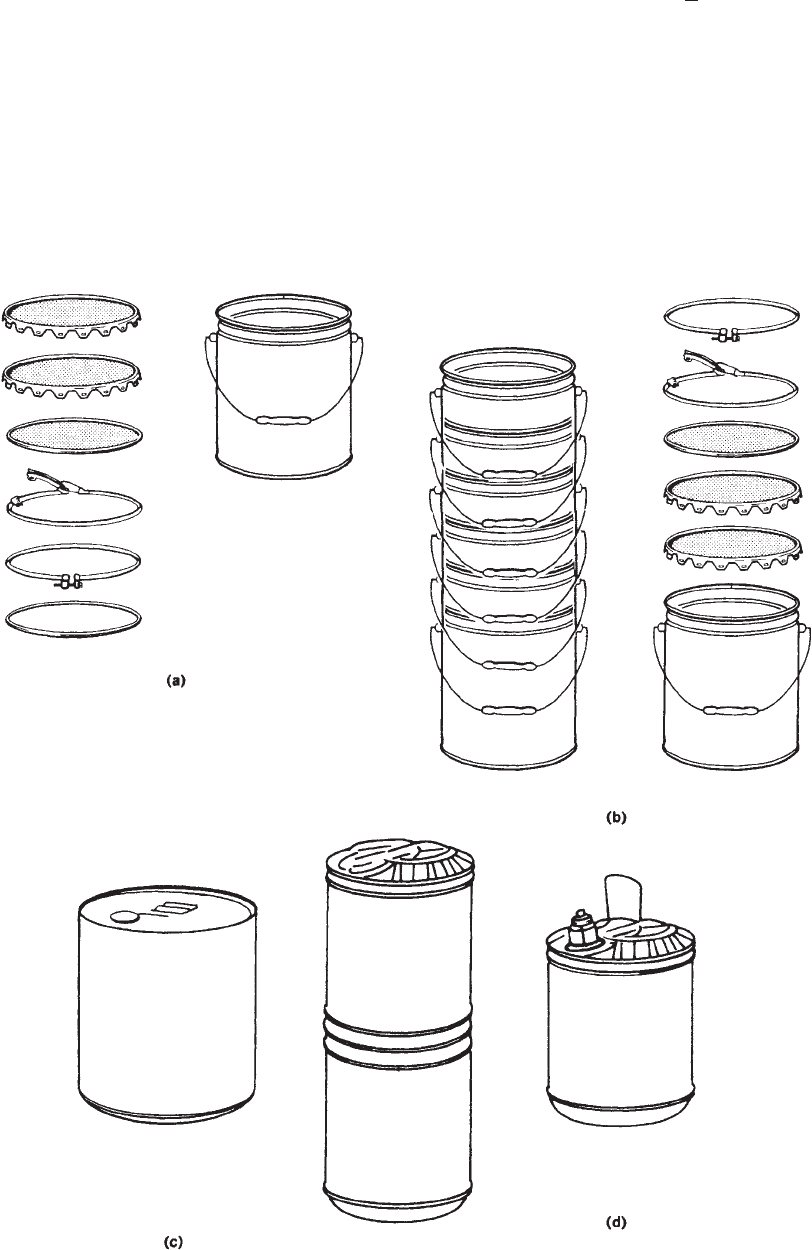
pail. They are made in four basic configurations: full open-
head, straight side, lug cover; full open-head, nesting, lug
cover; tight-head, straight side; and tight-head dome top
(see Figure 2). They are constructed of 0.0115-in. (0.3-mm)
or thicker steel. Pail heights vary by volume, but dia-
meters are 6 and 8 in. (15.2 and 20.3 cm, respectively) for
1 to 2.5-gal (3.8 to 9.5-L) sizes, 11.4 in. (28.6 cm) for
3–7 gal (11.4–26.5 L), and 13
15
16
in. (35.4 cm) for larger
capacities. The two open-head designs account for about
75% of the total pail production.
Both types of open-head pails have a liquid-tight,
welded side seam on the pail body and a bottom affixed
by double seaming (see Can seamers). Two side ‘‘ears’’ are
welded or riveted to the body, and a galvanized wire bail
handle is attached. Handles are furnished with or without
a grip, which can be wood or contoured plastic. The
straight-sided pail normally has one strengthening body
head (i.e., swedge), to add rigidity to the top of the
Figure 2. Designs for 5-gal (18.9-L) steel pails: (a) Open-head, straight side, lug cover; (b) open-head, nesting, lug cover; (c) tight-head,
straight side; (d) tight-head dome top. (Courtesy of SSCI.)
380 DRUMS/PAILS, STEEL

cylinder. The tapered type usually has a second bead that,
in nesting, rests on the top curl of the pail below and limits
nesting depth.
The tight-head pail, accounting for some 25% of sales, is
often used for the shipment of low viscosity or free-flowing
liquids. It embodies a welded side seam, double-seamed top
and bottom ends, and a carry handle, usually a D-ring, of
galvanized wire spot-welded to the head. This container
can be fitted with a variety of pouring and venting appa-
ratus. An offshoot of the tight-head pail is a domed-top or
utility pail, especially popular in 2
1
2
- and 5-gal (9.5- and
18.9-L, respectively) sizes for petroleum products.
Pails are used for liquids, viscous products, powders,
and solids. Pail markets include paint and printing inks;
chemicals; adhesives, cements, and roofing materials;
petroleum products; janitorial supplies (e.g., cleaners,
and waxes); abrasives; cosmetics; fasteners and stamping;
foods; insecticides; marine supplies; pharmaceuticals;
powdered metals; and scores of other products and
materials.
Because of their ability to withstand high tempera-
tures, pails are the container of choice for the transporta-
tion and indoor storage of flammable and combustible
liquids. The range of classes of flammable and combustible
liquids allowed for warehousing and storage is greater
than the range for like-sized containers made of plastic.
See, for example, NFPA Code 30 on Flammable and
Combustible Liquids (9).
In addition to varying capacities, steel thicknesses, and
container construction, a host of options, fittings, and
accessories are available to design a pail to a buyer’s exact
requirements.
Open-head pails can take two types of covers. The lug
cover, usually incorporating 16 wide lugs around its
circumference, can be applied at production-line speeds
by automatic crimping equipment, although hand-
operated and semiautomatic crimping tools are also avail-
able. The lug cover is opened with standard hand tools.
The second cover, a ring seal, is best for resealing pur-
poses. It consists of a formed disk that sits on the top curl
of the container and is clamped to it either by a separate
ring band or with rings that lock by lever action or bolt-
tightening.
Another option is a combination of steel thicknesses.
Cover and ends can be made of steel of different thickness
than the body for different requirements of strength and
economy. Lids and bottom ends can be strengthened by
using embossed circumferential beads to provide in-
creased rigidity.
On both tight-head and open-head pails, a wide range
of opening sizes, pouring spouts, and cap closures is
available. To cut costs, covers can have a simple, threaded
pouring nozzle topped by a screw cap. Even simpler are
pails furnished with just a dust cover over the pour
opening to keep the interior clean, with the user clinching
on or pressing in a pouring fitting after filling. Various
metal and plastic pouring devices are offered, mostly of
the pull-up style; these are covered by a cap during
shipment. Some pour fittings incorporate vent openings
that eliminate the need for a separate vent opening on the
cover. Tamperproof seals, consisting of a steel cap clinched
directly onto the pail fitting, are often used.
BIBLIOGRAPHY
1. Steel Shipping Container Institute, Steel Shipping Containers:
The Choice for the Environment, Washington, DC, 1994.
2. ANSI MH2-1991, American National Standards Institute,
New York, 1993.
3. Steel Shipping Container Institute, Understanding HM-181
for Steel Drums, Washington, DC, 1993.
4. U.S. Department of Transportation, Code of Federal Regula-
tions, Title 49, Parts 100–199 (October 1993).
5. Uniform Classification Committee, Uniform Freight Classifica-
tion, National Railroad Freight Committee, Atlanta.
6. National Classification Committee, National Motor Freight
Classification, National Motor Freight Traffic Association,
Alexandria, VA.
7. Steel Shipping Container Institute, A Buyer’s Guide to New
Steel Drums & Pails, Washington, DC, 1994.
8. United Nations Committee of Experts on the Transport of
Dangerous Goods, Recommendations on the Transport of Dan-
gerous Goods, 8th edition, United Nations, New York, 1993.
9. ANSI/NEPA 30, National Fire Protection Association, Quincy,
MA, 1993.
DRUMS/PAILS, STEEL 381

E
ECONOMICS OF PACKAGING
DIANA TWEDE
School of Packaging, Michigan
State University, East Lansing,
Michigan
PACKAGING MACROECONOMICS
U.S. industry shipments of packaging materials and con-
tainers in 2005 were nearly $103 billion, and sales of
packaging machines were estimated to be $5.76 billion.
Combined, these represent about 2.4% of all U.S. manu-
facturing shipments (see Table 1). But the economics of
packaging go far beyond the simple cost of producing the
materials and machines.
The total cost of the nation’s packaging operations is
easy to underestimate because it is embedded in the cost of
producing everything, and data on packaging operation
costs are not published. All products are packaged in some
way, and their components and ingredients are repacked
several times in the manufacturing operations of a supply
chain. The fact that all products are packaged means that
the packaging industry performance parallels the national
economy’s performance.
The packaging industries have almost every other kind
of business as a customer, and so packaging affects the
supply cost and demand of every product and factor of
production, from food to building materials to auto parts.
Retailing and distribution industry costs are also affected
by packaging. And after use, packaging affects the social
costs of disposal or recycling.
It is equally problematic to estimate the value of
packaging. The values of protection and containment
relate to the physical requirements of the product. Values
of communication and differentiation relate to the market-
ing requirements that facilitate sale. Therefore, the
amount of packaging materials used per product varies
enormously. For example, the can represents a much
larger proportion of the cost of a canned soft drink
compared to the relative cost of a multiwall shipping
sack for 50 lb of flour. Furthermore, packaging is a key
way to differentiate products and add value to markets
willing to pay higher prices.
Consumer products use 80% of the packaging materials
in the United States. The largest segment is the food and
beverage industry, purchasing a little over half of all
consumer packaging (35% for food and 19% for beverages).
Other consumer products like health and beauty aids and
household cleaners account for 8%, and a combination of
tobacco, clothing, appliances, electronics, and furniture
make up the rest (18% of consumer goods packaging).
Packages for shipping (which includes shipping containers
for consumer products) comprise 33% of the value of
packaging (2).
Globally, the cost of packaging is variously estimated at
between $390 billion (4) and $450 billion USD (5).
Developed market economies consume the most packa-
ging. Pira International estimates that North America
consumes 29% of the world’s consumer packaging and
Europe consumes 33%, compared to 4% by Latin America
and 34% by the rest of the world (5). Datamonitor splits
the worldwide consumption in thirds: the Americas at
34.2%, Europe at 33.2%, and Asia/Pacific at 32.5% (4). The
U.S. per capita consumption of packaging for 2004 was
estimated at slightly over $350 (5).
The expenditure on packaging is much lower in less
developed countries, and packaging solutions tend to have
lower cost. Materials and graphics are less sophisticated,
the process to make and fill packages is more labor-
intensive, and machinery is slower and less efficient
than in industrialized countries. Food is not shipped
long distances and is more likely to be purchased fresh
rather than processed and packaged. There is less variety
and much greater losses due to spoilage. But the packa-
ging that is developed is generally economical, material
recovery systems are efficient, and there are many crea-
tive packaging applications using indigenous materials
and appropriate technology.
Packaging plays a significant role in a nation’s eco-
nomic development. Improvements in packaging can fa-
cilitate economic growth by increasing the efficiency of
markets and by adding value to exports. Packaging can
reduce the cost of food and increase its supply by prevent-
ing losses, which can be as much as 50% for food in
developing countries.
The best way to add value to exports is to ship packaged
products rather than shipping in bulk. There is a growing
demand for more sophisticated packaging materials and
methods to be used for export packaging. There is increas-
ing realization by government authorities that investments
in packaging technology can yield economic benefits, and
organizations like the International Trade Centre have
implemented programs to develop human resources in
packaging and make information more easily accessible (6).
Table 1. Gross Domestic Product 2000–2005 versus
Packaging Expenditures (in millions of current U.S.
dollars)
2000 2005
Estimated U.S. value of all
manufacturing shipments (1)
$4,209,000 $4,545,000
U.S. value of packaging
shipments (2)
$92,617 $102,756
Percentage: packaging of all
shipments
2.2% 2.26%
U.S. packaging machinery
shipments (3)
$3,820 $5,760
Percentage (packaging
material+machinery)
2.32% 2.39%
383

Table 2. Actual and Forecast shipments of the U.S. Packaging Industry, 1992–2010
1992 2000 2004 2005 2010 Increase %/yr
Paperboard/Molded Pulp
Corrugated containers-a $19,138 $24,610 $28,385 $29,500 $31,484 1.3%
Folding cartons 7,731 8,450 8,320 8,360 9,300 2.2
Sanitary food containers
Milk and beverage 678 705 775 805 875 1.7
Cartons and trays 175 416 335 330 300 1.1
Lipid tight 77 107 154 161 190 3.4
Fiber and composite packaging
Cans 600 600 590 590 600 0.3
Drums 374 430 310 340 350 0.7
Rigid boxes 516 620 563 570 500 2.5
Molded pulp products
354 550 481 492 550 2.1
29,643 36,488 39,913 41,148 44,149 1.4
Metal
Cans 11,665 10,954 11,374 11,700 11,000 1.1
Shipping containers 1,132 1,200 1,345 1,440 1,470 0.4
Flexible 1,406 1,850 2,090 2,150 2,508 3.0
Miscellaneous
Crown and closures 811 776 749 778 660 4.0
aerosols 775 991 500 525 580 2.0
Foil containers 177 180 105 115 110 0.5
Collapsible tubes 56 75 55 50 45 3.0
Strapping 420 353 370 375 430 2.8
Pallets
25 20 25 25 30 3.0
16,467 16,399 16,613 17,158 16,833 0.4
Plastics
Containers
Blow-molding bottles 4,577 7,510 7,920 8,790 10,900 4.4
Closures 1,586 1,865 2,210 2,323 2,700 3.1
Miscellaneous 2,153 2,667 2,825 2,970 3,760 4.8
Shipping containers 618 965 1,725 1,770 2,000 2.4
Squeeze tubes 220 350 410 440 510 3.0
Flexible packaging
Speciality bags 959 1,450 1,644 1,690 1,910 2.5
Converted wraps 2,455 3,650 4,300 4,410 5,000 2.6
Wrappers 515 1,350 1,580 1,618 1,824 2.4
Shipping sacks and lines 220 265 220 235 240 0.5
Cushioning 835 1,395 1,485 1,515 1,665 1.9
Strapping 250 320 340 355 400 2.4
Pallets
55 160 220 230 270 3.3
Total 14,353 21,947 24,819 26,346 31,179 3.4
Paper
Flexible packing
Converted wraps
All paper 866 1,155 1,050 1,058 1,100 0.7
Paper/foll 633 705 825 840 900 1.4
Wrappers 453 830 760 750 700 1.3
Specialty bags-c
486 800 740 733 700 0.9
2,438 3,490 3,375 3,381 3,400 0.1
Label and tags 1,490 3,005 3,300 3,370 3,730 2.0
Heavy-duty bags 1,455 1,639 1,250 1,260 1,100 2.7
Tapes 235 260 280 283 300 1.2
Wadding
30 110 122 120 50 0
5,648 8,504 8,327 8,414 8,580 0.4
Glass
Containers 4,915 4,105 4,304 4,500 4,800 1.3
Wood
Pallets and skids 2,143 3,155 3,215 3,295 3,750 2.5
Containers
Nailed boxes and crates 418 360 418 427 475 2.2
(Continued)
384 ECONOMICS OF PACKAGING

PACKAGING SUPPLY INDUSTRIES
Packing is produced by four manufacturing industries
using very different raw materials and manufacturing
processes. In the richly forested United States, the largest
segment (40% of sales in 2005) is paperboard-based. Metal
represents 16%, plastics is 26%, paper is 8%, and glass is
5%. Table 2 shows sales in the United States, by packaging
material type, for an eighteen-year span, from 1992 to
2010 (estimated). It and most of the industry data which
follows are drawn from The Marketing Guide to the U.S.
Packaging Industry, used with permission (2).
The paper, glass, and metal packaging industries in the
United States are mature. Their growth rate generally
parallels, but is slower than, all manufacturing. The
packaging industries’ profitability varies, but is generally
below the average for other manufacturing industries.
Commodity markets for metals, paperboard, and plastic
resins used in packaging are characterized by low profit
margins and high capital investments. Packaging conver-
sion is, likewise, a low-profit sector. The degree of integra-
tion varies; paper and paperboard are the most vertically
integrated, plastics is becoming less integrated as resin
manufacturers have left the packaging business, and the
big aluminum and steel producers no longer make cans.
However, unlike other mature industries, the packa-
ging industry is not concentrated because packaging
producers of various materials compete with each other
due to the substitutability of container types. In 2005, only
26 companies had sales over $1 billion. The largest 50
packaging suppliers account for only 44% of total packa-
ging shipments, with many companies supplying only
one type of packaging material. Concentration is greater
within each material’s supply industry. Materials like
molded pulp, beverage cartons, glass containers, and
metal cans are made by industries in which the top four
companies account for 65% of shipments (2).
Paperboard Packaging
Paperboard-based packaging is the largest segment of the
packaging supply industry. It is also the most vertically
integrated; companies producing 50% or more of their own
paperboard account for 80% of the shipments of corru-
gated containers and folding boxboard cartons. Most of the
large companies making paper-based flexible packaging
also make their own paper (see also Paperboard).
Corrugated fiberboard accounts for almost 63% of
the paperboard tonnage used in packaging. Since most
products (in the United States, at least) are shipped in
corrugated fiberboard boxes, the price is sensitive to the
overall economy’s performance. Periods of growth directly
increase the demand for boxes by every industry, causing
suppliers to reach full production capacity, which leads to
higher prices. Similarly, the increase in imported goods
from China has drawn demand away from the U.S.
corrugated industry, and so the U.S. industry has cut its
production in response, using the power of the integrated
producers to orchestrate industry dynamics.
Paperboard packaging prices are also affected by the
cost of wood (or recycled raw materials) and energy. Wood
has always been relatively plentiful in the United States,
and corrugated fiberboard boxes are one of the most highly
recycled packaging materials. Energy is a large compo-
nent of the production cost.
Metal Packaging
Tin-plated steel and aluminum cans make up most (70%)
metal packaging. Packaging is a small portion (only 3.8%)
of total steel production, but is 21% of total aluminum
production. The metal can industry is one of the most
concentrated of packaging industries in the United States,
with the top 7 can producers accounting for 90% of the
volume.
Table 2. Continued
1992 2000 2004 2005 2010 Increase %/yr
Wire-bound boxes and crates 139
545
647 650 625
–0.8
Veneer and plywood containers 112
Cooperage 112
Excelsior
30 20 15 20 15 0.8
2,954 4,060 4,295 4,392 4,865 1.8
Textile
Bags 728 914 610 610 550 2.0
Twine 100 150 130 128 100 4.0
Flock
35 50 60 60 60 0
863 1,114 800 798 710 2.4
Total/Average $74,863 $92,617 $99,131 $102,756 $111,116 1.6%
Notes: Shipments of many miscellaneous and unreported packaging items, Whose value may be as high as $1 billion, are not included. Some of the most
important items excluded are plastic food and garbage bags, fast-food packaging, reconditioned barrels and drums, gas cylinders, tubes and cores, and bulk
containers.
a. Includes solid fiber boxes.
b. Includes value of container, value, cap and propellant.
c. Includes paper/foil laminates.
d. Percent increase from 2004 to 2010.
Source: Estimat es by Impact Marketing Consultants, Inc., The Marketing Guide to the U.S. Packaging Industry, 2006. Used by permission.
ECONOMICS OF PACKAGING 385
For many uses, steel and aluminum cans are inter-
changeable, and usage depends on relative prices. Alumi-
num is more expensive per pound than steel. But
aluminum cans are lighter weight, and most innovations
have emphasized further weight reductions. To reduce the
cost of raw materials, the aluminum industry has facili-
tated recycling, and 50% of the aluminum cans used in
2003 (in the United States) were recycled. Since 1981,
aluminum cans have outnumbered steel cans; aluminum
is more popular for beverages, but steel still predominates
for food (see Cans, aluminum; Cans, steel).
The largest use for metal cans (71%) is for carbonated
beverages. The metal can is such a vital input to beer
production that big breweries sometimes have their own
captive can producing facilities. Food manufacturers use
26% of the cans produced.
The metal share of the packaging industry has been
falling due to the substitution of plastics. Cans are being
replaced by plastic bottles for beverages and by rigid
plastic or retort pouches for food. Steel drums and pails
have been replaced by lighter weight plastic drums and
pails. The aluminum foil barrier in flexible packaging,
bottle caps, and collapsible tubes has likewise been re-
placed by new high-barrier plastics.
Plastics Packaging
Plastics are the fastest-growing segment in packaging.
Plastics have won market shares from all other packaging
materials, converting glass bottle users to plastic bottles,
paper bag users to plastic bags, fiberboard boxes to plastic
wraps, and steel drums to plastic drums. Plastic packages
generally use less material, are less costly to fabricate,
and weigh less, thus reducing transport costs.
The largest-volume plastic used for packaging is low-
density and linear low-density polyethylene used for film
(LDPE and LLDPE = 30% of plastics packaging), followed
by high-density polyethylene (HDPE = 26%), polyethylene
terephthalate (PET = 18%), polypropylene (PP = 14%),
polystyrene (PS = 8%), and polyvinyl chloride (PVC = 2%).
The largest growth has been in PET for beverage bottles,
including substitution for glass bottles and metal cans as
well as the dramatic growth in the sale of bottled water.
The production of plastic resins is concentrated in oil-
producing firms like Dow Chemical, ARCO, and DuPont.
But the plastics converting industry is much more diverse,
with few barriers to entry. Economical production scale is
much smaller than that for converting paper, metal, or
glass. Market leadership for a container type is often
governed by proprietary technology that provides a special
value. Since plastic forming is relatively easier than
forming other packaging materials, there is more captive
production by filling companies, especially for plastic
bottles, thermoforms, and flexible packages that are pro-
duced in a form/fill/seal operation. (see Blow Molding and
the articles on the individual plastics).
As the plastics industry has matured, it has developed
more specialty applications. Lamination, coextrusion, and
barrier coatings have improved barrier and strength
properties, and thereby increased the market for plastic
packaging. Furthermore, most composite packages (and
even packages not normally thought of as composites, like
coated cans and cartons) rely on an essential layer of
plastic that adds strength, sealability, or barrier to other
materials in the structure.
The flexible package converting industry is very dy-
namic. New materials and new combinations have been
developed to improve manufacturing options and to in-
crease the range of applications. Flexible packaging can
now be used to package almost any kind of product,
challenging every rigid packaging form with lower-cost
options.
The flexible packaging industry is vital for developing
countries without the resources or infrastructure needed
for glass, metal, and paperboard industries. As a country
develops its economy in the 21st century, improvements in
low-cost flexible packaging can stimulate every sector,
especially food industries.
Glass Packaging
Glass packaging is the smallest material segment in the
U.S. packaging industry. Glass has suffered from declining
sales as glass bottles and jars have been replaced by
plastic, metal, and composite packages for many products.
The 1980s was a period of consolidation and mergers, in
an effort to make the industry more competitive with
other materials. The top two producers now control 70%
of the market.
The raw materials for glass are relatively inexpensive,
but glass production requires a high amount of energy and
has high labor costs. Very few bottle producers own the
sources of raw materials, which account for 46% of the
cost. The increase in recycling glass has reduced energy
and material costs. Innovations in glassmaking have been
focused on weight reduction, including improving the
uniformity of glass distribution and plastic coatings, in
order to reduce material and shipping costs. In addition,
the efficiency of glassmaking has improved considerably
(see also Glass container manufacturing).
The largest use for glass bottles is for beer (57% in
2004), followed by food (19%), beverages (9%), and liquor
and wine (8%). However, in many cases, aluminum cans
have displaced glass bottles for beer, and PET bottles have
displaced glass for food, soft drinks, and liquor. Glass
applications are growing only for food and drinks where
its ‘‘prestige’’ image and high clarity are desired.
PACKAGING AFFECTS DEMAND FOR PRODUCTS
Packaging can increase the quantity demanded of a
product by reducing its cost. For example, as develop-
ments in packaging technology have reduced the cost of
protecting processed food, the market has grown to in-
clude more low-income consumers.
P
ackaging can also
increase the absolute demand for a
product by providing features that attract a new category
of consumers. For example, the market for paint was
increased by the introduction of ‘‘spray paint’’ to include
consumers who had never painted before.
386 ECONOMICS OF PACKAGING
Packaging is used as a tool to differentiate products
for market segmentation strategies. Buyers have unique
needs and can be segmented into broad classes. For
example, consumers with physical disabilities need easy-
to-open packages. Some of the primary packaging benefits
that are used to differentiate products are:
. The amount in the package, to match various con-
sumption rates
. Low-cost minimal packaging for frugal shoppers
. Convenient package opening, reclosing, and dispen-
sing features for a variety of consumer use behaviors
. Longer shelf life for consumers who want to store the
product for future use, including packaging to reduce
oxidation of fats and decay of fresh fruits and
vegetables
. Special packaging for special occasions (gifts, holi-
days, etc.)
. Appeal to a consumer’s psychographic image
. Fit with a lifestyle
. Package recyclability for environmentally conscious
consumers
Of these benefits, the most universal demand is for low-
cost improvements in package opening, reclosing, and
dispensing features.
Packaging affects all stages of the buyer decision
process—from problem recognition to postpurchase beha-
vior—especially for routine purchases of low-involvement
goods. Seeing a package can stimulate recognition of a
problem that could be solved by the product. Package
graphics can facilitate information search, evaluation of
alternatives, and the purchase decision, by showing the
attributes that differentiate the product inside. After the
product is purchased, packaging shows how to use the
product, and encourages a repeat purchase. Packaging
can also play a role in purchases that require more
extensive problem solving without the assistance of a
salesperson.
PACKAGING COSTS
The cost of packaging per product, expressed as a percen-
tage of selling price, varies widely, from 1% to 40%. For
some products, like bottled drinks, perfumes, and aerosols,
the package may cost more than the products’ ingredients.
These products depend on the package for their very
existence. For other products such as durable goods,
where the package is simply a means to facilitate distribu-
tion, the relative cost of the package is low.
Packaging costs depend on the materials and produc-
tion methods employed. The choice of materials generally
depends on the protection required and the marketing
requirements. Protection and preservation needs depend
on the nature of the product and its logistical system;
fragile products and packages that will be roughly
handled during distribution require more protection
than do rugged products; and for perishable products to
be stored, more preservation is required.
There is a growing recognition that package system
development should begin early in the product develop-
ment process. Packaging-related cost tradeoffs are much
easier to optimize before the product is fully developed.
For example, product modification to reduce fragility may
be more economical than improving package protection.
Material Costs
Packaging materials include the primary package and its
closure, the shipping container, and unitization materials.
The cost of packaging materials depends on the cost of the
raw materials (plastic, paper, wood, glass, and/or metal)
plus the cost of conversion into packages to be filled. Most
of the raw materials are competitively priced commodities.
U.S. prices for raw materials can be found in publications
such as Plastics News and Official Board Markets.
The percentage of the sales price represented by the
raw material cost fluctuates, depending on commodity
markets. In 2002, U.S. manufacturers of paperboard
packaging spent, on average, 54% of the sales price on
raw materials. It is highest for metal containers, 63%, and
lowest for glass, 37% (2).
The more complex conversion processes, such as mold-
ing, coating, or laminating, add a greater percentage to
the cost of converting the finished package. The conver-
sion setup cost can also vary by container type. Conversion
processes that require tooling, dies, or molds add fixed
costs that are generally amortized over an initial produc-
tion period.
The prices of packaging supplies are also affected by
competition, vertical integration, and opportunities for
intermaterial substitution. Prices are affected by general
economic conditions such as recessions that result in
oversupply, growth cycles that strain production capacity,
and the cost of energy. The export demand for goods and
for packaging materials also affects prices.
Packages can be purchased directly from the converters
or from independent distributors. While a converter may
offer
a lower price
for high-volume orders, it is rare to be
able to purchase all packaging components from a single
supplier. Bottles may be purchased from the bottle man-
ufacturer, but caps, labels, shipping containers, pallets,
and stretch-wrap will be purchased from other sources
(although in the United States, glass bottles are often sold
in corrugated fiberboard ‘‘reshipper’’ boxes). Independent
distributors offer various components as well as entire
packaging systems.
Most packaging is purchased competitively, especially
when it is a standard commodity. For example, corrugated
fiberboard regular slotted containers have standardized
properties and are very similar when purchased from
different suppliers. In order to ensure low cost, a purcha-
ser may encourage competing firms to bid against one
another. Packaging innovations, like light-weighting or
material substitutions, are often introduced by one sup-
plier competing against another.
At the same time, there is a countervailing trend to
closer partnerships between packaging suppliers and
purchasers. In exchange for a single-source contract,
suppliers provide services such as design, quality
ECONOMICS OF PACKAGING 387