
Yam, Kit L. (ed.). The Wiley encyclopedia of packaging technology
Подождите немного. Документ загружается.

generally depend on what assumptions are made, where
the boundaries of the system being evaluated are drawn,
and on what value judgments are made. While this can
lead to considerable controversy about specific comparisons
(what package is ‘‘best’’), this does not mean that there is no
point in trying to do so. In many cases, opportunities can be
identified to make changes that clearly reduce the environ-
mental impact of packaging systems.
BIBLIOGRAPHY
1. UNEP and SETAC, Life Cycle Initiative, web information.
Available at http://lcinitiative.unep.fr/. Accessed April 22, 2007.
2. Wal-Mart Scorecard, web information. Available at http://
www.walmartfacts.com/articles/4564.aspx. Accessed April 22,
2007.
3. L. L. Gaines, Energy and Materials Use in the Production and
Recycling of Consumer-Goods Packaging, ANL/CNSV-TM-58,
U.S. Department of Commerce, National Technical Informa-
tion Service, 1981.
4. Arthur D. Little, Inc., The Life Cycle Energy Content of
Containers: 1991 Update, report to The American Iron and
Steel Institute, The Steel Can Recycling Institute, Ref. 67276,
Arthur D. Little, Inc., Cambridge, MA, 1991.
5. I. Boustead and G. F. Hancock, Energy and Packaging, Ellis
Horwood, Chichester, UK, 1981.
6. NOAA, NASA, UNEP, WMO and EC, Scientific Assessment of
Ozone Depletion, 2006, web information. Available at http://
ozone.unep.org/Assessment_Panels/SAP/Scientific_Assess-
ment_2006/index.shtml, 2006. Accessed April 22, 2007.
7. Intergovernmental Panel on Climate Change, Climate
Change 2007, 4th Assessment Report 2007, web information.
Available at http://www.ipcc.ch/. Accessed April 22, 2007.
8. J. M. Gregory, P. Huybrechts, and S. C. B. Raper, Nature 428,
616 (2004).
9. U.S. Geological Survey, ‘‘Pharmaceuticals, Hormones, and
Other Organic Wastewater Contaminants in U.S. Streams,’’
2002, web information. Available at http://toxics.usgs.gov/
pubs/FS-027-02/pdf/FS-027-02.pdf. Accessed April 22, 2007.
10. Environment Canada, Endocrine Disrupting Substances in
the Environment, 1999 web information. Available at http://
www.ec.gc.ca/eds/fact/eds_e.pdf. Accessed April 22, 2007.
11. Center for Bioenvironmental Research at Tulane/Xavier Uni-
versities, web information. Available at http://e.hormone.tu-
lane.edu/aboutus.html. Accessed April 22, 2007.
12. T. Colborn, D. Dumanoski, and J. P. Meyers, Our Stolen
Future: How We Are Threatening Our Fertility, Intelligence
and Survival, Penguin Books, New York, 1996.
13. Our Stolen Future, web information. Available at http://
www.ourstolenfuture.org/. Accessed April 22, 2007.
14. U.S. Environmental Protection Agency, Municipal Solid
Waste in the United States: 2005 Facts and Figures,
EPA530-R-06-011, Oct. 2006. (Available at http://www.epa.-
gov/garbage/pubs/mswchar05.pdf)
15. Container Recycling Institute, web information. Available at
http://www.container-recycling.org/. Accessed April 22, 2007.
16. Steel Recycling Institute, ‘‘Steel Recycling Rates at a Glance,’’
web information. Available at http://www.recycle-steel.org/
PDFs/2005Graphs.pdf. Accessed April 22, 2007.
17. Pa per Industry Association Council, Recovery and Use of Old
Corrugated Containers, web information. A vailable at http://
stats.paperrecycles.org/index.php?graph=corrcont&x=36&y=12.
Accessed April 22, 2007.
18. U.S. Environmental Protection Agency, Characterization of
Municipal Solid Waste in the United States, 1995 Update, web
information. Available at http://www.epa.gov/epaoswer/non-
hw/muncpl/pubs/msw95.pdf. Accessed May 7, 2007.
19. NAPCOR, ‘‘2005 Report on Post Consumer PET Container
Recycling Activity,’’ Sonoma, CA, 2006. (Available at http://
www.napcor.com/pdf/2005_Report.pdf)
20. American Chemistry Council, ‘‘2005 National Post-Consumer
Plastics Bottle Recycling Report,’’ Arlington, VA, 2006. (Avail-
able at http://www.plasticsresource.com/s_plasticsresource/
docs/1900/1874.pdf)
21. Alliance of Foam Packaging Recyclers, web information.
Available at http://www.epspackaging.org/index.html. Ac-
cessed April 22, 2007.
22. Michigan Dept. of Environmental Quality, ‘‘Michigan Bottle
Deposit Law Frequently Asked Questions,’’ web information.
Available at http://www.deq.state.mi.us/documents/deq-wmd-
swp-mibottledepositlawFAQ1.pdf. Accessed May 7 2007.
23. Toxics in Packaging, web information. Available at http://
www.toxicsinpackaging.org/. Accessed April 22, 2007.
24. Sustainable Future, web information. Available at http://
www.sustainable-future.org/page.php?Page=home. Accessed
April 7, 2007.
25. W. McDonough, and M. Braungart, Cradle to Cradle: Remak-
ing the Way We Make Things, North Point Press, New York,
2002.
26. Sustainable Packaging Coalition, web information. Available
at http://www.sustainablepackaging.org/. Accessed April 7,
2007.
ENVIRONMENTAL MANAGEMENT SYSTEM
JOE CASCIO
BOOZ ALLEN HAMILTON
Ex-Chair, US Technical
Advisory Group
PRINCIPLES OF ENVIRONMENTAL MANAGEMENT
The overarching purpose of an environmental manage-
ment system (EMS) is to formalize environmental man-
agement and to instill the environmental ethic in
organizations. This is done primarily through formal
procedures, programs, and process management controls
that are applied to the organization’s operations. To
achieve these ends, over 150,000 organizations in coun-
tries around the world have implemented EMSs that are
based on the ISO 14001 international standard. Provi-
sions in the standard assist implementing organizations
in structuring procedures, programs, and processes into
formal systems. The standard is prescriptive only with
regard to organizational actions and structural arrange-
ments but contains no performance requirements and is
only moderately reliant on broad principles of environ-
mental care and behavior. The few ‘‘principles’’ that are
408 ENVIRONMENTAL MANAGEMENT SYSTEM
invoked include those dealing with employee involvement,
management visibility, process consistency, pollution pre-
vention, continual improvement, and system integration.
It is instructive to consider each one of these separately, if
only in brief:
Employee Involvement
Organizational success in environmental performance
often depends on employee involvement that can only be
achieved through employee commitment. In fact, where
environmental care is relegated exclusively to a specia-
lized staff, employees are less likely to acquire the habits
of thought and manner that raise the environmental
performance of the organization. With this in mind, the
authors of ISO 14001 shifted many of the responsibilities
for environmental care from the environmental staff to the
organization’s employees. The standard prescribes that
key requirements of the EMS be implemented at ‘‘each
relevant function and level’’ of the organization. This
places the primary mandate for action on the employees
in those functions and levels. For example, the standard
expects that employees know the environmental objec-
tives and targets, the applicable legal requirements, the
elements of environmental management programs, and
the operational controls that apply, as well as the impor-
tance of conformance to the environmental policy, the
significant environmental impacts of their work, and their
specific roles and responsibilities. Under the traditional
approach, awareness and responsibility for these items
would have been allocated almost entirely to members of
the environmental function.
Management Visibility
A successful EMS also requires management visibility and
leadership to bring it into being and to ensure its success.
The authors of the ISO 14001 standard reasoned that any
attempt to change an organization’s culture without
strong leadership from the top would likely end in failure.
Employees are not easily fooled when management is not
genuinely interested. An EMS requires that top manage-
ment articulate a vision for environmental protection and
that it play an active role to ensure the effectiveness of the
management system and its continual improvement over
time.
Prevention of Pollution
The authors of the ISO 14001 standard recognized the
challenge of getting organizations to think proactively
about the environmental consequences of the new pro-
ducts or processes they design. If engineers and product
developers can be made to think about this while they are
designing the new product or process, then significant
gains toward environmental protection may be realized.
To that end, ISO 14001 promotes preemptive environmen-
tal design either to avoid the creation of pollutants or to
enlist other techniques to avoid the improper treatment or
disposal of wastes.
Continual Improvement
When implemented, an ISO 14001 EMS establishes a
framework that relies on the continual improvement of
the various components of the system. A tacit tenet of ISO
14001—strongly articulated for quality management in
the ISO 9001 standard—calls for process consistency and
reliability. These two attributes provide confidence to the
organization that the desired outcome will be achieved
consistently. Continual improvement complements these
traits by working to ensure that processes do not stag-
nate—that is, ensure that they remain fresh, vigorous,
and relevant and become ever better in their consistency
and reliability. If they do not become better, they will
surely become worse. Continual improvement expects that
processes be kept under frequent review and updated by
the organization so that they are less likely to become
neglected and ineffective over time.
Integration
Finally, it is useful to view an EMS as a subsystem of
the organization’s total management system. The
ISO 14001 standard has been written to be applied flexibly
and compatibly, capable of being integrated within exist-
ing organizational systems. Organizations have in fact
found it easy to integrate their ISO 14001 EMSs with
their quality management subsystems and with other
subsystems including those for occupational health and
safety. In this view, the EMS is simply a component, a
subsystem of an organization’s full, overarching manage-
ment system.
THE RELATIONSHIP BETWEEN ISO 14001 AND
SUSTAINABLE DEVELOPMENT
The concept of sustainable development (SD) gained po-
pularity in 1987 with the publication of a UN-sponsored
report prepared by a group of eminent international
environmental experts led by Madame Gro Harlam
Brundtland of Norway. The main thesis of SD is that
human enterprise today should not rob future genera-
tions of their heritage—either of the ecology or of natural
resources.
The 1987 Report spawned a series of national and
international studies, commissions, and conferences on
SD, culminating in the 1992 Rio Conference on Environ-
ment and Development (UNCED). Despite all the atten-
tion and time lapse, many organizations today continue to
search for pragmatic ways to implement the principles of
SD. Arguably, the ISO 14000 series of standards for
environmental management and analysis provide the
very tools needed to effectively implement the concept of
SD. Provisions in the various standards of the series can
lead organizations to focus their environmental protection
efforts in ways they may never have done before. Principal
among these is the behavioral changes that can be made to
instill the environmental ethic in the organization’s em-
ployees. Inducing such cultural changes in organizations
can produce more efficient, reliable, and consistent envir-
onmental protection from operations and from decisions
ENVIRONMENTAL MANAGEMENT SYSTEM 409
and actions on new products, processes, and investments.
The ability to make these business decisions with a caring,
environmentally sensitive attitude, understanding, and
commitment is fundamental to the achievement of the
SD goals.
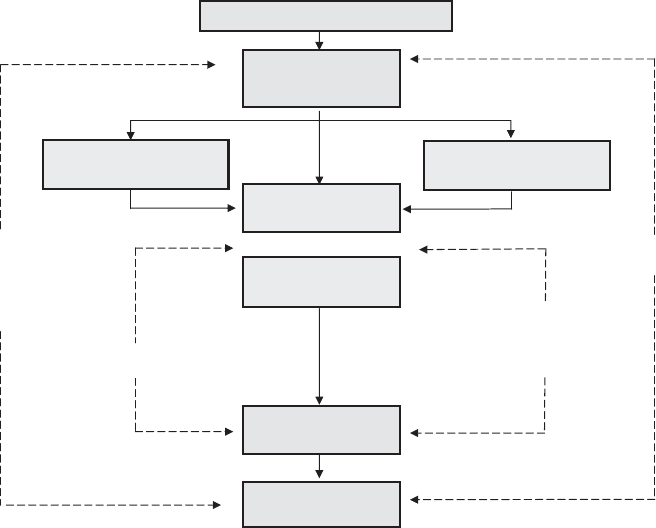
THE ISO 14001 ELEMENTS
The ISO 14001 standard consists of a number of required
elements that are interrelated to form a system. The
elements and their gross interrelationships are shown in
Figure 1. The paragraphs below provide a brief descrip-
tion of each of the relevant elements in the standard:
Organizational Goals
Every organization has its own goals that stem from the
vision and aspirations of its founders and leaders. These
may span the gamut from reaching specific financial goals
to providing social services to ensuring the national
defense. The possibilities, considering the vast number
of existing organizations, are virtually unlimited. ISO
14001 takes the existence of the organization’s fundamen-
tal goals as a fact, as a preexisting condition upon which
the organization then expresses its desire and makes
an additional management commitment to be an envir-
onmentally responsible organization. That commitment
helps to give shape to the organization’s environmental
vision, which is then transformed into a public statement.
The commitment must be expressed in a written, publicly
available environmental policy if the organization wishes
to obtain recognition for implementing an ISO 14001
conforming EMS.
Environmental Policy
The organization’s Environmental Policy verbalizes man-
agement’s commitment to run an environmentally respon-
sible enterprise. The content of the environmental policy
is meant to inspire—reflecting the commitment from top
management and serving as a beacon to guide the beha-
vior and actions of all members of the organization. These
commitments also serve to set the objectives and targets
for the EMS.
Environmental Aspects
The organization must identify its environmental aspects
to begin the effort to build an EMS and to give substance
to its commitment to be environmentally responsible. The
common approach to environmental care, prior to EMS,
was to review the environmental laws and regulations and
then set controls in place to avoid excursions from require-
ments. The concept was to match legal requirements to
the organization’s activities and implement control pro-
grams to maintain compliance with the law. This based
the entire focus of environmental protection on maintain-
ing compliance, not on identifying potentially harmful
activities, and gave rise to specialized organizational
competencies strictly devoted to maintaining compliance.
In contrast, an EMS works to place the emphasis on
identifying the potentially harmful activities irrespective
of legal and regulatory requirements. The environmental
interactions of these activities are designated as
ORGANIZATIONAL GOALS
ENVIRONMENTAL
POLICY
ENVIRONMENTAL ASPECTS ENVIRONMENTAL ASPECTS
LEGAL AND OTHER LEGAL AND OTHER
REQUIREMENTSREQUIREMENTS
SIGNIFICANT ASPECTS SIGNIFICANT ASPECTS
OBJECTIVES AND OBJECTIVES AND
TARGETSTARGETS
MANAGEMENT MANAGEMENT
PROGRAMSPROGRAMS
MANAGEMENT REVIEWMANAGEMENT REVIEW
EMS
EMS
AUDIT
AUDIT
MONITORING & MONITORING &
MEASUREMENT MEASUREMENT
COMMUNICATION
COMMUNICATION
DOCUMENTATION
DOCUMENTATION
DOCUMENTS DOCUMENTS
RECORDS RECORDS
NONCONFORMITY
NONCONFORMITY
EMERGENCIES EMERGENCIES
STRUCTURE STRUCTURE
TRAINING TRAINING
RESOURCES RESOURCES
OPERATIONAL CONTROL OPERATIONAL CONTROL
Figure 1. Interrelationship of ISO 14001 elements.
410 ENVIRONMENTAL MANAGEMENT SYSTEM
environmental aspects in an EMS, and only after they are
identified do we analyze the applicability of legal require-
ments. An EMS is structured to manage the organization’s
significant environmental aspects with the aim of pre-
venting them from occurring and causing harmful envir-
onmental impacts.
Legal and Other Requirements
Having identified all of the organization’s environmental
aspects, we next need to select those that are most
significant. The creators of ISO 14001 recognized that
any organization might identify hundreds, perhaps thou-
sands, of environmental aspects, but that only some of
those might pose a significant threat to the environment.
Among those that do pose such potential danger are those
aspects that have regulatory requirements. Regulatory
authorities have defined many substances, materials,
and activities that present significant environmental ha-
zards. It is prudent for the organization, therefore, to
compare its list of environmental aspects against legal
requirements to find those that have a match. The chances
are that those that have regulatory requirements pose
significant threats and should therefore be designated as
significant environmental aspects.
Significant Environmental Aspects
Regulation is not the only criterion for designating signifi-
cant environmental aspects; other factors may also be used
to establish significance. These include the aspect’s poten-
tial to cause environmental impacts, to pose health and
safety risks, and to create business exposures. The point
here, though, is to recognize that significance determines
the design and scope of virtually every element of the EMS.
An EMS focuses the organization primarily on managing
those aspects that are significant; the remaining aspects are
addressed through employee awareness , involvement, and
commitment as the environmental ethic slowly takes hold
throughout the organization. Among other ways, the EMS
focuses on significant environmental aspects as follows:
. The organization must consider significant environ-
mental aspects when setting its objectives and
targets.
. Environmental management programs (EMPs) are
designed to achieve the objectives and targets for
significant environmental aspects.
. Employees whose work may create significant im-
pacts must have received specific training and must
be adjudged competent on the basis of appropriate
education, training, and/or experience.
. The organization needs to consider external commu-
nication of its significant environmental aspects.
. The organization needs to put in place operational
controls for operations and activities associated with
significant environmental aspects.
. The organization needs to have procedures for the
significant environmental aspects of goods and ser-
vices it receives from external sources.
. The organization must have procedures for monitor-
ing and measuring the key characteristics of its
operations and activities that can have a significant
impact on the environment.
Objectives and Targets
Objectives and targets should be set before drafting that
portion of the policy that addresses the nature, scale, and
impacts of the organization’s activities, products, and
services. This ensures that policy language is consistent
with and reflects the organization’s objectives and targets.
Within the EMS, the objectives and targets determine the
shape and content of the environmental management
programs (EMPs).
Environmental Management Programs (EMPs)
While EMPs are primarily structured around the re-
sources and timelines to achieve objectives and targets,
they can also be used to consolidate other elements
required in an EMS. Operational controls, for example,
are needed to maintain control of operations and activities
associated with significant environmental aspects. One
can hardly expect to achieve objectives and targets if
operations and activities are subject to being out of con-
trol. This is also important for regulatory compliance,
since maintaining control is usually essential to staying
in compliance. There are significant reasons, therefore, to
incorporate operational controls within the EMPs. This
same reasoning can be applied to other requirements of
ISO 14001 such as training, roles, and responsibilities, as
well as monitoring and measurement. All of these neces-
sary elements of an EMS can be included in the full
documentation of the EMPs.
Communication, Documentation, Document Control,
Records Management, Nonconformity, and Corrective and
Preventive Action
These elements of an EMS apply across the system and
should be integrated with the organization’s existing
subsystems with similar functions. They act as lubricants
in the EMS, to keep it working smoothly through informa-
tion flow and self-corrective mechanisms. They should be
designed to fit naturally with the culture and structure of
the organization and its traditional approach to these
areas. They are not dependent on the number or type of
significant environmental aspects identified for the EMS.
Nonetheless, they are important parts of the system.
Document control, for example, ensures that only the
latest authorized version of procedures are being followed
by employees. The subsystem for records management
ensures that generated records are maintained, safe-
guarded, and retained appropriately in the system. Com-
munication ensures that information flows to the various
functions and levels of the organization to enable the
system
to maintain its
relevancy and functionality. Non-
conformity, along with corrective and preventive action,
provides the self-corrective mechanism that keeps the
EMS working as it was intended to work.
ENVIRONMENTAL MANAGEMENT SYSTEM 411
EMS Audits
EMS audits test whether the system has been implemen-
ted and maintained as designed. Importantly, system
audits are not compliance audits. The reason to look at
compliance data during an EMS audit, for example, is not
to test the organization’s regulatory posture, but rather to
test whether the programs (EMPs) that have been im-
plemented are actually working as they were intended to
work to achieve and maintain compliance. So, while EMS
audits look at all elements of the system, they have a
unique role in testing whether EMPs are actually achiev-
ing the ends for which they were designed—that is,
whether they are effectively working to achieve the objec-
tives and targets.
Management Review
ISO 14001 reserves a special role for top management, as
well it should. Not only must they formulate and articu-
late the environmental commitments of the organization
in the environmental policy, but periodically they must
also render judgment on whether the EMS continues to be
suitable, adequate, and effective.
Suitability addresses the issue of fit. Does the EMS fit
the nature and character of this organization? An EMS
that is designed for a municipal utility is not likely to be
suitable for an oil refinery.
Adequacy addresses the issue of resources and commit-
ment. Have proper and sufficient resources been allocated
to ensure that the objectives and targets can be reached?
Have all significant environmental aspects been identified
and addressed to avoid environmental incidents?
Effectiveness relates to whether the system, as de-
signed and implemented, can live up to the aspirations,
goals, and commitments in the environmental policy.
Here, it’s not just a question of the right level of resources,
but whether, as structured, the EMS can fulfill the policy
commitments. In a very broad sense this is also a deter-
mination of whether the EMS has the capacity to bring the
organization to its goal of becoming an environmentally
responsible organization.
BIBLIOGRAPHY
ISO 14001:2004(E), Environmental Management Systems—Re-
quirements with Guidance for Use, International Organization
for Standardization, Geneva, 2004.
ISO 14004:2004(E), Environmental Management Systems—Gen-
eral Guidelines on Principles, Systems and Supporting Tech-
niques, International Organization for Standardization,
Geneva, 2004.
World Commission on Environment and Development, Our Com-
mon Future, 1987.
J. Cascio, G. Woodside, and P. Mitchell ISO 14000 Guide, the New
International Environmental Management Standards
McGraw-Hill, New York, 1996.
W. G. Wilson and D. R. Sasseville Sustaining Environmental
Management Success John Wiley & Sons, New York, 1999.
P. A. Marcus and J. T. Willig, Moving Ahead with ISO 14000 John
Wiley & Sons, New York, 1997.
ENVIRONMENTAL REGULATIONS,
INTERNATIONAL
MICHELE RAYMOND
Raymond Communications,
Inc., Riverdale, Maryland
Updated by staff
INTRODUCTION
The global community’s interest in environmental sustai-
nabilty has risen considerably since the second edition of
the Encyclopedia was published. Many countries around
the world have implemented environmental packaging
requirements to allocate and distribute waste, to manage
costs, and to to shift responsibility on the packaging
manufacturer. The regulations differ greatly outside of
the United States, but these regulations impact U.S.
products. However, the U.S. must be aware of the global
regulations in order to remain competitive. International
fees and design requirements impact greatly on U.S. goods
sold abroad.
Environmental concerns over resource use, pollution,
and waste management, along with the idea that packa-
ging businesses should share some of these concerns,
have been the driving force behind packaging legislation.
In many countries, the polluter pays principle and the
Extended Producer Responsibility (EPR) are at the core
of these regulations. The EPR has grown in popularity
especially in Central and Eastern Europe. Asia is also
involved in regulatory activity and has achieved complex
packaging design requirements. Packaging engineers will
need to keep control over the design of their products and
be aware of fee requirements worldwide. This article gives
only a brief description of where focus must be placed for
any producer of packaging materials doing business out-
side of the United States.
FEES
Traditionally, packaging waste has been managed through
government-backed disposal and recycling, The cost of
waste management is not reflected in the price of the
product. Charging companies a fee on the packaging they
put out in the marketplace ensures that they share some
of the economic burden.
Fee programs around the world are all quite different.
Each country has a unique method for allocating recovery
costs by setting fees and defining categories. Most coun-
tries place responsibility for ensuring packaging collection
and recycling on the packer/filler or importer. Industry
associations have established collective systems to man-
age compliance of the companies involved. Usually, costs
are distributed among the members. In some countries,
the government continues to provide collection and recy-
cling services and charges a tax to industry based on the
quantities of packaging material involved. Fees must be
paid by the importer of goods. Fees are determined by
the packaging weight and the type of material used.
412 ENVIRONMENTAL REGULATIONS, INTERNATIONAL
Individual market types have a major impact on packa-
ging fees. Other countries have broader requirements.
Material definitions are not uniform and depend on the
specific materials involved. If a product is made up of
various materials, the component would fall into several
categories. For example, a paper (70%) and aluminum
(30%) product would fall into two material categories. In
France, Japan, Taiwan, Sweden, and the United Kingdom,
this example would be considered paper and the paper fee
would apply. In Austria, Germany, and South Korea, the
product would be considered a composite. This would
represent a higher fee than the paper category. Belgium
and Luxembourg do not have a designated category, and
the product would go to the ‘‘other’’ category. What
designates a packaging material that requires fees is
also different for many countries. Some programs cover
all packaging (sales, consolidation, and transport packa-
ging) whereas others focus only on sales packaging.
Austria, Belgium, the Czech Republic, Greece, Ireland,
Italy, and Hungary, for example, have fees for all types
of packaging including transport packaging. Variations
in the fee schedules make it hard to analyze cost. The
general trend is as follows: If a material is more difficult to
recycle, then the fee is higher. An example of a fee
schedule from Germany in 2004 was $0.19 for paper,
$1.37 for plastic, and $0.98 for a composite (1).
EUROPE
European lawmakers have a different approach to ensure
recycling than those in the United States. Unlike U.S.
legislatures that have created hundreds of laws to encou-
rage companies to use recycled material, those in Europe
apparently believe that it makes more sense to force
manufacturers to take more of a direct responsibility for
packaging waste.
The assumptions are that the less environmentally
sound containers will cost more to manage, consumers
will choose the better materials, and manufacturers will
supposedly use the materials in their new products.
The European Directive
The European Directive on Packaging was first passed in
1994 and amended in 2004. It contains some of the most
comprehensive requirements focused on reducing packa-
ging waste. All companies who sell products in the Eur-
opean Union (EU) must comply with the following: (a)
Source reduction: Companies must demonstrate that they
have reducd their packaging as much as possible and then
identify the critical area that prevents further reduction
in weight or volume of the packaging component. (b)
Recovery standards: Packaging components must be re-
coverable by at least three recovery routes (energy, or-
ganic, or material recovery). (c) Reuse: Optional but must
meet the requirements of the reuse standard if it is
claimed as reusable. (d) Heavy metal content: Sets a
concentration limit for lead, cadmium, mercury, and hex-
avalent chromium. (e) Hazardous substances reduction:
Noxious substances must be minimized if they could be
released in emissions, ash, or leachate when the packa-
ging is landfilled or burned.
All packaging placed on the EU market must be in
compliance with ERP or may be removed from the market.
U.S. companies must incorporate the ERPs into their
packaging design, and they must document how each
standard of the Directive considered.
One of the problems with the Directive is that each
country can set up its own ‘‘economic instruments’’ (i.e.,
taxes, deposits, industry collection fees, or a combination),
and each country can stress different types of packaging
from different sources. However, the European Parliam-
nent has adopted binding targets for the recycling of waste
for its 27 member countries. The plan should be formed by
2014 for full use by 2020. Countries that fail to comply will
be faced with full legal action (2)
All Packaging Affected
The Directive applies to all packaging. There are no
specific exemptions for institutional, commercial, or other
packaging that may be difficult to recycle. Every company
supplying companies within the EU with raw materials
for packaging, finished packaging, packaging components,
or packaged goods are affected by the Directive, as will
distributors of packaged goods and companies engaged in
the collection, sorting, recovery, or disposal of packaging
waste.
The Directive also covers disposable cups, plates, and
cutlery used in the food service sector, but does not include
the large road, rail, ship, and air containers. In princi-
ple, the Directive covers all packaging placed on the
market within the EU and all packaging waste, whether
disposed of at industrial or commercial sites or in private
homes.
The Directive is binding on national governments, not
on individual companies. Companies will simply be re-
sponsible for complying with whatever legal requirements
are laid down at the national level.
National governments must ensure that systems are
set up for the return or collection of used packaging, to
ensure that it is effectively reused or recovered. For
packaging
that ends up
in the home, recovery organiza-
tions are already in full operation in Germany and
Austria.
The legal basis for these operations varies: They can be
‘‘Take back,’’ which obliges a company to take back directly
or contract with third party; ‘‘Give back,’’ where compa-
nies are legally obliged to ensure that the used packaging
material in their possession is either ‘‘valorized’’ (which
means either recycled, composted, or sent for incineration
with energy recovery) or passed to an organization that
will take responsibility for valorizing it; or ‘‘Join up,’’
companies are legally obliged to join (and pay a fee) to
an approved recovery organization, which is responsible
for meeting mandated targets.
Member states must ensure that packaging complies
with certain essential requirements. These include mini-
mization of packaging weight and volume to the amount
needed for safety, hygiene, and consumer acceptance of
the packed product; minimization of noxious or hazardous
ENVIRONMENTAL REGULATIONS, INTERNATIONAL 413

constituents; and suitability for reuse, material recycling,
energy recovery, or composting.
The Directive contains certain ‘‘optional extras.’’ Mem-
ber states may (but do not have to) encourage environ-
mentally sound reuse systems, provided that these
conform with the EU Treaty; and where appropriate,
member states are to encourage the use of materials
recovered from recycled packaging waste in the produc-
tion of new packaging and other products.
The EU member states have been considering applying
reduced VAT rates on environmentally friendly producers.
EUROPEN is the voice of industry for packaging and the
environment in Europe. EUROPEN believes that any
attempt to favor some types of packaging over others
would be disproportionate to any real environmental
difference and would distort competition (3).
Germany
Germany enacted the world’s most stringent and well-
known packaging ordinance in 1991. It forced a direct
take-back obligation on the entire packaging chain (man-
ufacturers and distributors, including wholesalers and
distributors).
Quantified targets only apply to sales packaging within
the DSD system. Manufacturers and distributors taking
part in a ‘‘Dual System’’ which collects, sorts, and passes
on used sales packaging for recycling are exempted from
the general take-back requirement, provided that the
Dual System meets the targets laid down. The DSD does
not cover transport packaging or industrial packaging,
where the absolute take-back requirement applies.
DSD is a monopoly, so there are no competitive pres-
sures to keep costs down.
Pioneer disadvantage is that Germany was unable to
learn from experience elsewhere.
The Green Dot symbol (Figure 1) is the license symbol
of a network of industry-funded system for recycling the
packaging material of consumer goods. The Green Dot
means that a company has paid its DSD license fees and
has become well known in Europe. The Green Dot signifies
that a manufacturer contributes to the cost of recovery
and recycling. If a company does not join the Green Dot
scheme, they must collect recyclable materials them-
selves, and this sometimes is almost impossible for mass
products. Thirty-two countries use the scheme. Compa-
nies are not required to use the dot on their products
except for companies in France, Turkey, Spain, Portugal,
and Bulgaria which must use the logo.
The confusing issue for exporters is that use of the
symbol on signifies payment of appropriate fees in each
country where required. There is no pan-European pro-
gram. Most European countries have transposed the
Packaging and Waste Directive into national law. It is
important for an exporter to join for each country to
ensure compliance. Using the symbol without payment
of fees can bring lawsuits for fraud.
Many countries will move in the direction of shared
responsibility rather than full manufacturers responsibil-
ity as in Germany.
Refillables
Refillable containers are popular for beer and other bev-
erages in some European countries. Germany has a refill-
ables ‘‘quota’’ that has been challenged by the EU on trade
grounds. Portugal recently enacted a refillables quota in
its packaging law. Critics charge that these quotas are
designed to protect the market share of local beverage
makers, not protect the environment. Meanwhile, the
patchwork of deposits, voluntary and mandatory, are
pushing soft drink makers to use refillable plastic bottles.
PACIFIC RIM/EAST ASIA
Japan
Japan’s Environmental Agency is now the Ministery of the
Environment. Japan has a Fundamental Law for Estab-
lishing a Sound Material Cycle, meant to reduce waste,
recycle waste, and appropriate disposal for the final use.
The Ministry of International Trade and Industry has
spent millions on research for plastics-to-fuel technolo-
gies, and it is pushing Japanese governments to purchase
items with recycled content.
Hong Kong, Singapore, and Korea
All have active recycling systems, though they do not yet
have direct ‘‘take-backs’’ for packaging. Malaysia is con-
sidering the idea, because its government has consulted
with Germany’s Minister of the Environment.
China
China has placed greater concern on environmental issues
early in the 21st century. Problems are significant and
involve soil, water, and air pollution. China’s laws are
among the strictest in the world, but enforcing them has
been difficult. There is an eco-labeling law that apparently
restricts companies from making green claims without
government sanction.
As of June 1, 2008, all supermarkets and stores cannot
give out plastic bags. Stores must clearly mark the price of
plastic bags and are banned from tacking the price onto
products. Ultrathin (less than 0.025 mm) bags are also
banned (4).
Figure 1. Germany’s ‘‘Green Dot.’’ It is not to be confused with a
recycling logo.
414 ENVIRONMENTAL REGULATIONS, INTERNATIONAL

Australia
Australia maintains one of the strictest regimes of envir-
onmental regulation. The only non-European nation to
outrank it is New Zealand. The New South Wales govern-
ment administers environmental protection legislation
covering all facets of concern including waste disposal,
and avoidance, resource recovery, recycling, and waste.
Environmental regulations cover houshold, industry and
government agencies (5).
New Zealand
New Zealand payback accord is made up of manufacturers
and suppliers who use packaging, recyclers, and service
providers. In 2003, the New Zealand Sustainability initia-
tive set 2008 reycling targets . Rates are paper, 70%; alumi-
num,65%;glass,55%;plastics,23%;andsteel,13%(6).
DESIGN
Material Restriction
South Korea currently bans packaging that is press-
packed, coated, or shrink-wrapped in PVC. Several coun-
tries are expected to charge more for PVC packaging.
Expanded polystyrene is forbidden in South Korea for
packaging toys and composite materials. Phase-outs apply
to packaging of electrical, office, and audio–visual pro-
ducts. An increasing number of countries (Denmark,
Sweden, Norway, and Japan) have restrictions on the
use of phthalates used in food packaging and toys. Many
retailers, especially in Asia and Europe, refuse to accept
packaging made of PVC. France and Denmark provide a
fee reduction of certain materials that contain more than
50% recycled material.
Packaging Reduction
Several countries have implemented restrictions of empty
space and the permissible number of layers in a packaging
product. South Korea has a limit of no more that 10–35%
empty space or 25–40% for a set product (a gift containing
several packaged products). Austalia has limits that range
from 25% to 40%. There is a 40% limit in Japan for
cosmetic products. New Zealand has regulations that
forbid deceptive packaging. Many countries, such as Aust-
tralia, Belgium, the Netherlands, Greece, Slovakia, Spain,
and South Korea, require companies to submit a detailed
packaging reduction plam. The EU may make packaging
reduction part of its reporting requirement. Reduction
plans vary. Belgium, Greece, and the Netherlands require
a company to develop a plan only if the goods are manu-
factured in that country. Spain and Slovakia require a
plan if the quantity of packaging placed in the market
exceeds a certain tonnage.
ECO-LABELING
An eco-label is a label that identifies overall environmen-
tal preference of a product (i.e., goods or services) within a
product category based on life-cycle considerations, is in
contrast to a self-styled symbol or claim statement devel-
oped by a manufacturer or service provider. An eco-label is
awarded by an impartial third party that meets estab-
lished environmental leadership. The Global Eco-labeling
Network is a nonprofit association of third-party environ-
mental performance labeling organizations founded in
1994 to improve, promote, and develop eco-labeling (7).
Programs
The United States Environmental Protection Agency re-
searches international eco-labeling programs in order to
identify common themes and connections with the Inter-
national Community. Eco-labeling is voluntary, but the
European Union has implemented eco-labeling regulation
legislation. The EPA has identified 22 different eco-labling
programs worldwide. Five of the most developed programs
that have completed some form of evaluation are listed
below.
The EU Flower. The EU flower was introduced in 1992
(see Figure 2). It is run by by the European Commission
and is adminstered by Competent Bodies, which are
representative organizations chosen within the EU mem-
ber states. The flower logo is intended to promote design,
product, marketing, and the use of products that have a
reduced environmental impact during their life cycle.
Packaging awards have gone to rubbish bags and con-
verted paper products. The implementation of the EU’s
eco-labeling critria has been slow and has met with
resistance from manufacturers and distributors (8).
Germany’s Blue Angel. This program was implemented
in 1977, making Germany the first country to implement a
national eco-labeling program. The entire program is
administered and financially managed by the German
Institute for Quality Assurance and Certification (a pri-
vate institution). It is considered more successful than the
EU flower program. Packaging awards have gone to
return bottles, recycled plastic and paper, and crates for
food.
The Nordic Swan. The Nordic Swan was introduced in
1989 as a voluntary seal of approval (Figure 3). Currently,
Norway, Sweden, Finland, Iceland, and Denmark partici-
pate. The Nordic Council of Minsters oversees the program.
A listing for packaging guidelines has been approved.
Figure 2. European Union’s ecolabel symbol.
ENVIRONMENTAL REGULATIONS, INTERNATIONAL 415

Japan’s Eco Mark. This is the second oldest eco-labeling
program after the Blue Angel. It was introduced in 1989 as a
seal of approval program to promote environmentally
friendly products. It is implemented by the Japan Environ-
ment Association, a nongovernmental organization that acts
under the guidance of the Environment Agency. Awards
have been made for refillable containers, packaging mate-
rial from recycled pulp, and recycled paper for packaging .
Taiwan’s Green Mark. This program was launched in
1992 by Taiwan’s Environmental Protection Administra-
tion and is administered by the Environment and Devel-
opment Foundation, a private institution.
The United Nations Environment Program. This U.N.
program reviews eco-lableling as an environmental policy
tool and potential trade barrier.
Standards
The ISO standards for eco-labeling were set by dozens of
countries working throughout the 1990s to develop stan-
dards for sustainable environmental management. ISO
14020 lists a set of principles by a practioner of environ-
mental labeling. ISO 14024 specifies the procedures and
principles that third-party certifiers must follow. ISO 14020
guiding principles for eco-labeling include: accuracy; avoid-
ing unnessary trade barriers; scientific basis; provision of
information on methodology; life-cycle approach; allowance
of innovation; minimal adminstrative burden; open, con-
sentual process; and provision of information on products.
BIBLIOGRAPHY
M. Raymond, ‘‘Environmental Regulations, International’’ in A. J.
Brody and K. S. Marsh, eds., The Wiley Encyclopedia of
Packaging, 2nd edition, John Wiley & Sons, New York, 1997,
pp. 348–351.
Cited Publications
1. D. Allaway, International Packaging Regulations, State of
Oregon Department of Environmental Quality, Portland, OR,
www.deq.state,or.us.
2. ‘‘New Recycling Targets in Europe,’’ www.euobserver.com,
June 19, 2008.
3. ‘‘European Commission Consultation Review of Existing Leg-
islation of Reduced VAT Rates,’’ EUROPEN, Brussels, Bel-
gium, www.europen.com, accessed July 2008.
4. ‘‘China Bans Free Plastic Bags,’’ AP Press International,
Herald Tribune, January 9, 2008.
5. ‘‘Environmental Regulations,’’ www.business/nsw.gov.au, ac-
cessed July 2008.
6. ‘‘New Zealand Packaging Accord,’’ www.newzealand.govt.nz.
April 2008.
7. International Eco-labeling Programs, United States Envi-
ronmental Protection Agency, March 2008, http://www.
epa.gov.
8. The Eco-labeling Regulation of 1992, Forward Communi-
cations, June 22, 2008, http://forewardcommunications.
wordpress.com.
ESTIMATION OF SHELF LIVES OF OXYGEN
SENSITIVE PACKAGED PRODUCTS
KIT L. YAM
Department of Food Science,
Rutgers University, New
Brunswick, New Jersey
This article introduces a simple model equation (Equation
(3), described later) and its application to estimate the
shelf lives of oxygen sensitive foods in packages. A similar
form of this equation also may be used for moisture
sensitive products. The equation is useful to design
packages for protecting products that are sensitive to
the oxygen and moisture in air.
The accuracy of the estimations depends on whether
the situation being considered satisfies the assumptions of
the equation. The equation assumes the following: (1) the
shelf life of a product is controlled by the oxygen permea-
tion through the package, (2) the maximum allowable
oxygen of the product may be defined and is known, (3)
the package is made of a plastic material with uniform
thickness, (4) the package has complete integrity (no
leaks), and hence permeation is the only means of oxygen
transfer, and (5) the oxygen concentration driving force
(i.e., P
e
–P
i
in Equation (3)) is constant. Because these
assumptions are not always satisfied, experimental shelf
life studies are usually recommended to validate the
estimations of the equation.
Assumption (1) may be further explained using Figure 1,
which shows that oxygen from outside the package can
cause deterioration in the product by a series of steps as
follows: (a) permeation through the package wall into the
package headspace, (b) diffusion through the headspace to
the food product surface, and (c) reaction with the food
product until the extent of deterioration is no longer
acceptable. The shelf life of the product is, thus, equal
to the total time required for these steps to complete. In
most situations, the diffusion step may be ignored, because
the package headspace is usually small and diffusion of
oxygen occurs quite quickly in the headspace. Therefore,
the assumption that the shelf life is controlled by the
permeation step is valid only in situation in which the
N
O
R
D
I
C
E
C
O
L
A
B
E
L
Figure 3. The Nordic Swan.
416 ESTIMATION OF SHELF LIVES OF OXYGEN SENSITIVE PACKAGED PRODUCTS

time required for reaction step is small or negligible. In
practice, this assumption is satisfied if the package has
good oxygen barrier; for poor oxygen barrier packages, the
equation is not applicable because the reaction step controls
shelf life.
In Assumption (2), the maximum allowable oxygen is
the maximum amount of oxygen that a product can
tolerate before becoming unacceptable. Table 1 shows
the maximum oxygen and water tolerant limits for some
food products, which can be converted into the maximum
allowable values by multiplying the product weights. Note
that these limits may serve only as general references,
because experiments usually are required to obtain more
accurate values.
Equation (3) has the advantage that it is simple and
can provide useful estimations, although more sophisti-
cated equations are available for situations in which
higher accuracy is required (1).
MODEL EQUATION
The oxygen transmission rate (OTR) through a permeable
package (e.g., a plastic pouch) may be calculated using the
equation
OTR ¼
PA
L
P
e
P
i
ðÞ ð1Þ
where
OTR = oxygen transmission rate, cc O
2
/day
A= surface area of package, in
2
L = thickness of package, mil
P = oxygen permeability, (cc O
2
mil)/(100 in
2
day atm)
P
e
= oxygen partial pressure in external environment,
atm
P
i
= oxygen partial pressure in headspace, atm
If the assumptions stated earlier are satisfied, the shelf
life (t
s
) can be estimated as
t
s
¼
O
2; max
OTR
ð2Þ
where
t
s
= shelf life, day
O
2,max
= maximum allowable oxygen, cc O
2
As a reminder, Equation (2) assumes that the O
2
permeation through the package is the controlling factor
of shelf life. Substituting Equation (1) into Equation (2)
yields
t
s
¼
O
2; max
L
PA P
e
P
i
ðÞ
ð3Þ
This equation is useful for evaluating many what-if
scenarios, as illustrated in the following two examples.
APPLICATIONS OF MODEL EQUATION
Example 1. Assume an oxygen sensitive package food
has a shelf life of 12 months. If the package thickness is
decreased by 20% and the surface area is decreased by
30%, what is the new shelf life?
Equation (3) may be use to obtain
t
s2
t
s1
¼
O
2; max
L
2
PA
2
O
2; max
L
1
PA
1
¼
L
2
A
1
L
1
A
2
The subscripts 1 and 2 denote the changes before and
after, respectively. Since t
s1
= 12 months, L
2
= 0.8 L
1
and
A
2
= 0.7 A
1
, the new shelf life is estimated to be
t
s2
¼ 12
0:8L
1
ðÞA
1
L
1
0:7A
1
ðÞ
¼ 12
0:8
0:7
¼ 13:7 months
Example 2. A 100 g oxygen sensitive food is vacuumed
packed into a multi-layer plastic pouch, which has a
thickness of 10 mil, a surface area of 80 in
2
, and oxygen
permeability of 0.12 (cc mil)/(100 in
2
day atm). What is the
estimated shelf life if the oxygen tolerant limit of the
product is 5 ppm?
O
2
sensitive product
Permeation
Hermetically sealed plastic package
Reaction
O
2
Diffusion
Headspace
Figure 1. Permeation through package and reaction with
product.
Table 1. Maximum tolerant limits for some food products
Food Maximum
H
2
O (%)
Maximum O
2
(ppm)
Beer, wine 3, loss 1–5
UHT milk 3, loss 1–8
Soups, sauces 3, loss 1–5
Fruits juices, soft drinks 3, loss 10–40
Preserves, jams, pickles 3, loss 50–200
Dried foods 1, gain 5–15
Snack foods, nuts 5, gain 5–15
Instant coffee, tea 1, gain 15–50
Oils and fats, dressings 10, gain 50–200
ESTIMATION OF SHELF LIVES OF OXYGEN SENSITIVE PACKAGED PRODUCTS 417