
Yam, Kit L. (ed.). The Wiley encyclopedia of packaging technology
Подождите немного. Документ загружается.

2. Unitized loads in the holds of surface ships.
3. Containerized loads on container ships, on the decks
and in the holds of cargo vessels.
4. Transport by lighters and barges; on open boats
through surf to sandy beaches.
5. Rollon, rolloff (Ro-Ro).
6. Containerized air shipments plus ground handling
and transportation.
7. Individual packages and unitized loads shipped by
air freighters and in the holds of passenger planes.
8. Miscellaneous combinations of modes of transporta-
tion, handling, and intermittent storage in foreign
places and unknown conditions.
Export packaging encounters at least two domestic
movements that involve the usual hazards of handling,
loading, dropping, compression, and moisture, plus the
hazards of transportation. One major exposure is during
the movement to the seaport or the gateway airport. The
second involves the customs procedures and storage of the
country of debarkation, multiple handling, unforeseen
conditions of transshipment, and eventual delivery. Pro-
ducts must be packed for the toughest part of the journey
and survive all of the exposures.
Only about 30% of the cargo losses can be classed as
fortuitous losses resulting from sinking, stranding, fire,
collision, seawater, or heavy weather. One ship is lost,
somewhere in the world, almost every day. Approximately
70% of the losses may be preventable:
10% Water damage—freshwater, sweat, condensation,
and saltwater.
20% Theft, pilferage, and nondelivery
40% Handling and stowage—container damage, break-
age, leakage, crushing, contact with oil and other
cargo, contamination, and failure of refrigeration or
other equipment
During transit, cargo must withstand the conditions of
rough seas, turbulent air, and substandard roads.
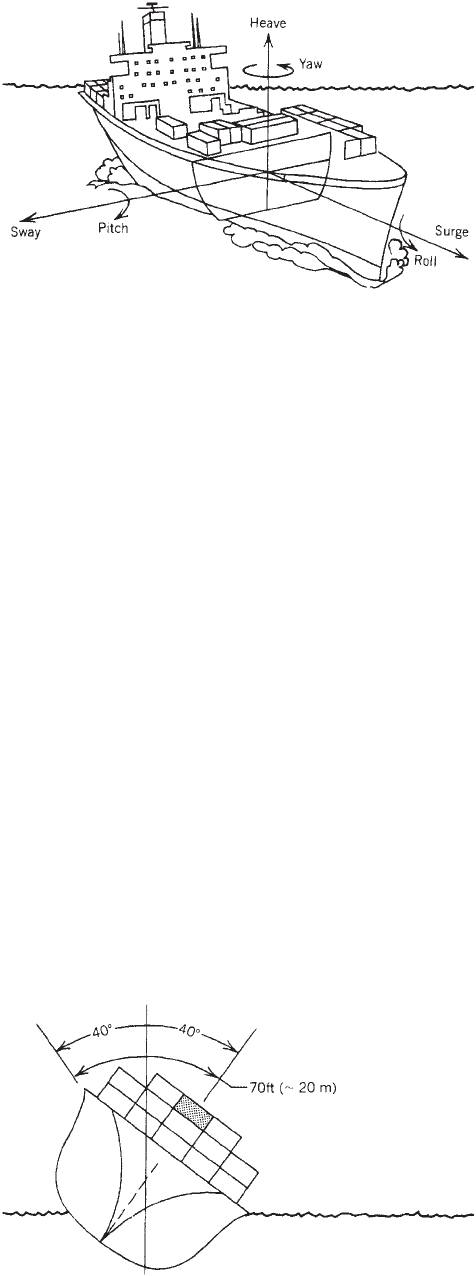
At sea, a ship may move in six different directions at
the same time. A top-loaded container may travel 70 ft
(B20 m) in each direction with each 401 roll as often as
eight or nine times per minute. Figures 1 and 2 diagram
the movements involved. The center point is least subject
to these movements, but the shipper does not control the
location and stowage of the cargo or of individual
containers.
SPECIFIC CONDITIONS
With the above as a brief introduction to the hazards of
international cargo movements, the packaging engineer
should further study this subject and the conditions that
may exist at the ports of embarkation and debarkation.
Brief descriptions of port conditions and equipment are
provided in Ports of the World (1, 2) and similar publica-
tions. Information can be obtained from the cargo carriers
regarding their equipment, methods of handling, routes,
stops, trans shipment, and other details. They can also
provide some information about local conditions at the
port facilities. Some marine underwriters may have con-
structive suggestions. The consular staffs and the com-
mercial development departments of each country are well
informed. Foreign sales agents can provide details about
the customers and their facilities, needs, and preferences.
Too often the shipper is uninformed and relies on gossip
rather than acquiring a realistic understanding of this
complex subject.
PRODUCT ANALYSIS
Every facet of the products to be exported must be
analyzed, and the potential problems, even marginal
ones, must be identified. Export handling and shipping
expose the weaknesses if they are overlooked.
Corrosion and Mildew. All metals must be protected
against water and moisture for surface transportation and
even for air shipment from or to humid and tropical areas.
All natural materials (e.g., leather, cotton, wool, and
paper) must be protected against moisture, fungus, and
mildew.
Figure 1. The six directions of motion of a ship at sea.
Figure 2. The distance (B20 m) traversed by a top-loaded con-
tainer in a 401 roll.
428 EXPORT PACKAGING
Problems can begin because the products are not
thoroughly cleaned for fingerprints, cutting or cooling
oils, dirt, and foreign matter, or because of unnoticed
rust, mildew, or local moisture in the packages. In transit
and in storage, the moisture and mildew, condensation, or
sweat may find the weak point in the packaging and cause
irreversible damage. If the product surface is critical or if
the item is expensive or choice, the damage may be total.
When the problems are identified, corrosion inhibitors
(special oils and petrolatums) or properly used vapor-
phase inhibitors and waterproof wrapping are applied.
For electronic equipment and critical metal surfaces or
hidden areas, desiccants with sealed moisture-vapor bar-
riers are used. If possible, the critical sections or elements
are removed from the larger units and packaged sepa-
rately (inside the larger box or a sheathed crate). A small
vapor-phase inhibitor or moisture-vapor barrier package
provides better protection more economically than a thor-
ough package for an entire unit. Containerization does not
assure protection against water damage or moisture. Air
shipment does not offer full protection because of en-
trapped atmosphere, and the cargo is on the ground
more than in the air.
Pilferage and Nondelivery. It is essential to recognize
that the exported products may stay days or weeks in
conditions where pilferage is easy. Therefore, the
packages should not identify the contents as worth pilfer-
ing for private use or resale. Identification of the product
on the outside of the package by brand name, manufac-
turer’s name, or the shape and size of the box is an open
invitation to steal. A damaged package exposes the con-
tents for pilferage.
Cigarettes, liquor, cameras, stereos, jewelry, furs, small
appliances, and many other items are ideal targets for
pilferage. Many consignees use code identification because
their names on the packages would encourage pilferage.
Some even have the items delivered to a ‘‘front’’ to avoid
identification.
With the potential problem of pilferage identified, steps
should be taken to assure special handling and account-
ability. Packages should be stored in separate locked areas
and on board in lockers or safes.
Nondelivery occurs when the packages are stolen,
destroyed, lost, unloaded and left at the wrong destina-
tion, or misdelivered. Adequate, permanent, and promi-
nent markings help to avoid some of these problems.
Unitizing or using master overpacks is also helpful.
Breakage. The internal weaknesses of electronic pro-
ducts equal the fragile construction, design, or materials
of many products; any part that extends; and any item
that is not in balance are all subject to breakage or
physical damage. It may be necessary to protect the
package from the product because of a dense weight load
or severe imbalance.
Any product that is hard to handle, tends to fall over, or
is especially awkward for any reason must be given special
consideration. Often, production equipment requires spe-
cial handling, and provision must be made in the package.
Skids and other devices may help to keep the equipment
on its base and handled properly.
Cushioning, blocking, and bracing are all essential (see
the Cushioning design article). Built-in lifting eyes or
other devices, special skids and pallets, and guide marks
for the stevedores are helpful. On large items, the balance
and the lifting points should be marked. Occasionally, an
experienced exporter includes special instructions and
photographs with the documentation and on the outside
of the packages or crates.
Contamination. Some products can be spoiled or da-
maged because they can absorb the odors or fumes from
the other items that may be in the same container or
nearby in the holds or warehouses. Often the people who
work with these items ignore or forget these problems.
Precaution can be taken to specifically request the
carriers not to expose the items to adverse conditions.
Sealed moisture-vapor barriers may give further assur-
ance. Packages should be marked to indicate that they
should not be stowed with potentially harmful cargo.
If photographic supplies and other sensitive items are
exposed to excess heat, light, or moisture, then damage
can result. This type of problem must be identified, the
product shielded in the packages, and full instructions
provided to the carriers.
Hazardous Materials. The shipper must identify any
hazardous materials. These should be separated and given
special documentation and packing under strict rules and
specifications. It is essential that each hazardous material
is classified and properly identified on the packages, with
the correct and legal labels.
It cannot be assumed that compliance with domestic
regulations will assure foreign acceptance of the ship-
ments. This requires special study. Improperly labeled
cargo may not be shipped and can cause great confusion
(see the Standards and practices article).
MARKS AND SYMBOLS
It is essential that proper markings and symbols be used.
Even a poor package, adequately closed and marked, has a
good chance of being delivered in reasonable order. An
excellent package that is not adequately marked may
never reach its destination.
Only those markings that are essential and appropri-
ate should be used. Any other markings, or too many, can
be confusing and serve no purpose. New, clean packages
with
no advertising or
other printing should be used. The
selected markings can be printed by the manufacturer of
the packages or stenciled permanently. Crayon, chalk,
marking pens, tags, and cards should not be depended on.
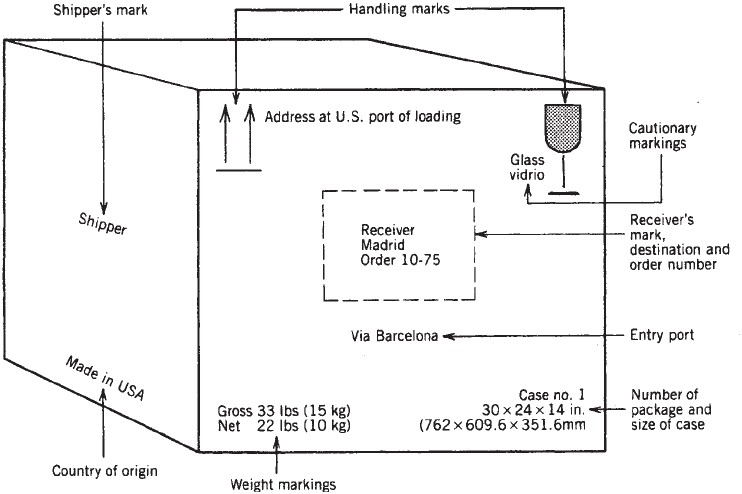
Code marks for the name of the consignee and of the
shipper (if used) are best for products that might be pilfered
(see the Code marking and imprinting article). These and
port marks should be large, clear, and applied on the side,
end, and top of each package (Figure 3). Required weight
and dimension information should be clear.
EXPORT PACKAGING 429
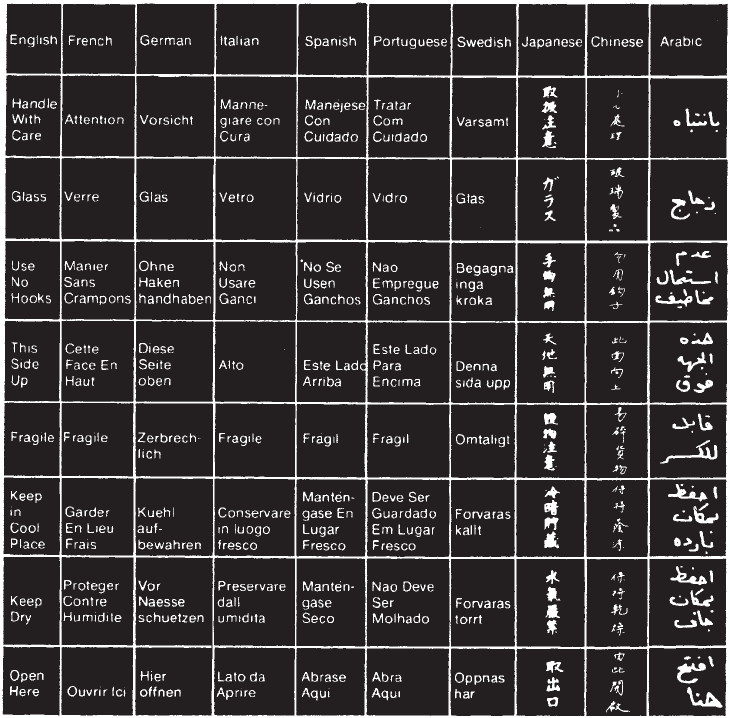
Handling precautionary instructions should be printed
or stenciled on the outside in the language of the destina-
tion country (Figure 4). Many times the cargo handlers
cannot read the language of the country in which they are
working. Pictorial precautionary markings may be the
most helpful (Figure 5). In general use, they are recognized
and have replaced a wide variety of symbols used in the
past. Regardless of the markings, it is essential to package
adequately and protect the products being shipped because
the precautionary marks are frequently ignored.
When a large number of units are being moved in a
single shipment, it helps to corner-code mark them with a
distinctive symbol or to color code the opposite top corners
with triangles or stripes. If a series of shipments is being
sent to the same destination to be collected and staged for
further inland shipment, the same method of coding should
be used. This helps to reduce the number of stray packages.
When a number of packages are being shipped to-
gether, they should be numbered on the packages with
the same numbers as the documentation. If there are 18
packages in a shipment, they should be numbered on the
packages as 1/18, 2/18, 3/18, y, 18/18. Thus, if a package
is missing, it can be checked on the documents for size,
weight, and contents.
PACKAGING FOR EXPORT
Some exporters use their domestic packages for export.
This is not good practice, but it may be economical.
Preparation of domestic packages for export includes the
following:
1. Waterproofing by liners, overwrapping, or over-
bagging.
2. Master packing small to medium size packages.
3. Unitizing a quantity of packages with suitable
strapping, adequate pallets, and shrink or stretch
films.
Unless conditions are thoroughly understood, this ap-
plies even for air shipments because of ground handling,
storage, and trans-shipment.
Packaging for Break Bulk. This is the traditional form of
shipment for small and large items stowed in holds or on
the decks of surface ships. The individual packages are
handled by the ship’s gear individually or on stevedore
pallets. They are pushed or moved manually, or some-
times by roller conveyor or lift truck, out of the square of
the hatch to wings. They are stacked with other cargo
and used to help brace the loads against movement as
the vessel rolls and pitches. There is a loading plan
specifying that the lightweight items should go on top
of the heavier and more rugged cargo and that special
classes of products should be given special treatment.
The plan must also consider late cargo and the sequence
of discharge at ports of call. Packages must withstand a
static load of similar material 20 ft (6.1 m) high without
distortion or rupture throughout the intended voyage.
This applies in the lateral as well as the vertical direc-
tion. Problems of shock and vibration may be 50 times
those normally experienced in domestic transit. Moisture
is usually encountered during a sea voyage at deckside,
in customs, and in lighters. Wooden boxes, sheathed
crates, and cleated ‘‘export’’ plywood are appropriate for
break bulk shipments when properly constructed,
packed, and secured.
Figure 3. Assignment of codemarks for shipping.
430 EXPORT PACKAGING
Unitized Loads. In addition to the details already cov-
ered, it is necessary to note that the outside boxes in unit
loads may be chaffed by other cargo during the ship’s
movement. The 20-ft (6.1-m) static load rule applies. It
may be necessary to provide a wood or heavy-duty cover to
distribute the superimposed weight and to protect the
individual packages.
Containerized Loads. Cargo containers provide physical
protection so the 20-ft (6.1-m) guideline does not apply.
The moisture problem can sometimes be intensified be-
cause of minimum air circulation. Containers should be
secured and loaded evenly from end to end. Containers
should be thoroughly cleaned and inspected before use.
There are special containers for unusual loads and condi-
tions. The packages may be removed at portside and then
face another domestic shipment to the consignees. Cus-
toms inspectors in some foreign ports do not restuff
containers the way they were shipped. They sometimes
repack with the larger and heavier items on top of the
smaller items, for example.
Lighters, Barges, and Open Boats. Some modern barges
may be similar to large containers. Lighters and open
boats may provide the most difficult tests of the trips. The
handling is doubled and may be crude or rough, partly
because of greater exposure to sea water, fog, mist, and
spray. Sound packaging is required.
Rollon, Rolloff (Ro-Ro). In this method of shipment,
highway trailers and other units on wheels can be loaded
and secured in the vessel for relatively short voyages.
These modern ships offer good conditions, and the hand-
ling is minimized; however, the loading, unloading, cus-
toms, and storage are portside.
Containerized Air Shipments. If the containers are prop-
erly loaded and precautions are taken against moisture in
the packages and on the ground, this method of shipment
may be the safest. Domestic packaging can often be used if
the delivery is known to be normal.
Individual Units by Air. Unit loads by air freighters and
individual packages unitized by the airlines for shipment
on air freighters may be moved automatically and have
little or no handling or moisture problems. Individual
packages in the holds of passenger planes, however, may
experience many rough handlings. In the cargo space, the
Figure 4. Precautionary handling instructions.
EXPORT PACKAGING 431
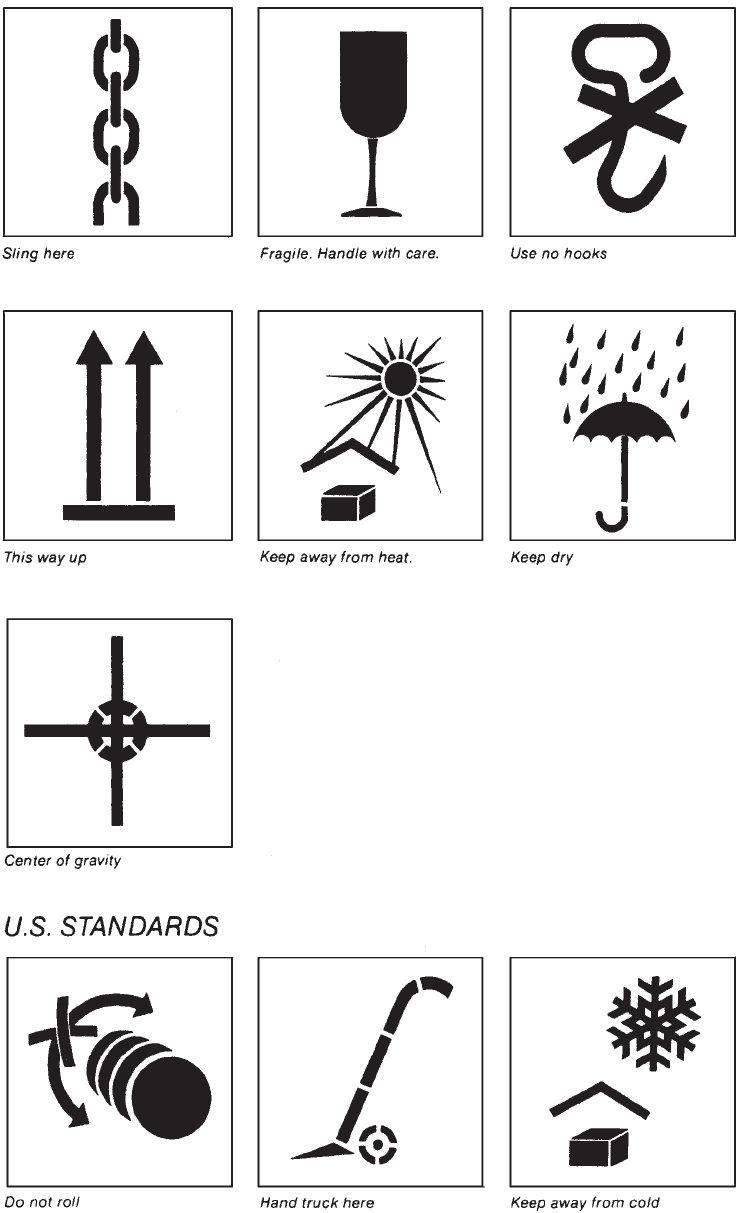
Figure 5. Pictorial representation of precautionary markings.
432 EXPORT PACKAGING
handler usually cannot stand up straight and often resorts
to crude methods of moving packages. The small items
may be rolled or thrown and will not be thoroughly
secured.
Miscellaneous Modes. Packages shipped to inland
points may experience a good deal of rough handling,
storage under unexpected conditions, and exposure to
pilferage and corrosion.
GUIDELINES
If shipments can be fully controlled by the shipper and the
consignee by containerization, documentation, represen-
tation at both ends, and complete understanding by all
parties, there can still be serious trouble unless adequate
packaging is used and properly implemented. It is almost
impossible to design and develop packaging that is too
good for export shipment.
BIBLIOGRAPHY
F. W. Green, ‘‘Export Packaging’’ in The Wiley Encyclopedia of
Packaging Technology 1st ed., Point O’View, pp. 276–282.
1. Ports of the World, Benn Publications, Ltd., London, annual.
2. Ports of the World, A Guide to Cargo Loss Control, Insurance
Company of North America, Philadelphia, Pa, 13th ed 1984.
General References
Preservation, Packaging and Packing of Military Supplies and
Equipment, 2 volumes, Defense Supply Agency, Department of
the Army, the Navy, the Air Force, Washington, DC.
EXTRUSION
J. A. GIBBONS
Egan Machinery Company
INTRODUCTION
Extruders are the most common machines in the plastics
processing industry. They are used not only in extrusion,
but in most molding operations Molding and extrusion are
the basic techniques of forming polymers into useful
shapes. The molding process, which is normally intermit-
tent, can fix three dimensions (height, width, length) of
an object. The continuous extrusion process through a die
can fix only two (height, width). These two processes are
usually complementary rather than competitive and pro-
duce a wide variety of products as diverse as pigmented
pellets, threaded closures, and refrigerator liners (1).
The extrusion process in which an Archimedean screw
rotates within a cylindrical barrel is probably the most
important polymer processing technique used today. It
is used to manufacture continuous profiles such as fibers,
tubing, hose, and pipe; to apply insulation to wire; and to
coat or laminate paper or other webs (see Extrusion coat-
ing). This article, however, deals primarily with single-
screw extruders for compounding polymers and producing
pellets, for producing rigid or foam sheet, and for making
blown or cast films.
The extrusion principle was first employed about 1795
for the continuous production of lead pipe. The first
patents on an Archimedean screw extrusion machine
were granted to Gray in England (2) and Royle in the
United States (3). During the nineteenth century the
machinery became refined for manufacturing rubber,
gutta-percha, cellulose nitrate, and casein products. Mod-
ern extrusion technology as applied to synthetic thermo-
plastic polymers began in about 1925 with work on PVC
(see Poly(vinyl chloride)). The first screw extruder de-
signed specifically for thermoplastic materials appears to
have been made by Paul Troester in Germany in 1935 (4).
SINGLE-SCREW EXTRUDERS
Modern single-screw extruders designed to process ther-
moplastic resins normally are o1 in. to 12 in. in diameter,
although larger extruders have been built. The most
common diameters for production-sized machines are
2–8 in. (51–203 mm). Figure 1 shows an 8-in. vented
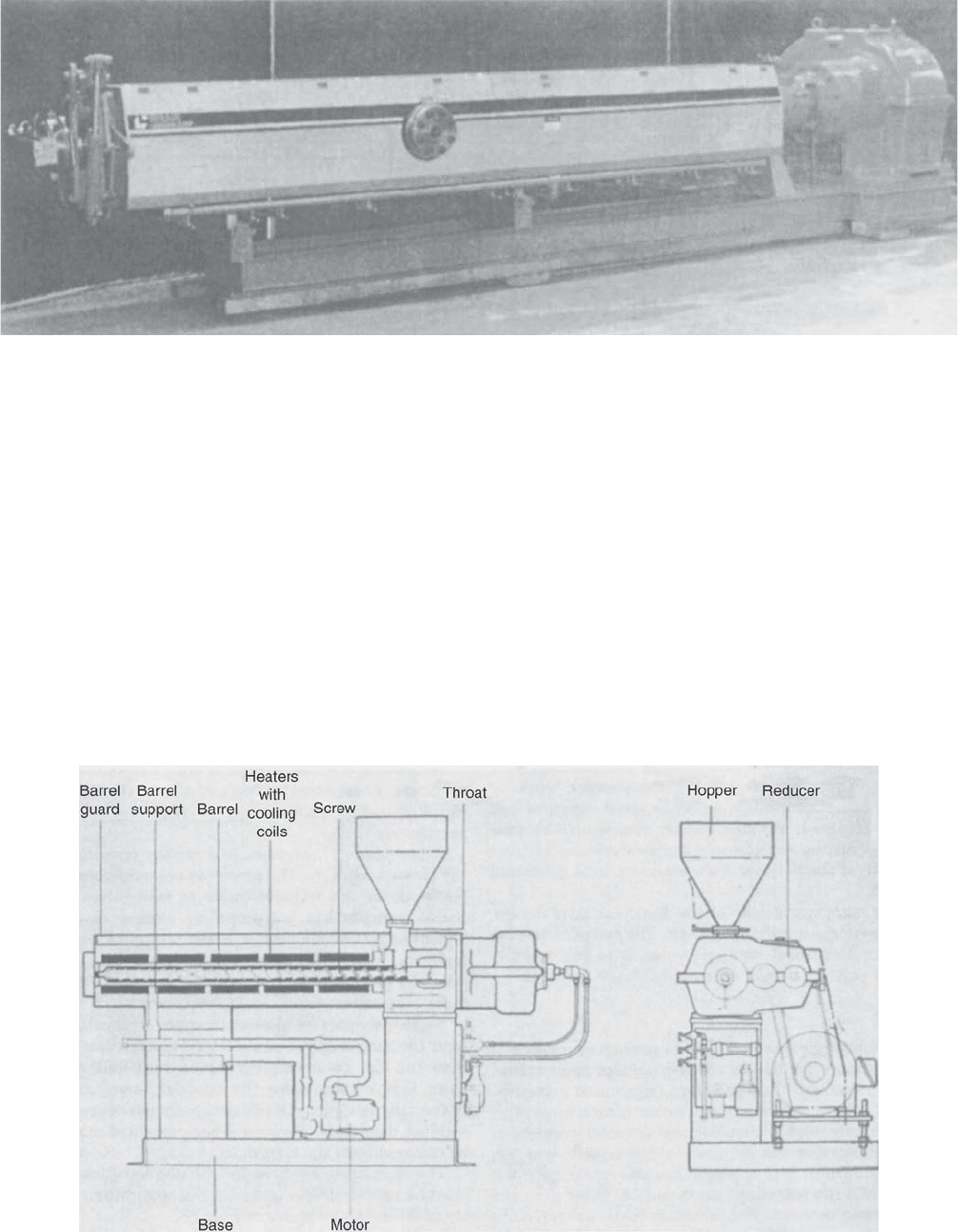
extruder with a barrel length of 32 diameter, and a 600-
hp (447.4 kW) drive. The main features of an extruder are
shown cross-sectionally in Figure 2.
The solid polymer fed to the extruder may be in the
shape of powder, beads, flakes, pellets, or combinations of
these forms. The extruder conveys, melts, mixes, and
pumps the polymer at high temperature and pressure
through a specially shaped die. The die’s configuration and
the solidifying or cooling process determine the shape of
the product.
All extruders consist of a barrel, a screw, a drive
mechanism, and controls. The heart of the extrusion
process is the screw. It is fashioned with a helical thread
or threads, along with varying channel depth. The func-
tion of the screw is to convey material and generate
pressure in order to produce pellets or other shapes. In
the case of a solids-fed screw the function is expanded to
include solids conveying, compression, and melting. Rota-
tion of the screw accomplishes all these functions.
Successful operation of an extruder depends on the
design of the screw. The depth and length of each zone of
the screw is determined by the product to be run. Barrier
flights and/or mixing sections are sometimes built into the
screw to improve its efficiency in melting and delivering a
homogeneous polymer to the die at the proper tempera-
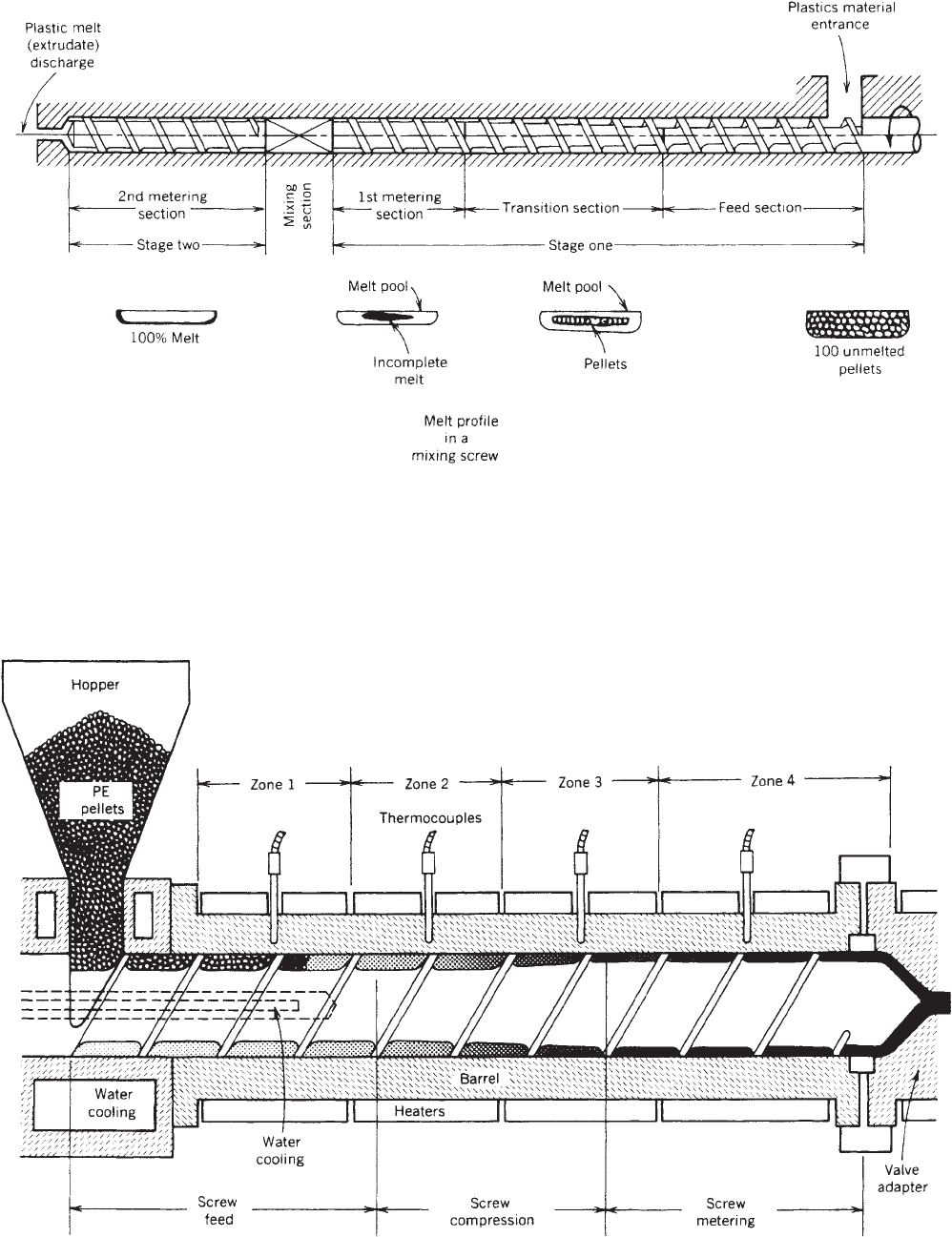
ture and pressure. The profile of the melting process in a
mixing screw is shown in Figure 3.
An extruder interior schematic is shown in Figure 4.
Here the solid resin is introduced into the hopper and,
through the action of the rotating screw, is conveyed into
EXTRUSION 433
the heated barrel. The screw in this section is feeding or
conveying the solids and hence is quite deep. The geome-
try of the screw is such that the depth decreases in the
transition zone, and the solids start to melt. Melting
results from the shearing action of the screw as motor
horsepower is converted into frictional heat. Barrel hea-
ters are used for start-up and to supplement the melting
process. The melt continues to be pumped toward the
discharge, or die end, of the extruder through the meter-
ing section of the screw. (Metering is pumping at a given
rate in a uniform manner, within close temperature and
pressure tolerances.) The die then forms the polymer in
the desired shape. Downstream cooling equipment solidi-
fies and maintains that shape.
Screws are cut from alloy steel. The tops of the convey-
ing flights are hardened or surfaced with special alloys for
extended life. The clearance between screw and barrel is
close. In operation, the screw floats in the barrel on a layer
of melted polymer.
The barrel, or hollow cylinder in which the screw
rotates, is manufactured from machined steel and
built to withstand pressures of 7500–10,000 psi (51.7–
68.9 MPa). Barrels are also lined with special alloys or
hard-surfaced to extend life. The length of a barrel is
defined as a multiple of its diameter (i.e., L:D ratio of
32:1 = a barrel:screw 32 diameter long). The length of an
extruder barrel is determined by the polymer and process
involved.
Figure 1. An 8-in. (203-mm) 32:1 L/D vented extruder.
Figure 2. A cross section of an extruder.
434 EXTRUSION
Extruders must be heated and cooled. Electrical heat-
ing or fluid heating can be used on the barrel. In electrical
heating, resistance heating elements in various forms
surround the barrel. Tubes for cooling fluid, cast in
aluminum, also contain heating elements. Some barrels
are built with jackets through which heating and cooling
fluid can be circulated. Extruder barrels are usually
divided into zones of specific lengths, each of which can
Figure 4. Schematic of the interior of an extruder.
Figure 3. Melt profile in a mixing screw.
EXTRUSION 435
be set at a desired temperature. The zones are controlled
by instruments or by microprocessors. Thermocouples are
normally used to sense temperature and to signal the
action of the controller (see Instrumentation).
The drive mechanism consists of a motor and a gear
reducer. The motor is usually a variable-speed dc drive
system with the ability to run a speed range of slow to fast
in a ratio of approximately 1:20. The gear reducer is used
to lower the speed of the motor output shaft (e.g., 1750–
2000 rpm top speed) to the desired screw rotation speed.
Most extruders operate in a variable screw speed range of
up to 200 rpm, but speeds considerably lower are used
with certain polymers, especially on very large machines.
The screw rotation speed depends on the diameter of the
extruder, the polymer to be extruded, and the production
rate desired. The limiting factor in a given-size extruder is
quality of the product, which is dependent on the melt
quality. As screw speed increases and more rate is
achieved, the melt quality deteriorates because of nonuni-
form mixing or excessive temperatures, or because of
degradation of the polymer from excessive heat generated
by high shear.
COMPOUNDING
Extrusion compounding as it relates to packaging consists
of preparing polymers for use in specific product applica-
tions. Mixtures of polymers, filled polymers, pigmented
polymers, and a host of other polymer additives constitute
a huge market. Compounding with a single-screw extru-
der consists of mixing and dispersing one or more minor
constituents (e.g., pigments, stabilizers) into a major con-
stituent, a polymer. The product of a compounding line is
pellets. These are used by the converting industry. Con-
verting is the process of melting the pellets and producing
extruded sheet, film, injection-molded parts, and so on.
Compounding can be separated by functions: resin-
plant extruding, blending, reclaim, and devolatization.
Resin-plant extruders take the products from a poly-
merization operation and make pellets. The feed to these
machines can be powder, granules, other irregular shapes,
or even a melt. A melt extruder has a molten feedstock and
only generates pressure, whereas a plasticating extruder
has the job of turning solids into a molten mass and then
generating pressure. During pelletizing, stabilizers and
processing aids are combined with the polymer (see Ad-
ditives, plastic).
A blending extruder is used to mix feedstocks of
compatible polymers, or different viscosities of the same
polymer. The blending operation tailors the physical prop-
erties to meet a specific end use.
Reclamation
Reclamation of polymers is an important segment of the
plastics industry. Film producers are satisfying sustain-
ability calls and reducing costs by replacing virgin plastic
with reclaim. Edge trimming is necessary when it comes
to cast films. The trims are recycled by means of a special
extruder, fed back in-line, and used for the encapsulation
of the film edges. For blown film, recycled material can be
used in the center layer of the film structure, and virgin
layers prevent recycled material from contacting pack-
aged food. Edge encapsulation prevents barrier material
from making it to the edge of the film, which would
preclude that scap from reintoduction (5).
The problems of reclamatiom are numerous because
the feedstock for the extruder comes in many sizes and
shapes. Some examples are polypropylene battery cases,
polyester X-ray film, soft-drink bottles, bread wrappers,
unusable foam products, fibers, filaments, and off-grade
film of all kinds. Specially designed extruders must be
used for processing these materials.
Some polymers require extraction of moisture or gases
from the melt before a satisfactory product can be pro-
duced from the die. To accomplish this, a vent hole with
vacuum pump is introduced along the extruder barrel, and
the screw is specially designed. Devolatizing extruders are
used where residual monomer, water, or other unwanted
materials must be removed from the extrudate.
The machinery required for the aforementioned pro-
cesses must be specifically designed for the application. A
wide variety of design features are utilized.
Specially designed extruders are used for the addition
of short fibers to thermoplastic polymers (6). This is done
to improve the physical, mechanical, and structural prop-
erties of the virgin plastic. Cost-per-unit volume can also
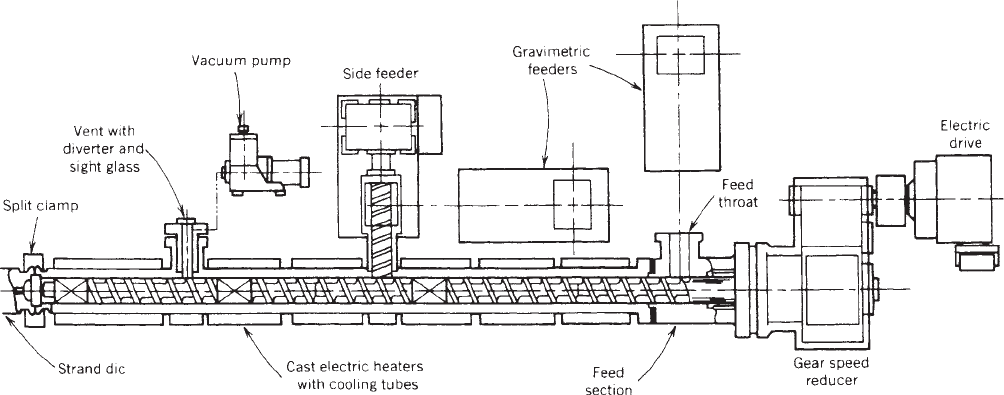
be improved. The extruder uses a three-stage screw. The
polymer is melted in the first stage. The short fiber,
usually chopped fiberglass, is screw conveyed into the
side of the extruder barrel. The glass and polymer are
mixed in the second stage. The third stage allows venting
and pressure generation for the die at the exit. A cross-
sectional view of a side-fed extrusion system is shown in
Figure 5.
Another unique design is used for reclaiming. Because
the bulk density of most of the scrap-plastic items is low,
use of a dual-diameter extruder has become prevalent.
The feed end of the screw has a larger diameter, so there is
a greater volume for the entering light fluffy feedstock.
This facilitates high production rates.
Vertical extruders meet special needs such as limited
floor space, or other plant layout requirements.
BLOWN AND CAST FILM
Film is a relatively thin [usually p10 mil (p254 mm)]
flexible web made from one or more polymers, either
blended or coextruded (see Coextrusion, flat; Coextrusion,
tubular) but not to be confused with a fabricated extru-
sion-coated
or laminated web
(see Laminating; Multilayer
flexible packaging).
Films are used in flexible packaging (for overwraps,
bags) as industrial wraps (stretch and shrink films), in
medical and health care products (disposable diapers,
backings, hospital bed liners), in agriculture (mulch films),
for sacks (drum liners, garbage bags), and as laminates
(aseptic container stock). (Some packaging overwrap films
are produced by casting a solvent solution of PVC resin on a
stainless steel belt and evaporating the solvent as the belt
436 EXTRUSION
travels through a heated chamber. This process normally
uses a pump to distribute the solution through the die.
Solvent casting is beyond the scope of this discussion.)
The same basic extrusion processes are used for produ-
cing both blown and cast film. The first two steps, melting
and metering, are part of the extrusion process described
above.
Forming
In the forming process, the polymer is squeezed through a
die as it leaves the extruder, to form a thin uniform web.
The cast-film process produces a flat web. In the blown-
film process the die shapes the polymer into a tube. This
latter process is more versatile because it can produce not
only tubular products (bags), but flat film as well, simply
by slitting open the tube. Key to the success of both
processes is the die, which must distribute the polymer
uniformly.
Orientation
In the orienting stage of the blown-film process, the tube is
blown up into a bubble that thins out, or ‘‘draws down’’ the
relatively thick tube to the required product gauge (thick-
ness). In certain blown-film processes, the polymer is
blown downward to produce films with special properties.
The ratio of the diameter of the blown bubble to the
diameter of the die is called the blowup ratio. Most
LDPE (see Polyethylene, low density)-blown films used
in packaging are made using blowup ratios of 2.0:1–2.5:1.
The blowup ratio is changed depending on the character-
istics of the resin being extruded and the properties
desired in the film. In cast film, the molten polymer is
also drawn down to the desired finished gauge. Drawdown
ratios between 20:1 and 40:1 are typical. (If a polymer
exits a die at 40 mils (1 mm) thick and finishes up 1 mil
(25 mm) thick, the overall drawdown ratio is 40:1.) In the
orientation process the long molecules of the polymer line
up in the stretching direction, which improves the film’s
strength in that direction. A key difference between the
two filmmaking methods lies in the manner of orientation.
Because both edges are free in cast film, it is drawn
down only in the direction the material exits the die
(machine direction). Because cast film is drawn in one
direction only, it usually exhibits excellent physical prop-
erties in the machine direction, and poor properties in the
cross-machine direction. The cast-film process is shown in
Figure 6. In the blown-film process, the extruded tube is
stretched in two directions: as it is blown into a bubble and
as it is drawn from the die in the machine direction by the
adjustable speed drive system. This results in strength
properties that are more uniform and can be balanced
depending on the blowup ratio and the takeoff speed.
Figure 7 illustrates the blown-film process.
Certain films can be biaxially oriented to enhance
properties for specific packaging uses such as shrink films
(see Films, shrink) or overwrap. The blown process pro-
duces a thick tube that is then reheated and blown out
while increasing the take-away speed to maximize orien-
tation in both directions. The cast process extrudes a
thick, flat sheet that is chilled, then reheated and
stretched in the machine direction and then reheated
and stretched across its width by means of a tenter frame.
The most common plastic materials to be biaxially or-
iented are polystyrene (see Polystyrene), homopolymers
and copolymers of polypropylene, usually coextruded (see
Film, oriented polypropylene); and polyester (see Film,
oriented polyester). These films are then coated to en-
hance heat-seal or barrier properties.
Quenching
After the polymer has been extruded, it must be solidified
into finished film. In blown film the quenching (or cooling)
process is achieved by convection, by blowing air on the
outside and sometimes on the inside of the bubble. Air
rings at the die exit direct and distribute air uniformly to
the bubble. In cast film the web leaves the die and is
Figure 5. Cross section of a side-fed extrusion system.
EXTRUSION 437