
Yam, Kit L. (ed.). The Wiley encyclopedia of packaging technology
Подождите немного. Документ загружается.

Most applications require transparency, but Aclar film
can be metallized with aluminum. Corona-treated film can
be printed with polyamide-based inks (see Inks). Best
results are obtained if the film is corona-treated in-line
prior to printing.
PROPERTIES
Aclar film can be sterilized with steam and with ethylene
oxide (ETO) systems. Radiation sterilization of Aclar
film in the cobalt-60 dosage range of 2.5–5 10
6
rad (2.5–
5 10
4
Gy) have been tested. Tests at 1 10
6
rad
(1 10
4
Gy) (2) indicate that little or no property loss occurs
at that dosage (see Radiation, Effects of). Aclar films have
outstanding barrier properties to water vapor and to other
gases (see Barrier Polymers). Properties at a wide variety
of temperatures can be determined by a method that is
described in Ref. (3). Table 1 compares transmission rates
of Aclar films with a number of other films.
Aclar film is inert to acids, bases, strong oxidizing
agents, and most organic chemicals. It exhibits excellent
dimensional stability in inorganics, including water, salt
solutions, strong acids, and bases. Some polar organics,
especially hot polar solvents, diffuse into Aclar film and
act as a plasticizer. These solvents cause it to become more
flexible and sometimes hazy. There are no known solvents
that dissolve the film at temperatures up to 2501 (1201C).
Mechanical properties are usually not an important factor
in packaging applications because the important mechan-
ical properties are those of the laminates. Aclar films are
not particularly strong or tough, but they have outstand-
ing abrasion resistance, important in clean-room packa-
ging of military hardware.
APPLICATIONS
Aclar film is used in military, pharmaceutical, electrical/
electronic, and aircraft/aerospace component applications.
It serves as a key component of a transparent laminated
barrier construction that meets the requirements of the
MIL-F-22191, Type I specification (see Military Packa-
ging). This laminate is used for packaging moisture-
sensitive military hardware. Aclar also passes the liquid
oxygen (LOx) compatibility impact test under NASA
specification MSFC-106A. It is used for packaging compo-
nents designed for service in liquid oxygen and other
oxidizers used in spacecraft applications. Gas sampling
bags made of Aclar are used on the Space Station (4).
The major commercial applications are in packaging
moisture-sensitive drugs. Aclar Flex 380 exhibits 10 times
the barrier protection of other films. It can reduce medical
errors and streamline operations by streamlining quality
control, product inspection, labeling, and product identifi-
cation (1). Laminates are used for rigid and semirigid
blister packs, lidding, unit-dose packages, and aseptic
peel-packs. They are also used in medical applications—
for example, as an overwrap for plastic containers for
biomedical specimens and/or pathology specimens. This
application requires a film that is sterilizable by heat and
ETO and that does not absorb or denature biological
fluids. Aclar film laminates are used in oxygen-rich en-
vironments for packaging items in liquid nitrogen (4).
SAFETY CONSIDERATIONS
Aclar film is inert and nontoxic and safe to handle at
ordinary temperatures. It is thermally stable for up to one
hour at temperatures as high as 4461F (2301C). It can be
processed for a few seconds at temperatures as high as
5541F (2901C), provided that the machine is ventilated
with an exhaust fan. Vacuum forming is typically done at
3741F (1901C) with exhaust-fan ventilation. If Aclar film is
continuously processed at temperatures above 4461F
(2301C), the processing machinery should be equipped
with ventilating equipment or the work should be per-
formed in an exhaust hood. The film should not be
disposed of by burning. Exposed to flame, it degrades to
fluorochlorocarbon gases, some of which are toxic. In the
presence of oxygen and olefins or polyolefins, it may form
HF and/or HCl when exposed to flame. These acids are
toxic if inhaled and are corrosive to metals (5).
BIBLIOGRAPHY
‘‘Film, Fluoropolymer’’ in M. Bakker, ed., The Wiley Encyclopedia
of Packaging Technology, 1st edition, A. B. Robertson and K. R.
Habermann, John Wiley & Sons, New York, 1986, pp. 311–313;
2nd edition, A. J. Brody and K. S. Marsh, eds., 1977, pp. 403–
405.
Cited Publications
1. ‘‘Aclar Homopolymers, www.honeywell.com, accessed August
2008.
2. King, Broadway, and Pallinchak, ‘‘The Effect of Nuclear Radia-
tion on Elastomeric and Plastic Components and Materials,’’
Report 21, Addendum AD 264890, Radiation Effects Informa-
tion Center (now defunct), Battelle Memorial Institute, Na-
tional Technical Information Series of the Department of
Commerce, August 31, 1964.
3. N. Vanderkooi and M. Ridell, Mater. Eng. 58 (March 1977).
4. ‘‘Aclar Films, Copolymers 22/33,’’ www.texastechnologies.com/
aclar, accessed August 2008.
5. Aclar Homopolymer Films, Material Safety Data Sheet,
www.honeywell.com, January 2004.
FILM, HIGH-DENSITY POLYETHYLENE
R. H. NURSE
J. S. SIEBENALLER
American Hoechst Corporation
Updated by Staff
INTRODUCTION
High-density polyethylene, (HDPE) film has been used for
a variety of specialty applications since the mid-1950s, but
468 FILM, HIGH-DENSITY POLYETHYLENE

it was not until the 1970s that significant growth began.
Today polyethylene is the third largest resin commodity
after poly(vinyl chloride) and polypropylene (1). Plants
using Ziegler and chromium catalysts to make film re-
ported production of 450 thousand tons/year. Japan and
Asia use twice as much film as the United States and
Western Europe (1). Much of this film is used for grocery
sacks and merchandise bags and a few other nonpacka-
ging applications. HDPE film is also used for a variety of
packaging uses that require the unique property profile
that HDPE films provide.
In packaging applications, HDPE films compete with
LDPE and LDPE/LLDPE blends, cast PP (see also Film,
Non-oriented Polypropylene), and oriented PP (see Film,
Oriented Polypropylene). These polyolefin films have
many properties in common, but with some significant
differences in degree. Typical HDPE film properties are
shown in Table 1.
HDPE, by virtue of its higher density, exhibits higher
tensile strength, lower WVTR, and greater stiffness than
LDPE or LLDPE/LDPE blends. PP films can offer higher
tensile strength because of a higher degree of crystallinity
and the ability to be biaxially oriented. PP films also have
excellent optical properties due to fine crystal structure
and biaxial orientation behavior. LDPE and LLDPE/
LDPE blends exhibit good clarity due to their lower degree
of crystallinity. HDPE is the most opaque of the three
polyolefin types. This is an advantage if opacity is desired,
because a relatively low amount of pigment is required to
achieve that opacity (see Colorants). LLDPE and LLDPE/
LDPE blends exhibit higher tendency to elongation under
load because of their lower crystallinity and, hence, lower
tensile modulus. This property is useful in stretch-wrap
applications (see Films, Stretch), but it is a disadvantage if
low elongation is required (as in handled grocery sacks). It
is important to recognize, however, that the properties of
all polyolefin films can be tailored during polymerization
or through the use of blends or coextrusions.
PACKAGING APPLICATIONS
Two of the most important applications for HDPE film are
retail grocery sacks and merchandise bags. HDPE films
have replaced large quantities of glassine for packaging
cereals, crackers, and snack foods. In these applications,
clarity is not desirable, and the translucency or opacity of
HDPE films is an advantage. They are used in conjunction
with bag-in-box vertical form/fill/seal equipment (see Bag-
in-Box, Dry Product; Form/Fill/Seal, Vertical). Rubber-
modified HDPE film is used for medical overwraps.
HDPE films are also used to produce shipping sacks.
Heavy-gauge coextrusions of HDPE with low-density
polyethylene are used for all-plastic shipping sacks (see
Bags, Heavy-Duty Plastic), and thin-gauge HDPE films
are used as moisture-barrier plies in multiwall bags (see
Bags, Multiwall). Very thin embossed HDPE film is also
used as a replacement for tissue paper; and without
embossing, it is used as an inner wrap for delicatessen
products. HDPE film is also used for foods that are heated
in the package (boil-in-bag items) (2).
FILM POLYMERS
Three principal polymer properties can be adjusted to tailor
the performance of HDPE films (see Polyethylene, High-
Density). Density plays the most significant role as a
measure of the degree of polymer crystallinity. Crystallinity
has a direct influence on tensile strength, WVTR, hardness ,
opacity, and coefficient of friction. HDPE film resins are
0.941–0.965 g/cm
3
, depending on comonomer type and
Table 1. Typical Properties of High-Density Polyethylene Film, 1 mil (25.4 lm)
a
Property ASTM Test Method HDPE-HMW (Blown) HDPE-MMW (Blown)
Specific gravity D1505 0.950 0.950
Yield, in.
2
/(lb mil)
[m
2
/(kg m)]
29,200 [1635] 29,200 [1635]
Haze, % D1003 78 78
Tensile strength, psi (MPa) D882 MD/XD, yield 5200 (35.9)/5000 (34.5) 4600 (31.7)/4400 (30.3)
MD/XD, failure 7500 (51.7)/7000 (48.3) 6500 (44.8)/6100 (43.1)
Elongation, % D882 MD 450 350
XD 500 550
Tensile modulus, 1% secant,
psi (MPa)
MD 125,000 (862) 120,000 (828)
XD 130,000 (897) 125,000 (862)
Tear strength, gf/mil (N/mm) D1922 Propagating, MD/XD 20 (7.7)/150 (57.9) 15 (5.8)/100 (38.6)
Service temperature range,
1F(1C)
200–250 (93–121) 200–250 (93–121)
WVTR, g mil/(100 in.
2
day)
[cm
3
mm/(m
2
day)];
381C, 98% rh
0.8 [0.3] 0.8 [0.3]
COF, face-to-face D1894 0.3 0.3
a
COF = coefficient of friction; MD, XD = machine, cross-direction.
FILM, HIGH-DENSITY POLYETHYLENE 469
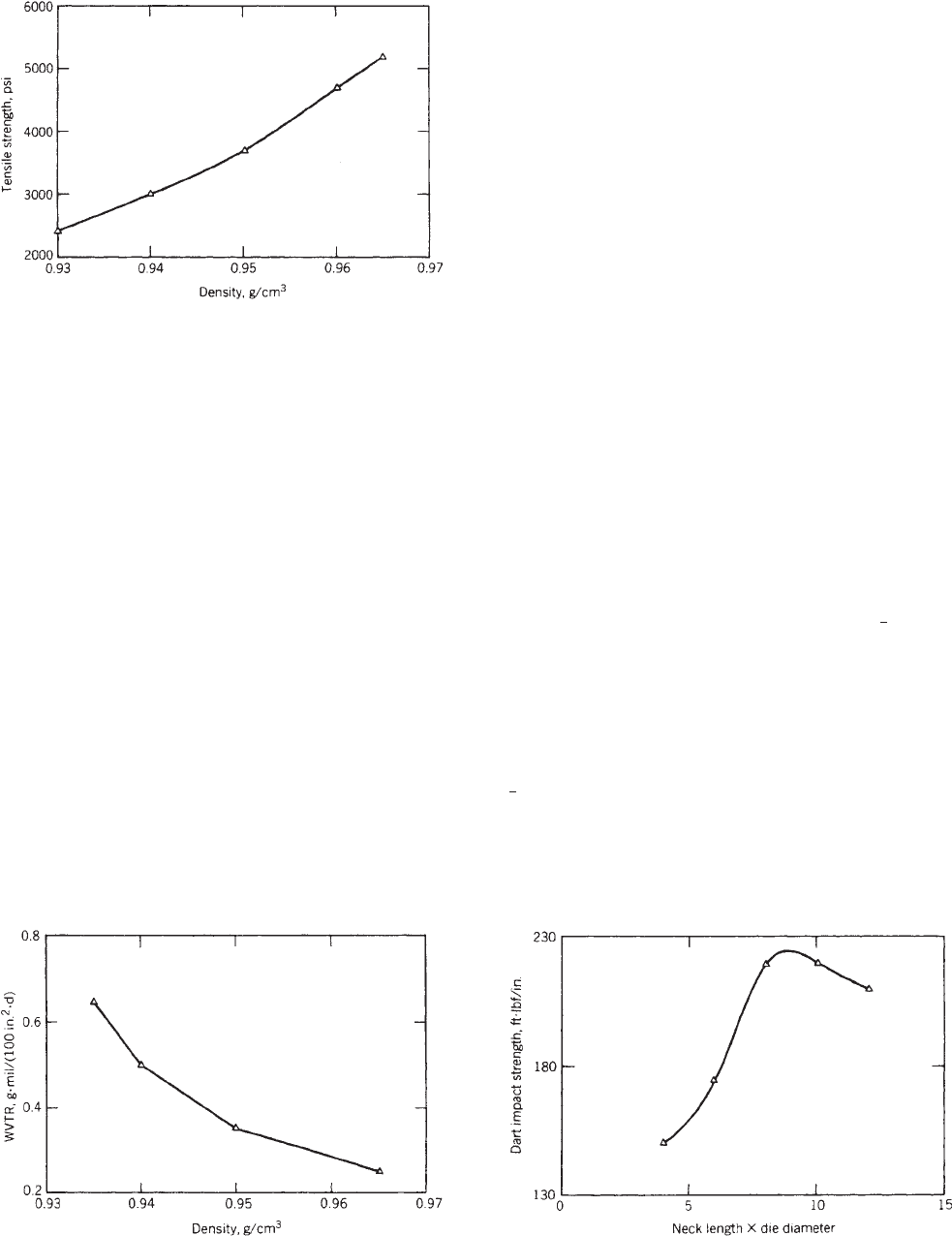
concentration. The most common comonomers are butene
and hexene. As density increases, tensile modulus and
tensile strength increase as well (see Figure 1). The same
is true for film hardness and, to some extent, for water-
vapor transmission rate (see Figure 2).
The molecular weight (MW) of the polymer has a
significant influence on toughness and impact strength.
For many years, HDPE films were made from medium-
molecular-weight (MMW) or low-molecular-weight (LMW)
polymers, for applications that required only medium-to-
low toughness. The development of high-molecular-weight
(HMW) polymers changed the range of applications avail-
able to HDPE films (3). The influence of MW on film
impact strength is significant (impact resistance increases
with molecular weight), but the processing of the resin is
critical as well (4).
Molecular-weight distribution (MWD) is the third para-
meter influencing resin design, because it influences
processing. Broad-MWD resins are easier to process
than narrow-MWD resins. The ability to process HDPE
at economic speeds and at controlled melt temperatures
requires careful resin design. High-flow LMW film resins
can be narrow or medium in MWD and still be extruded at
high output rates without excessive shear that would
degrade the polymer. MMW resins require some careful
control for high-speed extrusion (5). The use of HMW-
HDPE film resins requires extreme MWD control to
ensure both acceptable output rates and control of melt
temperatures. Thermal degradation must be avoided to
maintain the long molecular chains necessary to impart
high impact strengths. This MWD has been achieved in
some cases by bimodal polymerization technology. The
polymer chemist has certain secondary design criteria
available to fine-tune the HDPE film polymers. These
include special process stabilizers, high-heat stabilizers,
antistatic agents (see Additives, Plastics), different como-
nomer types, and the physical form in which the resins are
supplied (i.e., pellets or coarse powders).
FILM MANUFACTURING
Chromium-based catalysts can be used quite widely for
production of HDPE grades, but some of the best films, in
terms of mechanical properties and extrusion rates, are
bimodal resins made from Ziegler catalysts passing
through two or more reaction zones. Most recently, me-
tallocene resins have been used to produce extremely high
clarity resins, despite the high density (6).
HDPE films are produced using two principal extrusion
techniques: blown and cast (see Extrusion). The most
common is blown-film extrusion, in which 1
1
2
to 6-in:
(3.8 – to 15.2-cm) extruders extrude the resin in tubular
form. The tube is cooled, collapsed to a flat film, and either
wound in tubular form or slit and folded. The properties of
blown HDPE film are highly dependent on the type of
resins used and the design of the extrusion equipment
employed (6). MMW-HDPE films, monolayer or coex-
truded, are generally made with extruders in the
2
1
2
to 6-in. (6.4– to 15.2-cm) diameter range operating
at relatively low screw speeds yet achieving high output at
moderate melt temperatures. The screw L:D ratio is
normally 25–30 and the barrel design is normally smooth.
These conventional extruders do not allow full
Figure 1. Influence of density on tensile strength. To convert psi
to MPa, divide by 145.
Figure 2. Influence of density on WVTR. To convert g mil/(100
in.
2
d) to g mm/(m
2
d), multiply by 0.3937.
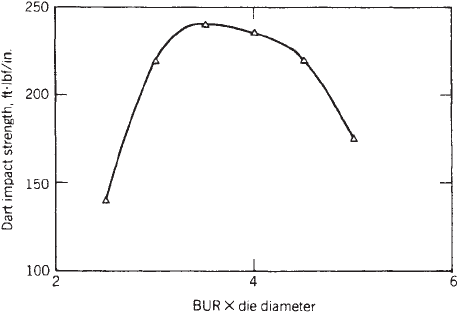
Figure 3. Effect of neck length on film toughness. To convert
ft lbf/in. to J/m, multiply by 53.38 (see ASTM D256).
470 FILM, HIGH-DENSITY POLYETHYLENE
development of the resin capability in terms of optimum
toughness, but they serve a useful role in providing high
outputs at economic rates for applications which do not
require the full–strength potential of HDPE.
In contrast, other designs for HMW–HDPE film extru-
sion are based on forced-feed grooved sections. They oper-
ate at high screw speed, using relatively short (18–21) L:D
ratios. These extruders achieve high output with the mini-
mum residence time required to produce a homogeneous
melt for the subsequent blowing and orientation processes
necessary to develop the optimum toughness and tensile
strength. For HMW film it is imperative to use a relatively
long neck length (frost height) (6–10 die diameter) and
high blowup ratio (3–5 die diameter) to achieve balanced
properties. The influence of these processing parameters
on the optimum toughness of the film is illustrated in
Figures 3 and 4.
LMW-HDPE films are generally made with cast-film
technology, in which free-flowing polymer melts are ex-
truded from flat dies on to substrates or chill rolls. These
polymers do not have the melt strength necessary for the
blown film process and their applications are limited.
BIBLIOGRAPHY
R. H. Nurse and J. S. Siebenaller, ‘‘Film, High Density Polyethy-
lene’’ in M. Bakker, ed., The Wiley Encyclopedia of Packaging
Technology, 1st edition., John Wiley & Sons, New York, 1986,
pp. 313–315; 2nd edition, A. J. Brody and K. S. Marsh, eds.,
1997, pp. 405–407.
Cited Publications
1. A. Borruso, ‘‘Polyethylene, High Density’’ in Chemical Econom-
ics Handbook, SRI Consulting, Menlo Park, CA, April 2008.
2. J. C. Brennan and B. P. F. Day, in J. C. Brennan, ed., Food
Processing Handbook, Wiley-VCH, Weinheim, Germany, 2006,
p. 306.
3. A. Brockschmidt, Plast. Technol. 30, 64 (1984).
4. H. R. Seintsch and H. E. Braselmann, ‘‘Further Evaluations of
HMW-HDPE Film Processing and Effects on Film Properties,’’
TAPPI Paper Synthetics Conference, Washington, DC, 1979.
5. H. E. Braselmann and R. E. Barry, ‘‘HMW-MMW HDPE
Extrusion and Fabrication Techniques for Grocery Sacks and
Merchandise Bags,’’ TAPPI 1984 Polymers, Laminations and
Coatings Conference, Boston.
6. E. Benham and M. McDaniel, ‘‘Polyethylene, High Density’’ in
Kirk–Othmer Encyclopedia of Chemical Technology, Vol. 20,
5th edition., Wiley, Hoboken, NJ, 2006.
FILM, ORIENTED POLYESTER
JOHN NEWTON
ICI, Delaware
Updated by Staff
INTRODUCTION
Biaxially oriented polyester film is considered a high-
performance film. It is used in numerous applications,
including graphic arts, information storage and display,
labels, solar control, membrane touch switches, pressure-
sensitive tapes, hot-stamping foils, photoresists, fiber-
glass-reinforced panels, postlamination, ID and smart
cards, and, last but not least, packaging.
World supply of PET film continues to expand. The
domestic manufacturers of PET film for the merchant
market are DuPont Films (Mylar, Melinex), Mitsubishi
(Hostaphan), Toray Lumirror), Terphane (Terphane), and
3 M (Scotchpar).
FILM MANUFACTURING PROCESS
Polyester is produced by combining ethylene glycol and
either terephthalic acid or dimethyl terephthalate in a
condensation reaction. PET film can be either cast or
oriented. The oriented variety can be either blown or
tentered (stentered). Tenter-oriented PET film is the
most versatile because the process imparts an improved
combination of physical properties.
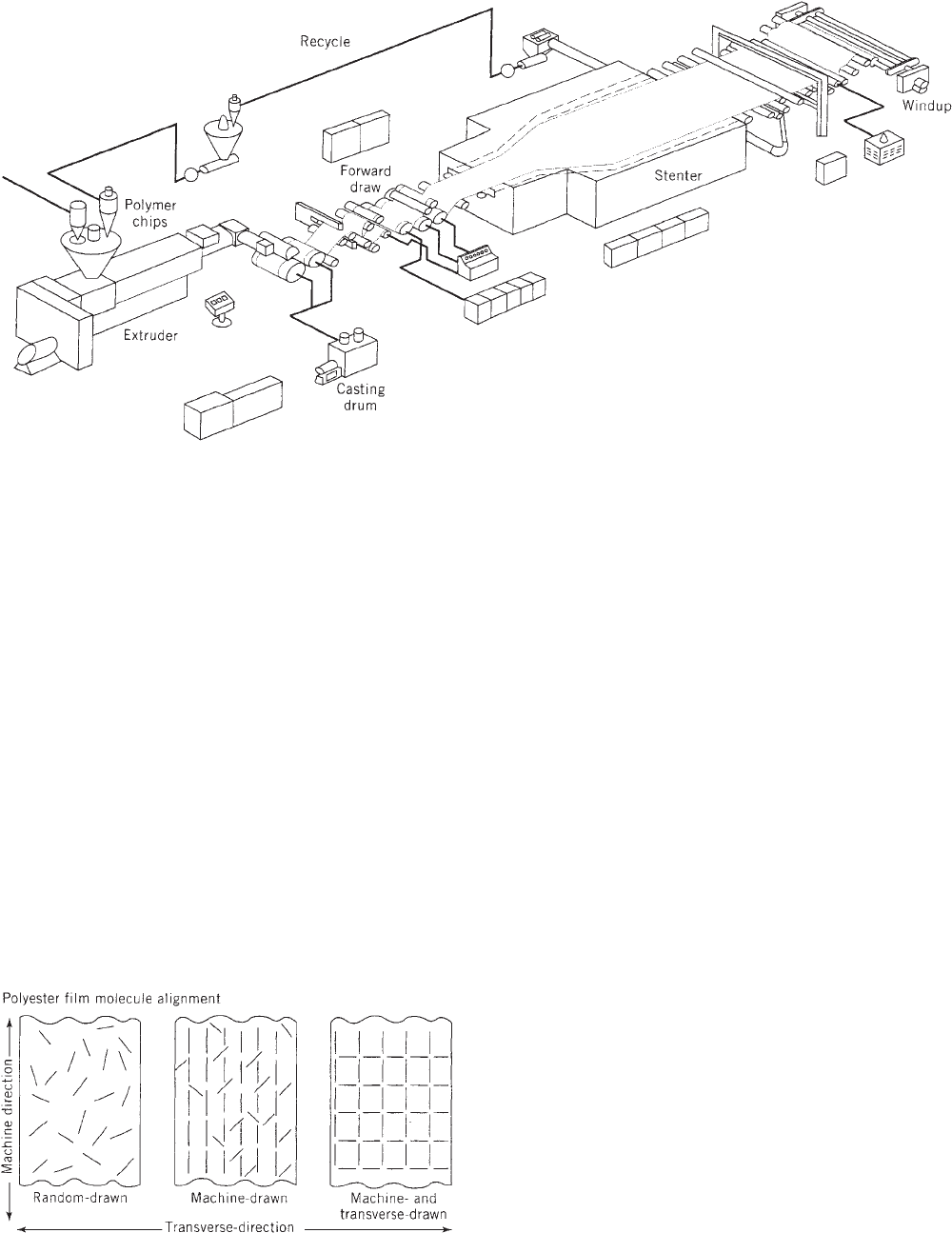
In the cast-tentered process, the molten resin is ex-
truded onto a cooled casting drum (see Figure 1). The film
is oriented in the machine direction by heating, then
stretching the film to three to four times its original
length. The film is then heated again in a tenter (a large
oven consisting of several heating zones) and drawn three
to four times in the transverse direction (see Figure 2).
The film proceeds to the hottest zone of the oven, where
the now biaxially oriented film is heat-set, or annealed.
This prevents the film from shrinking back to its original
unstretched shape.
Film processing conditions affect shrinkage, gloss, ten-
sile strength, elongation, and other characteristics. The
film can be treated or coated, within the manufacturing
process or afterward, to change or enhance its properties.
Figure 4. Effect of blowup ratio (BUR) on film toughness. To
convert ft lbf/in. to J/M, multiply by 53.38.
FILM, ORIENTED POLYESTER 471
FILM PROPERTIES
PET has an outstanding combination of properties that
make it valuable to the converting and packaging indus-
tries. Base PET film offers mechanical strength, dimen-
sional stability, moisture resistance, chemical resistance,
clarity, stiffness, and barrier properties. It handles well
and can be printed or laminated (see Table 1). In response
to customer needs, polyester film manufacturers have
developed many technologies that change film properties
to achieve useful effects (see Table 2).
Thermal
Polyester film gains excellent thermal properties through
the heat-set process, allowing it to be processed and used
in a wide range of temperatures. It tolerates temperatures
ranging from 701C to 1501C for several hours or more,
and can withstand even higher temperatures for shorter
time periods, making it suitable for extended drying
ovens, hot stamping, and packaging processes that form,
fill, and seal.
Barrier
Flavor preservation is a major concern in the packaging
industry. Barrier-type films constitute 50% of current U.S.
PET film consumption. Polyester film has demonstrated
an excellent ability to retain flavor and exclude odor from
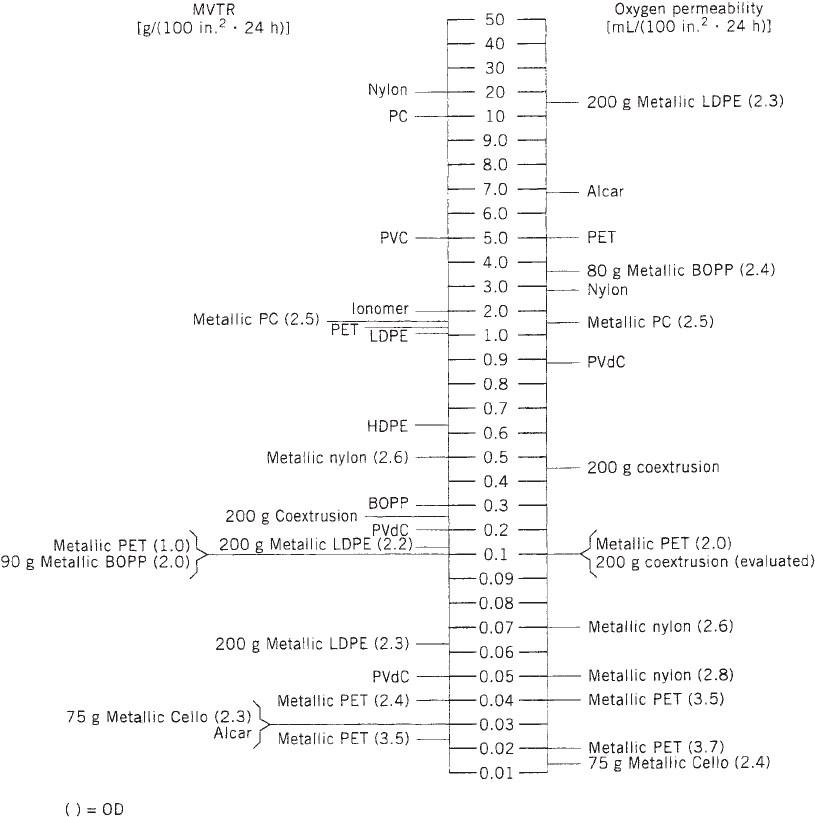
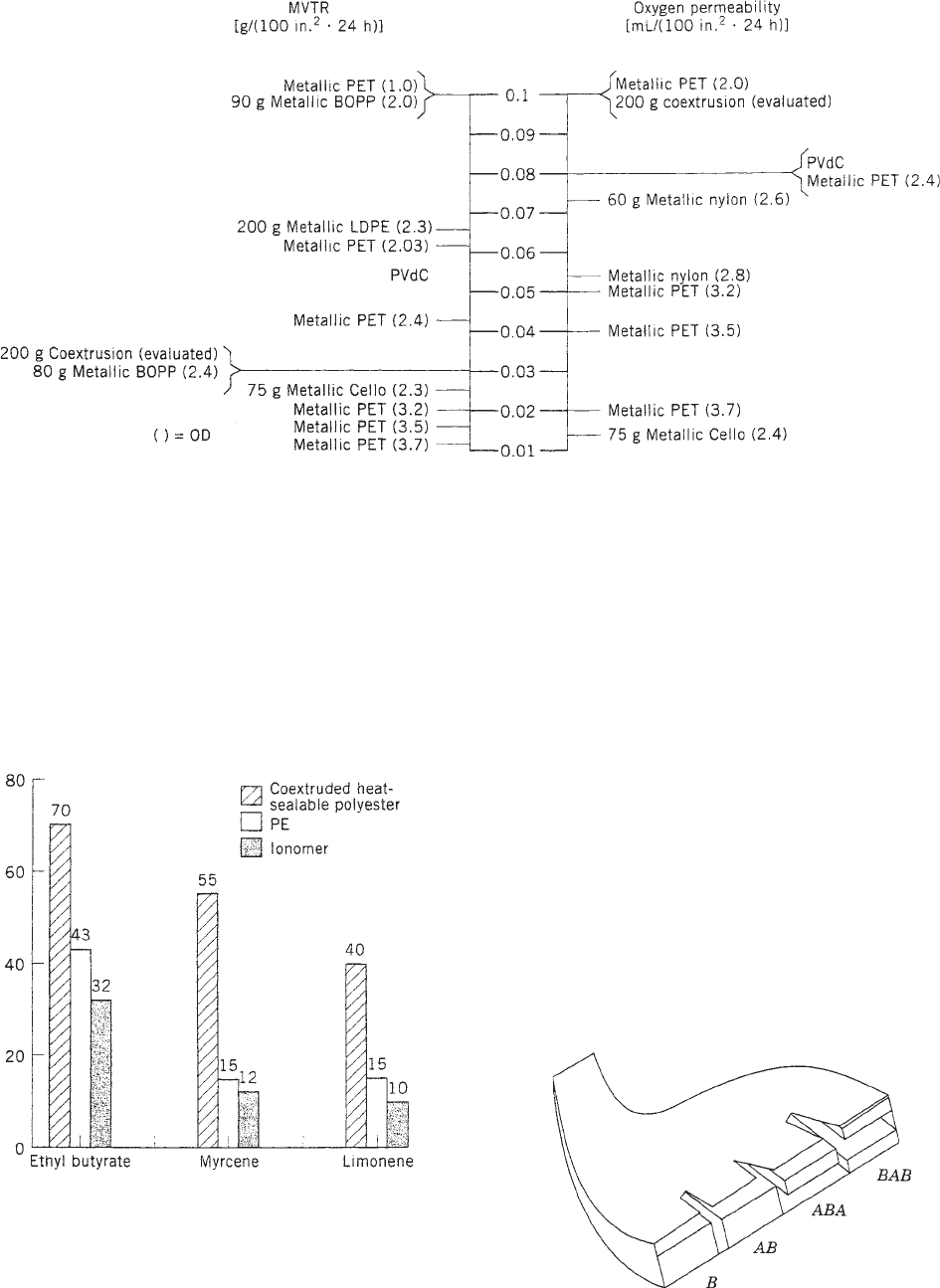
outside the packaging (see Figures 3 and 4). Metallizing or
coating with PVC can provide greatly increased barrier
properties.
Metallizing. Metallized films provide value to food
packagers concerned with package integrity and shelf
life. Metallized materials are decorative and also enhance
properties such as moisture, light and gas barrier, flavor
protection, protection against static electricity, and excel-
lent machineability. Films other than polyester are now
being metallized and used in packaging. However, polye-
ster is still chosen when superior thermal stability and
moisture and oxygen barrier are desired. Increasing the
metal thickness further improves these barriers (see also
Metallizing, vacuum).
PVC. PET can be coated offline (after the manufactur-
ing process) with poly(vinylidene chloride). PVDC-coated
PET is used in transparent packages to provide good
barrier properties without metallizing. Typical coating
thickness is 0.0001 in. (approximately 2 lb per ream). A
major application for PVC-coated PET is in packaging
processed meats such as hot dogs and luncheon meats.
Flavor Scalping
PET film is an excellent flavor and odor barrier for
packaging products that contain strong flavors, smells,
and migratory agents. The sealant that is used in a
package is important if flavor scalping (the loss of flavor
from a product to the laminate or environment) is an
Figure 1. Film processing.
Figure 2. Polyester orientation.
472 FILM, ORIENTED POLYESTER

issue. A coextruded, heat-sealable PET used as the sealant
layer scalps significantly less flavor from products than
does a PE sealant or an ionomeric (surlyn) sealant layer
(see Figure 5).
The sealant (in conjunction with the laminate chosen)
can either adsorb the flavor or allow permeation through
the sealant and perhaps the laminate. PET film as a
barrier web and coextruded, heat-sealable PET as a
sealant layer each provide superior flavor barriers in
comparison with other packaging films and sealants.
SURFACE MODIFICATIONS OF PET FILMS
Corona Treating
Corona treatments use an electrical charge to raise the
surface tension of film and enhance its wet-out properties.
Corona treatment more closely matches the energy of the
coating surface to the energy of the substrate surface. This
promotes the polyester film’s adhesion to various materi-
als used in different phases of conversion. Corona treating
has been an accepted method for over 30 years. Its use is
limited, however, because the treatment level dissipates
with time.
Pretreatments
Polyester can be pretreated in-line for a variety of surface
properties, making the coating an integral part of the film.
With pretreatment, the coating is so thin that it is
virtually invisible. The specific coating to be used depends
on customer needs and processes, including the inks or
solvents to be used, the processing equipment, and the
demand of the end use. Pretreatments can improve hand-
ling by affecting slip characteristics on one or both sides.
Some pretreats create a film surface that is receptive to a
broad range of coatings and inks. Antistat pretreatments
reduce static, which can cause handling problems and
compromise worker safety during processing. Other pre-
treats produce superior metal adhesion for certain end-
use applications.
Coextrusion
Coextrusion is another method for changing film proper-
ties. This process involves casting together two or more
Table 1. Typical Properties of Polyester Films
Typical
Property Gauge Values Units Test Methods
Physical Nominal yield 48 42,200 in.
2
/lb
Tensile strength MD 48 32,000 psi ASTM DB82A
TD 39,000
Elongation at break MD 48 110 % ASTM D882A
TD 70
Coefficient of friction (in/out) Dynamic 48 0.4 ASTM D1894
Static 0.5
Density 48 1.40 g/cc
Optical Total luminous transmission 48 88.5 % ASTM D1003
Gardner haze 48 3.6 % ASTM D1003
Thermal Typical shrinkage MD 48 3.6 % Unrestrained at
3741F for 5 minTD 4.0
Barrier MVTR 48 2.8 g/100 in.
2
ASTM F372
Unmetallized (24 h at 1001F and 90% rh)
Gas permeability (24 h at 771F and
75% rh at 1 atm)
48 O
2
N
2
CO
2
6.0 1.6
31.0
cc/100 in.
2
ASTM D1434
Metallized MVTR (24 h at 1001F and 90% rh 48 0.05 g/100 in.
2
ASTM F372
Table 2. Technologies Available that Affect Film
Properties
Technology Film Properties Affected
Manufacturing process Tensile strength
Flatness
Shrinkage
Abrasion resistance
Roll formation
Polymer modification (e.g., additives
or alloying)
Gloss
Clarity
Surface roughness
Slip
Abrasion resistance
Flexcrack
Adhesion
Heat seal
Barrier
Surface modifications (e.g., treating
or coating)
Adhesion
Slip
Barrier
Heat seal
Coextrusion Adhesion
Slip
Heat seal
Barrier
Surface roughness
Gloss
FILM, ORIENTED POLYESTER 473
layers of polyester film to produce desired surface proper-
ties (see Figure 6). For instance, one layer of clear film can
be coextruded with a layer of matte film, or a film that
handles well can be coextruded with a layer of heat-
sealing polyester, or resins of different colors can be
coextruded. The first commercially available coextruded
PET film imparted gloss and resisted glass fiber bloom
when used as a construction material for pool enclosures
and glazing. Today, one of the major applications for
coextruded PET is metallized snack-food laminations,
where it provides an absence of microcracking, a broad
seal range, temperature resistance, excellent barrier prop-
erties, and improved handling.
Other Surface Modifications
Techniques for producing high-barrier transparent coat-
ings have been available for many years. However, they
were not economically viable. Sputtering techniques using
indium tin oxide and aluminum oxide have produced films
with oxygen transmission rates equal to those of metalliz-
ing. More recently, plasma treatments using silicon oxide
products have also yielded barrier properties equal to
metallized polyester (see Figures 3 and 4).
TYPES AND APPLICATIONS
Flexible packaging is a large and ever-changing source of
demand for oriented PET film. Applications continue to
grow as manufacturers change processes and properties to
meet customer needs. In the past, polyester was consid-
ered the premier packaging material because of its unique
characteristics. However, many companies continued to
look for more economical ways of packaging. In many
cases, they were able to maintain product integrity while
using a less expensive package.
Figure 3. Barrier comparison. (Base substrates are 1 mil/metallic substrates 48 g unless noted otherwise.)
474 FILM, ORIENTED POLYESTER
In this day of downsizing and consolidation, however,
companies are investing in equipment that allows them to
run faster and use fewer people, and polyester is regaining
its cost-competitiveness. To run equipment at full poten-
tial, polyester is preferred by converters because of its
excellent ability to maintain registration (temperature
stability) and because of its outstanding uniformity across
the web and from point to point. The companies that use
these converted products are also looking to reduce their
costs by running faster. At one time, candy bars were
wrapped at a rate of 100 per minute; today they exceed
400 per minute. Companies using polyester for packaging
can obtain these higher speeds without distortion.
Coffee
Coffee has long been packaged in metallized polyester
structures for the fractional pack market. Typically, it has
been used for restaurants and offices. PET in conjunction
with aluminum foil and metallizing has taken a substan-
tial portion of the coffee-packaging market previously held
by metal cans. The brick-pack concept offers better eco-
nomics and reduced shelf space.
Boil-in-Bag
Boil-in-bag applications typically use a 0.5-mil PET film
with 2-mil medium-density PE adhesive lamination. A
two-part adhesive system is used. The PET film is neces-
sary for good dimensional stability in fabricating and
sealing the pouch. It also provides heat-dimensional sta-
bility during the boiling operation (1).
Figure 5. Percent of flavor compound retained. This graph in-
dicates the percentage of flavor compound retained in orange-
flavored Kool-Aid powder. Ethyl butyrate, myrcene, and limonene
are the three key flavor components in the orange-flavored
powder drink mix. The laminate structures were paper/poly/foil/
PE, paper/poly/foil/ionomer (surlyn), and paper/poly/metallized
heat-sealable PET.
Figure 6. Coextrusion.
Figure 4. Barrier comparison. (All substrates are 48 g unless noted otherwise.)
FILM, ORIENTED POLYESTER 475
Bag-in-Box
Typical structures are polyethylene/metallized PET/poly-
ethylene. Metallized PET is used because of good oxygen-
and moisture-barrier properties and resistance to flavor
scalping. Wine was the first application for this type of
structure. Today it is also used for bulk packaging of
condiments such as ketchup and mustard, as well as for
foods such as tomato sauce (see Bag-in-box-liquid product).
Retort
The term retort refers to the process of sterilizing (cook-
ing) a product after it is already packaged. A typical
structure contains PET/aluminum foil/high-temperature
adhesive/cast polypropylene (as a sealant layer) or PET-
aluminum foil/HDPE (2). This type of packaged provides
flavor that is closer to fresh vegetables in comparison with
canned vegetables.
Dual Ovenable Lidding
PET is typically used as a lid to cover frozen single-serve
dinners packaged in CPET trays. PET film can withstand
the temperature differential of the freezer-to-oven transi-
tion, for both convection and microwave ovens. This
market has a unique requirement: The film must seal to
the tray, but must be peelable after heating.
Standup Pouches
The conversion from rigid containers to standup pouches in
the United States has begun. Although the new packaging
is touted for source reduction, the conversion will be driven
by economics. The cost of producing, transporting, and
storing unfilled flat pouches is less than that of rigid
containers. Also, the pouches easily accept high-end gra-
phics to create bolder, brighter packages on the shelf. These
structures are typically thicker laminates (5–7 mil) to pro-
vide the stiffness necessary to stand on the shelf. PET, when
reverse-printed on the outside of these packages, provides
the thermal stability necessary to heat-seal through the
thickness of the laminates (see Standup pouches).
Medical Applications
Oriented polyester film is ideal for packaging of medical
and surgical devices because of its clarity (visibility) and
temperature stability during sterilization. Untreated
polyester has no migratory products. The PET film is
combined with special paper and spun-bonded polyolefin,
which allow gases to permeate both ways and restrict
unwanted bacteria. Ethylene oxide is the preferred ster-
ilization method today. Other techniques include steam
and gamma radiation. The properties of polyester film are
not affected at the highest levels of g radiation. Sheets are
also used to make X-ray film and test strips (3).
Shrinkable PET
Historically, both tamper-evident sleeves and labels have
been made of vinyl. Over the last few years, Europe has
begun to insist on products other than vinyl because of
environmental concerns. Now being offered in Europe is a
polyester that provides 50% shrink in the transverse
direction and 5% in the machine direction.
Hot-Stamping Foils
The preferred substrate for hot-stamping foil has, for
many years, been polyester film. The typical thickness is
48 gauge. Most of the film used is heat-stabilized to allow
for better quality in processing and reproduction. In the
normal hot-stamping process, heat and pressure are ap-
plied to produce a decorative image. Metallic hot-stamping
foils are used to decorate boxes and bottles for the
cosmetics and personal-care industries. A pigmented
stamping foil is used to code or date products.
Holograms
In the past, holograms were used primarily as security
devices on credit cards. Polyester was initially chosen as a
substrate for use in this application because of its high-
temperature stability and dimensional stability, along
with its ability to be produced in thin gauges (48 gauge).
The ability to use continuous processes with wider film
widths has led packagers to begin incorporating holo-
grams into packaging. New polyester films are being
developed that allow holograms to be produced at faster
speeds without coating (see also Holography).
Labels
The label industry uses many substrates, including paper,
PVC, styrene, polypropylene, and polyester. Polyester
plays many roles in this industry. It is sometimes used
as a base stock that receives printing or bar codes. It can
also be used as a protective cover lay or as a release liner.
It is available either in transparent or white. The ease
with which polyester can be metallized makes it suitable
for high-quality decorative applications such as personal-
care products, cosmetics, and pharmaceuticals.
ENVIRONMENTAL CONCERNS
PET film has a number of opportunities to stand out
against other flexible-packaging films as more and more
environmental pressure is placed on the packaging in-
dustry. Polyester is a good environmental choice because it
is inherently more recyclable than other plastics and
because of its capacity for including recycled content.
The biggest impact on the environment comes from
reducing the amount of overall material used in packa-
ging. Source reduction is driven by economic forces as
well. Rigid containers (glass, metal cans, rigid plastics,
etc.) are being converted to flexible standup pouches
where possible. Flexible standup pouches can reduce the
amount of packaging material by 70–80% when compared
to a rigid container. Empty pouches occupy 70–90% less
landfill volume. Rigid containers (plastic, cardboard, etc.)
are also being source-reduced to the minimum technical
requirements for their particular product.
PET film can also accommodate postconsumer recycled
(PCR) feedstock within its manufacturing process. The
476 FILM, ORIENTED POLYESTER
feedstock can be mechanically recycled, which requires a
relatively pure PET feedstock. Mechanically recycled PET
soda bottles can create a feedstock pure enough for FDA
compliance. The feedstock can also be chemically recycled
by either methanolysis or glycolysis process and can
remain in FDA compliance. PCR feedstock is more expen-
sive than virgin PET resin because of the additional
processing involved (see also Recycling).
PEN FILMS
Opportunities in the packaging market were created by the
introduction of PEN film and resin for bottles. PEN [poly
(ethylene naphthalate)] is a member of the polyester family
with a higher glass-transition temperature that delivers
improved performance characteristics. The most important
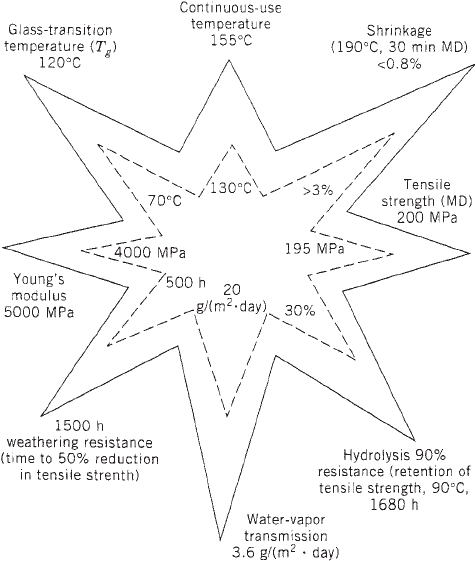
is its barrier properties. Teonex is the world’s first PEN
film developed by Teijin DuPont films. Compared to PET,
PEN provides approximately five times the barrier for
carbon dioxide, oxygen, or water-vapor transmission (see
Figure 7). PEN also provides superior performance at
higher temperatures when compared to PET. When used
as a resin for rigid-container packaging, PEN allows them
to be hot-fillable and both returnable and rewashable. As a
film, PEN provides 25% greater stiffness, allowing thinner
designs and greater barriers simultaneously (4).
BIBLIOGRAPHY
J. Newton, ‘‘Film, Oriented Polyester’’ in A. J. Brody and K. S.
Marsh, eds., The Wiley Encyclopedia of Packaging, 2nd edition,
John Wiley & Sons, New York, 1997, pp. 408–415.
Cited Publications
1. J. G. Brennan and B. P. F. Day, ‘‘Packaging’’ in J. G. Brennan,
ed., Food Processing Handbook, Wiley-VCH, Weinheim, 2006.
2. M. J. Kirwan and J. W. Strawbridge, ‘‘Plastics in Food Packa-
ging’’ in R. Coles, D. McDowell, and M. J. Kirwan, eds., Food
Packaging Technology, Blackwell Publishing, Oxford, 2003.
3. ‘‘Mylar Film and Polyester Film’’ Grafix Plastics, www.
grafixplastics.com/mylar, accessed October 2008.
4. Teonex, product outline, Teijin DuPont Films, www.
teijindupontfilms.jp, accessed October 2008.
FILM, ORIENTED POLYPROPYLENE
ELDRIDGE MOUNT
EMMOUNT Technologies,
Fairport, New York
Oriented polypropylene film was made commercially for
the first time by Montecatini of Italy in the late 1950s.
Shortly after Imperial Chemical Industries (ICI) of the
United Kingdom entered into OPP film production, Kor-
dite (the predecessor of ExxonMobil’s Commercial Films
Division), Hercules, Olin, and DuPont started production
in the early 1960s. Through the mid-1980s, OPP manu-
facturing equipment was engineered using in house ex-
pertise at the first 10–20 OPP manufacturers, but today
orientation equipment suppliers supply the engineering
expertise supplying turnkey lines around the world as the
demand for OPP films continues to grow. Orienting lines
are typically 6–8 M in width with 4–10 M lines in opera-
tion. Line speeds range from a low of 200 M/min (for older
machines), to 500 M/min (for a modern orienter).
In 2000, world demand stood at about 2,801,000 tonnes
and was in balance with annual capacity followed by a 5-
year period of excess capacity which is just now coming
back into balance with capacity at a world-wide demand of
approximately 5,000,000 tonnes (1, 2). Market growth of
approximately 5–6% is expected for the next 10 years with
world–wide capacity growing to approximately 9,000,000
tonnes by the year 2015. This assumes the continued
shutdown of older slower and narrower lines which are
rapidly becoming obsolete based upon their economics as
well as aspects of their machine design. Growth of OPP
markets is driven by technological product innovations,
geographic expansion, and population growth as the per
capita consumption of OPP increases with economic de-
velopment. In the last 10 years, capacity growth has been
primarily in the Far Eastern markets (China and India) as
well as in Latin America and Central and Eastern Europe.
Production capacity has been decreasing in North Amer-
ica, Japan, and, to a small extent, Western Europe. Also, a
great deal of consolidation has been taking place in the
market, with several manufacturers being absorbed by
other companies.
As of 2007, there were reported to be 195 producers and
516 orienting machines (2).
Figure 7. PEN films.
FILM, ORIENTED POLYPROPYLENE 477