
Yam, Kit L. (ed.). The Wiley encyclopedia of packaging technology
Подождите немного. Документ загружается.

Treofan is a large multinational OPP manufacturer
with offices in the United States, England, and Europe;
manufacturing operations are located in Mexico, Ger-
many, Belgium, Italy, and South Africa.
The three largest producers in North America are:
. ExxonMobil, with plants in the United States, Ca-
nada, Belgium, Netherlands, and Italy
. A. E. T. (Applied Extrusion Technologies, Inc.), with
three North American plants
. Amtopp
Other North American manufacturers include: Vifan,
Toray America, 3 M, BIAX Int. (Canada), B.C.F. (Bemis-
Curwood Films), Intertape Polymer, General Electric, and
Steiner Films.
The two largest manufacturers in South and Central
America are VITOPEL (Votorantin) in Brazil and Biofilm
in Colombia and Mexico, with more than 10 other produ-
cers (Treofan, Sigdopack, Polo Films, OppFilm, Bopp
Ecuador, Teleplastic, Agusa, Altopro, and Masterpack).
In Europe, ExxonMobil Plastics Ltd. and Innovia Films
Ltd. are the largest producers, and consolidation of many
of the original manufacturing companies continues in
Europe. Other producers are: Dor Films, Treofan, Vifan,
BOLLORE
´
, Manuli, Polinas, Bimo, Radici, Derprosa, and
about 12 other, smaller producers spread from Finland to
the old Eastern Block countries to Greece to Spain.
In the Far East there has been a large growth of OPP
capacity over the last 10 years, with large increases in
capacity in China and India. Japanese capacity has de-
creased as older capacity is shut down and replaced with
imported materials. A number of other producers are
located in Taiwan, South Korea, Indonesia, Malaysia,
Turkey, Egypt, India, and Israel.
RAW MATERIALS
The four resin categories used for OPP films are: homo-
polymer, copolymer, terpolymer, and modified resins (see
Polypropylene). Homopolymer resins are made by polymer-
izing propylene monomer with a variety of catalyst. Copo-
lymers incorporate 0.1–15% ethylene as a comonomer with
propylene. The amount of comonomer used depends on the
film’s end use. Terpolymer production uses butene along
with the ethylene and propylene feeds. Polypropylene
homopolymer resins are also modified with terpenes to
give them certain heat sealing properties (see Sealing,
Heat) and to improve moisture barrier and film production.
The homopolymer PP, is typically isotactic PP, and ad-
vances in molecular architecture control has permitted
improvements in film properties and productivity. Due to
advanced catalyst technology, syndiotactic PP, is now avail-
able and has been used in OPP shrink film production (3)
but has not resulted in any broad change in OPP film.
MANUFACTURING PROCESS
When a film is biaxially oriented, it is mechanically
stretched in the solid state (at a temperature below its
melting point), in perpendicular directions. This aligns the
film’s molecules in the transverse machine direction (TD)
and in the machine direction (MD). Once biaxial orienta-
tion has taken place, the film exhibits a marked improve-
ment in optical properties: mechanical strength, moisture
barrier, and low temperature durability over cast poly-
propylene film (see Film, Non-oriented Polypropylene).
The increase in strength allows OPP film to be made as
thin as 0.45 mils (11 mm) and still function as a laminating
substrate for packaging applications (see Laminating;
Multi-layer Flexible Packaging). Films as thin as 0.25
mils (6 mm) are routinely used for capacitors and under
special conditions films as thin as 0.04 mil (1 mm) can be
made. Balanced orientation is obtained when the degree of
orientation, as expressed by the film’s tensile strength, is
approximately equal in each principal orientation direc-
tion. There are two different methods of orienting OPP
film. They are called the ‘‘double bubble tubular’’ and
‘‘tenter frame’’. While both processes were in completion
in the early stages of OPP technology, today the Tenter
frame process dominates world-wide production of OPP
films.
Double Bubble Tubular Process
In this process, molten polypropylene resin is extruded
through a circular die (see Extrusion) and is water-
quenched to control the polymer morphology of the tube
and the tube is collapsed by a pair of nip rolls. At this
point, the quenched tube is relatively thick (e.g., 1000 mm
for a 25-mm finished film) and capacity of the bubble line is
generally controlled by quenching rate of the tube. Next
the tube is transported to the reheating section, where it is
reheated by circular radiant heaters to it orientation
temperature which is above the polymer’s T
g
(see Polymer
Properties) and below the melting temperature. Air is
injected into the tube after the first nip and held captive
by a second nip, and the increased air pressure forms an
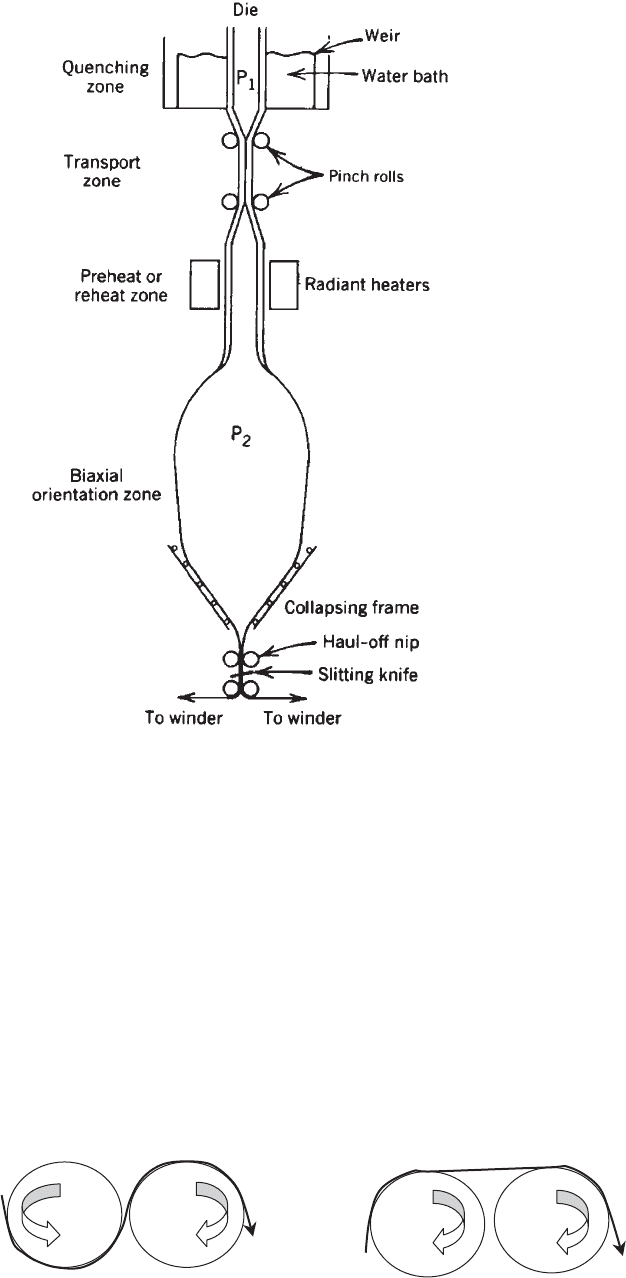
expanded bubble between the nips (see Figure 1). At the
same time the bubble is expanded, the bubble is pulled by
the second nip at a speed faster than it is fed by the first
nip. The size of the bubble’s circumference controls the
amount of transverse (TD) orientation and the speed
differential between the first and second nips controls
the degree of machine direction (MD) orientation.
After orientation, the film bubble is collapsed at the
second nip and is either wound up as a heat shrinkable
film or is reinflated and annealed for use as a stabilized,
heat-set packaging film (4). Heat stabilization in the
double bubble process is accomplished by one of several
methods. In the ‘‘third bubble’’ approach (5), the oriented
bubble is reinflated while the film’s temperature is ele-
vated to a point chosen for the required level of stability,
but below the orientation temperature, and then is cooled.
Alternatively, the collapsed bubble is passed over a series
of heated rollers (6), raising the film’s temperature as
outlined above, and then quenched on cold rolls. In other
cases the film has been held by clips and reheated in a
tenter oven with parallel chains as described below (7).
In all heat stabilization methods, the film is mechani-
cally restrained from shrinking back in the machine
478 FILM, ORIENTED POLYPROPYLENE
direction (MD). The amount of restraint in the transverse
direction (TD) varies from no restraint or 1–3% percent
width relaxation, down to essentially no restraint. This
heat treatment relaxes most of the high internal stresses
and tensions built up in the film during orientation
and provide a functionally stabilized product. However,
most double bubble films will be less dimensionally stable
than a film produced on a tenter frame, and in some
instances (e.g., tobacco over wrapping films) this can be
an advantage.
In the bubble-orientation process, after heat stabiliza-
tion the sides of the collapsed bubble are slit and the film
is wound simultaneously into two mill rolls. During this
winding operation the film is frequently corona treated
(see Surface Modification). This surface treatment con-
sists of a controlled electron and ion bombardment. The
film is slightly oxidized (3–8% oxygen incorporation),
thereby increasing its surface free energy, which produces
a multitude of sites that are chemically attracted to the
polymers used in off-line coatings, printing inks, and
laminating bonding-agents such as adhesives and poly-
olefin extrudate.
Tenter Frame Process
In this process, polypropylene resin is extruded out of a
horizontal flat die, sometimes called a slot die. The
extrudate is quickly cooled by a chilled roll, and a chilled
roll is immersed in a water bath or in a cold water bath.
Today the majority of lines use a chilled roll immersed
in a water bath. The quenching produces a sheet of
controlled morphology approximately 1000 mm thick (for
a 25-mm film). This heavy sheet is then reheated in contact
with heated rollers to its orientation temperature (above
the polymer’s T
g
but below its melting point). After
reheating, it is first oriented in the MD. The first mechan-
ical stretching is accomplished by drawing the sheet
between a set of two, closely spaced, rollers, with one
roller rotating faster (e.g., the fast roll) than the preceding
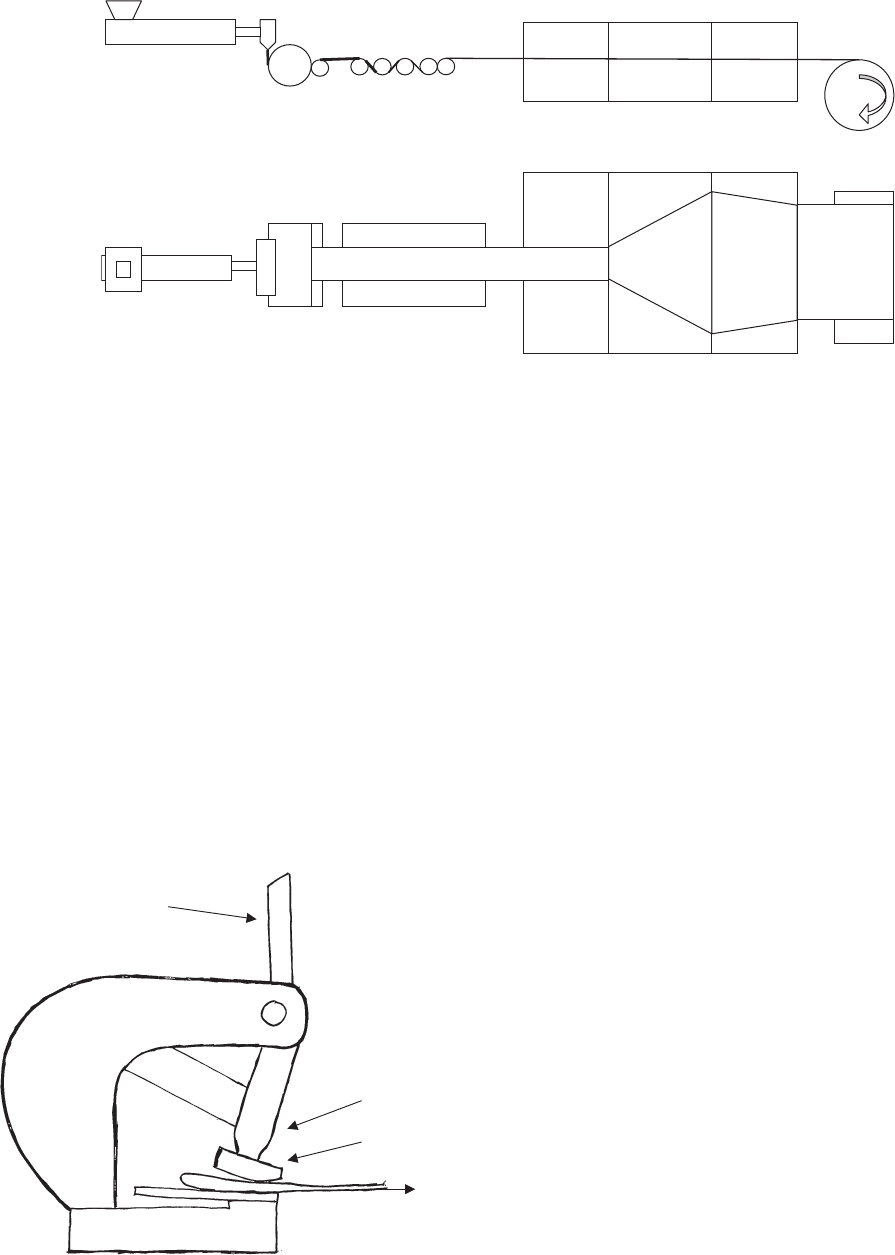
roller (the slow roll) (Figure 2). On some lines a number of
faster and slower roll sets are used, stretching and thin-
ning the sheet in two or more sequential steps.
The next step is TD orientation, which is done in a
‘‘tenter frame.’’ The tenter frame has two closely spaced
endless chains with film holding clips which diverge
apart to give a wider spacing at the end of the tenter
(see Figure 3). The MD-stretched film enters the smaller
open end and is gripped securely by its sides with spring-
loaded mechanical clips (Figure 4). The clips are mounted
on moving chains that run along lubricated tracks on each
side of the frames. As the chains move forward and out-
ward along these tracks, the film is stretched in the TD.
Evolutions in clip design have greatly improved the
manufacturing capabilities of orienting equipment and
the subsequent increases in film speeds.
To achieve good heat stabilization, the film, still se-
curely held by the clips, moves on into a heat-setting
(annealing) oven section. In this section, the clip/chain
systems at each side of the film have passed out of the
diverging TD stretching section into a section of the tenter
in which the chains run parallel to each other. Here the
film is subjected to elevated temperatures for a few
seconds while it is completely restrained in both direc-
tions. In some instances the TD stability can be improved
by decreasing the width of the film, by bringing the chains
S-wrap MD Stretching Stretching Roll to Roll
V
1
V
2
V
1
V
2
V
1
< V
2
Figure 2. Schematic diagram of the machine
direction orientation.
Figure 1. Schematic diagram of double bubble process.
FILM, ORIENTED POLYPROPYLENE 479
1–4% closer together during the annealing process. The
film is then cooled, released from the clips, has the thicker,
unstretched portion under the clips removed, is generally
corona- or flame-treated, and finally is wound up into mill
rolls. Most modern OPP Tenter lines wind a roll the full
width of the orienter, but some tenter frame users split the
full width film into two roughly equal-sized mill rolls by
slitting in-line (see Slitting and Rewinding) for subse-
quent use in film coating or metallization equipment.
Following orientation and stabilization, regardless of
the process used, the freshly produced rolls are usually
stored on racks for several days. During this time, remain-
ing internal tensions are relaxed and a higher degree of
crystallinity develops from secondary crystallization in
the film. Additives included in the resin, such as those
needed for slip, are also given time to bloom to the surface
(see Additives, Plastics). After the proper time interval,
the OPP film is ready for further processing in an off line
coating and/or a finished slitting operation.
In some instances an additional MD stretching unit
has been added after the TD oven to induce an additional
MD stretch to the biaxially oriented film. This is done
to increase the MD shrinkage of the film to make it
suitable for heat-shrinkable labels and may be done inline
on the film orienting equipment (8) or out of line during
slitting (9).
In the early days of OPP film production when outputs
were relatively low, double bubble lines were 120 in.
(3.05-m) in circumference and tenter frames were 120 in.
(3.05-m) wide. Over the years, larger lines have been
engineered for both processes . At one time, 24 0-in. (6.1-m)
circumference double bubble lines were in operation in
Europe, but due to their low speeds and outputs, the
majority of production capacity installed since the mid-
1980s has been high-speed 6.1-m-to 10.0-m-wide tenter
frame lines. Today the ‘‘standard’’ tenter line is 8.2 m and
produces film at greater than 500 m/min. This movement to
a much wider (and faster) line has greatly increased the
OPP film producers’ productivity and has also significantly
reduced the generation of narrow side rolls in slitting
operations as film converting (e.g ., coating, metallizing,
printing, and laminating) equipment, has also increased
in width. Both factors have contributed to OPP film’s
reputation of being the most economical of all highly
engineered, high-performance flexible packaging materials.
OPP FILM PROPERTIES
The very low density of polypropylene (0.905 g/cm
3
) allows
OPP film to have the greatest area-coverage yield per unit
of weight of any commercially significant thermoplastic or
cellulose-based sheet. Only cavitated opaque films can
have a lower density (e.g., 0.6 g/cm
3
) than clear OPP.
This high area yield and ability to be made into very
thin films are important contributions to its overall favor-
able economics, because the film is sold by the kilogram
Casting MD Stretching
Preheat TD stretching Annealing
Extruding
Winding
Stretching Oven
Figure 3. Schematic diagram of sequential biaxial film orienter.
Film
Closing
Spring
Gripping arm
Gripping foot
Opening Arm
Clip Body
Base attachment point to Chain
Figure 4. Side view of early style film stretching clip.
480 FILM, ORIENTED POLYPROPYLENE
but used by the square meter, which give it the lowest cost/
coverage area of comparable thickness films.
Thermal Properties
OPP films are intermediate in their temperature resis-
tance as compared to other polymer films. With a melting
point of 1651C, polypropylene films are more temperature-
resistant than polyethylene films but less resistant than
polyester films.
Normally, a heat-set OPP film can withstand brief
contact (0.5 to 1 s) with sealing mechanisms that are
1491C (3001F), or slightly above that, without significant
distortion in the seal areas (10). Sealing mechanisms
above this temperature are possible with reduced resi-
dence time (o0.5 s) but do create progressively greater
distortion potential until at about 1541C (typical orienta-
tion temperature) the film attempts to return to its
unoriented dimensions, leaving the heated portions of
the seal severely distorted. Because of this thermal
shrinkage at higher temperatures, OPP film’s sealing
range has an upper limit of 149–1521C (300–3051F).
When subjected to elevated air temperatures for sev-
eral minutes, heat-set OPP film will display a range of
dimensional changes, depending on the temperature to
which they are exposed. Below 751C, OPP film shows very
little or no shrinkage at extended heating times, and a
package wrapped in this material maintains its dimen-
sional integrity at normal packaging and distribution
temperature histories. At a temperature of approximately
1051C the film will show 1–2% MD shrinkage and perhaps
a TD width change of 0.5% shrinkage to 0.5% growth
within 7 min. However, at 1351C and 7 min, the film will
shrink approximately 3–5% in the MD and 2–3% in the
TD. The actual dimensional change values and shrinkage
versus. temperature profile will depend upon the manu-
facturing methods used to produce the film. Consequently,
heat-set OPP films will show some shrinkage if they are
exposed to very hot environments such as is found in
retort packaging (2501F (1211C) at 15 psi 103 kPa)), and
care should be exercised when choosing OPP for high-
temperature applications.
In some cases OPP films are made purposely unstable
so that they may be used for heat shrink films. These are
used in two principal markets today, namely, shrink over-
wrap films and roll-on shrink on bottle labels. For shrink
overwrap, at 1351C the film may shrink 35–50% in both
the MD and TD directions while for shrink labels the films
are designed to shrink uniaxially from 8–25% in the MD
with 0% TD shrinkage.
Physical Properties
There are relatively few physical property differences
between films made by the two processes (see Table 1).
Both films possess excellent moisture-barrier properties
but poor oxygen and aroma barriers. Moisture barrier
increases and decreases proportionately with the thick-
ness of the film under consideration. Tensile strength and
elongation of blown films tends to be about the same in
both directions (balanced). TD strength is higher than MD
strength in tenter-frame films, and MD elongation is
higher than TD elongation (unbalanced). Tenter-frame
film has generally superior heat stability over blown film
because of more severe annealing conditions that can be
practiced in the tenter-frame operation. Double bubble
OPP films have somewhat better impact strength. How-
ever, only in the most demanding and arduous packaging
applications would these relatively small differences be-
come significant.
Optical Properties
Standard OPP films are naturally high-clarity and high-
gloss films offering excellent printing graphics product
visual identification. However, many OPP suppliers also
offer clear films with a low-gloss, matte surface, to aid in
product graphic appeal and differentiation. Opaque, white
films with 20–30% light transmission are also widely
available as are metallized films with 1% or less light
transmission and high reflectivity for light-sensitive
products.
PRODUCT DEVELOPMENTS AND COEXTRUSION TO
SEVEN LAYERS
The first two OPP films produced were single-layer homo-
polymer shrink film and heat-stabilized film that could not
be heat-sealed. The former had limited application be-
cause of its need for hot-wire sealing and tremendous
shrink energy, which originally precluded it from wrap-
ping high profile products. The development of copolymers
allowed the widespread development of propylene shrink
films which today have replaced much of the original PVC
shrink films and compete strongly with crosslinked poly-
ethylene
shrink films.
Additionally, the development of
special polymeric coatings and polypropylene copolymers
and terpolymers during the 1960s, 1970s and 1980s
respectively, has alleviated the lack of sealability problem
in many applications.
The original heat-set OPP film gained wide acceptance
as a laminating substrate when combined with heat-
sealing polymer-coated cellophanes (see Cellophane) and
glassine papers (see Glassine). The OPP film contributed
strength, moisture barrier, and high surface gloss to the
lamination. However, before acceptance was forthcoming
from the marketplace, OPP film producers had to improve
the film’s slip characteristics over the relatively high
coefficient of friction (COF) that is natural to the film
and improve the low surface wetability. The addition of
internal surface-blooming slip agents reduces the film-to-
film COF to 0.2–0.4. This COF provides excellent machi-
neability on automatic bag-forming machinery used in the
snack food and candy industries, while surface oxidation
improved wettability. Converters developed the hot-melt
adhesive-based, heat-sealing thermal stripe that allowed
the production of lap back seals on vertical form/fill/seal
machines (see Form/Fill/Seal, Vertical). This technology
widened the use of OPP film laminations for snack foods,
candy, and pasta products. Today the use of three-layer
coextruded films permits the direct formation of lap seals
without the need for thermal strip technology. Another
FILM, ORIENTED POLYPROPYLENE 481

Table 1. Properties of Oriented Polypropylene
Films, 1 mil (25.4
l
m)
Typical Film Properties ASTM Test
Blown OPP
Film
Tenter-Frame
OPP Film
Slip-Modified
Film
Acrylic-Coated
Film
PVDC-Coated
Film
Coextruded
Film
White
Opaque
Film
Metallized
Film
Specific gravity
D 1505 0.905
0.905
0.905
Yield, in.
2
/(lb mil)
[m
2
/g m)
30,600
30,600
30,600
27,300
30,600 48,000
[1714]
[1714]
[1714]
[1529]
[1714] [2688]
Haze, %
D 1003
3.0
3.0
3.0
3.0
3.0
3.0
Light transmission, %
50–60
Tear strength, gf/mil
(N/mm), propagating
D 1922
4–6
4–6
4–6
4–6
(1.5–2.3) (1.5–2.3) (1.5–2.3)
(1.5–2.3)
Service temperature,
1F(
1C), range
70(39)
50(28)
40–110
(22–61)
Heat seal temperature,
1F(1C), range
230–300 25–300 190–300
(110–149) (121–149) (88–149)
Oxygen permeability,
cm
3
mil/(100
in.
2
d atm) [cm
3
mm/
(m
2
d kPa)];
D1434
771F (23
1C), 0% rh
160
160
160
150
1–3
160
160
4–18
[622]
[622]
[622]
[583]
[4–12]
[622]
[622] (16–70)
4–6
771F (23
1C), 50% rh
[16–23]
Water vapor
transmission rate
(WVTR) g
mil/100
in.
2
d) [g
mm/(m
2
d)];
0.25
0.30
0.30
0.30
0.30
0.30
0.60 0.1–0.3
[0.1]
[0.12]
[0.12]
[0.12]
[0.12]
[0.12]
[0.24] [0.04–0.12]
1001F (38
1C), 90% rh D1894
0.2–0.4
0.25
0.2–0.4
0.2–0.4
COF, face-to-face back-
to-back
0.4
0.4
0.2–0.4
0.25
0.2–0.4
0.2–0.4
Test conditions, 73
1F
(23 1C), 50% rh
482
application for this non-heat-sealing film is the inner liner
of paper bags for products such as cookies and pet foods.
Since this early beginning, the history of OPP product
development of has been the creation of improved barrier
technologies and the development of surfaces with special
attributes to permit the use of the base sheets barrier
properties in packaging and industrial applications. The
primary protection that OPP inherently supplies is that of
a moisture barrier. Additional barriers have been added
during the development of new products such as oxygen,
barriers, aroma (chemical) barriers, and light barriers.
However, it is the moisture barrier property, combined
with the unusually low polymer density, which results in
the maximum possible product coverage with one of the
lowest moisture permeabilities for clear films. When these
two features are combined with special surface attributes
such as sealability, printability, laminatability, coatability,
metallizability, and machineability, a high-quality, low-
cost packaging film emerged which replaced almost all of
the cellophane then in use in snack food packaging. In
addition to cellophane replacement, OPP has made
further inroads into glassine paper and some foil markets
as well. Today this combination of properties still drives
the expansion of OPP films into new packaging applica-
tions and developing markets.
In order to reach this point, several weaknesses of OPP
film relative to packaging in general and cellophane in
particular had to be addressed. The inherent limitations
to homopolymer OPP film are: no sealability, high COF
surfaces, low surface wettability, static generation, and a
lower use temperature range than cellophane.
In order to overcome these weaknesses in the product,
both film and packaging machine changes were required.
The temperature limitations were overcome by improve-
ments in packaging machine design and temperature
control of sealing jaws as well as the use of special acrylic
and PVDC polymer coatings and the use of low-melting
copolymers and terpolymers as film sealing surfaces. To-
day the machine evolution is complete and packaging
machines are designed with OPP film as a primary
wrap. Static generation occurs at all surfaces and, due to
the high dielectric strength of OPP, must be eliminated at
each point where static interferes with packaging ma-
chine performance. Product formulation approaches have
been hampered due to a lack of Food and Drug Adminis-
tration FDA-approved additives and the relatively high
additive levels that would be required. Surface wettability
is overcome by coating with acrylic polymers; for uncoated
films, it is overcome by the surface oxidation of the film
with corona, flame, or atmospheric plasma treatment on
the film orienter and perhaps at subsequent converting
steps. The development of multilayer coextrusion systems
has also permitted the incorporation of non-propylene
skins to be used, such as EVOH and nylon, which has
further broadened to the range of product developments.
The development of low COF surface modifications has
relied almost exclusively on film formulation develop-
ments and has seen many developments over the years.
The original surface modification for COF was a formu-
lated acrylic coating that combined excellent printability,
low COF, and broad sealability. The second development
was the use of fatty acid amides that when added to the
polypropylene, would diffuse to the film surface (called slip
bloom) with time and heat treatment after film orienta-
tion. While this lowered film COF, it is difficult to control
and the additive often interferes with printing ink adhe-
sion, metallization, and lamination bonds. Today this slip
blooming technology has been replaced by the use of
mineral and polymeric particles that are dispersed in
the film surface layers as well as the use of silicone oils
for higher temperature applications. This gives a film
COF’s of 0.25–0.5. While these COF values appear high
by the original standards, the films all exhibit a low but
uniform force to transport the film over the forming collar
and through packaging machines. It is this low film
transport force which is the critical property for proper
machineability and not the film-to-film COF.
Today, OPP film has found wide acceptance and con-
tinues to grow as new markets are developed making use
of its special product characteristics. Many of the technol-
ogies developed to permit the use of OPP have gone
through several developmental generations as new resin
and additive technologies were invented to overcome the
limitations of the first generation film modifications. To-
day, developments in polymer metallocene catalysis con-
tinues, thereby generating new propylene resins such as
high-crystallinity polypropylene and syndiotactic polypro-
pylene. How these new development and resins will im-
pact future growth in OPP packaging and new film
modification technologies is currently unclear.
SEALABILITY
The quest for functionality through heat-sealing on con-
ventional sealing mechanisms used on most packaging
machines let OPP film producers down four avenues of
development. The first was the modified polymer route.
This film uses a polypropylene that is modified with
natural and synthetic terpene resins. The film is heat-
sealable, although its sealing range is relatively narrow
(251ForB141C), and it does not have good hot-tack-seal
strengths needed for form/fill/seal packaging. In over-
wrapping applications where the product to be packaged
is contained in a carton or some other self-supporting
structure, this OPP film has found good acceptance.
Because this film is only partially heat-stabilized, it can
be
snugly tightened around
the carton or bundle through
the use of a heat tunnel. One version is used today as a
cigarette-packaging material. However, this technology
has largely been supplanted by surface sealability
modifications.
The second method of imparting sealability to OPP film
is by addition of an offline heat-sealable coating based on
an acrylic polymer (see Acrylics). This coating adds flavor
and aroma barrier, but no moisture or oxygen barrier
properties to the OPP film. However, it does provide a
relatively wide sealing range of 801ForB451C and adds
sparkle and good machine slip characteristics. It has a
film-to-film COF of 0.2–0.3. It has high-volume use in
horizontal form/fill/seal operations (see Form/Fill/Seal,
Horizontal) for items such as baked foods (cookies in
FILM, ORIENTED POLYPROPYLENE 483
particular) and candy. As an overwrap film, it is used for
pet foods and various tobacco products such as cigarettes,
cigars, and pipe-tobacco cartons. Its hot-tack and seal-
strength characteristics are such that it is used exten-
sively for VFFS packaging of lightweight products, such as
snack foods, but is not generally proposed for similar
packaging of heavy products. These acrylic coatings are
compatible with many inks (see Inks) and adhesives (see
Adhesives) used by converters and are also heat-sealable
with the PVDC coatings used on cellophane, glassine, and
other OPP films (see Vinylidene Chloride Copolymers).
The third method to obtain heat sealability is to coat
the OPP film offline with a PVDC coating, which also
overcomes the gas-barrier deficiency. This is required
because oriented polypropylene film in its uncoated form
is not considered to be a gas-barrier film (see Table 1). Its
oxygen permeability is relatively high at 731F (231C) using
1.00-mil (25.4-mm)- thick film (see Table 1). PVCD-coated
films fall into four categories. The first is readily machine-
able on heat-sealing, automatic packaging equipment. The
sealing range in this case is relatively wide (60–801For
33–451C), and the oxygen-transmission rate is improved
(see Table 1). These films are available with one or two
sides coated. The former is a laminating substrate for use
with other OPP films and cellulosic materials, to package
snack foods and candies. The two-side-coated product is
used in unsupported form for bags and carton overwraps.
In all of these applications, an aroma barrier (which the
PVdC supplies) is generally desired by the end-user.
The second category of PVDC-coated OPP film has a
superior gas barrier and an oxygen-transmission rate of
8–12 cm
2
/(m
2
d). However, because its sealing range is no
more than 501F (281C), this film is not used for its heat
sealability. Rather it is used as a laminating substrate
with various other materials for the controlled atmo-
sphere packaging of coffee, natural cheese, and processed
meats (see Controlled Atmosphere Packaging).
The third category combines an acrylic coating on one
side and a PVDC coating on the other side. The advantage
cited for this film is that it provides a degree of gas and
improved aroma barrier, is lap sealable, machines well,
and costs somewhat less that two-sided, heat-sealable,
PVDC-coated OPP films.
The fourth category of PVDC-coated films is the combi-
nation of the high-barrier PVDC coating with a broad-
seal-range, coextruded sealant skin. This film is used as a
laminating film with the high-barrier PVDC buried in the
structure and makes use of the excellent seal properties of
the coextruded skins (see below).
The fourth avenue of development of heat sealability of
OPP films is through coextrusion. Although coextruded,
multi-ply, heat-sealing OPP films have been available
since 1955; this type of film came into large-volume usage
during the late 1970s and early 1980s. This was in large
part due to the development of ethylene propylene copo-
lymers (EP copolymer) and later by ethylene, butylene
propylene terpolymers (EBP terpolymer), resins, and ad-
vances in the technology of coextrusion die design. Coex-
trusions are made using several basic approaches. In one
approach, two or more extruders feed their individual
molten polymer streams to a single manifold extrusion
die (see Coextrusion, Flat; Coextrusion, Tubular). In the
upstream section of the die is a round or rectangular ‘‘feed
block’’ mechanism that brings these polymer flows to-
gether into layers before passing them to the single cavity
(manifold) where they are deformed into a single wide,
thin rectangular sheet as it passes out of the die lips.
Another method is termed ‘‘tandem’’ coextrusion. With
this procedure the film’s core material is extruded from its
own extruder and die. This extrudate is then extrusion-
coated (see Extrusion Coating) from one or more extruders
and dies, or it is hot-nip laminated to other compatible,
independently manufactured films. In recent years this
‘‘tandem’’ coextrusion has been largely replaced with
multi-manifold coextrusion technology. In this OPP tech-
nology, generally three separate die manifolds are con-
tained together in the same die body. As the polymer flows
toward the die exit, the separate layers are combined
together in layers and then exit the die lips together.
This technology has permitted the combination of resins
that cannot be coextruded by the feed block method or
‘‘tandem’’ methods describe above. More recent develop-
ments have combined the feed block with the multi-
manifold dies to produce five and more layers in a single
sheet. In all coextrusion cases the multilayered sheets are
moved into the orientation units of the line. Coextrusions
can be made by both the blown bubble and tenter frame
processes.
Polypropylene does not anchor well to many other
polymers. As a result, great care must be taken in the
choice of materials used in OPP film coextrusions; other-
wise inter-ply bonds may be broken during orientation or,
later, by the stresses of package forming techniques and
distribution. Other demands on outer ply materials in-
clude hot-slip characteristics that allow easy film move-
ment over hot-packaging machine parts and surface-slip
characteristics for good overall trouble-free automatic
high-speed machining. The ply destined to be printed or
laminated must also be corona- or flame-treated.
Today, most coextruded OPP films consist of two to five
layers. The majority of the film’s mass is in the core ply
that is usually made with virgin homopolymer and some
regrind. One or both sides of the core may be covered with
a polypropylene-rich copolymer or terpolymer, an ionomer
(see Ionomers), or a vinyl acetate-modified polyethylene
layer. The choice of polymer depends on the purpose for
which the finished film will be used. Polypropylene-rich
copolymers of propylene and ethylene are used for their
good hot-tack seal strengths and excellent finished seal
strengths. Terpolymers of propylene, ethylene, and butene
are used to improve the film’s breadth of sealing range,
and today’s terpolymers have been developed to give
excellent hot-tack strength as well. Vinyl acetate-modified
polyethylene plies are used for their anchoring potential
in offline coating, laminating, and metallizing operations
(see Metallizing). Ionomer resin is used for its wide sealing
range and ability to repel grease and oils. It is somewhat
difficult to handle in the orientation process; but once
oriented and heat stabilized, it provides lower level seal
strengths of about 300 g/in. (116 N/m) which can be used
advantageously in packages that demand an easy-open
feature. Ionomer-skinned films are not generally made by
484 FILM, ORIENTED POLYPROPYLENE

the tenter process due to its aggressive adhesion to hot
metal surfaces used in the process and are only produces
on bubble equipment. These films are therefore at risk of
disappearing as lower productivity bubble lines are shut
down in favor of higher productivity tenters.
Coextrusion sealing temperature ranges very greatly,
depending on the sealing ply materials. General cate-
gories are listed in Table 2.
Thin coextruded OPP films, 0.57–0.70 mil (14–18 mm)
thick, are often laminated to other substrates such as
polymer-coated cellophane, glassine, paper, and other
OPP films for snack food, candy, processed cheese, and
pasta-product packaging. In unsupported form they pack-
age lightweight products such as single-serving packages
of crackers used in restaurants.
Medium-weight films, 0.800.90 mil (20–30 mm) thick, are
used for carton and tray overwraps by the bakery and
candy industries, as well as for form/fill/seal single wall
pouches by pet food producers. A specially designed med-
ium weight material is used as a cigarette package over-
wrap. Heavy, thick coextruded OPP films, over 1.00mil
(25.4 mm) thick, are normally used in unsupported form to
package cookies, candies, snack foods in small bags, and
other products that need the stiffness, strength, excellent
moisture barrier, and rich feel offered by these films.
OPAQUE FILMS
White opaque film is one of the fastest growing OPP film
developments in the United States and Western Europe.
The most widely accepted film products of this type are
made by the tenter-frame process. Homopolymer resin is
evenly mixed with a small amount of foreign particulate
matter. In one product, when the thick filled sheet is
oriented, the polypropylene pulls away from each particle,
creating an air-filled void (closed cell). After heat stabili-
zation the OPP film is similar to a micropore foamed
product. In the second product, the material is produced
as a filled film without voids. The opacity is a direct result
of the amount of particulate material included in the film.
In the film with air-filled voids, the imparted opacity
and whiteness is created to a small degree by the encap-
sulated particulate matter. However, the primary opacifi-
cation is brought about by light rays bouncing off the
polypropylene cell walls and the air within each cell. The
refractive index of the air is less than for polypropylene.
This refraction difference results in TAPPI opacity of
about 55%. The light diffusion gives the film the visual
effect of pearlescence. Brightness values are calculated at
65–75% by the GE method. The actual gauges of this white
opaque film are deceptively thick when their area yield
per unit of weight is considered. A 1.5-mil (38-mm)-thick
cavitated OPP film has an area yield of 30,000 in.
2
/lb
(427 cm
2
/g), which is about the same yield provided by a
1.0-mil (25.4-mm)- thick transparent OPP film.
Coextrusion and out-of-line coating techniques have
greatly expanded the market acceptability of white opa-
que OPP film. By using these approaches to film manu-
facture, the film can be made one- or two-side heat-
sealable. These steps can also increase the film’s moisture,
oxygen, and aroma barrier. White opaque OPP films are
finding growing volumes in snack-food packaging, candy-
bar overwraps, beverage-bottle labels, soup wrappers, and
other applications that traditionally have used specialty
paper-based packaging materials. White opaque films are
also finding new applications such as photographic paper
and digital printing substrates.
METALLIZING
The use of OPP film as a metallizing substrate is another
area of new market growth (see Metallizing). In this
process, aluminum is vaporized onto one side of a film or
paper in a high-vacuum environment. The speed of the
substrate’s passage over the vaporization pots controls the
amount of metal deposited on the film. If the metallized
surface is to be used primarily for decorative purposes, a
relatively light coating of approximately 4 O
2
(1.6 optical
densities, OD) is applied. This gives OPP film, originally
in transparent form, a light-transmission rate of about
5%. If the metal coating is used for significant improve-
ment of the finished film’s barrier properties, a heavier
disposition of 2 O
2
(2.2 OD) is employed. This level lowers
light transmission to about 0.6%. Moisture and oxygen
barrier are improved dramatically (see Table 1). In packa-
ging, metallized OPP films are widely used in snack-food
laminations and for confectionery wraps.
Today further product design advances have been made
by coextruding non-polypropylene polymer surfaces, that,
when metallized, lower the moisture barrier properties of
the metallized film relative to metallized OPP and below
that of metallized polyester (PET) films while approaching
the oxygen barrier properties of metallized PET (11).
Further developments have produced developmental sam-
ples of metallized OPP that have moisture and oxygen
barriers significantly better than metallized PET and
approaching the properties of foil. This is accomplished
by the incorporation of non-polypropylene layers such as
PETG (12), nylon (13), HDPE (14), and EVOH (15) for the
metallized surface.
LABELS
This is a growth area for OPP films with cavitated and
clear films gaining wide acceptance in many labeling
applications. The broad label categories where OPP is
making inroads are inmold labels, roll-fed labels,
Table 2. Coextruded OPP Film Sealing Temperature
Ranges
OPP Film
Sealing Temperature
Range
Copolymer group A (0.5–e.0%) 30–501F (16–281C)
Ethylene copolymer group B (Z4%
ethylene)
60–701F (33–391C)
Terpolymers (ethylene and butane) 85–951F (47–531C)
Ionomer 95–1051F (53–581C)
FILM, ORIENTED POLYPROPYLENE 485
pressure-sensitive labels, roll-fed shrink labels, cut and
stack for hot melt, and wet glue. The OPP film functions as
a carrier for sophisticated coatings that give many of the
surface properties needed for the label applications.
BIBLIOGRAPHY
W. R. R. Park, ed., Plastics Film Technology, Plastics Applications
Series, Van Nostrand Reinhold Company, New York, 1969.
O. J. Sweeting, ed., The Science and Technology of Polymer Films,
Vol. I, Interscience Publishers, New York, 1968.
O. J. Sweeting, ed., The Science and Technology of Polymer Films,
Vol. II, Interscience Publishers, New York, 1968.
C. J. Benning, Plastic Films for Packaging; Technology, Applica-
tions and Process Economics, Technomic Publishing Co., Lan-
caster, PA, 1983.
T. Kanai, and G. Campbell, eds., Film Processing, Hanser/Gard-
ner Publications, Cincinnati, 1999, pp. 339–343.
K. R. Osborn, and W. A. Jenkins, Plastic Films Technology and
Packaging Applications, Technomic Publishing Company,
Lancaster, PA, 1992.
R. J. Samuels, Structured Polymer Properties: The Identification,
Interpretation, and Application of Crystalline Polymer Struc-
ture, Wiley-Interscience, New York, 1974.
M. Bakker, Ed., The Wiley Encyclopedia of Packaging Technology,
Ist edition, John Wiley & Sons, 1986.
Cited Publications
1. M. Gschwandtner, Proceedings of AMI BOPP Film, 2007.
2. W. Pinneger, Proceedings of AMI BOPP Film, 2007.
3. M, Amon, R. G. Peet, and S. J. Pellingra, Jr., U.S. Patent
6,113,996, ‘‘Composition for Uniaxially Heat Shrinkable
Biaxially Oriented polypropylene Film,’’ U.S. Patent and
Trademark Office, Washington, DC, 2000.
4. C. J. Benning, Plastic films for Packaging; Technology, Appli-
cations and Process Economics, Technomic Publishing Co.,
Lancaster, PA., 1983, p. 39.
5. G. M. Reade, U.S. Patent 3,814,785, ‘‘Heat Stabilization of
Oriented Thermoplastic Films,’’ U.S. Patent and Trademark
Office, Washington, DC, 1974.
6. M. Yazawa, U.S. Patent 3,632,733, ‘‘Heat Treating Two-Ply
Biaxially Oriented Films,’’ U.S. Patent and Trademark Office,
Washington, DC, 1972.
7. P. J. Barham, J. A. Odell, and F. M. Willmouth, European
Patent Application 0 023776 A1, 1981.
8. L. E. Keller, and M-F. Nothnagle, U.S. Patent 5,691,043,
‘‘Uniaxially Shrinkable Biaxially Oriented Polypropylene
Film and Its Method of Preparation,’’ U.S. Patent and Trade-
mark Office, Washington, DC, 1997.
9. W. J. Ristey, G. A. Senich, W. J. Hill, and H. S. Anderson, U.S.
Patent 5,851,610, ‘‘Shrink Films and Articles Including the
Same,’’ U.S. Patent and Trademark Office, Washington, DC,
1998.
10. http://www.oppfilms.com/Public_Files/OPPFilms/Oriented_
PP_;Films/NorthAmerica/Test_Method_Dimensional_
Stability.pdf
11. Eldridge, M. Mount III, John R. Wagner, ‘‘Aroma, Oxygen and
Moisture Barrier Behavior of Coated and Vacuum Coated
OPP Films for Packaging,’’ J. Plastic Film & Sheeting V17
(July), 2001, pp. 221–237.
12. E. M. Mount, A. J. Benedict, European Patent 444340;
‘‘Metallizable Heat-Sealable, Oriented Polypropylene Film
Has Layer of Co-polyester to Improve Bonding to Metal,’’
1991.
13. R. A. Migliorini, E. M. Mount III, U.S. Patent 5,591,520,
‘‘High Barrier Film’’, U.S. Patent and Trademark Office,
Washington, DC, 1997.
14. R. A. Migliorini, E.M. Mount III, U.S. Patent 5194,318,
‘‘Multilayer Film with Metallized Surface,’’ U.S. Patent and
Trademark Office, Washington, DC, 1993.
15. R. A. Migliorini, U.S. Patent 5,153,074, ‘‘Metallized Film
Combination,’’ U.S. Patent and Trademark Office, Washing-
ton, DC, 1992.
FILM, PERFORATED
NAZIR MIR
Perftech, Inc., Oswego,
Illinois
INTRODUCTION
There is a growing interest to use flexible polymeric films
with ‘‘improved’’ gas and water vapor transmission proper-
ties for horticultural packaging and other food and indus-
trial applications. Fresh produce is still respiring, taking in
oxygen and giving out carbon dioxide, and thus its packa-
ging requires polymeric films with selective oxygen and
carbon permeability matching the requirements of this
respiring product. The word ‘‘improved’’ in the first sentence
above means those films having suitable gas and water
vapor transmission properties to match the requirements of
the application. While high-barrier films (those with low
transmission rates) are usually used to protect shelf-stable
foods against oxygen and water vapor, those films are not
suitable for packaging fresh produce. Films with improved
gas and moisture transmission properties for fresh produce
are generally achieved by one or a combination of the
following: (a) selection of polymeric films, (b) addition of
fillers during film extrusion, and (c) perforations.
Improved films are constantly being developed to sa-
tisfy the needs of the marketplace. Some of those films
include high (6–18%) ethylene vinyl acetate content, low-
density polyethylene (Elvax) films by DuPont, oriented
polypropylene (OPP) laminates by BP Amoco, styrene
butadiene block copolymer (K-Resin) films by Phillips
Chemical, ultra-low-density ethylene octene copolymer
(Attane series) films by Dow, and polyolefin plastomer
octene copolymer (Affinity series) films by Dow (1).
Plastic films can also be incorporated with inert organic
fillers such as CaCO
3
and SiO
2
or organic minerals such as
zeolite. Such films may then be biaxially oriented to create
small perforations generally in the range of 0.14–1.4 mmin
diameter (2). The gas and vapor transmission properties of
these films can be manipulated by adjusting the particle
size of the filler and the degree of stretching.
486 FILM, PERFORATED
Ethylene manipulation is extremely important for stor-
ability of some horticultural crops. Some additives such as
zeolites may also confer ethylene adsorption properties to
the film. Ethylene adsorption capacity by zeolite may be
reduced markedly by the presence of water vapor. It has
been shown that the ethylene adsorption capacity of a
zeolite impregnated film was negligible at 100% RH
compared to its maximum capacity at 0% RH (3). Because
most horticultural packaging applications are at condi-
tions near water vapor saturation, the use of such films
has not yet had any major commercial success.
MANUFACTURING TECHNOLOGY OF PERFORATED
FILMS
Perforated films are plastic films that have holes drilled
through all the layers of the film. Depending on the size
of perforation, the film may be called microperforated
or macroperforated films. Microperforated films have
perforations in the range of 5–300 mm in diameter,
while macroperforated films have perforation exceeding
300 mm in diameter. Generally speaking, microperforated
films are largely used to increase the gas properties of
packages containing high-respiring produce such as broc-
coli, bananas, and leeks.
Currently, much marketing effort is focused on improv-
ing the presentation and utility of value-added fresh
produce products. As a result, the produce industry is
shifting more and more toward product offerings in trays
as opposed to traditional breathable bags. The most
commonly trays used are either polyester or polypropy-
lene, both of which are quite impermeable to the gas
exchange in the thicknesses used for these applications.
Thus, to account for the respiratory requirement of
the packaged product, the trays need to be lidded with a
highly gas-permeable membrane. This can conveniently
be achieved using microperforation technology while
keeping the sealabilty, machineability, ink adhesion, and
other properties unchanged during the process. Macro-
perforated films are largely used to increase the moisture
properties of films for packing whole produce (such
as tomato, pepper, banana) and cold and hot bakery
products.
There are several postmanufacturing technologies
available for perforating plastic films. These technologies
include (a) mechanical puncturing by cold needle, and (b)
plastic melting at directed spots by hot needles, flame,
low-energy electrical discharge, and high-energy electrical
discharge and lasers. The cold and hot needle technologies
and the flame technology are commonly used for macro-
perforation, while the electrical discharge and lasers
technologies are commonly used for microperforation.
The technologies for macroperforation have been avail-
able in the industry for a relatively long time. Electrical
discharge systems for microperforation of plastic films is a
mature technology. Although the perforations on plastic
films can be achieved reliably with electrical discharge
systems, most systems have certain film thickness limita-
tions beyond which it is almost impossible to achieve
perforation consistently.
Laser technologies for perforation of plastic films are
relatively new. Practically speaking, laser systems contain
three key elements: (1) a laser medium that generates the
laser light, (2) a power supply that delivers energy to the
laser medium in the form needed to excite it to emit laser
light, and (3) an optical cavity that concentrates the light
to stimulate the emission of laser radiation. Since the
introduction of laser systems for perforation of plastic
films to the marketplace, technological improvements in
all these three components have improved dramatically.
For instance, the systems have evolved from weak 20-W
power sources to 2-kW power sources, from split beam
technology to beam compression and recently to polygon
mirror directing, which ensures that the beam strength
stays constant throughout the laser exposure interval.
This function has remarkably increased the speed and
quality of the perforations on a number of plastic films.
Figure 1 illustrates such a system.
Perforation of plastic films is commonly achieved by
CO
2
laser systems. The laser energy generated through
such a system is absorbed by a plastic film in directed
spots. The film in those spots are heated, melted, and
eventually evaporated, leaving perforations in the film.
Although the principle of laser-drilled perforations is
common in all plastic films, there is a strong interaction
between the nature of the films and their laser absorption
characteristics. Some films may need a very small dose of
energy to melt, while for others it may be almost impos-
sible to drill holes under commercial requirements.
TRENDS
A new trend in flexible film business is to offer materials
as blends of two or three different polymers, in which each
polymer performs a specific function such as improving
strength, transparency, or gas transmission to meet spe-
cific product requirements. Laminated film structures are
also becoming common for a number of value-added fresh
produce applications. The structural complexity of these
new films imposes a number of challenges and, at times,
imposes restrictions on the successful application of lasers
on the perforation quality and frequency of these films.
The perforation quality is often measured by shape, size,
and aspect ratio. Depending on the shape of perforations,
the aspect ratio can be 1 or >1. The circular perforation
has an aspect ratio of 1; and as the shape of the perforation
deviates from the circularity, the aspect ratio begins to
increase. The oblong perforation has an aspect ratio of 1.2
to 1.4. The aspect ratio is defined as the length of the
perforation in machine direction divided by the length of
the perforation in transverse direction. It is either circular
or oblong.
The adhesives in laminated structures can also inter-
fere with the laser energy absorption process and may
dramatically reduce the speed of laser perforation process.
In some instances, the adhesive may serve as a strong sink
for the laser energy, thus making it impossible to drill a
hole through all layers of the laminate. Thus, it is con-
ceivable to think that the development of operating per-
foration procedures for films that vary in chemical
FILM, PERFORATED 487