
Yam, Kit L. (ed.). The Wiley encyclopedia of packaging technology
Подождите немного. Документ загружается.

Maintaining Consistent Stretch Levels
To measure the degree of stretch your film achieves, you
need only three tools: a stretch wheel, a tape measure, and
knowledge of a simple mathematical formula.
A stretch wheel is 10 in. in circumference, rotates on an
axis, and is held in place by a handle. Jutting out from this
wheel is an ink mark that makes a black mark every 10 in.
on a roll of unstretched stretch film when the wheel is
allowed to rotate freely against the film.
To measure exactly how much a sheet of film has
stretched, roll your wheel horizontally against the outer
layer of film while it is on the spindle of the machine.
Make sure that at least four black marks have been made.
Initiate the wrap cycle so that the film is stretched.
Measure the distance between the marks. (Note: Make
sure that you measure the marks that do not cross
corners, but are on the flat side of the pallet.)
Now, using your mathematical formula, subtract 10 in.
from your measured distance and multiply that difference
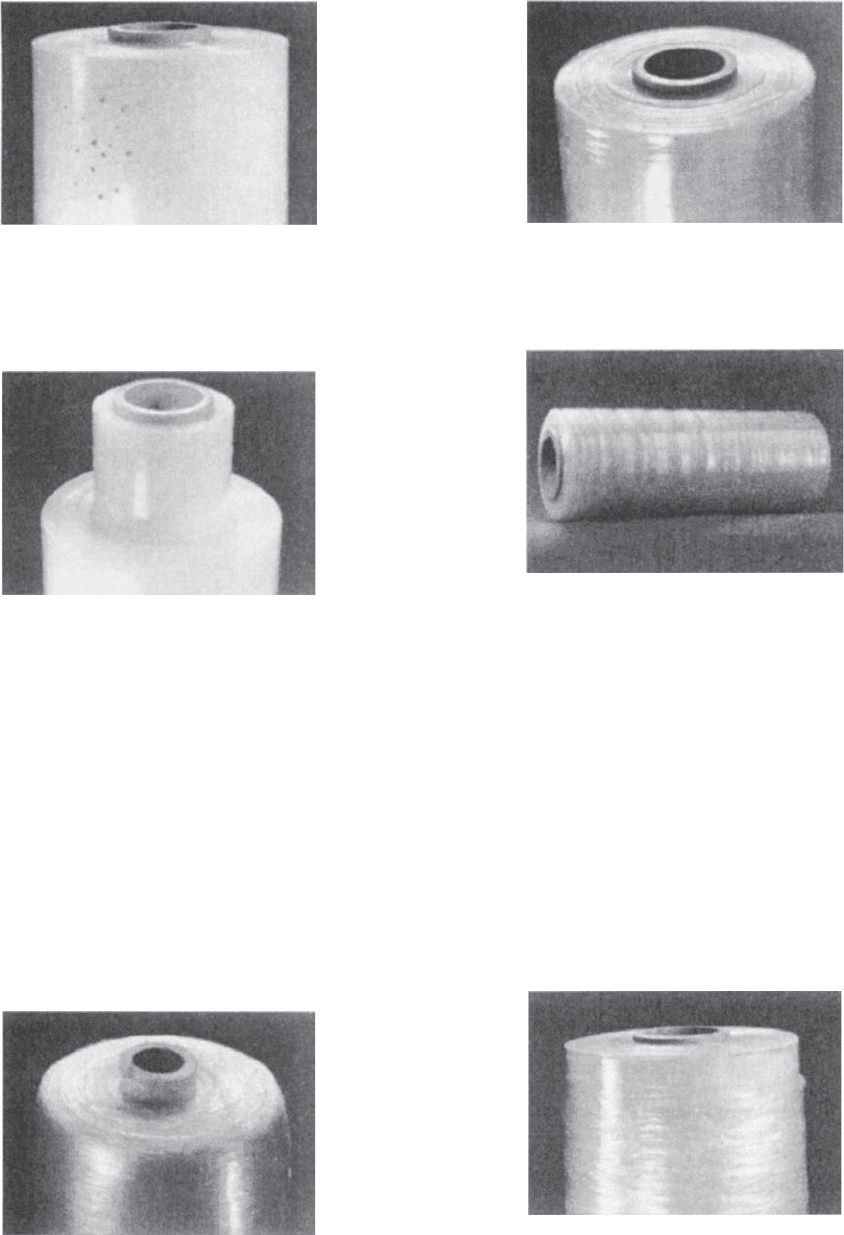
Figure 8. Black specks—degraded polymer or other film imper-
fections caused by a foreign material. Not a common problem.
Gives appearance of poor film quality.
Figure 9. Roll telescoping—the sliding of inner layers of the film
in a roll or the core out of a roll, increasing roll width and making
the roll unusable. This is typically caused by tackifier levels and
winding conditions.
Figure 10. Feathered edges—extension of a layer or layers of
film past the end of a film roll. Caused if the film wanders back
and forth during winding. If these loose edges fold over, they may
cause spiral tears during film unwinding.
Figure 11. Scalloped edges—sawtooth-appearing film edges
caused by poor slitting. Can cause web failure from edges.
Figure 12. Gauge bands—hard or soft rings on a roll of film,
caused by gauge (thickness) variations in the film. Normally,
gauge bands do not result in any wrapper failure. If a failure does
occur, it will come from a wrinkle in the band area. It will appear
as a slit starting between the prestretch rolls.
Figure 13. Tails–overwind—material that is disrupted by the
automatic index or transfer of the winder. During the transfer
from a full roll to any empty core, the web tends to draw in and
wrinkle. This allows additional air to be trapped and results in a
disrupted film appearance.
508 FILM, STRETCH
by 10. The answer is the percentage of stretch that film
has endured.
Example: After a sheet of film has been stretched, the
distance between the two black wheel marks reads 27 in.
Subtract 10 from this number (2710 = 17), and then
multiply 17 by 10 (17 10 = 170). (Answer: The film was
stretched 170%.)
FILM PROBLEMS
There are some problems that can occur when using
stretch film. As seen in the preceding section (‘‘Inspecting
and Handling Stretch Film’’), some of these problems are
manufacturer-related and some are shipping related.
Stretch-film problems can also stem from equipment con-
ditions, wrapping speeds, and operator ignorance. How-
ever, as long as you know how to identify these problems,
most have correctives.
This section focuses on how to spot common stretch-
film problems and what you can do to rectify them when
they arise. Stretch film failures and solutions will be
covered under
. Film breaks
. Film ‘‘tails’’
. Tackifier buildup
Film Breaks
There are three common film breaks that can be identified
by the way the stretch film tears. These breaks and the
solutions required to repair them are described in the
following list.
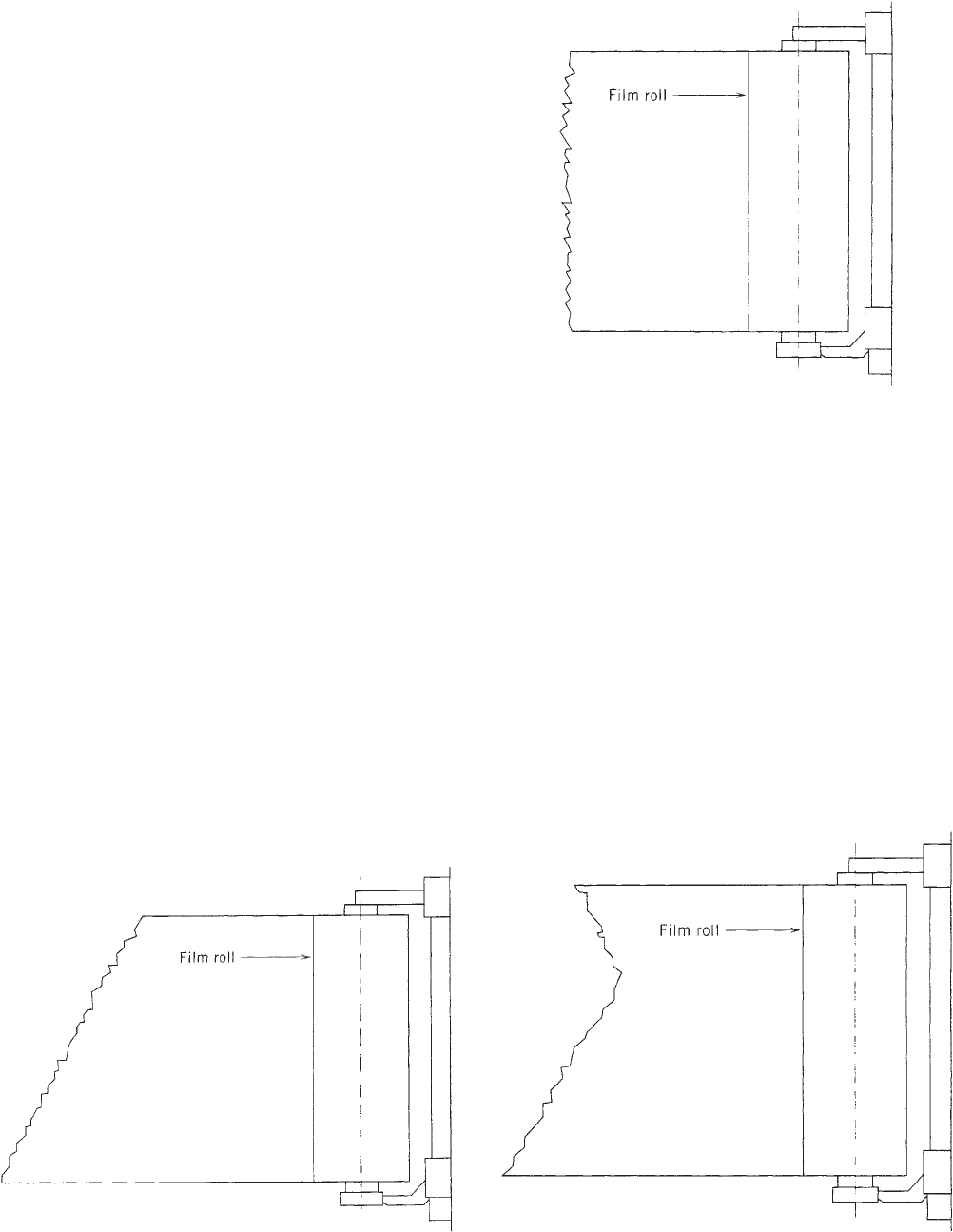
Edge. An edge tear starts at the top or bottom of a roll
and tears in a diagonal direction. It is usually caused
by a nick in the film edge. To fix the problem, simply
unwind the film until the imperfection is gone. (See
Figure 14.)
Ultimate Break. An ultimate break is a straight-line
break with pointed edges. The break occurs when
the film has been prestretched beyond its limits. To
avoid this type of break, reduce the percentage of
prestretch on your machine. (See Figure 15.)
Gel. A gel is a V-shaped break in the film caused by
resin imperfection or some other manufacturing
problem. Before replacing this roll of film, first try
to correct the problem by lowering the F2 and/
or prestretch percentage on your machine. (See
Figure 16.)
Figure 14. Film break at edge.
Figure 15. Ultimate break.
Figure 16. Gel or V-shaped break.
FILM, STRETCH 509
Film ‘‘Tails’’
A stretch-film ‘‘tail’’ is a loose end piece of stretch film that
hangs off a wrapped pallet.
Tails loosen or fall down on wrapped pallets if cling is
too low or there is too much dust on the film. But tails
occur primarily because film is cut off under tension. To
avoid creating tails, the final wrap should be made with a
reduced stretch percentage and lowered F2 so that the
film elasticity does not pull the tail free of the load.
Tackifier Buildup
Tackifier, the most common of which is PIB, is an additive
responsible for giving blown stretch film its cling. Over
time, tackifying agents will build up on machine rollers. If
allowed to accumulate, tackifier residue can cause stretch
film to stick to the rollers and to itself.
To avoid this scenario, machine rollers should be
cleaned on a regular basis. It is advised that a mild
detergent (isopropyl alcohol makes a good cleaner),
warm water, and a nonabrasive cloth be used for this
purpose because of the sensitivity of the machine rollers.
ENVIRONMENTAL EFFECTS ON FILM
The strength and protection stretch film affords the
packages it wraps has made it the unitizing material of
choice among thousands of businesses worldwide. But this
is not to say that stretch film is without its limitations.
There are certain environmental and physical conditions
that can impair regular stretch film’s performance. This
section reveals what these conditions are so that you can
avoid them and get the most out of your stretch film. The
topics discussed are
. Outside storage
. Static discharge
. The effect of temperature on film
. The effect of dust and grit on film
. Stacking pallets
Outside Storage
Regular stretch film is not designed for prolonged outside
storage. Stretch film is subject to photodegradation from
the ultraviolet rays in normal sunlight, which substan-
tially weakens the film.
If wrapped pallets are to be stored outside for more
than several weeks, they should be covered. Otherwise, for
prolonged outdoor applications, specially formulated ul-
traviolet-irradiation (UVI)-stabilized films should be used.
With UVI film, UV protection is optimized when used in
conjunction with opaque tinting.
Static Discharge
Stretch films will support a static discharge and, there-
fore, should not be used in explosion-prone environments.
Since stretch film can induce a static charge, electronic
devices packaged in stretch film run the risk of suffering
damage. Static buildup, however, can be dissipated
through use of Christmas garland or static eliminators.
Effect of Temperature on Film
Generally, higher temperatures make film softer and
easier to deform. Lower temperatures make film stiffer
and harder to stretch and deform. At higher temperatures,
where film is softer, machine-direction tensile strength,
tensile yield, puncture force, and transverse-direction tear
resistance all decrease. Machine-direction ultimate elon-
gation increases.
At lower temperatures, the opposite is true. Machine-
direction tensile strength, tensile yield, puncture force,
and transverse direction tear all increase. Machine-direc-
tion elongation decreases. If temperature plays a role in
your stretch-film requirements, contact your packaging
sales professional, who can recommend films that are best
suited for your particular needs.
Effect of Dust and Grit on Film
Dust has an adverse effect on film, causing it to lose its
cling. In high-dust and high-grit environments, debris can
build up on the prestretch and metal rollers and cause
failures in film performance. As mentioned earlier in this
section, the debris that collects on the rollers is often the
result of a buildup of tackifying agents. PIB, the most
common cling additive, can accumulate over time, causing
the film to wrap and/or sharp objects to be embedded in
the rubber rollers. Therefore, it is of utmost importance to
keep the rollers clean and free of buildup.
Stacking Pallets
Too much pressure may be placed on pallets by stacking
them too high. Two is the recommended limit.
GLOSSARY OF TERMS
Antiblock. Substances added into plastic materials that
retard or prevent film layers from sticking together.
Blowup ratio. The ratio of ‘‘bubble’’ or ‘‘tube’’ diameter
to extrusion die diameter. A primary consideration in
determination of transverse-directional (TD) shrinkage
and a partial determinant of machine-directional (MD)
shrinkage.
Blown film. Film that is fabricated by continuously
pumping the polymer through a circular orifice (die).
Once through the die, this polymer is then drawn upward
and filled with air, creating a tube. The volume of air
contained within the tube stretches the tube out to the
desired width and, in conjunction with rate at which it is
being pulled away from the die, the desired thickness is
created.
Caliper
. The thickness of
a film or bag, normally ex-
pressed in mils or as ‘‘gauge’’ (0.9 mil = 90 gauge = 0.0009
in.).
Cast film. Film that is fabricated by continuously
pumping the polymer through a straight slot orifice
(die), then chilling this hot sheet of plastic immediately
510 FILM, STRETCH
afterward by contact with a colled roll. Film width is
determined by the length of the slot. Thickness is deter-
mined by how fast the casting roll pulls the plastic away
from the slot (or die).
Cling. The characteristic of stretch film that makes it
stick to itself or other clean objects.
Coefficient of friction. A dimensionless numerical
representation of the ease with which two objects or
surfaces will slide against each other. Low numbers slide
easily. Total range due to the test definition is 0–1.
Coextrusion. Fabrication of a multilayer film by
pumping the various materials through separate extru-
ders and then merging the extrudates into a common die
assembly. These die assemblies are constructed to main-
tain distinct material layers with fusion occurring at the
boundaries, due to the pressures and temperature of the
extrudates.
Copolymer. A plastic or polymeric whose chemical
composition consists of more than one basic hydrocarbon
type. The materials are chemically bonded and remain in
combination, thus influencing the performance by their
own distinct characteristics.
Crosslinked PE. A polyethylene that has been specifi-
cally treated by chemical or physical means to cause
intrachain bonding.
Crystallization. The formation of distinct, ordered, and
repeated molecular groups. Polyethylene forms varying
amounts of crystalline structure depending on process
conditions and original molecular makeup. The remaining
portion is amorphous (which is the antonym of crystal-
line). Ice is crystalline; water is amorphous.
Dart drop. A method of measuring a film?s impact
strength or dynamic toughness. A hemispherical shaped,
weighted ‘‘dart’’ is dropped onto a film sample. The weight
at which 50% of the samples are punctured is considered
the WF
50
reading.
Die. A device used in extrusion processes to shape the
extrudate. Circular dies are used for blown products, and
slot dies are used for cast products.
Drawdown ratio. Commonly expressed as the ratio of
the width of the extrusion die orifice to the thickness of a
particular film. Frequently, however, and more correctly, it
is a ratio involving die orifice, blowup ratio, and final film
thickness as follows: die gap/(film gauge blowup ratio).
Eldastic recovery. The ability of a material to return to
its original shape or size after having been deformed or
subjected to strain.
Elmendorf tear. A testing method used to quantify a
material?s resistance to tearing forces. Generally, a sam-
ple is slit (initiated tear), then the force required to tear
apart the sample is measured and given as the tear value.
Elongation at break. The strain or deformation re-
quired to break a sample. Generally expressed as a
percentage by dividing the strain (distance) at which a
sample breaks by the original sample length.
EVA. Abbreviation (acronym) for the copolymer ethy-
lene vinyl acetate. Small percentages (1–18%) of vinyl
acetate monomers are frequently polymerized with ethy-
lene to provide greater extensibility or greater low-
temperature strength or to improve sealability.
Extrudate. Molten polymer.
Extrusion. The process of feeding, melting, and pump-
ing a material such that a desired shape or configuration
can be created. It is a continuous process and utilizes a
device similar to a meat grinder.
Film yield. Generally expressed as the square inches of
a film (area) that weighs one pound if the film is 1 mil
(0.001 in.) thick. Coverage is on a per pound (lb
1
) basis.
This should not be confused with yield point, yield
strength, or tensile yield, which are strength measure-
ments. Polyethylene yields 30,000 in.
2
/lb at 1 mil.
Gauge. Used as a synonym for film thickness or film
caliper. Sometimes expressed as 80- or 100-gauge, which
equates to 0.8 or 1 mil, respectively, or 0.008 or 0.001 in.,
respectively.
Gauge band. A conformation irregularity found in rolls
of material. A thick area in a film will produce a raised or
elevated ring in a finished roll of product. Conversely, a
thin area will result in a soft ring in a finished roll.
Gloss. The shine or sparkle of a surface. In LDPE film,
gloss is described as the amount of light reflected from the
surface. Standard technique places a light source and a
receiver at 451 angles from the surface. The number value
produced is roughly the percentage of light reflected from
the source into the receiver.
Haze. The lack of film transparency. It can be induced
by process considerations, inherently due to molecular
configurations or created by pigmentation. It is measured
by determination of the percentages of light not trans-
mitted through a film sample.
Homopolymer. a plastic resin or polymer whose entire
chemical molecular structure is of a single hydrocarbon
group. It is made by feeding a single monomer to the
reactor.
Impact strength. The ability of an object or material to
resist rapidly applied destructive forces. Refer to ‘‘Dart
drop.’’
LDPE. Low-density polyethylene—any polyethylene
homopolymer whose density is between 0.913 and
0.925 g/cm
3
(g/mL).
Modulus. Short for modulus of elasticity, which is a
numerical value reflecting a material’s resistance to de-
formation. A film with a high modulus is hard to stretch or
elongate.
Monomer. The incremental or elemental chemical ele-
ments before polymerization. Ethylene is a monomer.
Neckdown. The ‘‘narrowing’’ tendency of a film when it
is being stretched or pulled. Occurs when film is stretched
in the machine direction, resulting in decreased trans-
verse direction width.
Opaque. Film that is impervious to light: 100% haze
level.
Polyisobutylene (PIB). Tackifier additive in blown
film that gives it cling.
psi. Abbreviation for pounds per square inch (lb/in.
2
). A
unifying statistical measurement by which various thick-
ness of material can be tested, equated, and compared
without regard to actual specimen thickness.
Puncture performance. The relative comparison of a
material’s resistance to failures caused by penetration—
for example, how easily your finger pokes through a film
sample.
FILM, STRETCH 511
PVC. Abbreviation for poly(vinyl chloride). In film form,
it is used as a meat or produce wrap, as stretch film, and
as a high-clarity shrink wrap for consumer or retail
packaging.
Polymer. Means ‘‘many members.’’ A structure gener-
ated by the repetitious joining of many of the same
elementary units. Natural polymers are cotton, wood, or
protein. Synthetic polymers are polyethylene, polystyr-
ene, nylon, and so on.
Polyolefin. Polymers of basic unsaturated hydrocarbon
chains containing at least one double bond (e.g., polyethy-
lene, polypropylene, and polybutene). Not PVC or PVA.
Reactor. The equipment used to transform ethylene gas
to polyethylene.
Stress relaxation. Primarily it is the phenomenon of
force decay as a function of time. It means that the ‘‘rubber
band’’ tying a stretch load together exerts less force as
time passes. This rate of decrease varies greatly with
different polymers. PVC has an early decay that is much
greater and more rapid than that of LDPE.
Stretchability. A combination of factors related to the
ability of a material to be stretched or elongated—for
example, how easily and to what extent a film stretches
and whether it will return to its original length.
Tack. An adjective used to describe a film’s resistance to
slide against itself or another surface, or its resistance to
separation from itself. Similar terms are surface adhesion
or cohesion, surface seal, wetting of film layers, blocking,or
cling.
Tackifiers. Chemical substances added to increase the
tack of the parent or base material.
Tear resistance. The resistance of a film to be torn.
This is quantified by Elmendorf tear testing, and is
measured as the force required to propagate an initated
tear in the MD or TD direction.
Tensile ultimate. This is a stress level, measured in
psi, beyond which the specimen will break. It is the
laboratory-measured, maximum stress (applied force)
that the material will withstand. Tensile indicates that
test is conducted with a pulling or tensioning type of
loading.
Tensile yield. This is a stress level, measured in psi,
beyond which permanent deformation occurs. ‘‘Tensile’’
indicates that the specimen is pulled or ‘‘tensioned’’ rather
than compressed. Up to this stres or applied force level, a
release of the force will result in the specimen returning to
its original size. Pulling with a higher force will result in
an elongated sample, even after the force is removed.
Tint. A slight coloring that allows light transmission
and relatively good clarity.
Toughness. An overall strength measurement that
takes into account both the amount of pull and the amount
of elongation a sample can withstand. A tough material
will resist breakage by both resisting force and by elongat-
ing. A brittle material (e.g., glass) will resist force, but will
break instead of deforming; hence it has low toughness.
LDPE, which is plastic or tough, both resists and elon-
gates—hence is tougher than glass. The rate of force
application has significant effects on toughness, so com-
parisons must include testing data.
Ultimate Strength. Same as ‘‘Tensile ultimate.’’
Wide web. Wrapping with a roll of film approximately
the size of the load.
Wrap. One revolution of a machine turntable.
Yield stretch. Same as ‘‘Tensile yield.’’
Zippering. Lack of resistance to tear propagation of an
initiated TD cut or tear. Once the film has been torn or cut,
the resulting slit rapidly opens and completes a full-web
break.
FILM, TRANSPARENT GLASS ON PLASTIC
FOOD-PACKAGING MATERIALS
RUSSELL J. HILL
BOC Coating Technology,
Concord, California
INTRODUCTION
Commonly used polymeric packaging materials, such as
polyethylene terephthalate (PET), oriented polypropylene
(OPP), and biaxially oriented nylon (BON), do not have
sufficient oxygen or water-vapor barrier properties for
many packaging applications. To resolve this issue, multi-
layer material structures that incorporate aluminum foil
and polymeric films, aluminum metallized films, PVDC-
coated films, or coextruded EVOH films routinely are
applied. However, environmental considerations and the
push toward source reduction have created a market need
for a thin-film transparent oxygen or water-vapor barrier
coating that is friendly to the environment and convertible
into usable packaging materials and at the same time
capable of meeting the cost requirements of the food-
packaging industry. The coating should also use a low-
temperature process to coat heat-sensitive polymeric films
such as OPP and BON.
The goal of the scaleup process for the QLF transparent
barrier coating was to design and manufacture equipment
to provide SiO
x
-coated material that is environmentally
friendly, recyclable, microwavable, crystal-clear in trans-
parency, excellent in adhesion to the substrate, and able to
allow metal detection. In addition, the coating must with-
stand mechanical stress and the high temperatures gen-
erated during extrusion lamination and heat seal. It
should be printable, able to run at a high speed on
standard converting equipment, and be cost-competitive
compared with existing barrier materials. For commercial
success, the coating process must be capable of producing
high throughputs to meet the low coating cost demands of
the packaging industry.
WHY PLASMA-ENHANCED CHEMICAL VAPOR
DEPOSITION (PECVD)?
Coatings of SiO
x
can be produced by several methods that
include sputtering, evaporation, and PECVD.
512 FILM, TRANSPARENT GLASS ON PLASTIC FOOD-PACKAGING MATERIALS
Extensive R&D programs have been completed to in-
vestigate each technology to determine the most effective
method for creating a SiO
x
coating to meet scaleup process
goals. At the same time, a prototype machine was built
capable of coating rolls 660 mm wide to prove the produc-
tion and economic viability of whichever process was
chosen. This system had the capability to use all three
technologies. Table 1 shows the results of the study that
led to the focus on the PECVD process. Sputtering was
disqualified early, because of large power requirements
and low deposition rate. The process was not economical
for food packaging.
In contrast, the main advantage of evaporation was the
potential to run at very high line speeds, comparable with
those speeds used in vacuum metallizing of aluminum.
This potential has not been realized. SiO cannot be
evaporated at as high a rate as aluminum. If it is
evaporated at a power level to give the same rate as
aluminum, then molten SiO is spattered onto the film,
which causes holes in the film. Also, the thickness of the
coating needed to gain a suitable barrier is much greater
than that for aluminum metallizing (1500–3000 A
˚
vs.
200 A
˚
).
On the basis of the coating work carried out, the
PECVD process showed much more promise than eva-
poration in terms of economics and coating performance.
The economics for the PECVD process are better than
those for evaporation, because the vacuum requirements
are less stringent, which means that the time to change
rolls should be less; the power requirement per unit area
is less; cooling requirements are less; raw material is
inexpensive and available; source usage is higher, mainly
because of patented equipment design; and coating thick-
ness is less.
SCALEUP OF MANUFACTURING SYSTEMS
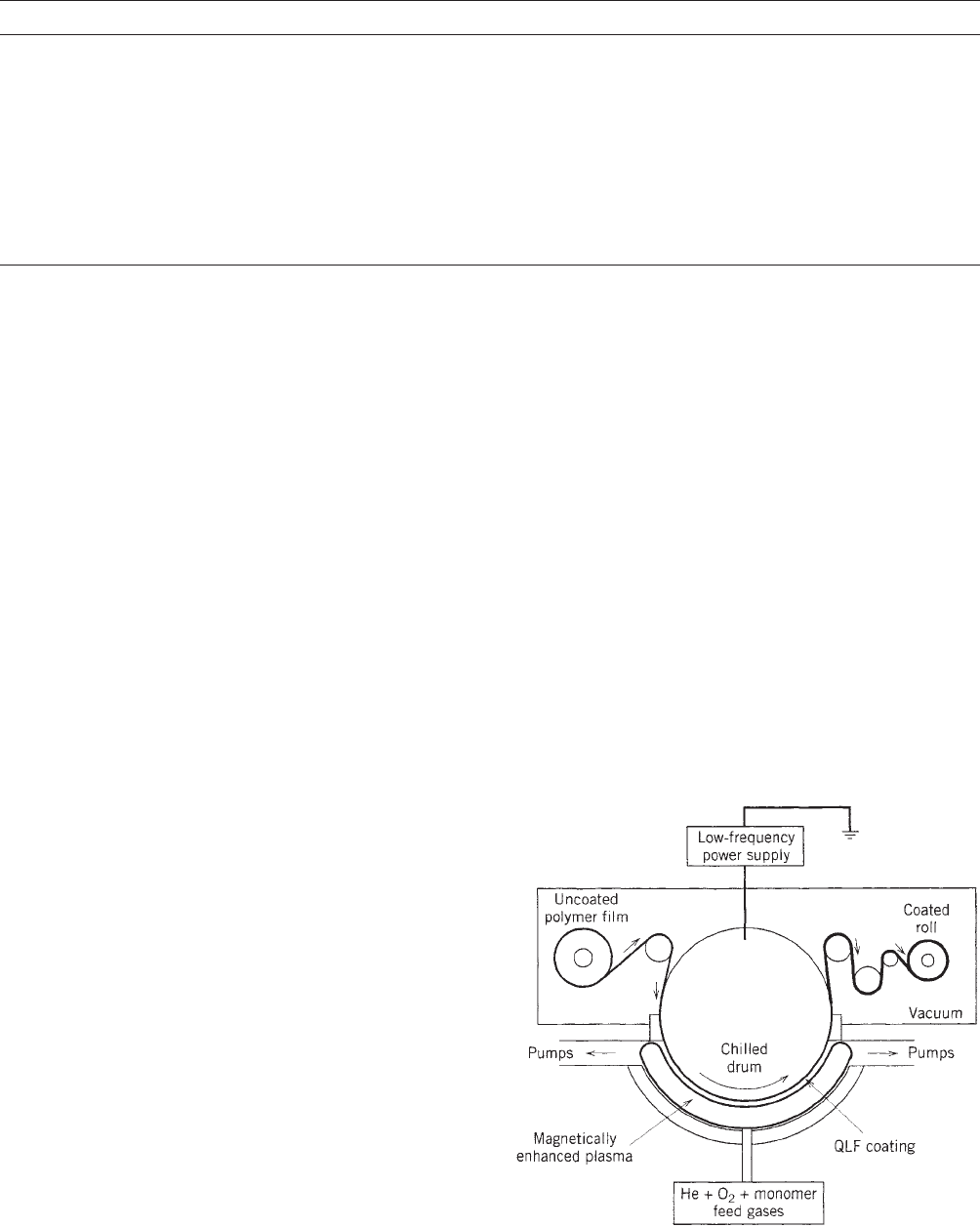
The SiOx deposition process described is a low-pressure,
low-frequency, and low-temperature PECVD process that
uses a mixture of helium, oxygen, and the organosilicon
compound hexamethyldisiloxane (HMDSO), as shown in
Figure 1. The plasma source uses a multipole magnetic
field to confine the plasma to obtain enhanced deposition
rates at low pressures. The resulting silicon oxide is the
QLF barrier coating.
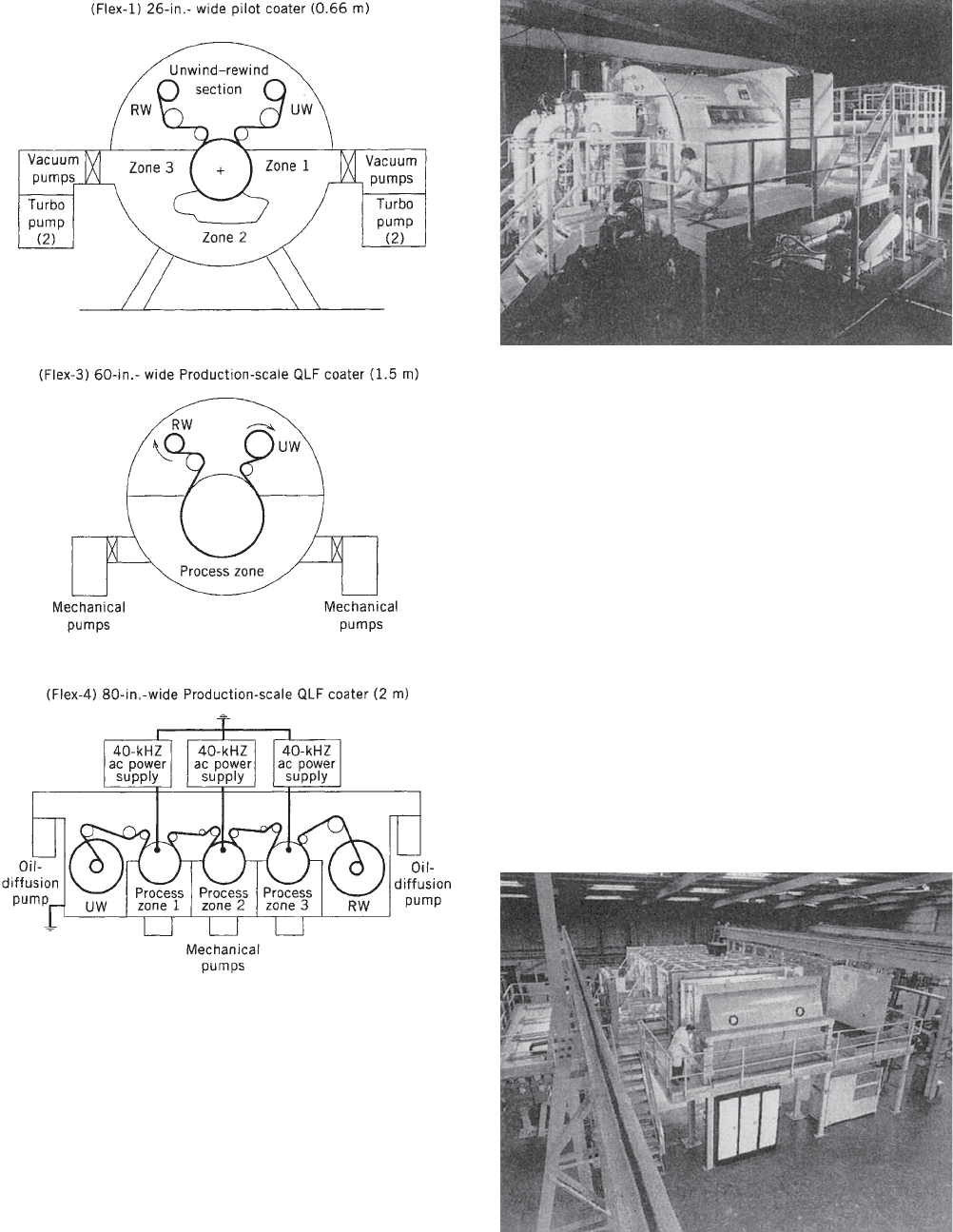
The three coaters used in the course of the maufactur-
ing scaleup effort are shown schematically in Figure 2.
The QLF coating was initially developed in a small
research roll coater. Because of technical risks and the
capital cost required to build a 1.5- or 2-m-wide vacuum
roll coater, the strategy involved incremental steps in
scaling up the coating process from a web width and speed
of 0.3 m wide at 0.3 m/min, to 0.66 m wide at 100 m/min,
then 1.5 m at W100 m/min and finally to 2 m at W100 m/
min. The challenge to incrementally increase the web
width and speed was recognized because of the need to
develop hardware capable of running under the process
conditions required to achieve the target barrier perfor-
mances and line speeds. BOC coating technology (BOCCT)
has systematically scaled up the process using statisti-
cally designed experiments that optimized the parameters
through different treatment conditions as well as the use
Table 1. Comparison of Glass-Coating Technologies
Feature Sputtering Evaporation PECVD
Vacuum (torr) 10
3
(proc.) 10
6
10
2
10
6
(base) 10
6
10
2
Power (kw) Thousands Hundreds Tens
Process temperature High High Low
Source Si + O
2
SiO/SiO
2
Monomer
Source cost High High/medium Low
Source utilization Roughly 40% Roughly 25% W50%
Coating thickness 400–500 A
˚
1500–3000 A
˚
150–300 A
˚
Film color Yellow Yellow Clear
Coating bond Mechanical Mechanical Chemical
Barrier (unlaminated) Medium Medium High
Figure 1. Proprietary plasma-enhanced chemical vapor
deposition.
FILM, TRANSPARENT GLASS ON PLASTIC FOOD-PACKAGING MATERIALS 513
of previous experience from other vacuum coating
machines.
The first scaleup phase was completed in a develop-
ment coater that can mechanically handle 0.66-m-wide
webs at speeds from 0.1 to 150 m/min. The second scaleup
phase was conducted in a production-scale coater that can
handle 1.5-m-wide webs at speeds from 10 to 300 m/min
(Figure 3). The process scaleup in this coater was com-
pleted using HMDSO as the monomer. The third scaleup
phase is a production coater that can handle 2-m-wide
webs at speeds from 30 to 300 m/min (Figure 4). This is a
modular design production coater with three isolated
process zones that provide flexibility for pretreatment
and/or posttreatment or for deposition with different
chemistries.
BARRIER PERFORMANCE
The unlaminated oxygen transmission properties achieved
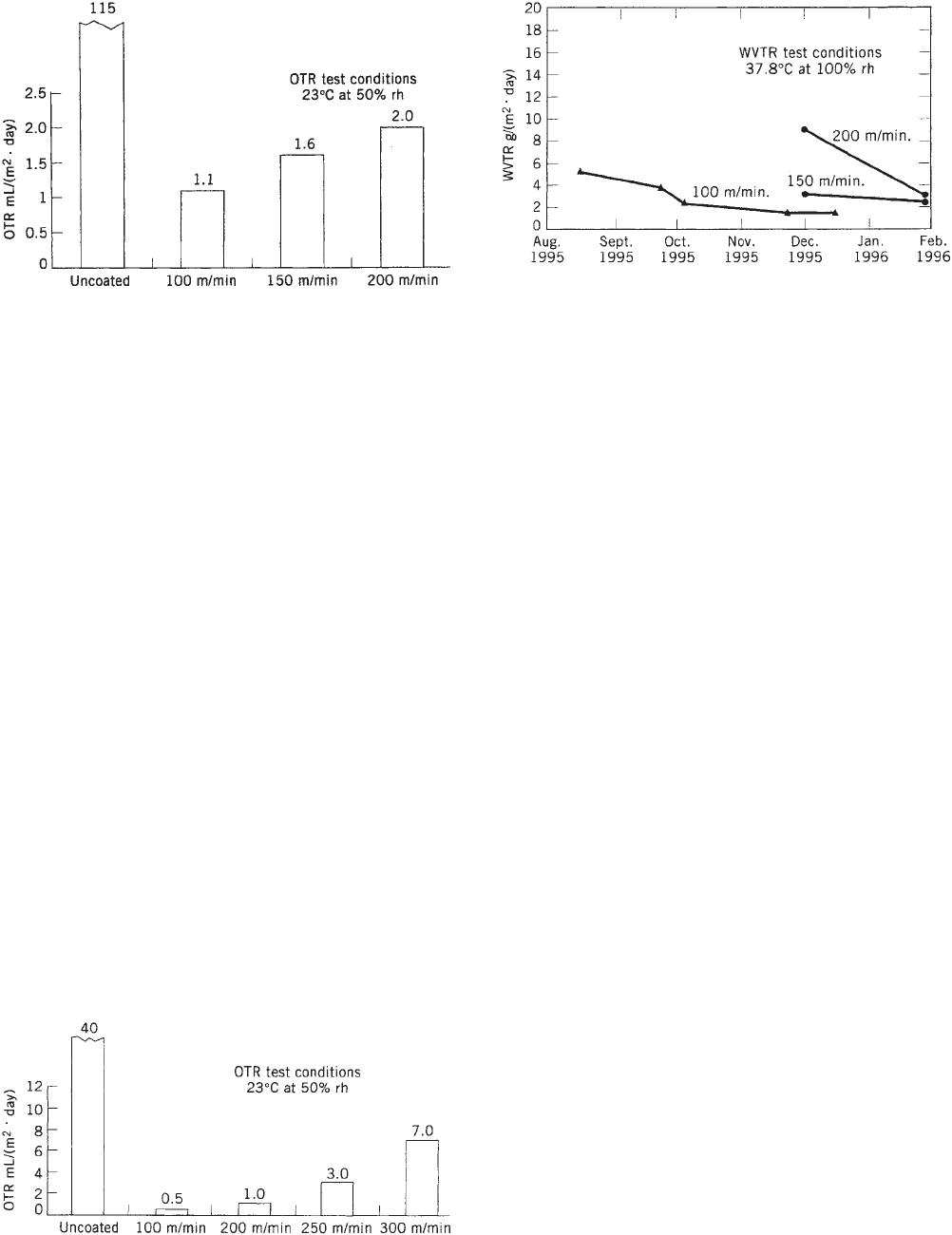
to date for PET and OPA are listed in Figure 5 and 6. A
typical oxygen transmission rate (OTR) for uncoated PET is
115 cm
3
/(m
2
24 h). With QLF coating applied at a speed of
100 m/min, the OTR is reduced to 1.1 cm
3
/(m
2
24 h). In-
creasing the line speeds to 200 m/min will result in an OTR
reading of 2 cm
3
/(m
2
24 h). The opportunity for high bar-
rier performance on other substrates is also possible.
Production rolls of OPA with QLF coating run at line speeds
of 300 m/min demonstrate an OTR of 7 cm
3
/(m
2
24 h).
These results represent the flexibility a roll coater can
offer. Whether a customer is targeting a high or medium
Figure 2. Flex-1, Flex-3, and Flex-4 schematic.
Figure 3. Flex-3: production-scale QLF roll coater.
Figure 4. Flex-4: production-scale QLF roll coater.
514 FILM, TRANSPARENT GLASS ON PLASTIC FOOD-PACKAGING MATERIALS
barrier application, a roll coater can satisfy their
requirements.
Initially, the technology was focused on an effort to
optimize the oxygen barrier primarily for liquid packa-
ging. Continued development was targeted toward up-
grading and optimizing the process for water vapor
(WVTR) as well. As indicated in Figure 7, the WVTR for
PET with QLF coating has been reduced from a level of
5.6 g/(m
2
24 h) in August 1995 to 1.4 g/(m
2
24 h) in De-
cember 1995. Development efforts are now focused on
increasing line speeds and on introducing a range of
different substrates to the PECVD process. (See also
Barrier Polymers.)
CONVERTING
Successful large-scale acceptability of QLF-coated materi-
als is dependent on the ease of convertibility as well as on
their cost and barrier properties. Extensive research has
been dedicated to determining how ‘‘robust’’ QLF coatings
are in varying converting processes. Because of the strong
chemical bond that exists between QLF coatings and PET,
converting results have been encouraging. Several packa-
ging converters have successfully adhesive- and extru-
sion-laminated QLF-coated PET, which maintain barrier
properties and achieve excellent bond-strength results.
Good ink adhesion also was achieved directly on the QLF-
coating surface. BOCCT can supply a recommended list of
inks and adhesives on request.
Gelbo flexing, which is a test commonly used to simu-
late stresses encountered in finished-packaged shelf life in
the marketplace, is also being investigated. Earlier papers
(1,2) already have reported that the finished-packaging
structures with the QLF coating survived the tests when
properly laminated.
COMMERCIALIZATION OF QLF BARRIER COATING
The transparent oxide barrier market has been plagued
by high cost and/or difficulties in converting or printing on
the barrier coating surface without losing the barrier
properties. One of the most crucial success factors in the
transparent high-barrier market is the ability to provide a
better, or comparable, material at a lower cost. QLF
coatings are not only the most ‘‘robust’’ transparent oxide
coatings available in the marketplace—they also provide
the most competitive economics.
Today, BOCCT roll coaters are built to offer the con-
verter or film manufacturer the flexibility to target both
the medium-barrier and the high-barrier markets. De-
pending on the barrier level one is looking to achieve, QLF
coating costs can range fromo$0.03 to o$0.045/m
2
. These
costs will continue to lower as more advances in line
speeds and barriers are achieved.
The use of commercial size coaters to improve the QLF
coating performance is continuing. QLF coatings are FDA
approved, provide a better barrier than polyvinylidene
chloride (PVDC) coatings, and are insensitive to humidity
changes as opposed to ethylene vinyl alcohol (EVOH).
Replacement of these coatings on substrates such as
PET and BON are the initial targets for large-scale
commercialization of QLF coatings.
CONCLUSION
QLF barrier coatings have been scaled up from a 0.3-
m-wide web laboratory coater at a line speed of 0.3 m/min
to a 2-m-wide web production coater capable of 300 m/min.
BOCCT is committed to continued improvements in both
line speeds and barrier performance. Currently, technol-
ogy-driven converters and film manufacturers are forming
partnerships with BOCCT to make QLF coatings a com-
mercial reality.
Figure 5. OTR of 12-mm PET with QLF coating.
Figure 7. WVTR of 12-mm PET with QLF coating.
Figure 6. OTR of 15-mm OPA with QLF coating.
FILM, TRANSPARENT GLASS ON PLASTIC FOOD-PACKAGING MATERIALS 515
QLF coatings applied to PET substrates can now per-
form with barriers and line speeds that exceed even the
most demanding expectations of the packaging industry.
Meeting the demand in the packaging industry for an
environmentally friendly, transparent barrier coating is
the goal of BOCCT.
BIBLIOGRAPHY
1. E. Finson and J. Felts, ‘‘Transparent SiO
2
Barrier Coatings:
Conversion and Production Status,’’ TAPPI J. 78, (1995).
2. E. Finson, and R. J. Hill, ‘‘Glass-Coated Packaging Films
Ready for Commercialization,’’ Packag. Technol. Eng., 36
(1995).
FLEXIBLE INTERMEDIATE BULK CONTAINERS
BRUCE CUTHBERTSON
Flexible Intermediate Bulk
Container Association
Updated by Staff
INTRODUCTION
Flexible intermediate bulk containers are defined as an
intermediate bulk container, having a body made of
flexible fabric, which (1) cannot be handled manually
when filled, (2) is intended for the shipment of solid
material in powder, flake, or granular form, (3) does not
require further packaging, and (4) is designed to be lifted
from the top by means of integral, permanently attached
devices (lift loops or straps) (1).
Flexible intermediate bulk containers (FIBCs), also
known as ‘‘big bags,’’ ‘‘bulk bags,’’ and ‘‘bulk sacks,’’ were
first manufactured in the late 1950s or early 1960s. There
is some controversy as to where the first FIBCs were
made; however, it is known that FIBCs were made in the
United States, Europe, and Japan during the time period
mentioned above. The first FIBCs were constructed with
heavy-duty PVC-coated nylon or polyester where the cut
sheets are welded together to form the FIBC. These FIBCs
were made with integrated lift slings around the con-
tainer, or were attached to a specially made pallet, or were
manufactured a metal lifting device that the container sat
on. These handling devices allowed the container to be
filled from the top and discharged from the bottom.
The initial cost of these heavy-duty containers is high;
therefore, they are designed to be reused many times in a
closed-circuit system, where problems of control logistics,
prevention of contamination, cleaning, and liability for
loss or damage can be agreed on by the shipper and
receiver of the product.
Flexible intermediate bulk containers manufactured
with polyolefin fabrics were experimented with in Eng-
land, Japan, Canada, and the United States all at about
the same time in the late 1960s to the early 1970s. It was
the development of these high-strength light-weight fab-
rics (i.e., polypropylene) that spurned the growth of the
flexible bulk bags that is universally used today.
The rapid growth in Europe in the manufacture of
FIBCs occurred in the mid-1970s during the oil crisis.
The oil-producing countries building program required
large quantities of cement. The demand for cement was
shipped in FIBCs at the rate of 30,000–50,000 metric tons
per week from Northern Europe, Spain, and Italy to the
Middle East.
The demand for bulk bags in the United States grew
slower than in Europe until 1984, when the U.S. Depart-
ment of Transportation (DOT) agreed to grant exemptions
for the shipment of hazardous products in FIBCs. Perfor-
mance standards for FIBCs were established and issued
by the Chemical Packaging Committee of the Packaging
Institute, USA under T-4102-85. These standards were
used to obtain exemptions until DOT included flexible
containers with the other types of IBCs in the regulation
HM181-E for hazardous products.
DESIGN
The flexible bulk container offers many features that are
unique to this package. It can be folded flat and baled for
shipment to the user. The weight of a bulk bag to ship one
metric ton of product weighs 8–10 lb, offering a low pack-
age:product weight ratio. The cost of FIBCs is competitive
with other forms of packaging because it is usually utilized
without pallets. They are easy to store and handle in
warehouses with standard equipment. When shipping by
boat, the FIBCs are gang-loaded with up to 14 bulk bags on
a spreader bar, and they are shipped as break bulk.
The standard diameter of FIBCs is 45–48 in., designed
to fit two across in a truck or a shipping container. Special
configured containers are made to meet specific require-
ments of the container user.
FIBCs generally are manufactured to meet specific
requirements of the container users. The height of the
container, the diameter and length of the spouts, coated or
uncoated fabric, and whether a polyethylene liner is
necessary will be specified according to the type of product
that will be shipped.
USES
Modern FIBICs transport over 0.25 10
9
t of goods per
year. They are used to store and move a variety of products
such as cereals, powdered chemicals, flour, and animal
feeds. With a capacity of of up to 3 m
3
and load capability
of 0.5–2 t, FIBCs are highly cost effective, easily recycl-
able, and ideal for free-flowing granules, powders, pellets,
and flakes (2).
When hazardous products are shipped in FBCs, the UN
mark for the product must be printed on the container
body. In the United States the manufacturer of the con-
tainer is self-certifying and marks the container according
to the regulations HM 181E. All other countries require
the container manufacturer to submit containers to third-
party testing for certification.
516 FLEXIBLE INTERMEDIATE BULK CONTAINERS
FIBCs containing nonhazardous or nonregulated pro-
duct when shipped export from the United States must
have performance testing certification if destined for a
country that require performance standards for bulk bags.
The following regulation numbers apply for perfor-
mance standards for containers with regulated products:
United States, HM 181E; United Nations, Chapter 16;
England, B.S. 6939; Canada, CGSB 43.146.
BIBLIOGRAPHY
1. B. Cuthbertson, ‘‘Flexible Intermediate Bulk Containers’’ in
A. J. Brody and K. S. Marsh, eds., The Wiley Encyclopedia of
Packging Technology, 2nd edition, John Wiley & Sons, New
York, 1997, pp. 448–449.
Cited Publications
1. Flexible Intermediate Bulk Container Association,
www.flexintcontainerassoc.com/index html, September 2008.
2. J. J. Wooster, ‘‘Packaging Flexible’’ in Mark Encyclopedia of
Polymer Science and Technology, Vol. 3, John Wiley & Sons,
Hoboken, NJ, 2003, p. 361.
FOAM, EXTRUDED POLYSTYRENE
PHILLIP A. WAGNER
The Dow Chemical Company,
Midland, Michigan
Updated by Staff
INTRODUCTION
Polystyrene foam sheet is a reduced-density sheet made
from polystyrene by the extrusion process. Produced in
many forms, it is most easily classified by its density and
thickness. This article deals with a sheet that has densities
of 3–12 lb/ft
3
(0.05–0.19 g/cm
3
) and thickness 0.012–0.250
in. (0.3–6.35 mm). Foamed thermoplastics provide excel-
lent insulating properties because of their low thermal
conductivity, good shape retention, and good resistance to
moisture pickup (1).
The first extruded foam sheet was produced in 1958 by
extruding expandable polystyrene beads. In the early
1960s, the direct-gas-injection extrusion technology was
developed and is by far the most widely used system today.
In the late 1980s and early 1990s, there was a decrease in
the volumes of foam produced due to the environmental
issues related to the blowing agents being used and
disposal of the foam. The use of new and more ecologically
acceptable blowing agents and increased recycling of the
products has reduced these concerns. Most of the foam is
used for disposable packaging such as meat and produce
trays, egg cartons, containers and trays for carryout
meals, and disposable dinnerware. It is also used for drink
cups, bottle labels, miscellaneous cushion packaging, and
applications where it is laminated to paper or films. A
large percentage of all foam sheet produced is thermo-
formed to manufacture the finished product. When it is
laminated with paper, it is usually fabricated by die
cutting and scoring to produce folding containers.
PRODUCTION
There are four direct gas injection processes to produce
polystyrene foam sheet. All four have the same objectives:
to melt the polymer, uniformly mix in the blowing agent
and nucleator, cool the melt, and allow the mix to expand
into a biaxially oriented sheet. The four processes employ
large-diameter or long L/D extruders, twin screw extru-
ders, the Winstead system using a single screw extruder
and its cooling system, and the two single-screw extruder
tandem system. Of these processes, the tandem system is
most successful and widely used (see Figure 1).
The tandem extruder system utilizes two single-screw
extruders: a primary extruder for melting, mixing, and
feeding the extrudate to a secondary extruder for cooling
and additional mixing of the extrudate prior to exiting an
annular die. Most tandem systems use 4.5-in. (11.4-cm)
primary extruders and 6-in. (15.2-cm) secondary extru-
ders with output rates of 500–1200 lb/h (227–544 kg/h). As
producers strived for higher output rates, 6-in. (15.2-cm)
primary and 8-in. (20.3-cm) secondary extruders with
output rates of 900–2000 lb/h (408–909 kg/h) have become
more popular. Tandem foam lines are supplied by several
extruder manufacturers (see also Extrusion).
In addition to the rather unique extrusion system, the
die–mandrel–takeoff system must be carefully designed. As
mentioned above, an annular die is generally used because
of the three-dimensional expansion of the foam. The foam
is drawn over a cooling sizing mandrel to cool the foam and
provide the desired sheet width. Blowup ratios and the die
diameter:mandrel diameter ratio must be calculated ac-
cording to the density and desired orientation of the foam
to be produced. Ratios of 3:1 to 4.5:1 are common. This
tubular sheet is slit into the required widths as it is drawn
off the mandrel and is then wound into rolls.
RAW MATERIALS
The ingredients required to produce foam sheet are resin,
nucleator, and blowing agent. The resin is normally a
high-heat general-purpose polystyrene such as Dow
Styron 685D. Nucleators, such as talc or a citric acid–
sodium bicarbonate mixture, are added to provide foaming
sites to obtain the desired cell size and uniformity. The
chlorinated fluorocarbons formerly used as blowing agents
have been replaced with more environmentally friendly
substitutes, such as HCFCs (HFC-152a) or low-molecular-
weight hydrocarbons such as butane or isopentane, carbon
dioxide, and blends of these blowing agents (1). The
blowing agent is dissolved and held in solution by the
pressure in the extruder (2). The blowing agent is injected
into the primary extruder approximately two-thirds of the
way up the barrel. This is accomplished by the use of a
positive-displacement volumetric pump. The amount and
FOAM, EXTRUDED POLYSTYRENE 517