
Yam, Kit L. (ed.). The Wiley encyclopedia of packaging technology
Подождите немного. Документ загружается.


structure, such as a sealant web for a stand-up pouch,
without compromising the structural rigidity of the pack-
age. Typically, this structure consists of a sealant film
laminated to a stiffer reverse-printed film. Pouch makers
are limited on downgauging the sealant film by the
rigidity requirements necessary for the stand-up feature
of the package. Through MDO, the stiffness of the sealant
film can be increased, while still maintaining sealing
properties, allowing the converter to use a downgauged
sealant film without compromising performance. Table 2
shows an example of an MDO sealant film, when com-
pared to a standard sealant film, that, captures a signifi-
cant yield increase with improvements in mechanical and
optical properties.
When comparing the downgauged MDO and generic
sealant films, the MDO film provides a 32% increase in
yield, a nearly 800% increase in machine direction mod-
ulus, an over 500% increase in machine direction break
strength, a 40% decrease in transverse direction strength,
similar haze, and better gloss. This film forms a seal
with strengths of approximately 5 lb at 2501F sealing
temperature.
An example for the second scenario would be replacing
a polyester film with an MDO polyolefin film. A specific
case involves replacing a 0.48-mil PET film with a 0.6-mil
polyolefin film (2), as shown in Table 3.
While the gauge of the polyolefin film is 25% heavier,
the yield (MSI/lb) is improved by 15%. This is due to the
difference in the densities of the two polymers. Additional
benefits include a 90% increase in machine direction
break strength, an anisotropic tear resulting in better
straight-line tear characteristics, the inherent hydropho-
bic nature of the polyolefin, and a heat-sealable film.
Significant shortcomings of the MDO polyolefin film
should be acknowledged, and they include the lack of
thermal stability at elevated temperatures, higher haze,
lower oxygen barrier, and lower transverse direction
tensile properties. As a result, some applications can
utilize the MDO polyolefin film and capture the yield
benefit, while others may be limited by the shortcomings
of the MDO polyolefin film.
High-barrier films for sealant webs or lamination
replacements are a third application where MDO films
can be utilized to significantly reduce packaging costs (2).
These films would be utilized to reduce costs in pouch
applications where the inherent properties of MDO films,
such as increased modulus, barrier, strength and gloss,
add value to the finished package and lower package costs
by reducing the need for secondary processes. The follow-
ing example of a sealable high-barrier MDO film combines
excellent moisture and oxygen barrier, good heat sealabil-
ity, high stiffness, high gloss, and low haze (Table 4).
The film’s tensile properties are significantly higher
than those of laminated polyester structures. In addition,
the high-gloss surface is similar to, if not better than,
other lamination-grade printed films and provides excel-
lent aesthetics to the package.
This film has oxygen and moisture barrier properties
similar to those of many coated and metalized films (9–11),
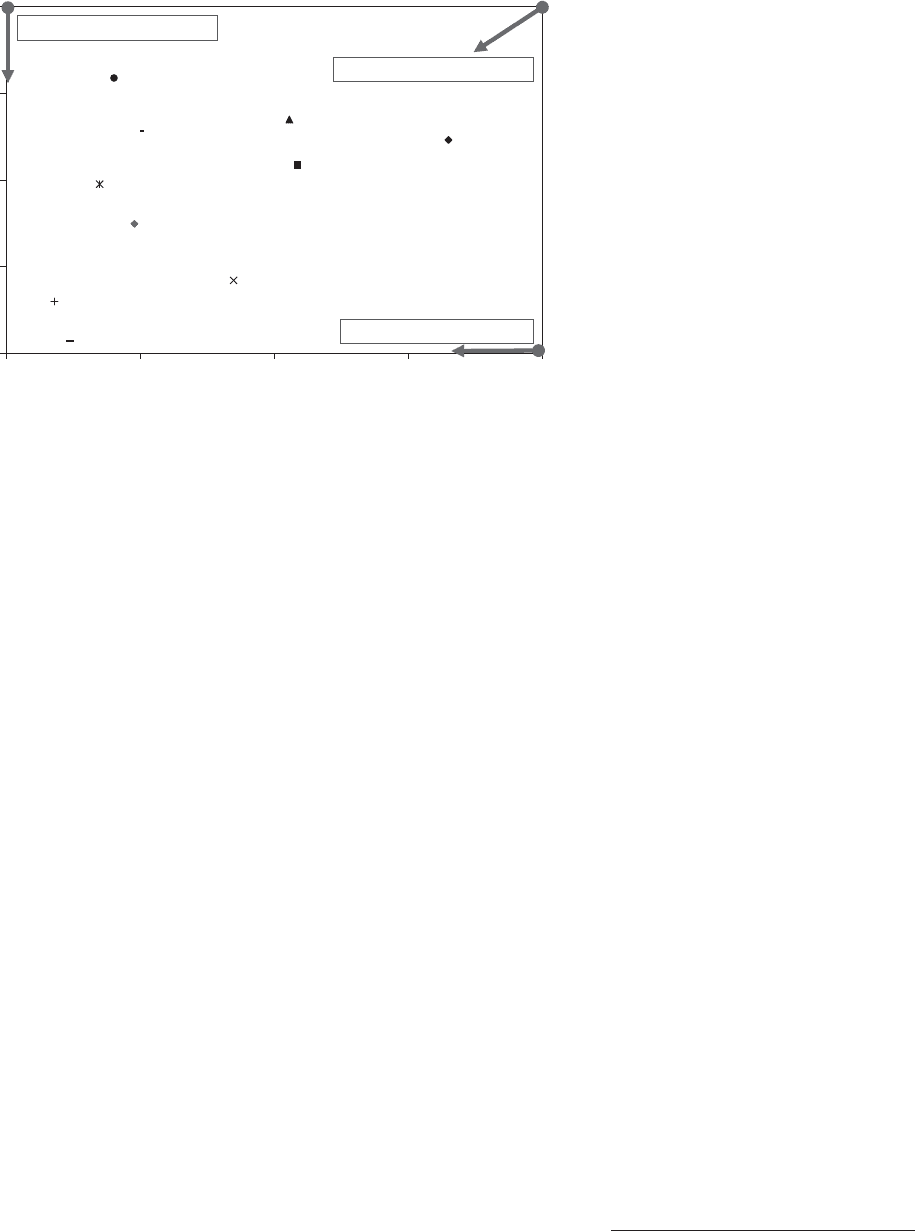
as shown in Figure 3.
Table 2. Typical Data for a Standard Sealant Film and a
Downgauged MDO Sealant Film
Property Units
Standard
Sealant
Film
MDO
Sealant
Film
Gauge mil 2.0 1.5
Yield MSI/lb 15.0 19.7
MD modulus psi 35,000 310,000
MD break strength psi 4,500 28,000
TD break strength psi 4,000 2,400
Haze % 10 9.0
451 Gloss 65 75
Heat seal temperature
for 5 lb/in. seal
strength
1F 200–250 250
Table 3. Typical Data for Oriented Polyester Film and a
MDO Polyolefin Film (2)
Property Units
0.48 mil
PET
MDO
Polyolefin
Film
Gauge mil 0.48 0.6
Yield MSI/lb 42.2 48.6
MD modulus psi 400,000–
600,000
500,500
MD break strength psi 32,000 60,000
TD break strength psi 39,000 5,600
MD break strain % 110 48
TD break strain % 70 6.7
MD Elmendorf
tear
g/mil 30 11.1
TD Elmendorf tear g/mil 30 54.0
Haze % 3.6 12
Table 4. Properties of a Sealable High-Barrier MDO Film
for the Replacement of Laminated Barrier Structures in
Flexible Packaging (2)
Property Units
Sealable High-Barrier
MDO Film
Gauge mils 2.6
MD modulus psi 230,000
TD modulus psi 170,000
MD break strength psi 13,400
TD break strength psi 3,100
MD break strain % 57
TD break strain % 1,440
MD elmendorf tear g 190
TD elmendorf tear g 250
OTR cc/100 in.
2
/day 0.091
WVTR g/100 in.
2
/day 0.314
451 Gloss (print side) 90.1
Transparency % 93.9
Haze % 10.5
Heat seal temperature
for 10-lb/in. seal strength
1F 250
688 MACHINE DIRECTION ORIENTATION
CONCLUSION
Machine direction orientation (MDO) of polymer films
provides significant improvements in both the cost
and performance of flexible packaging. Significant in-
creases in stiffness, strength, optics, and barrier are easily
attained through MDO. Each section of the MDO unit
is critical for the production of high-quality film, with
each requiring careful consideration during the equip-
ment design process. Utilizing MDO films can reduce
packaging costs through downgauging, replacing less
desirable films, and/or reducing the need for more costly
secondary processes in the manufacturing of flexible
packaging.
GLOSSARY OF TERMS
Blocking Blocking occurs when two layers of film ad-
here to each other. This is typically seen when a roll is
wound with too high of tension and cannot be easily
unwound. Winding with lower tensions and/or the addi-
tion of an anti-blocking agent to the polymer film can
minimize the effects of blocking.
Crushed Core Crushing a core refers to the event
where the paper cores that are used to wind the rolls are
crushed by the film that is being wound around them. This
can occur if the film is wound with too high of tension and/
or the film shrinks after it has been wound on the core.
Crushed cores make it difficult to unwind rolls in second-
ary processes.
Dart Drop The impact strength of the film, as measured
by a moving weighted dart.
Draw Gap The draw gap is the distance between the
slow draw and fast draw rolls. The draw gap can be given
either in terms of a radial or tangential distance between
the two rolls.
Draw Ratio (DR) The ratio at which the film is being
oriented. Draw ratio is also the ratio of the film thickness
before and after the orientation process.
Draw Resonance Draw resonance, also known as tiger
striping, is the presence of thick and thin streaks in the
transverse direction of the film. It is a property inherent to
the type of polymer being oriented.
Edge Bead An edge bead is the thick portion of film
located at the edges of the roll. Typically, the edge bead is
removed by cutting a small piece of film off the edge,
known as trim, prior to winding.
Gloss The amount of light reflected from the surface of
the film at a specified angle. Gloss is the shininess of the
film.
Haze The percentage of light that is not transmitted
through the film. Haze is the lack of film transparency.
MDO Machine direction orientation.
Neck-in The amount the width of the film changes after
orientation. The neck-in is calculated by subtracting the
width of the film after orientation from the width of the
film prior to orientation.
Nip Rolls The nip rolls are typically rubber covered
rolls that are used to pin the film to the surface of the
heated/cooled roll. Nip rolls are critical for proper tension
control throughout the process.
Orientation Temperature The orientation tempera-
ture refers to the temperature to which the film has
been heated by the preheating rolls prior to the orienta-
tion stage.
Profile The profile refers to the thickness of the film in
the transverse direction.
Rate of Draw The rate of draw is the rate at which the
film is being oriented. It is also referred to as the accel-
eration in the gap. The rate of draw is calculated by
dividing the difference between the fast draw and slow
draw speeds by the tangential distanced of the drawing
gap.
Rate of draw ¼
ðFast draw speed Slow draw speedÞ
Tangential gap distance
Roll Profile Roll profile refers to the uniformity of the
roll in the transverse direction of the film.
PA
Metallic PC
PET
Metallic PA
PVdC
Metallic LDPE
Metallic PET
Metallic BOPP
Metallic Cello
MDO
0.01
0.1
1
10
100
0.01 0.1 1 10 10
0
OTR (cc/100 in
2
/24 hr)
WVTR (g/100 in
2
/24 hr)
Improving Oxygen Barrier
Improving Balanced Barrier
Improving Moisture Barrier
Figure 3. Water and oxygen transmission rates
for various polymer films. Data for all films other
than the MDO film from references (9–11). Data
for the MDO film taken from reference (2).
MACHINE DIRECTION ORIENTATION 689
Trim A small piece of film cut from the edge prior to the
winding of the roll to remove the edge bead.
Yield Yield refers to the surface area, typically given in
thousand square inches (MSI) of one pound of film (lb).
BIBLIOGRAPHY
1. K. L. Williams, G. Laverde, R. Wolf, and D. R. Breese,
Economic benefits of machine direction orientation, SPE
Polyolefins RETEC Conference, 2005.
2. D. R. Breese, Economic benefits of utilizing MDO films in
flexible packaging, TAPPI PLACE, 2007.
3. E. Hatfield, Some of the important design requirements of a
machine direction orientor (MDO) Machine, TAPPI PLACE,
2007.
4. D. R. Breese, G. Beaucage, and K. L. Williams, Modeling the
effects of solid state orientation of blown high molecular
weight high density polyethylene films: A composite theory
approach, SPE ANTEC, 2005.
5. D. R. Breese and J. J. Strebel, Balancing tear strength and
modulus of machine direction oriented films containing high
molecular weight polyethylene, SPE FlexPackCon, 2006.
6. E. Hatfield, R. Tate, K. L. Williams, and B. Todd, New MDO
Medium molecular weight high density polyethylene films,
SPE ANTEC, 2001.
7. E. Hatfield and D. R. Breese, Step change improvements in
barrier using MDO, TAPPI 2006 Innovations in Barrier
Packaging, 2006.
8. D. R. Breese, and G. Beaucage, Effects of machine direction
orientation on the moisture and oxygen barrier properties of
HMW-PE films, TAPPI PLACE Conference (2005).
9. S. E. M. Selke, J. D. Cutler, and R. J. Hernandez, Plastics
Packaging: Properties, Processing, Applications, and Regula-
tions, 2nd edition, Hanser, Munich, 2004.
10. A. L. Brody, and K. L. Marsh, The Wiley Encyclopedia of
Packaging Technology, 2nd edition, John Wiley & Sons, New
York, 1997.
11. O. Vetter, Trends and opportunities in the European clear
barrier market, TAPPI PLACE, 2006.
MANAGING THE PACKAGING FUNCTION
AL CORNING
A Corning Consulting, Inc.,
Lombard, Illinois
Ongoing disagreements and/or confusion exists as to
where in the organization packaging best ‘‘fits’’ and,
even worse, a general lack of understanding on the part
of senior management, and other corporate groups, as to
what packaging can or should be doing to best serve that
business.
LOCATION IN THE ORGANIZATION
Where is the packaging function best positioned to serve
the company? Granted, there is no easy answer to this
question. The close relationship with suppliers that are
typically desired or required directs one to elect location
within the purchasing department as optimum. Especially
when one considers the increasing importance of
cost control, cost reductions, specification negotiation,
and supplier problem resolution—especially quality
problems.
Cases exist in which the manufacturing function has a
dominant need; and in all cases, packaging must assure
good working relationships with production management
and line personnel.
In essence, there is no one best answer for all, but the
wrong or inappropriate corporate location of the packa-
ging function ensures hampered performance and limited
professional growth or recognition of value.
PACKAGING RESPONSIBILITIES: KNOWN AND
UNDERSTOOD
Perhaps the prime responsibility of a packaging manager
is to understand clearly all that is currently and appro-
priately expected of the function, and, likewise, to educate
upper management, continually, as well as their peers or
‘‘customers’’ in other company functions’ as to what the
department’s capabilities and expected productivity are.
The latter is basis staffing, training thereof, budget, and
assigned priorities.
The emphasis on current expectations is to ensure that
the department manager keeps aware of ongoing changes
in the company and/or industry that continually impact
respective responsibilities and priorities. Those changes
must also be quickly communicated to the packaging staff.
STAFFING
One must expect the typical, and likely ongoing, under-
staffing that exists today has existed for years, and it will
likely continue in the future. This understaffing is due
partially to failure to communicate to senior management
the needs, benefits, and cost-effectiveness possible within
the packaging function. ‘‘Cost-effectiveness’’ is a combina-
tion of cost reductions and avoiding major costly claims or
mistakes that impact other corporate functions. This is
concept covered in a later paragraph.
Appropriate staffing is usually a matter of budget
restraints and the collective expectations of the packaging
department. Clearly delineated project assignments and
regular progress reports help emphasize possible under-
staffing. If certain engineers have more work assigned
than they can reasonably handle, then the resultant tardy
results and stress will quickly magnify the need for added
staffing. One cannot emphasize enough the need for
establishing a project priority system as the best measure
of ‘‘appropriate’’ staffing. In essence, continuing failure to
meet objectives and particularly timelines (schedules) will
be a failure of management. That could include depart-
ment managers and their superiors! If added staff is not
made available, then a reduction in priority assignments
is in order if timelines are to be met.
690 MANAGING THE PACKAGING FUNCTION
TRAINING
Because packaging as a whole is both complex and ever
changing, ongoing training programs are of paramount
importance, which include both technical and nontechni-
cal. Good examples of the latter include total quality,
teamwork, the development of leadership thereof, as
well as interpersonal relations and communications.
A need always exists for prompt and optimum deci-
sionmaking. Therefore, everyone in the department should
attend a course in problem analysis and decisionmaking.
They last throughout a career!
Finally, department managers are responsible for
training their successors; the earlier, the better.
BUDGET
The woes of an inappropriate budget are a great teacher
for future budgeting. Properly budgeted departmental
costs, as well as cost reductions, are a key to avoiding
monthly or quarterly stress through the year. Department
managers must take the time to fully understand what is
expected of them in the year ahead, both of themselves
and all others. This understanding helps establish a
budget, which at least allows for a good to excellent
performance. A constant review is essential through the
year as ‘‘surprises’’ come or situations change. The resul-
tant changes in priorities or workload can be deafening
(which refers to the screams from those individuals who
expect a certain level of performance from the packaging
functions).
EDUCATING ASSOCIATES AND SENIOR MANAGEMENT
It can be enlightening to find out how little your peers and/
or senior management understand about packaging! The
better packaging is understood, the more likely you can
expect proper recognition and understanding of your
problems in day-to-day affairs.
It is clearly worthwhile to prepare a brief, but thor-
ough, description of what you do and for whom. Also,
consider the benefits of a meeting in which you can
explain in some detail, and others can ask questions to
learn, the complexities and potential of the packaging
functions in your company.
COST REDUCTIONS AND CRISIS AVOIDANCE ($ AND $)
These concepts are two critical aspects of a packaging
department, which impact staffing, growth, and respect.
Every packaging person in the department should have
some cost reduction budget dollars assigned annually,
with a total cost reduction budget of 1–3% annually on
the basis of the total package material expenditures for
that year. Cost reductions affect the corporate ‘‘bottom
line’’ and should get attention at the highest levels,
especially if a year-end summary is sent out with wide
circulation!
Equally important is the avoidance of major packaging
crises, especially claims due to unsalable merchandise.
These claims can, and have, mushroomed into millions of
dollars. Then packaging is in the spotlight negatively!
Good packaging specifications and the enforcement
thereof, along with participation in vendor screening or
selection, are the responsibility of packaging. Many horror
stories exist about packaging and product claims that
serve to remind us how important the proper package
and package quality are to the marketplace.
PROFESSIONAL GROWTH AND ASSOCIATIONS
Packaging managers should assume responsibility for
their own and the department’s growth professionally
speaking. In addition to the training programs previously
mentioned, opportunities are present to participate in the
local chapter of the Institute of Packaging Professionals
(IoPP). Furthermore, it allows you to become a Certified
Packaging Professional (CPP) through the IoPP exam.
The CPP program has been modified to allow more alter-
natives to qualify for the CPP certification. This certifica-
tion is truly a matter of personal pride and industry
recognition of your interest in being a professional
member.
PROJECT CONTROL
The packaging manager should assume full responsibility
for projects assigned to the department and their success-
ful completion on a timely basis. The number of projects
accepted and their comparative or assigned priority
should be a direct responsibility of the department man-
ager and should be clearly understood in total by the
manager and the assigned engineer.
This control is a critical basis for good interrela-
tionships between packaging and other departments,
especially new-product development, marketing, and
manufacturing. Such activity often calls on the manager’s
diplomatic skills in explaining current workloads and any
new assignments’ comparative priority.
SELF-DIRECTED PROJECTS
One major means of helping the staff engineer gain
and retain pride in their work is to encourage their
self-initiated projects. This encouragement could, if not
should, involve up to 10% of their time. It certainly
develops a sense of personal pride and professional
growth.
This
might be a
good time to emphasize the benefit of
motivation in the individual engineer. A lack of motivation
to excel and/or improve is a sure sign that something is
awry and needs attention from the department manager.
Such lack of motivation can, and usually does, result in
less than quality efforts, all the way to sloppy or careless
work. The longer it continues unabated, the worse the
results become.
MANAGING THE PACKAGING FUNCTION 691
GLOBAL OUTLOOK
Today’s packaging manager must have a global interest
and awareness. Matters such as new products, materials
or equipment, and cost impact because of impending
worldwide shortages or market glut allow for constructive
planning and activity. Whether this knowledge is primar-
ily from trade magazines, meetings or seminars, supplier
presentation, or whatever, the point is that there must be
sources of global packaging knowledge for packaging
department managers. They, in turn, can sort out the
likely impact on their company products or industry and
keep the management appropriately informed.
PACKAGING SPECIFICATIONS
A first step in developing a worthwhile specification
program might be ‘‘descriptive’’ specifications. By defini-
tion, these specifications describe the package structure
and size. They lack any assurance of quality, or better-
controlled quality, from the vendor. This benefit comes
only from ‘‘performance’’ specifications that are complete
and negotiated with the vendor to ensure that they are
realistic. They should be signed off by the supplier and
your purchasing department as recognized operating
documents. Many historical examples exist in all indus-
tries of how performance packaging specifications pre-
vented claims and/or market disasters. Today, with the
constant emphasis on quality, it is the bestway to ensure
that the package is what was planned, tested, and ex-
pected from the package development effort.
CONCLUSION
In summary, the packaging manager has the opportunity
to hire motivated engineers and technicians, implement
an ongoing training program for their growth on the job,
and help ensure optimum department location in the
corporate structure that improves effectiveness as well
as the company profits. The latter is the result of well-
executed cost reductions and claim avoidance, along with
carefully prepared performance packaging specifications.
Truly, it is a professional effort conducted by a Certified
Packaging Professional (CPP).
MARINE ENVIRONMENT AND EXPORT
PACKAGING
JOHN P. C OLLETTI
John P. Colletti and Associates,
Pittsburgh, Pennsylvania
PURPOSE AND SCOPE
Before any meaningful discussion can occur about the
preparation of goods for export shipment, there must
first be an understanding of the terms ‘‘preservation’’,
‘‘packaging’’, and ‘‘packing’’. These three terms constitute
a total system that, when properly implemented, serves
the following purposes:
To protect cargo from the elements and the normal
rigors encountered in export transportation
To facilitate handling
To provide a degree of rigidity to the cargo
To provide continued protection to the cargo in short-
and long-term storage
This article is intended to offer the shipper a ready
reference on how to prepare a product for export ship-
ment. The fundamentals of preservation, packaging, and
packing, including the selection of materials, are dis-
cussed. Proven methods of construction of skids, crates,
and boxes are presented. The problems associated with
marine transportation and with the use of sea containers
are given special attention.
DEFINITIONS
Preservation is the operation by which goods are protected
from the elements, i.e., freshwater and salt water, heat,
cold, corrosive atmospheres, and humidity. Preservation
usually consists of the direct application of a coating
specifically designed to protect against a known hazard
such as rust. Other types of preservatives are vapor-
corrosion inhibitors (VCI) and vapor-phase inhibitors
(VPI), which are additives in the form of powder or
chemically treated paper that serve to inhibit the forma-
tion of water vapor and the rust resulting therefrom.
Desiccants are also used as preservatives because they
absorb moisture.
Packaging is an operation that consists of wrapping or
boxing an item as a preparatory step prior to placing the
item into the final shipping container. The nature of an
export shipment, i.e., by marine transportation, is such
that the cargo is handled many more times than a
domestic shipment, and for that reason, greater consid-
eration must be given to known or assumed levels of shock
and vibration. The type and extent of packaging depends
on these considerations as well as on marketing require-
ments and segregation requirements. It is usually per-
formed as an intermediate step in the protection of the
item from the rigors of transportation.
Packing is the final step in the preparation of goods for
shipment. Packing consists of the outer or external ship-
ping container, whether it is a box, crate, or sea container.
Cushioning, blocking, bracing, and anchoring are addi-
tional protective measures taken within this outer ship-
ping container.
If shippers would view the preparation of their goods
for shipment as a system consisting of preservation,
packaging, and packing and would conscientiously evalu-
ate their goods for susceptibility to the rigors encountered
in marine transportation, their goods would stand a
substantially better chance of arriving at the ultimate
destination in sound condition.
692 MARINE ENVIRONMENT AND EXPORT PACKAGING
VCIs and VPIs, when incorporated in waterproof
packaging, can add a substantial measure of protection
against moisture.
Desiccants are usually moisture-absorbing powders
contained in packages such as boxes or cloth bags. When
placed in relatively watertight or waterproof voids, these
desiccants will absorb excess moisture. They cannot,
however, be expected to continue to absorb water or
moisture beyond their absorption capability; therefore,
the amount of desiccant used must be carefully deter-
mined considering the expected temperature and humid-
ity levels and the volume of the spaces that they are to
protect.
Marks and numbers are extremely important. The
outer or external shipping container must clearly show
certain critical information essential to the safe handling
and expeditious delivery of cargoes to their final destina-
tion: The name and full address of the consignee; an
identifying number or code relating to the particular
item being shipped; full dimensions and gross and net
weight in both metric and British systems; and the
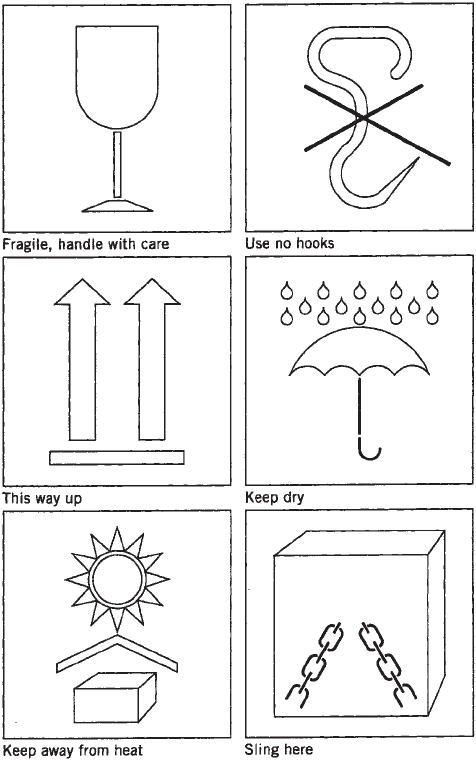
appropriate international shipping symbols such as
‘‘Keep dry,’’ ‘‘Fragile,’’ ‘‘This side up,’’ and ‘‘Lift here’’ or
‘‘Sling here,’’ are all part of the labeling requirements (see
also Figure 1).
Unitization is the assembly of cargoes of similar size
and configuration into a single bundle, group, platform,
or pallet. The purpose of unitization is to reduce cubage,
to facilitate handling, and usually to provide a greater
degree of rigidity to the unitized cargoes. The bundling of
pipe, coiled wire, lumber, and structural steel members
are examples of unitization.
Palletization is a special case of unitization and consists
of placing one or more similar units of cargo on wooden
pallets and securing the cargoes to the pallets usually by
means of steel or synthetic fabric tension bands. If re-
quired, overwraps may be applied to the palletized units to
provide either watershed or waterproof protection. Other
common methods of restraining and securing palletized
cargoes are shrink wrap and tension wrap (polyethylene
or polypropylene films).
The term protective materials generally refers to contact
preservatives such as paint, grease, and oil or to the
watershed or waterproof liners and wraps applied to protect
the cargo from the elements. Protective materials can also
include cushioning materials and blocking and bracing .
Skids are wooden timbers or alternative materials used
either as a base to facilitate handling for heavy cargoes
where cargoes possess inherent rigidity; or skids serve
alone as a base for cargoes that lack inherent rigidity,
protecting them and facilitating handling. Skids are also
major structural members in crate construction. It is
important to note that if skids are used alone as a base
to carry a cargo with or without inherent rigidity, then
attention must be given to the type of load (i.e., uniform or
concentrated), and the skid must be designed accordingly.
In addition, for economic reasons, skids used as structural
members in true crates can be significantly smaller in
cross section than the skids used as support bases because
crate side and top and end panels contribute significantly
to the overall strength of the crate.
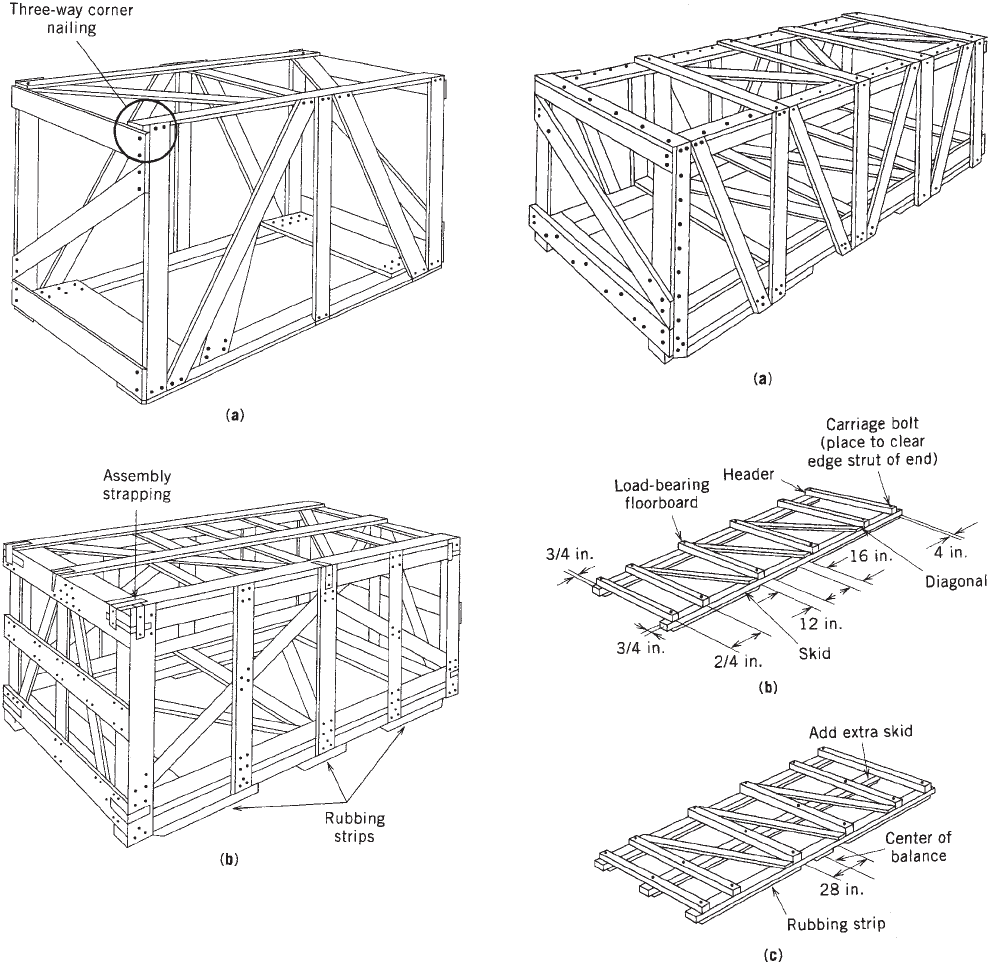
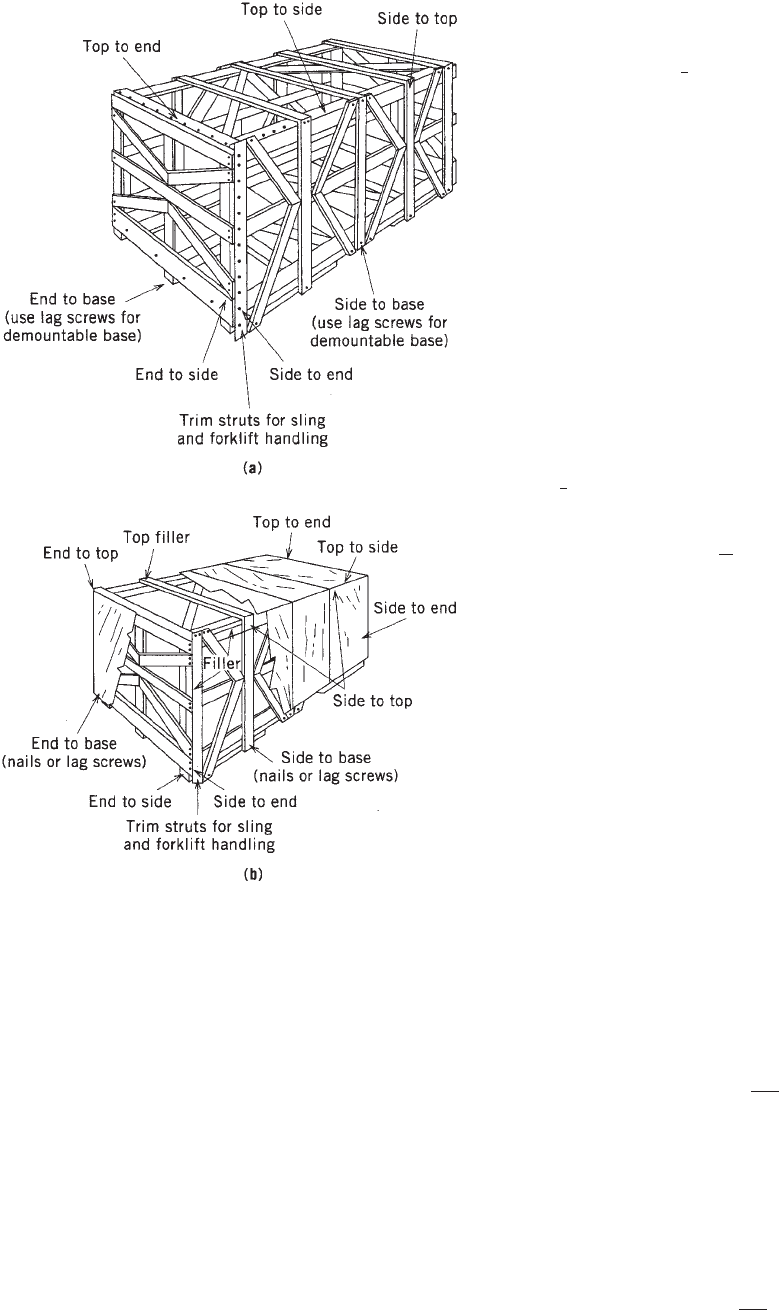
A wood crate (see Figures 2–7 for examples of open-
crate design) is a structural framework of members fas-
tened together to form a rigid enclosure that will protect
the contents during shipping and storage. This enclosure
is usually of rectangular outline and may or may not be
sheathed. A crate differs from a nailed wooden box in that
the framework of members in the sides and ends provides
the basic strength, whereas a box must rely for its
strength solely on the boards of the sides, ends, top, and
bottom. The crate framework can be considered to be
similar to a type of truss used in bridge construction. It
is designed to absorb most of the stresses imposed by
handling and stacking.
A wooden box is simply a rectangular enclosure that
consists of wooden boards or planks nailed along their
ends or sides to adjacent boards or planks. Boxes generally
do not employ framework such as that used in crates.
However, boxes can and should employ cleats and battens,
which are wooden members that act as nailers and
stiffeners.
The wood species most commonly used in crate construc-
tion are divided into four groups largely on the basis of
density. In general, it is good practice to use species in the
Figure 1. International shipping symbols.
MARINE ENVIRONMENT AND EXPORT PACKAGING 693
same group for similar parts. Group I consists of the softer
woods such as pine, spruce, and chestnut. Group II consists
of heavier woods such as Douglas fir and Southern yellow
pine. Group III woods are generally hard woods of medium
density and possess relatively good nail-holding capacity.
Examples o f these woods are ash, soft elm, and soft maple.
Group IV woods are heavy hardwood species, the heaviest
and hardest domestic woods. They have the greatest capa-
city to both resist shock and hold nails. They are difficult to
nail and tend to split but are especially useful where high
nail-holding capacity is required. Oaks, hickory, birch, and
white ash are examples of Group IV wood.
Wood defects should be carefully considered when
selecting wood for skid, crate, and box construction.
Seasoned wood is preferable to green lumber. Knots and
other various defects, such as slope of grain, decay, wane,
shakes, checks, splits, and warping, are defects that affect
the strength and long-term serviceability of wood. Guide-
lines for selecting wood with defects are contained in great
detail in the USDA Wood Handbook (1) and Wood Crate
Design Manual, Agricultural Handbook No. 252 (2).
Rub strips or runners are lumber strips secured to the
underside of skids and skid-based crates to facilitate
handling. Rub strips are an essential part of skid assem-
blies and crates and in box construction for loads in excess
of 200 lb.
Tension bands are metal or fabric bands or straps used
to secure or bind cargoes to pallets or skid bases or as an
Figure 3. (a) Typical open crate; (b,c) bases for light-duty open
crates [(b) r42 in. wide; (c) W42 in. wide] (2).
Figure 2. Open-crate designs: (a) light-duty open crate (for loads
to r200 lb) with three-way corner nailing, the key to proper
assembly nailing of crates of this type; (b) limited military-type
open crate (for loads r2500 lb) designed for the shipment of light,
bulky items that do not require a waterproof container (2).
694 MARINE ENVIRONMENT AND EXPORT PACKAGING
added measure of binding the external members of crates
and boxes. Tension bands are manufactured in a variety of
dimensions and are applied by means of mechanical or
hydraulic tensioning equipment. Tension bands are also
an essential part of good packing.
Reinforcing straps (see Figure 8) are mild steel metal
bands fitted with nail holes and can be affixed at the
corners of crates and at the junction of side-panel vertical
members and top-panel horizontal members. Reinforcing
straps should be applied in two directions where possible.
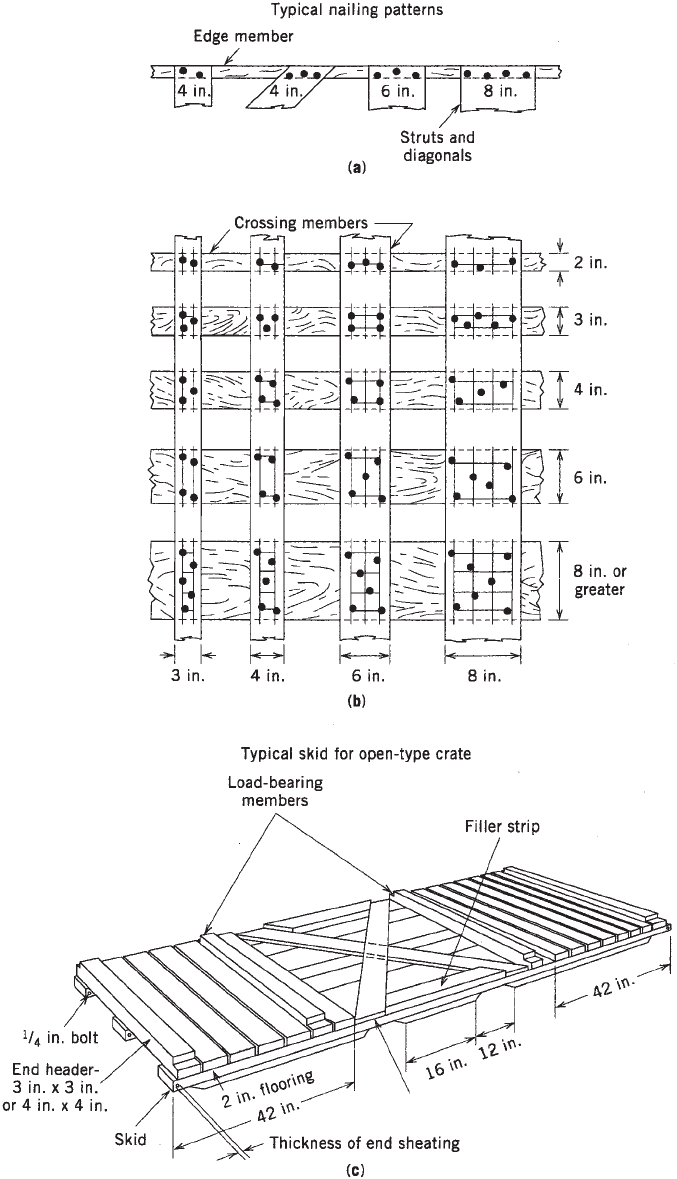
Figure 4. (a,b) Typical nailing patterns;
(c) typical skid for open-type crate (2).
MARINE ENVIRONMENT AND EXPORT PACKAGING 695
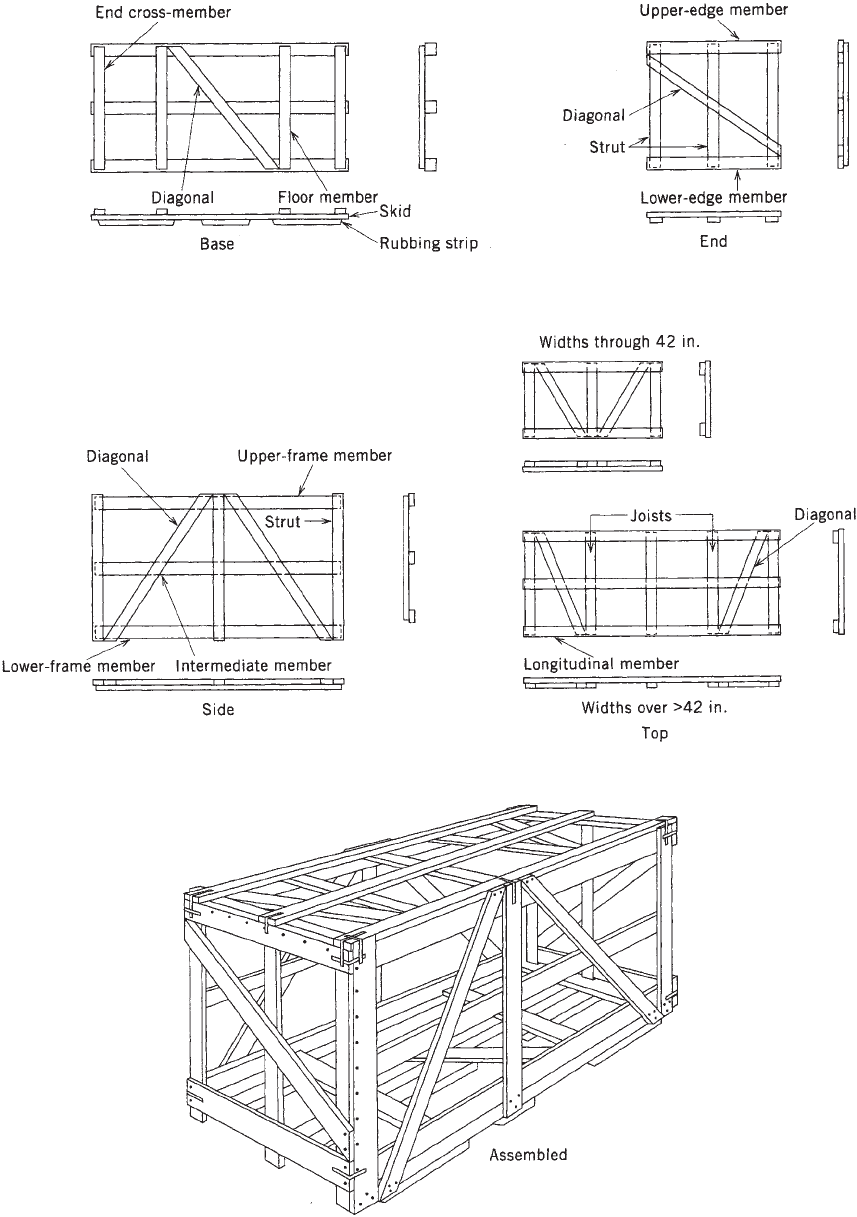
Figure 5. Crate components and final assembly (2).
696 MARINE ENVIRONMENT AND EXPORT PACKAGING
These straps serve as an added measure to prevent the
separation of joints.
Headers are timbers or alternative materials that are
bolted across the end of skid assemblies. Generally, they
are to be of at least the same cross section as the skid
members they join. Headers are an essential part of skid
assemblies in skids acting alone as well as skids serving as
part of a crate.
Load-bearing floorboards are wooden members or al-
ternative materials that are fastened transversely across
the tops of skid assemblies and carry the load of the item
for which the skid assembly is intended.
Splicing refers to the joining, end to end, of two lengths
of timbers of similar cross section to make one longer
section with approximately the same longitudinal
strength as a single continuous piece. The ends to be
spliced are to be notched to half the timber thickness,
and through-bolts are to be placed vertically through
the joining notched sections. Lapped along each side of
the splice is to be a
1
4
-in. steel plate of length no less than
three times the thickness of the members joined and
through-bolted, side to side, with at least two bolts in
each half of the splice.
A uniform load refers to a load that is distributed more
or less evenly over the entire unsupported length of the
member on which it rests. As was pointed out above,
consideration must be given to the type of load, i.e.,
uniform or concentrated, when determining the size of
members to be used as skids and load-bearing floorboards.
A concentrated load is a load that is not distributed
evenly over the unsupported length of the member on
which it rests. Rather, it is centered over a shorter
segment of the member on which its rests, which results
in a bending moment higher than that produced by a
uniform load of similar magnitude.
Rigidity refers to a strength property of materials that
allows them to resist deformation such as longitudinal
bending or racking. For example, a 20-in.-diameter pipe
with
1
2
-in. wall thickness and length of 20 ft may be able
to be picked up by a sling at its midlength without any
noticeable deformation, whereas a 2-in.-diameter pipe
with wall thickness of
3
16
in. and length of 20 ft would
droop noticeably if lifted with a sling at its midlength.
Items with no inherent rigidity, which are intended for
export shipment, should be skidded or crated to facilitate
handling and prevent damage.
Fragility is a term used to describe the degree of
susceptibility to damage from the normal rigors of trans-
portation, i.e., shock and vibration.
The Bending moment, as used within the scope of this
article, refers to the product of a load acting over a
distance to produce deformation of a structural member
that is subjected to the load at some point along its length.
The load may be uniform or concentrated as described
above. As an example, consider a beam supported only at
its extreme ends and subjected to a load at its midlength
such that the resultant of the load acting downward and
the reaction forces at the extreme ends acting upward is a
sagging of the beam. What actually happens here is that
the fibers of the beam in contact with the load are in
compression, whereas the fibers on the underside of the
beam opposite the load are in tension. The bending mo-
ments described above can be written in the form of the
mathematical expression
BM ¼
WL
4
ðft lbÞ
where BM is the bending moment, W is the applied load, L
is the unsupported length of the beam, and the denomi-
nator 4 takes into account that W is a concentrated load.
Similarly, the mathematical expression for the bending
moment resulting from the application of a uniformly
distributed load on the same beam
BM ¼
WL
4
ðft lbÞ
Figure 6. Assembly of (a) light-duty open crate; (b) covered-style
light-duty open crate (2).
MARINE ENVIRONMENT AND EXPORT PACKAGING 697