
Yam, Kit L. (ed.). The Wiley encyclopedia of packaging technology
Подождите немного. Документ загружается.

the efficient, effective forward and reverse flow and sto-
rage of goods, services and related information between
the point of origin and the point of consumption in order to
meet customers’ requirementsy. Logistics management
is an integrating function that coordinates and optimizes
all logistics activities, as well as integrates logistics activ-
ities with other functions’’ (1).
Logistical packaging is more than just cartons, crates,
and corrugated board (2). Also known as distribution
packaging and packaging logistics, it focuses on the
‘‘interaction and relationship between the logistical sys-
tem and the packaging system that add value to the
combined, overall, system—the Enterprise’’ (3).
Packaging affects the cost of every logistical activity
and has a significant impact on the productivity of supply
chains. Transport and storage costs are directly related to
the size and density of packages. Handling cost depends
on unit-loading techniques. Inventory control depends on
the accuracy of manual or automatic identification sys-
tems. Customer service depends on the protection afforded
to products as well as the cost to unpack and discard
packing materials. And the packaging postponement/spec-
ulation decision affects the cost of the entire logistical
system. An integrated logistics approach to packaging can
yield dramatic savings.
Logistical packaging facilitates product flow during
manufacturing and distribution. Logistical packaging in-
cludes shipping containers for consumer goods (which are
almost always also in consumer packages), industrial
packaging for factors of production ranging from automo-
bile parts to food ingredients, and institutional packages.
There is also a packaging aspect to vehicle loading and
unloading, as well as to intermodal containerization.
Every factory and/or logistical operation receives and
ships logistical packaging; most operations unpack, re-
configure, and repack products, as well as purchase and
dispose of packaging materials.
This article deals with the role of packaging in the
logistics systems of supply chains. Readers who seek more
general information about logistics and supply chain
management are referred to texts in the field (4–8).
LOGISTICAL PACKAGING FORMS
Since the early 1900s, common carriers in the United
States have tried to ‘‘regulate’’ the packages they trans-
port. The American Association of Railroads and the
American Trucking Association publish packaging mate-
rial ‘‘requirements’’ in their freight classification books.
Most of the requirements were developed with the help of
the Fibre Box Association (or its predecessors) and use
more corrugated fiberboard material than may be re-
quired for adequate performance (2).
The justification for these requirements has been that
carriers are responsible for paying in-transit damage
claims. One of the carriers’ common law liability defenses
is ‘‘an act of the shipper,’’ including insufficient packaging,
and carriers have tried to maintain that only the packages
in the ‘‘Classification’’ are ‘‘sufficient.’’
These requirements have traditionally been a barrier
to packaging innovation. The existence of the ‘‘Cardboard
Rules’’ has caused many firms to make logistical packa-
ging simply a purchasing responsibility, rather than an
area for proactive management (9).
The barrier has fallen; however; since transportation
was deregulated in 1980, carriers have been able to
exercise much less control over logistical packaging. After
all, carriers are responsible only for in-transit damage,
and there are nonapproved packages that are at least as
protective as those in the Classification.
The logistical channel members who buy, own, and sell
products have a much bigger stake in preventing damage
and controlling other packaging-related costs. The under-
lying logic of integrated logistics management is the
ability to control such systemwide costs.
Furthermore, transportation deregulation has caused
less freight to be subject to common carriers’ packaging
rules since much less freight pricing is governed by the
Classification and more contracts are negotiated. More
freight today is shipped by full truckload, never handled
by the carriers’ workers, and is therefore less subject to
abuse in transit. Today, the Classification ‘‘Cardboard
Rules’’ apply only to less-than-truckload (LTL) common-
carrier freight. And even LTL carriers will accept a
packaging exception to the rules if it is certified as passing
a series of performance tests (10).
This loosening of ‘‘rules’’ has triggered a renaissance in
logistical packaging. Shippers are questioning traditional
packaging materials and forms and are experimenting
with new, less costly packaging systems. For example,
some appliance shippers have reduced the cost of their
packaging by 50%, by replacing corrugated fiberboard
with film-based (shrink- or stretch-wrap) packaging sys-
tems. Some furniture manufacturers have reduced their
package purchase and disposal costs to almost nothing by
utilizing ‘‘blanket wrap’’ (moving van) trucking service.
Assembly companies have switched from expendable to
reusable packaging. These innovations have also been
shown to dramatically reduce damage (11).
Most of the new packaging systems are simple varia-
tions of traditional packaging forms, using traditional
materials in new and innovative ways. They all have
two things in common: They are tailored to perform for
specific products and logistical systems, and they mini-
mize packaging purchase and solid-waste disposal costs.
The traditional logistical packaging materials and
forms
are
. Wood pallets
, crates, blocking, and bracing
. Corrugated fiberboard boxes, dividers, inserts, and
dunnage
. Solid fiberboard slipsheets and boxes
. Plastic and multiwall paper bags and drums
. Intermediate bulk containers, bulk bags
. Steel cans, pails, drums, and straps
. Steel racks and cages
. Fabric (burlap and woven plastic) bags and blankets
. Plastic film shrink wrap and stretch wrap
. High-density plastic boxes, slipsheets, and pallets
. Blanket-wrapping, decks, and restraints
678 LOGISTICAL/DISTRIBUTION PACKAGING
. Plastic strapping
. Plastic foam cushioning and dunnage for fragile or
irregular shapes
Descriptions, properties, and specifications of most of
these materials can be found elsewhere in this
Encyclopedia.
LOGISTICAL PACKAGING PERFORMANCE
Logistical packaging only adds value because it functions
in a logistical system to provide protection, utility, and
communication. Performance specification and value ana-
lysis, which can be used to guide packaging innovation,
employ a functional approach.
The amount of protection that a package must provide
depends on the characteristics of the product and condi-
tions in the logistical system. The relationship can be
conceptualized as
Product characteristics þ logistical hazards
¼ package protection required
Damage is a symptom of a system out of adjustment,
resulting from product problems, handling problems, or
packaging problems. Packaging is generally responsible
for the product quality that is maintained after the name
goes on.
The relevant product characteristics are those that can
be damaged during distribution. Examples include the
propensity of food to deteriorate as a result of tempera-
ture, oxygen, or moisture; the tendency for furniture to
rub during transit vehicle vibration; and the fragility of
products and packages that can break when dropped
during material handling operations.
The hazards of a logistical system depend on the types
of transportation, storage, and handling used. For exam-
ple, full truckload (TL) transportation generally causes
less damage than less-than-truckload (LTL) transporta-
tion where packages are handled repeatedly during trans-
loading operations and have many more chances to be
dropped or loaded beneath or beside damaging cargo.
Railroad shipment often incurs damage as a result of
railroad switching and coupling operations.
The hazards of international transportation range from
flatbeds to bikecarts. Intermodal containerization for in-
ternational shipment has reduced impact and moisture
damage, compared to ‘‘breakbulk’’ shipping. But even
when products are shipped containerized, they will prob-
ably be handled in a breakbulk operation inland overseas
for which they require adequate packaging performance.
In general, moisture protection and protection from
oxidation are obtained by using barrier materials—which
keep water and water vapor, oxygen, and other destruc-
tive contaminants away from the product, and conserve
flavor components in food—or by enclosing desiccant or
oxygen-absorbing packets. Shelf life can be lengthened by
the use of barrier materials and/or controlling the atmo-
sphere inside food packages. Temperature protection re-
quires insulated containers.
Protection against impacts can be obtained through the
use of cushions for shock-sensitive products. Protection to
prevent impacts from bursting a package wall requires
improving the walls’ tensile strength and puncture resis-
tance. To prevent products from shifting during railroad
switching and coupling impacts or as an intermodal con-
tainer is placed onto or removed from a flatbed railcar,
trailer chassis, or ship, loads are blocked and braced to the
boxcar or container floor (12–14).
A basic rule for improving protection against impacts,
vibration, and compression is to always pack products
tightly so there is no headspace, no room to rattle, and a
shared reliance on box walls for stacking strength. Vibra-
tion or abrasion protection may also require changing
package surface or spring–mass characteristics. To im-
prove stacking, compression strength may need to be
added to the package walls.
The relative protectiveness of alternative packaging
systems can be evaluated and compared in laboratory
and field tests. Standardized tests are available from the
ASTM International and the International Safe Transit
Association (ISTA), which can be used to develop more
specialized tests to evaluate specific properties. The best
tests target the package’s specific damage characteristics
(e.g., bags’ ends burst in side drops) and provide a measure
of the difference between alternative packages’ perfor-
mance (how much energy is required to burst), rather
than simple pass/fail tests.
The more liable the product is to damage and the more
hazardous the logistical system’s operations, or the higher
the cost of damage, the more packaging protection is
required. It is important to note, however, that the amount
of protection is not directly related to the cost of packaging.
In most cases it is possible to improve protection and
reduce packaging cost at the same time by simply choosing
more appropriate materials and methods. For example, the
U.S. Food for Peace program has been able to reduce the
number of paper piles in multiwall bags and improve
protection by simply changing the bag sealing method.
Accurate measurement of damage can provide the most
valuable information for directing attention to problems.
But
packaging decisions regarding
damage prevention are
often made without sufficient information. Typical reports
of damage problems are unspecific as to the amount,
types, and causes. It is difficult to quantify costs for
damage, because they are scattered among firms in a
logistical system (15). Since carriers are (to the extent of
their contract) responsible for the damage they cause,
documented in-transit damage claims are the first place
to look for damage trends (16). Damage that is caused by
wholesalers and retailers is more elusive, and their co-
operation is required to report and evaluate losses.
In order to reduce waste, improve customer service,
and control packaging costs, some firms have developed
systems to track and manage product quality during
distribution (17). Such logistics quality-control systems
resemble systems for managing product quality during
manufacturing and include the following steps:
. Setting standards for critical defects
. Appraising conformance to standards, including
LOGISTICAL/DISTRIBUTION PACKAGING 679

. Monitoring and collecting data (e.g., electronic data
interchange)
. Reporting and evaluating data (Pareto analysis)
. Corrective action (modify the package, product, or
handling
Once a firm knows about its logistical damage, it can
target initiatives where they will do the most good. For
example, some furniture companies target specific
packages and products for improvement when damage
quantity and/or costs are higher than normal (18). Initia-
tives may include changing the product, changing the
logistical hazards, or changing the package. Specific in-
formation about damage is particularly useful when de-
veloping package tests and performance levels for
alternative packages. For example, some food manufac-
turers have learned that a most common source of damage
is box-cutter damage. In response, they have developed
easy-open display-ready packages (19).
In many cases, it costs much less to reduce the hazards
than to ‘‘improve’’ the packaging. Examples include
. The use of refrigerated transportation and storage to
protect fresh produce
. The use of storage racks in warehouses to prevent
compression damage
. Good sanitation practices during distribution to re-
duce the need for packaging to prevent vermin
infestation.
In other cases, the lowest-cost solution is to design
products to better survive shipment hazards. Product
design changes range from reducing fruit bruising
through genetic modification, to improving the impact
resistance of an electronic product’s circuit-board fasten-
ers. An impact-resistant product requires little cushion-
ing, which minimizes cube and trash, and is more reliable
in use than a fragile product.
Packaging must also protect people in the logistical
system from injury and accidents. Workers’ ergonomics
and safety problems can be solved through better packa-
ging, especially since there are so many possibilities for
injury while working with packages. Routine package
handling can be linked to chronic stress injuries, and
material-handling accidents can kill people.
Routine manual handling of packages has always been
taken for granted, but it is traditionally the source of many
back injuries. OSHA guidelines answer the question ‘‘How
heavy should manually handled packages be?’’ with an
answer that depends on how far and how often the lifting is
done. For example, for ‘‘continuous high-frequency lifting,
variable tasks,’’ such as manual receiving operations,
weights below 17 lb are acceptable and represent nominal
risk, weights between 17 and 50 lb are acceptable only with
administrative or engineering controls, and packages
weighing over 50 lb are unacceptable (20).
Accidents happen. Personal-injury lawsuits involving
packaging materials and methods are increasing. The
liability judgment generally depends on whether the
accident could have been foreseen and whether adequate
packaging and training procedures were followed. For
example, when a long-shoreperson is injured by a bag
that slips from a stack, the fabric is accused of not
complying to standards, the unit-loading technique is
examined (maybe it should have been stretch-wrapped),
and the port practices are questioned. It is especially
important for firms to evaluate packages that are involved
in previous accidents, in order to prevent future
occurrences.
The packaging function of utility relates to how packa-
ging affects the productivity and efficiency of logistical
operations. All logistical operations are affected by packa-
ging utility—from truckloading and warehouse-picking
productivity, to transportation and storage cube utiliza-
tion, to customer productivity and packaging waste
reduction.
Productivity is the ratio of real output to real input:
Productivity ¼
number of packages output
logistics input
Logistical productivity is the ratio of the output of a
logistical activity (like loading a truck) to the input (like
labor and forklift time required). Most logistical produc-
tivity studies center around making the input, particu-
larly labor, work harder.
But packaging unitization and size reduction initia-
tives easily increase the output of logistical activities.
Almost all logistical activity outputs are described in
terms of number of packages. Some examples include
number of cartons loaded per hour into a trailer, number
of packages picked per hour at a distribution center, and
number of packages that fit into a cubic foot (ft
3
; ‘‘cube
utilization’’) of vehicle or warehouse space (21). Testing
alternative packages for their logistical efficiency is a
simple matter of productivity measurement.
For example, palletization and/or unitization improves
the productivity of most handling operations. Warehouse-
order-picking productivity can be improved by making
packages easy to find and recognize, by packing items in
order picking quantities (e.g., dozens), and by making it
easy to repack the heterogeneous order.
Cube utilization can be improved by reducing package
size. Package size can be reduced by concentrating pro-
ducts (e.g., orange juice and fabric softener) or by elim-
inating space inside packages by shipping items
unassembled, nested, and with minimal dunnage. In
most cases, the amount of dunnage materials (e.g., ex-
panded polystyrene loose-fill) can be minimized simply by
reducing box size. Experts believe that improving cube
utilization is packaging’s greatest opportunity and predict
that, in general, packaging cube can be reduced by 50%,
doubling transportation efficiency.
Cube minimization is most important for lightweight
products (like assembled furniture) that ‘‘cube out’’ a
transport vehicle far below its weight limit. Trailer sizes
vary; most in the United States are 53 ft long, with inside
dimensions of 52.5 ft 99 in. 98 in. (high cube trailers
are 108 in. tall); and cargo weight limits are generally
about 40,000 to 44,000 lbs depending on the weight of the
680 LOGISTICAL/DISTRIBUTION PACKAGING
vehicle itself. On the other hand, heavy products (e.g.,
liquid in glass bottles) ‘‘weigh out’’ a transport vehicle
before it is filled. Weight can be reduced by changing the
product or the package. For example, substituting plastic
bottles for glass significantly increases the number of
bottles transported in a trailer.
Packaging utility also depends on the compatibility of
packages with pallets and other material-handling equip-
ment used in a logistical system. Pallet-load efficiency can
be improved by designing shipping containers to better
fit the footprint: Most grocery pallets in the United States
are 48’’ 40’’; most in Europe are 1200 mm 800 mm.
There are efforts underway to implement a compromise
standard of 1200 mm 1000 mm. In some logistical
systems, especially internationally, pallets are not used,
and packages may need the ability to be efficiently
manually handled (or by the longshoreperson’s hook)
repeatedly.
Packaging can also add utility for logistical customers.
The cost of unpacking is seldom considered by the firm
that packs products. But easy-opening features improve
retailer’s direct product profitability by reducing custo-
mers’ costs of opening and displaying or installing
products.
Packaging disposal is also borne by logistical custo-
mers. Besides the environmental impact, logistical packa-
ging trash disposal costs money and can severely reduce a
customer’s productivity, particularly in nations such as
Canada and Germany, which have enacted legislation to
reduce packaging waste.
Packaging solutions to disposal problems include redu-
cing, reusing, and recycling. Reduction of packaging
also saves on packaging purchase costs. Packaging reuse
generally adds some costs for sorting and return trans-
portation. Recycling is growing in more widespread use
and gaining popularity, thus reducing costs and increas-
ing markets.
Recycling is a good disposal method for most logistical
packaging waste, since logistical packaging waste natu-
rally collects in large heterogeneous piles. Manufacturers,
warehouses, and retailers discard large amounts of pal-
lets, corrugated fiberboard, polyethylene film, plastic
foam, and strapping. Recyclers appreciate such concen-
trated and relatively clean sources (compared to sorting
and cleaning curb-side and food-service wastes). Likewise,
purchasing packages made from recycled material en-
courages the growth of a recycled products market and
infrastructure. Recycling is sometimes called ‘‘reverse
logistics’’ (22).
One of the most popular trends is the use of more
reusable/returnable packaging for products such as as-
sembly parts, food ingredients, and snack chips, from
retail warehouse to store totes and intraplant shipments.
Most reusable packages are steel or plastic; some firms
reuse corrugated fiberboard boxes and pallet boxes. There
are also flexible reusable systems: blanket-wrapping and
intermediate bulk containers such as bulk bags.
The growing reusable packaging applications all have
one thing in common: a short vertical marketing system. A
vertical marketing system (as contrasted to a ‘‘free-flow’’
marketing system) is one in which the primary
participants are either corporate ownership, contracts, or
administration under the control of one firm (23).
A vertical marketing system is important because of
the need to control the movement of returnable containers
and the need to share the investment benefits. All part-
ners in a returnable system must cooperate to maximize
container use, and an explicit relationship is required for
coordination and control. Otherwise, containers are easily
lost or misplaced. Alternatively, deposit systems may be
necessary in free-flow marketing systems (like groceries),
where the channel members are linked only by transac-
tions. Deposit systems have been used for beverage bot-
tles, pallets, and steel drums.
The shipment cycle should be short, in terms of time
and space, in order to minimize the investment in the
container ‘‘fleet’’ and to minimize return transportation
costs. The size of the investment depends on the number of
days in the cycle.
Deciding to invest in a returnable-packaging system
is a very different task from purchasing ‘‘expendable’’
containers. The decision involves considering explicit re-
levant costs—purchase cost, including number of
packages in the cycle, and transport cost—versus the
purchase and disposal cost of expendables. Intangible
benefits such as improved factory housekeeping, improved
ergonomics, and decreased damage are often considered.
Generally, there are a number of unexpected costs, includ-
ing sorting, tracking, and cleaning. Most financial
analysis of returnable systems has been limited to ‘‘pay-
back period’’ justification rather than net present value
calculations, which would demonstrate the strategic and
profit potential of a returnable-packaging system
investment.
The efficiency of the logistics system that returns
containers or pallets to use determines the cost as well
as the environmental sustainability (24). Most logistical
systems for reusable packaging use a shared pool system,
rather than a strict one-for-one return. These can be
owned by the supply chain, rented from third parties or
traded in a free market (such as the market for used
wooden
pallets) (25).
The
function of communication is becoming more im-
portant for logistical packaging, as logistical management
information systems become more comprehensive. For all
practical purposes, the package symbolizes the product
throughout logistical channels. Correct identification of
stock-keeping units (including name, brand, size, color),
counting, special shipping instructions (e.g., ‘‘Hazar-
dous’’), and address are critical to quality logistical in-
formation management. International shipments require
the language of origin, destination, and intermediate
stops, as well as international markings for handling
instructions.
For example, automatic identification (e.g., bar coding
or radio-frequency identification) highlights the commu-
nication function and can interface with information
systems throughout a logistical system if the symbology
is standardized (see Radio Frequency Identification
(RFID)). But even manually readable packaging
must be clearly legible to interface with logistical man-
agement information systems; workers must be able to
LOGISTICAL/DISTRIBUTION PACKAGING 681
quickly recognize a package from its label. Almost every
logistical activi ty—ent ails reading the package and re-
cording or changing its status in an information system—
inventory control, shipping a nd receiving, order picking,
sorting, and tracking. Automatic identification technolo-
gies such as bar coding and radio-f requency identifi cation
enable a systems approach t o managing logistical infor-
matio n where ever y input is standardized and errors are
reduced.
The functions of packaging—protection, utility, and
communication—are the basis for packaging performance
specifications. Performance specifications outline what the
package must do (e.g., be able to survive an impact). The
specification of performance guides packaging changes
that add value and reduce costs.
Many firms and government agencies have adopted
packaging performance specifications for logistical packa-
ging. For example, the U.S. Department of Transportation
(DOT) has replaced hazardous-material packaging speci-
fications with ‘‘Performance Standards’’ that do not specify
material, but do specify tests (e.g., impact, permeability, or
compatibility tests) for specific product/package/hazard
conditions.
Performance specifications encourage innovation, and
innovation results in lower pac kaging costs. Mat erial
specifications are necessary, of c ourse, for routine packa-
ging purchases, but adding a performance specification
offers two benefits: (1) a firm that examines its current
and expected leve ls of packaging performance will always
uncov er opportunities to cut pac kaging-relat ed costs;
and (2) suppliers who are invited to compete on a perfor-
mance basis will always suggest lower-cost packaging
solutions.
TYPICAL LOGISTICAL PACKAGING PROBLEMS
There are three types of logistical packaging problem:
engineering problems, cost problems, and logistical pro-
blems with packaging solutions. Generally, logistical
packaging problems require on-site investigations—the
best way to find out more is to go and look.
Packaging professionals use engineering principles of
material science to develop new packages and solve pro-
tection and productivity problems. The most common
material properties that can be scientifically determined
are cushioning (for fragile products), impact and vibration
resistance of filled packages (26), shelf life and perme-
ability for oxygen- or moisture-sensitive food products
(27), and compression strength for hard-to-stack products
(28). Packaging professionals also use some industrial
engineering principles to configure packing operations
and choose packaging machinery.
Management of logistical packaging, however, involves
more than ‘‘package engineering.’’ Most packaging pro-
blem solving is not associated with developing new
packages for new products. In fact, most ‘‘new’’ logistical
packages are simply variations of packages used for
similar products and require very little ‘‘engineering.’’
The second principal activity of a packaging profes-
sional is to reduce the cost of purchasing packaging
materials and the cost of packing operations. The most
common areas for cost reduction are reducing package
weight or size, material substitution, size reduction, auto-
mation of manual tasks, and standardization. Innovative
incremental packaging solutions, which reduce cost and
improve performance, abound in the packaging supply
industry. Manufacturers of packaging materials and
equipment are sources of a great amount of free, if
potentially biased, consulting advice, so it is wise to
consult more than one. Other good references include
trade journals such as Packaging, Materials Handling
Engineering, Modern Materials Handling, and Transpor-
tation and Distribution.
The third type of packaging problem consists of logis-
tical problems and opportunities with packaging solutions.
Packaging can reduce the cost of every logistical activity:
transport, storage, handling, and inventory control, and it
can improve customer service. It can reduce the cost of
damage, safety, and packaging disposal. Integrated man-
agement of packaging and logistics is required, if a firm is
to realize such opportunities (29–32).
When packaging and logistics are integrated, it is
reasonable to consider where and when packaging opera-
tions fit into a logistical channel. Packaging postponement
can dramatically reduce the cost of an entire logistical
system.
The logistical concepts of postponement and speculation
can be profitably applied to packaging logistics. These
question where and when to add value (time, place, and
form utility) in distribution channels in order to reduce
costs or improve customer service. The principle of spec-
ulation says that manufacturing and shipping should
occur at the earliest possible time in the marketing flow
in order to achieve economies of scale. The opposite
principle of time and form postponement reduces risk by
requiring that changes in form and identity and inventory
location occur at the latest possible point in the marketing
flow
, since every
differentiation that makes a product
more suitable for a specified segment of the market makes
it less suitable for other segments. The traditional inven-
tory tradeoff is to reduce risk by postponement (just-in-
time logistics) or to reduce cost with economies of scale
(forward buying) (33).
Traditionally, the packaging point for bulk products
has been postponed or speculated, on the basis of product
and market conditions. For example, produce is canned
in the fall and stored in ‘‘bright’’ cans; labeling is post-
poned until food-marketing companies buy and brand it
throughout the year. Labeling postponement minimizes
the risk of inventory misforecasts and economizes
on canning production during a busy season. On the
other hand, processing and packaging of frozen fruit
concentrates, such as orange or grapefruit juice, is
an example of speculation, resulting in low costs
because weight is eliminated before shipping and homo-
genous waste at the orchard is processed for animal
food.
Postponement and speculation also apply to assembly
and packaging of more sophisticated products in a global
market with global sources. When products are similar,
but differentiated for local markets, assembly and
682 LOGISTICAL/DISTRIBUTION PACKAGING
packaging postponement offers opportunities for custo-
mizing packaging for the local markets while minimizing
long-distance transport costs and the amount of differen-
tiated inventory in the pipeline.
For example, one of the largest cost-savings initiatives
in packaging history (tens of millions of dollars per year) is
a case of international packaging postponement. To reduce
high transport and inventory management costs, a major
electronics manufacturer has postponed the packaging for
products shipped overseas. The products are shipped in
‘‘bulk packs,’’ palletized and stretch-wrapped, with mini-
mal interleaving between layers. Once there, products are
packaged to order. Transport costs have been cut in half,
since differentiation and cushioning are postponed until
they are required (34).
INNOVATIVE LOGISTICAL PACKAGING
This article has approached the field of logistical packa-
ging from a nontraditional perspective. The reason for this
approach is to encourage innovative packaging solutions
to logistical problems. Most traditional packaging forms
date from the early 1900s and are the most costly packa-
ging systems available. Innovation represents a dramatic
potential for savings.
Packaging innovation is a process of problem identifi-
cation, finding and testing potential solutions, deciding
which action to take, and following through to implemen-
tation. It requires proactive management by a project
champion—usually a packaging professional. It also re-
quires a systems and team approach, since packaging
affects so many other functional areas such as marketing,
operations, plant and product engineering, logistics, ac-
counting, and finance.
Identification of packaging-related problems is the first
step. Problems of cost, protection, utility, and communica-
tion may be identified by customers, salespeople, logistical
managers, or packaging professionals. The search for
packaging solutions may be formal or informal, but the
innovation process requires a potential solution before it
can proceed. Sometimes problems languish for years
before someone thinks of a good solution. Ideas for poten-
tial solutions can come from suppliers or consultants or
from the advice of colleagues. Alternative packages are
judged, subjectively or in lab tests, for their protection,
utility, and communication performance, as well as sys-
temwide cost implications. Next, the ‘‘best’’ solution
packages are tested in the field (test shipments) and for
market acceptance. The early rollout is a period of fine-
tuning. Problems with the new package are discovered
and corrected. Sustained implementation returns to a new
level of business as usual—generally with substantial cost
savings.
CONCLUSION
This chapter has shown that, beyond its purchase cost,
packaging affects the cost of every logistical activity.
Package size affects transportation cost; unitization
methods affect order picking and handling costs; identifi-
cation techniques affect inventory control; and customer
service depends on damage control and the cost to unpack
and discard packaging. Firms that manage packaging
from an integrated logistical perspective, rather than
from a traditional purchasing perspective, will find
many opportunities for improving their profitability.
BIBLIOGRAPHY
1. Council of Supply Chain Management Professionals. Supply
Chain Management and Logistics Management Definitions,
2007 (cited 2007 August 2); Available from: http://cscmp.org/
AboutCSCMP/Definitions/Definitions.asp.
2. D. Twede and S. E. M. Selke, Cartons, Crates and Corrugated
Board—Handbook of Paper and Wood Packaging Technology,
DEStech Publications, Lancaster, Pennsylvania: Inc., 2005.
3. M. Saghir, Packag. Technol. Sci. 15, 37–46 (2002).
4. D. J. Bowersox, D. Closs, and T. P. Stank, eds., 21st Century
Logistics: Maing Supply Chain Integration a Reality. Council
of Logistics Management, Oak Brook, IL, 1999.
5. D. J. Bowersox, D. J. Closs, and M. B. Cooper, eds., Supply
Chain Logistics Management. McGraw-Hill, Boston, MA,
2002.
6. J. T. Mentzer, Supply Chain Management, Sage Publications,
Thousand Oaks, CA, 2001.
7. D. Blanchard, Supply Chain Management: Best Practices.
Wiley, Hoboken, NJ, 2007.
8. H. Stadtler and C. Kilger, eds., Supply Chain Management
and Advanced Planning: Concepts, Models, Software and
Case Studies, 3rd edition Springer, Berlin, New York, 2005.
9. M. A. McGinnis and C. J. Hollon, J. Bus. Logist. 1, 45–62
(1978).
10. International Safe Transit Association, Pre-Shipment Test
Methods. ISTA Annual, Chicago.
11. D. Twede, J. Busi. Logist. 13, 69–94 (1992).
12. J. Agnew and J. Huntley, eds., Container Stowage: A Practical
Approach. Container Publications Ltd., Dover, NJ, 1972.
13. United States. Maritime Administration., A Shipper’s Guide
to Stowage of Cargo in Marine Containers. U.S. Department
of Transportation Documents, U.S. G.P.O., 1982.
14. Association of American Railroads, Loading Methods for
Closed Cars, AAR, Chicago, various dates.
15. J. L. Cavinato, Analysis of Loss and Damage in a Procure-
ment Distribution System Using a Shrinkage Approach, in
Business Logistics, Pennsylvania State University, State
College, PA, 1975.
16. W. J. Augello, in G. Pezold, ed., Transportation, Logistics and
the Law, 2nd edition, Transportation Consumer Protection
Council, Huntington, NY, 2004.
17. D. Twede, Packag. Technol. Sci. 4, 305–310 (1991).
18. T. J. Lowery, Quality Control of Products During Distribution,
in Logistical Packaging Innovation, Council of Logistics
Management, Chicago, 1991.
19. W. Thompson, Improving Customer Service ‘‘Packages’’:
Direct Product Profitability,inLogistical Packaging Innova-
tion, Council of Logistics Management, Chicago, 1991.
20. T. R. Waters, Applications Manual for the Revised NIOSH
Lifting Equation, U.S. Department of Health and Human
Services, Public Health Service, National Technical Informa-
tion Service, Cincinnati, OH, 1994.
LOGISTICAL/DISTRIBUTION PACKAGING
683
21. A. T. Kearney, Measuring and Improving Productivity in
Physical Distribution, Council of Logistics Management,
Chicago, IL, 1984.
22. M. P. A. R. D. de Brito, ‘‘A Framework for Reverse Logistics,’’
in Reverse Logistics: Quantitative Models for Closed-Loop
Supply Chains, M.F. Rommert Dekker, Karl Inderfurth and
Luk N. Van Wassenhove, eds., Springer-Verlag, Berlin, 2003,
pp. 3–27.
23. D. Twede and R. Clarke, J. Market. Channels Distrib. Syst.
Strategy Manage. 12, 7–26 (2004).
24. L. Kroon and G. Vrijens, Int. J. Phys. Distrib. Logist. Manage.
25, 56–69 (1995).
25. D. Twede, D. Mollenkopf, and C. Guzman-Siller, A Market
Driven Investigation of Pallet Trends in Grocery Chains,
National Wooden Pallet and Container Association, Washing-
ton, DC, 2006
26. R. K. Brandenburg and J. J.-L. Lee, Fundamentals of
Packaging Dynamics, 4th edition, L.A.B., Skaneateles, NY,
1991.
27. G. L. Robertson, Food Packaging : Principles and Practice,2nd
edition, Taylor & Francis/CRC Press, Boca Raton, FL, 2006.
28. G. G. Maltenfort, Corrugated Shipping Containers: An En-
gineering Approach, revised edition, Jelmar Publishing Co.,
Plainview, NY., 1996, p. vi.
29. K. Johansson, A. Lorentzon Karlsson, C. Olsmats, and L.
Tiliander , Packaging Logistics, Packforsk, Kista, Sweden, 1997.
30. M. Johnsson, ‘‘Packaging Logistics—A Value Added Ap-
proach,’’ in Engineering Logistics, Lund University, Lund,
Sweden, 1998.
31. M. Jahre, ‘‘Packaging Logistics for Improving the Environ-
ment and Economics in the Value Chain,’’ in Logistical
Packaging Review, Econpap, A
˚
rhus, Denmark, 2000.
32. C. W. Ebeling, Integrated Packaging Systems for Transporta-
tion and Distribution, Marcel Dekker, New York, 1990.
33. L. P. Bucklin,. J. Market. Res. 2, 26–32 (1965).
34. D. Twede, R. H. Clarke, and J. A. Tait, Packag. Technol. Sci.
13, 105–115 (2000).
684 LOGISTICAL/DISTRIBUTION PACKAGING
M
MACHINE DIRECTION ORIENTATION
D. RYAN BREESE
Eclipse Film Technologies,
Hamilton, Ohio
ERIC HATFIELD
Vice President, MDO
Engineering, Cincinnati, Ohio
INTRODUCTION
In the MDO process, a polymer film, tube, or sheet is
uniaxially stretched in the machine direction. MDO is also
commonly seen as the first of two steps associated with
biaxially orienting films, with the second step being the
tentering, which stretches the film in the transverse
direction.
Machine direction orientation (MDO) of polymer films
provides improvements in stiffness, strength, optics, and
barrier and has been commercially practiced for decades.
MDO is being utilized to produce films for a wide range of
applications and marketplaces, including food, medical,
and industrial packaging. Due to the strong economic
drivers, companies are utilizing MDO films at an ever-
increasing rate (1, 2). The improvement in mechanical
properties allows for the downgauging of a current film,
which is the most common use of MDO films. In addition,
MDO films can be used to replace a less desirable sub-
strate, such as one that is more costly, is more difficult to
source, is less receptive to ink, has a lower yield (MSI/lb),
and/or is less environmentally friendly. Also, through the
use of various polymers and film extrusion technologies,
MDO can be used to produce a single film that has a
desired combination of properties that were otherwise
only attainable through a more costly secondary process,
such as laminations or coatings.
STEPS OF THE MACHINE DIRECTION ORIENTATION
PROCESS
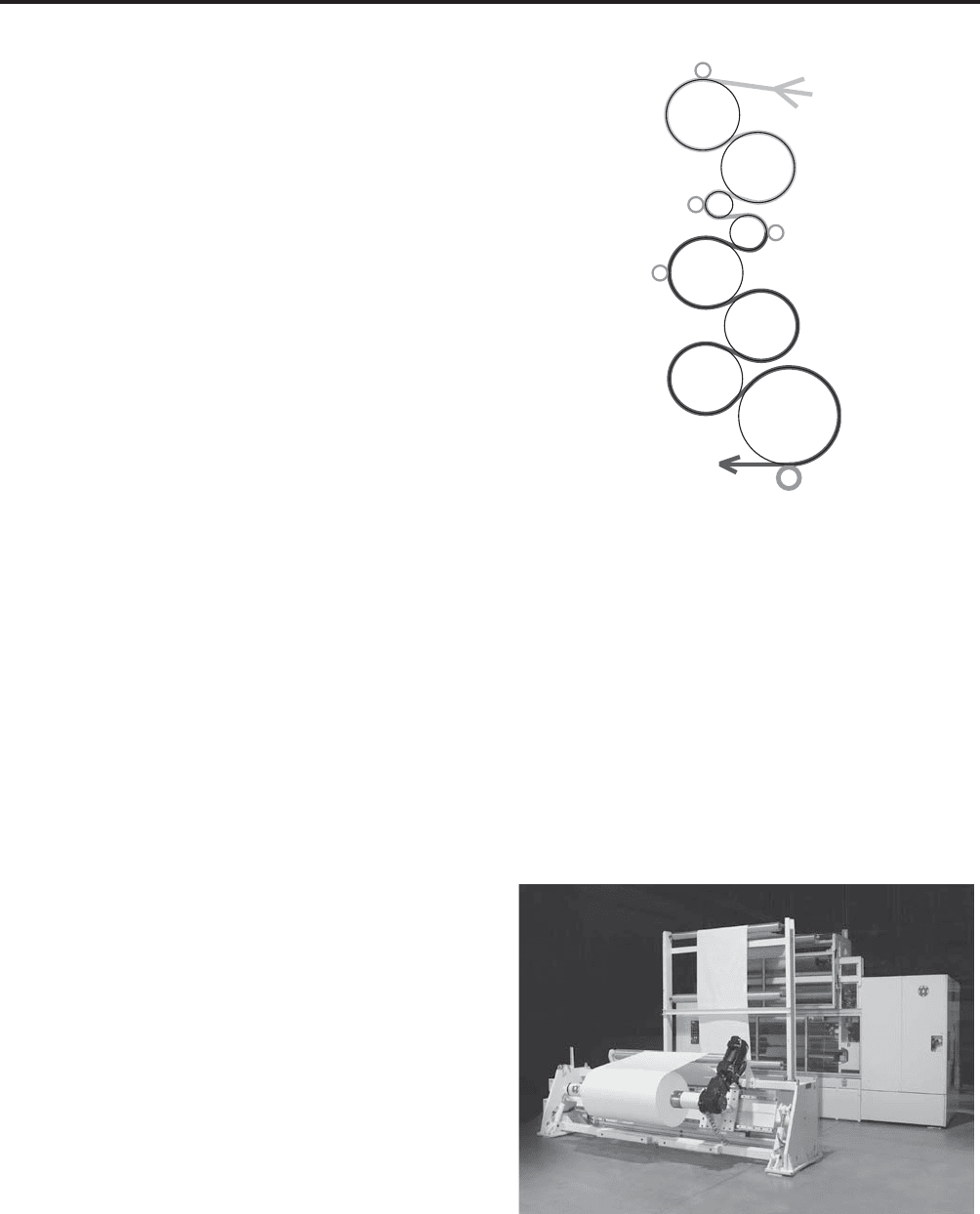
There are four main steps to the MDO process, as shown
in Figure 1 (3).
Figure 2 is a photograph of a commercial scale MDO
unit and its respective unwinder.
Preheat (PH). The function of the preheat section is to
uniformly heat the film to the desired orientation
temperature. This must be done without generating
wrinkles or damaging the surface of the film.
Drawing (SD, Slow Draw; FD, Fast Draw). After
preheating, the film is oriented between the slow
and fast draw rolls. In this stage, the fast draw roll is
rotating at a specified ratio faster than the slow
draw roll. The gap between these rolls can be
adjustable to process a wide variety of films. Typi-
cally, the film can be oriented to as high of a ratio as
10:1 in a single draw section. Higher ratios are
possible, but depend on the equipment’s design,
polymer selection, and film structure.
Annealing (A). The third section of an MDO consists
of the annealing rolls. This section thermally stabi-
lizes the film’s properties, such as the percentage of
shrink. For example, annealing the film at an ele-
vated temperature allows it to relax, minimizing the
IN
PH-1
PH-2
SD
FD
A-1
A-2
C-2
C-1
OUT
Figure 1. Schematic of an MDO. The equipment consists of
preheat (PH), slow and fast draw (SD, FD), and annealing (A)
and cooling (C) rolls. Nip rolls are shown on PH-1, SD, FD, A-1,
and C-2.
Figure 2. Photograph of a commercial scale MDO unit and its
respective unwinder.
685
percent shrinkage when the film is exposed to
elevated temperatures, as is the case with the pouch
or bag forming process. Conversely, immediately
cooling the film in the annealing section hinders
the relaxation of the film. The residual stress in the
film causes it to shrink when exposed to elevated
temperatures. This characteristic is desirable in
several applications, such as shrink wrap bundling
and shrink bottle labels.
Cooling (C). The cooling section is the last stage in the
MDO, where the film is cooled to near-ambient
temperature for winding.
DESIGN OF THE COMPONENTS OF A MDO LINE
The MDO production line consists of the following compo-
nents (3):
. Unwinder
. MDO unit
. Auxiliary equipment, such as treaters, profile
gauges, and trim collection systems
. Rewinder
Unwinder
An unwinder is used if the MDO is not in-line with film
extrusion, such as a blown or cast film unit. Often, the
unwinder is very simple; however, more elaborate units
can be utilized that make the process of changing rolls
easier and improve the economics of the process by
decreasing roll change over time. The following items
must be considered when choosing an unwinder:
. Changing rolls needs to be done safely and efficiently.
. The unwinder should be able to handle rolls of the
same dimensions as the rewinder.
. Tension control needs to be incorporated into the
unwinder operations to minimize wrinkles as the
film enters the MDO.
MDO Unit
While the basic sections of the MDO have already been
discussed, some general comments about each section
must be made.
Preheat Section of the MDO. In the preheat section,
accommodations for the relaxation of the film must
be included in the design of the MDO. If the film is
heated too fast, wrinkles can form, causing incon-
sistent operating conditions from uneven heating
of the film, resulting in unacceptable film quality
and/or breaks. If the film is heated too slowly, the
necessary orientation temperature will not be
reached, resulting in uneven stretching and possible
breaks.
Draw Section of the MDO. Orientation in the drawing
section must be conducted in a controlled fashion,
with uniform temperatures across the film. In addi-
tion, the rate at which the film is drawn is critical for
establishing stable operating conditions. Process
parameters, such as orientation temperature, draw
ratio, incoming line speed, and draw gap distance
are all critical for establishing a stable processing
window. Often, it is desirable to orient the film to its
maximum draw ratio prior to breaking. To do so, the
preheating temperatures are typically set as high as
possible without melting the film to the roll and the
rate of draw optimized to reduce the risk of film
breaking. Adverse effects of operating at such con-
ditions include the risk of melting the film to the
rolls, which can result in extensive cleaning, and
increasing the amount of neck-in. Large neck-in,
which is indicative of a slow rate of draw, results in
heavier edge beads that must be trimmed. Operat-
ing in such fashion increases the amount of scrap
and can result in downstream web handling issues,
such as wrinkles and poor roll winding uniformity.
In most cases, the draw rolls are smaller in dia-
meter, relative to the other rolls in the MDO, to
minimize the tangential distance between the re-
lease point off the slow draw roll and the inlet point
on the fast draw roll. This design is critical for
minimizing the amount of neck-in. In addition,
with some polymers such as high-density polyethy-
lene, draw resonance or ‘‘tiger striping’’ can be
caused by too low of a rate of draw. This results in
unacceptable film that has thick and thin strips in
the transverse direction. Setting the draw gap too
narrow can result in rates of draw that are above
those the film can withstand, resulting in undesired
web breaks.
Annealing Section of the MDO. The annealing section
is one of the most important stages within the MDO
for controlling film properties. In this section, the
film is stabilized at a specific temperature to provide
a film with a desired balance of properties. Inade-
quate annealing can result in films with higher
shrink values at a given temperature, lower gloss,
and higher haze values. Such issues can be detri-
mental to many secondary processes, such as pouch
making, where the film will shrink once heated,
resulting in an unacceptable seal. Annealing also
reduces the amount of shrinkage on the roll after it
has
been wound. Insufficient
annealing can result in
excessive tensions within the roll, often causing poor
roll profile and edges, blocking, and even crushed
cores. Typically, if the film is not designed for a
shrink application, it needs to be annealed to mini-
mize the previously mentioned issues. Annealing is
generally done near the orientation temperatures.
The equipment must be properly designed to allow
for adequate time to properly anneal the film prior to
the cooling section, and it is typically done with
several large-diameter rolls.
Cooling Section of the MDO. The function of the cool-
ing section is to uniformly cool the oriented film to
near-ambient temperature. It is important to note
686 MACHINE DIRECTION ORIENTATION

that the film is shrinking as it is cooled, so great care
must be taken to ensure that wrinkles do not form in
this section. This is done by setting the temperature
profile and individual roll speeds in the cooling
section to allow the film to relax in a controlled
fashion. Typically, the cooling section consists of
either a few large-diameter rolls or several smal-
ler-diameter rolls closely placed together.
Auxiliary Equipment
Most MDO lines have a method of treating to increase the
surface energy of the film. Such treatment is often neces-
sary for secondary process, such as printing and lamina-
tions. Corona treatment is the most commonly used
technique, but alternatives such as atmospheric plasma
treatment can also be utilized.
A profile gauge at the outlet of the MDO is a useful tool
for measuring the true draw ratio of the film, as well as
determining the appropriate location on the width of the
film to take edge trim.
Trim collection systems are also necessary in the MDO
process. The simplest technique is to utilize a small trim
winder. While these units can be economical and easy to
use, they do require periodically changing rolls during
production and may not be the most reliable solution.
More elaborate blower systems can be utilized to collect
the trim at the slitting station and pneumatically transfer
it to gaylords, bailers, or compactors. While blowing
the trim is a continuous process, it is more expensive to
purchase, install, and operate, is not as portable, and may
require more maintenance than winders. In addition,
blowing trim into gaylords results in inefficient scrap
management and higher transportation costs.
Rewinder
Selecting a high-quality, versatile rewinder is critical to
the production of high-quality MDO films. With the wide
range of physical properties attainable through MDO, a
robust rewinder is absolutely necessary. Inherent issues
with MDO film, including post-orientation shrinkage,
heavy edges, and warmer film temperatures, may make
it necessary to wind the film using low tensions as it comes
off the MDO line. Doing so will allow it to shrink on the
core after it has been oriented and minimize quality
issues.
IMPROVEMENT IN FILM PROPERTIES
MDO greatly improves the mechanical properties of poly-
mer films (4–8). Table 1 shows the typical relationships
between the changes in film properties as they relate to
increasing draw ratio.
The modulus of the polymer film can increase signifi-
cantly with increasing draw ratio (4–6), and in some cases
by 10 times in the machine direction and nearly twice in the
transverse direction (4, 5). Similar magnitudes of change
were seen in the machine direction break strength (4).
Barrier properties also improve significantly: The
water vapor transmission rates were reduced by nearly
70% for MDO HDPE (6), and oxygen transmission rates
were decreased by over 40% in LLDPE/tie/EVOH/tie/
LLDPE coextruded films (7). In addition, the MDO film
had 70% better oxygen barrier at high relative humidity
(90% RH) when compared to the undrawn film (7). For
bimodal HMW-PE films, the oxygen and moisture trans-
mission rates go through a maximum, relative to increas-
ing draw ratio, prior to decreasing significantly at higher
draw ratios (8). More complicated MDO films rival the
oxygen and moisture barrier properties of less desirable
coatings and laminations containing PVdC and metalized
films (2). These examples demonstrate how MDO can be
used not only to provide high barrier but also to tune the
barrier properties of polymer films.
Optical properties improve significantly after orienta-
tion. For HDPE, the gloss increased by over 70% while the
haze decreased by nearly 60% at a draw ratio of 6:1 (6). For
LLDPE/tie/EVOH/tie/LLDPE film, the gloss increased by
60% and the haze decreased by over 70% at a draw ratio of
6.5:1 (7).
Typically, machine direction tear and dart drop
strengths decrease with increasing draw ratio. Specially
formulating film structures can have acceptable tear
strengths for a given application, while obtaining several
of the previously mentioned benefits from the MDO
process (5). Additional work has also shown that through
film design, the relationship between dart drop and
draw ratio can be reversed, producing films that have
increasing dart drop impact strength with increasing
draw ratio (1).
ECONOMIC BENEFITS OF USING MDO FILMS
Packaging costs can be significantly reduced, often with
an improvement in performance, by utilizing MDO films.
Three ways that MDO films can reduce packaging costs
are (2):
. Downgauging a current film
. Replacing less desirable films
. Reducing or eliminating additional steps necessary
for the production of a flexible packaging
For the first scenario, the improvements in the modulus
can allow a converter to downgauge a film used in a
Table 1. Relationship Between Changes in MDO Polymer
Films Relative to Increasing Draw Ratio
Property Change
Modulus Increases
Tensile strength Increases
Barrier (water, oxygen, grease) Increases
Gloss Increases
Haze Decreases
Machine direction tear strength Decreases
Transverse direction tear strength Increases
Dart drop Decreases
MACHINE DIRECTION ORIENTATION 687