
Yam, Kit L. (ed.). The Wiley encyclopedia of packaging technology
Подождите немного. Документ загружается.

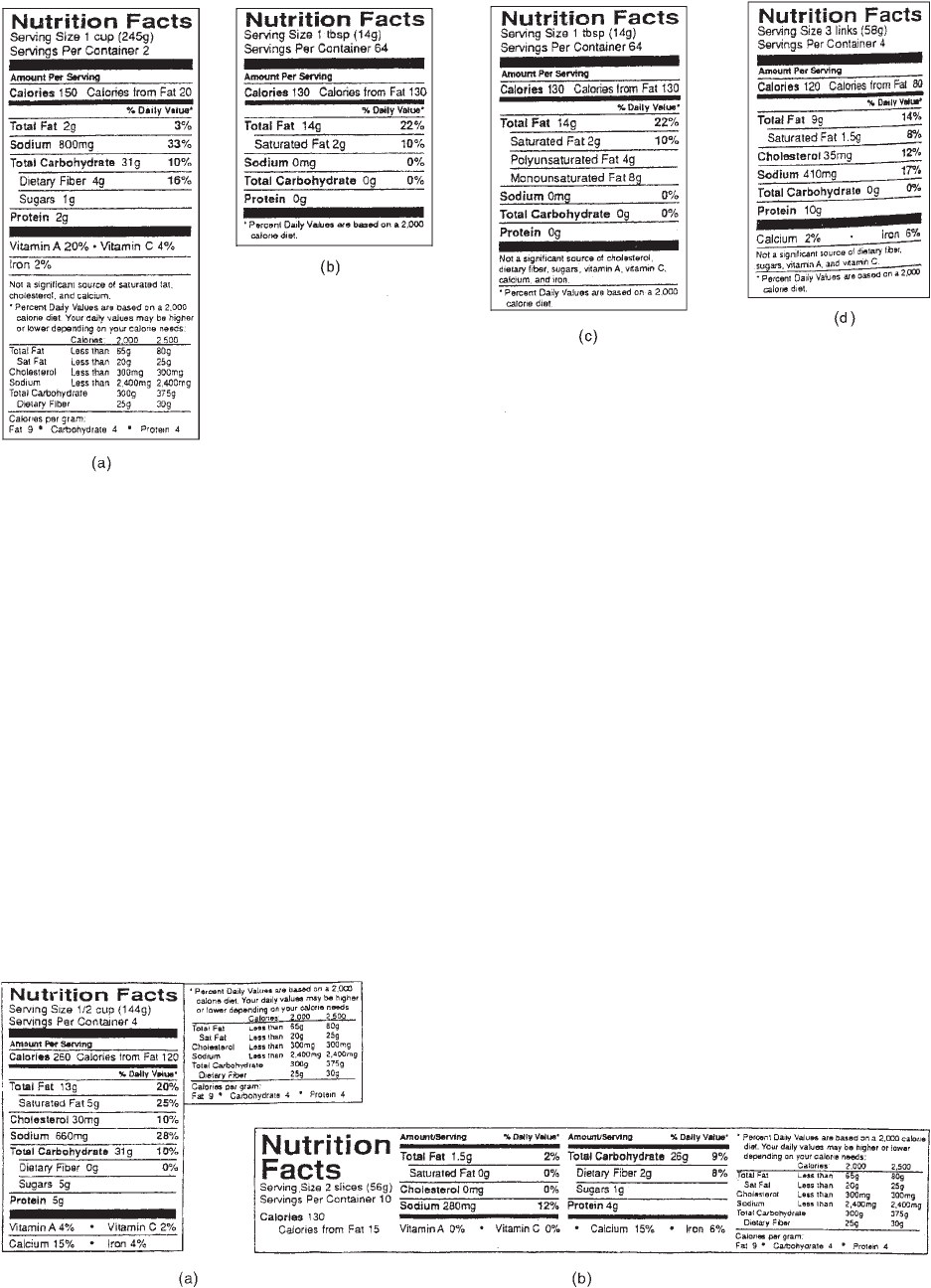
allows for presentation of nutrition information for a
variety of products contained within one package (e.g.,
variety package of cereal). Figure 5 pictures the Dual
Column and Aggregate displays.
A ‘‘Bilingual’’ display accommodates inclusion of a
second language in the Nutrition Facts panel. Special
labeling requirements apply to foods intended for young
children, so the Nutrition Facts panel is modified for these
products.
Package-Size Considerations
For packages with o40 in.
2
of ‘‘available space to bear
labeling,’’ any of the displays can be modified to create a
smaller Nutrition Facts panel. Specifically, the Daily
Values table may be omitted from the footnote and
abbreviations may be used. Figure 6 illustrates these
modifications of the Standard and Tabular displays.
On packages with o12 in.
2
of available space that
contain no other nutrition information and make no
claims, the Nutrition Facts panel may be replaced with
an address or phone number where nutrition information
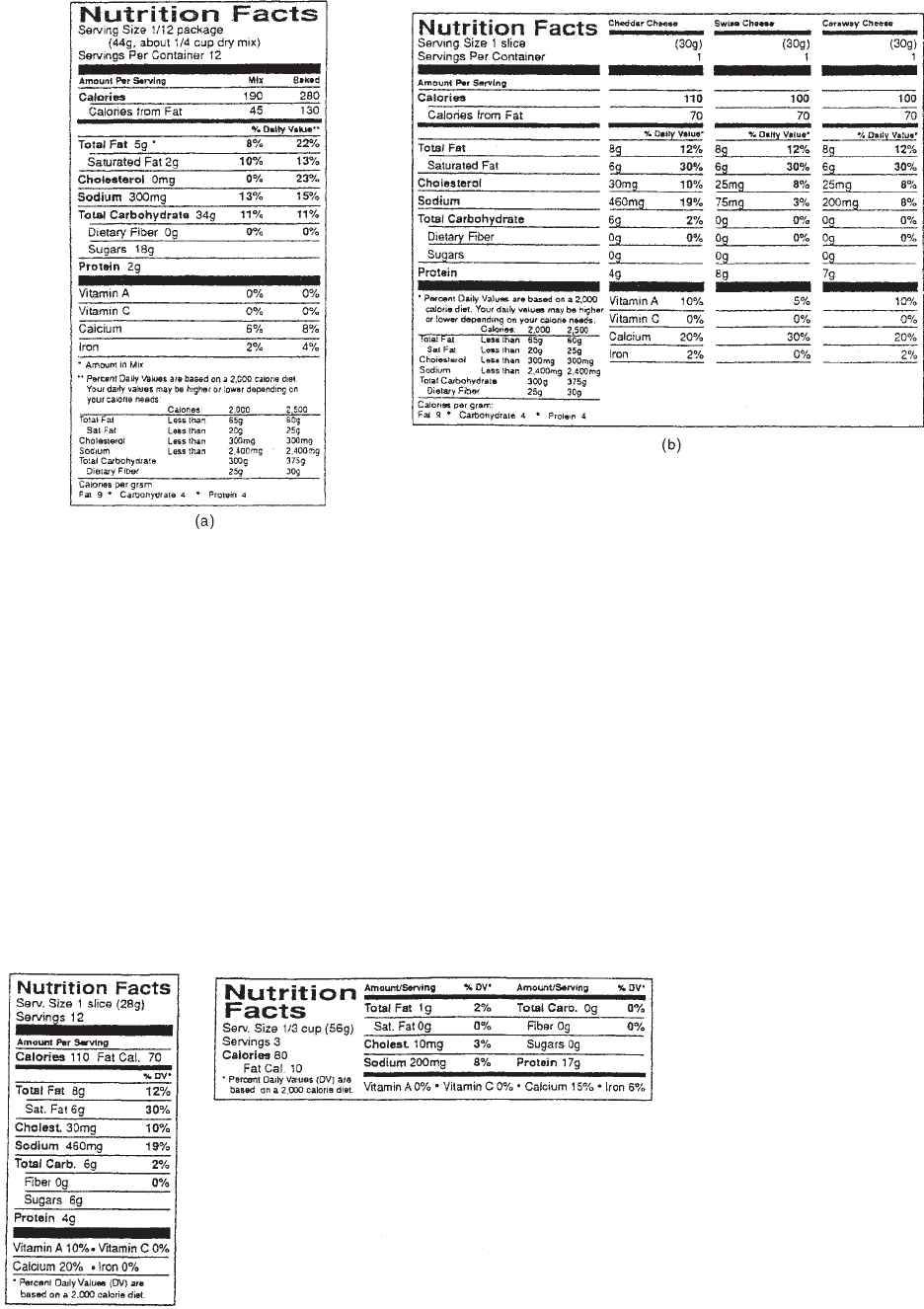
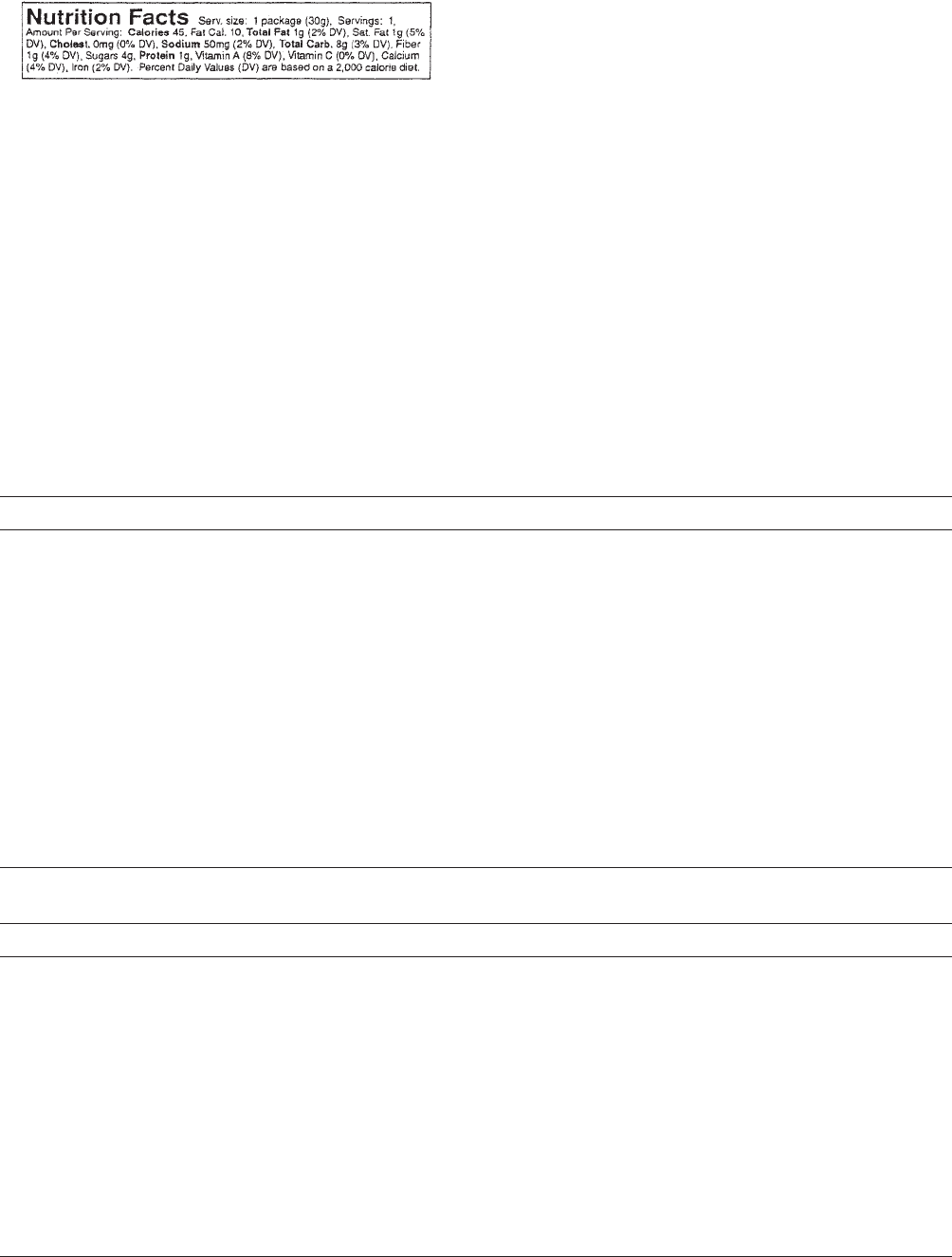
can be obtained. The ‘‘Linear’’ (paragraph) display is
provided to accommodate nutrition labeling of these small
packages when claims or nutrition information is present
(Figure 7). (A larger display may be employed at the
manufacturer’s discretion.) If no other display will fit,
then the Linear (paragraph) display also may be used on
packages with 12–40 in.
2
of available space.
Table 1 summarizes what display options are available
to various package sizes and the modifications that can be
made.
Figure 3. Abbreviated Nutrition Facts format: (a) Shortened format; (b) FDA Simplified format; (c) FDA Simplified Extended format;
(d) USDA Simplified format.
Figure 4. Modified (a) and Tabular (b) displays.
828 NUTRITION LABELING
CLAIMS
The regulations define two categories of claims: nutrient
content (or descriptors) and health claims (13). Nutrient-
content claims are statements about the level of a nutrient
in a food. Health claims, on the other hand, link the
nutrient profile of a food to a health or disease condition.
Nutrient content claims are used widely by the food
industry. Since the regulations governing health claims
are more complicated and restrictive, health claims are
not as common.
Nutrient-Content Claims
Nutrient-content claims (sometimes referred to as ‘‘de-
scriptors’’) characterize the level of a nutrient in a food.
Only defined terms can be used on the label to describe a
food’s nutrient content. When these terms are used, a
product must meet specific criteria. Nutrient-content
claims may be implied or expressed, comparative or
absolute (Table 2).
When a product bears a nutrient content claim
(whether it is implied or expressed), certain information
must be incorporated into the design of the package.
Depending on the type of claim and whether the product
is governed by FDA or USDA, the requirements for
claims-related information will vary. FDA mandates
more extensive information than USDA (i.e., the inclusion
of either a Referral or Disclosure Statement), and both
agencies require additional information on products bear-
ing comparative claims. All required statements must
adhere to placement and typesetting requirements that
are defined by the regulations. Table 3 summarizes the
Figure 5. Dual Column (a) and Aggregate (b) displays.
Figure 6. Modification of Standard and
Tabular displays for packages with o40
in.
2
‘‘available space to bear labeling.’’
NUTRITION LABELING 829
required statements that must accompany nutrient-con-
tent claims.
When an FDA-regulated product bearing a nutrient-
content claim contains excessive levels of key nutrients
that are associated with health risks, FDA requires a
Disclosure Statement that flags the nutrient(s) of concern
and directs the consumer to the Nutrition Facts panel. The
statment must be appear next to the largest claim on
each panel unless the claim is on the same panel as the
Nutrition Facts statement.
Both FDA and USDA product labels that bear a
comparative claim must include a Nutrient Claim Clar-
ification statement and Quantitative Information. On
FDA products, this information is required in addition to
a Referral or Disclosure Statement. The Nutrient Claim
Clarification statement identifies the comparison food and
states the percentage (or fractional) difference in the
subject nutrient(s) between the product and its compar-
ison food [e.g., 50% less fat than (comparison food), B33%
fewer calories than (comparison food)]. The Quantitative
Information provides the absolute amounts of the subject
nutrient(s) in the product and the comparison food. This
required information can be presented in a chart or
narrative format.
Health Claims
FDA has defined nine health claims and created very
strict criteria for use of these claims. No other nutrient-
disease associations can be made in food labeling. Written
statements, third-party references (e.g., ‘‘American Heart
Association’’), use of certain terminology in a brand name
(e.g., ‘‘heart’’), symbols, and vignettes may be considered a
health claim if the context in which they are presented
either suggests or states a relationship between a nutrient
Figure 7. Linear display.
Table 1. Display Options Based on Package Size
Package Size Display Options Modifications
W40 in.
2
Standard None available
Modified (if limited vertical space)
Tabular (if limited vertical space)
Dual Column
Aggregate
Bilingual
Child
12–40 in.
2
Standard Daily Value table omitted from footnote
Tabular
Dual Column Abbreviations permitted
Aggregate
Bilingual
Child
Linear (if no other displays will fit)
o12 in.
2
Linear Address/phone number (if no claims or nutrition information)
Daily Value table omitted from footnote
Abbreviations permitted
Table 2. Types of Nutrient-Content Claims
Type of Claim Definition Examples
Absolute Statement about the nutrient level in food without
referencing or comparing to another product
Free Low Very low High Source of Healthy Lean
Extralean
Comparative A claim comparing the level of a nutrient in one
product to the level of that nutrient in another
product or class of foods; also called a ‘‘relative
claim’’
Light or ‘‘lite’’ Reduced Less More
Implied Statement that leads a consumer to assume that a
nutrient is absent or present in a certain amount or
that the food may be useful in achieving dietary
recommendations
‘‘High in oat bran’’ implies ‘‘high in dietary fiber’’
Expressed Any direct statement about the level or range of a
nutrient in a food
Low fat
Low cholesterol
Low sodium
High in dietary fiber
830 NUTRITION LABELING

and a disease. When a statement, symbol, vignette, or
other form of communication suggests a link between a
nutrient and a disease, it is considered an implied health
claim, and it is subject to all the requirements for health
claims. The USDA has proposed regulations that parallel
the FDA’s.
The regulations governing health claims are very com-
plex. When a product bears a health claim, very specific
language must be used on the label. The regulations
pertaining to each health claim outline the assertions
that can be made and any additional required statements.
When a claim is implied through graphic representations,
a complete claim statement must be included on the label.
Since the required statements can be quite lengthy, the
complete claim may appear on a back or side panel. When
this approach is taken, a reference statement may be
placed on the front panel, flagging the claim and directing
the consumer to the location of the claim (e.g.,
‘‘See
for information about the relationship be-
tween
and .’’ The first blank contains the
location of the health claim (e.g., back panel, attached
pamphlet); the second blank should state the nutrient;
and the third blank, contains the disease or health-related
condition. Products bearing health claims must undergo
careful review by legal and/or regulatory experts to make
certain that the language is accurate and any graphics are
acceptable.
NUTRITION-LABELING RESOURCES
Although this article summarizes the evolution of nutri-
tion labeling and provides an overview of the nutrition-
labeling regulations, it is not a sufficient resource for
implementing the regulations. Understanding and com-
plying with nutrition-labeling regulations requires a
detailed working knowledge of the regulations and con-
tinuous monitoring of regulatory changes. Regulatory
guidebooks, such as those listed in the Bibliography at
the end of this article, can be expedient; however,
consulting the regulatory source documents is the most
accurate approach.
All federal regulations are compiled and updated an-
nually in the Code of Federal Regulations (CFR). Each
federal agency is assigned a numerical title of the CFR in
which the agency’s regulations are published. The FDA
regulations are published in Title 21, which includes eight
volumes of regulations, pertaining to foods, drugs, and
other products administered by the FDA. The first three
volumes contain the regulations related to foods (Part 1
through 99, Parts 100 through 169, and Parts 170 through
199). USDA’s food labeling regulations can be found in the
second volume (Parts 200 to end) of Title 9 of the CFR.
Since the CFR is updated only on a annual basis, other
sources must be consulted to identify recent regulatory
changes. The Federal Register releases proposed and final
regulations for all federal regulations on a daily basis.
Regular monitoring of the Federal Register is the most
accurate method of staying current. Many trade publica-
tions include columns that summarize regulatory updates
of importance to their readers. Food Labeling News,a
weekly newsletter, is another source for obtaining current
information on regulatory aspects of food labeling, adver-
tising, and packaging.
BIBLIOGRAPHY
1. Frank Olsson and P. C. Weeda, Complying with the Nutrition
Labeling and Education Act, The Food Institute, Fairlawn,
NJ, 1993.
2. White House Conference on Food, Nutrition, and Health.
Final Report, U.S. Government Printing Office, Washington,
DC, 1970.
3. Fed. Reg. 38, 2125–2132 (January 19, 1973).
4. Dietary Goals for the United States, U.S. Government Print-
ing Office, Washington, DC, Stock No. 052-070-04376-8, 1977.
5. Nutrition Labeling and Information: Hearings Before the
Subcommittee on Nutrition of the Senate Committee on
Agriculture, Nutrition, and Forestry, 95th Congress, 2nd
Session, 38, 1978.
Table 3. Required Statements for Nutrient Content Claims
When to Include
Absolute Claims
Comparative
Claims What to State
Disclosure
Statement
FDA products FDA products ‘‘See
panel for information on [nutrient(s)] and other nutrients.’’
Nutrient Claim FDA and USDA
products
Identity of comparison food and percent (or fraction) by which the nutrient
differs
Clarification
Statement
Example: ‘‘1/3 fewer calories than comparison food].’’
Quantitative
Information
FDA and USDA
products
Comparison of claims-related nutrient(s) in product and comparison food on
per serving basis. Example:
Product Fat
a
Calories
a
Light 4 g 200
Regular 8 g 300
Source: J. Storlie, Food Label Design: A Regulatory Resource Kit, Institute of Packaging Professional s, Hern don, VA, 1996. Used with permission.
a
Per labeled serving.
NUTRITION LABELING 831
6. U.S. Department of Agriculture/Department of Health and
Human Services, Nutrition and Your Health: Dietary Guide-
lines for Americans, Consumer Information Center, Depart-
ment 622N, Pueblo, CO, 1985.
7. The Surgeon General’s Report on Nutrition and Health,
USDHHS (PHS) Publication No. 88-50211, 1988.
8. National Research Council, Diet and Health: Implications for
Reducing Chronic Disease Risk, National Academy Press,
Washington, DC, 1989.
9. American Cancer Society Special Report, Nutrition and Can-
cer: Cause and Prevention, American Cancer Society, 1984.
10. American Heart Association, ‘‘Dietary Guidelines for Healthy
American Adults: A Statement for Physicians and Health
Professionals by the Nutrition Committee, American Heart
Association,’’ Circulation 77, 721A–724A (1988).
11. Institute of Medicine, Nutrition Labeling: Issues and Direc-
tions for the 1990s, National Academy Press, Washington, DC,
1990.
12. Public Law 1001-535.
13. J. Storlie, Food Label Design: A Regulatory Resource Kit,
Institute of Packaging Professionals, Herndon, VA, 1996.
14. Fed. Reg. 58, 2066–2956 (January 6, 1993).
15. Fed. Reg. 58, 632–691 (January 6, 1993).
16. Fed. Reg. 68, 41433–41506 (July 11, 2003).
General References
9 Code of Federal Regulations, Parts 200 to end, Superintendent
of Documents, U.S. Government Printing Office, Washington,
DC (for USDA food labeling regulations Title 9).
21 Code of Federal Regulations, Parts 1–99, 100–169, Super-
intendent of Documents, U.S. Government Printing Office,
Washington, DC (for FDA food labeling regulations).
Food Labeling News, CRC Press, Washington, DC.
J. L. Vetter, Food Labeling: Requirements for FDA Regulated
Products, American Institute of Banking, Manhattan, KS,
1993.
NYLON
Updated by Staff
INTRODUCTION
Nylons are selected for applications in the packaging
industry mainly for their functional contributions. In gen-
eral, they offer clarity, thermoformability, high strength
and toughness over a broad temperature range, chemical
resistance, and barrier to gases, oils, fats, and aromas. For
most packaging applications, nylons are used in film form,
as single components in multilayer structures (see Films,
plastic; Multilayer flexible packaging). Multilayer coex-
truded thermoformable structures containing polyester
and nylon layers have been reported (1).
Nylons, or polyamides, are thermoplastics character-
ized by repeating amide groups (–CONH–) in the main
polymer chain. The various types of nylon differ structu-
rally by the chain length of the aliphatic segments
separating adjacent amide groups. The combination of
hydrogen bonding of amide groups and crystallinity yields
tough, high-melting thermoplastic materials.
Polyamides can be described as long-chain molecules
with amide functionalities (–CONH–) as an integral part
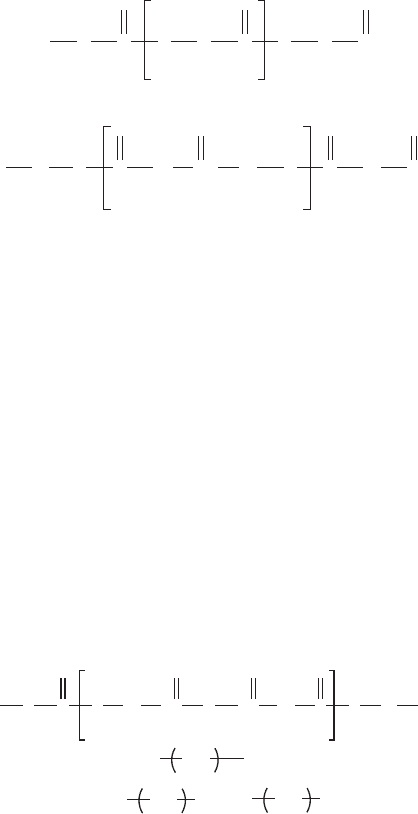
of the repeat unit. Film-forming nylons are usually linear
and conform to either of two general structures.
R C N
O
H
R
C
O
N R
H
COH
O
n
n
(1)
(2)
NH
2
NH
2
R′ N
H
C
R″
O
CN
O
H
R′
N
H
C
O
R″ CO
H
O
Examples of the first polymers are nylon 6 [R = (CH
2
)
5
],
nylon 11 [R = (CH
2
)
10
], and nylon 12 [R = (CH
2
)
11
]. Here,
the nylon type corresponds to the total number of carbon
atoms in the repeat unit. Examples of the second-type
nylons are nylon 6,6 ½R
u
¼ðCH
2
Þ
6
; R
uu
¼ðCH
2
Þ
4
;
and nylon 6, 10 ½R
u
¼ðCH
2
Þ
6
; R
uu
¼ðCH
2
Þ
8
. In the
case of the second-type polymers, Ru refers to the number
of methylene (CH
2
) groups or carbon atoms between
the nitrogen atoms and the R v refers to the number of
methylene groups or carbon atoms between the CO
groups. The n in the formula is the degree of polymeriza-
tion and its value determines the molecular weight of the
polymer.
Nylons can also be prepared as copolymers. For exam-
ple, a nylon 6/6, 6-copolymer might have the formula
NH
2
R C N
O
H
R′
NC
H
R
NC
H
R″
C
H
n
N R′ NH
2
R = CH
2
O O O
5
R′ = CH
2
6
R″ = CH
2
4
,
If the amounts of the nylon 6 and nylon 6,6 monomers
are varied, many combinations of the comonomers are
possible. This would give rise to a series of nylon 6/6,6
copolymers with different properties (2).
PROPERTIES
The flexibility of aliphatic chains permits film orientation
to further enhance strength (3). As the length of the
832 NYLON
aliphatic segment increases, there is a reduction in melt-
ing point, tensile strength, water absorption, and an
increase in elongation and impact strength. Copolymer-
ization also tends to inhibit crystallization by breaking up
the regular polymer chain structure and likewise yields
lower melting points than the corresponding homo-
polymers (4). The selection of a particular nylon for an
application involves consideration of specific physical
requirements (mechanical properties, barrier properties,
dimensional stability), processability (melting point), cost,
and so on.
Recent research efforts have been focused on producing
multilayer packaging films to improve their photostability
and recycling. The technology of blending represents a
potentially relevant new approach to barrier films with
improved recyclability as compared to multilayers. Theses
films are made on nylon 6 blended to ethylene-co-vinyl
alcohol (EVOH) in the presence of carboxyl-modified
EVOH (5). Due to environmental issues, increased efforts
have been made in developing barrier polymers for food
packaging that guarantee degradability. A potentially
degradable polymer based on the modification of nylon
10/12 was reported (6). The chemical modification con-
sisted of the replacement of two C–C linkages with two
ether linkages. A remarkable effect due to the ether
linkage produced an increase in water solubility and
diffusivity. A pronounced increase in water permeability
was detected. Nylon treated with UV light has been
examined as to its antimicrobial activity. Observed activity
is presumed based on the formation of surface amines (7).
Table 1 lists comparative properties of commercial
nylon films.
PROCESSING METHODS
Extrusion
Nylons are melt-processable via conventional extrusion,
but some parameters differ from those used in extruding
other resins (see Extrusion). Since the quality of extruded
film is sensitive to raw-material defects, nylon resins
should be clean and free of gel particles. Selection of resin
viscosity depends on use. Low-viscosity resins are used in
extrusion coating to allow rapid drawdown rates, whereas
medium- to high-viscosity resins are preferred for film
production. Because nylons are hygroscopic, special care is
required to ensure sufficiently low water content (o0.10
wt%) for the extrusion process. Unless properly packaged
and stored, nylon resins absorb moisture from the atmo-
sphere and inevitably pose processing difficulties (8). In
any extrusion operation, continuous production of uni-
form-quality film as well as maintenance of a safe work
environment is best achieved by monitoring and tightly
controlling all machine variables (temperatures, head
pressure, extruder drive load, screw rpm, etc.) (9, 10).
Many film converters have been successful in produ-
cing nylon film on conventional polyethylene extruders,
making only small modifications. The most important
factors to consider are temperature control and screw
design. The extruder must be equipped with adequate
heaters for the required processing temperatures (9). In
addition to heating capability, temperature control should
permit little fluctuation (731C) to ensure delivery of a
proper and consistent melt. Typical temperature profilies
are shown in Table 2.
Although a variety of screws have been used success-
fully for processing nylon resins, not all screws are
optimum for the nylon being processed. In general, a
nylon screw is thought of as a rapid-transition metering-
type screw. A compression ratio (volume of a feed flight
relative to the volume of a metering flight) of 3:1 to 4:1 is
acceptable for most nylons. Most nylon screws are 40%
metering, 3–4 turns transition, and the remainder feed
zone. Length to diameter (L : D) ratios of 20:1 and 24:1 are
common and acceptable. In designing a screw for a specific
nylon, factors that must be considered include melting
point of the resin, melt viscosity characteristics, machine
type, extrusion rate, and so on (8).
Film Manufacture
Nylon film can be produced by either the cast-film process
or the blown-film process. Semicrystalline polymers
like the nylons can be made ‘‘amorphous’’ by rapidly
quenching the melt via the cast-film process. That is, the
polymer chains are prevented from aligning and organiz-
ing into regular, three-dimensional ‘‘crystalline’’ struc-
tures. Thus, by varying quenching rates, nylons are
capable of existing in a low-order or amorphous state
and in a highly crystalline state. The properties of the
final film are highly dependent on the crystalline state of
the polymer. By a rapidly quenching the melt, favorable
properties of transparency and thermoformability are
induced.
In producing nylon film by the blown-film process, the
cooling rate is much slower than for the cast-film process:
The film is allowed to crystallize and film clarity is
generally sacrificed. Blown films are used in applications
requiring tubular film, or films of higher strength or better
gas-barrier properties than yielded by the cast process. A
chrome-plated bottom-fed die with a spiral mandrel is
generally
recommended for blown-film
processing to mini-
mize weld lines and polymer degradation due to stagnant
hold-up of melt in the die. Because of their stiffness,
nylons pose wrinkling problems in the bubble-collapsing
phase of production. Special care is required to properly
align the collapsing frame and nip rolls, minimize gauge
variations, and limit drag force in the collapsing assembly.
It has been suggested that the lower-density nylons show
less-severe wrinkling problems (8).
Oriented Nylon Films
The high strength and toughness properties of nylon films
can be further enhanced by orientation. The increased
alignment and tighter packing of polymer chains resulting
from the process also yields improved barrier properties.
Table 3 lists property comparisons for unoriented versus
biaxially oriented films. Preferential orientation, typically
machine direction, improves strength and toughness in
NYLON 833

Table 1. Properties of 1-mil (254.4-
l
m) Nylon Films
Value
Property
ASTM Test
Nylon 6 Nylon 6,6 Nylon 6/6,6
Nylon 6/12
Nylon 6,
Biaxially
Oriented
Melting point,
1F(1C)
424–428 510 (266) 388–395
386–392
424–428
(218–220)
(198–202) (197–200) (218–220)
Specific gravity
D1505
1.13
1.14
1.11
1.10
1.15
Yield, in.
2
/(lb mil) [m
2
/(kg mm)]
24,500 [1,372] 24,300 [1,361] 25,000 [1,400]
25,200 [1,411] 24,000 [1,344]
Haze, %
D1003
1.5–4.5
1.5
2.0
1.3
Light transmission, %
Tensile strength, psi (MPa) MD
D882
12,000
(82.8)
9,000 (62.1) 16,000 (110.3) 4,640 (32.0)
32,000 (220.7)
XD 10,000 (69.0) 9,000 (62.1) 16,000 (1
10.3) 4,500 (31.0) 32,000 (220.7)
Elongation, %
D882
MD
400
300
400
400
90
XD
500
300
400
500
90
Tensile modulus, 1% secant, psi (MPa)
MD 100,000 (689.7) 100,000 (689.7)
100,000 (689.7)
250,000
(1724.1)
XD 115,000 (793.1) 100,000 (689.7) 100,000
(689.7)
250,000
(1724.1)
Tear strength, gf/mil (N/mm) initial propagating
D1004
500 (193) 600 (232) 500 (193)
200 (77.2)
D1922
35 (13.5) 35 (13.5)
70 (27)
10 (3.9)
Bursting strength, 1 mil (25.4
mm), psi (kPa)
D774
Does not burst,
10–18
18 (124)
(69–124)
Water absorption, 24 h, %
D570
9893
7–9
Folding endurance cycles
D2176
W250,000
Change in linear dimensions at 212
1F (100
1C) for 30 min,
%
D1204
o21
o2.5
Service temperature,
1F(
1C) range
50–250
100–450
50–240
76–266
(46–121) (
73–232) (
46–116)
(60–130)
Heat-seal temperature,
1F(
1C) range
410–420
490–500
375–385
360–375
410–420
(210–216) (254–260) (191–196)
(182–191) (210–216)
Oxygen permeability cm
3
mil/(100 in.
2
day
atm)
[cm
3
mm/(m
2
day
kPa)]
D1434
231C, 0% rh
2.6 [10.1] 3.5 [13.6]
2.0 [7.8]
1.2 [4.7]
231C, 50% rh
5.0 [19.4]
231C, 95% rh
3.5 [13.6] 16.0 [62.2]
2.2 [8.5] 3.5 [13.6]
Water-vapor transmission rate, g
mil/100 in
2
day)
[g
mm/(m
2
day)], 100
1F (381
C), 90% rh
18 [7.1]
19 [7.5]
31 [12.2]
7 [2.8]
17 [6.7]
COF, face-to-face back-to-back
D1894
0.25–0.65
0.45
834

the direction of orientation. Biaxial orientation yields
films with balanced properties. Market development ef-
forts in this area are concentrated on critical packaging
applications requiring soft films that permit tight package
conformation and offer improved impact strength and
reduced pinholing, superior burst strength, and flexcrack
resistance. As with most other flexible substrates, or-
iented films permit further conversion, (e.g., printing,
lamination, metallization, etc.).
Three processes are used to manufacture biaxially
oriented nylon film.
One-Step Tenter Frame. This process simultaneously
draws cast nylon film in both the machine and
transverse direction (11).
Two-Step Tenter Frame. This is a two-step orientation
process in which a nylon film that has been modified
with a plasticizer is first drawn in the machine
direction and then drawn in the transverse direction
(12).
Blown Bubble. Nylon film extruded from a circular
die is oriented in the transverse direction by con-
trolled internal air pressure, and it is also oriented
in the machine direction by regulating the bubble
takeoff speed (13).
Coextrusion
Nylons used in film extrusion are often combined with
other plastic materials via coextrusion. In most cases,
polyolefins are used as coextrusion partners for nylon to
provide heat sealability, moisture barrier, and good eco-
nomics. As in single-layer-film extrusion, nylons can be
processed by cast-film coextrusion and by blown-film
coextrusion (see Coextrusion, tubular). The combining-
adapter technology is generally the preferred method for
joining layers in cast film coextrusion of nylon, although
multimanifold-die systems are also used. Special care
in matching resin viscosities is required when using the
combining-adapter system in order to produce films of
uniform layer profile. For both systems, nylon 6 is the
most common and preferred polyamide used in cast film
coextrusion.
Because the blown-film coextrusion process employs air
as the cooling medium, the melt is cooled slowly, permit-
ting spherulite formation in semicrystalline nylon homo-
polymers (i.e., nylon 6, nylon 6,6) and film transparency is
sacrificed. For this reason, less-crystalline nylon copoly-
mers such as nylon 6/12 and nylon 6/6,6 are gaining
acceptance in blown-film coextrusion.
Applications for nylon/polyolefin coextruded films
include vacuum packaging of meat products, cheese-
Table 2. Typical Temperature Profiles for Nylon Extrusion, 1F(1C)
Nylon 6 Nylon 6,6 Nylon 6/6,6
a
Feed zone 446–482 (230–250) 500–554 (260–290) 401–464 (205–240)
Transition zone 437–500 (225–260) 500–545 (260–285) 401–482 (205–250)
Metering zone 396–527 (220–275) 500–545 (260–285) 392–491 (200–255)
Head 437–518 (225–270) 500–545 (260–285) 401–482 (205–250)
Die 419–518 (215–270) 494–563 (255–295) 392–482 (200–250)
Melt temperature 437–518 (225–270) 500–512 (260–300) 401–482 (205–250)
a
Nylon 6/6,6 temperature profile reported by Allied Corporation for XTRAFORM resin.
Table 3. Comparative Properties of Unoriented, Uniaxially Oriented (MD), and Biaxially Oriented Nylon-6 Films (1-mil
or 25.4-lm Films)
Values
Property
Nylon 6 film,
Unoriented
Nylon 6 film,
MD-Oriented
Nylon 6 Film,
Biaxially Oriented
Specific gravity 1.13 1.14 1.15
Tensile strength, psi (MPa) MD 12,000 (82.8) 50,000 (344.8) 32,000 (220.7)
XD 10,000 (69.0) 10,000 (69.0) 32,000 (220.7)
Elongation, % MD 400 60 90
XD 500 450 90
Tensile modulus psi (MPa) MD 100,000 (689.7) 300,000 (2069) 250,000 (1724.1)
XD 115,000 (793.1) 100,000 (689.7) 250,000 (1724.1)
Initial tear strength, gf/mil (N/mm) MD 500 (193) 650 (251) 200 (77.2)
XD 500 (193) 1,300 (502) 200 (77.2)
Propagating tear strength, gf/mil (N/mm) MD 35 (13.5) 40 (15.4) 10 (3.9)
XD 35 (13.5) 100 (38.6) 10 (3.9)
Oxygen permeability, [cm
3
mm/(m
2
day kPa)]
cm
3
mm/(100 in.
2
d atm)
2.6 [10.1] 2.4 [9.3] 1.2 [4.7]
WVTR, g mil/(100 in.
2
day) [g mm/(m
2
day)] 18 [7.1] 18 [7.1] 17 [6.7]
NYLON 835
ripening pouches, consumer packaging of cheese and fish
products, and several nonfood packaging applications
including containers for chemicals, fertilizers, and animal
foods.
Extrusion Coating
Nylons with lower viscosity permit rapid drawdown rates
for extrusion coating (see Extrusion coating). Typical
substrates range from heavy-duty paperboard to inter-
mediate aluminum foils and papers, to thin polyethylene
films. Published literature describes the nylon extrusion
coating process in detail (8, 14). As in cast-film production,
annealing the nylon coating is necessary to impart dimen-
sional stability when a flexible substrate is used.
Blow Molding
Nylons of ultrahigh viscosity are commonly used in blow
molding (see Blow molding). Because of their excellent
impact strength, chemical resistance, toughness, and wide
temperature use properties, nylons are ideally suited for
several blow-molded applications, including industrial
containers, moped fuel tanks, and automotive oil reser-
voirs. A recent development for nylon in blow molding has
been in the area of blow-molded hydrocarbon-barrier
containers. The process employs a blend of a modified
nylon barrier resin and a polyolefin, extrusion blow
molded under controlled mixing conditions to produce a
barrier container competitive with surface-treated HDPE
bottles (3, 4, 14). Packaging applications include contain-
ers for charcoal lighter fluids, general-purpose cleaners,
waxes, polishes (see Surface modification) and those de-
scribed in several patents (15).
Secondary Conversion
Thermoforming. Nylon films are readily thermoformed
by conventional methods (see Thermoforming.) Ease of
formability is affected by nylon type (melting point),
molecular weight, degree of crystallinity, and machine
variables. In general, nylon films offer excellent thermo-
formability due to their high elongation. Furthermore, the
high elongation facilitates deep draw, and flex- and stress-
crack resistance of nylons minimize film breaks during
and after forming. Current applications include (a) va-
cuum and gas packaging of meats and cheeses and (b)
thermoform/fill/seal packaging of disposable medical de-
vices (see Controlled Atmosphere Packaging; Healthcare
packaging; Thermoform/fill/seal.)
Heat Sealing. Because of their high melting points,
nylons are typically coextruded with, laminated to, or
coated with a polyolefin heat seal layer (PE, EVA, EAA,
ionomer, etc.). However, unsupported nylon films are heat
sealed for applications that require heat-seal integrity
under high-temperature exposure (e.g., oven ‘‘cook-in’’
bags). By properly balancing the variables of time, tem-
perature, and pressure, unsupported nylons can be heat-
sealed at relatively low temperatures. For most commer-
cial applications, however, it is necessary to heat the films
to temperatures that closely approach their melting
points. This factor, compounded by the relatively narrow
melting range of nylons, necessitates precise temperature
(731C) and pressure control. By making necessary mod-
ifications to conventional machinery, nylons are success-
fully heat-sealed by thermal impulse and constant-heat
techniques.
Adhesive Lamination. Nylon films are combined with
other flexible materials via adhesive lamination to pro-
duce multiple structures, each ply contributing to the
requirements of the end product (see Laminating; Multi-
layer flexible packaging). Typical substrates include sea-
lant webs (PE, EVA, ionomer, etc.), and aluminum foils.
Converters may choose to laminate rather than coextrude
nylon to minimize scrap losses for short runs. Lamination
is also necessary when combining non-coextrudable or
incompatible plastics. The lamination process is described
in detail in published literature (16). The adhesive is
generally applied to the nylon web which has been corona
treated (see Surface modification) to assist wettability, as
the high melting point of nylon provides suitable stability
in solvent-drying ovens. Adhesive systems are typically
two-component types that vary for nylon types and sub-
strates. Nylon film suppliers recommend adhesives for
specific substrates (see Adhesives).
Vacuum Metallizing. Applications for metallized or-
iented nylon films are expanding in the packaging in-
dustry. Metallization offers functional contributions of
improved moisture, oxygen, and light barriers and unique
aesthetic appeal at the consumer level (17). The resultant
film offers excellent flexibility, oxygen barrier, flex-crack
resistance, antistatic properties, and printability. These
properties meet the necessary requirements for use in
such applications as institutional coffee pouches, metal-
lized balloons, and liquid-box containers (see Bag-in-box,
liquid product; Metallizing).
PACKAGING APPLICATIONS
Although nylons are not generally considered commodity-
packaging resins, the added material cost is easily justi-
fied in specific demanding applications where the nylons’
physical properties provide added protection, extended
shelf life, or reduced losses of expensive contents. The
combination of excellent thermoformability, flexcrack
resistance, abrasion resistance, gas-, grease-, and odor-
barrier, and tensile-, burst-and impact-strength over a
broad temperature range make nylons well suited for
many
packaging applications.
For most applications, ny-
lons are combined with other materials that add moisture
barrier and heat sealability, such as low-density polyethy-
lene, ionomer, EVA, and EAA.
Most nylon-containing packaging films are used in food
packaging, principally in vacuum-packing bacon, cheese,
bologna, hot dogs, and other processed meats (18). A varia-
tion of this package includes a carbon dioxide flush prior to
heat sealing to remove traces of oxygen, thus prolonging
shelf life for foods such as poultry, fish, and fresh meat (19).
Poly(vinylidene chloride) (PVDC) coatings are offered for
836 NYLON
improved oxygen-, moisture vapor-, or UV light-barrier
properties (see Vinylidene chloride copolymers).
Nylon 6 is the nylon resin used most frequently for
packaging applications because of the balance of cost,
physical properties, and process adaptability. For blown
or cast extrusion as well as cast coextrusion, nylon 6 resins
are favored by most converters, while lower-melting nylon
copolymers (nylon 6/6,6 or nylon 6/12) have been devel-
oped primarily to aid blown-film coextruders (lower melt-
ing points permit lower process temperatures for faster
melt quenching). In addition to lower melting points, the
nylon copolymers are less crystalline than their corre-
sponding homopolymers and provide better clarity and
thermoformability. On the high end of the melting-point
scale, nylon 6 and nylon 6,6 resins are appropriate for use
in oven-cooking bags, where high-temperature tolerance
is a key requirement. A ready-to-bake fish fillet product is
possible using an ovenproof film of nylon 6,6 for packaging
during storage (20).
Medical-packaging applications, such as packaging of
hypodermics and other medical devices, are a relatively
new and expanding area for the nylons. The combination
of toughness, puncture resistance, impact strength, abra-
sion resistance, and temperature stability make nylons
appropriate for protecting sterile devices during shipping
and storage. Although ethylene oxide and steam have
always been appropriate means of sterilization for nylons,
modified-nylon resins have recently been introduced that
permit radiation sterilization as well (21).
Biaxial orientation of nylon films provides improved
flex-crack resistance, mechanical properties, and barrier
properties. These films have new applications in packa-
ging foods such as processed and natural cheese, fresh and
processed meats, condiments, and frozen foods. They are
used in pouches, in bag-in-box structures, and in a box for
wine (22) (see Bag-in-box, dry product; Bag-in-box, liquid
product). In other areas (e.g., cooked meats, roasted pea-
nuts, smoked fish) the nylons compete with biaxially
oriented polyester (see Film, oriented polyester). Although
oriented nylons offer better gas barrier, softness, and
puncture resistance, oriented polyester offers better rigid-
ity and moisture barrier.
Other uses for nylon film include a nylon-6 shrink film
(see Films, shrink) for meat and fresh-vegetable packa-
ging (23), a nylon composite film used in a system to
produce greaseless fried chicken (24), a uniaxially or-
iented nylon-6 film for food packaging (25), a nylon-6
film with improved thermoformability (26), and a nylon
film as an outer protective layer for aluminum foil in
cookie and vacuum coffee packages (22). Laminated struc-
tures containing nylon provide an oxygen barrier for
packaging liquid and dry products. These structures are
used for packaging fruits, citrus juices, tea, and other
beverages (27).
BIBLIOGRAPHY
M. F. Tubridy and J. P. Sibilia,‘‘Nylon’’ in The Wiley Encyclopedia
of Packaging, 1st edition, Wiley, New York, pp. 477–482; 2nd
edition, pp. 681–686.
Cited Publications
1. A. J. Lischefski, U.S. Patent 7,201,966 (to Curwood Inc.), April
10, 2007.
2. Y. P. Khanna, E. A. Turi, S. M. Aharoni, and T. Largman, U.S.
Patent 4,417,032 (to Allied Corporation), November 22, 1983.
3. R. D. Deanin, Polymer Structure, Properties and Applications,
Cahners Books, Division of Cahners Publishing Company,
Boston, 1972, pp. 455–456.
4. K. J. Saunders, Organic Polymer Chemistry, Chapman and
Hall London, 1976, pp. 175–202.
5. P. Laurienzi, M. Malinconico, M. G. Volpe, D. Luongo, V. Ranieri,
and M. Scopini, Packag.Technol.Sci.14, 109–117 (2001).
6. M. A. DelNobile, G. Mensitieri, L. R. Lostocco, S. J. Huang,
and L. Nicolais, Packag. Technol. Sci. 10, 331–330 (1997).
7. Packag. Technol. Sci. 20, 231–273 (2007).
8. R. M. Bonner, ‘‘Extrusion of Nylons’’ in M. I. Kohan, ed.,
Nylon Plastics, Wiley, New York, 1973.
9. E. C. Bernhardt, Processing of Thermoplastic Materials,
Reinhold, New York, 1959.
10. J. M. McKelvey, Polymer Processing, Wiley, New York, 1962.
11. M. Kuga and co-workers, U.S. Patent 3,794,547 (to Unitika,
Ltd.), February 26, 1974.
12. U.S. Patent 26,340 (reissued August 2, 1977), K. Khisha
(Original); U.S. Patent 3,843,479 (October 24, 1974), I. Haya-
shi and K. Matsunumi (to Toyo Boseki, Ltd.)
13. K. Tsuboshima and co-workers, U.S. Patent 3,499,064 (to
Kohjin Co., Ltd.), March 3, 1970.
14. S. M. Weiss, in J. Abranoff, ed., Modern Plastics Encyclopedia,
Vol. 16, No. 10, McGraw-Hill Publications, New York, 1984,
pp. 199–202.
15. P. M. Subramanian, U.S. Patent 4,410,482, October 18, 1983;
R. C. Di Luccio, U.S. Patent 4,416,942, November 22, 1983; P.
M. Subramanian, U.S. Patent 4,444,817, April 24, 1984.
16. J. A. Pasquale, in J. Agranoff, ed., Modern Plastics Encyclo-
pedia, Vol. 61, No. 10, McGraw-Hill Publications, New York,
1984. pp. 284–286.
17. W. Goldie, Metallic Coating of Plastics, Electrochemical Pub-
lications Ltd., Hatch End, Middlesex, 1969.
18. E. C. Lupton, Modern Packag. 52(12), 26 (1979).
19. J. A Dorado-Rodelo, J. M. Ezquerra, and H. Soto-Veldez,
Packag. Technol. Sci. 20, 301–307 (2006).
20. K. Pomolpraser in J. Han, ed., Packaging for Nonthermal
Processing of Food, Blackwell, and the Institute of Food
Technologists, 2007, Chapter 6.
21. Allied Corporation, Modern Plast. 60(9), 114, 119 (1983).
22. ‘‘Packaging, Food,’’ in Kirk–Othmer Encyclopedia of Chemical
Technology, 5th edition, Vol. 18, Wiley Interscience, Hoboken,
NJ, 2006.
23. Plast. Ind. News 29(10), 148 (1983).
24. Food & Drug Packag. 46(12), 30 (1982).
25. J. Commerce 353(25,263), 22B (1982); Plastics World 40
(8), 76
(1982).
26. J
. Commerce 345(24,747),
5 (1980).
27. T. S. Reighard, U.S. Patent Application 20070184221, August
9, 2007.
General Reference
M. I. Kohan, Nylon Plastics Handbook, Carl Hanser Verlag,
Munich, Germany 1995. An excellent reference book covering
all aspects of nylon technology.
NYLON 837