
Yam, Kit L. (ed.). The Wiley encyclopedia of packaging technology
Подождите немного. Документ загружается.

sterilization. Polyvinyl chloride shows a reaction to radia-
tion at low levels by turning amber and eluting gas. The
significant change in mechanical properties in PVC occurs
at higher energy doses, around 100 Mrad (11).
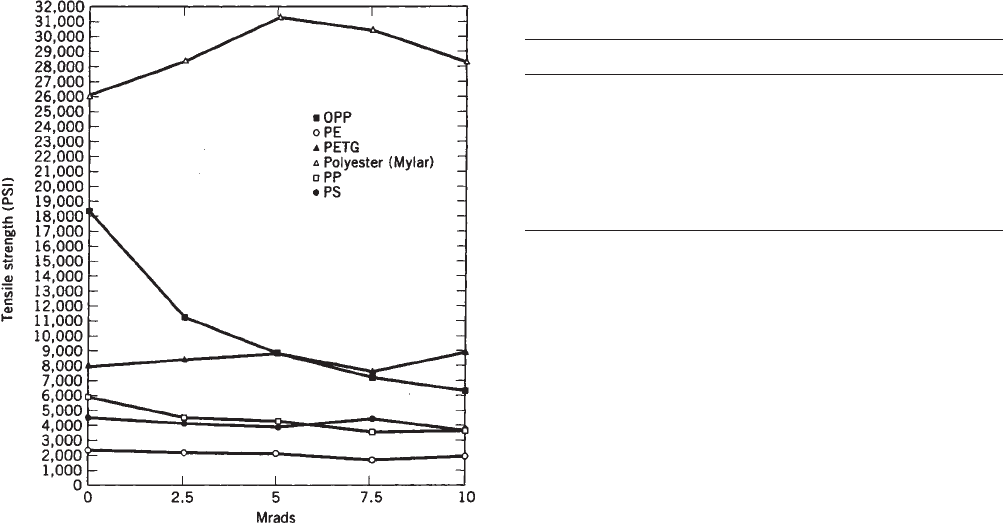
In contrast, polyester films show change due to expo-
sure by increasing tensile strength (12). The tensile
strength increase is dose-dependent over 0–5 Mrad and
then begins to reduce with increased exposure. Even at
12.5 Mrad the tensile strength of the sample is greater
than the original, untreated sample as shown in Figure 5.
This is a desirable property change in applications where
tensile strength is desirable. Polyester tennis strings
produced by a company named Gamma Gut are dosed by
gamma radiation to increase their tensile strength, which
is a quality necessary for tennis strings. The company
even identifies the process in the corporate name.
In addition to the mechanical properties changing, the
barrier properties of a material are also at risk. PETG, PP,
and nylon show significant loss of water-vapor-barrier
qualities when exposed to sterilizing doses of radiation.
These effects have been demonstrated to be dose-depen-
dent, so the greater the dose, the more pronounced the
effect (13). It is speculated that the effect comes from the
restructuring of the polymer chains, allowing more area
for water molecule transport. Table 5 shows the WVTR
values of various packaging films at different energy
doses.
The stabilization of these polymers to the radiation
levels seen in sterilization cycles is being accomplished by
the use of various additives. The additives are designed
to either react with the energy before it damages the
material or absorb the energy before it energizes the
material. These additives are specially formulated for
the particular application because their compatibility
with a product is a key consideration. PVC is modified
with lead carbonate or organic tin compounds, and this
change reduces the discoloration in the material (14).
Effects of Package. The effects on package integrity are
secondary to the effects of material integrity. There is no
elevated temperature to soften plastics, and there is no
evacuation cycle to stress the package seals. The embrit-
tlement of a material is the key issue because if a package
material is flexed and cracks, the sterile integrity of the
package is compromised and the product is viewed as
contaminated and unusable. Stresses encountered during
distribution take on greater importance when materials
have become brittle, so effective distribution testing is
prudent.
Shelf Life of Device Packages. The shelf life of a device
package is expressed as the length of time the package will
provide a sterile barrier. The shelf life has traditionally
been defined as only an event-related process where
events such as rough handling contribute to premature
aging of the package. Current research has indicated that
time is also a factor in device shelf life. There has been
evidence to suggest that material changes may occur
during poststerilization storage. These changes are the
same as those that occur immediately after sterilization
but seemingly increase over time. One study has shown
that aged EVA heatseals on porous packages sterilized by
EtO have significantly lower seal strengths than the same
packages immediately after sterilization (15). Other ob-
served effects are discoloration and increasing brittleness
of materials sterilized by radiation. These few observa-
tions make a case for increasing attention on poststorage
testing of the packages so that more can be learned about
the impact of sterilization method on shelf life (see also
Shelf life).
BIBLIOGRAPHY
1. F. Yambrach, Med. Device Diagn. Indust. 28(1), 134 (2006).
2. C. Henke, Med. Device Diagn. Indust. 14(12), 41 (1992).
3. A. F. Booth, Med. Device Diagn. Indust. 17(2), 64 (1995).
Figure 5. Tensile strengths of packaging films after exposure to
low-level radiation.
Table 5. Effects of Radiation on the WVTR of Packaging
Materials Tested [g/(100 in.
2
24 h) at 100 1F, 90% rh]
Materials (Mrad) 0 2.5 5.0 7.5 10.0
PETG 1.42 1.52 1.57 1.76 1.73
PET/PE 0.46 0.48 0.50 0.55 0.57
PP 0.19 0.21 0.21 0.23 0.24
OPP 0.30 0.33 0.33 0.35 0.37
PE 0.12 0.13 0.15 0.15 0.13
PET 0.25 0.28 0.28 0.29 0.28
Nylon/PE 0.26 0.29 0.34 0.37 0.37
858 PACKAGE-INTEGRITY IN STERILE DISPOSABLE HEALTHCARE PRODUCTS
4. Industrial Sterilization, Duke University Press, Durham,
NC, 1973; B-D International Industrial Sterilization Sympo-
sium, 1972 Amsterdam, Netherlands.
5. R. R. Reicht and D. J. Burgess, Med. Device Diagn. Indust.
13(1), 124 (1991).
6. C. Marotta, Med. Device Diagn. Indust. 6(2), 27 (1984).
7. G. G. Giddings, ‘‘Irradiation of Packaging Materials and
Prepackaged Foods’’ in Proceedings from the 4th International
Conference on Packaging, September 1985.
8. J. W. Barnard, Med. Device Technol. (1991).
9. J. N. Aaronson and S. V. Nablo, ‘‘The Application of Electron
Sterilization for Devices and Containers,’’ paper presented
at TAPPI Polymers, Laminations and Coatings Conference,
1986.
10. J. J. Killoran, Radiat. Res. Rev. 3, 369–388 (1972).
11. W. E. Skeins, Radiat. Phys. Chem. 15, 47–57 (1980).
12. V. Pungthong, Mechanical Properties of Polymeric Packaging
Films After Radiation Sterilization, M.S. thesis, Rochester
Institute of Technology, 1990.
13. R. L. A. Vas, Effects of Low Level Radiation on WVTR of
Plastic Packaging Films, M.S. thesis, Rochester Institute of
Technology, 1989.
14. M. Foure and P. Rakita, Med. Device Diagn. Indust. 5(12), 33
(1983).
15. A. T. Cook, The Effect of Accelerated Aging on Peelable
Medical Product Heatseals, M.S. thesis, Rochester Institute
of Technology, 1994.
PACKAGING DESIGN AND DEVELOPMENT
LAURA BIX
JAVIER DE LA FUENTE
RAGHAV PRASHANT SUNDAR
HUGH LOCKHART
School of Packaging, Michigan
State University, East Lansing,
Michigan
INTRODUCTION
Packaging is ubiquitous, yet invisible to many who use it.
It is present in almost all environments and facets of
modern day life, though few people give it any purposeful
thought. Hospitals, military outposts, construction sites,
industrial manufacturing facilities, retail outlets, and
restaurants (to name a few) all have personnel that
interface with packaging. It permeates our homes, busi-
nesses, churches, and schools and utilizes nearly every
material known, taking on many different forms and
functions.
It is challenging, in a single chapter, to discuss effective
package design in great detail due to the myriad of
products in need of packaging and complexity of stake-
holder desires. However, there are certain basic considera-
tions that designers should contemplate, regardless of
the product to be packaged or the packaging form to be
employed.
STAKEHOLDER PERSPECTIVES ON PACKAGING
Effective designers consider multiple inputs and desires
from varying stakeholders (see Figure 1), throughout
the life cycle of a package (from ingredients through
disposal), though many times these stakeholders don’t
even realize that their expectations for a product are
achieved by thoughtful package design.
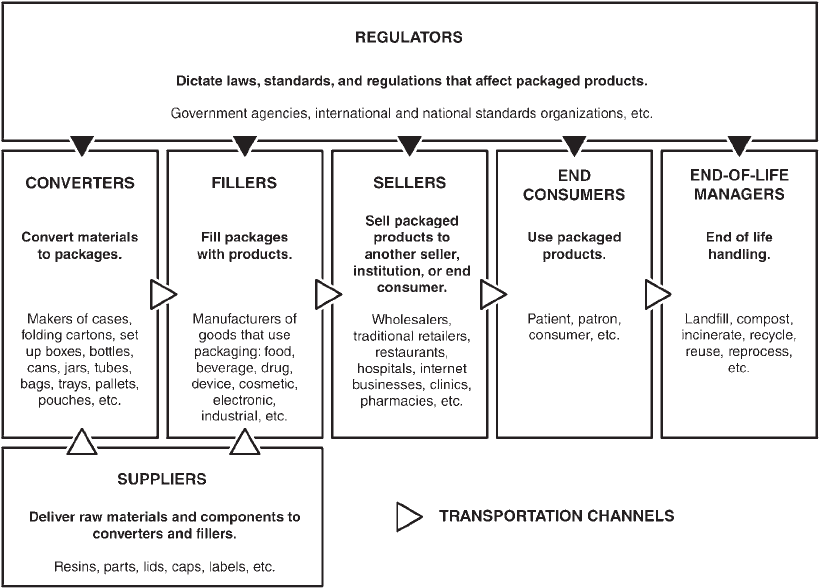
Converters and fillers expect that packages will be easy
to produce, fill, process, evaluate, handle, ship, store, and
track. The idea is to maximize production efficiencies (line
speeds, cube efficiencies, inventory control, and the like)
without imposing unnecessary burden on workers. Both
groups wish for products and packages that will satisfy
downstream customers’ (particularly sellers and end con-
sumers—see Figure 1) wants and desires, creating the
opportunity for more orders and more profit. Perhaps one
of the greatest motivators of package design decisions,
particularly for fillers, is the need to effectively brand
their products. With the fragmentation of traditional
media sources and the advent of technologies like satellite
radio and TiVo
s
, which allow consumers to filter adver-
tisements, packaging takes on a more prominent role in
attracting and retaining consumers. Distinguishing fea-
tures such as logos, wordmarks, colors, and functionality
are vital parts of this effort, and packaging is increasingly
seen as a tool for adding value.
A variety of sellers (retailers, internet businesses,
hospitals, pharmacies, restaurants, etc.) have many ex-
pectations as well. They expect affordable products that
will arrive in a pristine, genuine, shelf-ready condition
with maximum shelf life and features that make tamper-
ing evident. For many, packaging is part of loss prevention
programs which are meant to deter and detect theft, a
noted and costly problem (1). Certain sellers, like hospitals
and other healthcare facilities, desire packages that
readily identify contents when seconds count. They place
emphasis on the directions, and in some cases warnings;
designs that facilitate the safe and effective use of the
contents within are a priority. Other sellers (retailers)
still emphasize the importance of products that are easily
identified, but with the purpose of attracting consumers
for sale. Sellers also desire packages that are easily
integrated into their systems which track inventory, so
that billing, ordering, and, occasionally, recall, are effi-
cient and cost-effective.
End consumers want to be able to easily identify a
safe and affordable product that has arrived intact with
maximum shelf life remaining. They prefer things that
are easily opened, dispensed, and stored and express
frustration when designers do not consider their needs.
With increasing frequency, they express concerns regard-
ing the sustainability of packaged goods. Many end-users
desire products that have considered the social, economic,
and ecological impact of design choices on the world, with
designs that have zero or positive impacts being preferred.
To further complicate the considerations, end-users come
with preconceived notions about what packaging is appro-
priate for a given product. For instance, Americans were
very slow to embrace the concept of wine in anything but a
glass bottle with a cork until recently, and they are just
PACKAGING DESIGN AND DEVELOPMENT 859
beginning to accept bag-in-box systems and canned wine.
These conceptions are filtered through a cultural lens, so
as the marketplace becomes more global in nature, so, too,
does understanding how a design will be perceived and
embraced by the end-user. The rising globality of the
marketplace further complicates design decisions, as the
varying systems for distribution, storage, and handling
are not standardized and large distances, coupled with
multiple hand-offs, allow for problems with product
security.
It is for this reason that, with increasing frequency,
manufacturers, regulators, and standards organizations
are integrating automatic identification (auto-ID) and
authentication technologies into package designs. Fre-
quently, technologies like bar codes and radio-frequency
identification (RFID) are being included in package
systems in an attempt to provide a complete history
regarding the product’s origin, location, and conditions of
handling. Overt, covert, and forensic technologies are
commonly imbedded into packaging components in order
to deter and detect illicit activities (counterfeiting, up-
labeling, etc.) as well as authenticate genuine product.
Finally, at the very end of the stream are those that
deal with the issues of disposal, the end-of-life managers
(see Figure 1). They, too, have desires for packaging.
Packaging can end its life by being reused, either in the
same fashion as it was used to begin with (a returnable,
refillable bottle) or in a new way (a bottle that becomes
a vase). Packages that are to be reused in the same way
must be capable of withstanding the processing necessary
to ensure that they are as safe and effective the second
time around as they were the first. Those that are reused
for different purposes must suggest to the end-user (either
subtly or directly) that reuse of this item is an attractive
option.
A number of systems exist where packaging is pro-
cessed at the end of its life to become something else.
Recycling reprocesses the materials present into new
forms. Composting breaks the materials down into basic
components. Incineration captures the energy released as
the package is burned. Finally, packages may end up in
the solid waste stream, where they are land-filled.
Regardless of the process employed, end-of-life man-
agers desire package designs that can easily and safely
be integrated into existing systems for the collection and
processing of the materials. Designs must effectively
utilize appropriate disposal mechanisms and convey to
both the end-user and the disposal facility any necessary
steps to be taken (e.g., the classification of the materials
and separation of components).
Clearly, the considerations and decisions that astute
packaging designers regard are vast, and different pro-
ducts and stakeholders require emphasis on varying
aspects of the design.
THE LOCKHART PACKAGING MATRIX
The Lockhart Packaging Matrix is a tool that allows
designers to consider numerous design decisions and
Figure 1. Packaging supply chain stakeholders.
860 PACKAGING DESIGN AND DEVELOPMENT
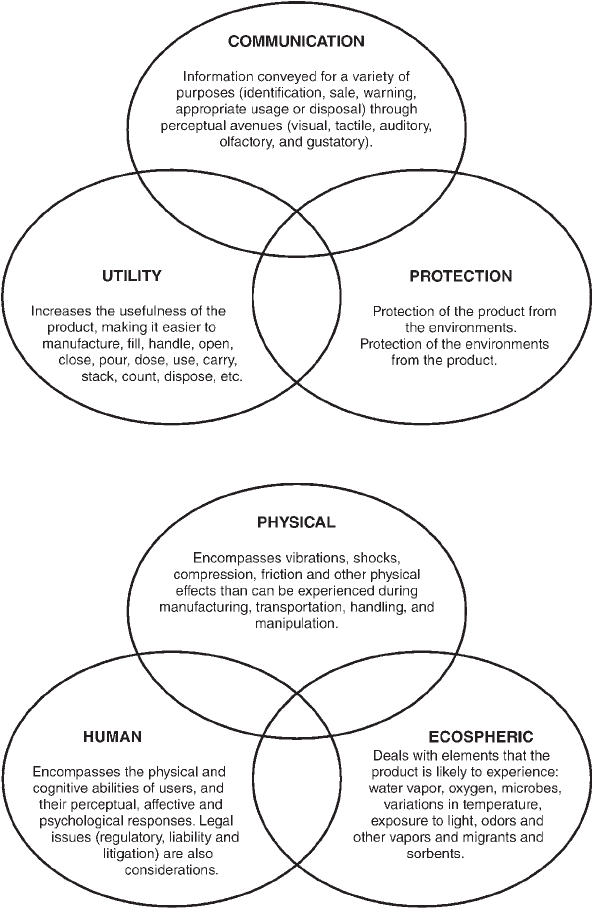
stakeholder perspectives in an organized fashion (2). It
considers packaging to be a socioeconomic discipline that
must perform three main functions—protection, utility,
and communication (see Figure 2)—in three environ-
ments: the physical, ecospheric, and human (see Figure 3).
These functions and environments frequently exert their
effects simultaneously, though the matrix separates them
for ease of understanding.
When all functions and environments are considered,
packaging is not just a means to protect or contain the
product, but also has the potential to impact the decisions
and lives of those interfacing with it throughout the chain
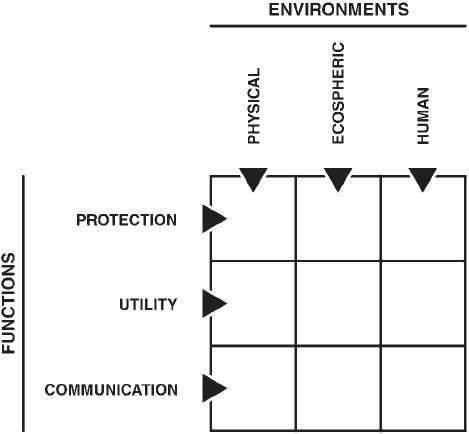
(see Figure 1). The Lockhart matrix presents, visually, a
way to manage the intersections of function and environ-
ment that occur (see Figure 4).
The challenge to designers when using the matrix is
to simultaneously consider all nine intersections of the
matrix from the perspectives of the many, varying mem-
bers of the supply chain (see Figure 1); optimal decisions
will maximize all intersections without suboptimizing
others. For instance, consider a package that contains a
prescription drug. By focusing solely on the category of
human/protection, a child-resistant container that is im-
pervious to all children might be created. The system is
suboptimized, however, if this comes at the cost of any
senior being able to access their medications; suboptimi-
zation of the human/utility interface of the matrix (see
Figure 4).
HISTORICAL EMPHASIS OF PACKAGING SCIENCE
Because packaging is a fledgling discipline, not all areas
of the matrix have received the same level of scientific
Figure 2. The functions that packaging must
perform.
Figure 3. The environments in which functions
must be performed.
PACKAGING DESIGN AND DEVELOPMENT 861
investigation. Consider the level of science that has
been applied across the three environments (ecosphere,
physical, and human; see Figure 4). The ecospheric
environment and the physical environment each have a
considerable history of scientific exploration which has
resulted in standardized test methodologies, predictive
models, and design innovations.
In the ecospheric environment, the role of packaging
as a barrier to deterioration (from air, water, light,
temperature, and living organisms) is well known.
Material and packaging innovations in this arena have
seen tremendous growth and development, and they
range from the simple to complex. Society has been the
benefactor of developments such as: amber glass and
canning; the creation of polymers that allow for less
breakage and lighter packages than glass or metal; the
incorporation of additives that extend the shelf life of
products by scavenging oxygen or killing microbes;
and the emerging introduction of nanocomposites, to
name a few.
Science was, and continues to be, used to catalyze and
inform these innovations. Fickian models can be used to
explain the transfer of molecules through barrier sys-
tems, and sorption moisture isotherms characterize pro-
duct delicacies; this information can be coupled to predict
and understand the resultant shelf life of products
through the use of multiple test standards (see Shelf
life, Testing, Permeation, and Leakage). Solubility para-
meters can be calculated to predict the likelihood of
product/package interaction. ‘‘Active packaging’’ (3) ma-
nipulates and reacts to the internal and external envir-
onment to achieve a desired goal for the product
(generally extension of shelf life). Chemical engineers
and material scientists have worked to understand the
‘‘weak links’’ that can be manipulated in material che-
mistries in order to create polymers that are biodegrad-
able or readily compostable.
Like the ecosphere, the physical environment has
been the benefactor of attentive scientists and engineers
during the years that packaging has been formally
studied. Accelerometers that can ‘‘map’’ physical condi-
tions and shock indicators that trigger a warning of
potential damage have been developed to provide informa-
tion to designers and end-consumers. Testing agencies
and research teams are capable of estimating component
fragility so that product and package design can be
manipulated to mitigate the probability of damage.
This information can be coupled with damage boundary
curves and cushion curves in order to help designers
maximize protection and minimize cost. All of these
approaches rely on sophisticated equipment and test
standards (see Distribution Hazard Measurement, Logis-
tical/Distribution Packaging) that have been put in place
over the years.
Obviously, packaging research has optimized perfor-
mance by providing science that garners insights into
the interactions between product and package when the
ecospheric and physical environments are considered.
However, the lack of this same degree of attention and
quantification of the human environment represents a
real opportunity for packaging designers, particularly as
the global population ages.
We submit that optimal designs consider the product
and the user (all three environments; see Figure 4) from
all stakeholder perspectives (see Figure 1). This is not the
traditional approach to design, which generally centers
on either the product or user as the focus of the decision
making process.
PRODUCT-CENTERED DESIGN (PCD) VERSUS
USER-CENTERED DESIGN (UCD)
In a product-centered design (PCD) process, designers
focus first on the technological development of the package
while considering product and production requirements,
after which point they address user functionality. The
traditional approach to packaging design has been largely
PCD, with concerns about the ability to efficiently fill,
protect, and distribute products driving most design
decisions.
By contrast, a user-centered design (UCD) process first
considers the needs and wants of the user. The users’
functional capabilities determine which product features
are satisfactory. For instance, if it is known that a user can
only exert a certain force, any design that requires a force
beyond that limit will be disallowed from consideration.
We suggest that truly optimal designs consider all
viewpoints, a combination of PCD and UCD processes.
During the entire process the design team must attempt to
balance requirements of the three environments (physical,
ecospheric, and human) and the three functions (protec-
tion, utility, and communication) described earlier from
varying stakeholder perspectives (see Figure 1–4). Though
all intersections of the matrix may not be given equal
credence for all products and stakeholders, all are con-
sidered and, if under- or disregarded, the decision to do so
is deliberate.
Figure 4. The Lockhart packaging matrix.
862 PACKAGING DESIGN AND DEVELOPMENT
PACKAGING DESIGN AND DEVELOPMENT—
CONSIDERING ALL PERSPECTIVES
A packaging project is quite unique in the sense that it
encompasses both the design of three-dimensional compo-
nents and the design of two-dimensional elements to
perform the functions of protection, utility, and commu-
nication in the varying environments. Usually, the end
result takes the form of a multicomponent system that
includes primary, secondary, and tertiary packaging.
Because of its interdisciplinary nature, the development
process affects all functions in an organization. Research,
sales, finance, legal, and the general management are
involved, but of particular importance are the functions
of marketing, design, and manufacturing because of their
continuous involvement along the entire process. It is for
these reasons that it is assumed that the design team will
have representatives from the latter areas.
There are many design and development processes
described in the literature (4–6). Even though some of
them do not specifically consider the design of packages,
from a broad perspective they all have conceptual simila-
rities. Regardless of the type of packaging system, a
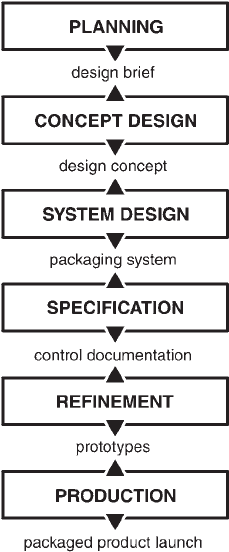
design project has four typical stages: research, design,
development, and manufacturing. We present a six-phase,
comprehensive methodology adapted from Ulrich and
Eppinger (5) for developing packaging systems (see
Figure 5).
The output of each phase is evaluated to determine
what design features move forward in the process.
Evaluations take the form of testing (mechanical and
chemical), user assessment, and/or internal assessment.
The process is iterative and usually bidirectional, mean-
ing that information gathered in later phases can be used
to modify and feed early stages (see Figure 5). The process’
phases are defined in terms of the state of the packaging
system being developed. They are as follows:
1. Planning
2. Concept design
3. System design
4. Specification
5. Refinement
6. Production
1. Planning. The objective of the planning phase is
to formulate a mission statement or design brief that
includes identification of target segments, businesses
goals, stakeholders (see Figure 1), assumptions, and both
product-centered and user-centered restrictions. The in-
puts of this phase take into account the corporate strat-
egy, an assessment of available technology, and market
objectives.
2. Concept Design. During the concept design stage,
several packaging concepts are generated and evaluated,
and one or more are selected for additional development
and testing. A concept is a description of shapes, functions,
and features which are intended to fulfill the expectations
generated, as expressed in the design brief. Concept
ideation is a complex task that implies several intercon-
nected activities which include:
a. Identifying Product and User Needs and Requirements.
The first activity is directed at recording the varying
requirements, needs, and desires for the package system
and communicating these to the development team and
members of the organization. The packaging matrix (see
Figure 4) can be used extensively in understanding and
prioritizing these requirements. The output of this step is
a hierarchical list of need statements with importance
weightings.
Activities carried out at this point include:
. Identification of stakeholder needs
. Identification of product requirements
. Data gathering from stakeholders and product
. Prioritization of the stakeholder needs and product
requirements
. Development of design parameters based on collected
data
. Interpretation of raw data in terms of stakeholder
needs and product requirements.
It is very important to identify the requirements of
the product and the varying stakeholders. Be aware that
product and stakeholder requirements may be juxtaposed
and that varying stakeholders are likely to place emphasis
on differing sections of the packaging matrix. As such,
prioritization is a crucial piece of the process.
Figure 5. A generic packaging design and development process.
(Adapted from Ref. (5).)
PACKAGING DESIGN AND DEVELOPMENT 863
To illustrate this, consider a prescription drug. Product
protection requirements may dictate the use of an opaque
or amber package (ecospheric/protection), but manufac-
turing may desire a clear material so that a vision
system can verify the presence of the pill in the blister
cavity (physical/utility). Similarly, stakeholders may have
different desires. Pharmacists have unique requirements
in terms of cost, storage, labeling, and filling operations,
but those needs may be very different from those of the
end-users.
Once the product requirements (physical and eco-
spheric) and the stakeholders’ needs and requirements
(human) have been identified, the team must gather data
in order to inform the design of the package. Product-
driven data may include: isotherms; chemical assays
that look at sensitivities; stability studies; fragility data;
characterization of the distribution environment (relative
humidity levels, typical temperatures, as well as shocks
and vibrations likely to be encountered); and limitations
imposed by the manufacturing process and distribution
systems. End-user insights may include data collected
from interviews, focus groups, ethnography, and use;
end-users may also be characterized by demographics,
psychographics, and anthropometrics, as well as in terms
of their physical capabilities (strength, range of motion,
visual acuity, etc.).
The next step is to design parameters from the raw
data. At this point in the process, the parameters are
described in terms of what the packaging has to do, as
opposed to prescriptive solutions. Design parameters are
then organized into a hierarchy and grouped in primary,
secondary, and even tertiary priorities. To establish the
relative importance of the parameters, the design team
can rely on its own knowledge about the user and
product; they can overpackage, or they can conduct fact-
finding to gather further information. There is a natural
tradeoff between the approaches: cost, speed, and accu-
racy. Relying on internal knowledge can aid in speed to
market and be cost effective, but can be detrimental in
terms of accuracy. Overpackaging, or overdelivering, can
also aid in speed to market, but can be costly in the long
term; mining more data to inform decisions can slow the
process, but can result in a more informed, cost-effective
solution.
b. Setting Target Specifications. Prioritized design para-
meters are then translated into target specifications.
These are measurable and precise descriptions of what
the packaging has to do. Target specifications represent
goals that, later in the process, can be readjusted in the
event of unforeseen constraints (i.e., technological, eco-
nomic, etc.). The process of establishing specifications
involves the selection of metrics, collection of competitive
benchmarking data, and the setup of ideal and acceptable
target values.
To illustrate this concept, consider a product that has
a design parameter indicating it to be moisture-sensitive.
In this step, the parameter is translated into a target
specification, a specific requirement for the maximum
allowable rate of moisture vapor transmission. The same
type of transition occurs with design parameters that
relate to user needs. The design parameter ‘‘easy opening’’
can be translated into target specifications relating to
package diameter, maximum allowable torque, and coeffi-
cients of friction between cap and hand, or the team could
just decide a percentage of opening success among the
target population.
c. Concept Generation. Target specifications are syn-
thesized into a set of packaging concepts from which the
team will make a final selection. The basic idea is to
exhaustively explore design solutions in order to reduce
the probability of finding a better alternative late in the
development process or, even worse, having a competitor
find one.
d. Concept Selection. The design team will use some
kind of method for selecting concepts. The approach to
concept selection can be either intuitive or structured and
can include:
. An External Decision. A customer or client makes
the selection.
. Product Champion. A member of the team makes a
selection based on personal preference.
. Intuition. A concept is selected by its feel.
. Multivoting. Team members vote for multiple de-
signs (i.e., ‘‘vote for your top 3’’). Each round, a
pre-determined number of designs are forwarded
for more voting, and votes are cast again (‘‘vote for
your top 2’’). This process continues until the de-
sign(s) is chosen.
. Pros and Cons. The team chooses a concept based on
a list of strengths and weaknesses of each concept.
. Prototype and Test. The team builds and test proto-
types of each concept and makes a selection based
upon test data.
. Decision
Matrices. The team
evaluates each concept
with respect to a set of selection criteria. Criteria are
based on previously discussed design priorities.
More structured methods provide objectivity throughout
the concept design phase and help to evaluate concepts
scientifically. Concepts are examined scientifically to de-
termine if they meet or exceed the needs and require-
ments of the product and varying stakeholders and the
selection is made based on objective results. New concepts
are also evaluated and benchmarked against the existing
competition.
e. Concept Testing. Selected concepts are evaluated by
potential users in the target market and subjected to
appropriate laboratory testing. These activities involve:
1. Defining the purpose of the test: the team needs to
define what questions will be answered with the
testing.
2. Selecting test conditions:
. In the case of user focused testing, it is assumed
that a sample population will reflect the target
864 PACKAGING DESIGN AND DEVELOPMENT
population. Testing can be conducted in a
variety of ways, including ethnographic research,
surveys, face-to-face interviews, telephone inter-
views, postal or electronic mail, and over the inter-
net. Concepts can be communicated in many
ways with different levels of description. These
include: verbal description, sketches, photos, vi-
deos, physical appearance models, and working
prototypes.
. In the case of pilot scale manufacturing, it is
assumed that incoming lots will reflect the varia-
bility of materials, line speeds, and other manu-
facturing parameters.
. In the case of stability testing, it is assumed
that conditions of test will be carefully chosen to
reflect, or accelerate, appropriate conditions of
storage and use.
. As with the other testing, physical testing will be
purposefully constructed so that conditions accu-
rately reflect handling and storage throughout
distribution channels.
3. Measurement of responses.
4. Analysis, interpretation of results, and selection of
a final concept.
f. Setting Final Specifications. Based on the final con-
cept, the team will be able to confirm or revise specifica-
tions. This is done by conducting a terminal evaluation
which, again, considers the broad spectrum of stakeholder
requirements with a heavy emphasis on technological
restrictions and manufacturing costs. During this phase,
the design team must perform a balancing act that con-
siders the myriad of requirements from the varying user
perspectives to arrive at the optimal package design for
the entire system. As such, the final specification process
calls for an active involvement of team members repre-
senting marketing, design, and manufacturing functions
of the organization.
3. System Design. This phase includes the definition of
all packaging system components and parts. The outcome
includes a geometric layout of the system, functional
specifications for each part, and a process flow diagram
for the production and packaging lines.
4. Specification. The output of this phase is the control
documentation for the entire packaging system, as ap-
proved by the respective areas (i.e., structural, graphics,
scheduling, manufacturing, marketing, customer service,
the filler, etc.). For the graphic elements of the system,
this phase implies the preparation of the final art work.
There are a multitude of possibilities, but it could include
adequate color separation for the printing system chosen,
photography at sufficient resolution, die lines, overprints,
illustrations, fonts, code bars, final identification suppli-
ers for components and substrates, specifications for
spot ultraviolet coating (varnish or lacquer), embossing/
debossing, foil stamping, matt/glossy finish, and so on. For
the structural parts of the system, specifications include
detailed descriptions of geometry, tolerances, materials,
and manufacturing processes of all components as well as
production tooling. It also identifies any standard parts to
be acquired from suppliers.
5. Refinement. The refinement phase involves the eva-
luation of preproduction versions of all packaging system
parts and the final assembly. Typically, two types of
prototypes are used here: alpha and beta. Alpha proto-
types are early versions of the packaging system; they
have the same geometry and material properties as
intended for the production version parts, but they may
or may not be fabricated using the actual production
process. Alpha prototypes are used to determine if the
design will work as intended, fullfilling key stakeholder’s
needs and requirements. Beta prototypes are built with
parts produced with the intended manufacturing pro-
cesses, but their assembly might not be performed using
the final assembling process. Beta prototypes are evalu-
ated by the team and by different stakeholders to identify
whether engineering changes are needed for the final
packaging system.
6. Production. During this phase, the packaging system
is produced on the final packaging line using actual
packaging components and parts. Packaged products are
evaluated using carefully constructed sampling plans to
determine the process’ ability to produce within specified
tolerances and to adjust the parameters of manufacture.
There is a gradual transition to full blown production. At
some point during this phase the final packaged product is
launched and distributed.
CONCLUSIONS
Seller
and end-user trial,
satisfaction, and repeat pur-
chase may be a direct function of packaging for many
consumer non-durables and perhaps for some durables as
well. The three functions of packaging (protection, com-
munication, and utility) play a key role in achieving
success.
Packaging that fails to fully protect the product has the
potential to result in excess damage and waste, dimin-
ished shelf life, and loss of flavor or efficacy. Problems
associated with insufficient protection are likely to lead to
customer dissatisfaction and negative word-of-mouth ad-
vertising. Likewise, packaging that fails to communicate
its marketing positioning, to differentiate from its compe-
titors, and to connect emotionally with consumers will
result negatively on the bottom line. Packaging that does
not provide the expected utility will put off consumers.
The product/package system must generate satisfaction,
and poorly designed packages have the potential fail to
attract sales and discourage repeat purchase.
It is important that designers recognize the power of a
comprehensive, deliberate approach to package design.
This chapter presents a six-step approach that can be used
to design packaging and the packaging matrix, a tool for
prioritizing the myriad of considerations and perspectives
that must be considered.
PACKAGING DESIGN AND DEVELOPMENT 865
BIBLIOGRAPHY
1. R. Koh, E. Schuster, and N. Lam, ‘‘Prediction, Detection, and
Proof: An Integrated Auto-ID Solution to Retail Theft,’’ MIT
Auto ID Center white paper, 2003.
2. H. E. Lockhart, ‘‘A Paradigm for Packaging,’’ Packaging
Technol. Sci. 10, 237–252 (1997).
3. T. P. Labuza and W. M. Breene, ‘‘Applications of Active Packa-
ging for Improvement of Shelf-Life and Nutritional Quality
of Fresh and Extended Shelf-Life Foods,’’ J. Food Processing
Preserv. 13(1), 1–69 (1989).
4. L. Roth, ‘‘The Making of a Designer: Ideas and Techniques’’ in
Packaging Design, Van Nostrand Reinhold, New York, 1990,
pp. 33–35.
5. K. T. Ulrich and S. D. Eppinger, Development Processes and
Organizations,’’ in Product Design and Development, Tata
McGraw-Hill Companies, New Delhi, 2004, pp. 187–208.
6. B. Stewart, The Packaging Designer ’s Toolbox’’ in Packaging
Design, Laurence King Publishing, London, 2007, pp. 59–92.
Further Reading
J. C. Jones, Design Methods: Seeds of Human Futures, John Wiley
& Sons, New York, 1981.
C. Lloyd-Morgan, Packaging Design, RotoVision S.A., Crans-pre
`
s-
Ce
´
ligny, Switzerland, 1997.
S. Cliff, 50 Trade Secrets of Great Design Packaging, Rockport
Publishers, Gloucester, Massachusetts, 1999.
K. T. Ulrich and S. D. Eppinger, Product Design and Development,
Tata McGraw-Hill Companies, New Delhi, India, 2004.
G. Calver, What Is Packaging Design?, RotoVision S.A., Mies,
Switzerland, 2004.
B. Stewart, Packaging Design Strategy, Pira International,
Leatherhead, Surrey, UK, 2004.
B. Stewart, Packaging Design, Laurence King Publishing,
London, UK, 2007.
PACKAGING DESIGN SYSTEM FOR
FRESH PRODUCE
P. V. M AHAJAN
F. A. RODRIGUES
M. J. SOUSA-GALLAGHER
Department of Process and
Chemical Engineering,
University College Cork,
Ireland
MAP DESIGN
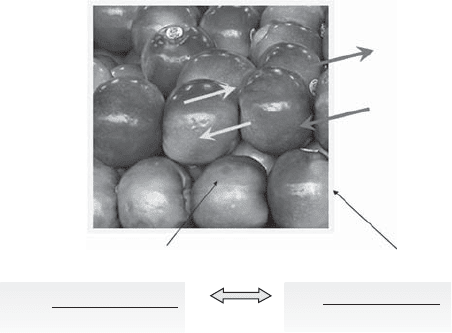
MAP design requires the determination of intrinsic prop-
erties of the produce—that is, respiration rate, optimum
O
2
and CO
2
gas concentrations, and film permeability
characteristics as shown in Figure 1. The ultimate aim
of this design process is to select suitable films for a given
product, its area and thickness, filling weight, equilibrium
time, and the equilibrium gas composition at constant and
varying temperature conditions (1, 2). It is noted that the
temperature is never constant in the distribution chain of
fresh produce. Due to the temperature dependence of the
respiration rate and the gas permeability of a packaging
film, a film that produces a favorable atmosphere at the
optimal storage temperature may cause excessive accu-
mulation of CO
2
and/or depletion of O
2
at higher tempera-
tures, a situation that could lead to metabolic disorders
with concomitant safety and quality issues.
The ‘‘pack-and-pray’’ approach and in-house trial-and-
error experiments are normally used to find a suitable
packaging material, film area for gas/water vapor ex-
change, package size, and the quantity of product to be
packaged. This is both time and labour intensive and
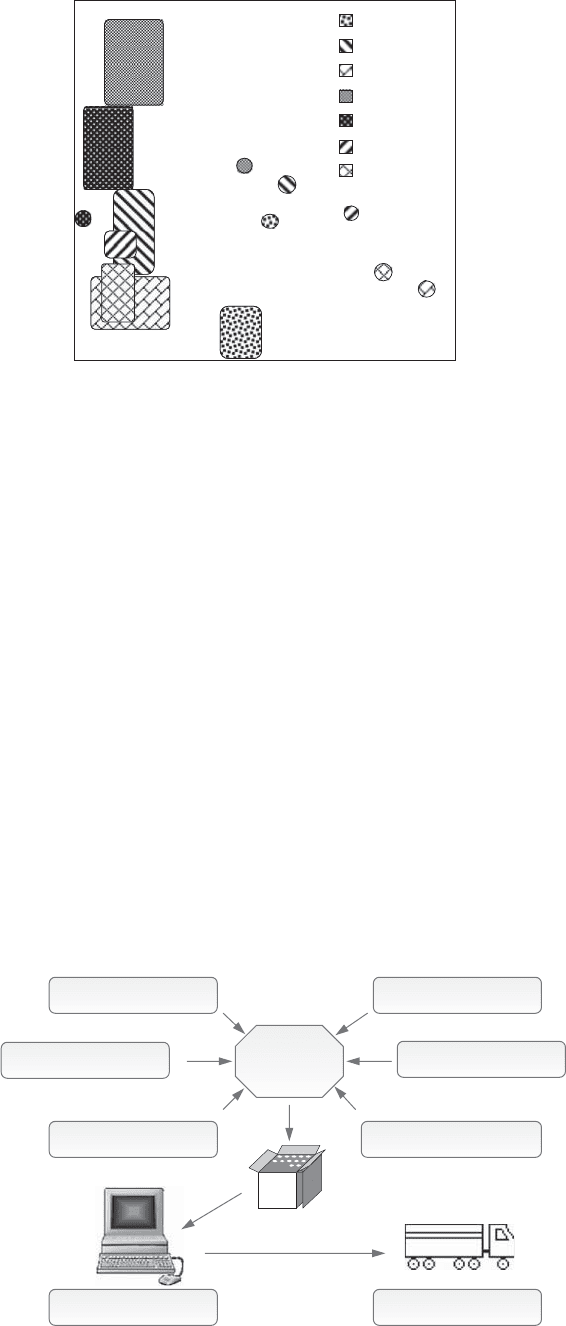
a potential risk to health. It is noted that the existing
commercial vegetable packages deviated from the opti-
mum MAP conditions as measured by our research group
(Figure 2) (3). A MAP system, if not designed correctly,
may be ineffective or even shorten the storage life of a
product. There is a wealth of published information on
MAP, yet no systematic study has been conducted to
establish which commercially available polymeric films
would be most suitable for a particular produce under a
given set of environmental conditions. Such analysis could
provide an initial screening of films, point out their
potential limitations, and allow a better package engineer-
ing design. Mathematical modelling and computer simu-
lation is a valuable tool in this context.
AN ENGINEERING APPROACH TO THE PACKAGE
DESIGN
Sound use of MAP entails consolidated knowledge of the
food–package–environment interaction: When a product
is packed, it is surrounded by a gaseous mixture, the
composition of which depends on the interactions between
the food product, the package material, and the environ-
ment. If the packed food is a fresh-cut product, such
interactions concern the respiration metabolism of the
product (Figure 1): The product exchanges gas with the
CO
2
CO
2
O
2
O
2
Film permeability
Product respiration rate
CO
2
permeability
mL of CO
2
/(kg.hr)
mL of O
2
/(kg.hr)
O
2
permeability
β =
RQ =
0.7 < RQ < 1.3
4 < β < 9
Figure 1. Basic principles of modified atmosphere packaging
(MAP).
866 PACKAGING DESIGN SYSTEM FOR FRESH PRODUCE
surrounding atmosphere, consuming O
2
and CO
2
carbon
dioxide (4). The ratio between the CO
2
production rate
(mL/(kg h)) and O
2
consumption rate (mL/(kg h)) is the
respiration quotient (RQ). Due to the respiration process,
an O
2
and CO
2
concentration gradient between the head-
space and the environment is generated. Thus, a gas flow
is activated through the packaging material due to film
permeability to O
2
and CO
2
. The ratio between the
permeability to CO
2
and the permeability to O
2
is known
as selectivity (b). From the above considerations, to design
a package for a fresh-cut product, one clearly needs to deal
with packaging system in dynamic conditions. Therefore,
to ensure a suitable gas composition during the product’s
shelf life, a model should take into account the factors and
steps shown in Figure 3. The first and most important
factor is the respiration rate. The mathematical model
for respiration rate is usually a function of O
2
,CO
2
, and
temperature (5). The second important factor is the type of
packaging material and its permeability in terms of O
2
and CO
2
. Permeability changes with temperature; hence,
a mathematical model is required to predict the perme-
ability change in the packaging material, which is a
function of temperature. Another factor is the best optimal
atmosphere required to extend product shelf life which
varies from product to product and is widely covered in
the literature. A real challenge is how to achieve this
atmosphere for a given type of product and packaging
conditions. The answer is to go for either (a) a layman’s
approach of trial-and-error experiments or (b) an engi-
neering approach where mathematical equations depict-
ing product respiration rate and package permeability
could be used to solve the mass balance equations of a
packaging system using software tools.
INTEGRATION OF MATHEMATICAL MODELS FOR
MAP DESIGN
For any packaging design, the product characteristics
such as respiration rate, density, and the optimum range
of O
2
and CO
2
for the best shelf life are needed for solving
the mass balance equations. Such data are widely avail-
able in the literature and has been compiled in a ready-
to-use format (2, 6). This database helps to choose the
appropriate film for the given product. Another database
has been created for packaging materials; this includes
their permeability values, mathematical models to predict
permeability at any temperature, film thickness, avail-
ability, and cost. When several films can be used to provide
a protective atmosphere, their cost is a major selection
factor. A packaging design protocol has been developed for
selection of the best film for a given product. This requires
knowledge of the optimum gas composition (O
2
and CO
2
)
and determination of the respiration rate of the selected
product using the database on respiration rate mathema-
tical models.
Product respiration
Package simulation
Product mass
Storage conditions
Product density
Package size/geometry
Packaging material
MAP
Design
Package validation
Figure 3. Factors affecting MAP design.
Spinach
Sweet corn
Mushrooms
Carrots
Lettuce
Broccoli
Cabbage
20
15
10
5
0 5 10 15 20
CO
2
(% v/v)
O
2
(% v/v)
Figure 2. Recommended atmospheres for vegetables and
average atmospheres of commercial packages. (Boxes show the
recommended gas composition, and circles show the average gas
composition of commercial packages.)
PACKAGING DESIGN SYSTEM FOR FRESH PRODUCE 867