
Yam, Kit L. (ed.). The Wiley encyclopedia of packaging technology
Подождите немного. Документ загружается.

PdM—Predictive Maintenance
PdM, one of the most popular terms in the maintenance
field, covers a wide range of practices, all of which try to
refute the old adage, ‘‘If it ain’t broke, don’t fix it.’’ PdM
practitioners follow a credo more like, ‘‘Don’t wait for it to
actually break before you fix it—figure out when it is going
to break and make sure you don’t have to fix it in the
middle of production.’’
From http://www.plant-maintenance.com/terminolo-
gy.shtml, predictive maintenance can be said to be an
equipment maintenance strategy based on measuring the
condition of equipment in order to assess its present
condition, predict its remaining useful life, and determine
an expected failure time in the future and then taking
ongoing appropriate action to avoid the failure and its
consequences. The condition of equipment could be mon-
itored using condition monitoring, statistical process con-
trol techniques, by monitoring equipment performance, or
through the use of the human senses. The terms condi-
tion-based maintenance, on-condition maintenance, and
predictive maintenance could be used interchangeably.
As the name implies, predictive maintenance antici-
pates equipment outages rather than reacting to them.
Benefits include fuller useful life for equipment and lower
backup inventory. It goes beyond preventive maintenance,
which at least strives to shift plant downtime to noncri-
tical periods. Initial cost of predictive monitoring systems
tends to be high, but much less than forced reactive
maintenance due to just one serious outage of a manufac-
turing line. In an era of intensive competition, where asset
usage and plant operating efficiency must be maximized,
it is predictive maintenance that should be a tool along
with reliability centered maintenance.
Diagnostic equipment is central to the PdM methodol-
ogy, and therefore it is no surprise that there are thou-
sands of products that enable users to anticipate machine
failure. Software—like CMMS, ERP, and EAM packages—
is a big part of this.
PM—Preventive Maintenance
In his 1998 book, Developing Performance Indicators for
Managing Maintenance (Industrial Press), Terry Wire-
man has this to say about PM:
The preventive maintenance program is the key to any
successful asset management process. The preventive main-
tenance program reduces the amount of reactive maintenance
to a level low enough that the other initiatives in the asset
management process can be effective. However, most compa-
nies in the United States have problems keeping their PM
programs focused. In fact, surveys have shown that only 20
percent of the companies in the United States feel their PM
programs are effective.
Historically; PM was introduced in the United States in
the 1950s and then adopted into the Japanese philosophy
of TPM (see below). PM is sometimes seen as an outmoded
concept today, having been supplanted by more recently
honed philosophies like RCM, TPM, and PdM, but its
general foundation of what TPM guru Seiichi Nakajima
calls ‘‘time-based maintenance featuring periodic inspec-
tion, servicing and overhaul’’ is still the basis for many
maintenance initiatives today. Regarding overhauling
equipment, it is now being more recognized by industry
to overhaul equipment based on predictive analysis and
inspection and overhaul as needed, not on a fixed cyclical
time parameter.
QCP—Quick Change Process
Quick change process (Figure 1) can be defined as all those
tasks that must be done quickly with accuracy and preci-
sion when changing from one product to another or one
Quick Change
Process
(QCP)
First Time Right & Quick
for Production Processes
People
Protocols (PP)
Change Part
Protocols (TP)
Machine
Protocols (MP)
Safety/STI/SOP
Cleanliness/Order
Decontamination
Storage/Transfer/Staging
Skill Level & Training
Vendor Support
Wear/Maintenance
Concept/Design/Specs
Decontamination
Clean Up
Vendor Support
Identify & Document
Safety & Ergonomics
Decontamination
Clean Up
Transfers & Storage
Input
Protocols (IP)
Supplier Support
Cleanliness/Order
Decontamination
Design/Specs/Tolerances
Transfers & Storage
Continuous Improvement
Continuous Improvement
Continuous Improvement
Company Policy/Management
Design/Specs
Wear/Maintenance
Safety & Ergonomics
Laws
Certifications
Standards
(Regional,
National,
International)
Quick Change Process
Loading/Housekeeping
Figure 1. An overview of the quick change process.
888 PACKAGING LINE PERFORMANCE
SKU to another. To accomplish this requires the proper
execution of associated tasks that are related to a given
SKU. The main tasks are made up of:
1. Offline preparatory, documentation, and ready
events.
2. Purge-out activities.
3. Change-out activities or changeover.
4. Run-up or start-up.
The interrelationship of all these tasks and their subtasks
involved in the change process can be very complex. A
review of this complexity will be done, along with discus-
sion of why changing the packaging process to be quick
change is a coordinated holistic effort.
Today the change-out process has to be taken seriously
and integrated into company policy in order to:
. Develop a just-in-time or on-demand production
philosophy.
. Increase their margins and profits.
. Run a large variety of different products on the same
line.
. Demonstrate control to regulatory groups.
. Maintain and increase market share.
Quick change process is fundamentally a significantly
modified version of single minute exchange of die (SMED)
philosophy and techniques expanded and targeted to
production facilities especially related to packaging, blow
molding, and converting industries. SMED uses philoso-
phical concepts and industrial engineering techniques to
facilitate the quick exchange of die sets in stamping
operations, as found in the automotive industry.
RCM—Reliability-Centered Maintenance
There is a whole sub-industry in the maintenance field
centered on RCM and its offspring, RCM2. Reliability can
be defined as ‘‘the process of managing the interval
between failures. If availability is a measure of the equip-
ment uptime or conversely the duration of downtime,
reliability can be thought of as a measure of the frequency
of downtime.
RCM thinking and practice began in the commercial
airline industry—a field where ‘‘downtime’’ has some
pretty unfortunate connotations—in the 1960s. In the
following decades, two engineers, Stanley Nowlan and
Howard Heap of United Airlines, published a study on
the subject that established it as a standard maintenance
practice.
There is likely nobody who has done as much to spread
the cause of RCM and RCM2 as John Moubray, who,
through his Aladon consulting firm (www.aladon.co.uk),
has worked with plants worldwide on reliability-based
initiatives. He defines RCM2 as ‘‘a process used to decide
what must be done to ensure that any physical asset,
system or process continues to do whatever its users want
it to do.’’
SCM—Supply Chain Management; or ISCM—Integrated
Supply Chain Management
Always a tough one to define—there are several competing
theories as to where the industrial chain of raw goods,
manufacturing, and distribution actually starts and ends.
Practitioners have, within the last few years, taken to
referring to ‘‘integrated supply chain management’’
(ISCM) just to further confuse the issue, but basically
they are the same.
ISCM is a process-oriented, integrated approach to procuring,
producing, and delivering products and services to customers.
ISCM has a broad scope that includes sub-suppliers, suppliers,
internal operations, trade customers, retail customers, and
end users. ISCM covers the management of material, informa-
tion, and funds flow:
You can find an excellent overview of the subject in the
‘‘Supply Chain Management Review’’ online magazine site
at: http://www.manufacturing.net.
Six Sigma
It is a systematic quality program that strives to limit
defects to three standard deviations on either side of the
mean or a total of six sigma. Sigma is just a term for one
standard deviation about the mean of a significant popu-
lation of measurements of a process variable. One of the
major focuses of Six Sigma is to reduce process variation.
In most companies, quality loss will be by far the smallest
of the OEE losses. A Six Sigma or equivalent program may
be necessary to maintain focus on quality improvements.
SPC—Statistical Process Control and SQC Statistical Quality
Control
Statistical process control (SPC) and statistical quality
control (SQC) methodology is one of the most important
analytical developments available to manufacturing in
this century. SPC has come to be known as an online
tool providing close-up views of what’s happening to a
process at the moment. SQC provides offline tools to
support analysis and decision-making to help determine
if a process is stable and predictable from shift to shift, day
in and day out, and from supplier to supplier. When SPC
and SQC tools work together, users see the current and
long-term picture about processing performance. SPC
provides online tools that permit a close-up view of what’s
currently happening to a process. SQC provides offline
tools to support analysis and decision-making about pro-
cess stability over time.
Before SPC, products were inspected after they were
completed and defective products were discarded or re-
worked. The idea behind continuous improvement is to
focus on designing, building, and controlling a process that
makes the product correctly the first time at the point of
manufacture.
How to Improve Using SPC and SQC
Key to improving a process is removing as much variation
as possible. When products and services are delivered
PACKAGING LINE PERFORMANCE 889
with minimal variation, customer requirements and
expectations are met. Manufacturers applying SPC and
SQC techniques rely on a variety of methods, charts,
and graphs to measure, record, and analyze processes to
reduce variations. In general, processes achieving the
most benefit from SPC and SQC are products with:
1. Highly repetitive manufacturing processes.
2. High-volume production and low margins.
3. Narrow tolerances.
To make SPC and SQC work, key parameters indicating
product variations are measured and recorded. For exam-
ple, key parameters for a roll of cloth could include
shrinkage, color, strength, and flaws per yard (meter).
SQC methods are used to analyze recorded data and
establish which variations are a natural part of the
process and which unusual variations are caused by
external factors, such as variations in raw materials.
SPC and SQC Tools
Control charts are a fundamental tool of SPC and
SQC and provide visual representation of how a process
varies over time or from unit to unit. Control limits
statistically separate natural variations from unusual
variations. Points falling outside the control limits are
considered out-of-control and indicate an unusual source
of variation.
Performance improvements of personal computer hard-
ware and software permit real-time data collection, num-
ber crunching, and graphing. Providing SPC information
in real-time allows operators to make adjustments or to
schedule maintenance on an as-needed basis. SPC and
SQC are an effective part of continuously improving a
manufacturing process. When measurements are accu-
rately collected and analyzed, improvements are identi-
fied and implemented, and controls established to ensure
improvements are permanent and the process is well on
its way to meeting quality requirements.
Process capability Cp or Cpk is a process that is used
within the SPC environment. It is a process that is a
unique combination of tools, materials, and methods, and
people engaged are producing a measurable output; for
example a manufacturing line for machine parts. All
processes have inherent statistical variability that can
be evaluated by statistical methods. The process capability
is a measurable property of a process. It is usually
reported in terms of the inherent variability of a process
and its output.
Two parts of process capability are: (1) Measure the
variability of a process and (2) compare that variability
with a proposed specification or product tolerance.
Process capability compares the output of an in-control
process to the specification limits by using capability
indices. The comparison is made by forming the ratio of
the spread between the process specifications (the specifi-
cation ‘‘width’’) to the spread of the process values, as
measured by 6 process standard deviation units (the
process ‘‘width’’).
The process capability index uses both the process
variability and the process specifications to determine
whether the process is ‘‘capable.’’
We are often required to compare the output of a stable
process with the process specifications and make a state-
ment about how well the process meets specification. To do
this, we compare the natural variability of a stable process
with the process specification limits.
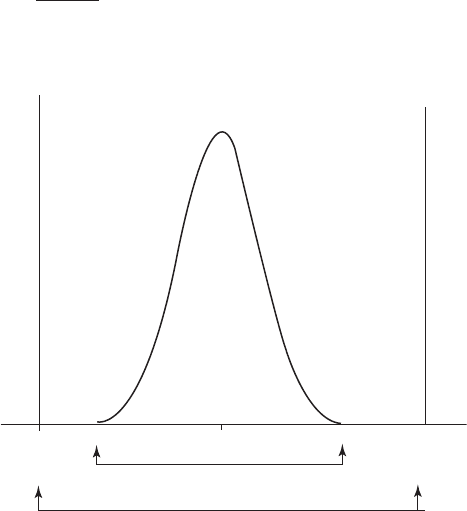
A
capable process is one where almost all the measure-
ments fall inside the specification limits. This can be
represented pictorially by the plot below:
LSL USL
Actual process spread
Allowable
p
rocess s
p
read
There are several statistics that can be used to measure
the capability of a process: C
p
, C
pk
, and C
pm
.
Most capability indices estimates are valid only if the
sample size used is ‘‘large enough.’’ Large enough is
generally thought to be about 50 independent data values.
The Cp, Cpk, and Cpm statistics assume that the popula-
tion of data values is normally distributed. This is dis-
played by the graph above in which there is a two-sided
specification,
X and s are the mean and standard devia-
tion, respectively, of the normal data and USL, LSL, and T
are the upper and lower specification limits and the target
value, respectively. References are
http://www.itl.nist.gov/div898/handbook/pmc/section1/
pmc16.htm or
http://www.isixsigma.com/st/process_capability/ or
Pyzdek, T, Quality Engineering Handbook, 2003, ISBN
0824746147
Bothe, D. R., Measuring Process Capability, 2001, ISBN
0070066523
Godfrey, A. B., Juran’s Quality Handbook, 1999, ISBN
007034003
ASTM E2281, Standard Practice for Process and Mea-
surement Capability Indices
890 PACKAGING LINE PERFORMANCE
TPM—Total Productive Maintenance
In the trendsetting 1982 book TPM Tenkai (which was
translated into English as TPM Development Program:
Implementing Total Productive Maintenance and pub-
lished in 1989 by Productivity Press), editor Seiichi
Nakajinia writes that in the years during and immedi-
ately following World War II, Japanese industrial man-
agers sought to compete in the world marketplace by
improving on the quality of their products. Building on
the American PM model, the Japanese developed the field
of TPM in the 1970s—most notably in the Toyota auto-
motive plants, as a way of furthering refining their main-
tenance practice. The overall aim of TPM is ‘‘a double
goal—zero breakdowns and zero defects.’’
Nakajinia says that TPM was defined in 1971 by the
Japan Institute of Plant Engineers with these 5 goals in
mind:
1. Maximize equipment effectiveness (in improving
overall efficiency).
2. Develop a system of productive maintenance for the
life of the equipment.
3. Involve all departments that plan, design, use, or
maintain equipment in implementing TPM (engi-
neering and design, production, and maintenance).
4. Actively involve all employees from top manage-
ment to shop floor workers (Top down approach).
5. Promote TPM through motivation management:
autonomous small-group activities.
For overviews of TPM, go to NASA’s site at www.larc.
nasa.gov/ or search for TPM.
Other Performance-Enhancing Methodologies
ABC/M Activity-Based Costing/Management
BPI Business Process Improvement
BPR Business Process Reengineering
CI Continuous Improvement
EAM Enterprise Asset Management
ERP Enterprise Resource Planning
JIT Just-in-Time (manufacturing)
LCC Life Cycle Costing
LEAN Lean production or manufacturing
MES Manufacturing Execution System
MP Maintenance Prevention
MPI Maintenance Performance Indicators
MRP Material Requirements Planning (MPR-I
and MPR-II)
MSDS Material Safety Data Sheet
MTBF Mean Time Between Failure
MTTR Mean Time to Repair (MTOF—Mean Time
of Failure)
RCAF Root Cause Analysis of Failure
RCD Reliability-Centered Design
SMED Single Minute Exchange of Dies
TCO Total Cost of Ownership
TMM Total Maintenance Management
TQM Total Quality Management
ZD Zero Downtime
BIBLIOGRAPHY
1. P. J. Zepf, P. Eng., CPP, How to Implement Performance
Measurements into a Production Process, Zarpac Inc., Oak-
ville, Ontario, Canada, 2002, http://www.zarpac.com.
2. T. J. Zepf, The Art of Work, Tanis Media, Oakville, Ontario,
Canada, 2006, www.amazon.com or http://www.tanismedia.
net.
3. A. B. Godfrey, Juran’s Quality Handbook, 5th edition,
McGraw-Hill, New York, 1999.
4. T. Pyzdek, Quality Engineering Handbook, 2003.
5. D. R. Bothe, Measuring Process Capability, ISBN
0070066523, 2001.
6. W. Kaydos, Operational Performance Measurement, Increas-
ing Total Productivity, CRC Press LLC, Boca Raton, FL, 1998.
7. E. E. Lewis, Introduction to Reliability Engineering, 2nd
edition, John Wiley & Sons, New York, 1996.
8. J. M. Moubray, Reliability-Centered Maintenance, 2nd edi-
tion, Industrial Press, New York, 1997.
9. J. D. Oleson, Pathways to Agility, Mass Customization in
Action, John Wiley & Sons, New York, 1998.
10. D. A. Shafer, Successful Assembly Automation, A Develop-
ment and Implementation Guide, Society of Manufacturing
Engineers, Detroit, MI, 1999.
11. W. Soroka, Fundamentals of Packaging Technology, 3rd edi-
tion, Institute of Packaging Professionals (IoPP), Naperville,
IL, 2002.
12. T. Wireman, Developing Performance Indicators for Mana-
ging Maintenance, Industrial Press, New York, 1998.
13. O. Kwon, New methodology for Measuring equipment perfor-
mance and managerial effect in TPM. PhD. Thesis, Depart-
ment of Industrial Systems and Information Engineering,
Graduate School, Korea University.
PACKAGING OF FOOD
GORDON L. ROBERTSON
Food
Packaging
Environment,
Brisbane, Australia
INTRODUCTION
Role of Food Packaging
Food packaging is essential and pervasive: It is essential
because without packaging the safety and quality of food
would be compromised, and it is pervasive because almost
all food is packaged in some way. Food packaging performs
a number of disparate tasks (1). It protects the food from
contamination and spoilage; it makes it easier to transport
and store foods; and it provides uniform measuring of
contents. By allowing brands to be created and standar-
dized, it makes advertising meaningful and makes large-
scale distribution and mass merchandising possible. Food
packages with dispensing caps, sprays, reclosable open-
ings, and other features make products more usable and
convenient.
PACKAGING OF FOOD 891
Functions and Attributes of Food Packaging
Four primary and interconnected functions of packaging
have been identified: containment, protection, conveni-
ence, and communication (1).
Containment. This function of packaging is so obvious
as to be overlooked by many, but it is the most basic
function of packaging. Food products must be contained
before they can be moved from one place to another. The
containment function of packaging makes a huge contri-
bution to preventing losses from the myriad of foods that
are moved from one place to another on numerous occa-
sions each day.
Protection. This is often regarded as the primary func-
tion of the package: to protect its contents from outside
environmental effects, be they water, water vapor, gases,
odors, microorganisms, dust, shocks, vibrations, compres-
sive forces, and so on, and to protect the environment from
the product.
For the majority of food products, the protection af-
forded by the package is an essential part of the preserva-
tion process. For example, aseptically packaged milk in
paperboard laminate cartons only remains aseptic for as
long as the package provides protection; vacuum-pack-
aged meat will not achieve its desired shelf life if the
package permits oxygen to enter. In general, once the
integrity of the package is breached, the product is no
longer preserved.
Freedom from harmful microbial contaminants at the
time of consumption can also be influenced by the pack-
age. Firstly, if the packaging material does not provide a
suitable barrier around the food, microorganisms can
contaminate the food and make it unsafe. Microbial con-
tamination can also arise if the packaging material per-
mits the transfer of, for example, moisture or oxygen from
the atmosphere into the package. In this situation, micro-
organisms present in the food but presenting no risk
because of the initial absence of moisture or oxygen may
then be able to grow and present a risk to the consumer.
Packaging also protects or conserves much of the
energy expended during the production and processing
of the product. For example, to produce, transport, sell,
and store 1 kg of bread requires 15.8 MJ (megajoules) of
energy. This energy is required in the form of transport
fuel, heat, power, and refrigeration in farming and milling
the wheat, baking and retailing the bread, and distribut-
ing both the raw materials and the finished product. To
produce the polyethylene bag to package a 1 kg loaf of
bread requires 1.4 MJ of energy. This means that each unit
of energy in the packaging protects 11 units of energy in
the product. While eliminating the packaging might save
1.4 MJ of energy, it would also lead to spoilage of the bread
and a consequent waste of 15.8 MJ of energy (1).
Convenience. Modern industrialized societies have
brought about tremendous changes in lifestyles, and the
packaging industry has had to respond to those changes
that have created a demand for greater convenience in
household products: foods that are pre-prepared and can
be cooked or reheated in a very short time, preferably
without removing them from the package; condiments
that can be applied simply by pump-action packages;
dispensers for sauces or dressings which minimize mess;
reclosable openings on drink bottles to permit consump-
tion on the go, and so on. Thus packaging plays an
important role in allowing products to be used
conveniently.
Two other aspects of convenience are important in
package design. One of these can best be described as
the apportionment function of packaging. In this context,
the package functions by reducing the output from indus-
trial production to a manageable, desirable ‘‘consumer’’
size. An associated aspect is the shape (relative propor-
tions) of the primary package in relation to convenience in
use by consumers (e.g., easy to hold, open, and pour as
appropriate) and efficiency in building into secondary and
tertiary packages. Packaging plays a very important role
in permitting primary packages to be unitized into sec-
ondary packages (e.g., placed inside a corrugated case)
and then for these secondary packages to be unitized into
a tertiary package (e.g., a stretch-wrapped pallet). As a
consequence of this unitizing function, materials handling
is optimized since only a minimal number of discrete
packages or loads need to be handled.
Communication. There is an old saying that ‘‘a package
must protect what it sells and sell what it protects’’; that
is, the package functions as a ‘‘silent salesman.’’ The
modern methods of consumer marketing would fail were
it not for the messages communicated by the package
through distinctive branding and labeling, enabling
supermarkets to function on a self-service basis. Consu-
mers make purchasing decisions using the numerous
clues provided by the graphics and the distinctive shapes
of the packaging. Other communication functions of the
package include (a) a UPC (Universal Product Code) that
can be read accurately and rapidly using modern scanning
equipment at retail checkouts and (b) nutritional informa-
tion on the outside of food packages which has become
mandatory in many countries.
Attributes. There are also several attributes of packa-
ging that are important (2). One (related to the conve-
nience function) is that it should be efficient from a
production or commercial viewpoint—that is, in filling,
closing, handling, transportation, and storage. Another is
that the package should have, throughout its life cycle
from raw material extraction to final disposal after use,
minimal environmental impacts. A third attribute is that
the package should not impart to the food any undesirable
contaminants. Although this last attribute may seem self-
evident,
there has been
a long history of so-called food
contact substances migrating from the packaging material
into the food (3). For many years the solder used in three-
piece metal cans resulted in lead migrating into some
foods; the switch to welded side seams eliminated this
source of lead. Plasticizers have also migrated into foods—
for example, phthalates (4), as well as monomers [e.g.
styrene monomer (5)], catalysts [e.g., antimony from
PET bottles (6)], and photoinitiators from printing inks
892 PACKAGING OF FOOD
[e.g., ITX (7)]. Not surprisingly, food packaging materials
are highly regulated to ensure consumer safety.
DETERIORATIVE REACTIONS IN FOODS
Foods are frequently classified on the basis of their
stability as nonperishable, semiperishable, and perish-
able. An example of the first classification is sugar;
provided that it is kept dry, at ambient temperature and
free from contamination, it should have a very long shelf
life. However, few foods are truly nonperishable, and an
important factor influencing their perishability is the
packaging.
For example, hermetically sealed and heat processed
(e.g., canned) foods are generally regarded as nonperish-
able. However, they may become perishable under certain
circumstances—for example, if the can seams are faulty,
or if there is excessive corrosion resulting in internal gas
formation and eventual bursting of the can. Foods with
low moisture content, such as dried fruits and vegetables
and baked goods, are classified as semiperishable. Frozen
foods, though basically perishable, may be classified as
semiperishable, provided that they are properly stored at
freezer temperatures. The majority of foods (e.g., flesh
foods (such as meat and fish), milk, eggs, and most fruits
and vegetables) are classified as perishable unless they
have been processed in some way. Often, the only form of
processing that such foods receive is to be packaged and
kept under controlled temperature conditions.
Deteriorative reactions occur in foods during proces-
sing and storage, and they combine to affect food quality.
These reactions can be biochemical (typically enzymic),
chemical, physical (typically as a result of moisture gain or
loss), and biological (both microbiological and macrobiolo-
gical due to insect pests and rodents). Knowledge of the
kinds of changes that influence food quality is an impor-
tant first step in developing food packaging that will
minimize undesirable changes in quality and maximize
the development and maintenance of desirable properties.
Once the nature of the reactions is understood, knowledge
of the factors that control the rates of these reactions is
necessary in order to fully control the changes occurring in
foods during storage—that is, while packaged. The nature
of the deteriorative reactions in foods, along with the
factors that control the rates of these reactions, has been
reviewed in detail elsewhere (1).
The rates of deteriorative reactions of particular foods
are influenced by two factors: the nature of the foods and
their surroundings. These factors are referred to as in-
trinsic and extrinsic parameters. Intrinsic parameters are
an inherent part of the food and include water activity
(a
w
), pH, redox (oxidation–reduction) potential (E
h
), oxy-
gen content, and product formulation including the pre-
sence of any preservatives or antioxidants. The a
w
of a
particular food can affect the rates of deteriorative reac-
tions in different ways; for example, the rate of none-
nzymic browning peaks at around 0.65 a
w
while the rate of
autoxidation of lipids decreases as a
w
rises from zero to 0.3
and then increases with further rises in a
w
. The destruc-
tion or inhibition of enzymes and microorganisms is
necessary for shelf-stable, high moisture content
(a
w
B0.85–1.0) foods, and this can be achieved through
the selection of suitable packaging materials and the
manipulation of extrinsic factors.
Extrinsic factors that control the rates of deteriorative
reactions include temperature, relative humidity (RH),
gas atmosphere, and light; packaging can influence the
impact of these factors on the rates of deteriorative reac-
tions to varying degrees, depending on the specific packa-
ging material.
The RH of the ambient environment is important and
can influence the a
w
of the food unless the package
provides a moisture barrier. Many flexible plastic packa-
ging materials provide good moisture barriers but none
are completely impermeable, thus limiting the shelf life of
low-a
w
foods. The presence and concentration of gases in
the environment have a considerable influence on the
growth of microorganisms, and modifying the atmosphere
inside the package is widely used. Increased concentra-
tions of gases such as CO
2
are used to retard microbial
growth and thus extend the shelf life of foods. Further-
more, vacuum packaging (i.e., removal of air (and thus
O
2
) from a package prior to sealing) can also have a
beneficial effect by preventing the growth of aerobic micro-
organisms.
The deterioration of packaged foods depends largely on
transfers that may occur between the internal environ-
ment inside the package and the external environment
that is exposed to the hazards of storage and distribution.
For example, there may be transfer of water vapor from a
humid atmosphere into a dried product, or transfer of an
undesirable odor from the external atmosphere into a high
fat product, or development of oxidative rancidity if the
package is not an effective O
2
barrier. As well, flavor
compounds can be absorbed by some types of plastic
packaging materials, a phenomenon referred to as scalp-
ing (8).
INDICES OF FAILURE
In designing suitable packaging for foods, it is important
to clearly define the indices of failure (IOF) of the food—
that is, the quality attributes that will indicate that the
food is no longer acceptable to the consumer. These might
be development of rancid flavors in cereals due to oxida-
tion; loss of red color (bloom) in chilled beef due to
depletion of oxygen; reduction in carbonation in bottled
soda due to permeation of CO
2
through the bottle wall;
caking of instant coffee due to moisture ingress; develop-
ment of microbial taint in chilled poultry; moisture loss in
green vegetables, resulting in wilting; and loss of vacuum
in canned berry fruits due to hydrogen gas production
with consequent bulging of the can ends.
Once the IOFs for a particular food have been defined,
the next step is to attempt to quantify the magnitude of
the particular degradation—for example, how much
moisture or O
2
can react with the food before it becomes
unacceptable. The final step is to ascertain which (if any)
of the IOFs might be influenced by the packaging material
since packaging cannot prevent all deteriorative reactions
PACKAGING OF FOOD 893
in foods. If, for example, the IOF of a snack food was loss of
crispness, then the packaging material could influence
this, depending on the extent to which it permitted the
ingress of moisture. Different plastic films, for example,
have different WVTRs; thus the shelf life obtained will
vary, depending on the particular plastic selected. Similar
considerations apply to foods where the IOF is oxidation.
However, it is not just the packaging material per se that
can influence shelf life; the method of filling the product
into the package is also important. For example, with
roasted and ground coffee, vacuum filling into metal cans
will remove 95% or more of the O
2
from the can compared
with inert gas flush packing in plastic foil laminate
pouches which will remove or displace 80–90% of the O
2
in the package. The residual O
2
in the package at the time
of filling will have a major influence on shelf life regard-
less of the O
2
barrier properties of the package itself.
Data on the WVTR and OTR of various plastics are
widely available. However, such data are often determined
on flat samples of film rather than actual packages where
creasing and sealing can adversely affect barrier proper-
ties. The dimensions of the package for a given weight of
food can have a large influence on shelf life. While a
spherical shape will minimize the surface area of the
package (and thus the quantity of moisture or O
2
that
will permeate into the package), it is not a practical shape
for commercial use; in practice, most packages tend to be
rectangular or cylindrical. Extremely thin packages have
a much greater surface area:volume ratio and thus re-
quire a plastic with better barrier properties to get the
same shelf life than if the same product were packaged in
a thicker format. For the same product packaged in
different sized packages using the same plastic material,
the smallest package will have the shortest shelf life
because the package surface area:volume ratio increases
with decrease in package size.
PACKAGING OF MAJOR FOOD GROUPS
Space does not permit a detailed description of the IOFs
and typical packaging materials used for the wide variety
of foods available to consumers today; such detail can be
found elsewhere (1). Instead the major food groups and
their packaging will be briefly considered.
Flesh Foods
Flesh foods such as meats, poultry, and seafood are subject
to rapid microbial spoilage due to their high pH and a
w
.
Oxidation of fat is also a problem, especially with pork and
poultry; another problem is oxidation of pigments in red
meats.
Beef. The importance of color as a marketing attribute
of red meat is well established, especially for self-service
retailing. Consumers, used to seeing bright red meat
prepared for sale, associate this color with good eating
quality, although there is little correlation between the
two. This association of the color of red meat (both in
the chilled and frozen form) with freshness has been the
dominant factor underlying retail meat marketing. The
loss of this bright red color, known as loss of ‘‘bloom’’ in the
industry, is affected by many factors, although the con-
sumer will usually relate the color loss to bacterial growth.
Because of the importance of meat color, various methods
of transportation, distribution, and packaging have
evolved which optimize the maintenance of a desirable
meat color.
The color of fresh meat depends chiefly on the relative
amounts of the three pigment derivatives of myoglobin
present at the surface: myoglobin (Mb), also referred to as
deoxymyoglobin; oxymyoglobin (O
2
Mb); and metmyoglo-
bin (MetMb). Mb is purple in color and predominates in
the absence of oxygen; O
2
Mb is bright red in color and
results when Mb is oxygenated or exposed to oxygen,
producing the familiar ‘‘bloom’’ of fresh meat. MetMb is
brown in color and exists when the oxygen concentration
is between 0.5% and 1%, or when meat is exposed to air for
extended periods of time. The color of meat as perceived by
the consumer is primarily determined by factors such as
the concentration and chemical form of the myoglobin, the
morphology of the muscle structure, and the ability of the
muscle to absorb or scatter incident light. To preserve red
meat, the objective is to retard spoilage, permit some
enzymic activity to improve tenderness, retard weight
loss, and ensure an O
2
Mb or bright red color at the
consumer level.
In distribution, most red meat is packaged under
vacuum in high O
2
and water vapor barrier flexible
packaging materials to retard deterioration. Vacuum
packaging achieves its preservative effect by maintaining
the product in an O
2
-deficient environment (nominally
less than 500 ppm). Any residual O
2
is rapidly consumed
by meat and muscle pigments, and CO
2
is produced as the
end product of tissue and microbial respiration. At the
retail level, highly oxygen-permeable flexible packaging
permits restoration of the bright red O
2
Mb color while
retarding the passage of water vapor.
Vacuum packaging has the inherent disadvantage that
both package and meat are subjected to mechanical strain.
Mechanical pressure on the meat may increase drip loss;
and if bone is present and not adequately covered with a
suitable material, the pack may be ruptured. As an
alternative to vacuum packaging, attempts have been
made to store meat under various gaseous atmospheres,
a process referred to as modified atmosphere packaging or
MAP. The strain on the packaging material can be alle-
viated by introducing another gas or mixture of gases after
evacuation and before sealing. The intention has generally
been to preserve the fresh meat color (O
2
Mb) and prevent
anaerobic spoilage by using high concentrations of O
2
(50–
100%) along with 15–50% CO
2
to restrict the growth of
Pseudomonas and related bacteria; EVOH is commonly
used as the barrier layer in coextruded films.
Poultry. Raw poultry meat is a perishable commodity of
relatively high pH (5.6 for breast muscle and up to 6.4 for
leg muscle) which readily supports the growth of micro-
organisms when stored under chill or ambient conditions.
The shelf life of such meat depends on the combined
effects of certain intrinsic and extrinsic factors, including
894 PACKAGING OF FOOD
the numbers and types of psychrotrophic spoilage organ-
isms present initially, the storage temperature, muscle pH
and type (red or white), as well as the kind of packaging
material used and the gaseous environment of the
product.
The vacuum packaging of poultry carcasses, cuts, and
other manufactured products can extend shelf life, pro-
vided that the product is held under chill conditions.
Vacuum packaging of poultry meat leads to the develop-
ment of mainly lactic acid bacteria, sometimes accompa-
nied by cold-tolerant coliforms. Although vacuum
packaging may be used to encourage the development of
an atmosphere around the product which delays microbial
spoilage, other systems in use involve addition of at least
20% CO
2
, to either individually packaged items or bulk
packs of varying size in an O
2
-impermeable plastic film.
Seafood. Flesh foods such as fish and shellfish are
highly perishable due to their high a
w
, relatively high
pH, and the presence of autolytic enzymes which cause the
rapid development of undesirable odors and flavors.
The effects of MAP on seafood are similar to those
described above for meat and poultry. Vacuum and MAP
(including flushing with N
2
and CO
2
), which suppress the
normal spoilage bacteria that cause off-odors and flavors,
extend the shelf life of seafood.
Most studies of MAP of seafood indicate a shelf-life
extension from a few days up to a week or more compared
with air storage, depending on species and temperature.
Differences in spoilage microflora and pH are mainly
responsible for the observed differences in shelf life,
provided that similar gas:product ratios are used.
Although some claims have been made of a shelf life of
up to 3–4 weeks for the refrigerated storage of MAP fish,
this is generally considered to be unrealistic. Target shelf
lives of these products are typically in the range of 10–14
days, but may reach 18–20 days if the temperature is
controlled very closely just above freezing point.
High-temperature abuse (21–271C) for periods of 12–
24 h is a major concern since MAP fish generally do not
become overtly spoiled under these conditions yet may be
toxic, whereas fish held at the same temperatures under
similar aerobic conditions start to become putrid before
toxin production occurs. If MAP fish are held at tempera-
tures greater than 101C, strong spoilage signals may not
develop in advance of C. botulinum toxin production.
The use of active packaging technologies such as O
2
scavengers and CO
2
emitters does not improve microbial
safety above that obtained by traditional MAP, and it gives
little or no additional shelf life to fresh seafood products
compared to MAP and vacuum packaging (9).
Horticultural Products
Fruits and vegetables are perishable products with active
metabolism during the postharvest period. Their shelf life
can be extended by, in simple terms, retarding the phy-
siological, pathological, and physical deteriorative pro-
cesses (generally referred to as postharvest handling).
Fruits may be divided into climacteric and nonclimacteric
types. Climacteric fruits are those in which ripening is
associated with a distinct increase in respiration and
ethylene production, with low temperatures greatly redu-
cing the magnitude of the climacteric. Typical climacteric
fruits include apples, pears, peaches, nectarines, bananas,
mangoes, plums, tomatoes, and avocados. Ethylene is a
natural plant hormone and plays a central role in the
initiation of ripening; it is physiologically active in trace
amounts (less than 0.1 ppm).
Aerobic respiration involves the oxidation of starch,
sugars, and organic acids to simpler molecules (CO
2
and
H
2
O) with the concurrent production of energy (ATP and
heat). If hexose sugar is used as the substrate, the overall
equation can be written as follows:
C
6
H
12
O
6
þ 6O
2
! 6CO
2
þ 6H
2
O þenergy
This equation suggests that if the CO
2
in the atmosphere
were increased (or the O
2
decreased), the respiration rate
would decrease and the storage life would be extended.
Such is the case, and the application of this approach is
the basis of MAP. The availability of absorbers of O
2
,CO
2
,
C
2
H
4
, and water provide additional tools for the packaging
technologist to use to maintain a desired atmosphere
within a package. Fresh fruits and vegetables vary greatly
in their relative tolerance to low O
2
concentrations and
elevated CO
2
concentrations. Reduction of the O
2
concen-
tration to less than 10% provides a tool for controlling the
respiration rate and slowing down senescence, although
an adequate O
2
concentration must be available to main-
tain aerobic respiration.
Minimally processed fruits and vegetables (MPFVs) are
products that have the attributes of convenience and
fresh-like quality, with their forms varying widely depend-
ing on the nature of the unprocessed commodity and how
it is normally consumed. They are sometimes referred to
as ‘‘fresh-cut’’ produce. Polymeric films are the most
common materials used for the packaging of horticultural
products including MPFVs; such films require a high
permeability to gases to avoid the development of injur-
ious atmospheres inside the package. This can typically
be achieved by microperforation of the film to give holes
with diameters ranging from 40 to 200 mm. In addition to
enabling the creation of MA conditions, polymeric
films provide other benefits including maintenance of high
RH and reduction of water loss. In packages where it is not
intended to create a MA, the main concern is to avoid
anoxic conditions and condensation of water vapor inside
the package. This is most easily achieved either by
incomplete sealing or by perforation of the plastic
packaging.
Dairy Products
Dairy products are derived from milk, which is usually not
sterile. Pasteurization is a low-heat process to destroy
disease microorganisms but not all microorganisms that
could cause spoilage. Pasteurized dairy products must be
maintained under refrigeration.
Milk is processed into a variety of products, all having
different and varying packaging requirements. The sim-
plest product is pasteurized milk where, after a mild heat
PACKAGING OF FOOD 895
treatment, the milk is filled into a variety of packaging
media and distributed. Nonreturnable packages such as
blow-molded HDPE bottles or LDPE-coated paperboard
gabletop packages are most often used for packaging and
distributing milk under refrigeration; the shelf life of such
a product varies from 2 to 10 days. UHT milk is subjected
to a more complex process and is aseptically packaged; the
packaging is sophisticated (typically a paperboard lami-
nate foil carton) and its shelf life can be up to 8 months at
ambient temperatures. Cream is typically processed and
packaged in a way similar to that of fluid milk and has a
similar shelf life. Fermented dairy products, although
being subjected to more complex processing operations,
are also typically packaged in a manner analogous to that
of fluid milk.
The other dairy products (butter, cheese, and powders)
are quite different in nature when compared to fluid milk,
and their packaging requirements are therefore also quite
different. Butter is very susceptible to light-induced fla-
vors, which results in off-flavors. Since butter is generally
exposed to fluorescent light during storage in retail dis-
play cabinets, the packaging material has a marked effect
on the amount of light transmitted and the related
intensity of the oxidized flavor. Butter packaged in various
types of conventional parchment papers develops objec-
tionable levels of oxidized off-flavor after a few hours
exposure in a supermarket display cabinet, while alumi-
num foil laminates are satisfactory even after 48 days of
continuous exposure.
Cheese is the generic name for a group of fermented
milk-based food products produced in at least 500 vari-
eties throughout the world. With the exception of some
soft cheeses, most cheese varieties are not ready for
consumption at the end of manufacture but undergo a
period of ripening (also referred to as curing or matura-
tion) which varies from about 4 weeks to more than 2
years. The duration of ripening is generally inversely
related to the moisture content of the cheese, although
many varieties may be consumed at any of several stages
of maturity depending on the flavor preferences of con-
sumers (1).
The two key parameters contributing to the stability of
cheeses are pH and a
w
. However, neither of these para-
meters is low enough to ensure complete stabilization of
the product, with the result that cheeses as a class
lie between perishable foods on the one side and inter-
mediate moisture foods on the other. While the packaging
will have no influence on the pH of the cheese, the a
w
of
the surface (and ultimately the interior) of the cheese will
be affected by the water vapor permeability of the packa-
ging material. Two other key factors that must be con-
sidered in the packaging of cheese are the effect of light
and O
2
. Light initiates the oxidation of fats, even at
temperatures found in refrigerated display cabinets, giv-
ing rise to off-flavors. In addition, the ingress of molecular
O
2
through the packaging film is undesirable because it
will contribute to the oxidation of fats and the growth of
undesirable microorganisms. Thus packaging films for
cheese must be sufficiently impermeable to O
2
to prevent
fat oxidation and mold growth. The introduction of pure
CO
2
into the package often produces the appearance of
vacuum packaging after a certain period of storage as a
result of absorption of CO
2
by the cheese as well as some
loss by diffusion through the packaging material.
Cereals, Bakery Products, Snack Foods, and Candy
Cereals. Cereals are the fruits of cultivated grasses,
with the principal cereal crops being wheat, barley, oats,
rye, rice, maize, sorghum, and the millets. The presence of
water and air renders grains susceptible to biochemical
deterioration; grains are also subject to infestation from
insects and rodents. It is essential that grain be dried to a
moisture content corresponding to 0.70 a
w
or less prior to
packaging and storage. Consumer packages for grain
commonly consist of heat-sealed pouches made from
LDPE film; these provide a satisfactory moisture barrier
and result in the required shelf lives for the grains.
Breakfast cereals contain most of the whole grain in
cooked or toasted form plus flavorings, vitamins, and
minerals. There are five modes of deterioration to be
considered when selecting suitable packaging materials
for breakfast cereals. They are moisture gain resulting in
loss of crispness; lipid oxidation resulting in rancidity and
off-flavors; loss of vitamins; breakage resulting in an
aesthetically undesirable product; and loss of aroma
from flavored products. The shelf life of breakfast cereals
depends to a large extent on the content and quality of the
oil contained in them. Breakfast cereals are packaged in
glassine, waxed glassine, or, mostly, polyolefin coextru-
sions in the form of pouches or bags within paperboard
cartons. Sugared cereals are often packaged in aluminum-
foil laminations to retard water vapor transmission.
Bakery Products. A wide variety of bakery products can
be found on supermarket shelves, including breads, un-
sweetened rolls and buns, doughnuts, sweet and savory
pies, pizza, quiche, cakes, pastries, biscuits, crackers, and
cookies. It is useful to classify bakery products on the basis
of their a
w
and pH since these parameters are a good
indication of the spoilage problems likely to be encoun-
tered. Microbial growth—in particular, mold growth—is
the major factor limiting the shelf life of bakery products;
chemical preservatives are used by the bakery industry to
prevent or retard microbiological spoilage. Staling is the
common description of the decreasing consumer accep-
tance of bakery products as they age, caused by changes in
crumb other than those resulting from the action of
spoilage organisms; it is the major mode of deterioration.
The objective in packaging bread is to maintain the
bread in a fresh condition by preventing too rapid drying
out without providing too good a moisture barrier, which
would promote mold growth on a soggy crust. Vacuum
packaging is not a suitable technology to extend the mold-
free shelf life of most soft bakery products since the
product is crushed under a vacuum. However, it has
been used to prevent mold problems in flat breads and
pizza crusts. An alternative to vacuum packaging is to
modify the atmosphere inside the package. A range of gas
mixtures has been used to extend the shelf life of bakery
products, from 100% CO
2
to 50% CO
2
and 50% N
2
.
896 PACKAGING OF FOOD
Extensions of 3 weeks to 3 months at room temperature
are achievable using appropriate mixtures of CO
2
and N
2
.
Hard baked goods such as cookies and crackers gen-
erally have moisture contents within the range 1–5%, a
w
values of about 0.1, and often a high fat content. Loss of
crispness and development of rancidity are the two major
IOFs. The typical material used for the packaging of
cookies and crackers is OPP, either as plain or pearlized
OPP film. If a superior O
2
barrier is required, acrylic-
coated OPP is used, and sometimes one side is coated with
PVC/PVdC copolymer rather than acrylic. Soft cookies are
packaged in low WVTR laminations containing aluminum
foil or metallized plastic film.
Snack Foods. Snacks foods comprise a very wide range
of products including potato and corn chips, pretzels,
popcorn, extruder puffed and baked/fried products, and
rice-based snacks. Fried snack foods can consist of many
different ingredients; but common to them all is fat, which
is used as a processing agent to dehydrate the product or
puff it and develop characteristic flavors. There are two
major IOFs of fried snack foods: development of fat
rancidity and loss of crispness. Thus a satisfactory pack-
age for fried snack foods would need to provide a good
barrier to O
2
, light and moisture.
Fried snacks foods are typically packaged in multilayer
structures, although spiral-wound, paperboard cans lined
with aluminum foil or a barrier polymer and sealed under
vacuum with an LDPE/foil end are used for some specialty
products that also require mechanical protection. The
major mode of deterioration for extruded and puffed
snacks is loss of crispness; for example, the critical a
w
for puffed corn curl is 0.36. Many extruded and puffed
snack foods are packaged in material identical to that for
fried snack foods. However, since the major mode of
deterioration is loss of crispness, a package that provides
a good barrier to water vapor is the primary requirement.
Candy. The three basic types of candies are chocolate
and hard and soft sugar. Chocolate is a suspension of
finely ground roasted cocoa beans or cocoa mass and sugar
particles in cocoa butter (the lipid fraction of the cocoa
mass). Chocolates may be either solid, solid with inclu-
sions such as nuts, or molded with centers. The chocolate
acts as a water vapor barrier that helps protect the
inclusions and fillings such as nuts, crisped rice, or liquid
cherry, which are susceptible to water gain or loss. Oxida-
tive and lipolytic rancidity are flavor defects, with the
former coming from oxidation of unsaturated fats and the
latter coming from enzymic hydrolysis of short-and med-
ium-chain triglycerides. Cocoa butter contains tocopher-
ols, which act as antioxidants and therefore confer a
natural protection against oxidation during storage. Being
high in fat, chocolate is very likely to absorb any foreign
odors from the surrounding atmosphere. Thus suitable
packaging materials must provide a good barrier to light,
O
2
, water vapor, and foreign odors. The most common
material used to package blocks of chocolate is a laminate
consisting of aluminum foil and LDPE, making it possible
to heat seal the package; chocolate products are also
packaged in pearlized OPP.
Hard candies consist almost entirely of sugar with
added flavors and are heated under vacuum to reduce
the moisture content to about 1%. They are extremely
hygroscopic, hard, and fragile. Soft candies include jellies,
marshmallows, and other crystallized products; they con-
tain a matrix of water that can be lost as a consequence of
evaporation, and so these products must be protected
against water loss. An important difference in the mode
of deterioration between the various candies is that crys-
tallized products tend to dry out under normal storage
conditions, while uncrystallized products tend to pick up
moisture from the atmosphere. Sugar candies are sealed
in packaging with a low WVTR such as cast polypropy-
lene; individual twist wraps are also common for many
candies.
Beverages
Beverages may be still or carbonated, alcoholic or non-
alcoholic. The major categories are water, juices, carbo-
nated soft drinks, and beer.
Water. The major deteriorative reaction in bottled
water is microbial growth. To avoid this, the water is
usually treated prior to bottling with chlorine or ozone.
Glass bottles were long considered the container of choice
for sparkling waters and carbonated soft drinks; but in
recent years, PET bottles have gained an increasing share
of this sector. The majority of still waters are now pack-
aged in plastic containers, with five principal resin alter-
natives: PET, PVC, PP, HDPE, and PC.
Juices. The quality of a juice depends essentially on the
species and maturity of the fresh fruit, the main factors
influencing the quality being the sugar:acid ratio, the
aroma volatiles, the phenolic components, and the ascor-
bic acid content. The four key deteriorative reactions in
juices are microbiological spoilage, nonenzymic browning,
oxidation resulting in loss or degradation of flavor compo-
nents and nutrients (essentially ascorbic acid), and ab-
sorption of flavor compounds by the package. The rate of
browning and nutrient degradation is largely a function of
storage temperature.
For many years, juices were packed in metal cans using
the hot-fill/hold/cool process to ensure that the juice was
commercially sterile. The use of glass bottles is also wide-
spread, with glass being the preferred packaging medium
for high-quality juices. However, over recent years an
increasing proportion of juices has been packaged asepti-
cally, generally into laminates of plastic film/aluminum
foil/paperboard. These products are then held at ambient
temperatures and the shelf life and nutrient composition
are greatly influenced by the barrier properties of the
carton, the interactions of the juice with the carton, and
the storage environment. The end of shelf life is related to
the extent of nonenzymic browning and the sorption of key
aroma and flavor compounds by the plastic in contact with
the juice, with the latter process being referred to as
‘‘scalping.’’
Flexible packaging is also used for juices; a variety of
laminate constructions are available, the most common
PACKAGING OF FOOD 897