
Yam, Kit L. (ed.). The Wiley encyclopedia of packaging technology
Подождите немного. Документ загружается.

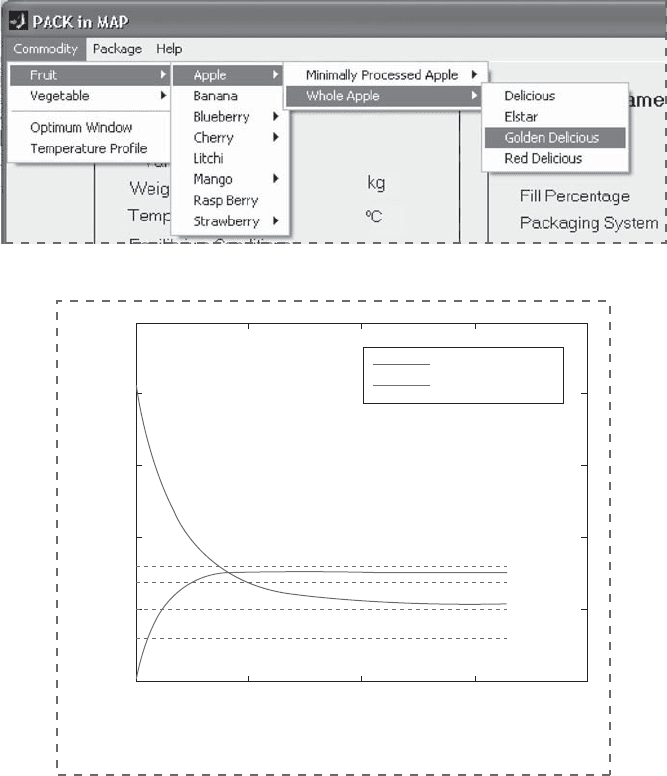
PACK-IN-MAP SOFTWARE
The published information on MAP has been compiled,
and software called PACK-in-MAP (7) has been developed
to establish which commercially available polymeric films
would be most suitable for a particular produce (1, 2). The
user-friendly software, PACK-in-MAP, has been developed
using the Matlab 6.0 program. It incorporates the data-
base for respiration rate, optimum temperature, and
optimum range of O
2
and CO
2
concentrations for different
fruits and vegetables and permeability of different packa-
ging materials, including micro-perforated films. This
database is helpful in designing MAP for 38 fresh and
fresh-cut products using 27 polymeric films and micro-
perforated packages. Some of the database is made flexible
so that users can configure it to their requirements.
In the Pack-in-MAP software, the user defines the type
of product, storage conditions, amount of product to be
packed, and size and geometry of the package. The soft-
ware selects the optimum gas composition (O
2
and CO
2
)
and calculates the respiration rate for that product. The
software then selects the best possible films in the given
range of permeability ratio and calculates the area of
each film required to achieve the desired gas exchange.
Alternatively, the user may specify the area available
for gas exchange, and the software calculates the
amount of product that can be suitably packed. It avoids
time-consuming trial-and-error experiments to determine
the best packaging system for the given product (1, 2).
Finally, the software simulates how the package atmo-
sphere (O
2
and CO
2
) changes over storage time (Figure 4)
for the given time–temperature profile for the particular
product. The simulated results have been successfully
validated for mushrooms and cheese by conducting packa-
ging experiments under known environmental conditions
for each product.
FEATURES AND BENEFITS OF PACK-IN-MAP SOFTWARE
Features
. Stand-alone user-friendly software for packaging
design
Oxygen
Carbon dioxide
0
0
0.05
0.1
0.15
Gas composition (atm)
0.2
0.25
50 100
Time (h)
Gas kinetics in MAP package
150 200
Figure 4. A graphical user interface of
PACK-in-MAP software and kinetics of
gas exchange in MAP.
868 PACKAGING DESIGN SYSTEM FOR FRESH PRODUCE
. Option for user-defined conditions for respiration
and permeability
. Selects the optimal storage conditions for a given
product (O
2
and CO
2
)
. Calculates the specified product respiration rate at
given storage conditions
. Selects the package geometry and calculates product
volume
. Selects the suitable packaging film(s) for a given
product
. Defines the amount of product to be packed
. Calculates the area of the film that should be avail-
able for gas exchange
. Simulates the package atmopshere with time in a
graphical form
. Enlists other polymeric film(s) suitable for the given
product
. Suggests different packaging options:
. Polymeric films with micro-perforations,
. Polymeric films with macro-perforation,
. Perforation-mediated packaging systems
. Defines the optimum size and number of perforations
for a given product
Benefits
. Reduces the cost by minimising the number of trials
per optimal packaging design
. Suggests the best possible packaging film to achieve
an optimal atmosphere for a given product
. Simulates the package atmosphere without knowl-
edge of mathematical models, package design, and
modified atmosphere packaging itself
. Capability of simulating the package at varying
temperature set according to the real-life distribu-
tion chain
. Evaluates the impact of product and package varia-
bility on internal package atmosphere
BIBLIOGRAPHY
1. P. V. Mahajan, F. A. R. Oliveira, S. C. Fonseca, M. J. Sousa, and
L. M. Cunha, in Y. H. Hui, ed., Handbook of Food Science,
Technology and Engineering, Taylor & Francis CRC Press,
2006, pp. 1–16.
2. P. V. Mahajan, F. A. R. Oliveira, J. C. Montanez, and J. Frias,
Innovative Food Sci. Emerging Technol. 8(1), 84–92 (2007).
3. P. V. Mahajan, F. A. R. Oliveira, J. C. Montanez, and T. Iqbal,
New Food 1, 35–36 (2008).
4. D. S. Lee, Y. Song, and K. L. Yam, J. Food Eng. 27, 297–310
(1996).
5. T. Iqbal, F. A. R. Oliveira, P. V. Mahajan, J. P. Kerry, L. Gil,
M. C. Manso, and L. M. Cunha, Acta Horticulturae (ISHS) 674,
105–111 (2005).
6. S. C. Fonseca, F. A. R. Oliveira, and J. K. Brecht, J. Food Eng.
52(2), 99–119 (2002).
7. Pack-in-MAP Packaging design web information. Available at
http://www.packinmap.com, accessed October 31, 2008.
PACKAGING FUNCTIONS AND
ENVIRONMENTS
KIT L. YAM
Department of Food Science,
Rutgers University, New
Brunswick, New Jersey
When designing a package, it is useful consider that the
functions of the package and environments the package
will likely encounter during its manufacture, distribution,
and end use. The concept discussed below is applicable to
almost any products; however, food is used as an example
since the concept is very useful to this product.
PACKAGING FUNCTIONS
A food package must serve one or more functions to justify
its existence. Traditionally, food packaging has four basic
functions: protection, convenience, communication, and
containment. A package design may be evaluated based
on how well the package performs the required functions
in a cost-effective manner.
. Protection. Protecting the food from physical da-
mage, physiochemical deterioration, microbial spoi-
lage, and product tampering is probably the most
important function of packaging. Without proper
protection, the food may become unappetizing, less
nutritious, and unsafe to consume.
The required packaging protection depends on
the stability and fragility of the food, the desired
shelf life of the food package, and the distribution
environment. Good package integrity is also re-
quired to protect against loss of hermetic condition
and microbial penetration.
Generally, the protection function of packaging is
limited to foods whose shelf lives are controlled by
environmental factors relating to physical damages,
humidity, oxygen, light, and, to some extent, tem-
perature. Packaging is usually not effective for
protecting foods whose shelf lives are controlled by
internal factors. For example, consider a tuna sand-
wich in which moisture may migrate internally,
from the tuna to the bread, causing the bread to
become soggy and unacceptable to the consumer.
The internal moisture migration is driven by the
difference in water activities between the tuna and
the bread, not by the relative humidity outside the
sandwich. Thus enclosing the sandwich with a
package will not solve the problem; perhaps placing
an edible coating between the tuna and the bread
may provide an acceptable solution.
. Convenience. This is an important function to satisfy
the busy consumer lifestyle. Examples of convenient
food packages are ready-to-eat meals, heat-and-eat
meals, and self-heating packages. Examples of con-
venient features are easy opening, resealability, and
microwavability. Innovations are constantly sought
PACKAGING FUNCTIONS AND ENVIRONMENTS 869

to provide more convenience without sacrificing
quality or increasing cost.
. Communication. The function of communicating is
important to create brand identity and influence
consumer buying decisions. The package communi-
cates with the consumer through written texts,
brand logo, and graphics. In many countries, nutri-
tional facts such as calories, fat, cholesterol, and
carbohydrate are required on all food packages.
The communication function is also important for
facilitating distribution and retail checkouts. The bar
code has virtually become an integral part of every
commercial food package. Besides the bar code, there
are other package devices, such as time-temperature
indicator and radio-frequency identification (RFID),
which enable the package to communicate more
effectively for the purpose of ensuring food quality
and safety. For example, intelligent packaging (1) is a
new technology that pushes the communication func-
tion to a higher level.
. Containment. Containing the food product is the
most basic function of packaging. The requirement
for containment depends on the size, weight, form,
and shape of the enclosed food; for example, a solid
food has different requirements from a liquid food.
The containment function is also closely related to
the rigidity of the package.
PACKAGING ENVIRONMENTS
The package typically functions under three environ-
ments:
. Physical Environment. This environment is con-
cerned with the physical conditions that a package
may encounter during its life cycle. For example, the
package may have to withstand the harsh tempera-
ture/pressure conditions during retorting, as well as
shock and vibration, falls and bumps, crushing from
stacking, and attack from insects and rodents dur-
ing storage and distribution. To protect against
this environment, the package must have adequate
mechanical strength and thermal stability, as well
as other properties depending on the situation.
. Ambient Environment. This environment is con-
cerned with the oxygen, moisture, odors, molds,
bacteria, light, and heat which are ubiquitous dur-
ing storage and distribution. To protect against the
negative impact of the ambient environment, the
package must have an adequate level of barrier
properties depending on the requirements of the
food.
. Human Environment. This complex environment is
concerned with the human aspects of packaging,
such as the user-friendliness, liking/disliking, and
safety of a package to the consumer. Many socio-
economic issues such as the impact of packaging on
the environment, packaging related legislations and
regulations, and packaging related litigations are
largely influenced by humans. Human perception,
vision, dexterity, and language are also included in
this environment.
Understanding these three environments and the nat-
ure of the food product is important for specifying the
packaging requirements.
Based on the above discussion, Table 1 may be con-
structed to provide an overview of the relationship be-
tween packaging functions and packaging environments.
This table is particularly useful during the early stage
of the package development process for facilitating
brainstorming and identifying key areas for further
consideration.
FUNCTIONS/ENVIRONMENTS TABLE
In Table 1, packaging functions and environments are
arranged in columns and rows. This table is useful for
identifying certain packaging features, operations, de-
vices, or considerations that are important for the package
to function under certain environments.
For many food packaging systems, it is possible to
associate items to most of the cells in Table 1. Although
the selection and interpretation of the cell items involve
somewhat subjective choices, the functions/environments
table helps the product development team to consider all
aspects of the food packaging system in a systematic
manner. Shown below are examples of items that may be
associated with the cells. With some imagination, other
helpful items may also be associated.
. Containment/Physical. The size and type of package
determine how much and what kind of food can be
contained and how much physical abuses the pack-
age can withstand.
. Containment/Ambient. The size and type of package
determine how much and what kind of food can be
contained
and the ability
of the package to protect
Table 1. Functions/Environments Table
Packaging Functions
Containment Protection Convenience Communication
ENVIRONMENTS Physical
Ambient
Human
870 PACKAGING FUNCTIONS AND ENVIRONMENTS
against oxygen, moisture, or light from the ambient
environment.
. Containment/Human. The size and type of package
determine how much and what kind of food can be
contained and ease of use of the package to humans.
. Protection/Physical. Mechanical strength and seal
strength are important for protecting the product
from physical abuses.
. Protection/Ambient. Barrier properties and seal in-
tegrity are important for protecting the food product
from the adverse effects of oxygen, moisture, mi-
crobes, and light in the ambient environment.
. Protection/Human. Tamper-evident packaging is
useful to protect the consumer from product tamper-
ing. Regulations are necessary to protect from un-
safe packages harmful to the consumer.
. Convenience/Physical. Efficiently bundled packages
offer convenience to the manufacturer during sto-
rage and distribution.
. Convenience/Ambient. Aseptic packages offer the
convenience of storing food products at ambient
environment instead of refrigerated conditions.
. Convenience/Human. Microwavable packages and
easy-to-open packages offer convenience to the
consumer.
. Communication/Physical. Bar codes can facilitate
communication of information through the physical
distribution of the product in the supply chain.
. Communication/Ambient. Time-temperature indica-
tors and biosensors may be attached to the pack-
age to communicate the conditions of the ambient
environment.
. Communication/Human. Nutrition labels, instruc-
tions, and graphics on the package can provide
useful information to the consumer.
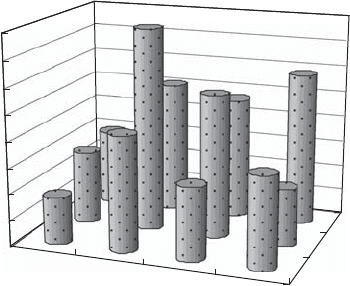
To take a step further, relative values (from 0 to
100) may be assigned to the cells in Figure 1 (2). A
three-dimensional chart may then be generated using the
functions, environments, and relative values as x, y, z
coordinates. The determination of these relative values is
a process that frequently requires subjective judgment. A
hypothetical example of this chart is shown in Figure 1.
The chart provides a bird’s-eye view of the functions–
environments relationships and is useful for prioritizing
the cells and identifying areas of strength and weakness of
the food packaging system.
BIBLIOGRAPHY
1. K. L. Yam, P. T. Takhistov, and J. Miltz, ‘‘Intelligent Packaging:
Concepts and Applications,’’ J. Food Sci. 70, R1–10, (2005).
2. HE Lockhart, ‘‘A Paradigm for Packaging,’’ Packag. Technol.
Sci. 10, 237–252 (1997).
PACKAGING IN CHINA
ZHI-WEI WANG
Packaging Engineering
Institute, Jinan University,
Zhuhai, People’s Republic of
China
PACKAGING INDUSTRY OF CHINA
The Chinese packaging industry is playing a more and
more important role in the world. It has now maintained a
good momentum of growth for the past 30 years due to the
progress of reform and opening up of trade, the establish-
ment of the socialist market economy system, and China
joining the World Trade Organization (WTO). From 1980
to the present, the total output value of the Chinese
packaging industry including packaging materials (paper,
plastic, glass, metal, bamboo and wood, and others),
packaging printing, and packaging machinery has
increased from RMB 7.2 billion (US$ 0.89 billion) to
RMB 500 billion (US$ 61.96 billion) at an average annual
growth rate of over 18%. It ranks 14th among 42 main
industries in China. In terms of packaging production,
China has become the third largest packaging country
after the United States and Japan.
The output of paper, plastic, metal, glass, and other
packaging materials has increased largely. Paper and
plastic packaging materials, which represent over 60% of
the Chinese packaging industry’s output, have become
the two pillars. The output of some packaging products in
China has taken the lead in the world, such as paper bags,
plastic weave bags, plastic bags, compound soft package,
and metal barrels. The packaging industry undertakes
annual packaging for hundreds of billion US dollars
domestic and overseas commodities, which has met the
need of national economic development.
Take year 2005, for example (1). The total output value
of the Chinese packaging industry has reached RMB
401.687 billion (US$ 49.774 billion), which is about 2.2%
Physical
Ambient
Human
0
10
20
30
40
50
60
70
80
Relative value
Containment
Protection
Communication
Convenience
Figure 1. Three-dimensional plot of functions versus
environments.
PACKAGING IN CHINA 871
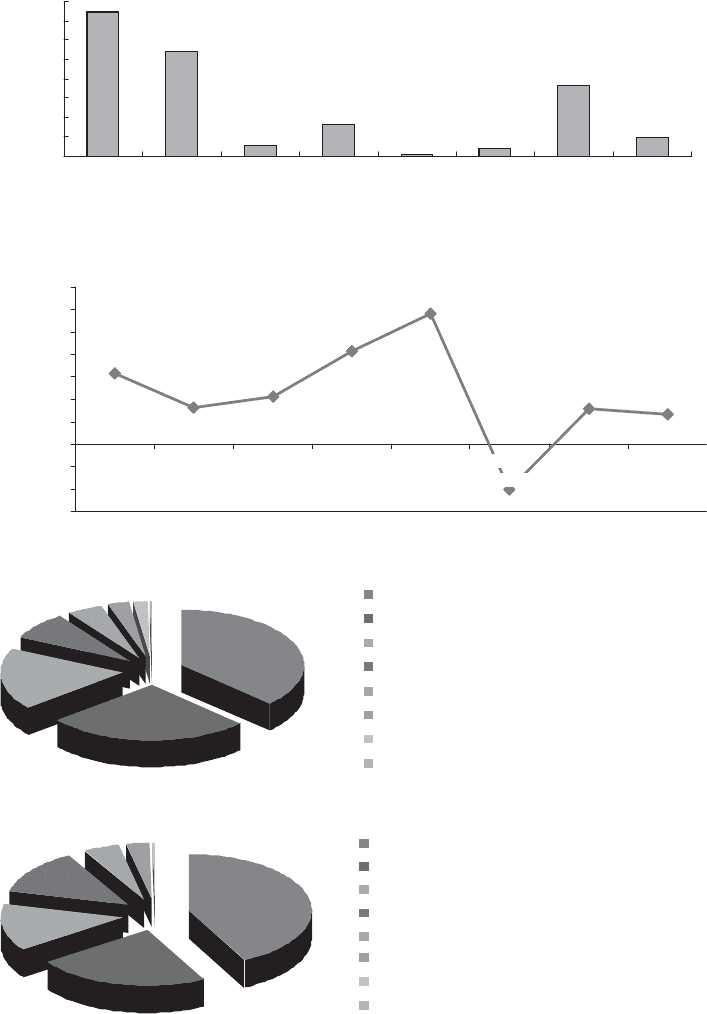
of the gross domestic product (GDP) for the year. The total
output value and growth rate of each kind of packaging
are shown in Figures 1 and 2. The proportion of the
output value of each packaging in the total output value
of China’s packaging industry is shown in Figure 3. In
terms of packaging innovation, the new product output
value is RMB16.261 billion (US$ 2.015 billion), which is
about 4.05% of the total output value for the packaging
industry. Although the innovation capability of the
Chinese packaging industry is low, its development speed
has exceeded the growth rate of total industrial output
value. In each kind of packaging, the largest proportion of
new product output value in total industrial output value
is occupied by packaging machinery, which is about 11.4%.
The contribution of new product output value of each
kind of packaging to total new product output value of
packaging industry is shown in Figure 4.
The economic structure of packaging enterprises
changes with the sound development of the Chinese
packaging industry. The number of public enterprises is
decreasing, while that of stock enterprises and others
types is increasing relatively fast, especially foreign-
funded enterprises. On the other hand, there is a tendency
of group development in the Chinese packaging industry.
−30.00%
−20.00%
−10.00%
0.00%
10.00%
20.00%
30.00%
40.00%
50.00%
60.00%
70.00%
Paper
packaging
Plastic
packaging
Glass
packaging
Metal
packaging
Bamboo &
wood
packaging
Printing Packaging
machinery
Other
packaging
Figure 2. The growth rate of each
kind of packaging. [Data source: In-
formation and Statistics Collections
on China’s Packaging Industry 2006
(1).]
0
20
40
60
80
100
120
140
160
Paper
packaging
Plastic
packaging
Glass
packaging
Metal
packaging
Bamboo &
wood
packa
g
in
g
Other
packaging
Printing
Packaging
machinery
Output value/billion yuan
Figure 1. The total output value of
each kind of packaging. [Data source:
Information and Statistics Collections
on China’s Packaging Industry 2006
(1).]
Paper packaging 37.13%
Plastic packaging 26.93%
Packaging printing 18.14%
Metal packaging 8.13%
Packaging machinery 4.79%
Glass packaging 2.68%
Others packaging 1.82%
Bamboo & wood packa
g
in
g
0.38%
Figure 3. The proportion of the output value of
each kind of packaging in the total output value
of China’s packaging industry. [Data source: In-
formation and Statistics Collections on China’s
Packaging Industry 2006 (1).]
Paper packaging 42.55%
Plastic packaging 22.72%
Packaging machinery 13.63%
Packaging printing 13.17%
Metal packaging 4.59%
Bamboo & wood packaging 0.18%
Others packa
g
in
g
0.04%
Glass packaging 3.12%
Figure 4. The contribution of new product out-
put value of each kind of packaging to total new
product output value of the packing industry.
[Data source: Information and Statistics Collec-
tions on China’s Packaging Industry 2006 (1).]
872 PACKAGING IN CHINA
Many large packaging groups have emerged in some
provinces and metropolitan regions of China, such as
Guangdong, Zhejiang, Jiangsu, and Shanghai.
The development of the Chinese packaging industry is
unbalanced due to the inconsistent development of the
local economy. The packaging industry in Eastern China
develops markedly faster than in Central and Western
China. In terms of economic structure, state-owned packa-
ging enterprises in Middle and West China surpass
foreign-funded enterprises and other types, while in
Eastern China the opposite situation is found. The further
economic development in China brings the need for
accelerating the development of the packaging industry
in Central and Western China.
The Chinese packaging industry has formed an ele-
mentary modern industry system with the main constitu-
tes of packaging materials and modern packaging
technology and equipments. China is developing from a
large packaging country to a powerful packaging country
in the world. By the year 2010, it is projected that the
Chinese packaging industry will be built into a modern
packaging industry with higher comprehensive innova-
tion ability, reasonable industry infrastructure, optimized
industry distribution, remarkable technical progress,
wholesome service system, perfect industry standard sys-
tem, prominent brand, and resources with multipurpose
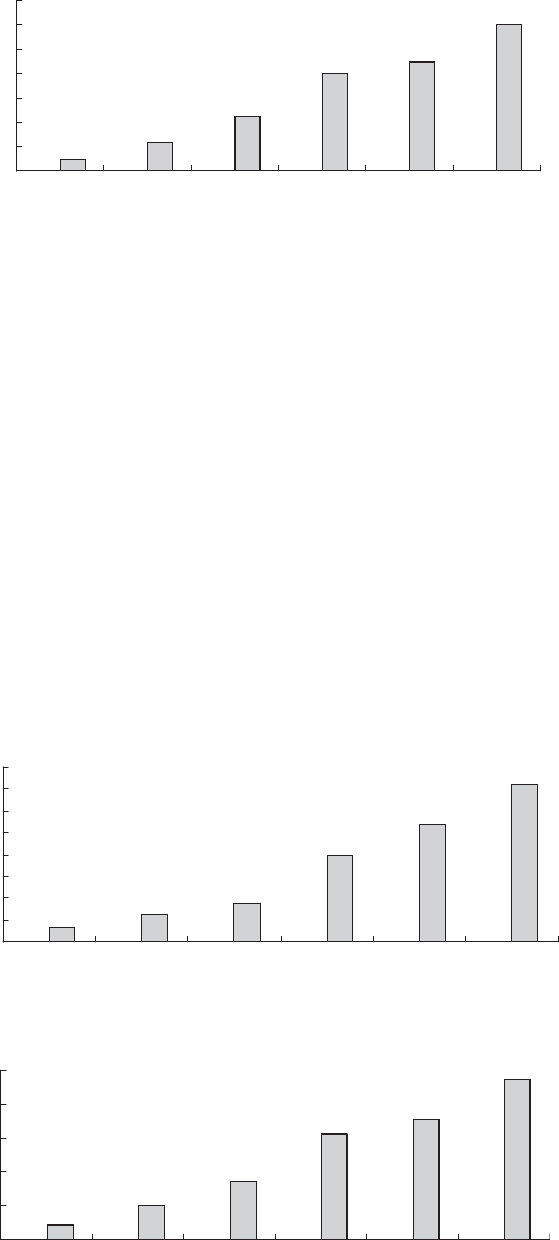
use. The total output value of the Chinese packaging
industry should reach about RMB600 billion (US$ 74.3
billion) in the year 2015. With the remarkable develop-
ment of packaging technology, it is estimated that the
output of paper packaging materials will reach 36 million
tonnes, plastic packaging materials 9.46 million tonnes,
metal packaging materials 4.91 million tonnes, glass
packaging materials 15.5 million tonnes, and packaging
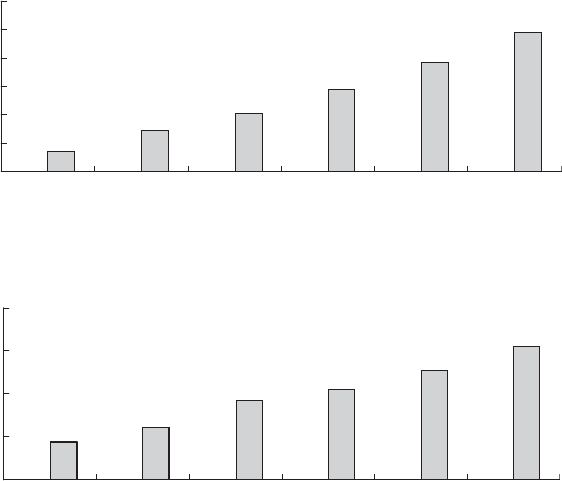
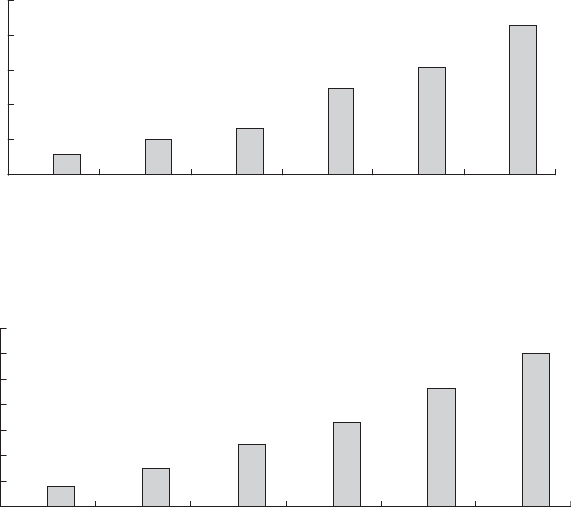
machinery 1.2 million sets, as shown in Figures 5–11 (2).
At same time, the high-quality packaging will strongly
support the further development of export trade of China,
particularly in those of higher-value products.
1990 1995 2000 2005 2010(p) 2015(p)
Year
Total paper packaging materials output
0
5
10
15
20
25
30
35
40
Output/million ton
Figure 6. Output of paper packaging materials of
China from 1990 to 2015. [Data source: China
Packaging Annual 2006 (2).]
1990 1995 2000 2005 2010(p) 2015(p)
Year
Total plastic packaging materials output
0
2
4
6
8
10
Output/million ton
Figure 7. Output of plastic packaging materials of
China from 1990 to 2015. [Data source: China
Packaging Annual 2006 (2).]
Total packaging output value
0
100
200
300
400
500
600
700
1990 1995 2000 2005 2010(p) 2015(p)
Year
Output value/billion yuan
Figure 5. Total output value of China packaging
from 1990 to 2015. [Data source: China Packaging
Annual 2006 (2). Note: ‘‘p’’ means ‘‘plan’’.]
PACKAGING IN CHINA 873
CHINESE PACKAGING STANDARDS
Since Packaging Standards are beneficial to national
interest and world economic prosperity, it is very impor-
tant to establish standards that meet international cri-
teria and fit the national situation within China as well.
Up to now, China has set up more than 500 national
packaging standards, which can be divided into three
levels: (1) fundamental packaging standards, such as
packaging glossary, packaging label, packaging series
dimension, fundamental test method of transport pack-
age, packaging technology, and packaging management
standards; (2) specialized packaging standards, such as
packaging material, packaging container, and packaging
machine standards; and (3) product packaging standards,
which specify the requirements for packaging of every
product. On the whole, China has built a system of
packaging standards which meets the needs of packaging
industry. The existing problems are: (1) Some standards
are unreasonable and imperfect; (2) the different packa-
ging standards are unsystematic and not well-coordi-
nated; and (3) some standards prefer form to content
and have poor operability.
In order to solve the problem of time efficiency and low-
level packaging standards, China has adopted many ISO
standards (IDT, MOD, NEQ). The Standardization Ad-
ministration of the People’s Republic of China has made a
vast revision to the packaging standards. In the food
contact materials, the standards of materials and contain-
ers including paper, plastic, glass, aluminum, steel, pot-
tery, plant fiber, and wood have been put into effect in
recent years; these focus on the restrictions on the harm-
ful substances in packaging materials and containers, but
no one considers the overall and specific migration limits
(OMLs & SMLs) compared with those of the EU and the
United States. At present, the revised standard systems
include: import and export food packaging, imported
timber packaging adopting international quarantine stan-
dards, exported timber packaging adopting international
standards, toy packaging keeping to the international
standards, food packaging acceptance standards, pre-
packaging food marking standards, classification and
quality standards for pharmaceutical packaging materials
and container, and so on. These standards systems will
regulate and boost the development of commodity packa-
ging forcefully. For the need of resources economizing, the
national standard ‘‘Requirements of Restricting Excessive
Package for Foods and Cosmetics’’ is in discussion and will
go into effect in 2008.
PACKAGING HIGHER EDUCATION IN CHINA (3)
Higher education in packaging within China has devel-
oped at a high speed in keeping with the development of
the packaging industry. The courses for packaging tech-
nology were set up in 1960s, and the undergraduates of
‘‘Packaging Machinery’’ (as a subdiscipline of ‘‘Mechanical
Engineering’’) were enrolled in Jiangnan University in the
1970s. The National Ministry of Education approved the
establishment of ‘‘Packaging Engineering’’ as an academic
discipline for undergraduates in the year 1984. Since
Total metal packaging materials output
0
1
2
3
4
5
6
Output/million ton
1990 1995 2000 2005 2010(p) 2015(p)
Year
Figure 8. Output of metal packaging materials in
China from 1990 to 2015. [Data source: China
Packaging Annual 2006 (2).]
Total glass packaging materials output
0
5
10
15
20
Output/million ton
1990 1995 2000 2005 2010(p) 2015(p)
Year
Figure 9. Output of glass packaging materials of
China from 1990 to 2015. [Data source: China
Packaging Annual 2006 (2).]
874 PACKAGING IN CHINA
then, the number of universities with a ‘‘Packaging En-
gineering’’ program has increased to about 60. Annually
about 3000 students graduate in ‘‘Packaging Engineering’’
from the universities, and about 70% graduates are em-
ployed within the Chinese packaging industry. Some
universities have set up Master’s programs in ‘‘Packaging
Engineering,’’ ‘‘Packaging Materials,’’ and ‘‘Packaging Me-
chanics and Engineering’’; Jinan University and Jiang-
nan University were the first to enroll Ph.D. students in
‘‘Packaging Engineering.’’ China has now established an
integrated talents cultivation system for the ‘‘Packaging
Engineering’’ discipline, which contains graduate educa-
tion (M.S and Ph.D), undergraduate education and voca-
tional education. The year 2007 has witnessed the
successful graduation of the first four Ph.D students in
‘‘Packaging Engineering’’ in China (supervised by profes-
sor Zhi-Wei Wang of Jinan University and Jiangnan
University). Compared with the higher education of
packaging in some advanced countries, such as the United
States, it could be argued that China has the following
weak points: (1) The curriculum is not systematic; the
coverage of the specialized subjects is narrow, and the core
courses are not clear; (2) ‘‘Packaging Engineering’’ is an
applied discipline, but the domestic universities usually
pay more attention to theory than to practice; and (3) the
domestic universities stress engineering but neglect the
important disciplines of graphic art, economy, and
management.
To solve these problems in packaging education in
China, a reform has been conducted in the higher educa-
tion of packaging undertaken by professor Zhi-Wei Wang
(Program of 21st Century National Higher Education
Reform (1282B12111): ‘‘Train and Practice of Modern
Packaging Talents’’ supported by the Ministry of Educa-
tion of China and World Bank Organization). Through
reform, China has established a new platform for the
‘‘Packaging Engineering’’ discipline and has made new
teaching plans and goals. The new teaching plan includes
six core courses: ‘‘Packaging Materials,’’ ‘‘Packaging Tech-
nology and Process,’’ ‘‘Packaging Machinery,’’ ‘‘Packaging
Structure Design,’’ ‘‘Packaging Decoration and Modelling
Design,’’ and ‘‘Transport Packaging.’’ These courses have
been acknowledged by domestic packaging universities.
Until now, the Packaging Education Committee of the
People’s Republic of China has published two series of
widely accepted textbooks and is publishing the third
series. Meanwhile, the packaging universities in China
are conducting an active academic exchange and coopera-
tion with international packaging universities and insti-
tutes. The development of higher education in packaging
in China supports and accelerates the development of the
national packaging industry.
BIBLIOGRAPHY
1. China Packaging Federation, Information and Statistics Col-
lections on China’s Packaging Industry 2006, Beijing, 2006 (in
Chinese).
2. China Packaging Federation, China Packaging Annual 2006,
Beijing, 2007 (in Chinese).
3. Z.-W. Wang, ‘‘Development of Packaging Higher Education in
China,’’ in Proceedings of 14th IAPRI World Conference on
Packaging. IAPRI, Stockholm, 2004.
Total printing output
0
200
400
600
800
1000
Output/billion P
1990 1995 2000 2005 2010(p) 2015(p)
Year
Figure 10. Output of printing of China from
1990 to 2015. [Data source: China Packaging
Annual 2006 (2).]
Total packaging machinery output
0
0.2
0.4
0.6
0.8
1
1.2
1.4
Output/million sets
1990 1995 2000 2005 2010(p) 2015(p)
Year
Figure 11. Output of packaging machinery in
China from 1990 to 2015. [Data source: China
Packaging Annual 2006 (2).]
PACKAGING IN CHINA 875
PACKAGING IN INDIA
P. V. N ARAYANAN
Indian Institute of Packaging,
India
INTRODUCTION
The growth, expansion, and diversification witnessed in
the packaging and the consumer sectors over the last five
decades have compelled the industry in India to review
and revamp its strategies. It is no longer a domestic issue.
The opportunities supported by the technology capabil-
ities and infrastructural facilities have caused the outlook
for the packaging industry in India to be global and
customer-oriented. The reach is aimed at new markets,
state-of-the-art packaging, accessibility, and optimization
of manufacturing with focus on logistics. The managerial
acumen achieved has provided the leadership quality to
enable economical production by adopting best practices,
provided under one roof and brand, with the aim of
becoming a category champion. Specialization is the key
for development that drives innovation and closer custo-
mer relationship, with the goal of becoming a total and
optimum packaging solution provider. The industry
has indeed a daunting task to meet demands from an
estimated 300 million consumers to at least 600 million
consumers by 2010. The fact that 2010 is not that far away
intensifies the demands.
The packaging industry with a consolidated average
growth annually at 12% on a normal path should aim to
produce over 20 million tons of packaging by 2010. This
estimate could be higher if the growth estimate of the
retail sector is any indication. This is not an exaggeration
if one considers the many shopping malls being con-
structed in many locations. In simple mathematical terms,
the industry sources of supply of converted packages are
set to double, if not more. Interestingly, it is not the
number, but instead new concepts and newer materials,
that suits the changing taste of the dynamic market
display and the product-package buyer. Industrialization
can only grow with little chance of decline in demand.
Industry will have to improve and specialize in niche
areas. With the per capita consumption valued at only
USD 10 as against the global average of USD 75, the rise
in demand is a clear indication of what the packaging
industry is heading toward.
The economic environment showing (a) a sustained
growth, (b) demographics and skill base, and (c) a positive
trend aided by liberalization and deregulation indicates a
conducive development of the business environment. It is
not ‘‘how you grow’’ but ‘‘how much will you grow.’’ The
country also has a positive advantage of a cross section of
demographic population with 50% below the age of 20
years and 64% below the age of 34 years. In essence, the
market movers and takers are a high percentage majority
and will set the trend of packaging. India is also moving to
attain the enviable position of the second strongest econ-
omy in the world, overtaking the United States. The per
capita income is set to quadruple by the year 2020,
thereby swelling the pocket of the consumers with higher
personal disposable income and higher purchasing capa-
city. It seems that the moment is right for progress. Four
key forces influence the shaping of the Indian economy:
rapid sustained growth; demographics and skill base;
liberalization and deregulation; and conducive atmo-
sphere for business development. The key goals are ex-
ploring nontraditional partnerships earmarking global
technology, markets, and the supply chain. Trade in goods
and services now account for over 35% of the GDP (gross
domestic product). The capital market is the most devel-
oped in emerging economies, and the liberal foreign
investment policy has enabled rapid growth in foreign
direct investment (FDI) and foreign institutional investor
(FII). India enjoys the benefit of having the largest
English-speaking graduate population with the third lar-
gest number of science and engineering graduates and
will emerge to have the largest work force by the year
2020. All these have a direct positive impact toward
obtaining technologically developed resources worldwide.
The national GDP is estimated to reach one trillion USD
in 2011 and is expected to be three trillion USD by 2025
and 27 trillion USD by 2050. With productivity set to grow
at a minimum of 8% by 2050, India is set become the
second largest economy in the world. Productivity in
industry and services will engage 60% of the labor services
and will grow four times that of agriculture. Also the India
GDP per capita between 2007 and 2020 in U.S. terms will
quadruple. During the period, crude oil consumption is set
to increase threefold and car purchases will multiply
fivefold.
India has 10 of the 30 fastest-growing cities in the
world and is urbanizing at a rapid rate.
Development of infrastructural facilities—that is, road,
rail, housing, townships, and dedicated freight corridors—
is considered a priority. The unprecedented demand and
actual purchase of high-end consumers goods such as two-
wheelers, four-wheelers, cell phones, and color televisions,
along with the use of credit cards, are clear indications of
the upgraded lifestyle of the common masses and the
increased availability of personal disposal income. More
and more families are becoming smaller and their eco-
nomic situation is becoming stronger with double incomes;
also a clear shift is seen for consumer-value-added pro-
ducts and convenience features. Hence, there is a growing
demand for brand name products packaged in various
sizes and styles.
GLOBAL PERCEPTION
The extent to which packaging has reached the common
public is indeed a matter of concern, particularly when one
talks of the growing consumer awareness on one hand
while mentioning the contribution of packaging to health
and hygiene on the other hand. The concept seemingly
gains ground in the context of the observation that 80% of
the world population gets the benefit of only 20% of the
global package production and availability. The essence
probably
lies herein as
much the 80% of the population
belongs to the developing third world. Most of these
876 PACKAGING IN INDIA
countries have a very low per capita with respect to
packaged product consumption and hence the emerging
markets. All these countries, no doubt India too, have a
long way to go to reach the global average in terms of
package consumption. What is more significant is that the
trend has been set and is unlikely to reverse. The overall
population is younger, and the lifestyle is now catalyzed by
economic considerations and an independent nature. The
new buyers are willing to experiment and spend. They are
articulate and seek solutions to satisfy their needs even by
paying the price. Quality and reliability are the buzz-
words, yet costs would remain an important factor. The
package conversion industry will find consumer demands
for development of new concepts and systems. The chal-
lenge will be to evolve packages that would provide the
optimum shelf life rather than long shelf life, considered
uneconomical and costlier, while at the same time moving
toward mechanization and semi- and fullautomation. The
product manufacturers will shift their choice for packa-
ging materials and packages that would suit such opera-
tions with minimal waste and the amenability to quicker
changeover. The packages would need to be modular to
facilitate distribution. The purpose of the package is to
increase value, widen the marketplace, achieve desired
performance and ensure compatibility, improve shelf life,
and make a favorable impression.
RETAIL SECTOR
The retail market in India presently estimated at 350
billion USD is expected to grow at about 12% consolidated
annual growth. The modern and sophisticated format
stores (supermarkets and department stores) are envi-
saged to grow over 40% annually and will account for 12%
of retail trade by value of 60 billion USD by 2012. The total
of retail sales is estimated at USD 500 billion by 2012.
This has been primarily facilitated by the increasing
willingness of the Indian consumer to accept the modern
system of shopping. The growing younger generation is
found to be experimental and can think differently on how
to spend their higher disposable personal income. Inter-
estingly, this phenomenon is not restricted to the urban
areas, but occurs equally in the rural areas as well. The
urban consumer is fundamentally different from the con-
servative budget shopper of earlier decades. This is aug-
mented equally by the increasing exposure to Western
lifestyles and habits. The consumer demographics are
evolving in smaller towns and rural areas where a shift
in shopping patterns and buying habits is motivated by
consumers’ desire to emulate an urban lifestyle.
This adds to the spread of the markets and penetration
of consumer-value-added packages and product range in
width and depth of the markets. The product and package
producers will have to rethink their package sizes in the
context of the retail sectors with more emphasis on family-
size and multidose packs. Product mix range and brands
will have to be increased since this will be demanded by
the growing cross section of interested buyers who will
look for wider choices. Physical parameters and graphic
design will have a greater role to play in display
arrangements and will have to create a favorable impres-
sion for the impulse buyer. The physical design, display
features, and graphics will have a hidden role to play—
that is, to convert an onlooker into a buyer and uncon-
sciously create a brand change. The retail market seems to
be dominated by textiles and apparel at 36%, followed by
jewelry and watches at 17%, food and grocery at 14%, and
footwear at 13%. Other markets will be mainly durables,
entertainment, health care, and home care. Besides dis-
play and graphics, a significant need in the physical
design feature will be ‘‘carry home’’ facilities. With the
retail sector being offered for foreign direct investment
and all world leaders set to enter the Indian retail trade,
the growth will be exponential. There will also be bulk
movement of farm products to supermarkets, and packa-
ging for consumer packs of fresh produce, poultry, meats,
eggs, and so on, will be needed. The retail and distribution
segments will have to address to two principal inventory
management tools: bar coding and RFID. These both
demand creators of labels and labelers, aided by auto-
mated produce handling, tighter tolerances, and quality
standards for speed and efficiency of larger volume pro-
cessing and packaging lines.
SHIFTS/TRENDS
The packaging industry began in India in the 1950s and
became noticeable in the 1960s. The industry grew in
dimensions in the 1970s with a larger cross section of
packaging materials and packages produced domestically.
In the early 1970s the machinery manufacturers for the
packaging industry seized the opportunity and made a
very successful impact. The industry assumed greater
significance in the 1980s, probably getting excellent sup-
port and recognition due to the industrial and fiscal
support extended to the food processing industry. The
1990s are considered the golden and growth years when
the industry grew in leaps and bounds due to the liberal-
ization policies adopted in the early 1990s and continued
thereafter. From the CAG (consolidated average growth
annually) of percent growth in the mid-1980s the industry
recorded a CAG of 18% by the mid-1990s and stabilized
thereafter at around 12%. The estimated packaging ma-
terials/package consumption in the mid-1990s was on the
order of 5 million tons and rose to over 10 million tons by
2005 and is expected to be more than double by 2010. This
takes into account the normal average growth with 5% of
agriculture and 10% of horticultural produce that is to be
processed and packed. An upward trend in this and the
fast-growing retail market will have tremendous impact
and probably will double the demand estimates. This also
reflects the need to increase the basic material production
and conversion industries. In simple terms, there is
potential for a yet another packaging industry. The output
value of the industry is over 2% of the GDP of the country.
A large number of factors attributed to the growth, and
principally they include: the shift from bulk distribution
and
packaging to more
and more consumer packages;
adopting newer systems in place of conventional packa-
ging; optimizing the packaging needs instead of long-life
PACKAGING IN INDIA 877