
Yam, Kit L. (ed.). The Wiley encyclopedia of packaging technology
Подождите немного. Документ загружается.

being LDPE-PET-alufoil-PET. For specific applications,
EVOH, OPA, or PP can be included in the structure.
Recent developments in barrier coatings for PET have
led to increasing use of PET bottles for fruit juices and
drinks, and this trend is likely to accelerate as production
ramps up and costs come down. Frozen concentrated
orange juice (421Brix) is usually held at 121C, at which
temperature it is still liquid; typical packaging materials
consist of a spiral wound paperboard tube with aluminum
ends, or an aluminum can.
Carbonated Soft Drinks. Soft drinks are prepared al-
most exclusively using the pre-mix system whereby the
blended syrup, after flash pasteurization if necessary, is
mixed with carbonated, treated water prior to delivery to
the filler. The degree of carbonation ranges from 1.5 to 5
volumes, each volume producing about one atmosphere of
internal pressure. The two major deteriorative reactions
in carbonated beverages are (a) loss of carbonation and (b)
oxidation and/or acid hydrolysis of the essential flavor oils.
The first is largely a function of the effectiveness of the
package in providing a barrier to gas permeation, while
the latter can be prevented to a large extent by the use of
high-quality flavorings and antioxidants and by deaerat-
ing the mix prior to carbonation (1). Typical packaging for
soft drinks are aluminum cans and PET bottles.
Beer. Beer is an alcoholic beverage made by brewing
and fermentation from cereals (usually malted barley) and
flavored with hops to give a bitter flavor. Owing to its low
pH (about 4.0), microbial degradation is not usually a
problem, and the use of pasteurization and aseptic cold
filtration excludes wild yeasts which could thrive. How-
ever, during storage, beer can undergo irreversible
changes leading to the appearance of haze, the develop-
ment of off-flavors, and increased color. Flavor loss is
accelerated in the presence of light and certain metal
ions. Beer is particularly vulnerable to O
2
, which causes
significant flavor deterioration; ideally the O
2
level in beer
should be less than 50 ppb immediately after packaging.
The traditional packaging media for beer was the glass
bottle sealed with a crown closure; but today in many
countries, two-piece DWI aluminum cans with a stay-on
tab now outnumber bottles. A small but increasing quan-
tity of beer is packaged in PET bottles containing an O
2
barrier to provide acceptable shelf life.
BIBLIOGRAPHY
1. G. L. Robertson, Food Packaging Principles and Practice, 2nd
edition, CRC Press, Boca Raton, FL, 2006.
2. J. M. Krochta, in D. R. Heldman and D. B. Lund, eds., Hand-
book of Food Engineering, 2nd edition, CRC Press, Boca Raton,
FL, 2007, pp. 847–927.
3. K. Grob, M. Biedermann, E. Scherbaum, M. Roth, and K.
Rieger. Crit. Rev. Food Sci. Nut. 46 , 529–535 (2006).
4. M. Wormuth, M. Scheringer, M. Vollenweider, and K. Hunger-
bu
¨
hler, Risk Analysis 26, 803–824 (2006).
5. A. L. Baner in O.-G. Piringer and A. L. Baner, eds., Plastic
Packaging Materials for Food. Barrier Function, Mass
Transport, Quality Assurance and Legislation, Wiley-VCH,
New York, 2000, pp. 427–443.
6. M. Haldimann, A. Blanc, and V. Dudler, Food Additiv. Contam.
24, 860–868 (2007).
7. T. Rothenbacher, M. Baumann, and D. Fu
¨
gel, Food Additiv.
Contam. 24, 438–444 (2007).
8. M. G. Sagilata, K. Savitha, R. S. Singhal, and V. R. Kanetkar.
Comp. Rev. Food Sci. Food Safety 6, 17–35 (2007).
9. M. Sivertsvik, in C. L. Wilson, ed., Intelligent and Active
Packaging for Fruits and Vegetables, CRC Press, Boca Raton,
FL, 2007, pp. 151–164.
PACKAGING OF FOOD FOR HIGH PRESSURE
TREATMENTS
RAFAEL GAVARA
RAMO
´
N CATALA
´
PILAR HERNA
´
NDEZ-MUN
˜
OZ
Institute of Agrochemistry and
Food Technology, IATA-CSIC,
Packaging Laboratory,
Burjassot, Spain
High hydrostatic pressure processing (HPP) is a novel food
preservation technology that is gaining commercial im-
portance as a consequence of current consumption trends
toward high-quality products with natural flavor and
taste, fresh-like characteristics, and no preservatives.
HPP presents unique advantages over conventional ther-
mal treatments due to low-temperature processes that
improve retention of food quality. Moreover, it is indepen-
dent of product size and geometry, and the pressure effect
is uniform and almost instantaneous; and although the
HPP has been reported to affect the texture of the food
product, other characteristics such as flavor, color, and
nutritional value are largely maintained (1).
Food preservation through HPP basically consists on
the application of hydrostatic pressures between 100 and
1000 MPa, with holding times typically between 0 and
3 min, at refrigeration and ambient temperature. Current
HPP research is exploring future applications at subzero
temperatures to more than 1001C and holding times up to
30 min. The simplest process consists of (a) heating (cool-
ing) to the treatment temperature (b) pressurization,
which produces an inherent adiabatic heating (c) pressure
holding time, which can include heat transfer between the
food, pressurizing fluid, pressure equipment, and the
environment, and (d) depressurization, which results in
an adiabatic cooling and final cooling (or heating) to
product storage temperature (2). However, to attain the
desired extent of the shelflife of foodstuffs by means of the
inactivation of microorganisms and enzymes in a short
treatment process, the HPP process can be very complex
with successive changes of pressure, as occurs in pulsed
high-pressure treatments (3).
Most HPP equipments work through batch processes,
although a few commercial semicontinuous units for the
898 PACKAGING OF FOOD FOR HIGH PRESSURE TREATMENTS
treatment of liquid foods and sauces that may contain
solids under 5 mm are under operation. In this latter case,
the food product flows and fills the treatment vessel,
which is then closed and pressurized. The treated product
is then driven to an aseptic (or clean) packaging step. The
food is not sterilized during the HPP treatment; therefore,
HP treatment can be classified as a nonthermal pasteur-
ization and can be used commercially for refrigerated,
lowacid (pH o 4.5) or low-water-activity products (e.g.,
jams). Since the food is processed prior to packaging, no
special requirements need to be fulfilled. Therefore,
packaging solutions for the packaging of HPP-treated
food in a semicontinuous unit are similar to those of
aseptic packaging. Refer to the aseptic packaging section
for packaging solutions.
The HPP treatments by batch processing present sev-
eral differences with respect to the semicontinuous one,
the most relevant being that the product is packaged
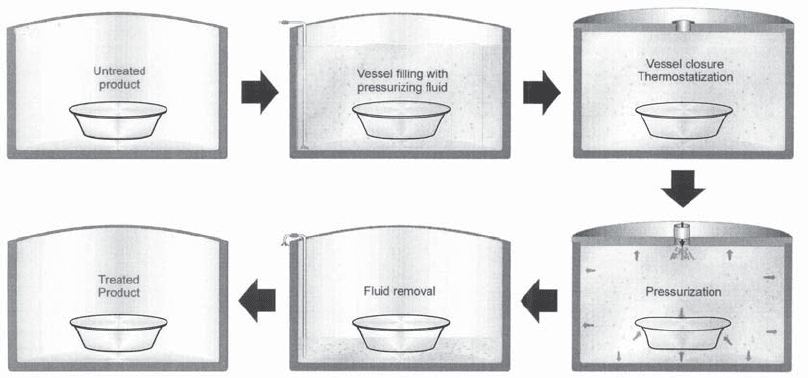
before the treatment. Figure 1 presents a batch HPP
scheme. The packaged product is introduced in the
vessel, which is then filled with a pressure-transmitting
fluid; this can be water or aqueous solutions of ethylene
glycol, propylene glycol, or other soluble oils. Then the
vessel is closed, and pressurization (100–1000 MPa) takes
place by pumping additional pressure-transmitting fluid.
After the treatment, pressure is released in a few seconds,
the vessel is opened, the fluid may be removed, and the
packages are removed, cleaned, and sent to the next
packaging step.
Except for the case of foods processed by semicontin-
uous units, packaging is a key factor to the feasibility of
high-pressure processing, because it must preserve the
intrinsic qualities of the food products without losing
integrity, barrier performance and mechanical character-
istics. This section highlights the requirements that a food
package has to fulfill to be used in high-pressure treat-
ments, lists the effects of such preservation technology
over packaging materials, and presents some of the most
conventional solutions.
PACKAGING REQUIREMENTS
During the HPP process, the food packages are immersed
in water or in aqueous solutions and exposed to high
pressures. Therefore, besides typical requirements of
food packaging such as airtightness, minimal food-packa-
ging interactions, and adequate optical and barrier prop-
erties, the package must transmit the hydrostatic
pressure to the packaged product, withstand the action
of the pressurizing liquid, and resist the action of pressure
without relevant changes. To transmit the hydrostatic
pressure to the packaged product, flexible packaging is
more convenient than rigid packaging. Rigid packages
such as metal cans or glass bottles tend to fracture or
become distorted as a result of the high pressure applied
(4). The use of packaging structures designed with cellu-
losic or other hydrophilic materials at the outermost layer
should be reconsidered since it could present signs of
deterioration caused by the direct exposure to water.
It is then crucial to understand the effects of high
pressure on relevant properties of plastic materials to
ensure the safety of the foodstuffs along their shelflife.
Isostatic pressure causes the food product to compress
three-dimensionally up to approx 12% at 600 MPa.The
package should follow this volume change without altera-
tions. Rigid containers do not compress to this extent, and
therefore they usually get distorted. On the other end of the
spectrum, expanded polymeric materials such as expanded
polystyrene or expanded polypropylene can be compressed a
minimum of 80% due to the large percentage of air occluded
in the package walls, and their use should be avoided.
PACKAGING SOLUTIONS
Many flexible packaging materials have been shown to
withstand HPP without visible signs of integrity loss. One
of the most important factors that have contributed to the
success of plastic films and sheets is the availability of
Figure 1. Scheme of a batch high hydrostatic pressure process.
PACKAGING OF FOOD FOR HIGH PRESSURE TREATMENTS 899
multilayer structures. A suitable multilayer structure
used to pre-package foods must have sufficient flexibility,
resilience, and resistance to delamination during the
compression process, because a loss of packaging integrity
would result in major food safety and quality deterioration
(5). Initially, the innermost layer of the structure should
be selected to limit food–package interactions (unless the
substance exchange is desired and beneficial; see Active
Packaging) and to provide hermetic a seal. Heat-sealable
materials such as polyolefins could be a good option,
although other sealing process can widen the materials
spectra (see the sealing section). The outermost layer of
the structure should resist the action of the pressurizing
fluid. With the exception of highly hydrophilic materials
such as polyvinyl alcohol, most polymeric materials could
be suitable. Reversed printed oriented polypropylene,
polyester, or polyamide films can be good choices.
Finally, the barrier properties to oxygen can be tailored
to the product requirement by varying the materials and
the number of layers in the structure (see the barrier
section). Many structures have been tested using PA,
EVOH, PVOH, aluminum foil, or polymer films coated
with aluminum, silicon oxide (SiOx), or aluminum oxide
(AlOx). Most of these packaging structures have been
tested with no relevant changes caused by the HPP
treatment. The packages showed sufficient degree of flex-
ibility and resilience to compensate for the reduction in
volume, no significant changes in tensile strength being
observed between controls and HPP treated samples.
Heat seal strength is a critical point in packages,
because if any void is present or generated by the treat-
ment along the seal of the package, the safety of the
packaged food will be seriously compromised. In general,
thermoplastic materials have been proven to withstand
HPP without significant losses in sealability. In other
technologies, such as in retortable food packages, the
seal is exposed to high temperatures and pressure
changes in both directions, which can affect and even
break the sealing. However, the sealing is not exposed to
such critical conditions in HPP treatment, since the
package always receives the pressure from the outside
and the temperature rarely reaches 701C.
High-pressure-induced delamination has been ob-
served in flexible packages made of composite materials
and having relatively large headspace volumes. Gases
reduce their volume during the HPP treatment much
more than food and packaging materials, promoting ten-
sions and failures. Headspace volumes should be mini-
mized to reduce the chances of having seal damages,
delaminations, and large deformations. The presence of
large headspace volumes increases largely the time to
obtain the required pressure since more pressurizing fluid
has to be pumped in the vessel. Also the packaging design
with materials of diverse nature can produce changes
in packaging properties. Thus, aluminum and metal oxi-
des present lower compressibilities than do polymeric
materials. This difference can be responsible for
the delamination and blistering observed in barrier
structures containing aluminum layer or coatings which
increase in delamination with exposure time and tem-
perature (5, 6).
BARRIER PROPERTIES
The barrier properties are often the most relevant char-
acteristic to be considered in the design of functional
polymeric packages for food. Therefore, HPP-induced
barrier changes can have a very negative impact concern-
ing packaged food quality. In general, the permeability to
oxygen, carbon dioxide, and water vapor do not change
relevantly after the HPP treatment. Nevertheless, a large
decrease of barrier has been observed in metalized films
apparently due to the damage caused in the aluminum
layer (4). It is also relevant to mention that HPP treat-
ments produce much less damage than do conventional
thermal treatments in the barrier properties of hydrophi-
lic materials such as EVOH. The concurrence of low
temperatures of treatment, shorter treatment period,
and the presence of high pressure produces a much lower
water sorption in those polymers, which results in the
reduction of package plasticization and of the subsequent
loss of barrier. The volume reduction of the voids present
in the polymer (free volume) which takes place during the
high-pressure treatment could be responsible for a de-
crease in solubility and a much slower molecular diffusion
though the polymer matrix. These two parameters con-
tribute to reduce the extent of mass transport through
packages and food–package interactions. In agreement
with this statement, migration studies showed that HPP
treatment do not alter the migration values of flexible
packaging structures (7).
Tests should be carried out to confirm the validity of a
package for HPP treatments keeping in mind that,
although most polymeric materials are suitable since their
main properties are not modified, good sealing properties,
design of the package structure with materials of similar
compressibility, and the reduction of the package head-
space volume will lead to a successful packaging solution.
BIBLIOGRAPHY
1. E. Palou, A. Lo
´
pez-Malo, G. V. Barbosa-Ca
´
novas, and B. G.
Swanson, ‘‘High-Pressure Treatment in Food Preservation’’ in
M. S. Rahman, ed., Handbook of Food Preservation, Marcel
Dekker, New York, 1999. pp. 533–577.
2. J. A. Torres and G. Velazquez, ‘‘Hydrostatic Pressure Proces-
sing of Foods’’ in S. Jun and J. Irudayaraj, eds., Food Proces-
sing Operations Modeling: Design and Analysis, CRC Press,
Boca Raton, FL, 2008, Chapter 7.
3. G. D. Alema
´
n, M. Walker, D. F. Farkas, J. A. Torres, E. Y. Ting,
S. C. Mordre, and A. C. O. Hawes, ‘‘Pulsed Ultra High Pressure
Treatments for Pasteurization of Pineapple Juice,’’ J. Food Sci.
61, 388–390 (1996).
4. C. Caner, R. J. Hernandez, and M. A. Pascall. ‘‘Effect of High-
Pressure Processing on the Permeance of Selected High-
Barrier Laminated Films,’’ Packag. Technol. Sci. 13, 183–195
(2000).
5. C. Caner, R. J. Hernandez, M. A. Pascall, and J. Riemer, ‘‘The
Use of Mechanical Analyses, Scanning Electro
´
n Microscopy
and Ultrasonic Imaging to Study the Effects of High-Pressure
Processing on Multilayer Films,’’ J. Sci. Food Agric. 83, 1095–
1103 (2003).
900 PACKAGING OF FOOD FOR HIGH PRESSURE TREATMENTS
6. A. Schauwecker, V. M. Balasubramaniam, G. Sadler, M. A.
Pascall, and C. Adhikari, ‘‘Influence of High-pressure Proces-
sing on Selected Polymeric Materials and on the Migration of
a Pressure-Transmitting Fluid,’’ Packag. Technol. Sci. 15,
255–262 (2002).
7. J. Dobia
´
s, M. Voldrich, M. Marek, and K. Chuda
´
ckova
´
,
‘‘Changes of Properties of Polymer Packaging Films During
High Pressure Treatment,’’ J. Food Eng. 61, 545–549 (2004).
PALLETIZING
A pallet is a low platform used to stack or accumulate
several smaller units of product so that they may be
conveyed by mechanical means. Pallets may be made of
wood (see Pallets, wood), plastic (see Pallets, plastic), or
corrugated kraft board (see Pallets, expendable corru-
gated), and they are usually rectangular rather than
square. The arrangement of product on the pallet (pallet
pattern) is critical to an orderly, compact loading, and
distribution system. Patterns correspond to the pallet
shape and are designed to afford the maximum load in
the minimum space without forfeiting structural strength.
Pattern design may be restricted by the primary and
secondary product packages, the shipping method and
size of conveyance, as well as warehouse space.
The quantities of pallets and tiers also are determined
by the shipping container, shipping method, and
distributor space allotment. The second layer, or tier,
may be exactly like the first, or rotated 1801, or it may
be an entirely different pattern. Unless the cases are
heavy and/or large, the pattern of the second layer is
changed to form a load that will not break apart. Rotation
by 1801 is a common solution. The stacking strength of the
load must be judged against the space limitations of the
pattern. A column stack (each layer identical) with cor-
ners one above the other is strongest, but it is most likely
to topple because the tiers are not interlocked. Many
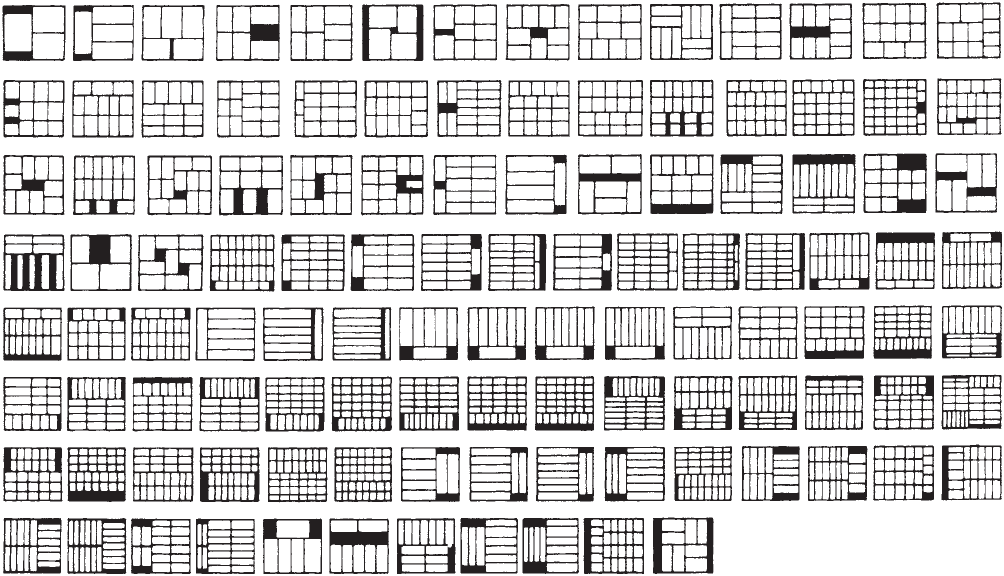
different pallet patterns are shown in Figure 1.
PALLETIZING
Once the pattern and number of tiers have been designed,
the method of product-to-pallet transfer is determined.
Hand palletizing is the most versatile method and is
effective when loading is slow. Single-product, single-
pattern, high-level palletization developed from hand
palletization. Recent technological advances permit auto-
mated palletization of almost every product, but this
process may not always be economical. The selection of a
palletizer demands consideration of performance require-
ments and space limitations. The palletizer is an element
in the total packaging/distribution system, and it should
never be a limiting factor. The palletizer should be capable
of speeds exceeding normal line speed by 5–10%, and
change over time from product to product should be
minimal. A fully automatic palletizer does not require an
operator in attendance full time.
Figure 1. Pallet patterns.
PALLETIZING 901
High-Level Palletizers. High-level palletizers (also
called moving-pallet palletizers) pick up the product at a
level above the height of a full pallet and form the tier
pattern on a bed. The pallet is raised to the bed level, and
the product is transferred (by a sweep or rake off system)
to the pallet. Then, the pallet is lowered one layer, and the
next tier is formed in the same manner and placed atop
the first. This process continues until the pallet reaches
the prescribed height. It is then transferred out to be
replaced by an empty pallet that is raised to the bed for a
repetition of the process. Numerically controlled tape
programs provide simple multipattern capability and are
adaptable for a variety of users.
Low-Level Palletizers. Low-level palletizers (also called
‘‘fixed-pallet’’ palletizers) were developed more slowly
than high-level palletizers, but with the introduction of
programmable logic controllers, they have become highly
competitive with high-level units in cost and speed. The
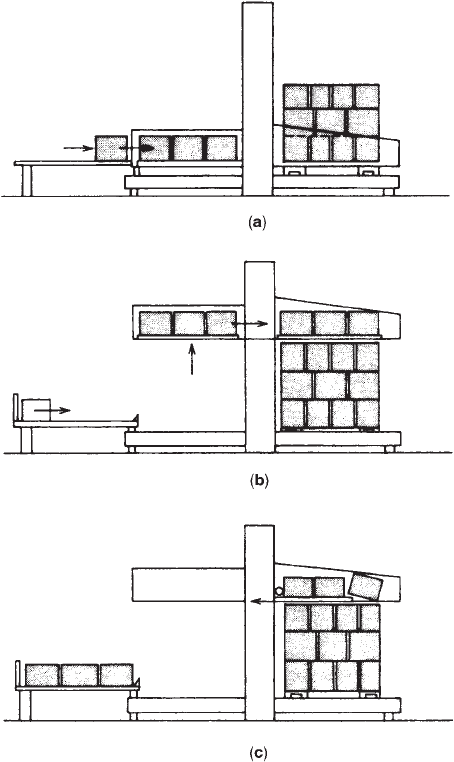
low-level palletizer operates at floor level (see Figure 2).
The pallet is neither raised nor lowered, and the tier is
formed at low level. The transfer bed or apron is raised or
lowered to the appropriate level, and the tier is trans-
ferred to the pallet. The bed returns to the tier-forming
position, and the next layer is formed. This pattern is
repeated until the pallet is full. After the full pallet is
discharged, an empty one is transferred into the load
station, and the process is repeated.
Robotic Palletizers. In the past, ‘‘pick-and place’’ sys-
tems picked up a product at one point and placed it at a
second point repeatedly. At present, robotic palletizers
may be thought of as intelligent, discriminating systems
capable of picking up several different products and
placing them at several different points. These units are
usually capable of movement in two or three planes, often
on rotational coordinates that operate from a fixed point at
the center of a circle. They are capable of picking up a
variety of products from one point on the circumference of
the circle and placing it on one of several pallets located at
other points around the circumference. Robotic palletizers
are most applicable when a variety of products require
different pallet patterns and relatively slow speeds are
acceptable.
Bulk Palletizers. The shift to bulk handling has reduced
the demand for case depalletization of empty containers.
Numerous applications exist for palletizing without ben-
efit of a case, for example, the transfer of empty cans from
the can manufacturer to the filler. Cans are bulk palle-
tized successfully because they are strong enough to
withstand relatively rough treatment. Improved handling
methods permit bulk palletization of glass containers, and
many plastic containers now are being bulk palletized as
they gain a greater place in the market.
Nested container-to-container bulk pallets can save up
to 15% space for the same number of containers compared
with column-stacked cases. That means 15% more con-
tainers can be shipped in the same truckload to the user,
which cuts time and expense. The compact loads also
reduce warehouse requirements. In addition, bulk
palletizing eliminates the labor and expense associated
with uncasing equipment and additional conveyors for
empty cases.
Bulk palletization is essentially an adaptation of high-
or low-level palletization. The product is accumulated on a
table or bed, then transferred by lifting a tier or clamping
the perimeter and sweeping the tier onto a pallet. A
corrugated sheet the size of the pallet, called a tier sheet,
is generally used between layers to provide stability to the
load. Increased stability can be gained by use of an
inverted tray instead of a tier sheet.
Figure 2. Operation of a low-level palletizer. (a) Operation 1.
Sealed shipping cases feed in and are oriented to the prepro-
grammed pattern. When one row is formed, the cases move
forward. The next row forms and moves forward, which continues
until the layer is complete and the loading plate is filled.
(b) Operation 2. The layer is lifted to the height of the existing
pallet stack. The filled loading plate moves into position just
above the pallet stack. (c) Operation 3. The loading plate retracts
allowing the cases to settle, row by row onto the top of the pallet
stack. The pallet is squared by a squaring bar, which also assures
complete unloading. The loading plate returns to starting position
where another accumulated load is ready.
902 PALLETIZING
Miscellaneous Palletizers. Other types of palletizers in-
clude drum palletizers, keg palletizers, and bag palleti-
zers. In most cases, these machines address a particular
end-use and are concerned only with a narrow portion of
the market place.
DEPALLETIZING
The removal of product from pallet depends on the con-
formation of the product. Bulk depalletizers remove tiers
of product from the pallet in much the same manner as
bulk palletizers in reverse. In one approach, the tops of the
containers are gripped mechanically, pneumatically, or
with a vacuum, and the tier is lifted onto a discharge
table. In another, the tier is swept onto the discharge
table. Removal of the tier sheet or inverted tray is as
critical here as in bulk palletization. Product stability is a
key factor in all bulk handling operations and the primary
determinant of method.
Depalletization of plastic cases or crates may require
modified bulk depalletizers or specialized robotic depalle-
tizers. Plastic crates usually have an interlocking feature
that requires a tier to be lifted clear of the one below before
transfer to the discharge table, thus precluding a sweep
system. Most pail depalletizers must handle the products
individually in addition to lifting clear of the pail below.
Depalletization of corrugated cases is more difficult
than palletization. The flaps on the cases get caught on
one another, which prevents consistent sweepoff. Corru-
gated cases do not interlock, so clamping the perimeter
causes the center cases in the tier to slip down. The most
reliable way to remove a whole tier of corrugated cases is
to use tier sheets, but the additional cost discourages wide
acceptance. The next-best method is a combination clamp-
ing and vacuum system. Some automated warehousing
systems remove cases from pallets one at a time in a type
of ‘‘order-picking’’ operation. Little effort is being ex-
pended today on finding better case-depalletization meth-
ods because the shift to bulk handling has shifted research
and development work in that direction as well.
BIBLIOGRAPHY
‘‘Palletizing’’ in S. D. Alley, ed., The Wiley Encyclopedia of Packa-
ging, 1st edition, ABC-KCM Technical Industries, Inc.
pp. 486–488.
PALLETS, PLASTIC
L. T. LUFT
Menasha Corporation
Neenah, Wisconsin
Plastic pallet construction began during the late 1960s
when the low cost of commodity resins such as polystyrene
(PS) and polyethylene encouraged scores of molders to
enter this promising market. In the early 1970s, high-
density polyethylene (HDPE) was priced at about $0.16/lb
($0.35/kg). Still in its infancy, the plastic pallet market
was severely curtailed when prices of commodity resins
more than doubled at the time of the 1973 oil embargo. A
2:1 price differential between wood and plastic pallets
quickly became a 4:1 price disadvantage.
Several changes that took place in the 1980s have
encouraged and use of plastic pallets as follows:
Packaging is now often considered part of direct pro-
duction cost instead of fixed overhead. This highlights the
savings generated by reusable pallets (1).
Adoption of the just-in-time inventory concept (2) in-
cluding reusable packaging, inventory reduction, and
higher quality.
Greater use of robots and automated palletizers that
require uniform size/weight pallets.
Increased awareness and regulation of plant
sanitation.
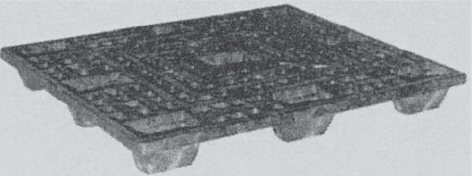
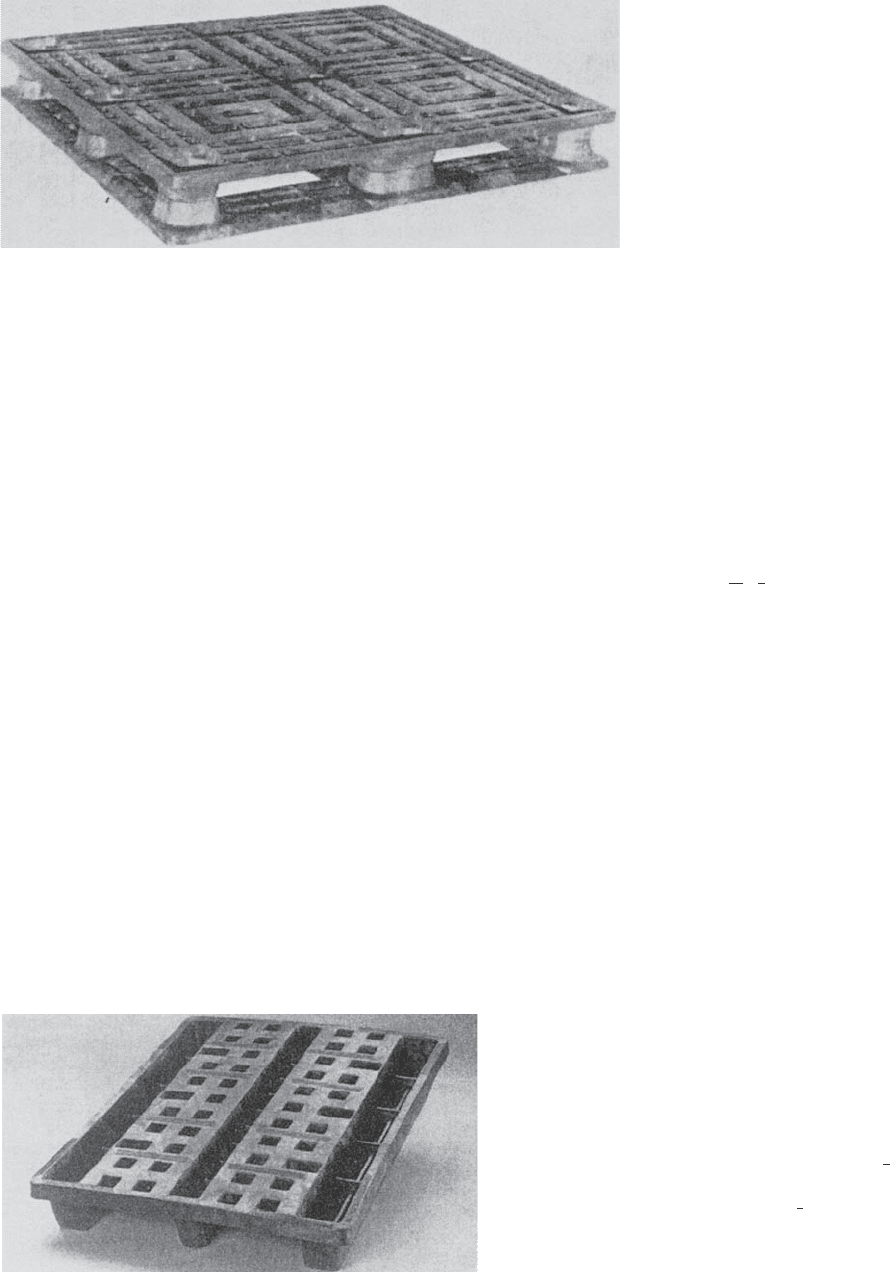
Typical single- and double-faced pallets are shown in
Figures 1 and 2.
Materials. Most plastic pallets are manufactured from
HDPE (see the Polyethylene, high-density article). Mate-
rials such as polystyrene, fiberglass-reinforced plastics
(FRP), and polypropylene are used occasionally. Heavy
pallet loads and unsupported pallet racking may dictate
the use of stiffer polystyrene (see the Polystyrene
article).
FRP (see the Thermosets article) are used for low-
volume custom pallet requirements or prototype pallets.
In this situation, low-cost wooden tooling is used with
the hand-layup fiberglass technique. Polypropylene (see
the Polypropylene article) has been used to construct
structural foam plastic pallets by companies with excess
virgin or regrind polypropylene. Polypropylene is not
normally used in pallet construction because it requires
relatively expensive impact modifiers for cold-weather
performance.
Polyethylene is favored for a many reasons, such as
commodity status (i.e., low cost, uniform performance,
readily available, and wide acceptance); excellent resis-
tance to impact; good performance under a wide range
of operating conditions (i.e., temperatures of –30 to 1501F
(34 to 661C), indoor or outdoor applications; light- to
heavy-weight loading; outstanding chemical resistance
to most acids and bases; U.S. Department of Agricul-
ture (USDA) and U.S. Food and Drug Administration
Figure 1. Typical single-faced plastic pallet.
PALLETS, PLASTIC 903
(FDA) clearance for use in food and pharmaceutical
plants; easy cleaning; and outstanding molding and de-
sign flexibility.
Polyethylene’s one glaring weakness is its inability to
resist deflection (bending) under load. This deflection
problem is especially serious in pallet-racking applica-
tions. Unsupported racks do not have center supports or
decking. In these racks, the pallet must span an open
space while maintaining the load. With loads of over
2000 lb (907 kg), plastic pallets are prone to bending
(deflection). In addition to the initial deflection, the plastic
pallet will continue to bend or creep for up to 2 weeks.
Over time, it may become difficult to reenter the pallet
with the forks of a lift. Most standard pallet rack, drive-
through rack, and gravity-flow rack are ‘‘unsupported.’’
In situations where heavyweight racking is a must,
steel-reinforced plastic or stiffer PS are frequently used.
Steel reinforcements add expense, and compared to
HDPE, PS costs more and offers less chemical and impact
resistance. One solution to the racking problem is in
the design of rackable pallets. Two-way-entry pallets can
rack over 3000 lb (1360 kg) in an unsupported rack (see
Figure 3). Experimental plastic resins are also being tried
in an attempt to solve the racking dilemma.
Design and Construction. Pallet design and the method
of construction greatly influence pallet performance, price,
and acceptance. Today plastic pallets are designed and
built using several different processing techniques (see
Table 1).
Structural Foam Molding. Most plastic pallets made
today are made by structural foam molding (3, 4). This
low pressure injection molding process produces parts
with a solid skin surrounding a foamed core. Compared
to high-pressure injection molding, structural foam mold-
ing allows the economic production of heavy wall sections
and helps reduce stress points throughout the pallet. The
structural foam process provides outstanding design flex-
ibility. Wall thickness of
3
16
2
3
4
in. can be molded to produce
pallets ranging from lightweight single-faced units to
super-duty racking pallets. Another benefit is high-speed
production, with cycle times as low as 2–3 min. Good
resistance to impact, high strength per pound (kilogram),
and good deflection strength are all positive characteris-
tics that make structural foam a good choice for large-
scale production of both custom and proprietary pallets.
The chief limitation of structural foam is that relatively
high volume (3000 total units minimum) is required to
amortize the relatively high tooling cost. When compared
with high-pressure injection molding, the tooling for
structural foam may be less costly. Most low-pressure
foam tools may be built from machined aluminum or
Kirksite, which reduces tooling costs by up to 50%.
When structural foam tools are built from steel, the cost
savings are negligible.
Injection Molding. High-pressure injection molding (see
the Injection molding article) also offers design flexibility.
It is used for the production of pallets that range from
light weight disposables to heavy-duty 60-lb (27-kg)
reusables. Injection molded parts generally have nar-
rower wall sections than structural foam, r0.300 in.
(r7.62 mm), and rely on their rib design for structural
integrity (5). Injection molding excels in light weight,
large-volume production. Cycle times for
1
8
-in. (3.2 mm)
injection-molded pallets can be under one minute. Heavy-
duty parts with wall section
1
8
in (3.2 mm) offer high
strength and excellent durability. Because high molding
pressures require expensive equipment and hardened-
steel tooling, high-volume production runs Z10,000) are
generally required to amortize tooling and press costs.
Figure 2. Typical double-faced plastic pallet.
Figure 3. Two-way entry racking pallet.
904 PALLETS, PLASTIC

Table 1. Plastic Pallets, Production Methods
Molding Process
Plastic Pellets
Advantages
Plastic Pallets
Disadvantages
Ideal Pallet
Application Secondary Applications
Tooling Options Average Cycle
Wall
Thickness
Structural-foam
molding
Economic production of
heavy-wall sections
High-cost tooling
and processing
equipment
Large-volume
custom or
proprietary
pallets with
runs of 1000
pallets or more
Manufacture of heavy-
duty racking pallets is
possible by using filled
polyethylene pallets or
polystyrene
Kirksite
aluminum steel
2–4 min
3
16
21:0 in (4.8–
25.4 mm)
Short cycle times
Minimum custom
order quantity
3000 units
Wall thicknesses of up to
1 in. (2.54 cm) can be
used when necessary
Good impact resistance
Good deflection strength
High strength per pound
(kilogram)
Good weight and
dimensional tolerance
allows complex shapes
Injection molding Flexible process allows
production of light-
weight disposable as
well as heavy-duty
returnable pallets;
allows complex
geometry
Highest tooling
cost Highest
equipment costs
High energy
costs
Largest-volume
custom and
proprietary
pallets
Lightweight disposable
pallets can be
inexpensively produced
by keeping wall
sections narrow and
cycle times short;
heavy-duty racking
pallets can be
manufactured by using
heavier wall sections
and a well integrated
rib design
Hardened steel 30 s–3 min
1
32
2
3
8
in. (0.8–
9.5 mm)
Rotational
molding
Low equipment cost Relatively long
cycle times
Low-volume
production of
large pallets
Manufacture of heavy-
duty racking pallet is
possible by
ecapsulating steel
reinforcements into the
pallets
Cast- aluminum
fabricated
metal-plated
nickel
3–6 min
1
8
2
1
4
in. (3.2–
6.4 mm)
Low tooling cost
Limited weight
and
dimensional
stability
Custom pallet
projects of 1000
units or more
are feasible
Production of double
walled parts
Limited to simpler
design
(geometry)
(Continued
)
905

Table 1. Continued
Molding Process
Plastic Pellets
Advantages
Plastic Pallets
Disadvantages
Ideal Pallet
Application Secondary Applications
Tooling Options Average Cycle
Wall
Thickness
Vacuum forming Low equipment cost
Relatively long
cycle times
Lower-volume,
low cost,
lightweight
pallets
Heavier loads up to 3000
lb (1361 kg) can be
accomodated by using
twin-sheet vacuum
forming
Metal Plaster
Epoxy Wood
3–6 min
1
8
2
1
4
in. (3.2–
6.4 mm)
Low tooling cost
Limited wall
thickness
Pallets projects of
500 units and
above are
feasible
Vacuum-formed pallets
are not generally used
for heavy-duty racking
applications
Limited depth of
draw
Limited design
complexity
Reaction-injection
molding
Lighter weight tooling
and equipment costs
less than injection
molding processes
Limited deflection
strength
Lighter duty
custom and
proprietary
pallets
Fiberglass-reinforced
reaction injection
molding is used to
increase deflection
strength for heavier
applications
Lightweight steel
Aluminum
Kirksite
Sprayed metal
2–4 min
1
8
22:0 in. (3.2–
51 mm)
Allows complex designs Slightly longer
cycle times than
injection-
molding
processes
Pallet projects of
1000 units and
above should be
justifiable
Steel reinforcements can
be encapsulated for
additional strength
Lower pressures and
temperatures afford
significant savings
(70%) over injection-
molding processes Limited
dimensional
stability
906

Rotational Molding. Rotational molding (3) (see the
Rotational molding article) uses a heated tool into which
solid or liquid polymer is placed. This process offers the
most economical tooling costs. Myriad sizes and designs of
a relatively low quantity (1000–2000 units) can be eco-
nomically justified. Design innovation, including the
molding of steel-encapsulated, smooth-skinned pallets is
a feature of rotational molding. Rotationally molded parts
offer good resistance to blunt impact and the repair of
small puncture damage is possible. Its drawbacks include
relatively long cycle times (as high as five min) and
relatively narrow
3
16
-in. (4.8-mm) wall thickness (6), which
limits rotationally molded pallets to medium-duty appli-
cations. Some rotationally molded designs can accommo-
date the addition of steel reinforcement for heavier loads
and pallet racking operations.
Thermoforming. Thermoformed plastic pallets (see the
Thermoforming article) are offered in dozens of low-cost
lightweight designs. Inexpensive tooling allows faster
amortization of low-volume custom pallets. For example,
custom reusable dunnage trays are often thermoformed.
Thermoforming, too, has its disadvantages. With cycle
times averaging 5-min (5), high-volume projects are
sometimes impractical. In addition, relatively narrow
wall thicknesses limit these pallets to lighter loads,
usually under 3000 lb (1360 kg). They are not often found
in heavy-duty racking applications. Twinsheet vacuum
forming allows heavier loads with reduced deflection,
but it lengthens cycle times and adds cost.
Reaction Injection Molding (RIM). RIM polyurethane
pallets have entered the market. RIM uses two or more
liquid components (polyol and isocyanate) that are mixed,
then injected into a closed mold. These two components
react to form a finished polymer, which takes on the shape
of the tool. The chief advantages of RIM are lower cost
equipment and tooling, especially in building large parts
such as pallets. The chief disadvantage of RIM pallets is
the lower resistance to deflection. For this reason, many
large RIM parts are steel reinforced or manufactured with
fiberglass or mineral fillers. These stiffening techniques
add cost.
Advantages. Plastic pallets are used primarily in the
food, pharmaceutical, textile, high-technology, and auto-
motive industries. Because of the higher cost of plastic
pallets, most purchasers use their pallets in-plant, or in
closed-loop shipping system. Plastic pallets are almost
always found in applications where the user can retrieve
most of the pallets after each trip.
Plastic pallets of all types offer certain generic advan-
tages which make them attractive alternatives to other
pallet materials. Listed below are some of the plastic
pallet’s chief benefits.
Long Pallet Life. The relatively expensive plastic pallet
must offer a long service life. Many customers
experience plastic pallet life of 5–9 years and
more (7).
Reduced Load Damage. Smooth molded plastic helps
eliminate product damage. There are no broken
boards or protruding nails to damage-sensitive
loads (7).
Easy Cleanup. Plastic pallets are easy to clean and
keep clean (8).
USDA and FDA Clearance. Both polyethylene and
polystyrene are acceptable in food and pharmaceu-
tical plants. Pallets made from these materials can
be approved on a case by case basis by the on-site
inspectors.
Reduced Worker Injury. Smooth construction and con-
sistent weights help to eliminate minor cuts and
back strain (7).
Chemically Inert. Polyethylene plastic pallets are
highly resistant to acids and bases, and at ambient
temperatures, hydrocarbon solvents.
Moistureproof. Plastic pallets will not absorb moisture
and soak loads. Plastic pallets will not rust or break
down in wet conditions (8).
No Harbor for Pests. Plastic pallets will not harbor
or support the growth of worms, eggs, molds, or
mildew.
The design advantages of plastic pallets can include the
following:
Nestability (single-faced pallets can nest with each
other when unloaded). This feature can save over
50% of valuable truck or dock space.
Interstacking (the ability to positively locate one loaded
pallet on top of another loaded pallet).
BIBLIOGRAPHY
‘‘Pallets, Plastic’’ in L. T. Luft, The Wiley Encyclopedia of Packa-
ging Technology, 1st ed., Neenah, WI: Menasha Corporation,
pp. 488–492.
1. U.S. Industrial Outlook, United States Department of Com-
merce, Jan. 1984.
2. J. M. Callahan, ‘‘Just-in-Time a Winner,’’ Automotive Ind. Mag.
65(3), 78 (March 1985).
3. Modern Plastics Encyclopedia, 1983–1984 ed., McGraw-Hill
Publications, New York.
4. ‘‘What’s Available in Plastics?’’, Warehouse Supervisor’s Bulle-
tin, National Foreman’s Institute, Waterford, CT, June 25,
1984.
5. ‘‘Pallets Take off in All Directions,’’ Modern Plast. Mag., 64–66
(March 1971).
6. ‘‘Fitting Plastic Pallets to the Job,’’ Plast. Design Forum 9(3),
57 (May/June 1984).
PALLETS, PLASTIC 907