
Yam, Kit L. (ed.). The Wiley encyclopedia of packaging technology
Подождите немного. Документ загружается.

7. R. F. Ellis, ‘‘Plastic Pallets Eliminate Product Damage in
Storage,’’ Modern Mater. Handling Mag. 39(8), 87 (June 8,
1984).
8. ‘‘Molded Plastic Pallets Solve Odor Transfer Problem,’’ Food
Processing Magazine, 46(3), 108 (March 1985).
PAPER
Updated by Staff
INTRODUCTION
There is no strict distinction between paper and paper-
board, particularly in view of the tremendous variation in
density possible with current technology. Generally, struc-
tures less than 0.012 in. thick (12 ‘‘points’’ or 305 mm) are
considered paper regardless of weight per unit area.
Except for the use of paper as an overwrap for folding
cartons, most packaging papers are used in flexible
applications.
A large number of grades of paper and board are
available for packaging and are employed for many dif-
ferent purposes. Packaging paper grades range from
simple wrapping paper (made from mixed recovered pa-
per) to kraft paper and are predominately supplied in
rolls. They are made from virign pulps (sulfite/kraft pulp),
from recycled fibers, or from mixtures of chemical pulp
and recycled fibers. These grades are used in the produc-
tion of bags, beer mats, carrier bags, and gift wrapping
paper for example.
For the foodstuff sector, special types of paper and
board are produced which must fulfill the requirements
of the food laws. These papers are used in the nonfood
sector—for example, as coating papers. The possibilities of
combination with each other and with other materials,
such as plastics, are numerous. In this way, special pack-
ing materials can be produced for most packaging pur-
poses (1).
The primary intermediate product used to make paper
is wood pulp. The properties of an individual paper or
paperboard are extremely dependent on the properties of
the pulps used. Pulp preparation from deciduous (hard-
wood) or conifer (softwood) species may be done by me-
chanical, chemical, or hybrid processes (2, 3). These
hardwood or softwood pulps may be used unbleached, or
they can be bleached to varying degrees by a diversity of
techniques.
Mechanical pulps produce papers that are character-
ized by relatively high bulk, low strength, and moderate to
low cost (4). Their use in packaging is very limited.
The kraft (sulfate) pulping process, introduced about
100 years ago, dominates the chemical pulping industry:
Yields are higher, pulps are stronger, and process chemi-
cals more completely and economically recovered than
with any other process. Although the sulfite processes
were extremely prominent 75–125 years ago, their chemi-
cals are difficult to recover, the resultant pulps are sig-
nificantly weaker than those produced by the kraft
process, and they produce no unique paper properties.
Unbleached pulps are generally stronger, stiffer, and more
coarse than their bleached counterparts, but papers made
of white, comfortable fibers are used in many more
applications. General treatments of pulping and bleaching
are provided in references (5–8).
The standard ream basis for packaging papers in the
United States is 500 sheets cut to a size of 24 36 in.
(61 91.5 cm) (3000 ft
2
or 279 m
2
). On this basis, packa-
ging papers normally weigh 18–90 lb/ream (8.2–40.8 kg/
ream), but some specialty applications require weights as
low as 10 lb (4.5 kg) or as high as 200 lb (90.7 kg)/ream. At
any given basis weight, density may typically be 0.08–
0.16 lb/in.
3
(2.2–4.4 g/cm
3
), providing a very wide range of
thickness and strength properties.
The two most general classifications of packaging
papers are coarse and fine. Coarse (kraft) packaging
papers are almost always made of unbleached kraft soft-
wood pulps. Fine papers, generally made of bleached pulp,
are typically used in applications demanding printing,
writing, and special functional properties such as barriers
to liquid and/or gaseous penetrates.
KRAFT PAPERS
In order to meet the high strength requirements, kraft
papers consist of primary or a mixture of primary and
secondary fibers of kraft pulp. They are used mainly for
packaging purposes.
Kraft papers, produced by the kraft process, derive
their name from the German word for ‘‘strong.’’ Kraft
paper is made from at least 80% sulfate wood pulp. It is
typically a coarse paper with exceptional strength. Some-
times made with a rough finish to keep bags from sliding
off piles, these papers are often made on a fourdrinier
machine and then either machine-finished with a calen-
dar stack or machine-glazed by using a Yankee dryer
(5, 6). The surface of these papers is acceptable for printing
by letterpress, flexography, and offset processes (see Print-
ing). In addition to wrapping applications, kraft papers are
used for multiwall bags and shipping sacks (see Bags,
multiwall), grocers’ sacks, envelopes, gummed sealing
tape (see Tape, gummed), butcher wraps, freezer wraps,
tire wraps, and specialty bags and wrappings that require
economy and strength. Paper for grocery bags and fast food
bags must have a high resistance to tearing. The fiber of
choice is softwood kraft, which may be bleached or
unbleached (9). Many papers formerly manufactured
from sulfite pulps, especially those of tissue weight, are
now manufactured with kraft pulps. Unbleached ‘‘sulfite’’
papers are used for products such as oil cans (intermediate
liner) and single-service food packages.
Extensible kraft papers have satisfied a special niche in
the packaging industry. Although creped papers have long
served both decorative and functional roles, other papers
capable of absorbing energy at sudden rates of strain have
908 PAPER
become increasingly important in uses such as shipping
sacks. Conventional creping is performed either at the wet
press section of a paper machine (wet crepe) or on a
Yankee dryer (dry crepe). Dry creping is most commonly
used to generate qualities such as softness and absor-
bency; wet creping is a technique for making tough,
flexible papers capable of absorbing tensile energy. A
secondary creping operation rewets a dry sheet, and it
may be done in-line on the paper machine or as an
independent manufacturing process. Whereas a standard
kraft paper might have a stretch (before breaking) of
3–6%, creped papers generally may be stretched
35–200% of their original length before breaking. Manu-
facturers of creped, extensible, and other coarse (kraft)
papers may be found in reference (10).
BLEACHED PAPER
Packaging applications that place a higher priority on
printing, writing, and special functional properties than
on economy and strength generally utilize bleached pa-
pers. The pulps used to manufacture bleached papers are
relatively white, bright, and soft, and they are also
receptive to special chemicals necessary to develop many
functional properties. Although generically not as strong
as unbleached kraft papers, bleached papers can be man-
ufactured to meet simultaneous requirements of both
strength and printability. Their whiteness enhances print
quality and generates a perception of cleanliness and
quality. The aesthetic appeal of bleached packaging pa-
pers may be augmented by clay coating one side (C1S) or
both sides (C2S). The increasing demand for a combina-
tion of functional performance and top-quality graphics
favors the C1S manufacturer who can satisfy the variety
of challenges of this market.
VEGETABLE PARCHMENT
Vegetable parchment is a highly waterproof, greaseproof,
boilproof paper of high purity. It is used in the packaging
of fats in combination with aluminum foil or a plastic
coating. Silicon-coated parchment paper has a wide range
of applications—for example, in antiadhesive papers (1).
The process for producing parchment paper was devel-
oped in the 1850s, making it one of the grandfathers of
special packaging papers. By soaking an absorbent paper
in concentrated sulfuric acid, the cellulosic fibers are
swollen tremendously and partially dissolved. In this state
the plasticized fibers close their pores, fill in voids in the
fiber network, and thus produce intimate contact for
extensive hydrogen bonding. Rinsing with water causes
reprecipitation and network consolidation, resulting in a
paper that is stronger wet than dry, lint-free, odor-free,
taste-free, and resistant to grease and oils. By combining
parchment’s natural tensile toughness with extensibility
imparted by wet creping, paper with great shock-absorb-
ing capability can be produced. Special finishing processes
provide qualities ranging from rough to smooth, brittle to
soft, and sticky to releasable. Parchment was first used for
wrapping fatty substances like butter; but this versatile
paper is now also used whenever food is prepared, frozen,
packaged, or displayed, as well as when tough, lint-free,
chemically pure surfaces are needed for special packages.
GREASEPROOF AND GLASSINE
Because cellulose is hydrophilic, it is a good substrate to
use for resisting penetration of hydrophobic liquids. As
noted above, vegetable parchment performs well as a
greaseproof paper because it is essentially pore-free and
composed of a hydrophilic material. ‘‘Greaseproof’’ paper
is a substrate manufactured to also have an essentially
pore-free consolidation; but mechanical refining (‘‘buffing’’
or cutting) is used in its production instead of swelling
with concentrated sulfuric acid. Refining fibrillates,
breaks, and swells the cellulose fibers to permit consolida-
tion of a web with many interstitial spaces filled in.
Glassine paper is produced by further treating ‘‘grease-
proof’’ paper with a supercalendar operation. The super-
calendar step involves moist high temperatures (steam),
pressure (several hundred pounds per lineal inch or
B100 kg/cm), and differential hardness (one roll typically
cotton or soft rubber, the other roll hard rubber or metal)
to polish the surface. Supercalendering a greaseproof
paper generates such intimate interfiber hydrogen bond-
ing that the refractive index of the glassine paper ap-
proaches the 1.02 value of amorphous cellulose. This
indicates that very few pores or other fiber–air interfaces
exist for scattering light or allowing liquid penetration.
High transparency is achieved by intensive supercalen-
dering. The paper is frequently colored. This paper is
used, for example, for wrapping chocolates or for packing
high-quality preserves.
Greaseproof and glassine papers are frequently plasti-
cized to further increase their toughness. They have a
reputation of running well on high-speed packaging lines,
and they have served well for odor and aroma barriers.
Like other flexible-packaging papers, they can be chemi-
cally modified to enhance functional properties (e.g., wet
strength, adhesion, release). When waxed, they are stan-
dard materials for primary food pouches used to package
dry cereals, potato chips, dehydrated soups, cake and
frosting mixes, bakery goods, candy and ice cream confec-
tions, coffee, sugar, pet food, and so on. In addition to their
protective functions, these papers heat-seal easily when
waxed and reclose well. Greaseproof paper is neither
waterproof nor boilproof.
WATER-, GREASE-, AND OIL-RESISTANT PAPERS
The distinction between greaseproof papers and grease-
resistant papers is a fairly subtle one, involving an under-
standing of the methods of penetration of liquids into
surfaces. Because the primary mechanisms involve capil-
lary penetration and/or wetting, it is appropriate to con-
sider the severity of the packaging requirement. The
requirement
may be for
minimal staining by grease, oil,
or water under negligible pressure; or it may be for
PAPER 909
absolute resistance to any penetration of the liquid over
long periods of time and/or under substantial pressure;
or it may lie between these extremes. Parchment, glassine,
and greaseproof papers offer decreasing protection from
grease and oil at the more restrictive end of the spectrum.
As noted above, their resistance is generated by the lack
of capillaries and the oleophobic nature of cellulose.
Greaseproof paper can be made resistant to grease pri-
marily by a beating process and by the addition of
auxiliary agents (1).
A consideration in designing primary packages is the
economics of using the various barriers available for the
job. A bag for a single-service consumable (e.g., French-
fried potatoes) may require resistance to staining for
only several minutes. A lubricating oil package, on the
other hand, may require a stain-free barrier for several
months. Imparting sufficient resistance to liquid penetra-
tion to meet the requirements of the less demanding
applications can be done very economically with chemical
treatments. If grease and/or oil penetration is the only
concern, moderate resistance (package life of minutes
to days) can be developed using waxes (see Waxes) and
other low-surface-energy materials such as fluorocarbons.
Fluorocarbon technology in papermaking has expanded
from multiwall and consumer bags to labels, coupons, and
carryout food packaging, perishable bakery goods packa-
ging, candy and confection packages, and form-and-fill
packages where edge wicking may be an important
consideration.
In many applications (e.g., carryout food packaging),
resistance to both water and oils must be developed for
adequate performance. The use of rosin-based chemicals
for developing water repellency in paper requires the use
of alum (Al
2
(SO
4
)
3
) or other multivalent cations that
destroy the grease-resisting properties of fluorocarbons.
The simultaneous development of both water and oil
resistance requires (a) the use of oleophobic chemicals
that react with hydroxyl and carboxyl groups on the
cellulose fibers and (b) the use of hydrophobic chemicals
such as fluorocarbons, which have also been modified
to react with the same cellulose functional groups. Typical
oleopholic chemicals currently in widespread use are
alkylsuccinic anhydrides and alkylketene dimers. The
most successful economic choices are made through
close consultation between the paper manufacturer and
the user, which allows the careful selection of designs for
meeting specific performance requirements. Grease- and
oil-resistant papers can be made to run well in most any
converting and printing processes.
WAXED PAPERS
Waxed papers are age-old papers that have served the
packaging industry well in applications requiring direct
contact with food for barrier against penetration of liquids
and vapors, as well as heat sealability, lamination, and
even printing. Waxing can be performed in-line with the
paper-manufacturing process, in-line with printing, con-
verting or lamination processes, or as a discrete process. A
great many base papers are suitable for waxing processes,
including (a) greaseproof and glassine papers and (b)
water-resistant papers. Supercalendered base paper is
designed for waxing and frequently contains titanium
dioxidea as filler. This type of paper is used for wrapping
candy. There are two fundamentally different waxing
processes, generating different characteristics for the
finished sheet (see Waxes). Wet waxing is an operation
in which the wax coating is applied to the surface of the
sheet. Surface wax is desirable for heat sealing and
lamination and is essential for vapor-barrier development.
Dry waxing is performed to absorb wax into the sheet,
leaving a surface that often does not look or feel waxy.
Penetration of wax allows additional surface treatments
for special release applications, or for further lamination.
Absence of the continuous film of wax on the surface
characteristic of wet waxed paper also allows the dry
waxed paper to ‘‘breathe’’ moisture, carbon dioxide, and
oxygen.
Waxed papers provide an economical choice for pri-
mary food packaging not only because of their versatility
but also because of their safety as tasteless, odorless,
nontoxic, and relatively inert materials. Their widespread
use in conventional packaging applications includes: de-
licatessen pickup sheets; box liners; cover, scale, and
utility sheets; patty papers; sandwich wraps; and bags,
laminations to other papers and paperboard for food
trays, locker papers, carryout cartons, food pails, baking
cups, folding cartons, cereal liners, and folding carton
overwrap.
SPECIALTY-TREATED PAPERS
Many packaging applications require barrier to sub-
stances other than water, grease, or oil. Most food-packa-
ging applications are well-served with water- and/or oil-
penetration resistance, but a number of products require
more elaborate barriers. Meat-wrapping paper demands
exceptional strength; resistance to grease, moisture, and
blood; easy release with no residual taste or odor; plus
‘‘bloom’’ retention. Freezer paper must remain pliable at
low temperatures and must offer puncture resistance,
moisture-vapor barrier, exceptional seal integrity, and
easy release from frozen or thawed meats. Other products
such as chemicals, drugs, cosmetics, personal-care items,
and industrial products require package functions such as
acid resistance, alkali resistance, alkali solubility, mold
resistance, flame retardation, solvent resistance, organic
polymer adsorption/absorption resistance or affinity, ad-
hesion, release, tarnish or rust inhibition, heat stability,
sterilizability, specific-ion adsorption, conductivity, resis-
tivity, stiffness, or flexibility. Photographic protective
wrapping paper is a black-dyed chemically neurtral paper
that can be folded without breaking and is suitable for
wrapping photographic film. To address the general man-
ufacturing techniques or even the functional property
classification of such a variety is beyond the scope of this
publication. Reference (11) provides a general treatment
of some of these products that have transcended proprie-
tary technology.
910 PAPER
WET-STRENGTH PAPERS
Conventional papers are not strong when wet. The most
predominant fraction of paper’s strength is the result of
hydrogen bonding between hydroxyl and carboxyl groups
of adjacent fibers. The removal of water during the
papermaking process generates these bonds, and the
process is reversible. The two strategies for manufactur-
ing strong-when-wet papers are (a) keep the water out of
the paper and (b) introduce additional chemical bonds
between fibers which are not influenced by the introduc-
tion of water.
As mentioned above, paper that has been parchmen-
tized is actually stronger wet than dry, principally
because of the loss of individual fiber identity during the
gelatinized stage of the process. Through advances in
chemical technology, several more economical alternatives
exist for generating wet-strength papers. In general,
the chemicals used to augment the natural hydrogen
bonding are crosslinked during the manufacturing
process. Common chemicals for producing wet-strength
papers include protein, urea, melamine, resorcinol,
and other phenolic or amino resins crosslinked with
formaldehyde, and condensation products of polyalkylene
polyamines with dicarboxylic acids crosslinked with epi-
chlorohydrin (12).
The conventional tests of wet-strength papers are for
tensile, tear, and burst strength, because these are the
most useful indicators of use requirements. The degree of
wet strength is expressed as a percentage of original dry
strength, and is referred to as the percent of strength
retention. The typical range for sack or pouch papers is
15–30%. Wet strength may also be generated in a variety
of permanence levels, so that the product will either
remain tough-when-wet, or eventually disintegrate with
soaking time or application of force.
ABSORBENT PAPERS
Papers designed for absorption of specific fluids are an
important part of the packaging industry. Although they
are a member of the class of ‘‘specialty-treated papers,’’
they are distinctive enough to warrant separate discus-
sion. Typically at the low end of the strength spectrum,
absorbent papers must not only be exceptionally porous,
they must also have surface modifications to render
affinity to the target liquid. When that liquid is aqueous,
they must generally also have a definitive level of wet
strength. Providing the special affinity to a given liquid is
often a proprietary technology involving chemicals that
are substantive to cellulose and to the target liquid. This
special class of papers currently services industries ran-
ging from fresh-food packaging to industrial-products
packaging.
TISSUE PAPERS
Tissues form a special group of fine packaging papers
because of their versatile performance. Tissue is made of
either virgin or recycled fiber. Always fairly thin, tissues
range from semitransparent to totally opaque. They can
be waxed or treated with any of the specialty treatments
(e.g., edible oils, for fruit wrapping, antitarnish metal
protection), or they can be used ‘‘as is’’ for applications
ranging from intermediate lamination steps in composite-
container construction (see Cans, composite) to gift wrap-
ping. They may be made exceptionally weak for softness,
or surprisingly tough in all directions. Tissue papers are
generally either machine-finished (MF) or machine-glazed
(MG). Machine finishing involves calendering between
rolls that are usually constructed of highly polished steel
that are hydraulically loaded to squeeze and polish both
sides of the paper to similar levels of smoothness. Machine
glazing of papers produces a smooth glazed side and a
rough back side. The special finish is the result of drying
the paper with 60–70% moisture on a Yankee dryer
[diameter 6–18 ft (1.8–5.5 m)] with a mirrorlike surface.
This glazing process produces a very smooth surface for
printing, adhesion, release, or wet waxing. A physical
fusion takes place with the surface fibers, producing a
physical barrier similar to a cast film. MG papers may
also be machine-finished to improve the smoothness
on both sides or to produce intermediate rolls which
process better through subsequent converting steps. A
great many applications for tissue paper today utilize
special treatments for adhesion or release in an inter-
mediate package-manufacturing process where the pa-
per’s light weight and thinness make it an economical
carrier for more costly substances (see Multilayer-flexible
packaging).
COATED PAPERS
Coated papers is a term generally reserved for papers
acting as a base for aqueous mixtures of clay and/or
other mineral pigments with natural and/or synthetic
polymers as pigment binders. The term does not typically
refer to papers that have been extrusion- or solvent-coated
with organics or plastics, or surface-treated with specialty
treatments listed above for functional improvements.
Aqueous coatings of paper are performed primarily for
market appeal where graphics are important. Coated
papers are consumed not only for labels and multiwall
bags, but also for lamination or combination with other
functional materials in composite structures. Coated pa-
pers are often coated on one side. Coated papers can be
designed for printing by any process from letterpress
to ink jet (see Code marking and imprinting). They
can also be painted, bronzed, and punched. They are
waterpoof and alkali-resistant to prevent the detachment
of labels in washing machines. They are used, for example,
as wrapping paper for chocolates, cigarettes, and soap.
Coated packaging papers are bleached kraft papers
having a one-sided matt or glossy coat and are suited for
the production of bags and carrier bags. Packaging lami-
nates based on cardboard and paper have been reported
(13, 14). The most-valued grades are typically produced
in discrete manufacturing processes that vary widely
(5,
6, 8). Detail
of coating technology state of the art are
PAPER 911
contained in annual TAPPI Coating Conference Proceed-
ings (15).
NONWOVENS
Nonwovens are materials used as cloth substitutes, made
entirely or partially from cellulosic fibers. As an industry,
nonwovens is dynamic and growing in medical, health-
care, industrial, food-processing, and consumer- and
household-products areas. Differentiated from classical
paper, which is formed in water and consolidated with
interfiber hydrogen bonds, nonwoven-manufacturing
technologies include resin and thermally bonded carded
web process, melt-blown process, and an air-laid process
(16) (see Nonwovens).
BIBLIOGRAPHY
M. Sikora, ‘‘Paper’’ in The Wiley Encyclopedia of Packaging
Technology, 1st edition, James River Corporation, Speciality
Packaging Papers Group, pp. 497–500; in 2nd edition, pp. 714–
717.
Cited Publications
1. O. Tillma, in H. Holik, ed., Handbook of Paper and Board,
Wiley-VCH. Weinheim, 2006, Chapter 11.
2. S. A. Rydholm, Pulping Processes, Wiley-Interscience, New
York, 1965.
3. M. G. Halpern, ed., Pulp Mill Processes, Developments Since
1977, Noyes Data Corp., Park Ridge, NJ, 1981.
4. D. R. Allen, ed., Uncoated Groundwood Papers, Miller Free-
man Publications, San Francisco, CA, 1984.
5. J. P. Casey, ed., Pulp and Paper Chemistry and Tech-
nology, 3rd edition, Vols. I–IV, Wiley-Interscience, New York,
1980.
6. R. G. MacDonald, ed., Pulp and Paper Manufacture, 2nd
edition, Vols. I–III, McGraw-Hill, New York, 1969.
7. Pulp Technology and Treatment for Paper, Miller Freeman
Publications, Inc, San Francisco, CA, 1979.
8. M. J. Kocurek and C. F. B. Stevens, eds., Pulp and Paper
Manufacture, 3rd edition, Joint Textbook Committee of The
Paper Industry, Atlanta, GA, 1984.
9. M. A. Hubble, ‘‘Paper,’’ in Kirk-Othmer Encyclopedia of Che-
mical Technology, Vol. 18, 5th edition, Wiley Interscience,
Hoboken, NJ, 2006.
10. Walden’s ABC Guide, www.pulpandpaper.net.
11. R. H. Mosher and D. S. Davis, Industrial & Specialty
Papers, Vols. 1–4, Chemical Publishing Co., 1970–1974,
1969–1973, Vol. 1 (Technology), 1968, Vol. 2 (Manufacture),
1968; Vol. 3 (Applications), 1969; Vol. 4 (Product Develop-
ment), 1970.
12. G. A. Keim, U.S. Patent No. 2,926,154, (to Hercules Powder
Company) February 23, 1960.
13. K. Magnusson, U.S. Patent Application 20050260366, Novem-
ber 24, 2005.
14. P. Frisk, K. Ono, and H. Agita, U.S. Patent No. 7, 201,971,
April 10, 2007.
15. A. F. Turbak, Introduction to Nonwovens, TAPPI, Atlanta,
GA, 1998.
16. Proceedings of PLACE: Polymers, Laminates, Adhesives,
Coatings, and Extrusions Conference, annual publication of
TAPPI Press, Atlanta, GA.
General References
B. Wirtzfeld, ed., The Paper Yearbook, Harcourt Brace Jovanovich,
New York, comprehensive listing of typical uses.
The Competitive Grade Finder, 18th edition, Grade Finders Inc.,
Bala-Cynwyd, PA, 1984.
J. Hube, ed., Kline Guide to the Paper Industry, 4th edition, C. H.
Kline, Fairfield, NJ, 1980.
API annual Statistics of Paper and Paperboard for relative
shipment and sales volume.
The Dictionary of Paper, 4th edition, American Paper Institute,
Inc., New York.
B. Toale, The Art of Papermaking, Davis Publications, Worcester,
MA, 1986; concise but fairly comprehensive treatment of
historical techniques for making contemporary decorative
papers
.
I. P.
Leif, An International Sourcebook of Paper History, Archer
Dawson, Hamden, CT, 1978.
H. F. Rance, ed., Handbook of Paper Science, Elsevier Scientific
Publishing; New York, 1982, Vol. 1, Raw Materials and
Processing, Vol. 2, Structure and Properties.
R. P. Singh, ed., The Bleaching of Pulp, 3rd edition, TAPPI Press,
Atlanta, 1979.
G. R. Hutton, ed., Phillips Paper Trade Directory-Mills
of the World, Derek G. Muggleton Publishers, Kent, UK,
1985.
PAPER, SYNTHETIC
TAMERICA PRODUCTS
Chino, California
Updated by Staff
INTRODUCTION
Synthetic plastic paper is a calendered plastic sheet that is
a unique mixture of clay (calcium carbonate) and poly-
propylene resin. This formulation makes it feel, look,
print, and fabricate like paper, but with the durability
and tear resistance of plastic. White opaque with a fine
matte finish, it is a single-layered substrate that offers
superior ink adhesion and has excellent bonding charac-
teristics. It is easily printable (no pretreatment). Hop-Syn
G2 synthetic paper is designed for printing high-quality
heavy-gauge polypropylene and designated for packaging
applications. Hop Industries, the maker of the Hop-Syn
line, has reported an increase in sales of its products from
its initial sales in 1997 of $22.9 10
6
to $45.2 10
6
in
2006 (1).
912 PAPER, SYNTHETIC
PROPERTIES
Temperature, Abrasion, Moisture, and Tear Resistance
Synthetic paper is dimensionally stable and can withstand
temperatures ranging from 601F to +2001F. Under any of
the above conditions, it is resistant to cracking, abrasion,
shrinking, or any distortion in color or sheet size. It is
scuff-resistant and weather-resistant and has high opa-
city for two-sided printing.
It is 100% waterproof and will not be affected by
moisture or humidity and offers superior tear resistance
over paper.
Printability
Hop-Syn brand synthetic paper (trademark of HIC Indus-
tries Corporation, formerly Tamerica) is formulated with
antistatic agents and offers a porous printing surface
good layflat and a very close gauge tolerance suitable for
high-speed printing. Its antistatic surface eliminates dou-
ble-fed sheets when printing, folding, and stacking. Sui-
table commerical printing methods include flexography,
rotary gravure, offset lithography, thermal transfer, ro-
tary letterpress, and screen (1).
Its porous surface allows ink to be absorbed under-
neath its surface, preventing the printed image from being
damaged by scuffing or scratching; this makes it easily
washable with a damp cloth when removing stains such as
grease, oil, foods, soft drinks, soaps, and/or detergents.
USES
Since synthetic paper is manufactured in a variety of
gauge thicknesses from 0.0031 to 0.020 in both sheet
and roll form, it has many new uses. Popular applications
include displays, boxes, tags, labels, maps, charts, li-
censes, credit cards, menus, posters, signs, banners, ca-
lenders, greeting cards, and shopping bags. However, this
is only a small sample of applications.
ENVIRONMENTAL CONSIDERATIONS
Synthetic paper (in this case Hop-Syn) is made from
polypropylene resin and clay (calcium carbonate). These
are nontoxic materials that contain no chlorine or other
halogens, producing neither dioxins, hydrochloric acids, or
other highly toxic materials. It recycles as a plastic, does
not drip when burned, emits no toxic fumes, and leaves a
clean ash when incinerated and can be easily recycled in
the manufacturing process.
BIBLIOGRAPHY
Tamerica Products, ‘‘Paper, Synthetic,’’ in The Wiley Encyclopedia
of Packaging, 2nd edition, John Wiley & Sons, New York, 1997,
p. 722.
Cited Publications
1. ‘‘Quality, Dedication, Integrity,’’ Hop Industries Corp., Lynd-
hurst, NJ, www.hopindustries.com, accessed July 2008.
PAPERBOARD
B. W. ATTWOOD
St. Annes Paper and
Paperboard Developments Ltd.
Updated by Staff
INTRODUCTION
Paperboard, often called simply ‘‘board,’’ is one of the major
raw materials used in packaging. The term includes box-
board, chipboard, containerboard, and solid fiber. Its appli-
cation covers a wide range of uses from simple cartons
(see Cartons, folding) to complex containers used for
liquids. It can also be converted into drums for bulk
packaging of chemicals or combined with other materials
to produce containers large and strong enough for the
protection of large, heavy, and often fragile items during
transport. In addition to product-protection requirements,
paperboard must often have at least one smooth surface
capable of accepting high-quality print (see Printing).
Paperboard is widely used because it meets the following
criteria for successful packaging, namely to: contain the
product; protect goods from mechanical damage; preserve
products from deterioration; inform the consumer; and
provide visual impact through graphical and structural
design (1).
TERMINOLOGY
‘‘Paper’’ is the general term for a wide range of matted or
felted webs of vegetable fiber (mostly wood) that have been
formed on a screen from a water suspension. The general
term can be subdivided into paper (see Paper) and paper-
board. There is no rigid line of demarcation between paper
and board, and board is often defined as a stiff and thick
paper. ISO standards state that paper with a basis weight
(grammage) generally above 250 g/m
2
(B51 lb/1000 ft
2
)
shall be known as paperboard, or ‘‘board.’’ The definition
becomes less clear because in some parts of the world,
board is classed as such when its caliper (thickness)
exceeds 300 mm(B12 mil) [in the United Kingdom, 250 mm
(B10 mil)]. There are exceptions to the above: Blotting
papers and drawing papers thicker than 300 mmare
classified as paper; and corrugating medium, linerboard,
and chipboard less than 300 mm are classified as
paperboard.
It is also not possible to strictly define paperboard by its
structure or by the type of machine used to produce it. For
example, paperboard can have either a single- or multi-ply
structure and can be formed on a fourdrinier-wire part, a
PAPERBOARD 913

single or a series of cylinder molds, or a series of modern
formers, or sometimes by means of a combination of one or
more of the above (see diagrams and related text). For a
small part of the market, paperboard is produced by
laminating sheets of paper together. In that case, the
product is solid fiber (see Boxes, solid fiber).
The following terms are in general use in paperboard
manufacturing and associated converting industries:
Basis Weight. This is the weight of a known area—for
example, g/m
2
(grammage) or (lb/1000 ft
2
), the
weight in pounds of a ream (usually 500 sheets) of
paperboard cut to its ‘‘basic size.’’
Caliper (Thickness). The thickness of the sheet ex-
pressed in micrometers (mm), or thousandths of an
inch (mil or points) (mil = 25.4 mm).
Size of a Sheet. The width and length of a sheet of
paperboard. The width, always expressed first, is
the dimension cut at right angles to the direction of
the sheet. Length is the dimension cut in the ma-
chine direction. For example, 20 30 in. means 20
in. (50.8 cm) cut across the machine by 30 in.
(76.2 cm) cut in the direction of the machine. The
first dimension is often termed the cross-direction
and the second dimension the machine direction.
Structure. The composition of the web (see Figure 1).
Ply. A fibrous layer of homogeneous composition.
Topside. The side of the web opposite to the wire side
is the normal paper definition for this term. In the
case of paperboard, topside can also mean liner side,
generally the better-quality face of the web. Some
grades of paperboard are known as double-lined, in
which case the two faces of the web are both of high
quality.
Liner. A ply of good-quality fiber (usually white), on
the topside.
Underliner. The layer (ply) of fiber between the ex-
ternal layer (topside/liner) and the middle.
Middle. The layer (ply) of fiber between the two
external layers or between the underliner and an
external layer.
Backs. The outside layer (ply) of fiber directly oppo-
site to the liner layer.
Duplex (or Biplex). This is a board consisting essen-
tially of two layers of different furnish.
Triplex. This is a board consisting essentially of three
different furnish layers (external furnish layers may
have the same composition).
Multiplex. This is a board with more than three
furnish layers. Two or more of the layers can have
the same composition. Also known as a multilayer
board.
Furnish. The constitution of the various materials
that are blended in the stock suspension from which
the paperboard plies are made. The main constitu-
ents are the fibrous material (pulp or secondary
fiber), sizing agent, fillers, and dyes.
STRUCTURE AND PROPERTIES
The structure of a typical multiply paperboard (see Figure 1)
consists mainly of cellulose fibers. The most common source
is mechanical and chemical pulps derived from wood. Sec-
ondary fibers are used widely in the cheaper grades. Other
sources of cellulose fiber are occasionally used such as straw
and esparto.
Examination of the structure shows that it consists of a
compact network of the fibers bonded together by mechan-
ical entanglement and chemical links. This structure can
be a thick single homogeneous ply or, as is more often the
case, of two to eight thinner plies. The multiply construc-
tion allows different types of fibers to be used for the
different plies. Improved fiber economy is achieved by
selected distribution of the fiber types through the web
(e.g., by using cheaper fibers for the inner layers). Im-
proved characteristics are obtained by using the correct
selection of fiber for the individual layers (e.g., stronger
fibers for the outer plies). A typical example of a multi-ply
construction is a type of paperboard known as whitelined
chip. The top ply (liner) is made of bleached chemical wood
pulp, which provides surface strength, good appearance,
and printing properties. For the other plies, secondary
fiber is used.
It is of extreme importance that the individual plies of
multilayer paperboard are bonded together. If the bonding
is poor, the structure can break up, with resultant dete-
rioration in strength during subsequent processing and
use. The level of bonding achieved, which must meet
certain requirements, is dependent on having the right
balance of mechanical entanglement and chemical bond-
ing. If, for example, a paperboard sheet is subjected to
continuous folding (e.g., the hinged lid of a cigarette
carton) and the bonding level is too high, cracking at the
hinge will occur.
PHYSICAL CHARACTERISTICS
Mechanical Properties
Because paperboard has the same type of fibrous structure
as paper, the strength-to-weight relationship is of the
same order as that for paper. Because of its extra thick-
ness and the bonding between the plies, it normally has
considerably greater flexural rigidity (stiffness). The
choice of furnish for the individual plies influences the
Figure 1. Structure of a typical multi-ply paper-
board.
914 PAPERBOARD
stiffness characteristics: Increased stiffness is obtained by
increasing the strength of the outer plies by using a
stronger pulp. During the converting of paperboard, it is
often necessary to fold the sheet, and because of the
thickness of the paperboard, large internal forces are
generated. These can cause structural damage to the
outer layers (cracking). In order to carry out the folding
operation with minimum damage to the outer layers, the
ply bonding is broken down locally by a creasing operation
before the paperboard is folded. A paperboard sheet has
grain characteristics similar to those of paper, with the
sheet being strongest in the machine direction.
Optical Properties
Paperboard is normally opaque by virtue of its thickness,
and only the color (whiteness, etc.) and occasionally the
gloss of its outside plies are important. For a multi-ply
paperboard with a white liner on darker underplies (e.g.,
when wastepaper is used), liner-ply opacity is important
in order to maintain the white appearance of the liner
surface. If a dark waste paper is used, an underply
(underliner), consisting either of a lighter colored waste
paper or a mechanical pulp furnish, is applied. This
reduces the showthrough of the dark waste layer and
improves the whiteness of the liner surface.
Absorptive Properties
The surface of paperboard is often required to have
characteristics suitable for printing. To obtain these char-
acteristics the surface layers are sized in ways similar to
those used for paper. Paperboard, however, must often be
glued during the manufacture of cartons, and for this the
surfaces must be absorbent. In a typical case, the back
surface has higher absorption characteristics than the
liner ply, thus allowing the back ply to absorb some
moisture during the gluing operation. Like paper, paper-
board changes dimensions if it absorbs moisture. The
degree of change depends on many factors such as type
of fiber, condition of fiber, and structure of the fibrous
network. This effect of dimensional change with change of
moisture content presents many problems during convert-
ing operations such as printing. For example, in lithogra-
phy and laminating (see Laminating), serious dimensional
change can cause print misregister or curling of the
paperboard web.
PAPERBOARD MANUFACTURE
The methods of fiber treatment (beating, refining, clean-
ing, etc.) are essentially the same as those used in
manufacturing paper grades. After the sheet has been
formed, the methods used for removing excess water and
finishing the web (pressing, drying, calendering, etc.) are
also essentially the same as those in the manufacture of
paper. The main difference is found at the forming section
of the machine, where the web is formed.
Sources of Fiber
The choice is between virgin, or primary, fiber derived
from logs of wood, and recovered, or secondary fiber
derived from waste paper and paperboard. About 55% of
fiber used is virgin fiber and the remainder is from
recovered fiber. It must be noted that fibers from all
sources are not universally interchangeable with respect
to the paperboard products that can be made from them.
Some fibers are not not recoverable and some that are
recovered are not suitable for recycling. Fiber cannot e
recyled indefinitely.
Forming Methods
The following are the main forming methods used in the
manufacture of paperboard:
. Single-ply paperboard: mainly Fourdrinier.
. Multi-ply paperboard:
1. Fourdrinier with secondary head boxes.
2. Rotary formers (multiples and using multilayer
formers).
3. Twin wire formers (multiples and using multi-
layer flow boxes).
4. Combination of the above.
Fourdrinier Machine
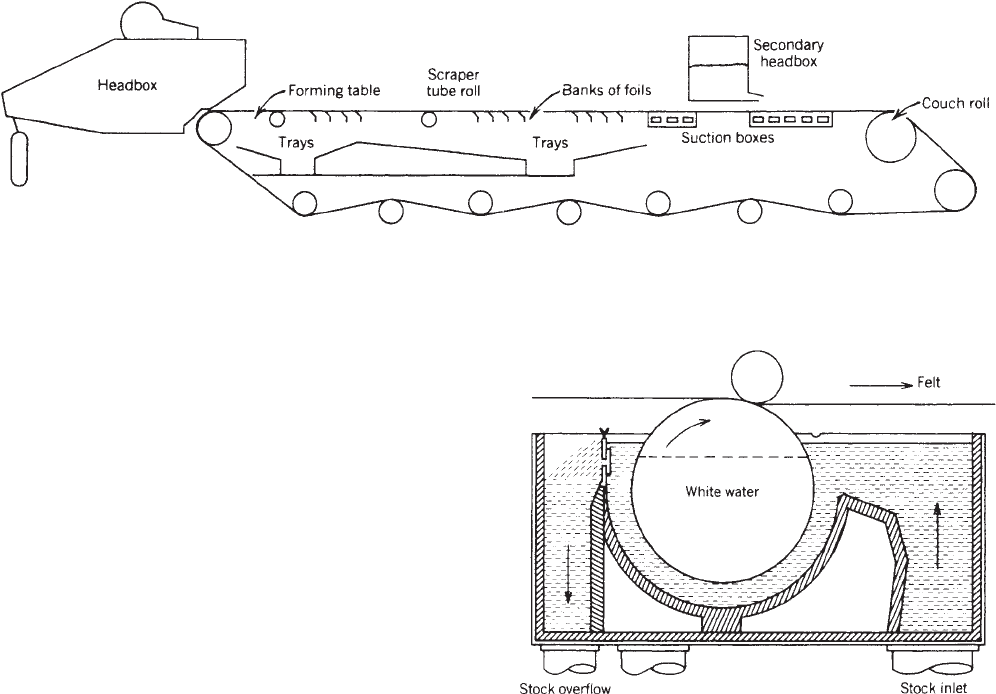
The forming section of a Fourdrinier machine is made up
of two essential parts: the flow box and the drainage table.
The operation of both parts can influence the structure of
the resulting paperboard web. It is normally the aim to
deliver the fiber suspension, well-dispersed, to the moving
screen at approximately the same velocity as the screen.
The concentration going to the screen for paperboard
generally ranges within 0.4–1.2%, depending on the fur-
nish and product requirements (Figure 2).
On early machines and some still used today, prelimin-
ary dewatering takes place at the table rolls. The action of
each table roll can be considered as a pump, with drainage
being induced by the suction on the downstream side of
each table roll, so that the drainage flow is intermittent. A
positive-pressure pulse exists on the upstream side of each
table roll, so water is forced up through the screen and the
deposited mat. This mechanism has considerable influ-
ence on web structure. The magnitude of the positive and
negative pulses depends on table roll diameter and screen
speed.
Modern practice is to replace the table rolls by sta-
tionary foils. These units generate less intense suction
pulses than table rolls, and the length of the drainage zone
can be considerably extended. These foils are often closely
spaced along the Fourdrinier forming table so that there is
a gain in available drainage. Further down the Four-
drinier table, when concentration is 3–4%, suction flat
boxes are used to continue the drainage at a rate con-
trolled by the level of vacuum in the box. It should be
noted that flat vacuum boxes can be used at the initial
drainage
zone, and today
a unit is often used that in effect
is a combination of foil sections in a vacuum enclosure
PAPERBOARD 915
(wet-suction box). When producing heavyweight papers
and boards, because drainage is more difficult, it is usual
to use additional vacuum boxes. This can lead to excessive
drag on the screen, resulting in higher power require-
ments and excessive wear of suction box tops and screen,
and may even lead to screen stalling. For the production of
multi-ply paperboard, such as linerboard, a secondary
flow box is often used. A base ply is formed first and after
sufficient dewatering has taken place a second ply is
applied by means of the secondary flow box. The asso-
ciated fibrous suspension is then drained through the base
ply, and dewatering is carried out essentially by flat
vacuum boxes with thickening as the main mechanism.
Rotary Forming Devices
In these units the forming screen is in the form of a drum
and the fibrous suspension is fed to the screen by various
methods ranging from (a) simply immersing the rotating
screen in a chamber (vat) containing the fibrous suspen-
sion to (b) the use of a type of flow box.
Cylinder Mold Machines. There are two basic types:
Uniflow and Contra Flow. In the Uniflow machine, the
fibrous suspension is fed into the vat at the ingoing face of
the cylinder mold (forming screen); in the Contra Flow, the
suspension enters at the emerging face (see Figure 3).
The draining forces are low, typically 1–5 in. of water
static head difference. The mechanism of forming is com-
plex; and because of the low-drainage forces, considerable
washoff of the fragile newly formed web followed by
redeposition takes place in the forming area. The forming
zone is obviously too long with continual washing off and
redepositioning taking place so that the overall mat
deposition is inefficient. Various modifications have taken
place in attempts to overcome this problem. Further
development has led to a variation known as the rotary
former.
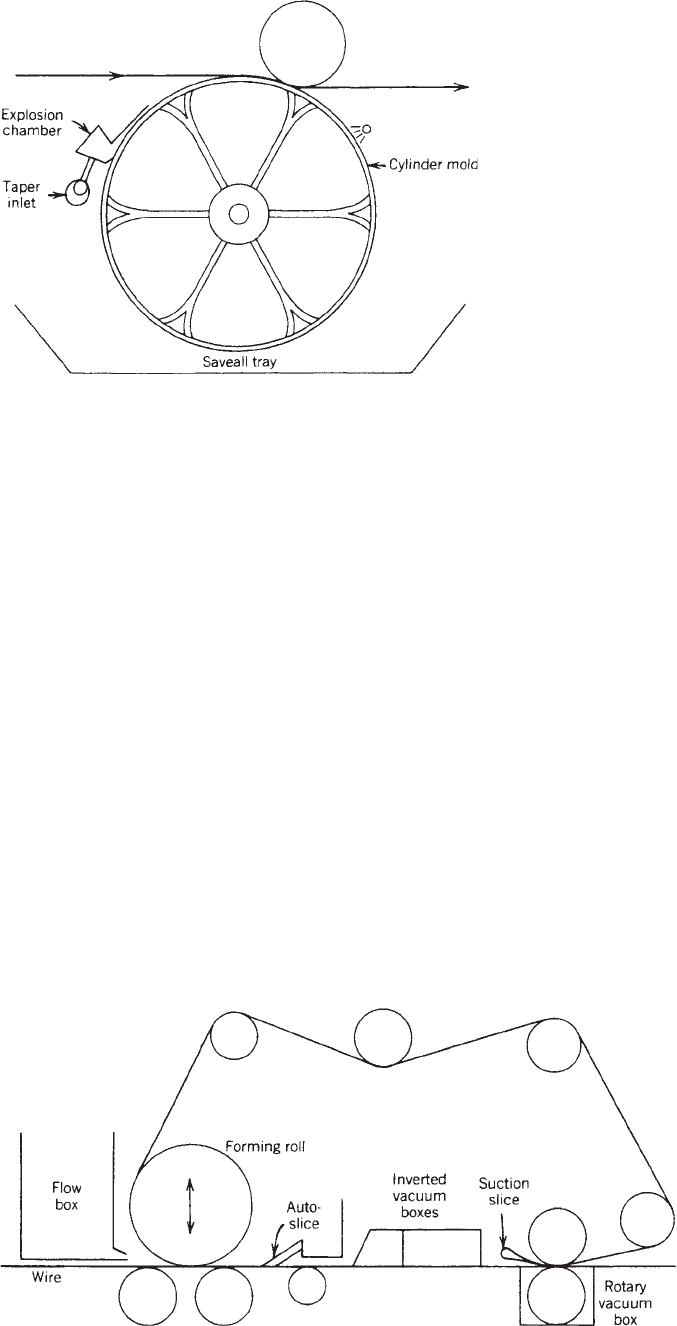
Roll Formers. Figure 4 shows a typical rotary former. It
is easy to see that it consists essentially of a cylinder-
forming screen with an associated type of flox box.
The forming length has been considerably decreased,
and the drainage forces can be far higher than is the
case with the previously described cylinder mold units
(Figure 4).
The cylindrical screen can be of relatively simple con-
struction relying on a pressure force in the forming zone
to assist drainage or it can be in the form of a suction
roll using a series of vacuum boxes to further assist
dewatering. Compared to cylinder molds, roll formers
have several advantages:
1. They can develop and tolerate higher levels of
turbulence in the initial forming zone because the
drainage zone is enclosed, whereas the initial form-
ing zone in a cylinder-mold machine starts at a free
surface.
2. High pressure in the free suspension and the possi-
bility of using suction on the underside of the forming
screen permit a much higher rate of drainage.
3. The rotary former has a more uniform metering of
the fibrous suspension onto the forming screen.
Although both types of rotary forming devices can be used
to produce paper, the greatest application by far is the
manufacture of multi-ply board. A number of the units are
operated in series, progressively building up a multi-ply
web.
Figure 2. Fourdrinier forming.
Figure 3. Cylinder-mold forming.
916 PAPERBOARD
Twin-wire Formers
The third basic method used for paper and paperboard
forming is a relative newcomer, invented in the 1950s
and called the twin-wire method. In this technique the
paper web is formed between two forming screens.
The idea dates back to the nineteenth century, but it
was only in the 1950s that serious development took place,
taking advantage of improved ancillary equipment. The
process became a commercial reality and a viable conten-
der in some applications. Figure 5 shows a typical twin-
wire forming unit, in this case the basic Inverform
concept, a UK invention and the first commercial twin-
wire system.
In all twin-wire formers, the fibrous suspension is fed
into the gap between two converging forming screens by
means of a flow box where dewatering and associated web
forming takes place. The action related to web structuring
in the forming zone is still not fully understood but
with regard to dewatering, the twin-wire concept offers
the opportunity to carry out symmetrical drainage of
the fibrous suspension from both sides. This allows a
symmetrically structured web to be formed and provides
the opportunity to greatly increase the dewatering poten-
tial. Dewatering is assisted by the use of deflectors, which
press into the forming screens, and/or vacuum boxes
operating on one or both forming screens. A further
benefit of the twin wire concept is the absence of a free
surface in the forming zone. Wire hs been repalced by
plastic netting.
In general terms, multi-ply webs are produced by (a)
separately forming the individual plies and then combin-
ing them together; (b) forming onto an existing ply or
plies, to form more plies; (c) using multilayer (stratified)
flow boxes; or (d) a combination of a–c.
Examples of multi-ply arrangements in use today are
shown in Figures 6 and 7.
Machine Finishing
The surface of the paperboard web can be treated during
the manufacturing process by various means according
to the characteristics required of the finished product. It is
not unusual to use as part of the drying process an M.G.
(Yankee) cylinder, which imparts a smooth surface to one
side of the web without too much densification of the web
taking place. In the drier section, there is often a size press
where chemicals can be added to the surfaces of the web in
order to impart certain characteristics (e.g., hard sizing or
barrier properties). Paperboard machines often have coat-
ers ‘‘in line’’ with the operation at which one or more
layers of coating medium can be applied. At the end of the
manufacturing process, right before the windup, one or
more stacks of calenders are installed. A stack of calenders
consists of a number of horizontal cast iron rolls set one
above each other. As the web of paperboard passes
through the nips, the calenders increase the smoothness
and gloss of the surface of the web.
TYPES OF PAPERBOARD
The simplest types of paperboard are single-ply thick
papers used for many nonpackaging purposes (e.g., index
board for card-filing systems and display mounting). They
have a degree of stiffness and an acceptable appearance
(e.g., a uniform surface). This type of paperboard can also
Figure 5. An Inverform (Beloit) twin-
wire forming section.
Figure 4. A cylinder former.
PAPERBOARD 917