
Yam, Kit L. (ed.). The Wiley encyclopedia of packaging technology
Подождите немного. Документ загружается.

be made from waste paper. The product will have good
stiffness characteristics, but not necessarily good appear-
ance. Its main use is as package inserts and envelopes.
Paperboard with similar structure, but with improved
printing surfaces, has a wide range of uses (e.g., high-
quality display). The greatest volume of paperboard is
used, however, in packaging.
Single-ply paperboard made from 100% bleached-
chemical wood pulp is used for food packaging where
purity and clean appearance is required together with a
degree of strength and a surface of sufficient quality to
accept good-quality print. Materials of this type are often
coated or laminated with a plastic film to improve barrier
properties. Compared to single-ply structures, multiply
paperboard can be used over a much wider range of
applications because virgin-pulp outer layers with good
appearance, strength, and printing properties can be
combined with lower-grade middle plies. These paper-
boards are often combined with other materials such as
plastic film or high-quality paper in order to extend the
range of application. The general term for this range of
paperboard is folding box-board.
Another type of paperboard, known as fiberboard, is
used to produce large and strong cases. The materials
used for the construction of these containers are made
from several layers of paperboard. There are two main
types: solid board (two or more boards are laminated
together) and corrugated board. In the production of
corrugated board, two facings are glued to both sides of
the corrugating medium to produce a single-wall corru-
gated board. For stronger and larger boxes, three facings
and two media are used (double-wall corrugated). Triple-
wall corrugated uses four facings and three media (see
Boxes, corrugated).
The types of paperboard mentioned have, in general, a
basis weight range from 200 to 600 g/m
2
(B41 to 123 lb/
1000 ft
2
). Thicker and heavier paperboards are used in
many applications ranging from building materials to
suitcases. They are often produced by laminating many
layers of thinner paperboards.
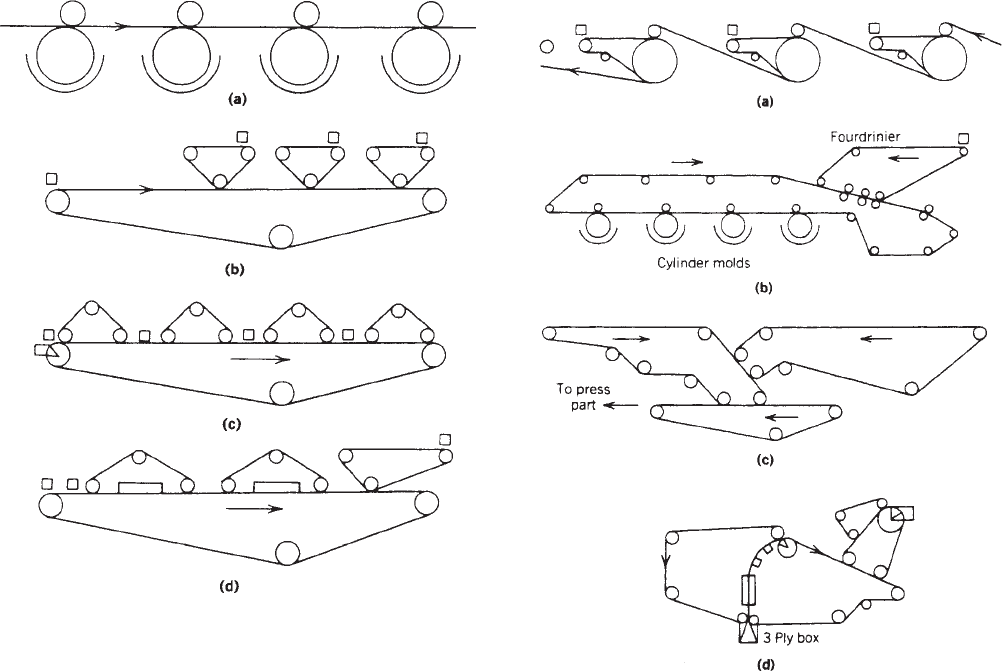
Figure 6. Typical multi-ply forming arrangements. (a) Typical
cylinder M/C. Common throughout the world. Can be Uniflow,
Contra Flow, and so on, including mixtures. (b) Fourdrinier
with ‘‘on top’’ mini-Fourdriniers. Examples in Europe and the
United States. (c) Suction breast roll with Inverform units.
Example in the United States. (d) Fourdrinier with bel bond
units and mini-Fourdrinier. Examples in United Kingdom and
Europe.
Figure 7. Examples of multi-ply formers. (a) Super ultra
former. Examples include Japan, the United States, Canada,
and so on. (b) Typical combination M/C. Examples are mainly
in Europe. (c) Typical multiwire M/C. An example is Finland. (d)
Commercial application of contro flow former. An example, is
Finland. Contra Flow former combined with an arcu (rotary)
former.
918 PAPERBOARD

Table 1 shows a typical range of paperboard grades
with comments on their furnish, requirements, and end
usage. The following definitions describe the most com-
mon types of paperboard used in packaging.
Body or Baseboard. This is a board that is ultimately
treated by, for example, a coating or a surface
application.
Lined Board. A multi-ply board with a liner ply,
usually of high-grade material (e.g., white-lined
chipboard).
White-Lined Board (Duplex). A board with a bleached
pulp liner and the remainder of the board
made up of, for example, a mixture of chemical
pulp and mechanical pulp. Often used for food
packaging (2).
Kraft-Lined Chipboard. An unbleached kraft liner on
a wastepaper base used for packaging products such
as electrical and mechanical components.
Test Jute Liner. This is a type of kraft-lined chipboard.
Sometimes the liner is made from a strong kraft
wastefurnish.Thismaterialiscombinedwithfluting
medium to produce corrugated board.
Double-Lined Board. A board lined on both sides. For
example, the outer surfaces (liner) can consist of
bleached pulp and the middle mechanical pulp. It is
used for high-quality packaging of foods and
cosmetics.
Carton Board (Folding-Box Board). Paperboard of
various compositions used for the manufacture of
folding cartons and set up boxes.
Foodboard. Single- or multi-ply paperboard used for
food packaging. It is hard-sized for water resistance.
Liquid Packaging Board. Also called special-food
board, or milk-carton board, this strong board is
usually 100% chemical pulp, often plastic-coated. It
is formed into containers for a wide range of liquids
(e.g., milk, other beverages).
Frozen-Food Board. Single- or multi-ply paperboard
with high moisture- and water-vapor resistance. It is
often single-ply, made from bleached wood pulp with
a surface coating for high-quality print.
Kraft Linerboard. A strong packaging paperboard
with a two-ply construction made essentially from
virgin kraft pulp and produced on a Fourdrinier
machine. The top ply is added by means of a
Table 1. Examples of Typical Paperboard Grades
Board Grade
Grammage Range
g/m
2
(lb/1000 ft
2
)
a
Typical Furnish
Special
Requirements
(Physical) Typical Usage
White-lined folding-
box board
200–800 Liner, virgin pulp Bending General packaging cartons
(40–160) Underliner, mechanical
pulp
Printing
Middles, waste Plybond
Backs, mixture (mechanical
and chemical pulp)
Stiffness
Chipboard 200–800 100% waste Bending Packaging cartons, tubes,
and stiffeners
(40–160) Plybond
Gypsum board 300–800 100% waste Plybond Outer component of
plasterboard
(60–160)
Test liner 150–300 Liner, virgin pulp (kraft):
rest, waste
Bending Outer components of
corrugated
containerboard
(30–60) Bursting strength
Plybond
Crush resistance
Linerboard 150–300 100% virgin pulp Bursting strength Outer components of
corrugated board(30–60)
Foodboard 200–600 100% virgin pulp (single- or
multi-ply)
Bending All foods, especially frozen
foods (high-quality
containers)
(40–120) Printing
Plybond
Stiffness
Liquid packaging 200–400 100% virgin pulp (single- or
multi-ply) with barrier
(coating and/or laminate)
Bending Containers for wide range of
liquids including milk(40–80) Printing
Plybond
Stiffness
Fluting medium 90–200 Typical—100% waste or
semichemical hardwood
pulp
Crush resistance Inner components of
corrugated
containerboard
(18–40)
a
g/m
2
= 0.2 lb/1000 ft
2
.
PAPERBOARD 919
secondary flow box. It is used in the manufacture of
large containers, combined with fluting medium to
form corrugated board.
Fluting Medium (Corrugating Medium). A board
usually with a basis weight of 100–125 g/m
2
(20–25
lb/1000 ft
2
) and a caliper of 225 mm (9 mil) made from
semichemical hardwood pulp or waste paper. The
material is fluted in a corrugating machine and
combined with linerboard to produce corrugated
board.
Chipboard. A paperboard made from waste paper,
used in low-grade packaging, solid fiber, and book-
board. Chipboard is not usually used in contact with
food, but is used as an outer carton (2).
Machine-glazed Board. Paperboard that in its manu-
facture has had one face made smooth and glossy by
drying on a large polished steam-heated drying
cylinder (Yankee cylinder).
Tube Board. A paperboard generally unsized and
smooth finished. It is slit into narrow widths for
winding and pasting into spiral or convoluted mail-
ing tubes, cores, etc.
Can Board. Paperboard used for the manufacture of
composite cans and fiber drums. The cans are used
for packaging a wide range of materials including
liquids and powders.
Coated Boards. Paperboards of various grades that
have been coated on one or both faces in order to
make the surfaces suitable for high-quality printing.
ENVIRONMENTAL CONCERNS
Environmental and waste issues are current major issues
(1). Paperboard’s advantages are as follows:
1. The main raw material (wood) is based on a natu-
rally renewable resource, the growth of which re-
moves carbon dioxide from the atmosphere, thereby
reducing the greenhouse effect.
2. When the packaging is completed, many types of
paperboard packaging can be recovered and re-
cycled. If these are not options, it is biodegradable
in a landfill.
BIBLIOGRAPHY
B. W. Attwood, ‘‘Paperboard’’ in M. Bakker, ed., The Wiley En-
cyclopedia of Packaging Technology,1stedition,JohnWiley&
Sons, New York, pp. 500–506; 2nd edition, A. J. Brody and K. S.
Marsh, eds., 1997, pp. 717–723.
Cited Publications
1. M. J. Kirwan, ‘‘Paper and Paperboard--Raw materials, Proces-
sing, and Properties’’ in M. J. Kirwan, ed., Paper and Paper-
board Packaging Technology, Blackwell Publishing, London,
2005.
2. J. G. Brennan and B. P. F. Day, ‘‘Packaging’’ in J. G. Brennan,
ed., Food Processing Handbook, Wiley-VCH, Weinheim, 2006.
PATENT LAW PRIMER FOR THE PACKAGING
INDUSTRY*
KEITH A. ZULLOW
Goodwin Procter LLP**
RAIVO A. KARMAS
Sandoz Inc.
INTRODUCTION TO THE UNITED STATES PATENT
SYSTEM
The Role of Patents
Patents have economic and business implications. For ex-
ample, in 2006, on the eve of a patent infringement trial
involving semiconductor packaging, the parties entered
into an $80 million settlement (1). While such multi-million
dollar disputes do not occur every day, patents are regularly
used to generate licensing revenues, to block competitors
from a market, and as negotiating tools. The packaging
industry has been active in building patent portfolios in
diverse packaging-related technologies such as packaging
machines, systems and materials, methods of manufacture,
closure systems, and so on. Universities have also become
more active in patenting inventions to generate licensing
revenues. For example, U.S. Patent 7,213,967, entitled
‘‘Method and System for Conservative Evaluation, Valida-
tion and Monitoring of Thermal Processing,’’ was issued to
researchers from the University of North Carolina (2).
To function most effectively in a world where patents
play an ever larger role, scientists and engineers should
have at least a basic understanding of patents and what
they can and cannot do. Lack of such knowledge can be
costly. For example, learning about a competitor’s patent
too late could prevent a product launch even though plant
and equipment have been built and purchased and em-
ployees have been hired and trained.
The Foundations of U.S. Patent Laws
The U.S. Constitution. The U.S. Constitution explicitly
authorizes Congress to provide a system to encourage
innovation by providing inventors with exclusive rights
to their discoveries for a limited amount of time. This is
the foundation of U.S. patent laws, which grant inventors
the right to exclude others, for a limited time, from
making, using, selling, or offering for sale in the United
States, or importing into the United States, a patented
invention. George Washington signed the first patent
statute in 1790 (3). Since then, U.S. patent laws have
undergone various revisions. Currently, the patent statute
is codified in Title 35 of the United States Code.
The associated rules and regulations are in Title 37 of
* Revised from a series originally published in Cereal Foods World
53(1–5), 00–00, 2008.
** Disclaimer: This column is prepared and published for infor-
mational purposes only and should not be construed as legal
advice. The views expressed in this column are those of the
authors and do not necessarily reflect the views of the respective
author’s law firm (or its individual partners) or employer.
920 PATENT LAW PRIMER FOR THE PACKAGING INDUSTRY
the Code of Federal Regulations. More recently, Congress
has been considering revisions to harmonize U.S. patent
law with that of the rest of the world.
The United States Patent and Trademark Office
(‘‘USPTO’’). The USPTO interprets and applies U.S. pa-
tent laws to determine whether inventions are patentable.
This chapter focuses predominantly on ‘‘utility patents.’’
Utility patents protect the way an article is used and
works. To receive a utility patent, an invention must have
a utility and it must be novel and nonobvious. These
requirements are described below.
Utility: A patentable invention must have a practical
use (4). This standard is easy to meet, but there are
some restrictions (5). For example, inventions that
only have harmful uses are not patentable, nor is the
impossible (such as a perpetual motion machine)
patentable.
Novelty: A patentable invention must be new (6). It
cannot already exist in the public domain, also
known as the prior art. For example, an inventor
cannot patent what someone else has already done
or published. Furthermore, if an inventor publishes
his own invention, a patent must be sought within a
time period set forth in the U.S. patent laws, or the
invention will not be considered new. Therefore, to
avoid inadvertently losing the right to obtain a
patent, one should speak with a patent attorney
before disclosing an invention to the public, through
publication, commercial use, or any other means.
For example, the courts invalidated a design patent
directed to an ornamental juice container design
because the patentee had offered for sale containers
of an indistinguishably similar design more than
one year before applying for the design patent (7).
The prior offer for sale rendered the container de-
sign non-novel.
Obviousness: Even novel inventions cannot be pa-
tented if they are obvious (8). An invention is
obvious if it is a straightforward combination or
application of prior art information and does not
require doing something inventive. For example,
two patents directed to meat packing technology
were invalidated as obvious in view of prior art
patents that, taken together, disclosed features si-
milar to those in the invalidated patents. This was
so even though the invalidated patents were the first
to have combined the prior art features (9).
In addition to utility patents, one can seek design
patents. Design patents cover ornamental features of an
object. To receive a design patent, an ornamental feature
must be novel and nonobvious. The utility requirement
does not apply to design patents.
The Federal Courts. The federal court system interprets
and applies the patent laws to resolve disputes between
patentees and potential infringers. Patent disputes begin
in one of the United States District Courts (‘‘District
Courts’’). All patent appeals from District Courts are
heard by a single court, the Court of Appeals for the
Federal Circuit (‘‘the Federal Circuit’’). The District
Courts must abide by Federal Circuit rulings. Having
the Federal Circuit handle all patent appeals promotes
uniformity in interpretation and application of patent
laws, thereby strengthening the patent system. Appeals
from the Federal Circuit go to the U.S. Supreme Court.
The Federal Circuit (and all U.S. courts) must abide by
Supreme Court rulings.
The Terminology of Patent Enforcement: Infringement,
Validity and Enforceability
Patent disputes typically concern the infringement, valid-
ity, and/or enforceability of a patent. These terms are
explained below.
Infringement: Patents give patent holders the right to
prevent others from making, using, selling, or offer-
ing for sale in the United States, or importing into
the United States, the patented inventions (10).
Infringement occurs when one violates such patent
rights without authorization (for example, without a
license) from the patent holder. The relief for in-
fringement can be damages and/or an injunction
(11). Damages are payments of money. Injunctions
involve a Court ordering an infringer to stop all
infringing activity, even if it means closing plants,
recalling products, and eliminating jobs.
Validity: An issued patent is presumed to be valid
(12). This means that it can be used to exclude
others from infringing unless someone proves that
the patent is invalid or unenforceable. Invalidity
is a defense to patent infringement and requires
proof that a patent, even though it issued, does not
satisfy the requirements of patentability, such as
utility, novelty, or nonobviousness. Proof of invalid-
ity precludes the patentee from recovering damages
or obtaining an injunction even if there is
infringement.
Enforceability: Patent applicants have a ‘‘duty to dis-
close’’ (13) to the USPTO all information that the
applicants believe could be material to determining
whether
a patent should
issue. The USPTO Exam-
iner relies on the applicant for such disclosure. In
contrast, an accused infringer, through the litigation
process, can review the patent holder’s internal
documents, including notebooks, e-mails, reports,
memoranda, and the like. If these documents show
that the patentee violated the duty of disclosure (by
intentionally failing to disclose information to the
USPTO or misleading the USPTO), a court can find
the patent unenforceable. An unenforceable patent
cannot be enforced, even if it meets the require-
ments of patentability and is infringed. For example,
in a case concerning a patent to nonhydrogenated
canola oil having superior oxidative and fry stability,
the inventor obtained the patent by telling the
examiner that the new oil had superior stability
compared to similar oils. The alleged infringer,
PATENT LAW PRIMER FOR THE PACKAGING INDUSTRY 921
however, proved that the applicant withheld contra-
dictory data from the patent examiner. As a result,
the Court found the patent unenforceable (14).
The Players
The following entities are involved in obtaining and
enforcing patents.
The USPTO is the administrative agency empowered
to issue patents in accordance with the patent
statute and rules. Patent examiners work with
applicants to determine whether inventions are
patentable.
The Federal Courts are the arbiters of patent disputes.
Litigation in the federal courts is an adversarial
process in which patent holders attempt to enforce
their patent rights and alleged infringers defend
themselves. The written decisions of the federal
courts set precedent for interpreting and applying
patent laws. Federal Circuit patent decisions are
available at http://www.cafc.uscourts.gov/dailylog.
html.
Inventors are the creators of intellectual property.
Society is the ultimate beneficiary of intellectual prop-
erty. Intellectual property laws strive to balance the
goals of spurring innovation for the benefit of society
while preventing removal of common technology,
ideas, and business tools from the public domain.
Persons of skill in the art are the contemporaries to
whom patent teachings are addressed, and through
whose eyes patents are interpreted.
Businesses frequently invest in and own intellectual
property, and set strategies regarding what intellec-
tual property to pursue and how to protect and
leverage it.
Patent Counsel are company and law firm attorneys
involved in planning and implementing patent-re-
lated activities, including:
Developing and implementing patent strategies,
budgets and priorities;
Drafting and filing patent applications and work-
ing with the USPTO to obtain patents;
Managing and maintaining patent portfolios;
Licensing patents;
Monitoring competitor patent activity;
Providing legal opinions regarding patent infringe-
ment, validity and enforceability;
Evaluating patent portfolio value and strength
prior to mergers or acquisitions, and;
Litigating patent disputes.
A Changing World for Innovation and Its Laws
The value of a patent depends on its scope and strength.
Evaluating the scope and strength of a patent requires
staying abreast of changes in U.S. patent laws and their
interpretation by the Federal Courts. For example, the
U.S. Supreme Court has shown a renewed interest in
patent cases, recently deciding cases relating to the
standard of obviousness (15), the standard for awarding
a permanent injunction in patent cases (16), the propriety
of a licensee (i.e., the party taking a license from the
patent owner) suing a licensor (i.e., the patent owner) to
invalidate a licensed patent (17), and application of patent
exhaustion doctrine, under which the initial authorized
sale of a patented item or process terminates all patent
rights to that specific item or process (18). Thus, although
U.S. patent laws have existed for over 200 years, they are
constantly evolving.
THE INTERPLAY BETWEEN PATENTS AND OTHER FORMS
OF INTELLECTUAL PROPERTY
Intellectual property has been defined as ‘‘[a] category of
intangible rights protecting commercially valuable pro-
ducts of the human intellect’’ (19). In practical terms,
intellectual property relates to patent, trademark, copy-
right, and trade secret rights. Utility patents and trade
secrets protect functionally useful technologies (i.e., the
useful arts), but in different ways. Design patents
protect ornamental features of an article of manufacture.
Trademarks, which include trade dress and servicemarks,
protect brand reputation and are extremely important
with respect to consumer products packaging. Copyrights
protect works of authorship, including computer
software programs, and are available for registration of
packaging designs. Table 1, at the end of this section,
compares the forms of intellectual property discussed in
this section.
Patents
Patentable Subject Matter. There are three types of
patents: utility and design patents, which relate to packa-
ging, and plant patents. The discussion below focuses
primarily on utility patents.
Utility patents cover new and useful processes, ma-
chines, articles of manufacture, or compositions of matter
(4). These subcategories are broad and cover most inven-
tions, including packaging machinery and systems, che-
mical compounds, formulations, methods of synthesizing
compounds, and more. Abstract ideas, principles of nat-
ure, and purely mathematical formulas without a practi-
cal application are not patentable.
The USPTO has issued over seven million patents, and
it posts thousands of newly issued patents every Tuesday.
One can use the USPTO to learn about a field of interest
by
searching and reading
patents and published patent
applications as follows:
1. Go to: http://www.uspto.gov/patft/index.html;
2. On the left side of the page, under issued patents,
select ‘‘Advanced Search’’;
3. In the Query box, type a search term;
4. Click on the ‘‘Search’’ button.
The result will be a list of issued patents. Utility patents
are numbered without prefix, design patents have the
prefix ‘‘D,’’ and plant patents have the prefix ‘‘PP.’’
922 PATENT LAW PRIMER FOR THE PACKAGING INDUSTRY

Table 1. A Comparison of Patents, Trademark
s, Copyrights, and Trade Secrets
Utility Patent
Design Patent
Trademark
Copyright
Trade Secret
How created
Invented
Invented
Used in commerce
Independent creation
once fixed in tangible
form
Expended efforts
Governing Law
Federal (35 U.S.C.)
Federal (35 U.S.C.)
Federal (15 U.S.C.:
Lanham Act) & State
Federal (17 U.S.C.: post
1-1-1978)
State
Federal: Economic
Espionage Act
Federal system for
conferring rights
USPTO assess
patentability
USPTO assess
patentability
USPTO ensures criteria
are met
No substantive
examination
n/a
Registration with
Copyright Office
suggested but not
required
Subject Matter
Useful arts
Ornamental features Words, symbols
, sounds,
trade dress, etc., used
to associate a product
or service with its
source
Forms of expression, not
underlying ideas or
functional features
Secret information that
provides a competitive
advantage
Criteria
Utility
Novelty
No prior user
Original, but not
necessarily novel
Secret
Novelty
Nonobviousnesss
Distinctive mark
Nonobviousness
Other
Other
Other
Duration
20 years from earliest
filing date
14 years from issuance. As long as trademark
is in
use
Individual
As long as kept secret
70 years after the author’s
death
Works for hire,
anonymous,
pseudonym
Earlier of: 95 years from
publication or 120 years
from creation
Nature of exclusive rights Preclude others from
making, using, selling,
offering for sale in the
United States, or
importing into the
United States
Preclude others from
making, using, selling,
offering for sale in the
United States, or
importing into the
United States
Preclude use of
confusingly similar
mark with similar
goods or services
Control over
reproduction,
derivative works,
distribution,
performance, display,
and digital
transmission
Preclude
misappropriation
923
The Nature of Patent Rights.
Patent Rights Are Governed By Federal Law. Each coun-
try has its own patent laws. The U.S. Patent Statute is
codified in Title 35 of the United States Code. U.S. patents
provide rights only in the United States and its territories.
Therefore, a patent application must be filed in each
country in which patent rights are sought. Furthermore,
one does not have to live in or do business in the United
States to obtain or enforce a U.S. patent.
The Goal Is Disclosure, Not Secrecy. A patent, and the
concomitant right to exclude others, is granted in ex-
change for disclosing to the public the details of how to
make and use an invention, including disclosure of the
inventor’s understanding of the best way to make and use
the invention when the patent application was filed (20).
Such disclosure enriches the public knowledge, provides a
foundation for future innovation, and gives competitors
notice of what a patent covers, so that the competitor can
try to avoid infringement. Failure to disclose such infor-
mation may render a patent invalid if the adequacy of
disclosure is challenged during a patent dispute.
An Application Is Examined Before Patent Rights Are
Granted. The USPTO grants patents only after a USPTO
examiner has reviewed an application and found that it
complies with all statutory criteria. To be patentable, an
invention must have utility and be novel and nonobvious,
and the patent application must satisfy the disclosure
requirements mentioned above (21).
A Right to Exclude. A U.S. patent confers upon the
patent owner a time limited right to exclude others from
making, using, selling, or offering the invention for sale in
the United States, or importing the invention into the
United States. A patent does not, however, grant the
patentee any right to make, use or sell anything. For
example, assume that Company A has patented a novel
polymer A and that Company B has patented an improved
method of synthesizing the polymer. Company A can use
its patent to preclude Company B from using polymer A in
any way. Likewise, Company B can use its patent to
preclude Company A from synthesizing polymer A using
the improved method. Due to the exclusive nature of
patent rights, companies in patent-active industries often
obtain freedom-to-operate or noninfringement opinions
before investing too much on developing or launching a
new product.
Duration. The right to exclude others from practicing a
patented invention starts on the date that the patent is
issued by the USPTO and ends on the patent’s ‘‘expiration
date.’’ Although a patent suit cannot be initiated until a
patent is issued, under certain circumstances, damages
may be recoverable for infringement that occurred before
issuance (22). The right to exclude others from practicing
a patented invention ends on the patent’s expiration date.
The expiration date of U.S. utility patents (and U.S. ‘‘plant
patents,’’ which are not discussed in this chapter) is
typically calculated as 20 years from the date that the
application was filed, while design patents expire 14 years
from the date the patent is granted. However, the expira-
tion date of a utility patent in force on June 8, 1995 (or
that issued on an application that was filed before June 8,
1995) is the greater of 20-years from the earliest applic-
able filing date or 17 years from the patent grant. In
addition, a patent term extension may be granted when
specific types of delays occurred during PTO examination
of the patent application. Ultimately, determining the
expiration date of a patent can be complex. Therefore, it
is best to consult an attorney when trying to determine the
expiration date of a patent of interest.
Enforcing Patents. Obtaining a patent does not guaran-
tee that a competitor will not attempt to practice the
patented invention. This is because the competitor (1)
may not know about the patent or (2) may know about
the patent but think it is not infringed or that it is invalid
or unenforceable (and may have a legal opinion support-
ing this position). Therefore, a patent holder should
vigilantly identify potential infringers, analyze suspected
products, and enforce patents as appropriate. This could
involve either (a) contacting the potential infringer to
discuss licensing or some other arrangement or (b) initi-
ating a law suit seeking damages and an injunction.
Design Patents. Design patents are granted on orna-
mental designs of articles of manufacture (23). A design
patent protects only the appearance of the article and not
structural or utilitarian features. In the packaging field,
protectable designs include the overall configuration or
shape of the package. For example, The Coca Cola Com-
pany received a design patent for its contour bottle in the
1930s (24). Ornamentation on the surface of the package
may also be patentable. Like utility patent applications,
design patent applications are reviewed for novelty and
nonobviousness, among other criteria. Inventions with
both a utility and a novel appearance may be eligible for
both utility and design patent protection.
Trademarks
Subject Matter of Trademarks. Trademarks are any
‘‘word, name, symbol or device, or any combination
thereof,’’ used by providers of goods and services to
distinguish their goods and services from others in the
minds of consumers (25). Features such as color, shape,
smell,
sound, and configuration
may also serve as a mark
(26, 27). A loyal consumer will often associate a trademark
with certain characteristics of a brand, such as quality or
durability. This phenomenon is often referred to as ‘‘brand
recognition.’’ Trademarks, therefore, encourage companies
to invest in the goodwill associated with their trademarks
by producing products with desirable qualities. Trade-
mark disputes arise when marks on similar goods lead
to consumer confusion or deception.
Trademarks Cannot Contribute Functionality to the Pro-
duct. The purpose of a trademark is to associate a good
with its source. A trademark should not provide function-
ality to the product. For example, a trademark was
granted for a unique scent applied to embroidery yarn,
924 PATENT LAW PRIMER FOR THE PACKAGING INDUSTRY
because the scent was not a natural or inherent feature of
the yarn and provided no utilitarian advantage other than
to identify the manufacturer (26). If the scent had utility,
patent protection would have been more appropriate.
Trademarks Should Not Be Descriptive of the Product or
Service. One should be allowed to accurately describe his
products or services without fear of infringing a trade-
mark. Therefore, trademark law is loathe to remove
descriptive words from the public domain. In contrast,
distinctive words make strong trademarks. Trademarks
are, as a result, classified on a spectrum of increasing
distinctiveness as generic, descriptive, suggestive, or arbi-
trary/fanciful (28).
Generic words lack distinctiveness and are ineligible
for protection because it would be unfair to deny
competitors the right to refer to their products by
name. Thus no one can claim the exclusive right to
use the phrase ‘‘Barrier Bag’’ as a trademark for
bags made from ‘‘barrier materials’’ possessing ‘‘bar-
rier characteristics’’ (29).
Descriptive words describe the product, its attributes,
or its claims. Descriptive words have little distinc-
tiveness and are protectable only after developing
‘‘secondary meaning’’ wherein the public associates
the mark with the products of a single source. For
example, ‘‘Squeeze ‘n Serve’’ as applied to a ketchup
container was denied trademark registration be-
cause it is merely descriptive of a feature of the
product and had not developed secondary meaning
(30).
Suggestive marks do not name or describe the pro-
duct, but still suggest qualities or claims of that
product. Suggestive words are given trademark
rights without demonstrating secondary meaning.
‘‘Loc-Top’’ as applied to bottle closure caps is an
example of a suggestive mark (31).
Arbitrary or fanciful marks are the strongest. Such
marks bear no logical relationship to the product on
which they are used. ‘‘Apple’’ as applied to compu-
ters is an arbitrary mark. ‘‘Exxon’’ and ‘‘Kodak’’ are
made-up terms and are fanciful marks (28).
The Nature of Trademark Rights. Trademarks do not
exist on their own. Trademarks must be associated with
a product or service. Actual use of a mark (or intended use
followed by evidence of actual use) is necessary to estab-
lish and maintain a trademark. A valid trademark gives
the owner the right to prevent others from using a
confusingly similar mark with related goods or services.
Trademarks Are Governed by State and Federal Law. Fed-
eral and state laws provide for trademark registration, but
the systems differ. State registrations are typically admi-
nistered by the Secretary of State. Each state has its own
requirements. The federal system involves USPTO exam-
ination to ensure that there are no conflicting marks and
that the mark is proper. Furthermore, to obtain federal
protection, a mark must be used in interstate commerce.
The ‘‘
s
’’ symbol denotes a federally registered trademark
and may only be used with registered marks. Federal
registration lasts 10 years and is renewable indefinitely
as long as the mark is in use (32).
Trademark registration is not required, but it offers
enforcement advantages if litigation arises. The ‘‘TM’’ or
‘‘SM’’ symbols are available for state registered and un-
registered marks. They denote a common law or state
registered trademark or servicemark and are not gov-
erned by federal statute. Using the appropriate symbol is
important because it impacts the defenses alleged infrin-
gers can raise in litigation.
Duration. Unlike patents, trademarks can last indefi-
nitely. However, trademarks can be lost through non-use
or if the mark becomes ‘‘generic.’’ A mark becomes generic
when the public starts using the mark as a noun rather
than an adjective to describe the product’s source of origin.
For example, the former trademark ‘‘cellophane’’ became
generic (28). While companies invest heavily in promoting
trademarks, they also take pains to prevent the trade-
marks from becoming generic.
Copyrights
Subject Matter of Copyrights. Copyrights protect origi-
nal works of authorship, including literary, musical,
dramatic, choreographic, sculptural, audiovisual, and ar-
chitectural works (33). These categories are interpreted
broadly. For example, a computer program can be consid-
ered a literary work, and the decorative features of a belt
buckle can be considered a sculptural work.
Novelty is not required to receive copyright protection,
provided that the work is original to the author. Thus,
independent creation is a defense to copyright infringe-
ment. In contrast, independent (but later) invention is not
a defense to patent infringement (although it may be a
defense to a charge of ‘‘willful’’ infringement, where a
patentee seeks ‘‘enhanced’’ damages from an alleged
infringer).
Copyrights Protect Form of Expression. Copyrights pro-
tect forms of expression, not underlying ideas or informa-
tion conveyed. For example, an engineer could write a
manual on how to build a new reaction vessel and obtain
copyright protection for the manual. Copying the manual,
word for word, without permission would be copyright
infringement because the manual, as written, embodies
the form of expression. However, following the manual’s
instructions to build the reaction vessel would not violate
the copyright. Protecting the vessel itself would require a
patent.
Additionally, copyrights do not protect functional fea-
tures of a device. For example, a copyright might protect
ornamental aspects of a belt buckle as a sculptural work,
but will not protect the functional features themselves
(34). Design patents and trade dress might also protect
such nonfunctional features.
Computer Software. Copyright and patent protection
overlap when it comes to computer software. A computer
PATENT LAW PRIMER FOR THE PACKAGING INDUSTRY 925
program, as a written expression of language, is eligible
for a copyright for the program code. The functional
aspects of the program as executed—what it does—are
not copyrightable, but may be patentable.
The Nature of Copyright Protection. The copyright
owner has the right to control reproduction of the copy-
righted work, preparation of derivative works, distribu-
tion of copies, public performances, public displays, and
public digital audio transmissions.
Copyright Is Protected by Federal Law. Copyright protec-
tion is afforded by federal statute, set forth in Title 17 of
the United States Code. Congress adopted the first copy-
right statute in 1790, and since then it has made sub-
stantial changes to the copyright laws in 1831, 1870, 1909,
and 1976 (33). For most purposes, the provisions of the
1976 Copyright Act went into effect on January 1, 1978.
The 1909 Act continues to be important for protected
works that were originally governed by the 1909 Act (33).
Registration Is Available. A work receives copyright
protection under the 1976 Copyright Act as soon as it
has been ‘‘fixed in a tangible form of expression’’ (33). This
is a relatively easy standard to meet. If a work can be
perceived and copied, it is in a tangible form of expression.
For example, notes on a blackboard can have copyright
protection. Registration with the U.S. Copyright Office is
not required to get copyright protection, but registration
provides benefits. A work can be registered at any time
during the life of a copyright (35). For works authored
prior to January 1, 1978, the Copyright Act required
certain formalities to receive protection and to maintain
protection.
Duration. Copyright duration depends on when the
work was created. A typical lifespan for a work under
the current law can be 70 years from the author’s death.
However, for ‘‘works made for hire,’’ anonymous, and
pseudonymous works, it is the earlier of 95 years from
publication or 120 years from creation (35). Works under
the prior act (i.e., works authored prior to January 1,
1978) could last for a maximum of 95 years.
Overlap Between Copyright, Patent, and Trademark Law
The nonfunctional features of a package may be protect-
able as trademarks/trade dress, by design patent, and by
copyright. For example, a company sued its competitor for
allegedly infringing its design patent and copyrights to
packaging for a food product. Based on the design patent
infringement claim, the court granted preliminary injunc-
tive relief, enjoining the defendant from selling its product
in its infringing packaging (36). Because the nature of the
protection provided by trademarks, design patents, and
copyrights differ, an intellectual property attorney should
be consulted when deciding how best to protect nonfunc-
tional features of a package.
Trade Secrets
Subject Matter of Trade Secrets. A trade secret is vir-
tually any type of confidential information that provides
its owner a competitive advantage because the informa-
tion is not generally known or readily ascertainable. Trade
secrets can encompass patentable information, such as
product formulations, or nonpatentable information, such
as customer lists. The ‘‘formula’’ for Coca-Cola
s
is an
example of a trade secret.
The Nature of Trade Secret Rights.
Trade Secrets Are Governed by State Law. Trade secrets
are governed by state law, not federal law (except for the
Federal Economic Espionage Act of 1996, 18 U.S.C. yy
1831–39, which is beyond the scope of this chapter).
Therefore, the definition of a trade secret can vary from
state to state, with important implications. For example,
in a case involving a technical executive moving from a
first company to a competitor, the court recognized three
theories of trade secret misappropriation: actual, threa-
tened, and inevitable disclosure. The first company’s posi-
tion was that the executive would inevitably communicate
its trade secrets to the competitor. The court indicated
that under an inevitable disclosure theory, misappropria-
tion would exist. But, the case was decided under state
laws that did not recognize ‘‘inevitable disclosure,’’ and no
misappropriation was found (37). Such cases highlight
how important it is for companies to have protocols that
address expectations and obligations of newly hired em-
ployees and employees that leave to find work elsewhere.
Trade Secrets Do Not Involve a Registration or Review
Process. As explained above, the goal of patent law is
disclosure, not secrecy. In contrast, the value of a trade
secret is its secrecy. One does not ‘‘apply’’ for a trade
secret. Instead, trade secrets simply exist if kept secret.
Indeed, failure to adequately protect the secrecy of the
trade secret can result in its loss.
Duration of a Trade Secret. While patent rights expire
when a patent expires, trade secret rights last as long as
secrecy is maintained. Therefore, maintaining trade se-
crets requires reasonable measures to prevent careless
disclosure by employees or easy access by outsiders. Such
measures include establishing and enforcing company
policies regarding trade secrets, educating employees
about maintaining trade secrets, limiting employee
and visitor access to sensitive information and areas,
maintaining nondisclosure agreements with employees
and third parties, screening information in marketing
and sales materials to prevent disclosure of trade secrets,
controlling communications with vendors and co-manu-
facturers, and using noncompete agreements where
appropriate. One can sue if a trade secret is misappro-
priated. Reverse engineering a product to learn a trade
secret is not misappropriation.
To Patent or Maintain As A Trade Secret
Companies often must decide whether to seek patent
protection or maintain information as a trade secret. In
926 PATENT LAW PRIMER FOR THE PACKAGING INDUSTRY
making the decision, one might consider the following
factors:
Period of an Invention’s Utility: Is the field of inven-
tion fast moving? If so, is it worth spending the time,
potentially years, to obtain a patent – or is trade
secret protection preferable?
Plans to License or Sell the Invention: Will the inven-
tion be licensed or sold? If so, patent protection may
be preferable.
Ability to Reverse Engineer: Is the invention easy to
reverse engineer? If so, patent protection may be
preferred. Typically, products are easier to reverse
engineer than processes.
Ability to Design Around: Will the invention obtain
broad or narrow patent protection? If the invention
is narrow and the same result can easily be achieved
without using the invention, does the invention
merit patent protection?
Combining Patent And Trade Secret Protection:An
applicant, after having filed a patent application for
an invention, may develop patentable improvements
that can be protected by patent or as trade secrets.
Summary Comparison of Patents, Trademarks, Copyrights,
and Trade Secrets
Table 1 provides a summary comparison of the different
forms of intellectual property discussed above.
OBTAINING A PATENT
This section introduces the concepts and terminology
involved in obtaining patents and the strategic purposes
for doing so. As explained below, the procedure for obtain-
ing a patent is very rule oriented.
How Patents Fit into Business Plans
Before seeking a patent, a company should understand
what role patents can or will play in its business plan. For
example, companies obtain patents for different reasons,
including:
Excluding others and protecting a competitive
advantage
Maintaining customer confidence (e.g., for ingredient
suppliers)
Generating licensing revenue
Creating negotiating leverage when dealing with
competitors
Attracting potential acquirers
The Value of a Patent
Once a company decides to obtain a patent, it makes sense
to obtain the most valuable patent possible. Patent value
depends on many factors, including:
Usefulness:. Value increases with increasing useful-
ness/necessity of the patented technology to the
patent holder and/or its competition.
Unassailability:. Valuable patents can withstand
challenges to their validity and enforceability dur-
ing a lawsuit.
Breadth:. Value increases with increasing breadth of
the patent, making it harder for competitors to
achieve a similar result without infringing the
patent.
The Patent Process
There are three primary phases in obtaining a patent: (1)
the invention, (2) drafting and filing the patent applica-
tion, and (3) prosecuting the patent application before the
USPTO. Each phase requires a commitment of resources
and money. Additionally, phases 2 and 3 involve attorney
time and USPTO fees. A schedule of such fees, including
reduced fees for ‘‘small entities,’’ is available at the
USPTO website (38). An overview of each phase is pro-
vided below.
The Invention. Many companies have procedures for
employees to submit inventions for review and potential
patenting. Such procedures often employ an invention
disclosure form which:
Identifies the potential inventors and their contribu-
tion(s) to the invention
Describes the invention, how to make and use it, and
how and when it was developed
Identifies materials (notebook(s), memoranda, etc.)
that record the work underlying the invention
Identifies prior art
Identifies past and planned marketing activities
Identifies past and planned publications or presenta-
tions regarding the subject matter of the invention
Typically, a committee comprising members from tech-
nical, business, and legal departments meet and review
invention disclosures to assess commercial viability and
determine whether to seek patent protection, rely on trade
secret protection, or take no action at all.
The United States has a first-to-invent patent system.
This means that if two inventors file separate patent
applications on the same invention, the patent goes to
the first inventor, regardless of who filed the first patent
application. Laboratory notebooks and internal memor-
anda are often used to establish the invention date.
Most of the rest of the world uses a first-to-file system,
rather
than
a
first-to-invent
system. In a first-to-file
system, the patent goes to the first individual to file an
application—the invention date is irrelevant. Congress is
considering changing the U.S. to a first-to-file system to
harmonize U.S. patent law with the rest of the world.
Drafting and Filing a Patent Application.
Conducting a Literature Search. If a patent is desired,
the invention disclosure and other technical information
PATENT LAW PRIMER FOR THE PACKAGING INDUSTRY 927