
Yam, Kit L. (ed.). The Wiley encyclopedia of packaging technology
Подождите немного. Документ загружается.

are forwarded to a patent attorney. The patent attorney
may conduct a search of related patents and publications
to assist in understanding the potentially patentable
aspects of the invention—the aspects not already known
in the field. This search may also reveal competitors’
patents in the same field that may impact the ability to
launch a product based on the invention.
Drafting the Patent Application. The next step is to draft
the patent application. This step depends on whether the
patent attorney is filing a provisional application or a non-
provisional application. The patent attorney could also file
a U.S. application that is a counterpart to a previously
filed international application. Such counterparts are
beyond the scope of this article.
Provisional applications serve as a temporary place-
holder to establish a filing date. They are not reviewed by
the USPTO and do not result in issued patents. Provisional
applications require a thorough description of the technical
details of the invention, but the description can be informal.
For example, a technical report, memorandum, or set of data
tables may suffice. Provisional applications, unlike nonpro-
visional applications, do not require claims (described be-
low). Thus, filing a provisional application is convenient
when there is no time to draft a more formal nonprovisional
application before publicly disclosing the invention. Addi-
tionally, filing a provisional application buys an applicant
some time to assess whether the invention merits the costs
associated with filing a nonprovisional application, which
can be significantly more than the cost of filing a provisional
application. A non-provisional application must be filed
within a year of the filing of the provisional application.
A nonprovisional patent application is the formal ap-
plication that the USPTO examines for patentability.
Nonprovisional applications must include a written de-
scription of the invention and at least one claim. The
requirements for filing a nonprovisional application are
available at the USPTO website (38). An applicant can file
a nonprovisional application without filing a provisional
application. Only a nonprovisional application can issue
as a patent. Attorney time and filing fees can make filing a
nonprovisional application expensive.
The Claims Define the Invention. Patent claims, which
appear at the end of each patent, define the invention.
They are the legal boundaries of the patentee’s right to
exclude. Drafting claims typically involves discussing the
invention with the inventors and probing whether and
how the invention can be applied beyond the immediate
uses envisioned by the inventor. In drafting patent claims,
the patent attorney balances the conflicting goals of
obtaining the broadest possible protection for the novel
aspects of the invention without encompassing subject
matter that was already known in the field. Patent
attorneys often achieve this balance by drafting a series
of claims of varying breadth.
Other Statutory Requirements of the Application. In
drafting the application, the patent attorney considers
criteria the patent examiner will use to assess patent-
ability, including utility, novelty, and nonobviousness, and
satisfying the definiteness, written description, enable-
ment, and best mode requirements described below (20).
Definiteness: The claims of a patent must clearly set
forth the patented subject matter, such that one can
determine whether or not they infringe the patent.
Written Description: The patent specification must
describe the invention in a way that demonstrates
that the inventor actually possessed the claimed
invention. For example, when during prosecution
(i.e., the back-and-forth communication with the
examiner to obtain a patent, described below), an
applicant amended a claim to cover packaging con-
figurations that lacked ‘‘an annular reinforcing
bead,’’ while everything in the patent (i.e., the
abstract, specification, and drawings) described
that feature as mandatory to the invention, a court
found the amended claim invalid for failure to
comply with the written description requirement of
the patent statute (39).
Enablement: The patent specification must enable
those skilled in the art to make and use the inven-
tion without undue experimentation. This entails
providing information that is necessary to make and
use the invention and that would not otherwise be
known. It does not require providing basic informa-
tion that would be know to people working in the
field.
Best Mode: The patent specification must disclose the
best way of practicing the invention known to the
inventors at the time of filing the application. For
example, if the inventors believe that a particular
grade of plastic works best in the invention, they
must disclose that grade in the application.
Determining Inventorship. In the United States, only
inventors can apply for patent applications. The inventors
can assign ownership of the invention to a company, but
the
application must be
filed by the inventors. Conse-
quently, the patent attorney must determine the identity
of the true inventors. Although inventorship can be cor-
rected, improper inventorship is also a basis for invalidat-
ing a patent.
Each claim of a patent can have one or more inventors,
and different claims can have different inventors. Each
inventor should be included in the patent application.
Therefore, joint inventorship is common. Joint inventor-
ship may cause issues for inventions created with outside
consultants, comanufacturers, or research institutes.
Therefore, when working on joint projects, it is important
to consider up front who will own inventions resulting
from such projects. Issues may also arise when an inven-
tor has left a company and is needed to participate in filing
a patent application.
Accuracy of the Application. Before filing an application
with the USPTO, the inventors must carefully review the
application for accuracy. The inventors then sign a De-
claration stating that they are the original inventors and
that the contents of the application are accurate. In the
928 PATENT LAW PRIMER FOR THE PACKAGING INDUSTRY
Declaration, the inventors also acknowledge their duty of
candor to the USPTO. This duty is described below.
The Duty of Candor. Under U.S. patent law, the
patent applicants (including each named inventor) have
a duty to provide to the patent examiner any informa-
tion that could be material to the patentability of their
invention. Such information could be prior art, public
presentations, or data relating to the invention. This is
known as the ‘‘duty of candor.’’ This duty begins with the
filing of the application and continues until the patent
issues. This duty may be satisfied by identifying such
information in the application itself, or by separately
submitting materials to the USPTO in what is called
an Information Disclosure Statement . Failure to comply
with the duty of candor can render an issued patent
unenforceable.
The Filing Date and Its Implications. Once the USPTO
receives an application, it assigns a filing date. This date is
the presumptive date of invention and is used by the
patent examiner when searching for prior art to assess
novelty and nonobviousness. Furthermore, in the United
States, an inventor has a one-year grace period to file a
patent application after a public disclosure or public use of
the invention by the inventor (or anyone else). The filing
date marks the end of the one-year grace period. This
grace period distinguishes U.S. patent law from that of
most of the rest of the world, where patent rights are not
available after an invention has been disclosed to the
public. Therefore, before publicly disclosing or publicly
using an invention, it is important for the inventor (or
intellectual property management) to discuss such poten-
tial disclosures with a patent attorney to (1) ensure that
the U.S. patent application is filed within one year of such
events and (2) consider how such disclosures might impact
patentability in other countries.
Prosecuting the Patent Application. The USPTO pub-
lishes its Manual of Patent Examining Procedure (‘‘the
MPEP’’) to provide patent examiners, applicants, and
attorneys a reference on practices and procedures relating
to prosecution of patent applications before the USPTO.
The MPEP is available on the USPTO website at http://
www.uspto.gov/web/offices/pac/mpep/mpep.htm.
The USPTO assigns patent applications to examiners
who specialize in the relevant technology. The examiner
reviews the application to ensure that it complies with the
statutory requirements described above. The examiner
then communicates with the applicants regarding
whether the application meets such requirements. This
process of communication between applicant and exam-
iner is referred to as patent prosecution. The USPTO
maintains a written record of these communications
known as the prosecution history of the application/pa-
tent. The public and competitors may rely on the prosecu-
tion history to aid in understanding the scope of the patent
claims. The applicant and examiner may speak with each
other, but only written communications become part of the
prosecution history on which the applicant, public, and
competitors may rely. Such written communications can
include summaries of oral communications.
Office Actions. If an application does not meet the
requirements for patentability, the examiner issues an
Office Action. An Office Action is a written communication
from the examiner containing a claim-by-claim analysis of
the invention. The examiner separately either allows or
rejects each claim, providing the basis for each rejection.
Office Actions become part of the prosecution history.
Office Action Responses. Applicants have a set period of
time, typically two to three months, to respond to an Office
Action. This time can be extended through payment of
extension fees. A response can address a rejected claim by
canceling the claim, amending the claim to attempt to
overcome the rejection, or explaining why the rejection is
wrong and arguing for allowance of the unamended claim.
A response can include a submission of data or other
information in support of the applicant’s arguments.
Office Action responses become part of the prosecution
history.
Examiner Interviews. In addition to or in lieu of submit-
ting an Office Action response, an applicant can request
an Examiner Interview to discuss the invention, discuss
the examiner’s bases for rejection, and explain the appli-
cant’s counterarguments. Interviews can be telephonic or
face-to-face. After an examiner interview, the examiner
typically issues an Examiner Interview Summary
, sum-
marizing
what was
discussed in the examiner interview.
Examiner Interview Summaries become part of the pro-
secution history.
The Prosecution History. As explained above, all written
communications between applicant and examiner go into
the prosecution history. Thus, any admissions or explana-
tions in the prosecution history can be used by accused
infringers during litigation, or by competitors trying to
interpret the scope of a patent. This prevents applicants
from (a) adopting a narrow view of the invention with the
examiner for purposes of patentability and (b) later ar-
guing for a broad interpretation when asserting the patent
in litigation. Therefore, the ability to amend claims and
debate claim scope with the examiner is not a substitute
for drafting a well-thought-out application.
Publication of the Application. Patent applications
are generally published by the USPTO about 18 months
after filing, even if the application is still being prosecuted
and even though the application may never issue as a
patent. Applicants who file a patent application only in
the United States may request that the application not be
published. This enables an applicant to maintain the
information in the patent application as a trade secret
until the patent issues, if it issues. If such a request was
made and a patent never issues, the USPTO will not make
the information of the patent application available to the
public.
Monitoring published applications can provide insight
into competitor activities. The USPTO posts newly
PATENT LAW PRIMER FOR THE PACKAGING INDUSTRY 929
published patent applications every Thursday(38). Once a
patent application is published, its prosecution history
becomes publicly available and is accessible at the USPTO
website at http://portal.uspto.gov/external/portal/pair.
Final Rejection or Allowance. Eventually, a patent ap-
plication is either allowed or the examiner issues a final
rejection of one or more claims. If at least one claim is
allowed, the applicant can obtain a patent on that claim,
and file a continuation application (see below) to continue
prosecution of the other claims. The applicant can also
appeal the Examiner’s rejections.
Upon issuance, the patent owner’s rights and the
presumption of validity attach. The USPTO issues new
patents every Tuesday.
The Patent Family. During prosecution, before a patent
application is abandoned or matures into an issued pa-
tent, an applicant may file related applications, which
may include divisional applications, continuation applica-
tions, and continuation-in-part applications, each of
which is briefly described below. The original application
is called the parent application.
Divisional Applications: If a parent application con-
tains claims directed to more than one invention, the
examiner may require that the applicant prosecute
the claims to the different inventions in different
applications. For example, if an application contains
claims to both a new compound and a new package,
the examiner might require the applicant to prose-
cute the compound claims in one application and the
package claims in another. The applicant must then
choose which type of claim to prosecute in the
original parent application and cancel the unchosen
claims. The applicant can then file a divisional
application to prosecute the unchosen claims.
The divisional application is limited to subject mat-
ter disclosed but not pursued in the original
application.
Continuation Applications:Acontinuation can be
filed to continue prosecution of finally rejected
claims with new arguments or amendments. A con-
tinuation may also be useful where only some claims
in the original application have been allowed and
some have been rejected. In such circumstances, the
applicant can choose to have a patent issue on
the allowed claims and pursue the rejected claims
in the continuation application.
Continuation-in-Part Applications:Acontinuation-
in-part (‘‘CIP’’) is an application filed during the
pendancy of a parent application that contains
some new matter—that is, information that was
not in the original application. The original matter
in the CIP is entitled to the filing date of the original
application, but the new matter is not. New matter
may be added for any reason, including providing
support for claim amendments necessary to over-
come an examiner’s rejection or to pursue improve-
ments made to an invention during prosecution of
the application.
Divisional, continuation, and CIP applications must be
filed during the pendancy of the parent application.
Maintenance Fees. The USPTO requires patent holders
to pay significant maintenance fees at 3.5, 7.5, and 11.5
years after issuance, respectively, to keep a patent alive.
Companies often reevaluate the value of a patent when
maintenance fees are due because paying maintenance
fees on patents claiming unused or outdated technology
may not make business sense.
Reissue and Reexamination. After a patent issues, appli-
cants and third parties can have the USPTO reconsider
the issued patent through reissue and/or reexamination
procedures.
Reissue: A patent holder can seek reissue to correct
mistakes in a patent, such as claiming too much, or
claiming too little. A reissue that narrows the claim
scope can be pursued any time before patent expiry,
but a reissue that broadens the claim scope must be
requested
within two years
after issuance.
Reexamination: Reexamination allows the patentee
or a third party to request that the USPTO reex-
amine a patent’s claims in light of specific pieces
of prior art. The USPTO will only conduct a reex-
amination upon presentation of a substantial new
question of patentability. A patentee may seek reex-
amination to bolster the strength of a patent—that
is, reinforce the presumption of validity in light of
newly discovered prior art. A competitor may seek
reexamination as a relatively inexpensive alterna-
tive to litigation to invalidate a patent. However,
such an approach can backfire where, because the
competitor’s rights are limited during reexamina-
tion, the patent makes it through reexamination
and is actually strengthened by the procedure.
THE ANATOMY OF AN ISSUED PATENT
Below we familiarize the reader with the structure of
patents to facilitate reading, navigating, understanding,
and using patents.
Sections of a Patent—Overview
Reproduced below, as Figure 1, is the cover page of U.S.
Patent No. 6,639,004, entitled ‘‘Method For Making Odor
Sorbing Packaging Material.’’
In addition to the cover, a patent also contains draw-
ings (where necessary), a specification, and at least one
claim. Below we provide a brief overview of the content
and function of these parts.
The Cover. The cover of a patent includes the patent
number and issue date, its title, the names of the inven-
tors and patent owner or assignee, information regarding
the filing of the application, information regarding related
references, and an abstract. These parts of the cover are
described below.
930 PATENT LAW PRIMER FOR THE PACKAGING INDUSTRY
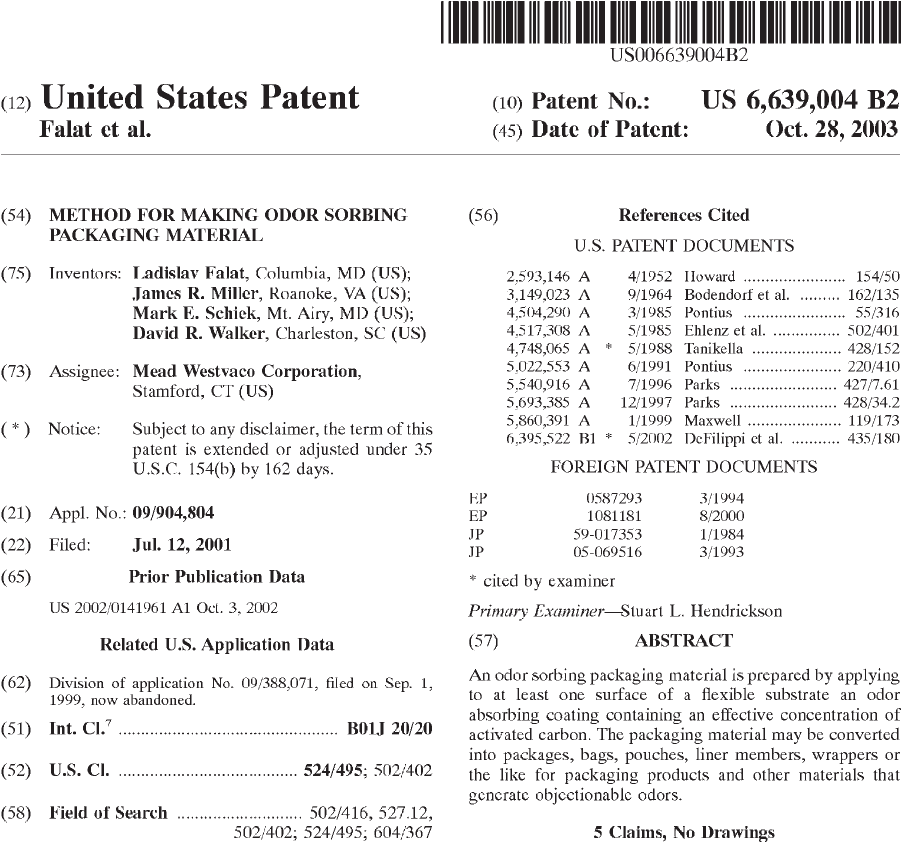
Patent Number : The patent number is at the top
right-hand corner of the cover. Here, the patent
number is 6,639,004. Patents are frequently referred
to by the last three digits of the patent number.
Thus, we refer to U.S. Patent No. 6,639,004 as
‘‘the ’004 patent.’’
Issue Date: The issue date is just below the patent
number. The ’004 patent issued on October 28, 2003.
A patent owner’s rights and the patent’s presump-
tion of validity begin on the issue date.
Title: The title of a patent appears in the upper-left-
hand column of the cover. The ’004 patent is entitled:
‘‘Method for Making Odor Sorbing Packaging Mate-
rial.’’ This provides some guidance regarding the
subject matter of the patent. However, what a patent
protects is defined by its claims, not its title. Indeed,
due to changes in claims during prosecution, the
title may not completely or accurately reflect the
subject matter claimed. Therefore, any review of a
patent should go far beyond the title. For example,
the title of the ’004 patent recites a ‘‘method’’ of
making materials, but the claims are directed to
materials, not methods of making them.
Inventors: Beneath the title is a listing of the inven-
tors, Ladislav Falat, James R. Miller, Mark E. Shiek,
and David R. Walker.
Assignee: Beneath the listing of inventors is identifi-
cation of the assignee of the ’004 patent, Mead
Westvaco Corporation. A patent is personal property
and therefore can be sold, mortgaged, transfer-
red, and so on. Under U.S. patent laws, such trans-
fers are made by using a written instrument known
as an assignment. The person transferring the
patent, often the inventor, is the assignor, while
the recipient is the assignee. Employment contracts
often require that an employee assign to the
Figure 1. Cover of U.S. Patent 6,639,004.
PATENT LAW PRIMER FOR THE PACKAGING INDUSTRY 931
employer/company rights to any invention made
during employment. Patents can be assigned multi-
ple times. The USPTO maintains an assignment
database within its website (40). The cover may
not have the most current assignment information.
For the most current assignment information, one
should check the assignment database and check
with the USPTO assignment office.
Filing Date: Beneath the assignee information is fil-
ing date information. The cover of the ’004 patent
indicates that the application for the ’004 patent was
filed on July 12, 2001.
Notice Regarding Patent Term: The determination of
the expiration date of a patent can be complex and is
beyond the scope of this article. One fact to consider
in such a determination is whether any portion of
the patent term has been disclaimed or extended.
The cover indicates that the term of the ’004 patent
has been extended by 162 days.
Prior Publication Data: U.S. patent applications are
typically published about 18 months after they are
filed. The publication date is provided beneath the
filing date. The cover indicates that the application
for the ’004 patent was published on October 3, 2002
as publication number 2002/0149161 A1.
Related U.S. Application Data: Beneath the filing
date is the heading ‘‘Related U.S. Application
Data.’’ This part of the patent provides information
regarding related applications, such as divisionals,
continuations, and continuations-in-part. This sec-
tion indicates that the application that matured into
the ’004 patent was a divisional application filed off
of an earlier application having serial number 09/
388,071 (‘‘the ’071 application’’). The ’071 application
was filed on September 1, 1999 and is now
abandoned.
U.S. Cl.: The USPTO classifies patents into classes
and subclasses based on subject matter. All issued
patents are classified according to this system. The
class is identified by the heading ‘‘U.S. Cl.’’, found
beneath the related U.S. application data. The clas-
sifications provide information about the subject
matter of the patent.
Field of Classification Search: This section lists the
classes and subclasses that the patent examiner
searched when assessing the novelty and obvious-
ness of the ’004 patent. One can search the USPTO
patents database by class and subclass to uncover
patents in a field of interest. The USPTO website
provides an index of classes (41). For example, the
following are some classes relevant to packaging:
053
065
106
156
206
215
Package making
4Glass manufacturing
Compositions: coating or plastic
Adhesive bonding and miscellaneous chemical
manufacture
Special receptacle or package
Bottles and jars
224
229
264
413
Package and article carriers
Envelopes, wrappers, and paperboard boxes
Plastic and nonmetallic article shaping or treating:
processes
Sheet metal container making
References Cited: The cover lists the U.S. patents,
foreign patents, and other materials the examiner
considered when assessing patentability. Such ma-
terials often provide a starting point for learning
more about the subject matter of an invention, or for
an alleged infringer trying to attack the validity of a
patent.
Abstract: The cover includes an abstract of the inven-
tion at the bottom of the right-hand column. The
abstract provides an overview of the invention. Like
the title, due to changes during prosecution, the
abstract may not completely or accurately reflect
the subject matter ultimately claimed.
Drawings. After the cover come drawings, if there are
any. Drawings are required, if necessary, to understand
the invention. Therefore, the USPTO may deem an appli-
cation incomplete if drawings are absent. Drawings are
typically explained in the specification (described below).
The cover of the ’004 patent indicates that it has no
drawings.
Specification. The specification is the text of the patent.
It comes after the cover and drawings and before the
claims. In essence, the specification is a ‘‘user manual’’
that
should provide enough
description and detail to
enable persons skilled in the art to make and use the
full scope of the claimed invention. It defines terms used in
the claims and often provides examples of the invention. It
is the specification that must satisfy the written descrip-
tion, enablement, and best mode requirements of patent-
ability. Therefore, the specification must be drafted as
broadly as necessary to support broad claims, and with as
much specificity as necessary to support narrow claims.
Understanding the claims of a patent often requires care-
ful review of the specification.
A specification typically has the following sections:
background of the invention; summary of the invention;
brief description of the figures; detailed description of the
invention; examples, and claims (which are technically
part of the specification).
The background of the invention describes the general
field of the invention, notes insufficiencies in existing
technology, and explains generally how the invention
solves such problems. The summary of the invention
usually provides additional information about how the
invention solves the problem addressed by the invention.
The brief description of the drawings briefly explains what
the drawings show. The detailed description of the inven-
tion typically explains the invention and how to make and
use it. Finally, the examples demonstrate how the inven-
tion works, either by describing actual experiments and
results or by setting forth methods that could be used and
indicating expected (but not actual) results (known as
932 PATENT LAW PRIMER FOR THE PACKAGING INDUSTRY
‘‘prophetic’’ examples). A proper specification should make
clear whether an example is actual or prophetic.
Claims. The claims are found at the end of the patent
and follow the statement ‘‘I Claim’’ or ‘‘What is claimed is.’’
The claims include ‘‘limitations’’ that define the bound-
aries of a patent owner’s right to exclude. Such limitations
are (a) the elements against which patentability is tested
and (b) the elements that a product or process must
contain to infringe. Thus, any review of a patent must
include careful consideration of the claims.
Claims are numbered. By statute, each claim must be
written as a single sentence. As a consequence, claims
often are less readable than typical English sentences.
Claims usually have three parts: a preamble, a transition,
and a body. For example, consider the following hypothe-
tical claim in which the parts are denoted.
1.
A composition
|fflfflfflfflfflfflfflfflfflfflffl{zfflfflfflfflfflfflfflfflfflfflffl}
Preamble
consisting of
|fflfflfflfflfflfflfflfflfflffl{zfflfflfflfflfflfflfflfflfflffl}
Transitional Phrase
ingredient A; ingredient B; and also ingredient C:
|fflfflfflfflfflfflfflfflfflfflfflfflfflfflfflfflfflfflfflfflfflfflfflfflfflfflfflfflfflfflfflfflfflfflfflfflfflfflfflfflfflfflfflfflfflfflfflfflfflffl{zfflfflfflfflfflfflfflfflfflfflfflfflfflfflfflfflfflfflfflfflfflfflfflfflfflfflfflfflfflfflfflfflfflfflfflfflfflfflfflfflfflfflfflfflfflfflfflfflfflffl}
Body
Below we provide some basic information about these
three claim parts. Books have been written about claim
drafting and how to determine the meaning of claims.
Such detail is beyond the scope of this article (42).
The Preamble. A preamble is an introductory statement
that names the thing that is claimed or defines the field of
invention. The preamble may or may not serve as a claim
limitation. If a preamble serves as a claim limitation, it
narrows the claim. In other words, it provides an addi-
tional requirement a product or process must possess to
infringe the claim.
The Transition. The transition comes between the pre-
amble and the body. One of the following two transitional
phrases, or a variation thereof, is used in most claims: (1)
consisting of, as used in the hypothetical above, or (2)
comprising. The transitional phrase used affects how a
claim is construed.
Consisting Of: The term ‘‘consisting of ’’ is referred to
as a ‘‘closed’’ transitional phrase. This means that
the claim covers products and process that include
only the limitations that follow the transition. For
example, in the hypothetical above, the claim covers
only compositions that contain ingredients A, B, and
C; compositions with only A, B, and C would infringe
claim 1. The claim would not cover compositions that
also contain ingredient D; a composition containing
A, B, C, and D would not infringe claim 1.
Comprising: The term ‘‘comprising’’ is known as an
‘‘open’’ transitional phrase. This means that the
claim covers products and processes that include
each limitation that follows this phrase but that
infringing products can also include additional ele-
ments. For example, had the hypothetical above
used ‘‘comprising’’ as the transitional phrase, the
claim would cover compositions that contain ingre-
dients A, B, and C, whether or not they also contain
ingredient D; a composition containing A, B, C, and
D would infringe the claim if it were written with
‘‘comprising’’ as the transitional phrase.
The Body. The body of the claim is everything that
follows the transition phrase. The body contains the
limitations of the claim. As noted previously, limitations
are (a) the elements against which patentability is tested
and (b) the elements that a product or process must
contain to infringe. In claim 1, above, A, B, and C are
limitations.
There are two primary claim types: independent and
dependent. Independent claims stand on their own. De-
pendent claims relate back to or ‘‘depend from’’ a previous
claim. A dependent claim is construed to contain each
limitation of the claim from which it depends, as well as
the additional limitations added in the dependent claim
itself. Consider the following hypothetical claim set:
1. A packaging film comprising laminate A, laminate
B, and an adhesive.
2. The packaging film of claim 2 further comprising a
coating.
3. The packaging film of claim 3, wherein the coating is
impermeable to moisture.
Claim 2 is an independent claim that has three limita-
tions: laminate A, laminate B, and an adhesive. Claim 3 is
a dependent claim that depends from claim 2. Therefore,
claim 3 contains all three limitations of claim 2 (laminate
A, laminate B, and an adhesive), as well as the additional
limitation of a coating (whether impermeable to moisture
or not). Claim 4 depends from claim 3 (which depends
from claim 2). Therefore, claim 4 contains the laminate A,
laminate B, and the adhesive limitations of claim 2 and
the coating limitation of claim 3, with the additional
limitation that the coating must be impermeable to moist-
ure. A competitor need only infringe one patent claim to be
liable for infringement and face an injunction and/or
infringement damages.
Claim Construction. Claim construction is a very com-
plicated process by which the claims are interpreted to
understand what they do and do not cover. It requires
consideration of the language of the claims themselves,
the specification, and the prosecution history of the patent
(e.g., representations made to the examiner to obtain the
patent). Claim construction begins with the language of
the claim. Typically, the words and phrases in the claims
are given their ordinary meaning as used and understood
by people in the field of the invention. However, a patentee
can be his or her own ‘‘lexicographer,’’ meaning that the
patentee may use claim terms in a way that is markedly
differently from their ordinary meaning, provided that the
patentee’s definition is clearly set forth in the patent
specification. Even seemingly simple terms may lead to
PATENT LAW PRIMER FOR THE PACKAGING INDUSTRY 933
claim construction disputes during litigation. Resolution
of such disputes often requires a court hearing that can
last hours or even days. For example, in one patent
dispute, the parties fought about the meaning of the claim
term ‘‘generally convex’’ (43). Resolution of such claim
construction issues is often determinative of whether a
patent is valid and/or infringed.
Legal Opinions
Understanding what a claim covers is crucial to assessing
issues of infringement and validity. For example, if a
business wants to determine if a proposed new product
may infringe an existing patent, it must (1) construe the
claims and (2) compare the construed claims to its new
product. Infringement is not determined by comparing a
proposed product to the patent holder’s product. Infringe-
ment is tested against what is claimed in the patent.
Similarly, to assess the validity of a patent, one must (1)
construe the claims and (2) consider the construed claims
in view of the prior art and other patentability require-
ments to determine if the claimed invention meets the
requirements of patentability. Federal courts strictly ad-
here to these two-step processes.
Due to the complexity of the claim construction process,
a patent attorney is typically consulted. For example,
companies often seek freedom-to-operate opinions or non
infringement opinions from patent attorneys before
launching a new product. Such opinions entail searching
the patent landscape to identify patents of interest, ana-
lyzing the patents (claims, specification, and prosecution
histories), construing the claims, and comparing the
claims to the proposed product to assess the potential for
infringement liability. If potentially troublesome patents
are identified, the patent attorney may be asked to assess
the validity and/or enforceability of the patent. The patent
attorney may also be asked for advice regarding design
around options—that is, ways to achieve the same result
without infringing any potentially problematic patent
claims.
ENFORCING PATENTS
The rights that accompany an issued patent are not self-
executing. Although the patent holder has the right to
exclude competitors from making, using, selling, or offer-
ing for sale in the United States, or importing into the
United States, the patented invention, the mere existence
of a patent does not ensure that infringing competitors
will not enter the market. For example, a competitor
might sell a potentially infringing product because the
competitor (1) did not know about the patent, (2) believed
that the product would not infringe the patent, (3) be-
lieved that the patent was invalid, (4) believed the patent
was unenforceable, and/or (5) believed that infringement
would not or could not be detected.
This section addresses the identification of potential
infringers, the interaction between business goals and
appropriate enforcement action, and the litigation
process.
The Several Phases of Patent Enforcement
Pre-Enforcement. Before attempting to enforce a pa-
tent, a patentee must first determine whether there are
potential infringers. This typically involves monitoring
the market to identify potentially infringing activity,
obtaining potentially infringing products, and assessing
whether such products infringe. The scientists and en-
gineers working within a field, reading related literature,
and attending trade conferences are often a source of such
competitive information. Monitoring published patent
applications and issued patents can also provide insight
regarding competitor activities and where infringement
might arise.
Once a potentially infringing product or process is
identified, one must construe the claims and compare
them to the potentially infringing product or process to
determine whether there is infringement (see section
entitled ‘‘The Anatomy of an Issued Patent,’’ above).
Patent counsel can be very helpful construing claim terms.
Again, whether the patentee has a product of its own, and
how that product compares to the potentially infringing
product, is not relevant to the infringement analysis.
Deciding What to Do About Potential Infringer. Upon
identifying a potential infringer, and concluding that a
product or process likely infringes, the patent holder must
decide what to do. For example, the patent holder could
contact the potential infringer with the goal of negotiating
a license for royalties or a cross-license. Alternatively, the
patent holder could provide the potential infringer with
notice of the patent and ask the potential infringer to
remove a potentially infringing product from the market.
The patent holder may instead decide that the ultimate
goal is a license or cross-license, but choose to initiate a
litigation to signal the patent holder’s belief in the
strength of the patent, hoping that this will result in
better license terms. Or, the patent holder might decide
not to assert the patent for business or other reasons.
Ultimately, how a patent holder proceeds will depend
on the specific facts. However, the decision making process
often includes considering and weighing the answers to at
least the following questions:
1. What role does the patent play in the patent holder’s
business strategy? For example, does the patent
protect a market that is important to the patent
holder and in which the patent holder competes? If
so, the patent holder has increased incentive to sue
to
exclude competitors as
opposed to providing a
license that would likely increase competition.
2. What is the relationship, if any, between the patent
holder and the potential infringer? For example, are
they fierce competitors or have they worked out
patent licenses and other business agreements in
the past? What relationship does the patent holder
desire? If a friendly relationship is desired, litigation
may not be the best approach.
3. How strong is the patent at issue? For example, are
there documents created during prosecution of the
patent that might provide a basis for alleging
934 PATENT LAW PRIMER FOR THE PACKAGING INDUSTRY
inequitable conduct? Through discovery (discussed
below), alleged infringers will often find weaknesses
in the patent—some previously known to the patent
holder and some previously unknown. Weaknesses
in a patent provide a motivation for a nonlitigation
resolution.
4. How much time would a patent infringement law-
suit require from important scientists or executives,
and would such time commitments disrupt impor-
tant R&D or business functions? The level of dis-
ruption must be weighed when determining
whether to bring suit.
5. Does the potential infringer have any patents that
could be used against the patentee? If so, a cross-
license may be an appropriate goal, because a law-
suit (and countersuit by the competitor) might result
in neither party being able to market their respec-
tive products.
6. Is the relevant market large enough, or important
enough, to merit a lawsuit that could cost millions of
dollars? Litigation can result in large damage
awards that justify the costs involved. It can also
result in excluding a competitor from an important
market, whereas a license might result in less of a
revenue stream.
7. What are the potential damages that could be
recovered from the potential infringer?
Enforcement Through Litigation
If a patentee decides to sue, the lawsuit will typically
progress through the following phases, each of which is
discussed below: (1) filing of the lawsuit, (2) fact and
expert discovery, (3) claim construction; and (4) trial.
Patent lawsuits rarely go to trial in under a year, and
they often take several years to reach that point. The
following sections go into more detail on the phases of
litigation.
Filing of the Lawsuit.
The Patent Holder Files a Complaint. If a patent owner
has a good faith belief that a competitor is infringing, the
patent owner can enforce its patent rights in court. As
explained in the section entitled ‘‘Introduction to the
United States Patent System,’’ patent suits are handled
in the federal court system. To initiate a lawsuit in the
federal court system, the patentee must file what is called
a Complaint. The Complaint names the alleged infringer,
identifies the patent(s) that are allegedly infringed, recites
the allegedly infringing activity, and specifies the reme-
dies that the patent holder seeks. Typically, the patent
holder seeks payment of money damages and/or an in-
junction ordering the infringer to stop the infringing
activity.
The patent holder may bring suit on one patent or
several patents. For example, assume that the patent
holder has a first patent covering a packaging material
and a second patent covering packages made with the
material. If a competitor is selling a product in a package
made with the claimed packaging material, the patent
holder could sue on both the material and the packaging
patent. Furthermore, a patent holder can assert a patent
even if it suspects that only some, but not all, of the claims
are infringed; that is, a patent is infringed if there is
infringement of a single claim.
The party filing suit is known as the Plaintiff, and the
party being sued is known as the Defendant. Typically, but
not always, the Plaintiff is the patent holder and the
Defendant is the potential infringer.
The Alleged Infringer Files an Answer to the Complaint.
After the Complaint is filed, the competitor files an
Answer, which additionally includes defenses. These de-
fenses usually include one or more of the following:
noninfringement, invalidity, and/or unenforceability. The
alleged infringer can assert as many defenses as
applicable.
Evidence And Burdens. Discovery is the process through
which the parties obtain information, known as Evidence,
relevant to the case. The patent holder uses discovery to
uncover details about the accused product or process to
prove that infringement exists. Conversely, the alleged
infringer uses discovery to uncover information relevant
to invalidity or unenforceability defenses, such as infor-
mation regarding how an invention was conceived or
whether the inventors withheld material information
from the USPTO during prosecution of the patent.
Such evidence, in the form of documents, testimony,
and often expert opinion, is presented to the court to try to
meet a party’s burden of proof in the case. In patent
litigation, the patent holder has the burden to prove
infringement by a preponderance of evidence—that is,
that there is more than a 50% likelihood that the allegedly
infringing product uses the patented subject matter. This
means
that if neither
the patent holder nor the alleged
infringer provide any proof of infringement or non-infrin-
gement, there will be no infringement because the patent
owner has not met its burden.
Similarly, the alleged infringer has the burden of
proving defenses against infringement but, as explained
above, does not have to prove noninfringement. With
regard to proving invalidity and/or unenforceability, the
alleged infringer must do so by clear and convincing
evidence. This is a more difficult standard to satisfy than
the preponderance of the evidence standard, because once
a patent is issued by the USPTO, it is presumed valid.
Fact Discovery. During fact discovery, the parties re-
quest and exchange factual information related to the
case. The Federal Rules of Civil Procedure (‘‘the Rules’’),
which govern litigation in federal court, provide the
following mechanisms for obtaining such factual informa-
tion: document requests, interrogatories, requests for
admission, and depositions. Fact discovery usually in-
volves disclosing to the opposing party, a competitor,
information that one would consider confidential. Typi-
cally the parties have the court enter a Protective Order
that protects such information by governing who of
the opposing party can see such confidential information,
as well as what the receiving party can do with the
PATENT LAW PRIMER FOR THE PACKAGING INDUSTRY 935
information. In other words, the protective order is nego-
tiated so that even though information is exchanged, the
dissemination and use of confidential information can be
restricted.
Document Requests. Each party is permitted to request
documents from the opposing party to obtain evidence
relevant to their allegations or defenses. These requests
are called Document Requests. Each party is obligated to
preserve and hand over documents that might prove
relevant to the lawsuit. These include laboratory note-
books, meeting minutes, memoranda, financial data, ad-
vertising and marketing documents, flow diagrams,
forecasts, organizational charts, invoices, consulting
agreements, e-mails, and the like. The Rules require ex-
changing information maintained in paper form as well as
in electronic form, and even electronic information that
has been erased, where traces are accessible. Ultimately,
the parties can exchange tens of thousands, hundreds of
thousands, or even millions of pages of such documents.
These documents are then reviewed by the respective
parties to identify evidence to present to the court to prove
infringement, invalidity, and so on.
Interrogatories and Requests for Admission. An Interro-
gatory is a question to the opposing party that the oppos-
ing party must answer. For example, an alleged infringer
might propound interrogatories regarding how and when
the inventors of a patent conceived their invention, or
when the patent holder first showed prototypes of the
invention to a customer. The patent holder must then
make a good faith effort to obtain and provide an answer
to the interrogatory. Likewise, the patent holder may
present interrogatories to the alleged infringer asking
for details about its process or products.
Requests for Admission are statements that the oppos-
ing party is asked to admit. Such admissions can reduce
the issues for trial. For example, based on the review of
documents produced in response to a document request,
an alleged infringer might ask the patent holder to admit
that its inventors had not conceived their invention by a
given date. Once admitted, the alleged infringer would no
longer have to prove (or present evidence regarding) the
admitted fact at trial. Likewise, if the alleged infringer
admits that its process uses a specific step(s), the patent
holder will not need to separately prove this at trial when
attempting to prove infringement.
Depositions. Typically after documents have been ex-
changed and reviewed, each side identifies individuals
(i.e., witnesses) from the opponent’s company for deposi-
tion. These often include the inventors, people with knowl-
edge of the patent prosecution, people with knowledge of
the accused products or processes, people knowledgeable
about product costs and profit margins, and so on. During
a deposition, the witness is required to answer questions
from the opposing attorney. The attorney’s questions and
the deponent’s answers are recorded by a stenographer
and may also be videotaped. All questions are answered
under oath, and the answers (subject to objections) can be
used at trial for different purposes, including to impeach a
witness’ testimony if the witness’ trial testimony differs
from the witness’ deposition testimony.
Fact depositions are used to gather fact evidence re-
lated to the issues in the case (infringement, validity, etc.).
Fact depositions therefore address what actually hap-
pened with regard to the invention at issue, the allegedly
infringing product, and other issues in the case. Question-
ing of the patent holder’s witnesses often relates to how
the patented process or product was developed, commu-
nications with the USPTO, and the content of relevant
memoranda, reports, correspondence, e-mails, and so on.
Questioning of the accused infringer often relates to (a)
the details of accused products or processes and (b) the
accused infringer’s knowledge of the patents in suit.
Many scientists and engineers dread the idea of being
deposed. Depositions represent an unfamiliar environ-
ment to most scientists and engineers, and many are
anxious about how their performance will impact their
company. To alleviate such anxiety and to prepare for the
deposition, the witness will usually have a meeting with
an attorney that will represent the witness at the deposi-
tion, also known as the attorney who defends the witness.
During this meeting, the attorney can answer questions
the witness has regarding depositions. In addition, the
attorney will usually:
1. Explain the mechanics and rules of a deposition,
such as the role of the witness, questioning attorney
and defending attorney, the presence of a court
reporter, and so on.
2. Review the issues in the litigation.
3. Discuss the witness’ knowledge regarding the issues
in the litigation.
4. Explain how the witness fits into the case.
5. Discuss questions and/or issues that will likely arise
during the deposition.
6. Provide guidelines regarding how to answer ques-
tions, including telling the witness to listen to ques-
tions carefully, to answer only the question asked,
and to tell the truth.
Adequacy of preparation for a deposition often correlates
with how well a witness does do at deposition. Therefore,
it
is important to
allow an appropriate amount of time for
preparation. Often such preparation will last a day or
more, depending on the anxiety level of the witness, how
important the witness is to the case, and the amount of
material to review.
Impact of Fact Discovery. As discovery proceeds, each
party typically refines its litigation positions based on the
discovery it obtains. For example, the alleged infringer
might refine its defenses to include an unenforceability
defense if it learned during discovery that one of the
patent holder’s inventors had information material to
patentability that was not provided to the USPTO. Re-
finement can be based on uncovered documents, interro-
gatory responses, request for admission responses, and
deposition answers.
936 PATENT LAW PRIMER FOR THE PACKAGING INDUSTRY

In some cases, fact discovery can drain a company’s
resources. For example, key employees may have to spend
days, or weeks, helping attorneys collect documents for
production, helping attorneys respond to interrogatories
and requests for admission, preparing for depositions, and
being questioned as witnesses at depositions. Through the
discovery process, opposing counsel will often find any
‘‘skeletons’’ that exist in relation to the litigation. The
disruptive nature of litigation must therefore be weighed
against the potential value of litigation before a patent
owner asserts a patent.
Expert Discovery. Expert discovery follows fact discov-
ery. During expert discovery, the parties work with ex-
perts in the field of the invention covered by the asserted
patent(s). Experts can be university professors with ex-
pertise in the technology at issue, outside consultants,
financial experts (to address, for example, damages is-
sues), and the like.
Experts are retained to provide expert opinions regard-
ing issues in the case. Unlike fact witnesses whose testi-
mony is limited to what actually happened, experts can
provide opinions and consider what would happen in
various hypothetical circumstances. Experts typically
rely on documents and other information exchanged by
the parties during fact discovery. They may also conduct
tests or find relevant scientific materials on their own.
Thus, for example, a patent holder may hire an expert to
submit a report providing opinions as to how the alleged
infringer’s product meets all of the limitations in its
patent claims, supported by testing that the expert con-
ducted. The alleged infringer may retain an expert to
submit a report giving opinions regarding why the as-
serted patent claims are invalid.
After an expert submits an expert report on behalf of a
party, the opposing party will usually take the expert’s
deposition. Such depositions are used to more fully under-
stand the expert’s opinions and to probe the bases for the
opinions.
Claim Construction. At some point during litigation, the
parties may have a hearing before the court to establish
the meaning of the asserted claims, or, more particularly,
specific terms within the asserted claims. This is known as
a claim construction hearing. The claim construction
hearing can happen during or after fact or expert discov-
ery, or even as part of the trial. The result of a claim
construction hearing often has a large impact on the
litigation. For example, if a claim is construed narrowly,
it might make it difficult for a patent owner to prove
infringement. However, that same narrow construction
might help the patent owner defend against an allegation
of invalidity.
Trial. Many patent cases do not go to trial. One reason
is that many patent cases settle before trial because of
weaknesses in the parties’ positions revealed during fact
and/or expert discovery. Another reason is that cases may
be resolved before trial if a party has proven to the judge
that there are no issues of fact that have to be resolved at
trial, thereby allowing the judge to rule without the need
for a trial. However, if a case does not settle or end for
some other reason, it will go to trial.
The trial is an opportunity for a judge and/or jury to see
fact and expert witnesses testify and to assess their
credibility. Indeed, many cases are won or lost based on
whether the judge and/or jury believe a witness.
During trial, and even after the trial but before a
decision has been rendered by the judge or jury, the
parties can still settle the case. Again, such settlements
occur because presentation of evidence at trial, or the
performance of a witness at trial, may highlight a weak-
ness in a party’s position. If a case does not settle, a
decision will be rendered. As explained in the section
entitled ‘‘Introduction to the United States Patent Sys-
tem,’’ such decisions can be appealed to the Federal Circuit
and ultimately to the U.S. Supreme Court.
Acknowledgments: The authors appreciate the assistance of Ms.
Victoria Elman in preparing the section entitled ‘‘The Interplay
Between Patents and other Forms of Intellectual Property’’ and
they also appreciate the helpful suggestions of Professor John R.
Kettle III of Rutgers University School of Law—Newark.
BIBLIOGRAPHY
1. Intellectual Property Today, September 2006, p. 11 (Decisions
& Settlements).
2. J. Simunovic, K. R. Swartzel, and E. Adles, U.S. Patent
7,213,967 (to North Carolina State University), 2007.
3. D. S. Chisum, C. A. Nard, H. F. Schwarz, P. Newman, and F. S.
Kieff, Principles of Patent Law: Cases and Materials,
3rd edition, Foundation Press, New York, 2004, p. 19.
4. 35 U.S.C. y 101.
5. Juicy Whip Inc. v. Orange Bang Inc., 185 F.3d 1364 (Fed. Cir.
1999).
6. 35 U.S.C. y 102.
7. Continental Plastic Containers Inc. v. Owens-Brockway Plas-
tic Products Inc., 141 F.3d 1073 (Fed. Cir. 1998).
8. 35 U.S.C. y 103.
9. Union Carbide Corp. v. American Can Co., 724 F.2d 1567
(Fed. Cir. 1984).
10. 35 U.S.C. y 271.
11. 35 U.S.C. yy 281, 283, 284
12. 35 U.S.C. y 282.
13. 37 C.F.R. y 1.56.
14. Cargill Inc. v. Canbra Foods Ltd., 81 U.S.P.Q.2d 1705 (Fed.
Cir. 2007).
15. KSR International Co. v. Teleflex Inc., 127 S.Ct. 1727 (U.S.
2007).
16. eBay Inc. v. MercExchange LLC, 126 S.Ct. 1837 (U.S. 2006).
17. MedImmune Inc. v. Genentech Inc., 127 S.Ct. 764 (U.S. 2007).
18. Quanta Computer, Inc. v. LG Electronics, Inc., 06–937 (June 9,
2008).
19. B.A. Garner, Black’s Law Dictionary, 7th edition, West Group,
St. Paul, MN, 1999, p. 813.
20. 35 U.S.C. y 112.
21. 35 U.S.C. yy 101, 102, 103, 112.
22. 35 U.S.C. y 154(d).
23. 35 U.S.C. y 171.
PATENT LAW PRIMER FOR THE PACKAGING INDUSTRY 937