
Yam, Kit L. (ed.). The Wiley encyclopedia of packaging technology
Подождите немного. Документ загружается.

POINT OF PURCHASE PACKAGING
JENNIFER GRIFFIN
Polaroid Corp., Cambridge,
Massachusetts
Point-of-purchase (POP) packaging materials play an
important role in marketing efforts of consumer product
companies. Displays, fixtures, signs, and related materials
at the retail store represent POP, packaging. Food,
drug, specialty, and convenience stores, as well as mass
merchandisers and warehouse clubs, all make use of
POP packaging. The medium is used in almost every
category of product from health and beauty aids to
household appliances. POP materials are used to increase
sales, obtain positioning on the retail floor, and carry the
brand name and strategy along with related advertising
efforts.
HIGH VISIBILITY VERSUS POP PACKAGING
A distinction can be made between the primary package
that is considered highly visible and the packaging that is
considered POP. Both forms of packaging are an important
promotional medium, especially in self-service stores.
However, POP packaging is different from high-visibility
packaging, because in most cases, it consists of the promo-
tional materials that surround the primary package. For
most consumers, POP packaging implies that the product
is new to the market, is offered at a sale price, or comes
with another promotional tie-in (1). High-visibility packa-
ging includes blister, clamshell, and skin packaging, as
well as packages with windows (see Blister packaging;
Carded packaging). These forms of primary packaging
display the product’s benefits, and they promote impulse
purchases. Often, retailers request product manufacturers
to replace the standard primary package with a high-
visibility package for two reasons: (1) sales assistance is
not available to help with customer purchase decisions so
the package needs to sell itself, and (2) they request the
high-visibility package to have better pilfer resistance
than the standard package. Despite the distinction be-
tween the two types of packaging, the lines between
primary packaging and POP packaging have blurred,
and the diversity of POP allows for exceptions. Primary
packaging can also function as a point-of-purchase device
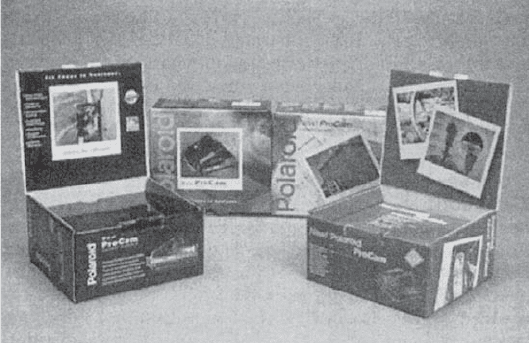
as observed in Figure 1. These two camera boxes function
as the primary package and also as an informational sales
tool. Retailers leave these boxes in the open position on a
countertop for the customer to read about product features
of the professional cameras. The bleached-white, lami-
nated, E-flute, die-cut, corrugated box is designed in the
style of a counter display (see Board, corrugated; Diecut-
ting). Extra lithographic printing surfaces are available for
the selling message as a result of the double wall hinge
cover, double sidewalls, double front wall, and the interior
shelf-style panel for a clean, finished appearance (see
Lithography; Offset printing).
MATERIALS
Because POP packaging is so varied, material selection is
based on the intended duration of the promotion. POP is
commonly defined as either temporary or permanent. In
general, temporary displays are used until the product is
depleted, or for less than 6 months. Permanent displays
have an intended length of use for more than 6 months. A
third category called semipermanent often marries packa-
ging materials used in both of the categories to give the
display an extended shelf life over temporary displays.
The most widely used material in temporary exhibits is
corrugated board. Paperboard is also popular (see Paper-
board). Permanent display construction makes use of
extruded plastic sheet fabrications, plastic profile and
tubing, plastic molding, wire, metal extrusions, foam-
board, or wood. To create semipermanent displays, corru-
gated board can be used with more durable materials such
as wood, plastic, or metal. Solid fibreboard (see Boxes,
solid-fiber) or corrugated board of heavy construction
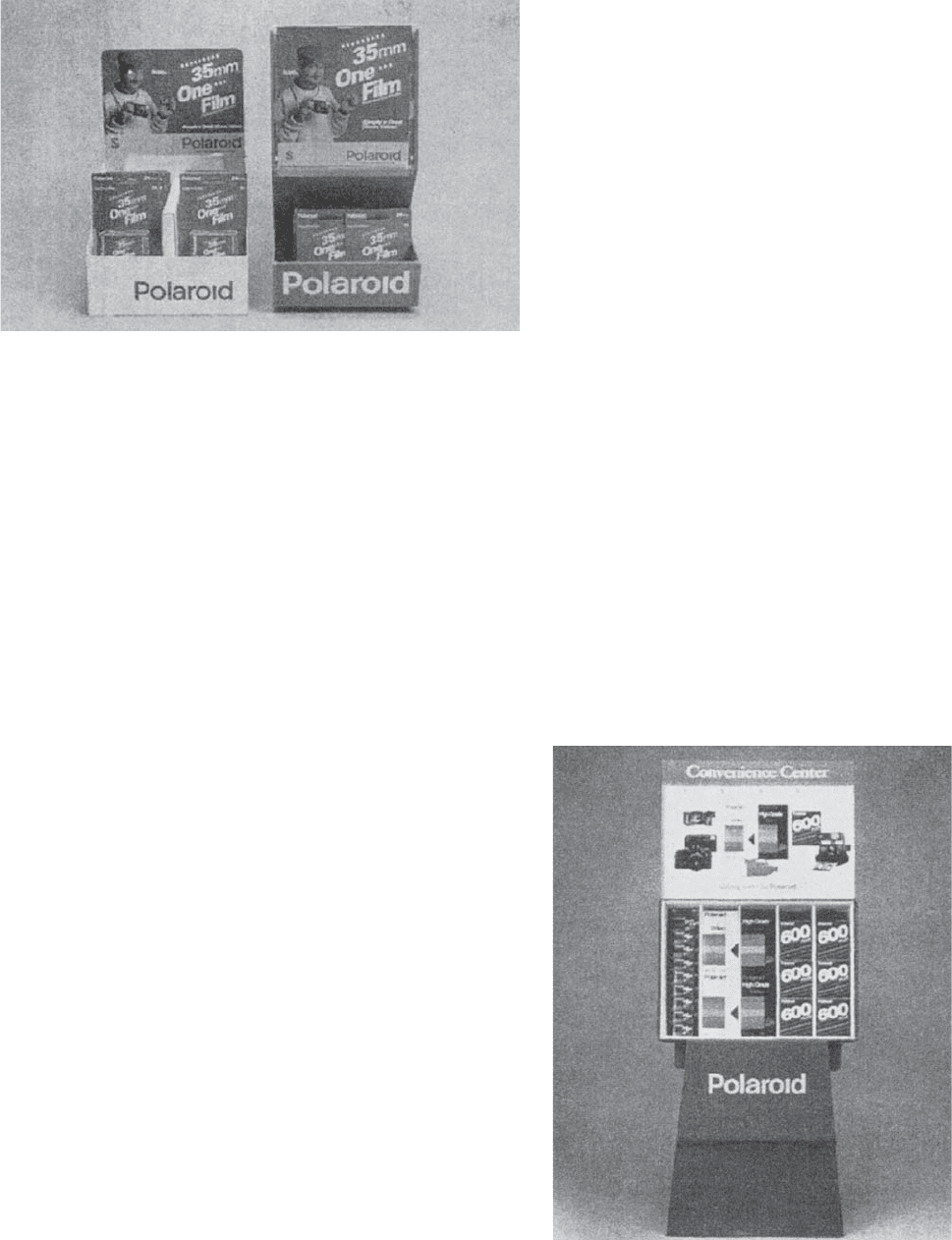
could also be used alone. Figure 2 shows a temporary
counter display made of bleached-white, corrugated board
on the left. The permanent counter display on the right is
an extruded plastic sheet fabrication.
Figure 1. A primary package functions as a point-of-pur-
chase device.
958 POINT OF PURCHASE PACKAGING
TEMPORARY POP CATEGORIES
Common Elements of Counter and Floor Stands. The most
widely used display styles for temporary promotions are
counter and floor-stand displays. Both styles share com-
monly used structural design elements. The most visual
element that these two styles share is the header portion
(also called the riser panel) of the display. The header is a
display panel that protrudes up from the open side of the
display box to advertise the contained product. The header
often comes attached to the body of the display as a
hinged-cover panel with a front tuck flap. The header
folds back for setup. It may also arrive as a separate piece
that slides into a slot on the body. The most popular
manufacturing technique for header cards is to preprint
a lithographic sheet and glue it to a sheet of paperboard or
corrugated board. This technique allows for high-quality
printing for the sales message, where as the other parts
of the display can be printed at lower cost using flexogra-
phy or can be left unprinted (see Flexography). The
temporary display in Figure 2 has a flexo printed body
with a litho sheet header card that is laminated to
corrugated board.
The body of counter and floor-stand displays is de-
signed in either an easel style or a tray style. Easels often
have cells to partition the product. Figure 3 shows a
corrugated-board, floor-stand display that uses an easel-
style body with cells. This display ships as a prepackaged
multipack so that the loading of the product is not
required by the retailer. The tray style often uses a tiered
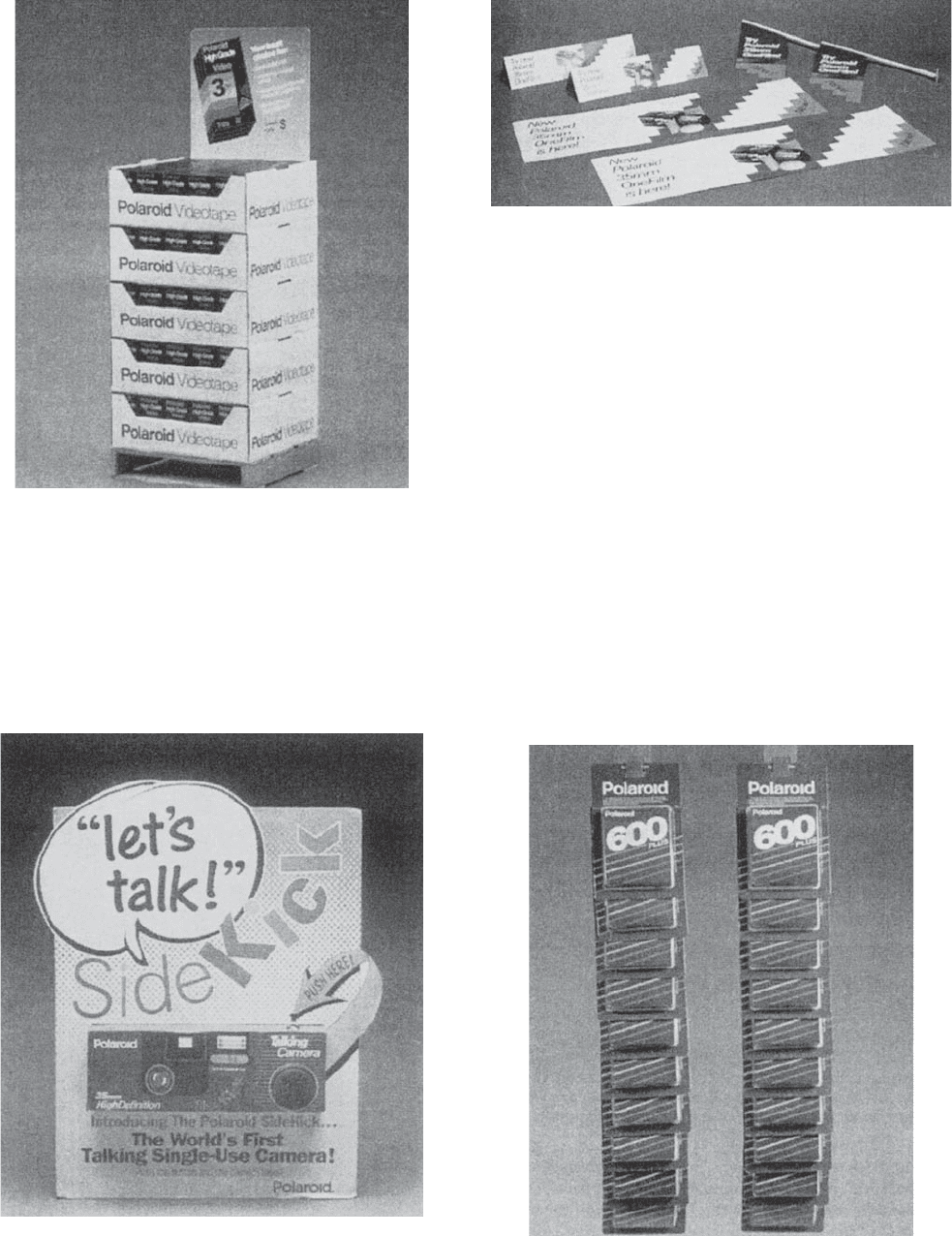
tray as shown in Figure 4. The tiered-tray floor stand
ships on a custom-sized wood skid. This display is in-
tended as an end cap that will be placed at the end of an
aisle. Some tiered trays are offset so that all of the product
is displayed at once. The pallet-unit style shown in Figure
4 is commonly referred to as a ‘‘stacker.’’ This display is
intended for a wholesale or warehouse club store. The
large amount of product contained in the display would
not be suitable for traditional retailers.
Floor-stand displays sometimes require a base to sup-
port the display. Figure 3 shows a typical base design. A
popular industry practice is to use modular stock display
designs from POP manufacturers. Then, the display is
customized with special structural features on the header
and the client’s graphics. The client incurs a lower cost,
because no tooling charge for die-cutting exists for the
stock elements.
Other Counter and Floor-Stand Displays. Counter dis-
plays have several unique categories, including contest
boxes, counter cards, and literature holders. Figure 5
shows a counter card with an interactive feature. The
camera’s audio unit is a talking voice chip with three
prerecorded messages. Floor stands include several un-
ique categories, as well. The standee is a standup person
or object that is usually two-dimensional with an easel
backing for support. Standees are often used when a
Figure 2. A temporary corrugated-board counter display
(left) and a permanent counter display made of extruded
plastic sheet (right).
Figure 3. A corrugated-board floor-stand display that uses an
easelstyle body with cells. The header and base are stock display
designs.
POINT OF PURCHASE PACKAGING 959
public figure joins a company’s advertising campaign.
This visual element triggers recognition and reinforces a
positive impression, which leads to consumer loyalty.
Lastly, the dump bin style is also a category used in floor
stands.
Miscellaneous Temporary POP. Several miscellaneous
categories fit under the temporary POP umbrella. Pole
displays, overheads, banners, flags, posters, and mobiles
are common. Figure 6 includes several examples of POP
promotions that are used to complement a display system.
The small flags in the photograph are used as ‘‘shelf
talkers,’’ with plastic clips to secure to the shelf edge.
Along with hooks and clips, merchandising strips are
popular, especially for use on power-wing or end-cap metal
racks. A power wing is the side of an end cap where
impulse merchandise is hung, often on hooks. Figure 7
shows two merchandising strips loaded with instant film
packs.
The last area that falls under temporary POP is
incentive items such as game cards, sweepstakes cards,
rebate offers, on-pack coupons, and bottle neck toppers.
The $5 mail-in rebate offer shown in Figure 8 has a
counter card with a pad of rebate cards that explains the
Figure 5. A counter card displays the product by mounting it in
the card’s panel. Customers can hear three prerecorded messages
by pushing the
RELEASE button.
Figure 4. A palletized-unit display called a stacker uses a tiered
tray design. A removable header tops the display.
Figure 6. The photo includes banners, signs, and ‘‘shelf talker’’
flags on standout poles that clip onto a shelf edge.
Figure 7. Two merchandising strips hold the instant film packs
in a vertical display.
960 POINT OF PURCHASE PACKAGING
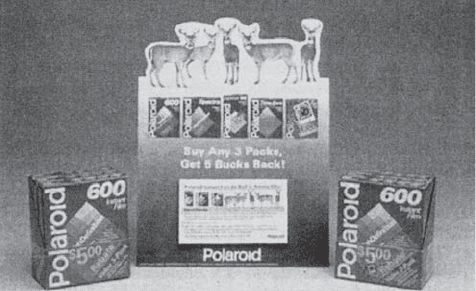
rules of the promotion. Of special note to graphic artists is
the packaging graphics redesign of the whole line of
instant film shown on the center card. Earlier versions
of the film box did not have a unified look for the product
line’s corporate and brand identity.
PERMANENT POP CATEGORIES
Permanent POP includes many of the categories that have
been detailed for temporary displays such as any of the
counter and floor stands. Much of permanent POP in-
cludes fixtures, which are not actually ‘‘packaging.’’ How-
ever, it is the packaging engineer’s job to specify the
fixture and design shipping packaging to transport the
promotion’s fixture and the enclosed product to the retail
store. A category called the spinner or spinner rack is most
often intended for permanent display. It comes in counter
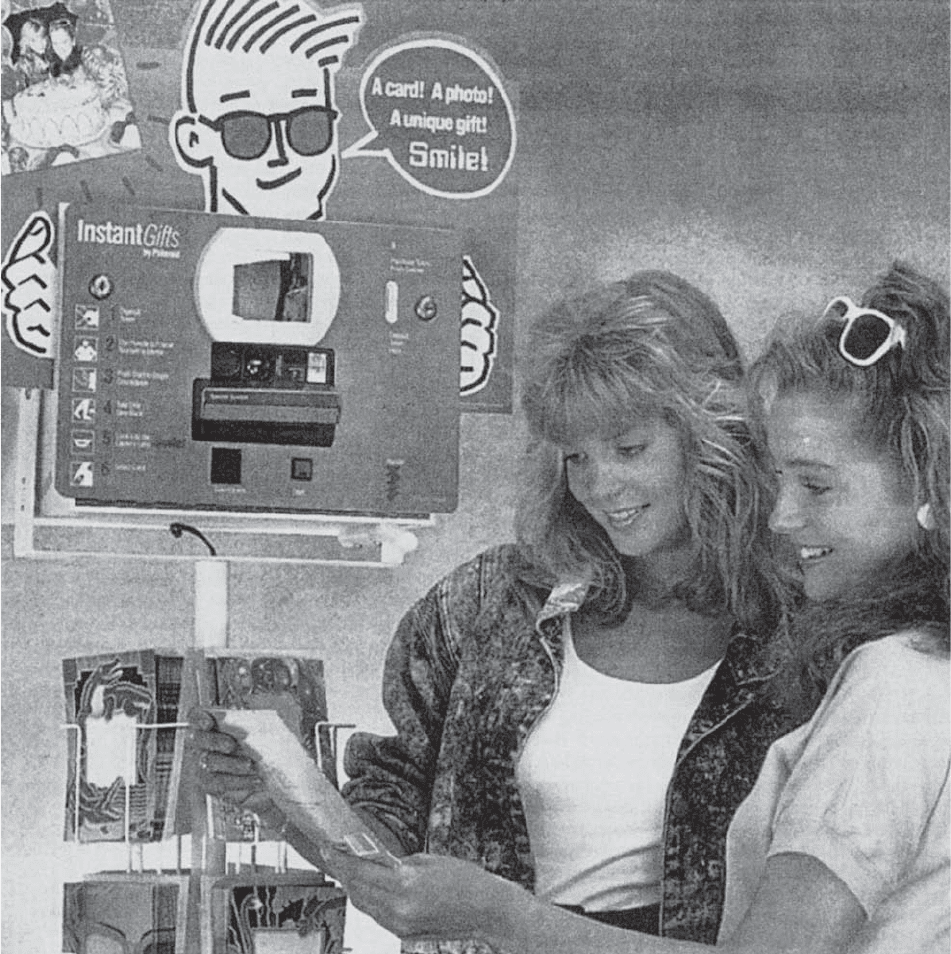
or floor-stand designs. Figure 9 shows a floor-stand spin-
ner rack with wire display pockets. Spinner racks that
have hooks or pegs are also popular, and they are for
products with hang tabs. Another form of permanent POP
is product sampler or tester unit displays for industries
such as cosmetics. Other categories usually associated
with permanent POP are items such as dangling inflata-
bles and motion displays that are heavily used in the
competitive field of beverage and liquor packaging.
The next category of permanent POP is full-line mer-
chandisers, which are category or shelf management
systems. They are used to organize a company’s offerings
for a product line in any department of a retail store. It
ensures facings are easily identifiable. Examples are seen
in panty hose, wrapping paper and bows, and other
product lines with many choices. For a product manufac-
turer, a full-line merchandiser ensures that the product
will not be subject to the whim of a retailer’s planogram.
Retail stores use planograms—written diagrams with
instructions—to lay out departments. The retail store
finds planograms useful for cutting in new products,
positioning higher-margin products in more visible loca-
tions, and periodic cleaning of fixtures. The last perma-
nent category worth mentioning is computerized kiosks
with interactive touchpad displays and printers. The
kiosks are used in various applications such as multi-
media questionnaires or self-service tools in which custo-
mers use the kiosk to help identify correct replacement
parts for a product.
TRENDS
Trends in the industry include cross-merchandising
in which two marketers join together in a promotion
program. It is also called cobranding. For instance,
a soft-drink manufacturer teams up with a candy com-
pany to do a joint temporary display. With changing
channels of distribution due to increased competition
from wholesale clubs and superstores, manufacturers
are feeling a greater retailer influence. Promotions have
become more account-specific, because retailers are de-
manding the customizing of displays for their use only.
Another trend is co-marketing. Co-marketing teams up a
retailer and a marketer who have developed a promotion
together to leverage store and brand-name equity in order
to build sales for both. A distinction is made between co-
marketing and ‘‘prepackaged’’ promotions that a manu-
facturer has thoroughly thought out and then tailored to a
specific retail account (2). For more specific data on trends
in POP, P/O/P Times magazine published a second
annual report on trends and growth patterns in its
November/December 1994 issue.
FOR FURTHER INFORMATION
The Point-of-Purchase Advertising Institute offers many
reference materials for sale through its information center
in Washington, DC [phone (202) 530-3000]. These materi-
als include written surveys, brochures, books, mono-
graphs, yearbooks, and audio cassettes. A helpful
handbook is the POPAI P-O-P Desktop Reference, which
provides 1200 POP industry terms. The General Refer-
ences list in the Bibliography (below) includes the only two
books in print on the subject. Periodicals are the industry’s
major communication tool. Trade magazines that cater to
the industry include P/O/P Times, a publication of point-
of-purchase advertising and display; P.O.P. & Sign Design,
for high-volume producers of displays, sign, and fixtures;
Creative, which is published for sales promotion and
marketing professionals who manage point-of-purchase
display, trade-show-exhibit, and sales-promotion pro-
grams; and Promo, a magazine about promotional market-
ing. Creative publishes a yearly illustrated supplier
directory arranged by category that includes company
listings. In addition, several marketing management and
packaging periodicals occasionally carry related journal
articles. A Marketing Science article details a mathema-
tical model for managing shelf space at retail (3). Research
published by Percy and Rossiter shows how to apply
successful message construction in POP to encourage a
consumer purchase decision on the basis of an interplay of
customer involvement and motivation (4).
Several trade shows catering to the POP market
are held each year. Merchandising and design innovations
Figure 8. A pad of rebate offers on a counter card. Note the
packaging graphics redesign to unify the look of the instant film
product line.
POINT OF PURCHASE PACKAGING 961
in POP packaging are promoted yearly in industry
achievement award contests. The Point-of-Purchase Ad-
vertising Institute, POPAI, has sponsored a competition
each year since 1960. Another contest is held at the
annual Display, Sign and Fixture Design show.
BIBLIOGRAPHY
1. Editor, ‘‘How Shoppers Feel about Displays,’’ P/O/P Times, 58
(1995).
2. C. Hoyt, ‘‘Co-Marketing: What It Is And Is Not,’’ Promo, 32
(1995).
3. A. Bultez and P. Naert, ‘‘S.H.A.R.P.: Shelf Allocation for
Retailers’ Profit,’’ Market. Sci., 211–231 (1988).
4. L. Percy and J. Rossiter, ‘‘A Model of Brand Awareness and
Brand Attitude Advertising Strategies,’’ in Psychology & Mar-
ket, John Wiley & Sons, New York, 1992.
General References
Point of Purchase Design Annual, Rockport Publications,
1994.
Point of Purchase Design Annual: POPAI’s 36th Merchandising
Awards, Retail Report, POP Advertising Institute Staff,
1994.
Figure 9. A permanent floor-stand spinner rack displays personalized greeting cards. The customer inserts the instant photo she has just
taken into the card.
962 POINT OF PURCHASE PACKAGING
POLY(VINYL CHLORIDE)
DENNIS A. COCCO
PolyOne Corporation, Avon
Lake, Ohio
Poly(vinyl chloride) (PVC) is, in terms of sales volume, the
largest member of a group of polymers commonly referred
to as ‘‘vinyls.’’ These polymers are all based on either the
vinyl radical (CH
2
QCH—) or the vinylidene radical
(CH
2
QCR—). Included in this unique and versatile group
of polymers are poly(vinyl acetate), poly(vinylidene chlor-
ide) (PVDC), poly(vinyl alcohol), poly(vinyl fluoride), poly(-
vinylidene difluoride) (PVDF), and poly(vinyl butyral).
However, homopolymer PVC has the greatest applicability
to packaging applications.
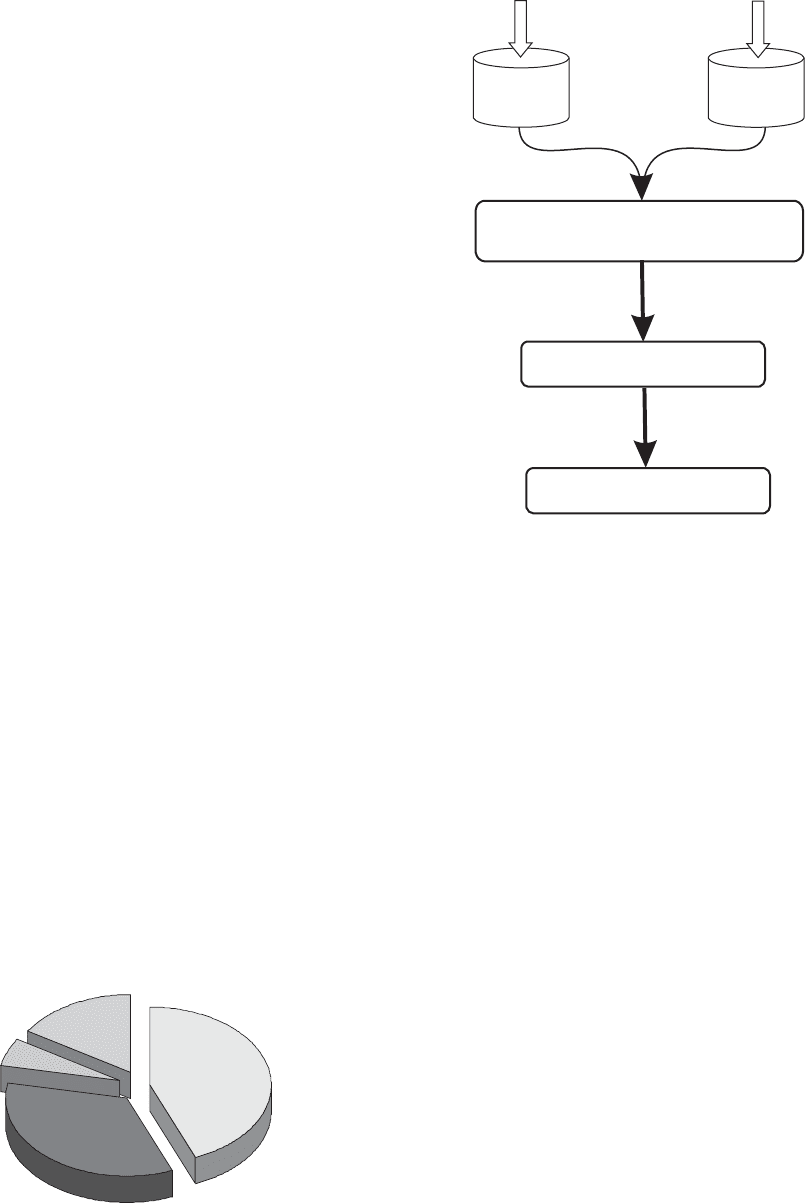
PVC packaging represented about 6% of total annual
North American sales of PVC of 16.0 billion pounds in 2006
(see Figure 1). Growth has remained fairly steady over the
past 10 years at approximately 1–2% per year. However,
PVC is still a relatively minor material in the overall
packaging market and is about 4% of all plastics used.
When first developed in the 1930s, PVC found little
applicability or marketplace acceptance because of its ten-
dency to thermally degrade or dehydrochlorinate (1) when
heated. However, scientists soon discovered that additives
such as stabilizers and plasticizers could easily be com-
pounded into PVC to make it processable without thermal
degradation. More importantly, they found they could also
modify PVC’s physical properties across a broad spectrum.
As a result, PVC has evolved into one of the world’s
most versatile polymers and the second-largest volume-
produced plastics because of its toughness, relatively low
cost, and the ability to modify its physical properties. A
wide range of applications today includes pipe and pipe
fittings, house siding, windows, electrical and telecommu-
nication wire coatings, credit cards, and medical intrave-
nous bags and tubing, as well as packaging applications
such as bottles, food films, and blister packs.
HOW VINYL IS PRODUCED
Poly(vinyl chloride) (PVC), more commonly referred to as
vinyl, consists of three primary elements: chlorine, carbon,
and hydrogen. Chlorine is derived from a chloralkali
production process; carbon and hydrogen are derived
from ethylene through either a petroleum or natural gas
cracking process (see Figure 2).
In the chloralkali process, salt is combined with water
to form a brine solution. This saltwater (NaCl + H
2
O)
solution is passed through an electric current in a process
where chlorine atoms are attracted to the anode and
where the sodium ions in the solution are attracted to
the cathode electrode. This electrolysis process produces
an electrochemical unit (ECU). The ECU is made up of 1.0
parts of chlorine and 1.1 parts of caustic soda (sodium
hydroxide).
Ethylene is derived from the cracking of either petro-
leum or natural gas. In this process the feedstock is put
through a catalyst bed at high temperature and pressure
to produce ethylene and a number of other co-products
such as propylene and butadiene. The ethylene is further
processed to separate it from the coproducts.
Ethylene and chlorine are combined to first make 1,2-
dichloroethane, then ethylene dichloride (EDC), and fi-
nally vinyl chloride monomer (VCM or CH
2
QCHCl).
PVC is normally polymerized from VCM by one of four
processes (suspension, mass, emulsion, and solution) into
the following polymer structure:
ðCH
2
CHClÞ
n
Each process uses peroxide-type initiations to produce
free radicals, and the exothermic reaction is normally
carried out at 95–1671F (35–751C) (2). Under different
Total = 16 Billion Lbs.
Pipe - 44%
Other - 16%
Packaging - 6%
Other
Construction - 34%
Figure 1. North American PVC end-market 2006.
Natural Gas
Feedstocks
PVC Compounds
PVC Resins
Vinyl Chloride Monomer
(VCM)
Salt
Ethylene
Chlorine
Polymerization
Additives
Figure 2. PVC production process.
POLY(VINYL CHLORIDE) 963

reactor configurations, agitation, and reaction media,
these four processes produce PVC resins with uniquely
different physical characteristics. These characteristics
play important roles in subsequent application processes
such as extrusion and calendering.
The most commonly used process, which accounts for
more than 90% of the PVC produced in North America, is
called suspension polymerization. The remaining 10% is
made up of mass polymerization and emulsion or solution
polymerization processes. Each process creates a PVC
resin that has a unique structure that plays a role in the
type of end-use application that best fits the resin type.
For example, suspension and mass polymerization-type
PVC is used in pipe and house siding applications, while
emulsion would be used coatings, toys, and flooring.
Packaging applications generally use suspension and
emulsion polymerized PVC resins.
There are presently six major manufacturers of PVC
resins in the United States: OxyVinyls LP, Westlake
Chemical Corporation, PolyOne Corporation, Shintech
Inc., Georgia Gulf Corporation, and Formosa Plastics
Corporation.
VINYL INDUSTRY CHANNELS
About 74% of all North American PVC resin is sold
to fabricated products manufacturers, which convert
the resin to compounds before producing the final end-
use products. Custom compounders that make compounds
for sale to PVC product fabricators purchase approxi-
mately 10% of the vinyl resin production. The remaining
16% is used by PVC resin producers that have their
own integrated compounding facilities. These custom
compounds are then sold to PVC fabricators in North
America and throughout the world. Approximately 8% of
the North American PVC resin production is exported
annually.
STRUCTURE AND PROPERTIES
As a basis for discussing PVC’s structure or morphology
(3–5), some typical suspension-resin characteristics are
shown in Table 1.
Molecular Weight
The molecular weights of PVC resins produced in the
United States are typically 0.55–1.50 inherent viscosity.
As molecular weight increases, physical properties such as
tensile strength and tear strength increase proportio-
nately (6, 7), as does melt viscosity, which affects product
processing. The tradeoff in selecting a PVC resin is to
choose the minimum molecular weight to meet the end-
product physical requirements while minimizing melt
viscosity.
Particle Size
PVC particles are somewhat spherical as a result of the
polymerization process (agitation, suspending agents,
etc.). The resin particles generally have a size distribution
of 70–250 mm in diameter, which results in a mean size of
130–165 mm.
Bulk Density
PVC has a specific gravity of approximately 1.40, but the
resin’s bulk density (8) is significantly less: 0.450–0.550 g/
mL. Bulk density is directly related to the particle’s
morphology and specifically the resin’s porosity, particle
size and distribution, and particle surface characteristics.
Porosity
A single PVC resin particle from the reactor has a
structure that contains many openings in its surface
plus a measurable and accessible void within the particle.
The amount of free volume within a resin particle is
referred to as its porosity. This unique characteristic
allows a PVC resin to absorb liquids such as plasticizer
during the compounding operation. The amount of poros-
ity and its accessibility play an important role when
considering the amount and viscosity of the liquids added
during compounding.
Residual Vinyl Chloride Monomer
During the polymerization of PVC, not all of the VCM is
converted to polymer. Today the amount of residual mono-
mer remaining in the dried PVC resin is significantly less
than 1 ppm. This level establishes safe worker levels and
provides acceptable levels in the product.
COMPOUNDING PVC
As discussed earlier, the addition of compounding addi-
tives enables PVC to be modified into many useful pro-
ducts. For example, the addition of a liquid plasticizer
such as di(2-ethylhexyl)adipate (DEA) permits the produc-
tion of a flexible film with the oxygen-transmission proper-
ties required for red meat packaging. The addition of a
rubbery polymer such as methacrylate butadiene styrene
(MBS) significantly improves the toughness or crack
propagation characteristics as measured by impact tests
(e.g., Gardner or Izod). PVC’s tremendous versatility
results from the ability to tailor those properties to the
Table 1. Typical Characteristics of a PVC Suspension
Resin
Molecular weight
Inherent viscosity, ASTM D1243-95
(2000)
0.88–0.98
Weight average molecular weight 142,000–185,000
Number average molecular weight 55,000–62,000
Mean particle size, ASTM D1921-06 130–165 mm
Apparent bulk density, ASTM D1895-06
(2003)
0.450–0.550 g/cm
3
Porosity, ASTM D2873
a
0.23–0.35 cm
3
/g
Residual monomer, ASTM D 3749-95
(2002)
o1.0 ppm
a
Method withdrawn, no replacement.
964 POLY(VINYL CHLORIDE)
requirements of the application. With the proper addi-
tives, a rigid PVC bottle can be blow-molded for edible-oil
packaging. Other ingredients allow the extrusion of a
blown flexible film for produce wrapping. These formula-
tions are generally highly proprietary and very specific to
use applications and properties.
Stabilizers
Stabilizers give PVC the ability to withstand the thermal
and shear conditions of processing without polymer de-
gradation (9). Stabilizers used in food-contact applica-
tions, which must have FDA clearance, include Ca/Zn
salts, epoxidized soybean oil, and octyl tin mercaptides.
In other applications, stabilizers such as butyl or methyl
tin mercaptides are used.
Plasticizers
There are numerous types of plasticizers, and each im-
parts a specific set of properties to the final product (10,
11). These liquid or polymeric additives generally reduce
the T
g
of PVC. At the same time, they reduce tensile
strength and increase elongation. Certain plasticizers,
such as di(2-ethylhexyl)phthalate (DEP), improve PVC’s
water-vapor barrier properties; DOZ (dioctyl azelate) sig-
nificantly improves its low-temperature impact strength.
Lubricants
Generally, lubricants are added to PVC compounds to
reduce the frictional properties between the compound
and the metal surface of the processing equipment (12).
They are also used to reduce the surface friction of the
final product or to reduce the product’s surface static
properties. Lubricants include such families as paraffin
waxes and metal stearates.
Impact Modifiers
Many types of impact modifiers have been developed for
PVC packaging applications to improve PVC’s toughness
for transportation and handling. Examples include metha-
crylate butadiene styrene (MBS), chlorinated polyethy-
lene, and acrylic polymers. The type used depends on
application requirements such as clarity, cost efficiency,
low-temperature impact, and metal-release properties.
Fillers and Pigments
Fillers such as CaCO
3
can reduce the raw-material costs of
a PVC compound. They have little effect on physical
properties at low levels. Some fillers can improve proper-
ties such as stiffness or abrasion resistance.
PVC IN PACKAGING
PVC packaging applications fall into three general cate-
gories: film and sheet, bottles, and others (including coat-
ings and cap liners). About 25% of PVC in packaging
involves food applications, 35% medical uses, and 40%
nonfood end uses. These market percentages have re-
mained remained fairly steady over the past 10 years.
Film & Sheet:
Bottles:
Other:
• Jars for oils, peanut butter
• Personnel care products such as
shampoo
• Pharmaceutical bottles for drugs and
medicines
• Household bottles for cleaning fluid
• Automotive bottles for lubricants
• Cap and closure liners
• Can coatings
• Bister and clamshell packaging of toys,
electronics, hardware, household goods
• Flexible film for produce and meat
packaging
• Medical/Healthcare packaging for
pharmaceuticals and medicine packaging,
IV and blood bags
• Shrink wrap for tamper-proof over-the-
counter medicines
Figure 3. Typical PVC packaging uses.
POLY(VINYL CHLORIDE) 965

Figure 3 describes the typical PVC packaging uses, and
Table 2 gives the historic and current PVC packaging
market sizes.
Film and sheet are the largest applications for PVC in
packaging. Rigid blister pack and clamshell applications
are the largest single use of PVC. PVC’s toughness and
clarity make it an ideal material to protect goods during
shipping and while on the store shelf. As Figure 3 depicts,
nearly 300 million pounds of PVC are used annually to
make rigid sheet in thicknesses ranging from 0.010 to
0.150 in. PVC also has proved to be an excellent thermo-
forming plastic. Because of its ability to hold a form during
the thermoforming process, its high impact resistance
(even at low temperatures), and its excellent clarity, it
has become widely used in the packaging of retail goods
and medical products. One of the single most important
growth applications has been in drug blister packaging,
including unit-dose packets. PVC’s performance and cost-
effectiveness have led to its dominance of more than 95%
of this market (13).
Flexible PVC film is used in food film for packaging
meat, cheese, and produce. Among the advantages of PVC
for these uses are its clarity, barrier properties, puncture
resistance, and cling for good sealability (14). One of the
unique advantages of PVC is its moderate oxygen perme-
ability, which helps retard the transition of meat color
from red to brown. Competition from modified atmosphere
and high barrier films materials will likely limit the
growth of PVC in this application.
PVC is used in bottles because of its clarity, impact
resistance, ease of formability, chemical resistance , and
cost-effectiveness. As a result, the PVC bottle market is
primarily for cleaners, chemicals , toiletries, and cosmetics.
The use in food packaging has continued to decrease
because of competition from other materials such as PET,
which has seen rapid acceptance worldwide in water bottles .
Approximately 350 million pounds of PVC is currently
used annually in North America in various flexible and
rigid medical packaging applications. PVC continues to
find growing use because of its properties of clarity, impact,
chemical resistance, barrier characteristics, and ability to
be sterilized (15) with little loss of properties. Flexible PVC
is the leading material for us in IV and blood bags. Despite
growing concerns about the presence of plasticizers, since
replacing glass for critical applications more than 35 years
ago, PVC has proved to be safe, reliable, and the most cost-
effective material available. PVC is also used in tubing for
connecting various devices to patients.
Rigid PVC has also found growing use in blister packs,
trays, and pouches as well as pharmaceutical bottles,
particularly where barrier properties are required. Be-
cause of competing materials and attempts at substitu-
tion, PVC demand in medical applications is expected to
grow no more than 3% per year over the next five years.
FDA STATUS
PVC is used extensively in food-contact applications such as
meat wrap. It is prior-sanctioned for use in general food-
contact applications by virtue of an article published in July
1951 in the Journal of the Association of Food and Drug
Officials of the United States by A. L. Lehman of the FDA.
In addition, PVC resins are listed in a number of specific
FDA regulations relating to food-contact substances.
PVC AND THE ENVIRONMENT
Due to an anti-chlorine campaign led by environmental
extremists, PVC is sometimes scrutinized and written
about in misleading ways concerning its place in the
environment. While some claim that PVC manufacturing
is a large source of dioxin, in fact the United States
Environmental Protection Agency (16) long ago concluded
that this is far from being true. Their studies concluded
that the manufacture of intermediate feedstocks for PVC
is only a minor dioxin source (less than 11 grams per year
for the entire industry) and that the PVC industry has
made steady progress each year lowering the levels. The
fact that over the last 20 years PVC production has tripled
while dioxins in the environment have continued to
decrease is difficult for PVC opponents to explain.
Other claims against PVC say that it is overwhelming
our trash and recycling systems. Yet PVC is a small source
in the municipal waste stream because most of its applica-
tions are durable, long-life products such as vinyl siding
windows and pipe. In those applications , manufacturers are
ready, willing, and able to provide recycling support if the
material can be collected and separated efficiently. In fact,
over a billion pounds per year of PVC is recycled on a post-
industrial basis, implying that post-consumer recycling is
mostly a matter of economic will. It is important to place
criticisms of PVC into context and comparison with alter-
natives that would be substituted in its place. Recent
European studies using life-cycle analysis (LC A) as a com-
parative environmental tool, have concluded that, overall,
PVC has a similar environmental impact as alternatives .
The debate on PVC will long continue. However, it
continues to prove to be a cost-effective and safe material
for many applications, including packaging. Advocates
against PVC in packaging continue to wage a spirited
campaign and point to companies that have switched to
alternative materials. In most cases, the switch occurred
mainly for economic reasons; for example, as a bottlers
production runs lengthened, switching to injection mold-
ing processes meant lower costs per unit and therefore a
switch in materials was necessary. Given its product life-
cycle phase, PVC use in packaging will likely continue at a
mature pace and its history as a safe cost-effective mate-
rial will likely never change.
Table 2. PVC Packaging Market Size
a
(million pounds)
1994 2006
Film and sheet
b
547 804
Bottles 188 160
Other packaging 80 36
Total 815 1000
a
all figures in resin equivalents.
b
Includes both flexible and rigid compounds.
966 POLY(VINYL CHLORIDE)
BIBLIOGRAPHY
1. A. Guyot, M. Bert, P. Burille, and co-workers, ‘‘Trial for
Correlation between Structural Defects and Thermal Stabi-
lity in PVC,’’ paper presented at the Third International
Symposium on Polyvinylchloride, Case Western Reserve Uni-
versity, Cleveland, OH, August 10–15, 1980.
2. L. F. Albright, Chem. Eng. 00, 145–152 (1987).
3. P. R Schweagerle, Plast. Eng. 00, 42–5 (1981).
4. N. Berndstein and G. Manges, J Pure Appl. Chem. 49, 597–
613 (1977).
5. H. Behrens, Plaste and Kautschuk 20(1), 2–6 (1973).
6. J. R. Fried, Plast. Eng. 00, 27–33 (1982).
7. S. Kaufman and M. M. Yocum, Plastic Compound 00, 44–46
(1978).
8. M. A. Kauffman and R. S. Guise, J. Vinyl Technol. 16, 39–45
(1994).
9. R. D. Dworkin, J. Vinyl Technol. 11, 15–22 (1989).
10. F. Tomasellik, V. P. Gupta, H. S. Caldiron, and G. R. Brown, J.
Vinyl Technol. 10, 72–76 (1988).
11. J. K. Sears and J. R. Darley, The Technology of Plasticizers,
John Wiley & Sons, New York, 1982.
12. J. A. Falter and K. S. Geick, J. Vinyl Technol. 16, 112–115
(1994).
13. M. Larson, Pharmaceut. Med. Packag. News 00, 23–27 (1993).
14. J. Southus, ‘‘PVC Film & Sheet in Packaging,’’ paper pre-
sented at the Regional Technical Conference, SPE, Missis-
sauga, Ontario, Canada, September 13–14, 1983.
15. N. Perry, ‘‘Flexible PVC Medical Packaging Applications,’’
paper presented at the Regional Technical Conference, SPE,
Missisauga, Ontario, Canada, September 13–14, 1983.
16. D Winters, Director Dixon Policy Project, Office of Pollution
Prevention and Toxics, United States Environmental Protec-
tion Agency, U.S. EPA’s Dioxin Reassessment: Sources, Fate,
Exposure.
17. W. F. Carroll, Jr., J. Vinyl Technol. 16, 169–176 (1994).
18. F. E. Krause, J. Vinyl Technol. 16, 177–180 (1994).
General References
L. I. Nass, ed., Encyclopedia of PVC, Vol. 1 (1976), Vol. 2 (1977),
Vol. 3 (1977), Marcel Dekker, New York.
W. S. Penn, PVC Technology, MacLaren, London, 1966.
J. H. Briston and L. L. Katan, Plastic Films, Longman, New York,
1983.
POLY(LACTIC ACID)
RAFAEL AURAS
School of Packaging, Michigan
State University, East Lansing,
Michigan
INTRODUCTION
Poly(lactic acid) (PLA) polymers are biodegradable polye-
sters derived from lactic acid (LA) or 2-hydroxy propionic
acid, which is generally obtained by bacterial fermenta-
tion of carbohydrates from agricultural crops such as corn,
potato, and cassava. PLA has been used extensively for
medical applications since the 1970s because of its bior-
esorbable and biocompatible properties in the human
body. Its use in packaging and textile applications until
now has been scarce because of its high initial costs.
However, discoveries of new polymerization pathways
and advances in manufacturing technologies have drama-
tically lowered PLA costs (1–5). PLA was approved by the
U.S. Food & Drug Administration for use in contact with
foods in 1992 (6), PLA resin can be produced entirely from
biomass, and the final products can safely be recycled,
composted, or incinerated (2). PLA has been recognized by
industries, consumers, and governments as a candidate
material to help in reducing the municipal solid waste
produced by packaging and containers (7).
To date, the production of PLA has reached a large-
scale industrial capacity (75 metric kt in 2007 and is
expected to reach 325 metric kt by 2010), which makes it
the most important biopolyester produced from renewable
resources (4). NatureWorks LLC (Blair, NE), the former
Cargill Inc., and Dow joint venture, which is nowadays
owned by Cargill Inc. and Teijin Ltd., produces the largest
amount of commercially available PLA resins with a total
production of 140 ktpa as of January 2009. Nature Works
is also planning to start building a second plant. Toyota
has produced special PLAs since 2003 for automotive
applications. Galactic and Total Petrochemicals, Uhde
Inventa Fischer, and Pyramide Bioplastics have an-
nounced plans to produce commercial PLA by the end of
2009. PURAC and Sulzer have also announced joint
efforts to produce PLA from solid lactide to obtain ex-
panded PLA beads to target the market of expanded
polystyrene (PS). Additional development of stereocom-
plex PLA by PURAC, Musashino Chemical Laboratory,
and Teijin has gained attention for the production of a 50/
50 blend of poly(L-lactic acid) PLLA and poly(D-lactic
acid) PDLA with a high melting point targeting fiber
applications. More pilot scale plants to produce PLA
have been announced in China, and currently, PURAC
has expanded its lactic acid capacity targeting the in-
crease of PLA demand (2, 4).
PRODUCTION OF HIGH-MOLECULAR-WEIGHT PLA
The main constitutional unit of PLA is lactic acid. LA can
exist in two main optical configurations: L or D. PLA
polymers can be produced with varying degrees of L or D
lactic acid. According to its molecular composition, PLA can
be named as poly(XY-lactic acid), in which X and/or Y are
the amount of L and D lactic acid, respectively. D lactic acid
mainly comes from the racemic lactic acid (LD configura-
tion). So, a PLA polymer’s label as poly(96% L-lactic acid)
will be composed of 96% L-lactic acid and 4% D lactic acid.
PLA is mainly produced by three synthesis processes:
(a) polymerization through lactide formation, (b) direct
condensation polymerization, and (c) azeotropic dehydra-
tion condensation (see Scheme 1). Ring open polymeriza-
tion process is the technology producing the most amount
POLY(LACTIC ACID) 967