
Zhang K., Li D. Electromagnetic Theory for Microwaves and Optoelectronics
Подождите немного. Документ загружается.

10.4 Diffraction of Plane Waves in Anisotropic Media 651
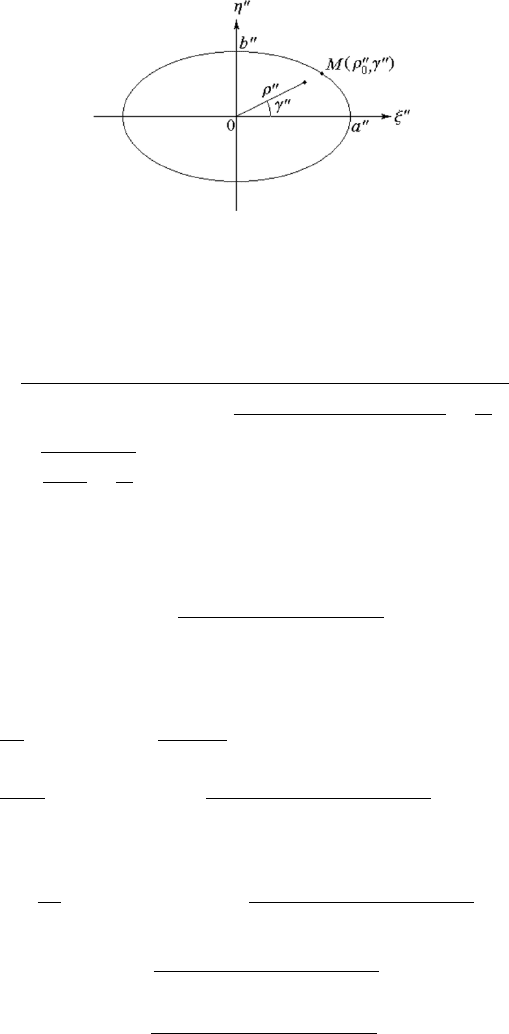
Figure 10.20: The integrating region for Fresnel diffraction.
where C
1
is a constant. The integrating region is an ellipse whose major and
minor semi-axes can be derived from (10.76), (10.120), and (10.121):
a
00
= a
s
¡
n
2
e
cos
2
α + n
2
o
sin
2
α
¢
µ
1
L
0
(n
2
e
cos
2
α + n
2
o
sin
2
α)
+
1
ζ
0

,(10.123)
b
00
= an
e
s
1
L
0
n
2
e
+
1
ζ
0
. (10.124)
In Fig. 10.20 the integrating region of (10.122) is shown in a polar coor-
dinate system. M (ρ
00
0
, γ
00
) is a point on the boundary, and its polar radius
is
ρ
002
0
=
a
002
b
002
a
002
sin
2
γ
00
+ b
002
cos
2
γ
00
. (10.125)
Expressing (10.122) in terms of polar coordinates, we derive the diffraction
integral
ψ =
C
1
ζ
0
Z
2π
0
Z
ρ
00
0
0
exp
µ
−jk
0
ρ
002
2

ρ
00
dρ
00
dγ
00
=
−jC
1
k
0
ζ
0
·
2π−
Z
2π
0
exp
µ
−
jk
0
a
002
b
002
2a
002
sin
2
γ
00
+ 2b
002
cos
2
γ
00

dγ
00
¸
. (10.126)
The intensity on the axis is
I =
C
2
ζ
2
0
(
4π
2
− 4π
Z
2π
0
cos
µ
k
0
a
002
b
002
2a
002
sin
2
γ
00
+ 2b
002
cos
2
γ
00

dγ
00
+
·
Z
2π
0
cos
µ
k
0
a
002
b
002
2a
002
sin
2
γ
00
+ 2b
002
cos
2
γ
00

dγ
00
¸
2
+
·
Z
2π
0
sin
µ
k
0
a
002
b
002
2a
002
sin
2
γ
00
+ 2b
002
cos
2
γ
00

dγ
00
¸
2
)
, (10.127)

652 10. Scalar Diffraction Theory
where C
2
is a constant. This integral can be done numerically. The distri-
bution obtained should be changed to an expression in the x
0
y
0
z
0
coordinate
system in which the z
0
axis is along with the diffraction beam axis. From
(10.92) we obtain the relation between ζ
0
and z
0
0
:
ζ
0
= n
o
n
e
s
n
2
e
cos
2
α + n
2
o
sin
2
α
n
4
e
cos
2
α + n
4
o
sin
2
α
z
0
0
. (10.128)
Substitution of (10.128) into (10.126) and (10.127) will give the distribution
on the diffracted beam axis.
10.5 Refraction of Gaussian Beams
in Anisotropic Media
The propagation of Gaussian b eams in unbounded crystals has been discussed
in the last chapter. In practical applications, most problems are related to
the behavior of Gaussian beams in bounded crystals. For a Gaussian beam
incident on a crystal surface from free space, the propagation and distribution
of the refracted beam in the crystal belongs to such a problem, and it is very
important in laser generation, frequency multiplication, and interaction of
laser beams with other fields and waves such as the electric field, magnetic
field, microwave, and acoustic wave, etc.
If the complex amplitude distribution at a cross section normal to the
beam axis is known, we are able to derive the distribution of the refracted
wave through scalar diffraction theory. In applying this approach, because
there is no opaque screen as in diffraction at a small aperture, it is unnecessary
to make the Kirchhoff boundary conditions such that the optical field ampli-
tude and its derivative are zero simultaneously on the screen. As discussed
in Section 10.1, there are three diffraction formulas, and we may choose one
of them arbitrarily to give identical results. In this section the first kind of
Rayleigh–Sommerfeld diffraction formula is adopted, because with it there is
no need for the field derivative at the input plane. It has been proved that
the inclination factor in the diffraction integral formula can be neglected and
this does not influence its accuracy.
If the waist of an incident Gaussian beam is located on the crystal surface,
the waist of the refracted beam is on that surface too. The treatment of such
a problem is simple, and the result can be derived directly by solving the
scalar wave equation. If the beam waist is not on the surface, it will be very
complicated to solve this problem, and it cannot be done through solving the
wave equation. In this section we will discuss the latter case.
In this section, we discuss the refraction of Gaussian beams in uniaxial
crystals. In biaxial crystals it can be treated with a slightly modified ap-
proach. Because of double refraction, a beam with any polarization will split
10.5 Refraction of Gaussian Beams in Anisotropic Media 653
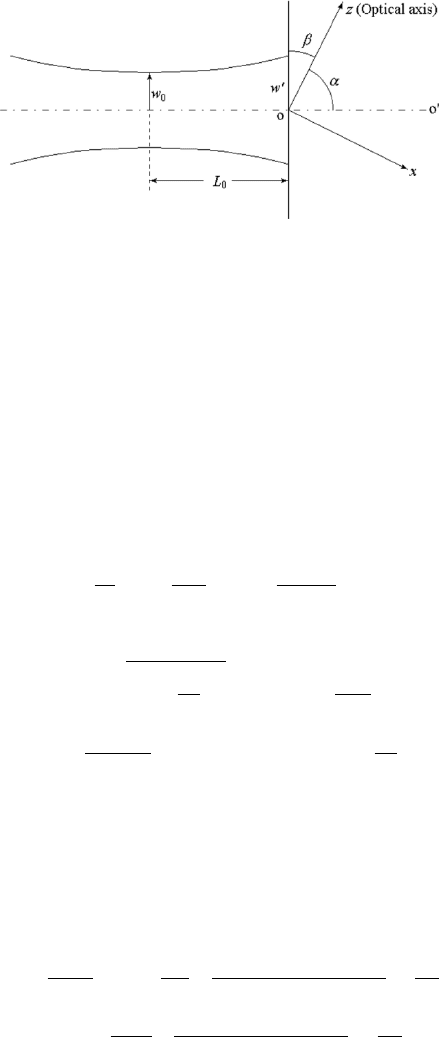
Figure 10.21: Coordinate system for the refraction of Gaussian beam at the
surface of a uniaxial crystal from free space.
into two beams. The refraction of the ordinary wave is the same as that in
isotropic media, so we discuss only the refraction of the extraordinary wave.
For simplicity, here we discuss the refraction of Gaussian beams normally
incident on a uniaxial crystal surface, shown in Fig. 10.21. A coordinate
system is chosen with the z axis along the optical axis of the crystal. The
angle between the z axis and the beam axis is α, and the distance from the
waist to the surface is L
0
. The amplitude of the refracted beam on the crystal
surface is proportional to that of the incident beam and expressed as
ψ
0
=
C
w
0
exp
µ
−r
2
i
w
02

exp
µ
−jk
0
r
2
i
2R
0
+ jφ
0

, (10.129)
where
w
0
= w
0
s
1 +
µ
L
0
s
0

2
, s
0
=
πw
2
0
λ
,
R
0
=
s
2
0
+ L
2
0
L
0
, φ
0
= arctan
µ
L
0
s
0

.
In the above formulas, C is a constant, λ is the wavelength in free space,
k
0
is the wave number, w
0
is the radius of the incident beam waist, w
0
and R
0
are the radius and the curvature radius of the incident beam at the
crystal surface, and r
i
is the radical coordinate in the incident plane, which is
expressed in (10.116) in the ξηζ system. Substitution of (10.116) into (10.129)
yields the complex amplitude of the incident wave in the ξηζ system:
ψ
0
=
Ce
jφ
0
w
0
exp
·
−
1
w
02
µ
ξ
02
n
2
e
cos
2
α + n
2
o
sin
2
α
+
η
02
n
2
e
¶¸
×exp
·
−jk
0
2R
0
µ
ξ
02
n
2
e
cos
2
α + n
2
o
sin
2
α
+
η
02
n
2
e
¶¸
. (10.130)

654 10. Scalar Diffraction Theory
Substituting (10.130) into (10.17) and neglecting the inclination factor, we
obtain the diffraction integral
ψ =
jk
0
Ce
jφ
0
2π
Z
∞
−∞
Z
∞
−∞
ψ
0
exp
³
−jk
0
p
(ξ − ξ
0
)
2
+ (η − η
0
)
2
+ ζ
2
´
p
(ξ − ξ
0
)
2
+ (η − η
0
)
2
+ ζ
2
dξ
0
dη
0
=
jk
0
Ce
−jk
0
ζ+jφ
0
2πζw
0
Z
∞
−∞
Z
∞
−∞
exp
½
−
jk
0
2ζ
£
(ξ − ξ
0
)
2
+ (η − η
0
)
2
¤
−
µ
1
w
02
+
jk
0
2R
0
¶µ
ξ
02
n
2
e
cos
2
α + n
2
o
sin
2
α
+
η
02
n
2
e
¶¾
dξ
0
dη
0
. (10.131)
In the above integral the exponential factor can be expressed as the form of
−jk
0
[g(ξ, ξ
0
) + h(η, η
0
)]/2, where
g(ξ, ξ
0
) =
ξ
2
ζ + m
+
µ
1
ζ
+
1
m

(ξ
0
− bξ)
2
, (10.132)
m =
k
0
R
0
w
02
¡
n
2
e
cos
2
α + n
2
o
sin
2
α
¢
k
0
w
02
− 2jR
0
, (10.133)
b =
m
ζ + m
, (10.134)
h(η, η
0
) =
η
2
ζ + n
+
µ
1
ζ
+
1
n

(η
0
− fη)
2
, (10.135)
n =
k
0
R
0
w
02
n
2
e
k
0
w
02
− 2jR
0
, (10.136)
f =
n
ζ + n
, (10.137)
Substituting (10.132)–(10.137) into (10.131), we obtain
ψ(ξ, η, ζ) =
jk
0
Ce
jφ
0
2πw
0
ζ
exp
·
−jk
0
ζ −
jk
0
2
µ
ξ
2
ζ + m
+
η
2
ζ + n
¶¸
×
Z
∞
−∞
Z
∞
−∞
exp
½
−jk
0
2
·µ
1
ζ
+
1
m

(ξ
0
−bξ)
2
+
µ
1
ζ
+
1
n

(η
0
−fη)
2
¸¾
dξ
0
dη
0
.
(10.138)
With the integral of the Gaussian function,
Z
∞
−∞
e
−a
2
x
2
dx =
√
π
a
, (10.139)
the integral in (10.138) can be expressed as
jk
0
2πw
0
ζ
Z
∞
−∞
Z
∞
−∞
exp
½
−jk
0
2
·µ
1
ζ
+
1
m

(ξ
0
− bξ)
2
+
µ
1
ζ
+
1
n

(η
0
− fη)
2
¸¾
dξ
0
dη
0
=
1
s
w
02
µ
1 +
ζ
m
¶µ
1 +
ζ
n

. (10.140)

10.5 Refraction of Gaussian Beams in Anisotropic Media 655
Substituting (10.140) into (10.138), we obtain
ψ(ξ, η, ζ) =
C
s
w
02
µ
1 +
ζ
m
¶µ
1 +
ζ
n

×exp
·
jφ
0
− jk
0
ζ −
jk
0
2
µ
ξ
2
ζ + m
+
η
2
ζ + n
¶¸
. (10.141)
Expression (10.141) represents an elliptical Gaussian beam in the ξηζ coor-
dinate system. Because m is not the same as n, the beam waists in the ξ and
η directions are not at the same positions. Only when R
0
is infinite, that is,
the incident beam waist is at the crystal surface, are m and n pure imaginary
numbers, and the waists of the refracted beam in the ξ and η directions are
both on the crystal surface.
To obtain the real distribution, (10.141) should be transformed into an
expression in the x
0
y
0
z
0
coordinate system. From (10.73), (10.75), (10.77),
(10.85), and (10.86), the transformation relations between the ξηζ and xyz
coordinate systems are
ξ =
s
n
4
e
cos
2
α + n
4
o
sin
2
α
n
2
e
cos
2
α + n
2
o
sin
2
α
x
0
,
η = n
e
y
0
, (10.142)
ζ =
n
o
n
e
(n
2
e
− n
2
o
)x
0
sin α cos α + n
o
n
e
(n
2
e
cos
2
α + n
2
o
sin
2
α)z
0
q
(n
2
e
cos
2
α + n
2
o
sin
2
α)(n
4
e
cos
2
α + n
4
o
sin
2
α)
.
Substitution of (10.142) into (10.141) yields the distribution in the x
0
y
0
z
0
coordinate system. Because ζ is a function of x
0
and z
0
, there appear cross
terms of x
0
z
0
in the amplitude expression in the x
0
y
0
z
0
coordinate system,
and this will lead to the inclination of the wave front. The expression of the
amplitude is
ψ =
C
√
w
x
0
w
y
0
exp
"
−
(n
4
e
cos
2
α + n
4
o
sin
2
α)x
02
(n
2
e
cos
2
α + n
2
o
sin
2
α)
2
w
2
x
0
−
y
02
w
2
y
0
#
×exp
−jk
0
n
o
n
e
(n
2
e
−n
2
o
)x
0
sin α cos α+n
o
n
e
(n
2
e
cos
2
α+n
2
o
sin
2
α)z
0
q
(n
2
e
cos
2
α + n
2
o
sin
2
α)(n
4
e
cos
2
α + n
4
o
sin
2
α)
×exp
½
−jk
0
·
(n
4
e
cos
2
α + n
4
o
sin
2
α)x
02
2(n
2
e
cos
2
α + n
2
o
sin
2
α)
3/2
R
x
0
+
n
e
y
02
2R
y
0
¸
+j
φ
x
0
+ φ
y
0
2
¾
,
(10.143)
where
w
0
(1 +
ζ
m
) = w
x
0
e
−jφ
x
0
, (10.144)

656 10. Scalar Diffraction Theory
w
0
(1 +
ζ
n
) = w
y
0
e
−jφ
y
0
, (10.145)
1
ζ + m
=
1
q
n
2
e
cos
2
α + n
2
o
sin
2
α R
x
0
− j
2
k
0
(n
2
e
cos
2
α + n
2
o
sin
2
α)w
2
x
0
,
(10.146)
1
ζ + n
=
1
n
e
R
y
0
− j
2
k
0
n
2
e
w
2
y
0
, (10.147)
w
x
0
= w
0x
0
s
1 +
(z
x
0
− z
0x
0
)
2
s
2
x
0
, (10.148)
w
0x
0
=
2R
0
w
0
p
k
2
0
w
04
+ 4R
02
= w
0
, (10.149)
s
x
0
=
q
n
2
e
cos
2
α + n
2
o
sin
2
α πw
2
0
λ
, (10.150)
z
x
0
=
n
o
n
e
£
(n
2
e
− n
2
o
)x
0
sin α cos α + (n
2
e
cos
2
α + n
2
o
sin
2
α)z
0
¤
(n
2
e
cos
2
α + n
2
o
sin
2
α)
q
n
4
e
cos
2
α + n
4
o
sin
2
α
,
(10.151)
z
0x
0
=
−
q
n
2
e
cos
2
α+n
2
o
sin
2
αk
2
0
R
0
w
04
k
2
0
w
04
+ 4R
02
=−
q
n
2
e
cos
2
α+n
2
o
sin
2
αL
0
,
(10.152)
φ
x
0
= arctan
2R
0
z
x
0
k
0
w
02
³
q
n
2
e
cos
2
α + n
2
o
sin
2
α R
0
+ z
x
0
´
+
φ
0
2
= arctan
µ
z
x
0
− z
0x
0
s
x
0

, (10.153)
R
x
0
=
(z
x
0
− z
0x
0
)
2
+ s
2
x
0
z
x
0
− z
0x
0
, (10.154)
w
y
0
= w
0y
0
s
1 +
(z
y
0
− z
0y
0
)
2
s
2
y
0
, (10.155)
w
0y
0
=
2R
0
w
0
p
k
2
0
w
04
+ 4R
02
= w
0
, (10.156)
s
y
0
=
n
e
πw
2
0
λ
, (10.157)
z
y
0
=
n
o
(n
2
e
− n
2
o
)x
0
sin α cos α + n
o
(n
2
e
cos
2
α + n
2
o
sin
2
α)z
0
q
(n
2
e
cos
2
α + n
2
o
sin
2
α)(n
4
e
cos
2
α + n
4
o
sin
2
α)
, (10.158)
10.5 Refraction of Gaussian Beams in Anisotropic Media 657
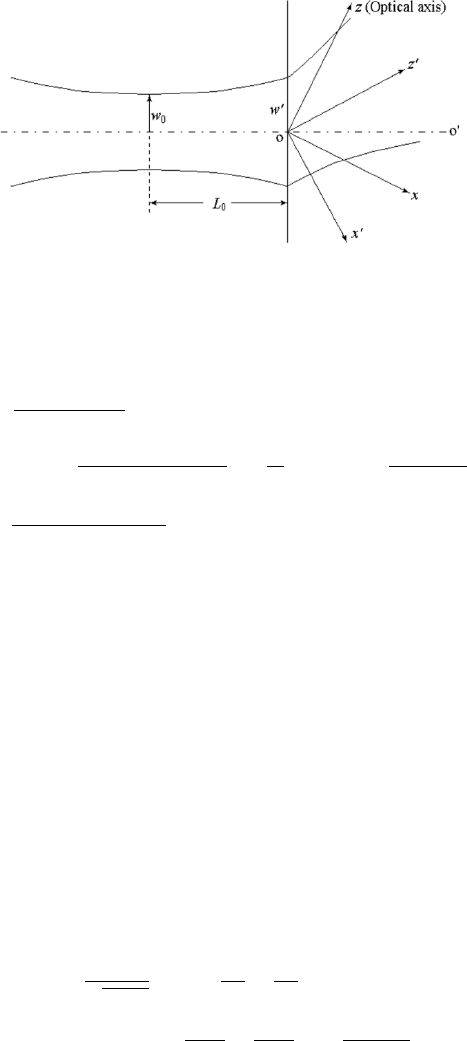
Figure 10.22: The distribution of a diffracted Gaussian beam at y
0
= 0 plane
for the case that n
e
> n
o
.
z
0y
0
=
−n
e
k
2
0
R
0
w
04
k
2
0
w
04
+ 4R
02
= −n
e
L
0
, (10.159)
φ
y
0
= arctan
·
2R
0
z
y
0
k
0
w
02
(n
e
R
0
+ z
y
0
)
¸
+
φ
0
2
= arctan
µ
z
y
0
− z
0y
0
s
y
0

, (10.160)
R
y
0
=
(z
y
0
− z
0y
0
)
2
+ s
2
y
0
z
y
0
− z
0y
0
. (10.161)
In the plane of x
0
= 0, the distribution is symmetric with respect to the z
0
axis, and the parameters relating to y
0
from (10.144)–(10.161) have definite
meanings. w
y
0
is the semi-width of the beam, and w
0y
0
is the semi-width
of the beam waist, both at the x
0
= 0 plane. In the plane of y
0
= 0, the
distribution is unsymmetrical, and the parameters relating to x
0
in (10.144)–
(10.161) do not have apparent meaning. If |n
2
e
−n
2
o
| ¿ n
2
e
+ n
2
o
, or the angle
α is very small, the terms including x
0
in (10.158) can be neglected, and the
beam parameters can be calculated in the y
0
= 0 plane.
If L
0
> 0 the waist of the diffracted beam is a virtual waist that is located
outside the crystal. In Fig. 10.22 the distribution of a diffracted Gaussian
beam at the y
0
= 0 plane is shown for the case that n
e
> n
o
. The beam axis
is close to the optical axis of the crystal, and the diffracted beam waist is in
free space, which is a virtual waist.
For the special case α = 90
◦
, the amplitude in the crystal is expressed as
ψ =
C
√
w
z
w
y
exp
µ
−
z
2
w
2
z
−
y
2
w
2
y

exp (jk
0
n
e
x)
×exp
·
−jk
0
µ
n
o
z
2
2R
z
+
n
e
y
2
2R
y

+ j
φ
z
+ φ
y
2
¸
, (10.162)

658 10. Scalar Diffraction Theory
where
w
z
= w
0
s
1 +
(Z
z
− Z
0z
)
2
S
2
z
, w
y
= w
0
s
1 +
(Z
y
− Z
0y
)
2
S
2
y
,
S
z
=
n
o
πw
2
0
λ
, S
y
=
n
e
πw
2
0
λ
,
Z
z
=
n
e
n
o
x, Z
y
= x,
Z
0z
= −n
o
L
0
, Z
0y
= −n
e
L
0
,
R
z
=
(Z
z
− Z
0z
)
2
+ S
2
z
Z
z
− Z
0z
, R
y
=
(Z
y
− Z
0y
)
2
+ S
2
y
Z
y
− Z
0y
,
φ
z
= arctan
Z
z
− Z
0z
S
z
, φ
y
= arctan
Z
y
− Z
0y
S
y
.
It should be noticed that this expression (10.162) is in the xyz coordinate
system, and the beam axis is along the x-axis. In y = 0 plane and z = 0
plane, the beam is symmetrical, but it is not axially symmetrical, and the
beam wrists in the two planes are not at the same position.
10.6 Eigenwave Expansions
of Electromagnetic Fields
In addition to the scalar diffraction theory discussed in the previous sections,
there is a straightforward method based on the superposition of eigenmodes
of the wave equation to deal with diffraction and beam propagation problem.
If the field distribution at a plane is given, the amplitudes and phases of the
eigenmodes constructing this field distribution can be obtained. When the
wave propagates to the next plane, the amplitudes of these eigenmodes do not
change but the relative phases change. The distribution at the new plane can
be derived through re-superposition of these eigenmodes. The mathematical
bases of this method is Fourier transformation. In this section we will discuss
it in both rectangular and cylindrical coordinate systems and deal with its
applications in anisotropic media and inhomogeneous media.
10.6.1 Eigenmode Expansion in a Rectangular
Coordinate System
In homogeneous media the eigenfunctions in a rectangular coordinate system
are uniform plane waves, and the plane waves in all directions constitute an
orthogonal and complete eigenmode set. The plane wave of scalar form can
be expressed as
E(x, y, z) = E
0
e
−jk·x
= E
0
exp[−j(k
x
x + k
y
y + k
z
z)], (10.163)

10.6 Eigenwave Expansions of Electromagnetic Fields 659
where |k| =
q
k
2
x
+ k
2
y
+ k
2
z
= k = ω
√
²µ and E
0
is the amplitude. Any
distribution of a monochromatic electromagnetic field is formed by the su-
perposition of eigenmodes. The spectrum of plane waves is continuous, so
the superposition is expressed as an integral:
ψ(x, y, z) =
1
2π
Z
∞
−∞
Z
∞
−∞
F (k
x
, k
y
) exp[−j(k
x
x + k
y
y + k
z
z)]dk
x
dk
y
, (10.164)
where F (k
x
, k
y
) represents the complex amplitude of plane waves whose wave
vectors have transverse components k
x
and k
y
. The values of k
x
and k
y
range
from −∞ to ∞, so k
z
may be an imaginary number. Supposing the complex
amplitude distribution at plane z = 0 is ψ
0
(x
0
, y
0
). We then have
ψ(x
0
, y
0
) =
1
2π
Z
∞
−∞
Z
∞
−∞
F (k
x
, k
y
) exp[−j(k
x
x
0
+ k
y
y
0
)]dk
x
dk
y
, (10.165)
where x
0
and y
0
are the transverse coordinates at the z = 0 plane. Expression
(10.165) is the Fourier transformation. From it we obtain
F (k
x
, k
y
) =
1
2π
Z
∞
−∞
Z
∞
−∞
ψ(x
0
, y
0
) exp[j(k
x
x
0
+ k
y
y
0
)]dx
0
dy
0
. (10.166)
We use F and F
−1
to represent Fourier and inverse Fourier transformations,
and (10.165) and (10.166) can be rewritten as
ψ
0
(x
0
, y
0
) = F[F (k
x
, k
y
)], (10.167)
F (k
x
, k
y
) = F
−1
[ψ
0
(x
0
, y
0
)]. (10.168)
Substitution of (10.168) into (10.164) yields
ψ(x, y, z) =
1
2π
Z
∞
−∞
Z
∞
−∞
F
−1
[ψ(x
0
, y
0
)] exp[−j(k
x
x + k
y
y + k
z
z)]dk
x
dk
y
=
1
2π
Z
∞
−∞
Z
∞
−∞
F
−1
[ψ
0
(x
0
, y
0
)] exp[−j(k
x
x + k
y
y)]
×exp
³
−j
q
k
2
− k
2
x
− k
2
y
z
´
dk
x
dk
y
= F
n
F
−1
[ψ
0
(x
0
, y
0
)] exp
³
−j
q
k
2
− k
2
x
− k
2
y
z
´o
. (10.169)
Within the paraxial condition, k
z
≈ k −
¡
k
2
x
+ k
2
y
¢
/(2k), and (10.169) is
expressed as
ψ(x, y, z) = e
−jkz
F
½
F
−1
[ψ
0
(x
0
, y
0
)] exp
·
j
2k
¡
k
2
x
+ k
2
y
¢
z
¸¾
. (10.170)
If the field distribution at the z = 0 plane is known, the distribution in the
whole space can be derived by applying (10.169) or (10.170).

660 10. Scalar Diffraction Theory
After some manipulation, (10.170) can be changed to the familiar diffrac-
tion formula. It can be written as
ψ(x, y, z) =
e
−jkz
(2π)
2
Z
∞
−∞
Z
∞
−∞
dx
0
dy
0
ψ
0
(x
0
, y
0
)
Z
∞
−∞
Z
∞
−∞
exp[−jk
x
(x−x
0
)−jk
y
(y−y
0
)]exp
·
j
2k
¡
k
2
x
+k
2
y
¢
z
¸
dk
x
dk
y
. (10.171)
The second integral in (10.171) is expressed as
Z
∞
−∞
Z
∞
−∞
exp
·
−jk
x
(x − x
0
) − jk
y
(y − y
0
) +
j
2k
¡
k
2
x
+ k
2
y
¢
z
¸
dk
x
dk
y
= exp
½
−jk
2z
£
(x − x
0
)
2
+ (y − y
0
)
2
¤
¾
×
Z
∞
−∞
Z
∞
−∞
exp
(
j
2k
·
k
x
−
k
z
(x−x
0
)
¸
2
z+
j
2k
·
k
y
−
k
z
(y−y
0
)
¸
2
z
)
dk
x
dk
y
=
j2πk
z
exp
½
−jk
2z
£
(x − x
0
)
2
+ (y − y
0
)
2
¤
¾
. (10.172)
Substitution of (10.172) into (10.171) yields
ψ(x, y, z) =
jke
−jkz
2πz
×
Z
∞
−∞
Z
∞
−∞
ψ
0
(x
0
, y
0
) exp
½
−jk
2z
£
(x − x
0
)
2
+ (y − y
0
)
2
¤
¾
dx
0
dy
0
. (10.173)
We notice that (10.173) is identical to (10.22) within the paraxial condition.
10.6.2 Eigenmode Expansion in a Cylindrical
Coordinate System
For simplicity, in this subsection we discuss only the field with axially sym-
metrical distribution. In the cylindrical coordinate system, the eigenmode in
uniform media is
E(ρ, z) = E
0
J
0
(k
ρ
ρ)e
−jk
z
z
, (10.174)
where k
2
ρ
+ k
2
z
= k
2
= ω
2
²µ and J
0
is the Bessel function of the zeroth order.
The electromagnetic field distribution can be expressed as an integral,
ψ(ρ, z) =
Z
∞
0
F (k
ρ
)J
0
(k
ρ
ρ)e
−jk
z
z
k
ρ
dk
ρ
, (10.175)
where F (k
ρ
) is the complex amplitude of the eigenmodes. At the plane of
z = 0, the field distribution is
ψ
0
(ρ
0
) =
Z
∞
0
F (k
ρ
)J
0
(k
ρ
ρ
0
)k
ρ
dk
ρ
, (10.176)