
Zhang K., Li D. Electromagnetic Theory for Microwaves and Optoelectronics
Подождите немного. Документ загружается.

Chapter 10
Scalar Diffraction Theory
Diffraction is an important topic in the study of the propagation of electro-
magnetic waves. For a wave that is incident on an aperture in an opaque
screen, the propagation of the wave in front of the screen is called diffraction.
In fact the propagation of wave beams with finite transverse dimensions can
also be treated by means of the approach for diffraction problems. Diffraction
is a common phenomenon of wave propagation. The diffraction law based
on scalar theory had been established before J.C. Maxwell established his
systematic electromagnetic theory.
In this chapter we discuss only the scalar diffraction theory. This theory
is valid for cases in which the dimensions of the aperture are much larger
than the wavelength. The diffraction field is dependent on the aperture form
and the incident waves. In general the incident waves include plane waves,
spherical waves and some kinds of beams.
We first derive Fresnel–Kirchhoff and Rayleigh–Sommerfeld diffraction
formulas from the scalar wave equation and Green theorem (in Section 10.1),
then deal with Fraunhofer diffraction and Fresnel diffraction for plane waves,
spherical waves, and Gaussian beams at round apertures (in Sections 10.2
and 10.3). Diffraction in anisotropic media is an important part of this
chapter, and we will discuss it in Sections 10.4 and 10.5. In the last section,
we deal with diffraction problems through an alternative approach, i.e. the
superposition of wave functions, and treat the propagation of wave beams in
isotropic, anisotropic, homogeneous, and inhomogeneous media.
10.1 Kirchhoff’s Diffraction Theory
10.1.1 Kirchhoff Integral Theorem
The basis of diffraction was founded by Huygens and Fresnel. Huygens pro-
posed the construction theory, Fresnel supplemented it with the interference
principle of the secondary wavelets, and the combination is the so-called
622 10. Scalar Diffraction Theory
Huygens–Fresnel principle. Later Kirchhoff put it on a sound mathematical
basis by expressing the field solution at any point in a closed surface as an in-
tegral in term of the field amplitude and its first derivative on the boundary,
which was realized through Green’s theorem. The second Green theorem is
expressed as
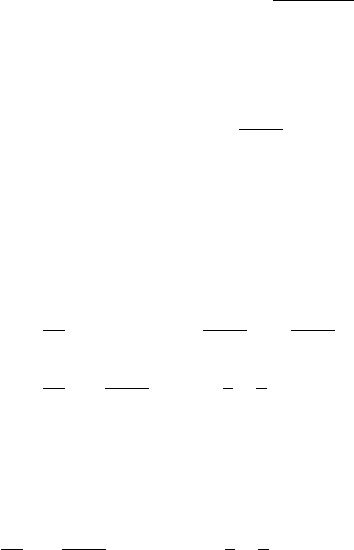
Z
V
0
[ψ(x
0
)∇
02
G(x
0
, x) −G(x
0
, x)∇
02
ψ(x
0
)]dV
0
=
I
S
0
[ψ(x
0
)∇
0
G(x
0
, x) −G(x
0
, x)∇
0
ψ(x
0
)] · dS
0
, (10.1)
where V
0
is a volume bounded by a closed surface S
0
, the direction of dS
0
is along the outward normal from S, and x and x
0
are vector coordinates of
points inside and on the closed surface. In the integration, x
0
is a variable and
x is a constant. ψ is a scalar function which represents an electromagnetic
component and satisfies the scalar Helmholtz equation
∇
2
ψ + k
2
ψ = 0. (10.2)
G(x
0
, x) is the Green function of Helmholtz’s equation, which satisfies
(∇
02
+ k
2
)G(x
0
, x) = −
δ(x
0
− x)
²
. (10.3)
In Section 1.5, it was proved that the solution of (10.3) in a uniform
medium is a spherical wave emitted from a point source
G(x
0
, x) =
e
−jkr
4π²r
, (10.4)
where r = |x − x
0
|. Expression (10.4) is called as the Green function of
the Helmholtz equation in unbounded space. It is different from the Green
function of Poisson’s equation by a factor e
−jkr
, i.e. a term of wave propa-
gation. Substitution of (10.3) and (10.4) into (10.1) yields the expression of
field amplitude at an arbitrary point within the closed surface
ψ(x) = −
1
4π
I
S
0
·
ψ(x
0
)∇
0
µ
e
−jkr
r

−
e
−jkr
r
∇
0
ψ(x
0
)
¸
· dS
0
= −
1
4π
I
S
0
e
−jkr
r
·µ
jk +
1
r

r
r
ψ(x
0
) − ∇
0
ψ(x
0
)
¸
· dS
0
, (10.5)
where the direction of dS
0
is taken as outward from the boundary. For
convenience, n is taken as the inward unit vector normal to the boundary,
so dS
0
= −ndS
0
, and (10.5) is rewritten as
ψ(x) = −
1
4π
I
S
0
e
−jkr
r
n ·
·
−
µ
jk +
1
r

r
r
ψ(x
0
) + ∇
0
ψ(x
0
)
¸
dS
0
, (10.6)
10.1 Kirchhoff’s Diffraction Theory 623
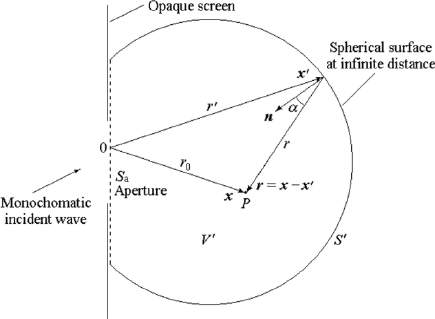
Figure 10.1: Diffraction from an aperture on a plane opaque screen.
which is called as the Kirchhoff integral theorem. With it, the complex am-
plitude of electromagnetic field can be derived from the complex amplitude
and its gradient on the boundary. In the integral, e
−jkr
/r denotes a spher-
ical wave from a point source, the amplitude of which is the dot product
between n and a vector function expressed in the square bracket. In other
words, the field in a closed boundary is expressed as the interferential su-
perposition of waves emitted from point sources on the boundary, which are
the secondary wavelets proposed by Huygens. The interferential principle of
secondary wavelets was proposed by Fresnel, so (10.6) is the mathematical
representation of the Huygens–Fresnel principle.
10.1.2 Fresnel–Kirchhoff Diffraction Formula
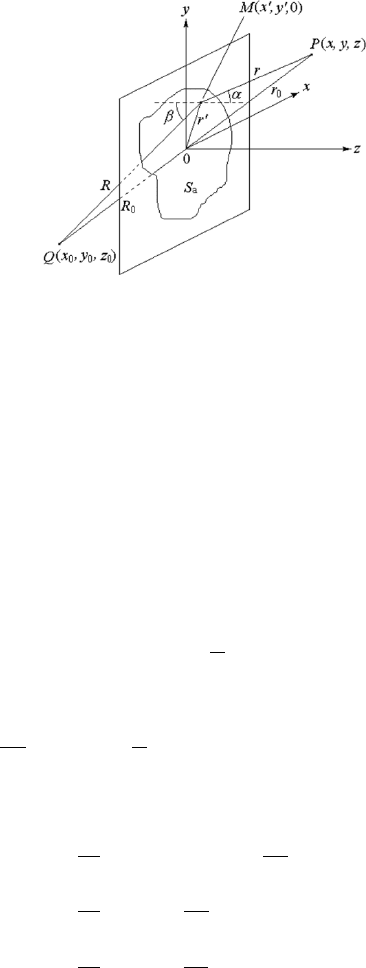
As shown in Fig. 10.1, a monochromatic wave is incident on a plane opaque
screen with an aperture. The incident wave may be of any distribution if the
variation of its phase and amplitude across the aperture is small and smooth.
P is a point at which the complex amplitude is to be determined. We denote
this point as the observation point or field point. The dimensions of the
aperture are small compared to the distance between P and the screen, and
large compared to the wavelength.
The integrating domain of formula (10.6) can be divided into three parts
which are the aperture, the non-illuminated side of the opaque screen ex-
cluding the aperture and a portion of a spherical surface at infinite distance.
The origin of the coordinate is located at an arbitrary point in the aperture.
x is the position vector of the observation point, x
0
is the position vector
624 10. Scalar Diffraction Theory
of a point on the boundary, and we assume that r
0
= |x|, r
0
= |x
0
|, and
r = |x − x
0
|.
We first carry out integration on the opaque screen and the aperture.
The value of ψ and ∇
0
ψ on them are never known exactly, and consequently
Kirchhoff made the following assumptions.
1. In the aperture, ψ and its derivative along the normal from S, ∂ψ/∂n,
are identical to those of the incident wave in the absence of the opaque
screen.
2. On the opaque screen, ψ = 0 and ∂ψ/∂n = 0.
These assumptions are called Kirchhoff’s boundary conditions and are the
basis of Kirchhoff diffraction theory. Obviously, Kirchhoff’s boundary condi-
tions do not agree with rigorous electromagnetic theory. As the dimensions
of the aperture are much larger than the wavelength, the first assumption
will not introduce much error. Only the field near the rim of the aperture
is disturbed, and as long as the aperture is large enough compared with
the wavelength, the edge effect can be ignored. Nevertheless, the second as-
sumption is strictly contradictory to electromagnetic theory. According to
electromagnetic theory, if the field amplitude on a surface and its derivative
along the normal to the surface are zero in the field region, the field will be
zero everywhere. Even so, if the dimensions of the aperture are much larger
than the wavelength, Kirchhoff’s b oundary conditions are still acceptable.
The second assumption can be modified to avoid the contradiction through
choosing an appropriate Green function.
Next we analyze the integration on the spherical portion. Obviously, the
field on the spherical surface is caused by the disturbance in the aperture.
As r
0
→ ∞, the field amplitude on the spherical surface is
ψ(x
0
) =
e
−jkr
0
r
0
, (10.7)
and its derivative along the inward normal from S
0
is
n · ∇
0
ψ(x
0
) =
µ
jk +
1
r
0

ψ(x
0
). (10.8)
Obviously, if r
0
→ ∞, then r/r = n, 1/r = 1/r
0
. On the spherical surface we
have
n ·
·
−
µ
jk +
1
r

r
r
ψ(x
0
) + ∇
0
ψ(x
0
)
¸
= 0. (10.9)
The integral on the spherical surface is zero.
By applying Kirchhoff’s boundary conditions, we find the complex am-
plitude at an arbitrary point in front of the aperture will be
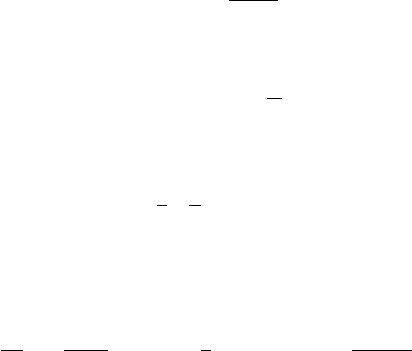
ψ(x) = −
1
4π
Z
S
a
e
−jkr
r
·
−
µ
jk +
1
r

ψ(x
0
) cos α +
∂ψ(x
0
)
∂n
¸
dS
0
, (10.10)
10.1 Kirchhoff’s Diffraction Theory 625
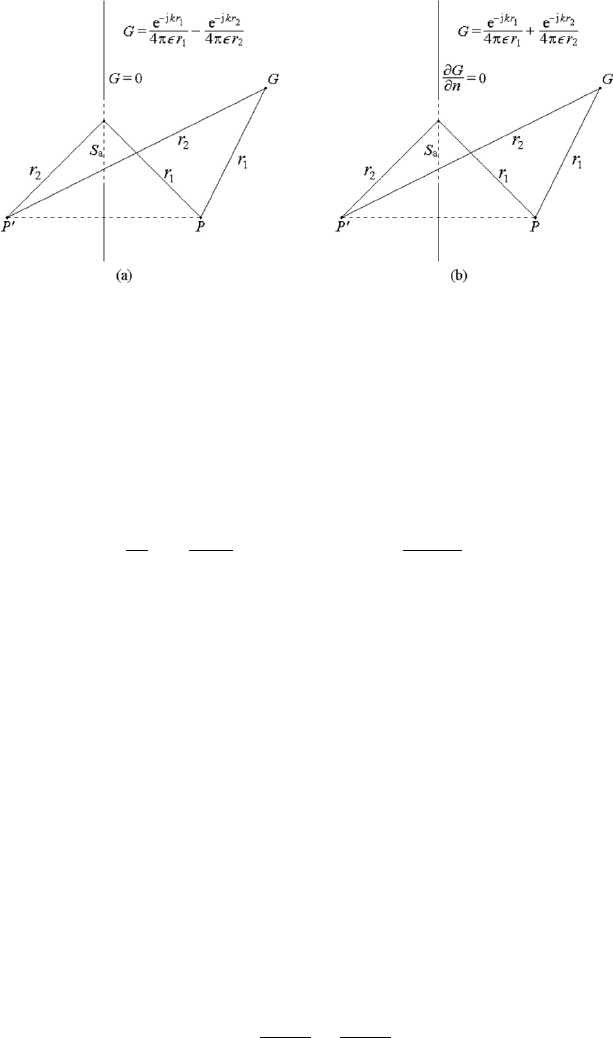
Figure 10.2: Right half-space Green functions of the first kind (a), and the
second kind (b).
where S
a
is the aperture surface and α is the angle between r and n.
Kirchhoff’s boundary conditions require that the observation point is far
from the aperture, otherwise the edge effect may not be neglected. For r À λ,
(10.10) is simplified to
ψ(x) = −
1
4π
Z
S
a
e
−jkr
r
·
−jkψ(x
0
) cos α +
∂ψ(x
0
)
∂n
¸
dS
0
, (10.11)
where the integrating domain is the aperture only.
10.1.3 Rayleigh–Sommerfeld Diffraction Formula
In the last subsection, the choice of the Green function of the unbounded
space leads to the requirement for the second item of Kirchhoff’s boundary
conditions. To avoid the assumption that both the field amplitude and its
derivative are zero on the opaque screen simultaneously, we can adopt Green
functions of half-space, which are divided into two kinds called the half-space
Green functions of the first kind and that of the second kind.
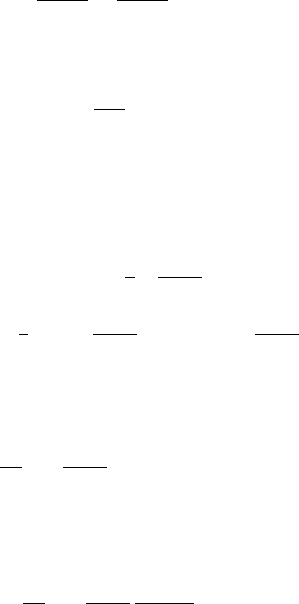
As shown in Fig. 10.2(a) and (b), P is a point to the right of a screen,
and P
0
is the mirror image point of P . If two point sources with the same
amplitude are placed at P and P
0
, they form the Green function of half-space.
If the two point sources have reverse phases, they compose the half-space
Green function of the first kind. If they have identical phases, they compose
the half-space Green function of the second kind.
The half-space Green function of the first kind is
G =
e
−jkr
1
4π²r
1
−
e
−jkr
2
4π²r
2
. (10.12)
626 10. Scalar Diffraction Theory
In the right half-space it satisfies (10.3). On the opaque screen and in the
aperture
G = 0. (10.13)
Choice of the half-space Green function of the first kind will leave out the
requirement that the field derivative is zero on the opaque screen.
The half-space Green function of the second kind is
G =
e
−jkr
1
4π²r
1
+
e
−jkr
2
4π²r
2
. (10.14)
It satisfies (10.3) in the right half-space. On the opaque screen and in the
aperture
∇
0
G · n =
∂ G
∂ n
= 0. (10.15)
Choice of the half-space Green function of the second kind will leave out the
requirement that the field amplitude is zero on the opaque screen.
On the screen and in the aperture r
1
= r
2
= r and the gradient of the
half-space Green function of the first kind is
∇
0
G = (∇
0
r
1
− ∇
0
r
2
)
µ
−jk −
1
r

e
−jkr
4π²r
= 2n cos α
µ
1
r
+ jk

e
−jkr
4π²r
≈ 2jkn cos α
e
−jkr
4π²r
, (10.16)
where α is the angle between r
1
and the normal of the screen. Substitution
of (10.16) into (10.1) yields the diffraction field
ψ(x) =
jk
2π
Z
S
a
e
−jkr
r
cos αψ(x
0
)dS
0
. (10.17)
In obtain (10.17), G = 0 in the aperture and r À λ are used.
From the half-space Green function of the second kind, we derive the
diffraction field
ψ(x) = −
1
2π
Z
S
a
e
−jkr
r
∂ψ(x
0
)
∂n
dS
0
. (10.18)
The above formulas are two kinds of Rayleigh–Sommerfeld diffraction
formulas. In applying the half-space Green functions to derive the diffraction
field, we can assume the field distribution on the opaque screen separately.
For the half-space Green function of the first kind, only the field itself is
assumed to be zero; for the second sort of half-space Green function only
the derivative of the field is assumed to be zero, and this has avoided the
contradiction in Kirchhoff’s boundary condition.
From (10.11), (10.17), and (10.18) we know that the Fresnel–Kirchhoff
diffraction formula is the average of two kinds of Rayleigh–Sommerfeld
diffraction formulas.
10.2 Fraunhofer and Fresnel Diffraction 627
Figure 10.3: Coordinate system for the diffraction of spherical wave.
10.2 Fraunhofer and Fresnel Diffraction
10.2.1 Diffraction Formulas for Spherical Waves
Fig. 10.3 shows that a spherical wave sent from Q is incident on an aperture
in a opaque screen. The coordinate system is set to make the screen lie in the
xy plane and the origin O be a point in the ap erture. P is the observation
point and M is an arbitrary point in the aperture. The angles which the lines
QM and P M make with the normal are β and α, respectively. The complex
amplitude of the incident wave in the aperture is
ψ(x
0
) =
1
R
e
−jkR
. (10.19)
The derivative of ψ along the p ositive z direction is
∂ψ
∂n
= −
µ
jk +
1
R

cos βψ(x
0
) ≈ −jk cos βψ(x
0
). (10.20)
Substitution of (10.19) and (10.20) into (10.11), (10.17), and (10.18) yields
ψ(x) =
jk
4π
Z
S
a
(cos α + cos β)
1
rR
e
−jk(r+R)
dS
0
, (10.21)
ψ(x) =
jk
2π
Z
S
a
cos α
1
rR
e
−jk(r+R)
dS
0
, (10.22)
ψ(x) =
jk
2π
Z
S
a
cos β
1
rR
e
−jk(r+R)
dS
0
. (10.23)
It is meaningless to discuss which of the three diffraction formulas is more
accurate, because they are all derived under some approximate conditions.

628 10. Scalar Diffraction Theory
Near the edge of the aperture the assumed boundary conditions are much
more different from the real ones. In order to reduce the edge effect we need
to make some restrictions. First, the dimensions of the aperture are much
larger than the wavelength. Second, the distances of the observation point
and the source point from the aperture are much larger than the dimensions
of the aperture. Third, the phase variation of the incident wave across the
aperture is small and smooth, which means that the incident angle must not
be too large. Based on these restricting conditions, cos α and cos β are nearly
invariable over the aperture. Furthermore we may predict that the diffraction
field must distribute near a line which passes through Q and the aperture
center, which means α ≈ β, and the three diffraction formulas are identical.
Now we investigate minutely the diffraction integral under the paraxial
condition. Letting cos α = cos β = 1 in (10.21), we obtain
ψ(x) =
jk
2π
Z
S
a
1
rR
e
−jk(r+R)
dS
0
, (10.24)
where R and r in the dominator can be replaced by R
0
, the distance of the
source point to the coordinate origin, and r
0
, the distance of the observation
point to the coordinate origin, respectively. R and r in the exponential factor
cannot be replaced, because they are related to the phase variation. Generally
r + R will change by many wavelengths as M is at different locations. Then
(10.24) is simplified to
ψ(x) =
jk
2πR
0
r
0
Z
S
a
e
−jk(r+R)
dS
0
. (10.25)
The distance from P (x, y, z) to M(x
0
, y
0
, 0) is
r =
p
(x − x
0
)
2
+ (y − y
0
)
2
+ z
2
≈ r
0
−
xx
0
+ yy
0
r
0
+
x
02
+ y
02
2r
0
, (10.26)
where r
0
=
p
x
2
+ y
2
+ z
2
. The distance from Q(x
0
, y
0
, z
0
) to M(x
0
, y
0
, 0) is
R = QM =
q
(x
0
− x
0
)
2
+ (y
0
− y
0
)
2
+ z
2
0
≈ R
0
−
x
0
x
0
+ y
0
y
0
R
0
+
x
02
+ y
02
2R
0
, (10.27)
where R
0
=
p
x
2
0
+ y
2
0
+ z
2
0
. Substituting (10.26) and (10.27) into (10.25)
yields
ψ(x) =
jk
2πR
0
r
0
e
−jk(R
0
+r
0
)
Z Z
e
jkf (x
0
,y
0
)
dx
0
dy
0
, (10.28)
where
f(x
0
, y
0
)=
µ
x
r
0
+
x
0
R
0

x
0
+
µ
y
r
0
+
y
0
R
0

y
0
−
1
2
µ
1
r
0
+
1
R
0

¡
x
02
+y
02
¢
. (10.29)
10.2 Fraunhofer and Fresnel Diffraction 629
Figure 10.4: The pattern of Fraunhofer diffraction.
If R
0
and r
0
are so large that the phase variation caused by the quadratic
terms of x
0
and y
0
in (10.29) can be neglected, the result of (10.28) is called
Fraunhofer diffraction. In fact it is the diffraction of a plane wave with the
observation point located at infinite distance.
In practical applications it is not necessary to place the wave source and
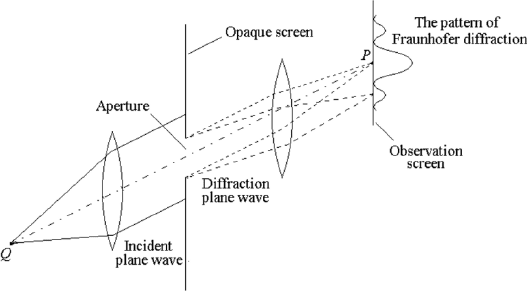
the observation point at an infinite distance. In Fig. 10.4, a lens parallel to
the screen is located to its left, and the point source is placed at the focal
plane of the lens. In this way the incident wave will be approximately a plane
wave. To the right of the screen, another lens parallel to the screen is placed,
and at the focal plane of the second lens the pattern of Fraunhofer diffraction
will be displayed on an observation screen.
If the quadratic term of (10.29) cannot be neglected, the result is called
Fresnel diffraction, which is the diffraction with the observation point at a
finite distance. Fraunhofer diffraction is suitable for calculations of the far-
field distribution, and Fresnel diffraction is suitable for calculations of the
distribution in a medium range. For the near-field, Kirchhoff’s boundary
conditions are not valid, and the diffraction theory is not suitable for calcu-
lations of this kind of field distribution.
10.2.2 Fraunhofer Diffraction at Circular Apertures
As mentioned previously, Fraunhofer diffraction is the diffraction of plane
waves with the observation point at an infinite distance. For a normally
incident plane wave both x
0
/R
0
and y
0
/R
0
are zero in (10.29). Neglecting
the second-order term of x
0
and y
0
in (10.29) and substituting it into (10.28),
630 10. Scalar Diffraction Theory
Figure 10.5: Coordinate system for the Fraunhofer diffraction at a circular
aperture.
we obtain the field amplitude of Fraunhofer diffraction:
ψ =
A
r
0
Z Z
exp
·
jk
µ
xx
0
r
0
+
yy
0
r
0
¶¸
dx
0
dy
0
, (10.30)
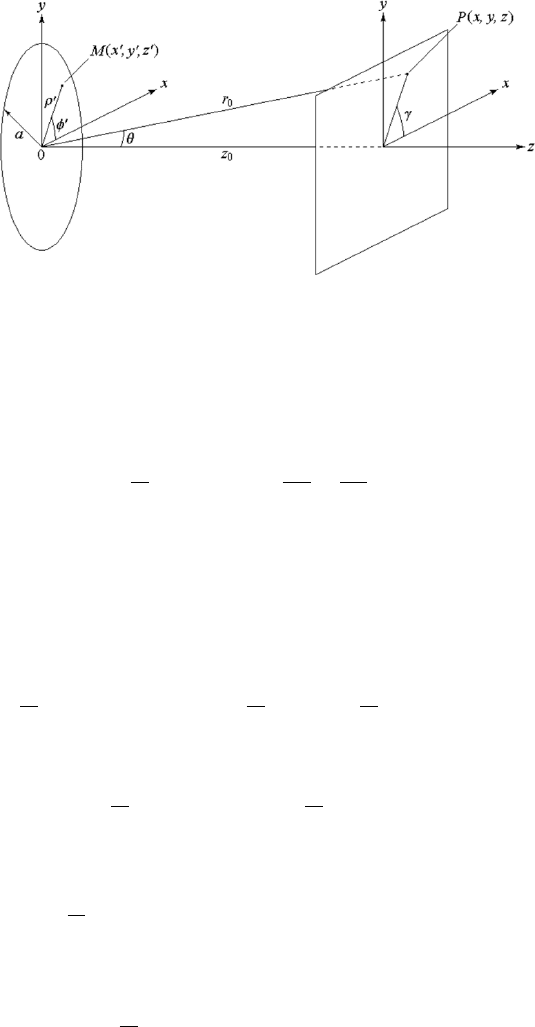
where A is a constant. As shown in Fig. 10.5, we can carry out the integral
in a polar coordinate system of ρ
0
and φ
0
. For the diffraction at a circular
aperture with radius a the origin of the coordinate system is at the center of
the aperture.
By coordinate substitution that x
0
= ρ
0
cos φ
0
and y
0
= ρ
0
sin φ
0
, (10.30)
becomes
ψ =
A
r
0
Z
a
0
ρ
0
dρ
0
Z
2π
0
exp
·
jk
µ
x
r
0
ρ
0
cos φ
0
+
y
r
0
ρ
0
sin φ
0
¶¸
dφ
0
. (10.31)
From Fig. 10.5, we have
x
r
0
= sin θ cos γ,
y
r
0
= sin θ sin γ. (10.32)
Substitution of (10.32) into (10.31) yields
ψ =
A
r
0
Z
a
0
ρ
0
dρ
0
Z
2π
0
exp[jkρ
0
sin θ cos(φ
0
− γ)]dφ
0
. (10.33)
Since γ is invariant, (10.33) is the same as
ψ =
A
r
0
Z
a
0
ρ
0
dρ
0
Z
2π
0
exp(jkρ
0
sin θ cos φ
0
)dφ
0
. (10.34)