
Zhang K., Li D. Electromagnetic Theory for Microwaves and Optoelectronics
Подождите немного. Документ загружается.

10.2 Fraunhofer and Fresnel Diffraction 631
0 2 4 6 8
0.0
.2
.4
.6
.8
1.0
k a sin
T
0
II
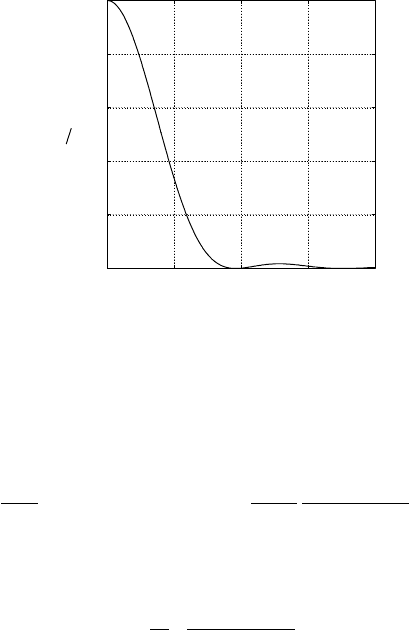
Figure 10.6: Intensity distribution of the Fraunhofer diffraction at a circular
aperture.
By introducing the integral representation and the derivative formula of
Bessel function, we express (10.34) as
ψ =
2πA
r
0
Z
a
0
ρ
0
J
0
(kρ
0
sin θ)dρ
0
=
πa
2
A
r
0
2J
1
(ka sin θ)
ka sin θ
, (10.35)
where J
0
and J
1
are Bessel functions of the zeroth order and the first order.
The diffraction intensity is then
I =
I
0
r
2
0
·
2J
1
(ka sin θ)
ka sin θ
¸
2
, (10.36)
where I
0
is a constant, I
0
/r
2
0
≈ I
0
/z
2
0
is the intensity on the axis. The
intensity distribution is shown in Figure 10.6.
The intensity distribution is dependent on the diffraction angle θ. At
θ = 0 it has the principal maximum, and with the increase in θ it oscillates
with gradually diminishing amplitude. When the intensity is zero, there are
concentric dark rings. The dark rings correspond to the roots of the first-
order Bessel function; that is
J
1
(ka sin θ) = 0. (10.37)
The first dark ring occurs where sin(θ) = 3.832λ/2πa = 1.22λ/d, where d is
the diameter of the aperture. It is easy to prove that about 84% of the total
energy is contained in the region bounded by the first dark ring, and about
90% of the total energy is in the region bounded by the second dark ring.
Where the intensity takes the maxima, there are concentric bright rings. The
diffraction angles corresponding to the bright rings are determined by
J
2
(ka sin θ) = 0, (10.38)
632 10. Scalar Diffraction Theory
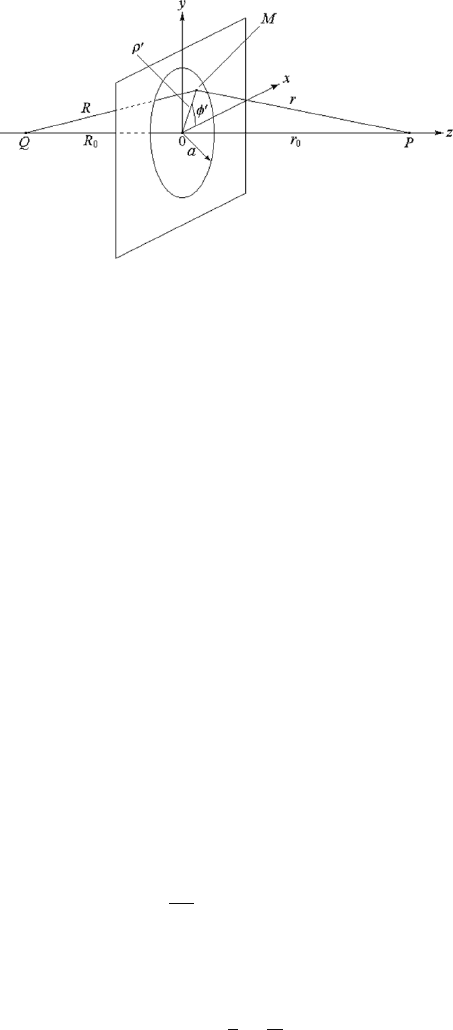
Figure 10.7: Coordinate system for the Fresnel diffraction at a circular aper-
ture.
but the principal maximum of the intensity is located on the axis.
10.2.3 Fresnel Diffraction at Circular Apertures
In Fraunhofer diffraction, the source and the observation point are both at
an infinite distance from the aperture, but in Fresnel diffraction at least the
observation point is at a finite distance. The calculation of Fresnel diffraction
is very complicated compared with that of Fraunhofer diffraction. Even for
a long narrow slit it will still involve the Fresnel integrals. With the applica-
tion of electronic computers this problem becomes simple, and the classical
method is unnecessary. In this section we will discuss only the simplest ex-
ample to illustrate the basic properties of Fresnel diffraction.
We deal with Fresnel diffraction of a spherical wave normally incident on
a circular aperture, as shown in Figure 10.7. For simplicity, we calculate
only the diffraction field distribution on the axis passing through the center
of the aperture. The calculation is carried out in a polar coordinate system.
Expression (10.24) is directly used to derive the diffraction field distribution.
In the polar coordinate system the integral is expressed as
ψ = jk
Z
a
0
1
rR
exp[−jk(r + R)]ρ
0
dρ
0
. (10.39)
From the relations ρ
02
+ r
2
0
= r
2
and ρ
02
+ R
2
0
= R
2
, we obtain
d(r + R) =
µ
1
r
+
1
R

ρ
0
dρ
0
. (10.40)
10.2 Fraunhofer and Fresnel Diffraction 633
Substitution of (10.40) into (10.39) yields
ψ = jk
Z
1
r + R
exp[−jk(r + R)]d(r + R). (10.41)
For the case that r
0
and R
0
are much larger than the radius of the aperture,
(10.41) becomes
ψ =
jk
r
0
+ R
0
Z
ξ
2
ξ
1
exp(−jkξ)dξ =
1
r
0
+ R
0
¡
e
−jkξ
1
− e
−jkξ
2
¢
, (10.42)
where ξ
1
= r
0
+ R
0
, ξ
2
=
p
a
2
+ r
2
0
+
p
a
2
+ R
2
0
. Expression (10.42) can be
further expressed as
ψ =
1
r
0
+ R
0
exp[−jk(r
0
+ R
0
)]
×
½
1 − exp
·
−jk
µ
q
a
2
+ r
2
0
+
q
a
2
+ R
2
0
− r
0
− R
0
¶¸¾
= ψ
0
(1 − e
−jkq
), (10.43)
where ψ
0
is the amplitude at P of a spherical wave sent from a source located
at Q in the absence of the opaque screen. q is the route difference between
QMP and QP where M is a point at the rim of the circular aperture. The
route difference q is expressed as
q =
q
a
2
+ r
2
0
+
q
a
2
+ R
2
0
− (r
0
+ R
0
). (10.44)
From (10.43), the optical intensity at P is
I = 4I
0
sin
2
µ
kq
2

= 4I
0
sin
2
³
πq
λ
´
, (10.45)
where I
0
is the intensity in the absent of the opaque screen. If q is a multiple
of half-wavelength, the optical intensity is maximum or zero. Accordingly,
the radius of the aperture satisfies
q
a
2
+ r
2
0
+
q
a
2
+ R
2
0
− (r
0
+ R
0
) =
nλ
2
, (10.46)
that is,
P M + QM − P Q =
nλ
2
, (10.47)
where n is an integer. Under the condition formulated by (10.47), the aper-
ture is said to contain n half-period zones. At the observation point P ,
the field amplitudes caused by two neighboring half zones cancel each other.
Whether the intensity is maximum or minimum depends on whether n is an
even number or an odd number. If n is an even number, the intensity is
634 10. Scalar Diffraction Theory
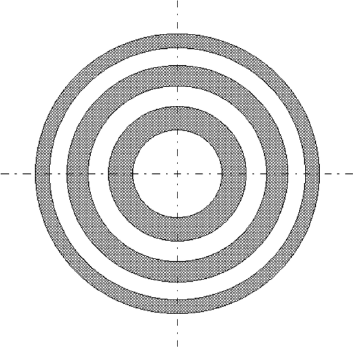
Figure 10.8: Fresnel half-zone lens.
zero. If n is an odd number, the intensity is maximum. In Fig. 10.8, the
alternate half zones are blackened, and the amplitude at p is N times that
caused by a half zone; here N is the total number of the transparent half
zones. Such a zone plate is called a Fresnel half-zone lens, which is widely
used in optical instruments. If the alternate half zones are not blackened,
and instead an additional phase shift of half wavelength is attached to them,
the optical amplitude will be M times that caused by a half zone; here M is
the total number of half zones.
10.3 Diffraction of Gaussian Beams
Because of the importance of Gaussian beams in modern optics and opto-
electronics, it is necessary to study their diffraction [108]. In this section
we discuss only the diffraction at circular apertures. For apertures of other
forms, there are no analytical solutions in general.
10.3.1 Fraunhofer Diffraction of Gaussian Beams
In Fraunhofer diffraction, the incident wave front at the aperture is required
to be planar, and this condition can be satisfied only as the aperture is located
at the beam waist or far from the beam waist. The latter is the same as the
diffraction of a plane wave, and in this section we discuss only the former.
As shown in Fig. 10.9, a Gaussian beam is normally incident on a circular
aperture whose radius is a. The beam waist is located at the aperture, and its
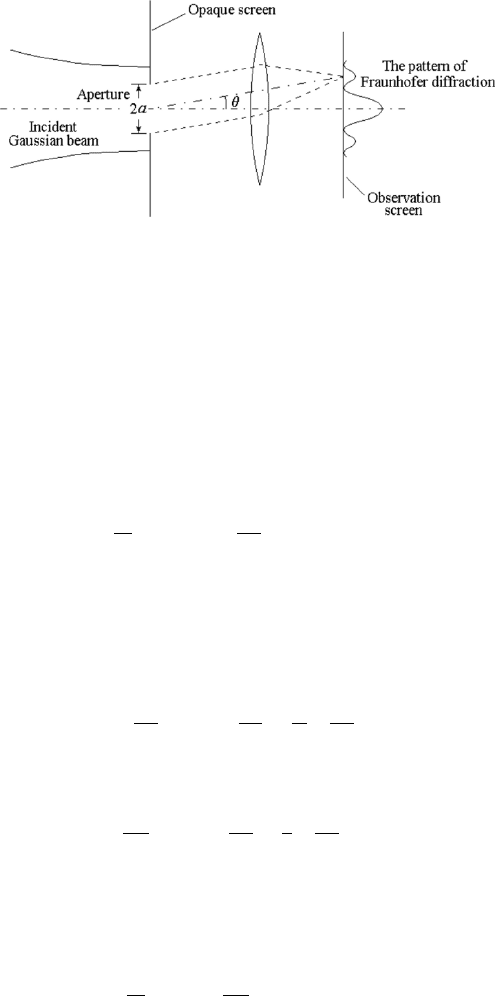
10.3 Diffraction of Gaussian Beams 635
Figure 10.9: Fraunhofer diffraction of Gaussian beam at a circular aperture
located at the beam waist.
radius is larger than that of the aperture, otherwise the aperture is unneces-
sary. On the other hand, if the radius of the aperture is too small compared
with the beam waist, the situation will be identical to the diffraction of a
plane wave. With the same approach as in dealing with the diffraction of
a plane wave, the integral formula of Fraunhofer diffraction of a Gaussian
beam at a circular aperture is expressed as
ψ =
A
r
0
Z
a
0
exp
µ
−
ρ
02
w
2
0

J
0
(kρ
0
sin θ)ρ
0
dρ
0
, (10.48)
where A is a constant, w
0
is the radius of the incident beam waist, θ is the
diffraction angle, and r
0
is the distance from the observation point to the
center of the aperture. Under the condition that a
2
¿ w
2
0
the exponential
term in the integral is expanded as
exp
µ
−
ρ
02
w
2
0

= 1 −
ρ
02
w
2
0
+
1
2!
µ
ρ
02
w
2
0

2
− ···. (10.49)
Here we introduce the series expansion of Bessel function of the zeroth order:
J
0
µ
2ρ
0
w
0

= 1 −
ρ
02
w
2
0
+
1
4
µ
ρ
02
w
2
0

2
− ···. (10.50)
Obviously, if a
2
¿ w
2
0
, replacing the exponential term in the integral with
the Bessel function is better than neglecting the second-order term in (10.49),
and we make such a replacement. The integral is then
ψ =
A
r
0
Z
a
0
J
0
µ
2ρ
0
w
0

J
0
(kρ
0
sin θ)ρ
0
dρ
0
. (10.51)
According to the integral formula for the product of Bessel functions, the
636 10. Scalar Diffraction Theory
amplitude of the diffracted field is then
ψ =
Aa
2
r
0
"
a
2
k
2
sin
2
θ −
µ
2a
w
2
0

2
#
×
·
ka sin θ J
1
(ka sin θ) J
0
µ
2a
w
0

−
2a
w
0
J
0
(ka sin θ) J
1
µ
2a
w
0
¶¸
. (10.52)
The dark rings are determined by
ka sin θJ
1
(ka sin θ)J
0
µ
2a
w
0

−
2a
w
0
J
0
(ka sin θ)J
1
µ
2a
w
0

= 0. (10.53)
The series expansion of J
1
is
J
1
µ
2a
w
0

=
a
w
0
−
1
2
µ
a
w
0

3
+ ···. (10.54)
For a ¿ w
0
, we only take the first two terms of the expansion of J
0
and the
first term of the expansion of J
1
, and (10.53) is expressed as
xJ
1
(x) −
2a
2
w
2
0
− a
2
J
0
(x) = 0, (10.55)
where x = ka sin θ. The value of x for dark rings is determined by (10.55),
whereas the value of x for dark rings in diffraction of a uniform plane wave
is determined by J
1
(x) = 0 (x 6= 0). We can compare the difference between
them. Let x
0
be a root of J
1
(x) (x 6= 0), and x
0
+ ∆x be the solution of
(10.55), we have
d
dx
[xJ
1
(x)]
x=x
0
∆x −
2a
2
w
2
0
− a
2
·
dJ
0
(x)
dx
|
x=x
0
∆x + J
0
(x
0
)
¸
= 0. (10.56)
Introducing the derivative of Bessel functions, we obtain
x
0
J
0
(x
0
)∆x +
2a
2
w
2
0
− a
2
[J
1
(x
0
)∆x − J
0
(x
0
)] = 0. (10.57)
Because J
1
(x
0
) = 0, (10.57) is simplified to
∆x =
2a
2
x
0
(w
2
0
− a
2
)
. (10.58)
Substitution of x = ka sin θ into (10.58) yields
∆θ =
4
k
2
(w
2
0
− a
2
) sin 2θ
0
, (10.59)
10.3 Diffraction of Gaussian Beams 637
0 2 4 6 8
0.0
.2
.4
.6
.8
1.0
Plane wave
Gauss beam
0
II
k a sin
T
1 wa
Figure 10.10: Comparison of the intensity distributions of Fraunhofer diffrac-
tion of Gaussian beam and plane wave.
where θ
0
is the diffraction angle corresponding to a dark ring for plane-wave
incidence. Expression (10.59) shows that the diffraction angle of a Gaussian
beam is larger than that of a plane wave, and the lower the diffraction order,
the larger the difference between the diffraction angles is. From (10.59) we
can derive the relative difference of the diffraction angles between a Gaus-
sian beam and a plane wave. As the diffraction angle is small, we take the
approximation that sin θ = θ and cos θ = 1, and (10.59) is expressed as
∆θ
θ
0
=
2
(kaθ
0
)
2
µ
w
2
0
a
2
− 1

=
2
x
2
1n
µ
w
2
0
a
2
− 1

, (10.60)
where x
1n
is the nth root of the Bessel function of the first order. In Table
10.1, we give the first three roots of J
1
(x) and the relatively increasing quan-
tities of the diffraction angles of a Gaussian beam with respect to those of a
plane wave for different a/w
0
.
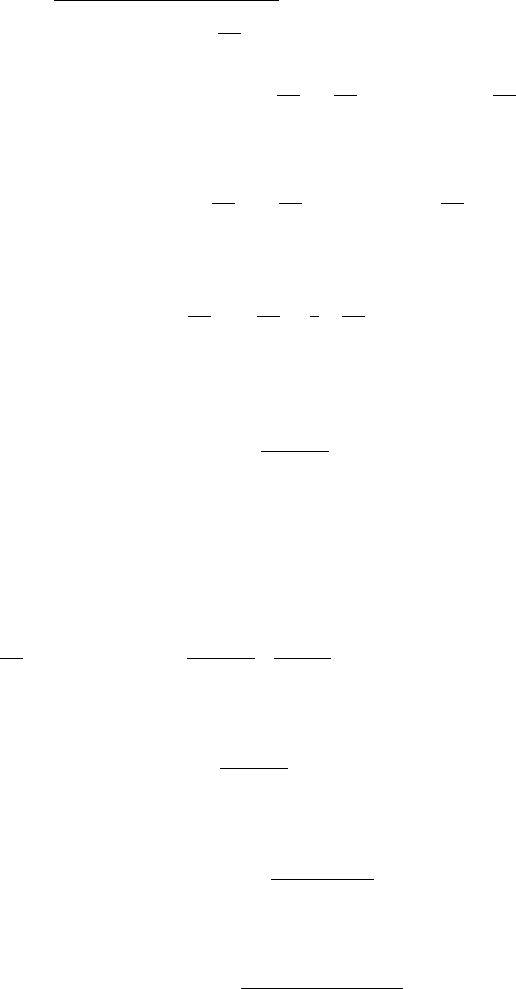
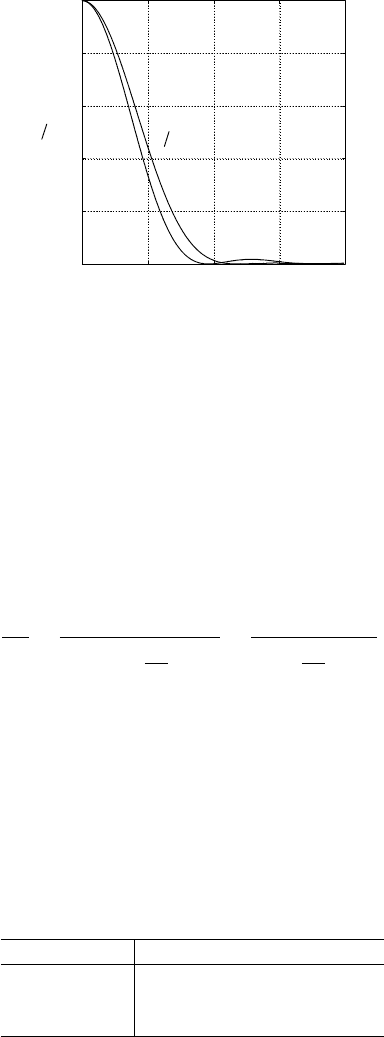
In Fig. 10.10, the solid curve represents the intensity of Fraunhofer diffrac-
tion of a Gaussian beam at a circular aperture, and the dashed curve repre-
sents that of a plane wave at the same aperture.
Table 10.1 x
1n
and ∆θ/θ
0
∆θ/θ
0
a/w
0
= 0.5 a/w
0
= 0.25
x
11
= 3.832 4.5% 0.9%
x
12
= 7.016 1.35% 0.27%
x
13
= 10.173 0.64% 0.13%
638 10. Scalar Diffraction Theory
Figure 10.11: Fresnel diffraction of a Gaussian beam at a circular aperture.
10.3.2 Fresnel Diffraction of Gaussian Beams
As in the discussion of the Fresnel diffraction of a plane wave, here we discuss
only the diffraction intensity on the axis. In Fresnel diffraction there is no
requirement that the aperture must be located at the beam waist, so in the
aperture the amplitude and phase of the incident wave are both variable.
It is easy to prove that three diffraction formulas will give the same results
under the paraxial condition, and here we choose the Rayleigh–Sommerfeld
diffraction integral of the first kind. For normal incidence the inclination
factor in the integral is omitted.
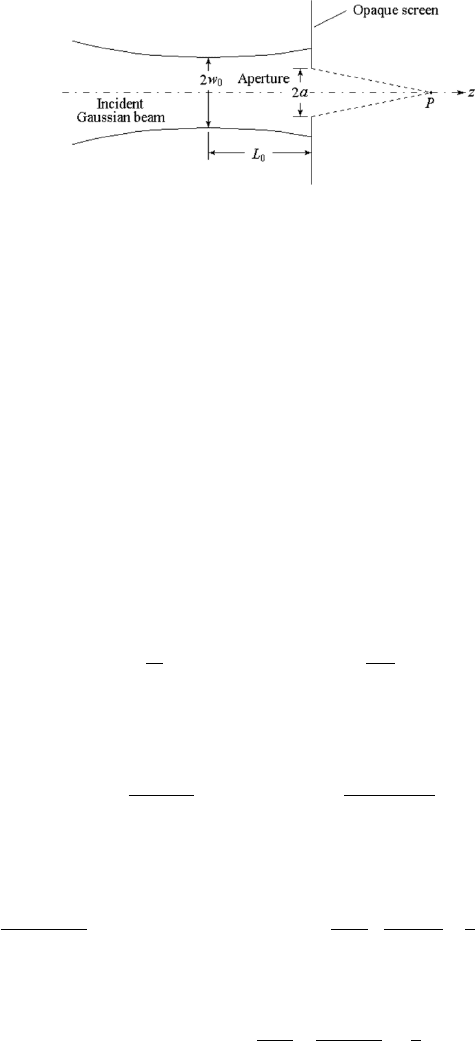
In Fig. 10.11, a Gaussian beam whose beam waist is located at L
0
left
of the ap erture is normally incident on it. The radius of the beam waist is
w
0
, and the radius of the aperture is a. From (10.17) the Fresnel diffraction
integral at the observation point P on the axis is
ψ(z) =
jk
z
Z
a
0
ψ
0
exp
·
−jkz
µ
1 −
ρ
02
2z
2
¶¸
ρ
0
dρ
0
, (10.61)
where z is the distance from P to the aperture center. The amplitude of the
incident beam in the aperture is
ψ
0
=
A
L
0
+ js
exp
½
−jk
·
L
0
+
ρ
02
2(L
0
+ js)
¸¾
, (10.62)
where A is a constant and s is the confocal parameter of the incident beam.
Substituting (10.62) into (10.61), we obtain
ψ =
A
L
0
+z+js
exp[−jk(L
0
+z)]
½
1−exp
·
−
jka
2
2
µ
1
L
0
+js
+
1
z
¶¸¾
. (10.63)
(10.63) can also be expressed as
ψ = ψ
0
½
1 − exp
·
−
jka
2
2
µ
1
L
0
+ js
+
1
z
¶¸¾
, (10.64)
10.3 Diffraction of Gaussian Beams 639
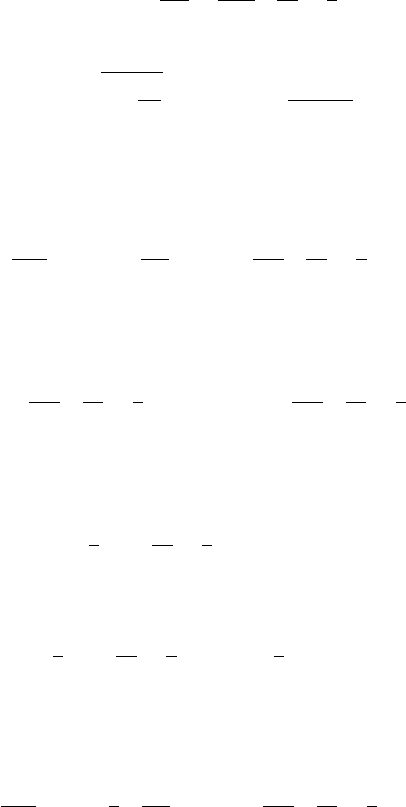
where ψ
0
is the amplitude at the observation point in the absence of the
opaque screen. (10.64) can be further expressed as
ψ = ψ
0
½
1 − exp
·
−
a
2
w
02
−
jka
2
2
µ
1
R
0
+
1
z
¶¸¾
, (10.65)
where
w
0
= w
0
r
1 +
L
2
0
s
2
, R
0
=
L
2
0
+ s
2
L
0
. (10.66)
In the above formulas, w
0
is the radius of the beam waist, and w
0
and R
0
are
the beam radius and the curvature radius at the aperture, respectively. The
intensity is then
I = 2I
0
exp
µ
−a
2
w
02
¶½
cosh
µ
a
2
w
02

− cos
·
ka
2
2
µ
1
R
0
+
1
z
¶¸¾
, (10.67)
where I
0
is the intensity at P in the absence of the screen. As a/w
0
¿ 1, the
diffraction intensity is simplified to
I = 2I
0
½
1 − cos
·
ka
2
2
µ
1
R
0
+
1
z
¶¸¾
= 4I
0
sin
2
·
ka
2
4
µ
1
R
0
+
1
z
¶¸
. (10.68)
Obviously the intensity is dependent on the radius of the aperture. Varying
the radius causes entire extinction at the observation point, and the condition
for this is
1
4
ka
2
µ
1
R
0
+
1
z

= nπ, (10.69)
where n is an integer. Under the condition that
1
4
ka
2
µ
1
R
0
+
1
z

=
µ
n +
1
2

π, (10.70)
the diffraction intensity is maximum. If the condition that a/w
0
¿ 1 is not
satisfied, (10.67) can be expressed as
I = 2I
0
exp
µ
−a
2
w
02

(
1 +
1
2
µ
a
2
w
02

2
− cos
·
ka
2
2
µ
1
R
0
+
1
z
¶¸
)
. (10.71)
Under the condition of (10.69), the intensity is minimum, but it is not en-
tirely extinct. As the radius of the aperture increases, the maximum and
the minimum of the diffraction intensity are both close to I
0
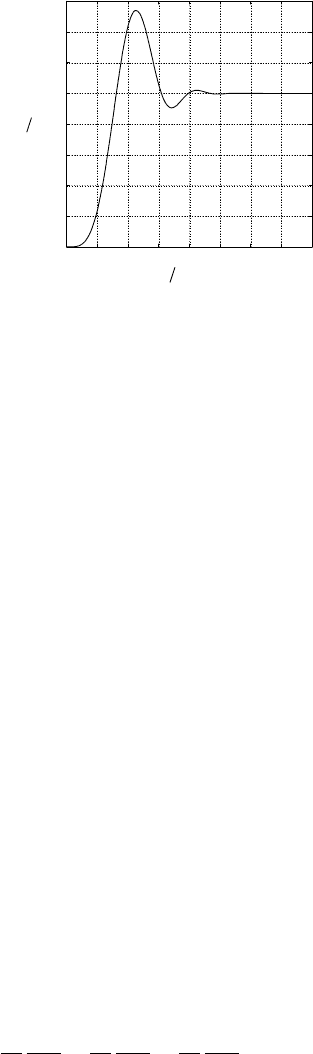
. Figure 10.12
shows the diffraction intensity at a point on the beam axis as a function of
the radius of the aperture.
640 10. Scalar Diffraction Theory
0.0 .5 1.0 1.5 2.0 2.5 3.0 3.5 4.0
0.0
.2
.4
.6
.8
1.0
1.2
1.4
1.6
0
II
'wa
Figure 10.12: The diffraction intensity at a point on the beam axis as a
function of the radius of the aperture.
10.4 Diffraction of Plane Waves
in Anisotropic Media
In microwaves and optoelectronics, more and more crystal materials are used
to give rise to some particular functions which involve generation of mi-
crowave and light wave, propagation, transformation, and interaction with
other kinds of waves, etc. Most crystals are anisotropic, so it is valuable to
study the diffraction in anisotropic media.
In this section we will investigate the diffraction in uniaxial crystals. Since
the diffraction of ordinary wave is the same as that in isotropic media, we
discuss only the diffraction of the extraordinary wave.
10.4.1 Fraunhofer Diffraction at Square Apertures
In Fig. 10.13, a monochromatic plane wave with angular frequency ω is in-
cident normally on a square aperture of side 2a on the surface of a uniaxial
crystal from free space. The coordinate system is so chosen that its z axis
coincides with the optical axis of the crystal, the x axis and y axis are along
other principal dielectric axes. The angle between the incident direction and
the optical axis is α. In order to process more conveniently, the y axis is set
to be along a side of the aperture.
In crystals, if the coordinate axes are along the principal dielectric axes,
this coordinate system is called the principal coordinate system. The wave
equations for an extraordinary wave with angular frequency ω in the principal
coordinator system is given in (9.215) as:
1
n
2
e
∂
2
ψ
∂x
2
+
1
n
2
e
∂
2
ψ
∂y
2
+
1
n
2
o
∂
2
ψ
∂z
2
+ k
2
0
ψ = 0, (10.72)