
Zhang K., Li D. Electromagnetic Theory for Microwaves and Optoelectronics
Подождите немного. Документ загружается.

10.4 Diffraction of Plane Waves in Anisotropic Media 641
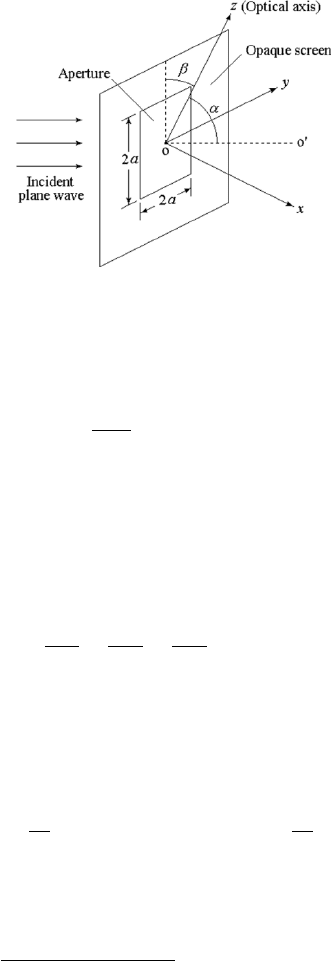
Figure 10.13: Coordinate system for Fraunhofer diffraction of plane wave at
a square aperture on the surface of a uniaxial crystal from free space.
where n
o
and n
e
are the effective indices for ordinary and extraordinary
waves, respectively, k
0
= ω
√
ε
0
µ
0
, and ψ is arbitrarily a component of electric
or magnetic fields, or a vector potential of the wave. In order to derive
a standard wave equation from (10.72), we need to make the coordinate
transformation that
u = n
e
x, v = n
e
y, w = n
o
z. (10.73)
Substitution of (10.73) into (10.72) yields
∂
2
ψ
∂u
2
+
∂
2
ψ
∂v
2
+
∂
2
ψ
∂w
2
+ k
2
0
ψ = 0. (10.74)
The new coordinate system is shown in Fig. 10.14(a), where the y axis is
perpendicular to the paper. After coordinate transformation, the normal of
the crystal surface oo
0
becomes oo
00
, the angle α becomes α
0
, and β becomes
β
0
. The relations between the angles are
α
0
= arctan
³
n
e
n
o
tan α
´
, β
0
= arctan
³
n
e
n
o
tan β
´
. (10.75)
Obviously, if n
e
6= n
o
, line oo
00
is no longer perpendicular to the aperture in
the uvw coordinate system. After coordinate transformation, the sides of the
aperture are
2a
0
= 2a
q
n
2
e
cos
2
α + n
2
o
sin
2
α and 2b
0
= 2n
e
a. (10.76)
To obtain the diffraction distribution, further coordinate transformation
is necessary. The uvw coordinate system is rotated to the ξηζ system in which
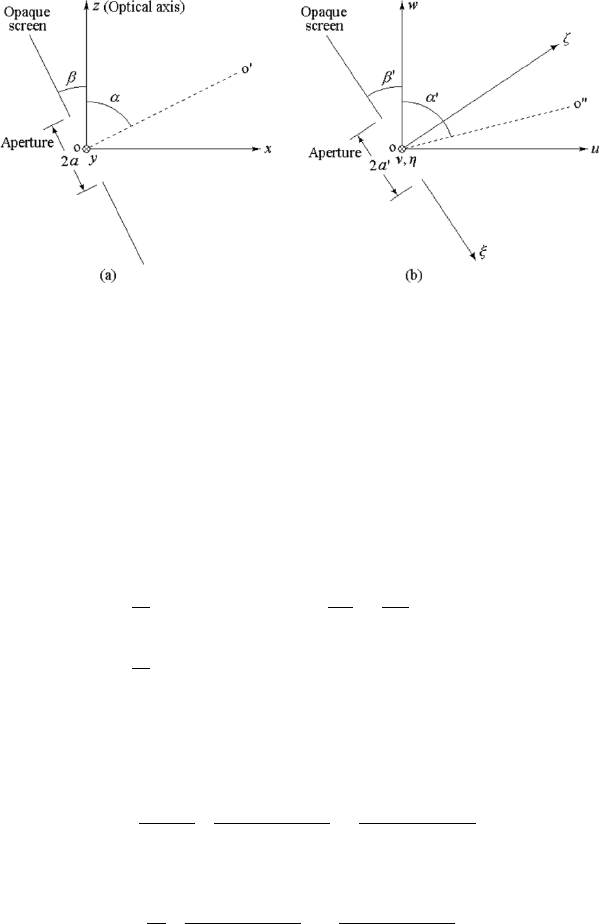
642 10. Scalar Diffraction Theory
Figure 10.14: Coordinate transformation for Fraunhofer diffraction of a plane
wave on the surface of a uniaxial crystal from free space.
ζ axis is perpendicular to the aperture, and the η axis coincides with the v
axis, which is also perpendicular to the paper, as shown in Figure 10.14(b).
The transforming relations are
ξ = u sin β
0
− w cos β
0
, η = v, ζ = u cos β
0
+ w sin β
0
. (10.77)
In ξηζ coordinate system, the amplitude distribution of the diffracted field is
ψ =
C
r
0
Z
a
0
−a
0
Z
b
0
−b
0
exp
·
jk
0
µ
ξξ
0
r
0
+
ηη
0
r
0
¶¸
dξ
0
dη
0
=
C
r
0
Z
a
0
−a
0
Z
b
0
−b
0
exp[jk
0
(sin θξ
0
+ sin φη
0
)dξ
0
dη
0
, (10.78)
where C is a constant, angles θ and φ are shown in Fig. 10.15, and r
0
is the
distance from the origin to the observation point. The result of integrating
(10.78) is
ψ =
4Ca
0
b
0
r
0
·
sin(k
0
a
0
sin θ)
k
0
a
0
sin θ
¸·
sin(k
0
b
0
sin φ)
k
0
b
0
sin φ
¸
. (10.79)
The intensity distribution is
I =
I
0
r
2
0
·
sin(k
0
a
0
sin θ)
k
0
a
0
sin θ
¸
2
·
sin(k
0
b
0
sin φ)
k
0
b
0
sin φ
¸
2
, (10.80)
where I
0
/r
2
0
is the intensity on the axis and I
0
/r
2
0
≈ I
0
/ζ
2
0
.
To obtain the real diffraction pattern, (10.79) and (10.80) need to be
transformed to the formulas in the xyz coordinate system. From the trans-
forming relation of (10.73), (10.77), and (10.75), the trigonometric functions
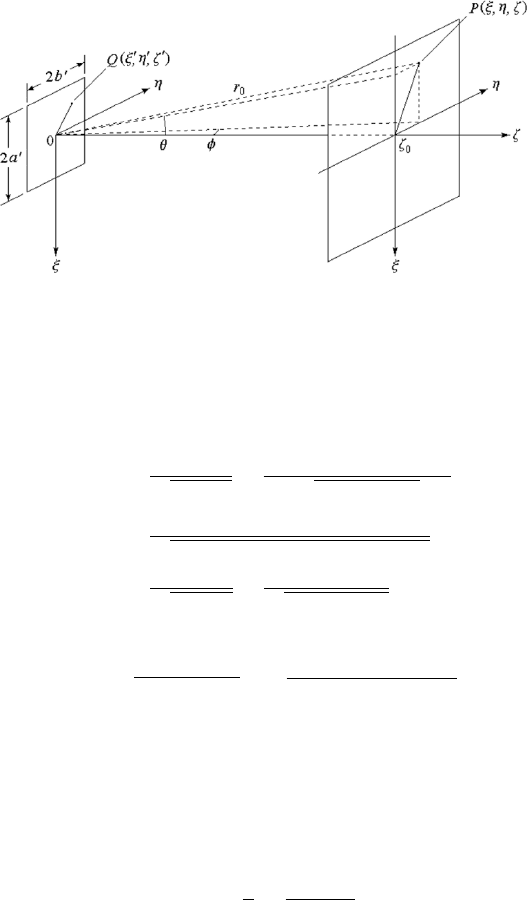
10.4 Diffraction of Plane Waves in Anisotropic Media 643
Figure 10.15: Coordinate system for the integration for Fraunhofer diffraction
of a plane wave at a square aperture.
in (10.79) and (10.80) are expressed as
sin θ =
ξ
p
ξ
2
+ ζ
2
=
n
e
x sin β
0
− n
o
z cos β
0
p
n
2
e
x
2
+ n
2
o
z
2
=
n
2
e
x − n
2
o
z tan α
p
(n
2
e
x
2
+ n
2
o
z
2
)(n
2
e
+ n
2
o
tan
2
α)
, (10.81)
sin φ =
η
p
η
2
+ ζ
2
≈
n
e
y
p
n
2
e
y
2
+ n
2
o
z
2
. (10.82)
The distance from the observation point to the origin is
r
0
=
p
ξ
2
+ η
2
+ ζ
2
=
p
n
2
e
x
2
+ n
2
e
y
2
+ n
2
o
z
2
. (10.83)
The axis of the diffracted beam is determined by letting sin θ = 0 and sin φ =
0. From (10.81) and (10.82), the equations for the axis are
n
2
e
x − n
2
o
z tan α = 0, y = 0. (10.84)
The angle between the beam axis and the z axis is expressed as
tan σ =
x
z
=
n
2
o
tan α
n
2
e
. (10.85)
This angle is shown in Fig. 10.16, where OP is the axis of the diffracted
beam. If n
e
> n
o
, then σ < α, and the beam axis is close to the optical axis.
If n
e
< n
o
, the beam axis is far away from the optical axis.
To study the distribution of the diffracted field penetratingly, it is nec-
essary to express the field in a new x
0
y
0
z
0
coordinate system in which the
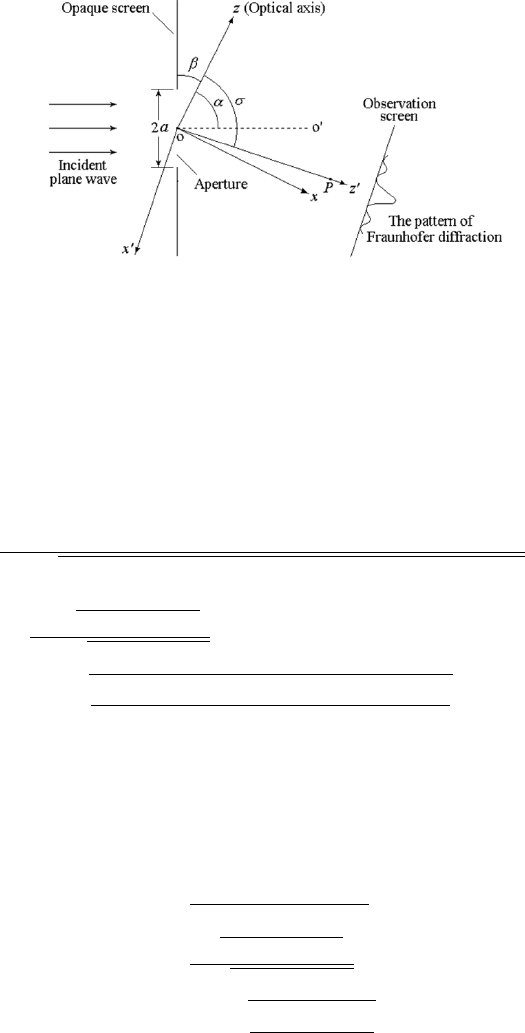
644 10. Scalar Diffraction Theory
Figure 10.16: Relation between the axis of the diffracted beam and the co-
ordinate axes.
beam axis OP is along the z
0
axis. This coordinate system is also shown in
Fig. 10.16, and the transforming relations are
x = x
0
cos σ + z
0
sin σ, y = y
0
, z = −x
0
sin σ + z
0
cos σ. (10.86)
Substitution of (10.86) into (10.81)–(10.83) yields
sinθ =
(n
4
e
+ n
4
o
tan
2
α)x
0
n
o
n
e
p
(n
2
e
+n
2
o
tan
2
α)[(n
2
e
+n
2
o
tan
2
)z
02
+2(n
2
e
−n
2
o
) tan αx
0
z
0
]
, (10.87)
sin φ =
y
0
p
n
4
e
+ n
4
o
tan
2
α
n
o
z
0
p
n
2
e
+ n
2
o
tan
2
α
, (10.88)
r
0
= n
o
n
e
s
(n
2
e
+ n
2
o
tan
2
α)z
02
+ 2(n
2
e
− n
2
o
) tan αx
0
z
0
n
4
e
+ n
4
o
tan
2
α
. (10.89)
In obtaining the above three equations, high-order terms of x
0
and y
0
are
omitted. Because of the existence of the cross term x
0
z
0
, in the plane of
y
0
= 0, the diffraction beam is not symmetric with respect to the z
0
axis. If
the diffraction angle is not too large, the cross terms in the above formulas
can be neglected, and they can be expressed as
sin θ =
(n
4
e
+ n
4
o
tan
2
α)
n
o
n
e
(n
2
e
+ n
2
o
tan
2
α)
tan θ
0
, (10.90)
sin φ =
p
n
4
e
+ n
4
o
tan
2
α
n
o
p
n
2
e
+ n
2
o
tan
2
α
tan φ
0
, (10.91)
r
0
= n
o
n
e
s
n
2
e
+ n
2
o
tan
2
α
n
4
e
+ n
4
o
tan
2
α
z
0
. (10.92)

10.4 Diffraction of Plane Waves in Anisotropic Media 645
Substitution of (10.76), (10.90), (10.91), and (10.92) into (10.80) gives the
intensity distribution
I =
I
0
0
z
02
µ
sin Θ
0
Θ
0

2
µ
sin Φ
0
Φ
0

2
, (10.93)
where I
0
0
/z
02
is the intensity on the axis, and
Θ
0
= k
0
a sin θ
0
n
4
e
cos
2
α + n
4
o
sin
2
α
n
o
n
e
q
n
2
e
cos
2
α + n
2
o
sin
2
α
, (10.94)
Φ
0
= k
0
a sin φ
0
n
e
n
o
s
n
4
e
cos
2
α + n
4
o
sin
2
α
n
2
e
cos
2
α + n
2
o
sin
2
α
. (10.95)
In obtaining (10.93)–(10.95) we have replaced tan θ
0
and tan φ
0
with sin θ
0
and sin φ
0
, respectively. The intensity distribution oscillates with increasing
diffraction angle, and the maxima gradually diminish. The principal maxi-
mum is on the beam axis. Where the value of Θ
0
or Φ
0
is ±π, ±2π, ±3π ···,
the intensity is zero corresponding to the dark stripe. The ratio of diffraction
angles that correspond to the dark stripes in the x
0
and y
0
directions is
sin θ
0
sin φ
0
=
n
2
e
q
n
4
e
cos
2
α + n
4
o
sin
2
α
. (10.96)
If n
e
is different from n
o
by a large quantity, and α is not very small, the
difference between diffraction angles in the two directions is obvious.
10.4.2 Fraunhofer Diffraction at Circular Apertures
In Fig. 10.17 is shown a plane wave incident on a circular aperture located
on the surface of a uniaxial crystal. Line oo
0
is the axial of the aperture, and
the angle between oo
0
and the z axis is α.
According to the coordinate transformations represented by (10.73) and
(10.77), in the ξηζ co ordinate system, the circular aperture becomes an el-
liptic one whose major and minor axes are given by (10.76). In the ξηζ
coordinate system the amplitude distribution of the diffracted field is
ψ =
C
r
0
ZZ
exp
µ
jk
0
ξξ
0
+ ηη
0
r
0

dξ
0
dη
0
, (10.97)
where C is a constant, r
0
is the distance from the coordinate origin to the
observation point. The integrating region is the ellipse mentioned above. To
finish this integral, it is necessary to transform the elliptic integrating region
to a circular one, and the transforming relations are
ξ
0
= a
q
n
2
e
cos
2
α + n
2
o
sin
2
α ξ
0
0
, η
0
= an
e
η
0
0
. (10.98)
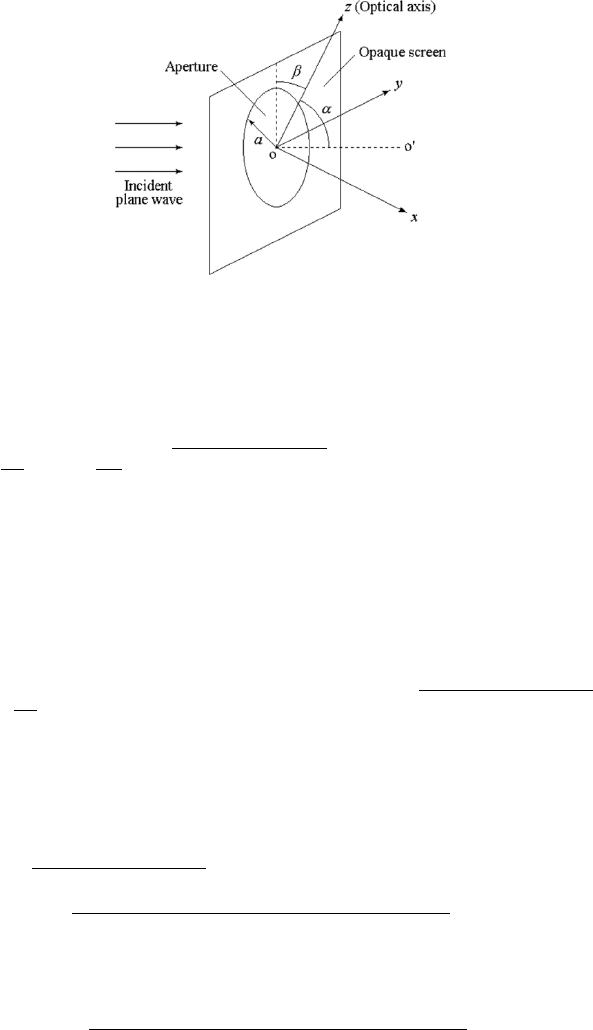
646 10. Scalar Diffraction Theory
Figure 10.17: Coordinate system for Fraunhofer diffraction of plane wave at
a circular aperture on the surface of a uniaxial crystal from free space.
After variable substitution, (10.97) is changed to
ψ =
C
1
r
0
ZZ
exp
·
jk
0
r
0
µ
a
q
n
2
e
cos
2
α+n
2
o
sin
2
α ξξ
0
0
+an
e
ηη
0
0
¶¸
dξ
0
0
dη
0
0
, (10.99)
where C
1
is a constant. The integrating region is circular with a radius of
1. The integration is carried out in a polar coordinate system. As shown in
Fig. 10.18, ρ
0
0
and γ
0
0
are the polar coordinates of a point in the diffraction
aperture, and ρ, γ, and ζ are those of a point in the observation plane. The
coordinate relations are ξ
0
0
= ρ
0
0
cos γ
0
0
, η
0
0
= ρ
0
0
sin γ
0
0
, ξ = ρ cos γ, η = ρ sin γ.
In terms of the polar coordinates, (10.99) is expressed as
ψ =
C
1
r
0
Z
1
0
ρ
0
0
dρ
0
0
Z
2π
0
exp
·
jk
0
aρ
0
0
sin θ
µ
cos γ cos γ
0
0
q
n
2
e
cos
2
α + n
2
o
sin
2
α
+n
e
sin γ sin γ
0
0
¶¸
dγ
0
0
, (10.100)
where sin θ = ρ/r
0
, θ is the diffraction angle. The exponential factor is
expressed as
q
n
2
e
cos
2
α + n
2
o
sin
2
α cos γ cos γ
0
0
+ n
e
sin γ sin γ
0
0
=
q
n
2
e
cos
2
α cos
2
γ + n
2
o
sin
2
α cos
2
γ + n
2
e
sin
2
γ cos(γ
0
0
− δ)
= W cos(γ
0
0
− δ), (10.101)
where
W =
q
n
2
e
cos
2
α cos
2
γ + n
2
o
sin
2
α cos
2
γ + n
2
e
sin
2
γ. (10.102)
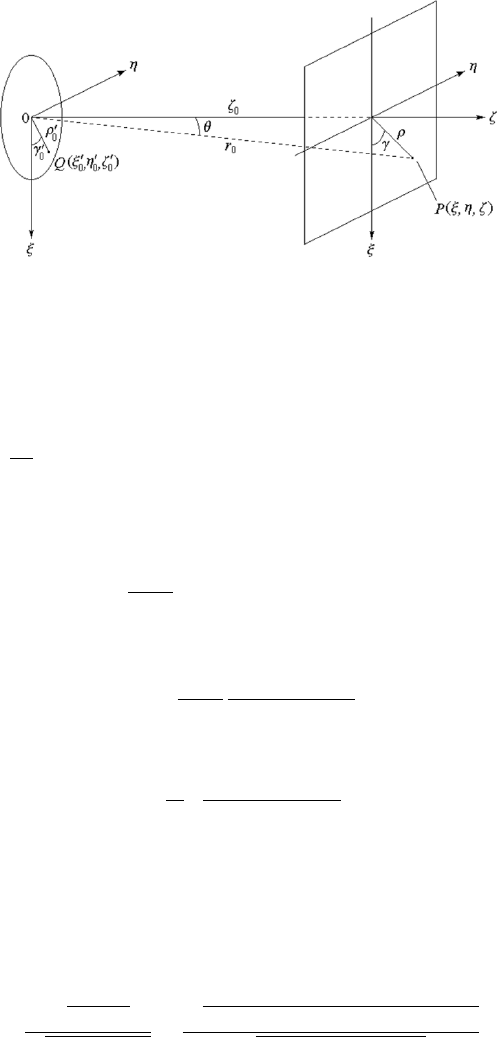
10.4 Diffraction of Plane Waves in Anisotropic Media 647
Figure 10.18: Coordinate system for the integration for Fraunhofer diffraction
of a plane wave at a circular aperture.
Substituting (10.101) into (10.100), we obtain
ψ =
C
1
r
0
Z
1
0
ρ
0
0
dρ
0
0
Z
2π
0
exp[jk
0
aρ
0
0
W sin θ cos(γ
0
0
− δ)]dγ
0
0
. (10.103)
The result of (10.103) is independent of δ, so we did not give its expression.
With the integral representation of Bessel functions (10.103) becomes
ψ =
2πC
1
r
0
Z
1
0
J
0
(k
0
aρ
0
0
W sin θ)ρ
0
0
dρ
0
0
. (10.104)
According to the integral of Bessel functions, we get the diffracted field dis-
tribution
ψ =
2πC
1
r
0
J
1
(k
0
aW sin θ)
k
0
aW sin θ
. (10.105)
The intensity distribution is
I =
I
0
r
2
0
·
2J
1
(k
0
aW sin θ)
k
0
aW sin θ
¸
2
. (10.106)
Formula (10.106) is the expression of the diffraction intensity in the ξηζ coor-
dinate system. By a similar treatment as that used for a square aperture, we
transform it to a formula in the x
0
y
0
z
0
coordinate system in which the z
0
axis
is along the beam axis. From (10.73), (10.75), (10.77), (10.85), and (10.86),
in the x
0
y
0
z
0
coordinate system, the trigonometric functions in (10.102) and
(10.105) are expressed as
sin θ =
p
ξ
2
+ η
2
p
ξ
2
+ η
2
+ ζ
2
=
p
(n
e
x sin β
0
− n
o
z cos β
0
)
2
+ n
2
e
y
2
p
n
2
e
x
2
+ n
2
e
y
2
+ n
2
o
z
2

648 10. Scalar Diffraction Theory
=
q
n
4
e
cos
2
α + n
4
o
sin
2
α
×
q
(n
4
e
cos
2
α+n
4
o
sin
2
α)x
02
+n
2
e
(n
2
e
cos
2
α+n
2
o
sin
2
α)y
02
n
o
n
e
(n
2
e
cos
2
α + n
2
o
sin
2
α)z
0
, (10.107)
cos
2
γ =
ξ
2
ξ
2
+ η
2
=
(n
e
x sin β
0
− n
o
z cos β
0
)
2
(n
e
x sin β
0
− n
o
z cos β
0
)
2
+ n
2
e
y
2
=
(n
4
e
cos
2
α + n
4
o
sin
2
α)x
02
(n
4
e
cos
2
α+n
4
o
sin
2
α)x
02
+n
2
e
(n
2
e
cos
2
α+n
2
o
sin
2
α)y
02
, (10.108)
sin
2
γ =
η
2
ξ
2
+ η
2
=
n
2
e
y
2
(n
e
x sin β
0
− n
o
z cos β
0
)
2
+ n
2
e
y
2
=
n
2
e
(n
2
e
cos
2
α + n
2
o
sin
2
α)y
02
(n
4
e
cos
2
α+n
4
o
sin
2
α)x
02
+n
2
e
(n
2
e
cos
2
α+n
2
o
sin
2
α)y
02
. (10.109)
From (10.102) and (10.107)–(10.109), we obtain
W sinθ =
q
(n
4
e
cos
2
α+n
4
o
sin
2
α)[(n
4
e
cos
2
α+n
4
o
sin
2
α)x
02
+n
4
e
y
02
]
n
o
n
e
q
n
2
e
cos
2
α + n
2
o
sin
2
α z
0
. (10.110)
With the relations that x
0
/z
0
= tan θ
0
cos γ
0
and y
0
/z
0
= tan θ
0
sin γ
0
, (10.110)
is expressed as the function in a spherical coordinate system
W sin θ =
q
(n
4
e
cos
2
α+n
4
o
sin
2
α)[(n
4
e
cos
2
α+n
4
o
sin
2
α) cos
2
γ
0
+n
4
e
sin
2
γ
0
] sin θ
0
n
o
n
e
q
n
2
e
cos
2
α + n
2
o
sin
2
α
, (10.111)
where θ
0
and γ
0
are the polar and azimuthal angles. In the derivation of
(10.111), tan θ
0
was replaced by sin θ
0
. Substituting (10.111) into (10.106),
we obtain the diffraction intensity at a circular aperture in a uniaxial crystal
I
0
=
I
0
0
z
02
·
2J
1
(Θ
0
)
Θ
0
¸
2
, (10.112)
where I
0
0
/z
02
is the diffraction intensity on the beam axis, and
Θ
0
= k
0
a sin θ
0
q
(n
4
e
cos
2
α+n
4
o
sin
2
α)[(n
4
e
cos
2
α+n
4
o
sin
2
α) cos
2
γ
0
+n
4
e
sin
2
γ
0
]
n
o
n
e
q
n
2
e
cos
2
α + n
2
o
sin
2
α
. (10.113)
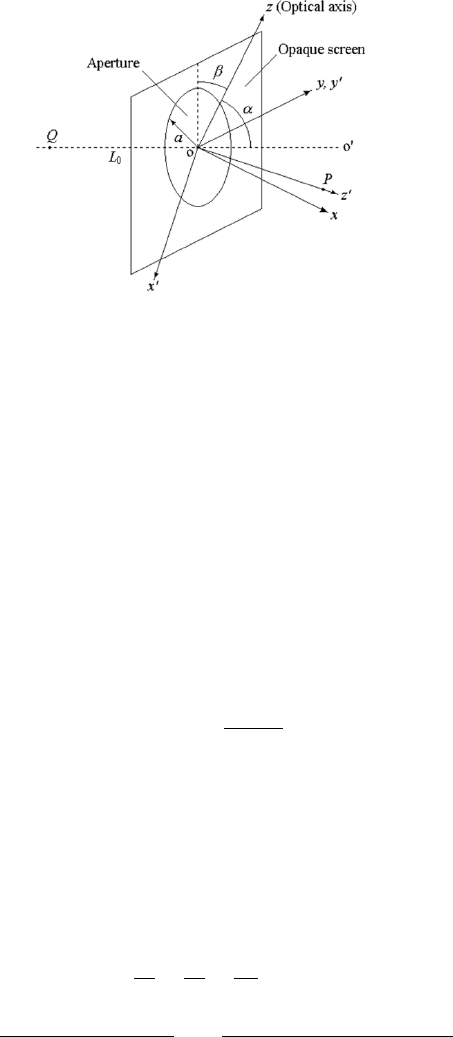
10.4 Diffraction of Plane Waves in Anisotropic Media 649
Figure 10.19: Coordinate system for Fresnel diffraction of plane wave at a
circular aperture on the surface of a uniaxial crystal from free space.
10.4.3 Fresnel Diffraction at Circular Apertures
As the far-field condition required by Fraunhofer diffraction is not satisfied,
the diffracted field should be derived according to the Fresnel diffraction
formulation. In a uniaxial crystal, the diffraction at a circular aperture is as
shown in Figure 10.19. The diameter of the aperture is 2a. A point source
is located at Q on the axis oo
0
, which is perpendicular to the aperture and
passes through its center. The distance from the point source to the center
of the aperture is L
0
. The coordinate system is so chosen that the z axis is
along the optical axis of the crystal. The angle between the z axis and oo
0
is
α. The incident field amplitude distribution can be expressed as
ψ
0
= C exp
µ
−jk
0
r
2
i
2L
0

, (10.114)
where C is a constant, r
i
is the radical coordinate of a point in the aperture.
The coordinate transformation is the same as that in the treatment of Fraun-
hofer diffraction. In Fraunhofer diffraction the incident field in the aperture
is uniform, but in Fresnel diffraction this requirement is unnecessary. To
obtain the field distribution in the aperture in the ξηζ coordinate system, r
i
should be expressed as a function of ξ, η, and ζ. From (10.73), (10.75), and
(10.77) we obtain the expression for r in the ξηζ coordinate system:
r
2
= x
2
+ y
2
+ z
2
=
u
2
n
2
e
+
v
2
n
2
e
+
w
2
n
2
o
=
1
n
2
e
cos
2
α + n
2
o
sin
2
α
ξ
2
+
n
4
e
cos
2
α + n
4
o
sin
2
α
n
2
o
n
2
e
(n
2
e
cos
2
α + n
2
o
sin
2
α)
ζ
2

650 10. Scalar Diffraction Theory
+
η
2
n
2
e
+
2(n
2
o
− n
2
e
) sin α
n
o
n
e
(n
2
o
+ n
2
e
) cos α
ξζ. (10.115)
In the ξηζ coordinate system, the plane of the aperture is where ζ = 0.
Substitution of ζ = 0 into (10.115) yields
r
2
i
=
ξ
02
n
2
e
cos
2
α + n
2
o
sin
2
α
+
η
02
n
2
e
, (10.116)
where ξ
0
and η
0
are the coordinates of a point in the aperture. Substituting
(10.116) into (10.114), we get the incident field distribution in the aperture
ψ
0
= C exp
·
−jk
0
2L
0
µ
ξ
02
n
2
e
cos
2
α + n
2
o
sin
2
α
+
η
02
n
2
e
¶¸
. (10.117)
The diffraction integral in the ξηζ coordinate system can be derived from
(10.22). Here we discuss only the diffraction field distribution on the beam
axis. Letting the inclination factor in (10.22) be 1, and noting the different
meaning of α in (10.22) and (10.117), we obtain the integral at the observation
point P (0, 0, ζ
0
):
ψ =
jk
0
C
2π
Z Z
1
p
ξ
02
+ η
02
+ ζ
2
0
exp
·
−jk
0
2L
0
µ
ξ
02
n
2
e
cos
2
α + n
2
o
sin
2
α
+
η
02
n
2
e

−jk
0
q
ξ
02
+ η
02
+ ζ
2
0
¸
dξ
0
dη
0
. (10.118)
The integrating region is an ellipse whose major and minor axes are repre-
sented by (10.76). For ζ
0
À ξ
0
and ζ
0
À η
0
, neglecting ξ
0
and η
0
of the
dominator in the integral, we obtain
ψ =
jk
0
C exp(−jk
0
ζ
0
)
2πζ
0
Z Z
exp
½
−jk
0
2
·µ
1
L
0
(n
2
e
cos
2
α + n
2
o
sin
2
α)
+
1
ζ
0

ξ
02
¸
−
jk
0
2
µ
1
L
0
n
2
e
+
1
ζ
0

η
02
¾
dξ
0
dη
0
. (10.119)
By variable substitution that
ξ
00
=
s
1
L
0
(n
2
e
cos
2
α + n
2
o
sin
2
α)
+
1
ζ
0
ξ
0
, (10.120)
η
00
=
s
1
L
0
n
2
e
+
1
ζ
0
η
0
, (10.121)
(10.119) is changed to
ψ =
C
1
ζ
0
Z Z
exp
·
−jk
0
2
(ξ
002
+ η
002
)
¸
dξ
00
dη
00
, (10.122)