
Ambaum M., Thermal Physics of the Atmosphere
Подождите немного. Документ загружается.


4.5 DRY STATIC ENERGY AND BERNOULLI FUNCTION 83
(Navier–Stokes equations or Euler equations); this specific force f is given by
f =−v ∇p −∇. (4.55)
With the definition of the Montgomery function this becomes
f =−∇ + T ∇s. (4.56)
This expression becomes particularly simple when isentropic coordinates are
used; that is, the specific entropy is used as a vertical coordinate. This is only
possible when there is a stable stratification so that ds/dz>0 everywhere and
z can be mapped uniquely onto s. The ‘horizontal’ part of the specific force f
h
in isentropic coordinates becomes
f
h
=−∇
h
(4.57)
because horizontal gradients are evaluated at constant s.
The vertical part of the specific force f
v
is
f
v
=
−
∂
∂z
+ T
∂s
∂z
ˆ
k, (4.58)
with
ˆ
k the unit vector in the vertical. Because the entropy s is the vertical
coordinate it is an increasing function of height z only. Therefore, the vertical
specific force becomes
f
v
=
ds
dz
−
∂
∂s
+ T
ˆ
k. (4.59)
In hydrostatic balance, vertical accelerations are ignored so that the vertical
specific force has to vanish,
∂
∂s
= T. (4.60)
This is the isentropic formulation of the hydrostatic equation Eq. 4.13. Note
that this balance is here only used as an approximation for the vertical force
balance; for a strictly motionless fluid we have d = T ds everywhere, as in
Eq. 4.50.
Isentropic coordinates have a couple of advantages. They give an expres-
sion for the horizontal specific force as a simple gradient, Eq. 4.57. Further-
more, the vertical velocity in isentropic coordinates is Ds/Dt. In the absence of
diabatic effects we have Ds/Dt = 0, so there is no vertical motion in isentropic
coordinates. Because the large-scale flow in the atmosphere is to a good ap-
proximation adiabatic, the flow in isentropic coordinates is quasi-horizontal.

84 CH 4 THE ATMOSPHERE UNDER GRAVITY
A disadvantage of isentropic coordinates is that the atmosphere is assumed
to be stable (ds/dz>0) everywhere so that the geometric height can be
mapped uniquely onto the entropy. Where the atmosphere becomes near
neutral, an isentropic coordinate representation becomes inaccurate because
here very few isentropic levels correspond to a large height difference. For
example, isentropic coordinates are not optimal in the planetary boundary
layer. In practice isentropic coordinates are mainly used to simulate strongly
stratified flows, such as the stratosphere. Alternatively, models can use hy-
brid coordinates: the vertical coordinate transforms smoothly from entropy
s aloft to a more appropriate variable near the Earth’s surface (typically a
-coordinate with = p/p
sfc
).
4.6 STATISTICAL MECHANICS
The isothermal atmosphere has a pressure profile as in Eq. 4.16. Because tem-
perature is constant this also gives the density profile, the so-called barometric
distribution,
=
0
exp
−
Z
H
=
0
exp
−
RT
0
, (4.61)
with the geopotential or, equivalently, the potential energy per unit mass.
By definition
R =
R
=
N
A
k
B
(4.62)
with R
the universal gas constant, N
A
the Avogadro number, k
B
the Boltz-
mann constant, and the molar mass. Note that /N
A
is the mass per
molecule so the energy per molecule E equals
E =
N
A
. (4.63)
The mass density is proportional to the probability of finding a molecule
at a particular location. Thus the probability P of finding a molecule at some
potential energy level E equals
P = P
0
exp
−
E
k
B
T
. (4.64)
The probability is proportional to the well-known Boltzmann factor
exp (−E/k
B
T), a result that is traditionally arrived at by methods of stati-
stical mechanics.
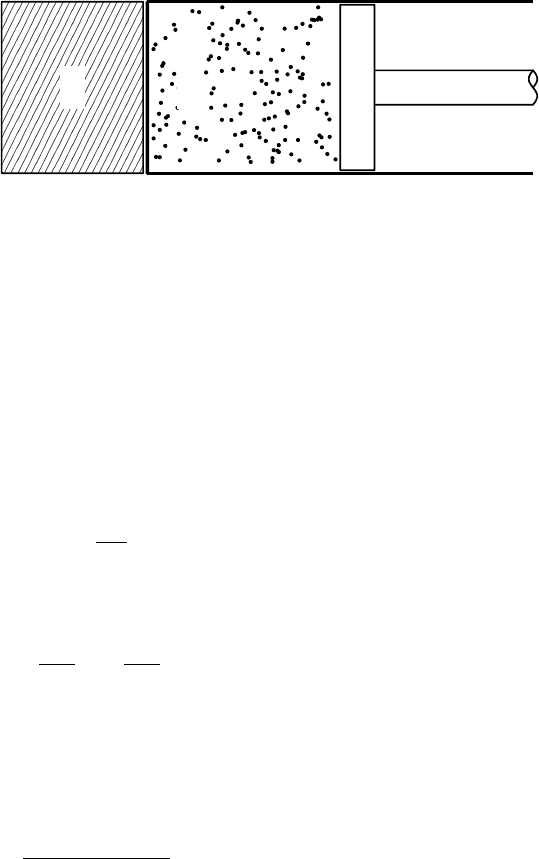
The Boltzmann factor for general thermodynamic systems follows from
considering a system A to be kept at constant volume V and constant tem-
perature T by interacting with a reservoir R (a system with infinitely large
4.6 STATISTICAL MECHANICS 85
RA
FIGURE 4.5 System A is in contact with a reservoir R which has constant temperature and
volume.
heat capacity) at temperature T, see Figure 4.5. System A is kept at constant
temperature through heat flows between the reservoir and the system.
What is the probability of finding system A in a particular microstate i?
According to the Boltzmann entropy this can be expressed in terms of the
entropy of the whole system, see Eq. 2.38. Assume that when system A is in
microstate i, the entropy of the reservoir is S
R,i
. The entropy of system A in
microstate i is by definition 0, because it corresponds to a single state. That
means that the total entropy when system A is in microstate i equals S
R,i
.So
the probability P
i
of finding system A in microstate i equals
P
i
= P
0
exp
S
R,i
k
B
. (4.65)
The reservoir entropy varies according to the first law at constant volume
dS
R
=
dU
R
T
=−
dU
A
T
, (4.66)
where, in the second equality, it is assumed that energy is conserved so U
A
+
U
R
= constant. Because T is constant, the entropy of the reservoir S
R
is a linear
function of the energy of the system U
A
. We thus find that the probability of
finding system A in microstate i, with given temperature T, equals
I P
i
=
exp (−U
A,i
/k
B
T)
Z
, (4.67)
where we have rewritten the normalization P
0
as 1/Z, a standard notation
in statistical mechanics, see below. The probability is proportional to the
Boltzmann factor.
The Boltzmann factor is a central result in classical statistical mechanics
(quantum systems at low temperatures have different statistics, depending on
whether they are made of fermions or bosons). We will come across instances
of the Boltzmann factor in interpreting equilibrium states of droplets. We also
referred to the Boltzmann factor in Section 3.3, in the discussion of the heat
capacity of ideal gases.

86 CH 4 THE ATMOSPHERE UNDER GRAVITY
As an application, consider an ideal gas with molecules moving freely in-
side a fixed volume that is kept at temperature T. The ideal gas is made up of
non-interacting molecules. This means that the probability distribution for
finding a molecule in a particular energy state is proportional to the Boltz-
mann factor, with the energy representing the energy of the single molecule.
The molecule has internal energy (in any accessible rotational vibrational
modes) and kinetic energy. The molecule will always be in some internal
energy state (it has a probability of 1 of being in any of the internal energy
states), so the probability for the molecule to have a velocity U = (U , V , W )
will be proportional to
exp
−
M
1
U
2
+ M
1
V
2
+ M
1
W
2
2k
B
T
= exp
−
M
1
|U|
2
2k
B
T
, (4.68)
with M
1
the mass of the molecule. We have assumed here that each veloc-
ity vector U represents a possible microstate of the system, which is true for
macroscopic systems. The number of microstates corresponding to a speed |U|
is proportional to 4|U|
2
, the area of a spherical shell in three-dimensional
U-space that corresponds to the given speed. Therefore, the probability dis-
tribution P(|U|) of finding a molecule at a given speed |U| is
I P(|U|) =
M
1
2k
B
T
3/2
4|U|
2
exp
−
M
1
|U|
2
2k
B
T
, (4.69)
where the prefactor was calculated by the normalization condition
∞
0
P(|U|)d|U|=1, (4.70)
using the identity
∞
0
x
2
exp ( − a
2
x
2
) =
√
4a
3
. (4.71)
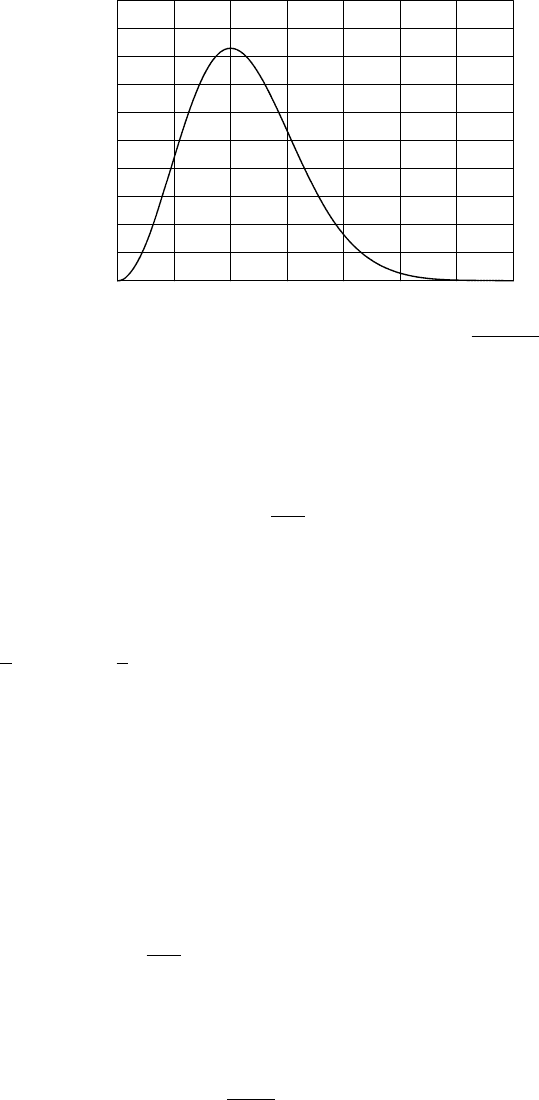
The probability distribution for molecular speeds in an ideal gas, Eq. 4.69,
is called the Maxwell distribution, see Figure 4.6. The Maxwell distribution
has been verified experimentally. The probability distribution for a single
component of the velocity, say U (which can be positive as well as negative),
can be found by normalizing the single component factor of Eq. 4.68. We find
the distribution P
1
(U ) for a single velocity component,
P
1
(U ) =
M
1
2k
B
T
exp
−
M
1
U
2
2k
B
T
. (4.72)
4.6 STATISTICAL MECHANICS 87
0123
speed
0
1
probability
FIGURE 4.6 Maxwell velocity distribution in units of
2k
B
T/M
1
.
With this distribution we can calculate the expectation value of the root-
mean-square of U , again using the identity Eq 4.71,
U
2
=
∞
−∞
P
1
(U ) U
2
dU =
k
B
T
M
1
, (4.73)
which is most usefully written as the average kinetic energy for motion in the
x-direction,
1
2
M
1
U
2
=
1
2
k
B
T, (4.74)
and equivalently for the other two velocity components. We thus find that
each translational degree of freedom has on average k
B
T/2 of kinetic energy,
and we are back at the microscopic definition of temperature introduced in
Chapter 1, Eq. 1.6.
The Boltzmann factor links the microscopic world of microstates to the
macroscopic world of thermodynamics. The probabilities of all microstates
have to add up to unity. This then defines the normalization constant Z in
Eq. 4.67, which is called the partition function,
I Z =
i
exp
−
U
A,i
k
B
T
. (4.75)
It can now be verified that the mean energy U
A
of system A can be written
as
U
A
=
i
P
i
U
A,i
= k
B
T
2
∂ ln Z
∂T
. (4.76)

88 CH 4 THE ATMOSPHERE UNDER GRAVITY
An assumption of statistical mechanics is that this mean value of the system
energy U
A
is the actual observed value U
A
. If we define the free energy F
A
of the system as
F
A
=−k
B
T ln Z, (4.77)
it can now also be verified that this free energy satisfies
S
A
=−
∂F
A
∂T
V
= k
B
ln Z +
U
A
T
, (4.78)
which is the expected thermodynamic relationship between F
A
and U
A
,
F
A
=U
A
−TS
A
. (4.79)
This demonstrates that the above definition of F
A
in terms of the partition
function is consistent with thermodynamics. All the usual thermodynamic
quantities can be related in a similar way to the partition function and, for
differently constrained systems, to its modifications.
We are now also able to prove the equipartition theorem, which is central to
our understanding of heat capacity. The energy of the system U is a function
of all the degrees of freedom, usually called generalized coordinates.Ifwe
integrate all the degrees of freedom out except a single one, say q, then we
can write the probability distribution over q as
P(q) =
1
Z
exp
−
U(q)
k
B
T
(4.80)
Here we assume that q is a continuous variable. For a discrete variable, the
derivation is not strictly valid. Indeed, this is the reason why, for example,
the vibrational degrees of freedom do not contribute in the usual way to the
heat capacity of a diatomic gas: their energy levels are too far apart to be
well approximated by a continuous variable. Using partial integration, we
can now demonstrate that the expectation value of q dU/dq is
q
dU
dq
= k
B
T. (4.81)
We assume that for q →∞we have U →∞, so that the boundary term in
the partial integration vanishes. Now typically the energy is quadratic in its
generalized coordinates. For example, the kinetic energy in the x-direction
for a particle can be written as p
2
/2M
1
with p the particle momentum in the

4.6 STATISTICAL MECHANICS 89
x-direction. Generally we can write
U(q) = U
0
+ ˛q
2
, (4.82)
where the constant ˛ depends on the nature of the generalized coordinate q.
For such a quadratic dependence on the generalized coordinate q, Eq. 4.81
reduces to the equipartition theorem,
˛q
2
=k
B
T/2. (4.83)
For a more general representation of the dependence of the energy on the
generalized coordinate of the form
U(q) = U
0
+ ˛q
n
(4.84)
we find the generalized equipartition theorem,
28
I ˛q
n
=k
B
T/n. (4.85)
The altitude z of a particle in a gravitational field is an example of a degree
of freedom with n = 1 because its potential energy is M
1
gz. According to
the generalized equipartition theorem, the mean potential energy of a par-
ticle in an isothermal atmosphere is therefore k
B
T. This result is consistent
with the barometric distribution, Eq. 4.61. The generalized equipartition the-
orem is also used in the derivation of the Rayleigh–Jeans radiation law, see
Section 9.9.
P
ROBLEMS
4.1. Newton’s law of gravity states that the gravitational acceleration outside
a spherical body of mass M is
g =−
ˆ
r G
M
r
2
,
with G the universal gravitational constant,
ˆ
r the unit radial vector point-
ing outward, and r the radial distance to the centre of the sphere. Show
that the geopotential around such a body can be written as in Eq. 4.5
with g
0
= GM/a
2
where a is the radius of the sphere.
4.2. The centrifugal acceleration points away from the rotation axis ˝ and
has magnitude ˝
2
x, with x the distance to the rotation axis and ˝ the
rotation rate. This corresponds to an additional apparent geopotential
28
Tolman, R. C. (1918) Phys. Rev. 11, 261–275.

90 CH 4 THE ATMOSPHERE UNDER GRAVITY
of ˝
2
x
2
/2. With the result from Problem 4.1, the total effective geopo-
tential around a rotating spherical planet can be written as
= g
0
az
a + z
−
1
2
˝
2
x
2
,
with z, as before, the vertical height above
the sphere of radius a. Show that if the
planet’s surface is a geopotential, its semi-
major axis b and semi-minor axis a are
related by
b − a = qa, with q = ˝
2
a/2g
0
.
a
x
z
b
Ω
The observed value for Earth is q ≈ 1/300. The present model is not
accurate because it assumes the gravitational potential of a spherical
planet instead of an oblate planet.
4.3. The adiabatic lapse
a
is the temperature change with height in a hy-
drostatic, isentropic fluid. From this definition one would expect that
I
a
=−
∂T
∂p
s
dp
dz
. (4.86)
Use the reciprocity relation for partial derivatives and a Maxwell relation
to show that this is equivalent to Eq. 4.29.
4.4. Assuming water has a constant heat capacity c and a constant thermal
expansivity ˛, show that the temperature profile for an adiabatic lapse
rate in water is
T = T
0
exp (−g
0
˛Z/c).
The scale height for this profile is very large so a linear profile is ap-
propriate for large height ranges. For water ˛ ≈ 2 × 10
−4
K
−1
and
c ≈ 4.2 × 10
3
Jkg
−1
K
−1
so that at typical temperatures the adiabatic
lapse rate is less than about 0.15Kkm
−1
.
4.5. Estimate typical values for the geopotential thickness of the
1000–500 hPa layer when the surface temperature is 0
◦
C and when
the surface temperature is 20
◦
C. By how much would the geopoten-
tial thickness of the 1000–500 hPa layer increase on a uniform increase
in temperature of 1
◦
C?
4.6. Show that, for an isothermal atmosphere, the Brunt–V
¨
ais
¨
al
¨
a frequency
is given by:
N
2
=
g
2
c
p
T
.

4.6 STATISTICAL MECHANICS 91
The isothermal atmosphere is one of the most stable profiles observed in
the atmosphere (for example, in the lower stratosphere). This provides
a typical upper bound for the buoyancy frequency. Hence show that
typical buoyancy periods are not shorter than about 5 minutes.
4.7. Total air temperature. The air at the skin of an aircraft has the same
speed as the aircraft itself because viscosity makes the air ‘stick’ to the
aircraft. In the frame of reference moving with the aircraft the air then
has to decelerate from the aircraft speed to a standstill at the skin of the
aircraft. Use the Bernoulli equation to show that the temperature T
t
of
this decelerated air is related to the actual air temperature T by
T
t
T
= 1 +
− 1
2
V
C
2
,
with = c
p
/c
v
, V the flight speed of the aircraft, and C =
√
RT
the speed of sound. The ratio V /C is called the Mach number. The
temperature T
t
of the decelerated air is called the stagnation temperature
or the total air temperature. In this context, the actual air temperature T
is also called the static air temperature. A probe on an aircraft measures
the total air temperature and uses the flight speed to calculate the static
air temperature.
Calculate typical values of the total air temperature for an aircraft
at cruising altitude. Would an aircraft expand appreciably due to this
heating effect? The difference between T
t
and T can be quite large:
the same effect is responsible for heating up spacecraft or meteorites
when they (re-)enter the Earth’s atmosphere. In popular literature it is
often said that this heating is due to friction. This is a confusing way
of describing the phenomenon. Friction only ensures that the air sticks
to the space ship; the heating itself is due to the Bernoulli effect, or its
supersonic equivalent (at very low densities ballistic effects of individual
molecules need to be taken into account).
4.8. Entropy in statistical mechanics. Using the definition of the probability
P
i
of a microstate i, from Eq. 4.67, show that the entropy of a system,
Eq. 4.78, can be expressed as
I S
A
=−k
B
i
P
i
ln P
i
. (4.87)
This expression for entropy is called the Gibbs entropy. Besides its central
role in statistical mechanics, it is also the relevant expression of Shan-
non’s information entropy, see footnote 14. Show that if the microstates
i have an equal probability, the Gibbs entropy reduces to the Boltzmann
entropy, Eq. 2.35.

5
Water in the atmosphere
Water vapour is the most important variable constituent of the atmosphere.
For this reason, water vapour is normally treated as a separate constituent
alongside the well-mixed gases (nitrogen, oxygen, and argon) that make
up the rest of the bulk of the atmosphere. When water vapour cools down
enough it will condense to a liquid or even freeze to a solid; it will experience
a phase transition. In this chapter we examine the thermodynamics of phase
transitions and derive its key result: the Clausius–Clapeyron equation, which
describes the equilibrium pressure of the vapour at coexistence with the liq-
uid. Although we use these results to understand the properties of water
in the Earth’s atmosphere, we can use them equally to understand freezing
of CO
2
in the Martian atmosphere or the formation of methane clouds on
Titan.
One result of phase transitions in the atmosphere is the formation of clouds
and precipitation. However, the formation of drops from vapour depends
critically on additional factors such as surface tension and solute concentra-
tion. This is the subject of Chapter 7.
Phase transitions are also responsible for a large amount of heat trans-
fer in the atmosphere. To evaporate water requires energy, the latent heat
of evaporation. This latent heat is given back to the atmosphere on con-
densation. So vapour is a storage and transport medium of energy. Latent
heat is one of the most important contributions to the global energy cy-
cle. For example, the atmosphere is dominantly heated in the tropics and the
main source of heat for the tropical atmosphere is latent heat in convective
clouds.
Water vapour is sometimes confused with moist air or steam. Water vapour
is a gas made up of H
2
O molecules. Moist air is a mixture of dry air and water
vapour. Steam is technically a vapour at high temperature (above boiling
point) and pressure. In informal language, steam is a mixture of air and
vapour where the water vapour is condensed into small haze droplets.
93
Thermal Physics of the Atmosphere Maarten H. P. Ambaum
© 2010 John Wiley & Sons, Ltd. ISBN: 978-0-470-74515-1