
Ambaum M., Thermal Physics of the Atmosphere
Подождите немного. Документ загружается.


52 CH 3 GENERAL APPLICATIONS
excluded volume is customarily written as bn, with n the number of mols and
b = V
c
N
A
a molecule size parameter which is specific for each gas.
In a real gas, two molecules will attract each other on average. This attrac-
tive force, the so-called van der Waals force, is due the induced electric dipole
moments in the molecules. It corresponds to a negative interaction potential
energy compared to the non-interacting ideal gas. Let us assume that only
molecules within a certain distance of each other, molecules in the potential
well, interact with each other and they do so with an average interaction
potential energy −E
well
, see Figure 3.2. The total potential energy difference
E
p
between the real gas and the ideal gas can then be written as
E
p
=−E
well
× molecules per potential well × N
=−E
well
V
well
N
V
N, (3.48)
where V
well
is the effective volume of the potential well. Customarily, this
total interaction potential energy is written as
E
p
=−an
2
/V, (3.49)
with n the number of mols and a = E
well
V
well
N
2
A
, a molecule interaction para-
meter, which is specific for each gas. The size of the interaction potential
energy decreases with density; at very small densities it can be ignored and
we are back at the ideal gas situation. The approximation of this interaction
potential using the finite well can be fairly straightforwardly generalized to
realistic interaction potentials;
20
the resulting equation is the same.
We can now include the effects of the finite volume and the interaction
potential in the free energy of the ideal gas to find an approximation of the
free energy for a more realistic gas:
F(V, T ) = F
ideal
(V − nb, T) − an
2
/V. (3.50)
It now follows that for a gas with this free energy the pressure is given by
p =−
∂F
∂V
T
=
nR
T
V − bn
− a
n
V
2
, (3.51)
which is van der Waals’ equation.
For typical atmospheric parameters the excluded volume and the interac-
tion potential can be ignored: for N
2
we have a = 0.1370 Pa m
6
mol
−2
and
b = 0.0387 × 10
−3
m
3
mol
−1
, which at standard atmospheric values corres-
ponds to a correction in the pressure of 0.8 parts per thousand and a cor-
rection in the volume of 1.6 parts per thousand. If we use the equation of
state to calculate the air density at standard pressure and temperature, then
20
See, for example, Kittel, C. & Kroemer, H. (1980). Thermal physics, 2nd edn. W. H.
Freeman, New York.

3.5 OPEN SYSTEMS: ENTHALPY FLUX 53
the ideal gas law underestimates the density of air by 1 g m
−3
compared to
van der Waals’ equation. We can safely use the ideal gas law for all practical
applications.
The above derivation uses an interaction potential based on a constant
average density throughout the gas, the so-called mean field method. This
ignores correlations between the positions of individual molecules (the at-
tractive force makes molecules preferentially cluster together on average).
Such correlations can be taken into account in a systematic way to find more
accurate approximations to the free energy. Typically, the pressure or the
free energy is written as a power series in the density. Such an expansion is
called a virial expansion. The virial expansion for the pressure has the form
p = RT
1 + B
2
(T) +B
3
(T)
2
+ ...
(3.52)
where the B
i
for i = 2, 3 ...are virial coefficients, which are functions of the
temperature. For small densities the equation of state reduces to that of an
ideal gas. For a van der Waals gas, the second and third virial coefficients
are given by
B
2
=
b
−
a
2
RT
,B
3
=
b
2
2
, (3.53)
with the molar mass of the substance, R its specific gas constant, and a and
b its van der Waals coefficients, see Problem 3.9.
At high densities the free energy cannot be determined as a modification of
the free energy of the ideal gas. For extremely high densities the free energy is
dominated by entropy variations due to the possible configurations of densely
packed molecules. Here an ordered state provides most freedom of motion
to the molecules and will therefore correspond to the largest entropy: the
molecules undergo an entropy driven phase transition to a crystalline state.
3.5 OPEN SYSTEMS: ENTHALPY FLUX
The first law expresses conservation of energy for closed systems, systems
that interact with their environment through heat and work exchange but not
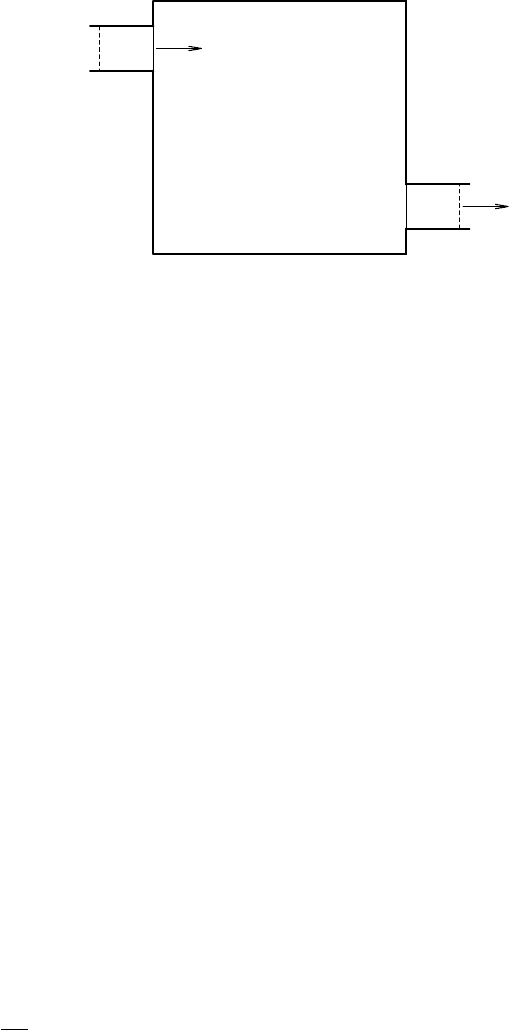
through mass exchange. An open system allows mass exchange. Figure 3.3
shows a schematic of an open system. For simplicity the open system has one
inlet and one outlet. We allow an amount of mass ıM
1
to flow in through
the inlet and an amount ıM
2
to flow out of the outlet. The system gains an
amount of energy equal to U
1
= ıM
1
u
1
, with u
1
the specific internal energy
of the matter flowing into the inlet port. But to make this flow enter the
system an amount of work equal to p
1
dV
1
= p
1
ıM
1
v
1
has to be performed
on the system, with p
1
the pressure at the inlet. The total energy gain of the
system is therefore ıM
1
(u
1
+ p
1
v
1
) = ıM
1
h
1
with h
1
the specific enthalpy
at the inlet. Similarly, the total energy loss is ıM
2
u
2
plus the work p
2
dV
2
done by the system to expel the fluid. The total energy loss of the system is
54 CH 3 GENERAL APPLICATIONS
out
δ M
2
δ M
1
in
FIGURE 3.3 Open system with one inlet and one outlet port.
therefore ıM
2
h
2
, with h
2
the specific enthalpy at the outlet. The total energy
change ıU of the open system is
ıU = ıM
1
h
1
− ıM
2
h
2
. (3.54)
So when matter flows into and out of a system, its energy change is due
to the flux of specific enthalpy into and out of the system, not the flux of
specific internal energy. This is the key application of enthalpy. The difference
between specific enthalpy and specific internal energy is pv, which is called
the flow work. Any matter flow contributes internal energy as well as flow
work to the energy budget.
The above argument can be generalized to a system with several inlets
and outlets. If the mass flux ıM
i
through port i of the system is considered
positive when directed outward, then energy change due to the enthalpy flux
through any number of ports is
ıU =−
i
ıM
i
h
i
=−
i
i
U
i
h
i
A
i
ıt, (3.55)
with
i
, A
i
, U
i
the density, port cross-sectional area, and outward flow velocity
at port i, and ıt the time over which the energy change is considered. More
generally we can choose our system V to be some fixed volume in three-
dimensional space with boundary area A and express the rate of change of
energy due to the enthalpy flux through A. If we denote U = (U , V , W ) the
three-dimensional flow velocity and
ˆ
n the unit vector normal to the surface
A (by convention
ˆ
n points outward), then we can see that the rate of internal
energy change dU/dt of the volume due to the enthalpy flux has to be
dU
dt
=−
A
(Uh) ·
ˆ
n dA. (3.56)
Because the volume choice is arbitrary, we can use Gauss’ theorem to trans-
form this into a local change of specific internal energy due to the enthalpy

3.6 LATENT HEAT 55
flux,
∂(u)
∂t
=−∇·(Uh). (3.57)
The local change of volumetric energy density (u) is due to a divergence of
the enthalpy flux (Uh).
21
3.6 LATENT HEAT
Consider the situation where the open system is made up of an open container
with a liquid and the associated vapour above it. The two subsystems, liquid
and vapour, can exchange matter through evaporation and condensation,
and so can each individually be considered as an open system exchanging
enthalpy. Now, some mass ıM evaporates from the liquid to the vapour.
According to our analysis this process transfers some enthalpy from the liquid
to the vapour. The vapour gains an enthalpy of ıM h
v
, while the liquid loses an
enthalpy of ıM h
l
. Because in general h
v
=h
l
(normally h
v
>h
l
), the enthalpy
budget for such an evaporation is not closed. Indeed, it costs energy to
evaporate a liquid to a vapour. This energy is associated with the energy
barrier molecules have to overcome to escape the intermolecular attractive
forces in the liquid. The energy required is ıM (h
v
−h
l
), which is proportional
to the specific enthalpy difference between the vapour and the liquid. This
enthalpy difference defines
I L = h
v
− h
l
(3.58)
where L is called the enthalpy of vaporization (units J kg
−1
). In atmospheric
science the enthalpy of vaporization is usually called the latent heat of evap-
oration. The energy associated with evaporation or condensation processes
is called latent heat.
If we evaporate a mass of liquid at a fixed temperature T then all the heat
we put into the liquid ıQ is used for evaporation. The enthalpy of evaporation
can then be written as an entropy difference between the vapour and liquid
states,
ıM (h
v
− h
l
) = ıQ = ıM T (s
v
− s
l
). (3.59)
So the evaporation of the liquid corresponds to an increase in entropy. This
equation is only valid at equilibrium; that is, if the evaporation occurs at a
fixed temperature, T. We can now rewrite this equation as
h
l
− Ts
l
= h
v
− Ts
v
. (3.60)
21
The expression Uh is really a flux density, that is, a flux per unit area. Here, and
throughout the rest of this book, we will use the term ‘flux’ to mean either ‘total flux’ or
‘flux density’, depending on the context.

56 CH 3 GENERAL APPLICATIONS
We therefore find that at equilibrium the specific Gibbs functions g = h − Ts
for the liquid and vapour phases are the same,
g
l
= g
v
. (3.61)
This important aspect of phase transitions is covered in more detail in
Section 5.1.
Note that at equilibrium, the entropy change due to evaporation is re-
versible. To achieve evaporation at a fixed temperature, we need to put in
energy ıQ, as in Eq. 3.59, to overcome the enthalpy barrier between the
vapour and the liquid. We can now extract the same amount of energy at the
same temperature to to reverse the process through condensation.
At equilibrium the latent heat of evaporation is a function of temperature
only because at equilibrium the vapour pressure is a function of temperature,
see Section 5.1. However, to a very good approximation this is also true in
more general cases. From Eq. 3.36 we see that if we consider the vapour an
ideal gas, its enthalpy h
v
is a function only of temperature. From Eq. 3.26
we see that this is also true to a good approximation for the enthalpy h
l
of a
liquid. From the definition of L in Eq. 3.58 it then follows that for both the
vapour and the liquid
dh
v,l
dT
=
∂h
v,l
∂T
p
= T
∂s
v,l
∂T
p
= c
p v,l
. (3.62)
Combining these results with the definition of the latent heat of evaporation,
Eq. 3.58, we find that to a good approximation
I
dL
dT
= c
pv
− c
pl
. (3.63)
This equation is sometimes called Kirchhoff’s equation. As for all substances
c
pl
>c
pv
, we find that the latent heat of evaporation is a decreasing function
of temperature. This is expected because at the critical temperature, the tem-
perature above which vapour and liquid become indistinguishable, the latent
heat of evaporation vanishes.
So we find that the specific latent heat of evaporation can be approximated
as
L = L
0
− (c
pl
− c
pv
)(T − T
0
), (3.64)
where it is assumed that both heat capacities are constant over the temper-
ature range of interest, and where L
0
is the value of the latent heat at some
reference temperature T
0
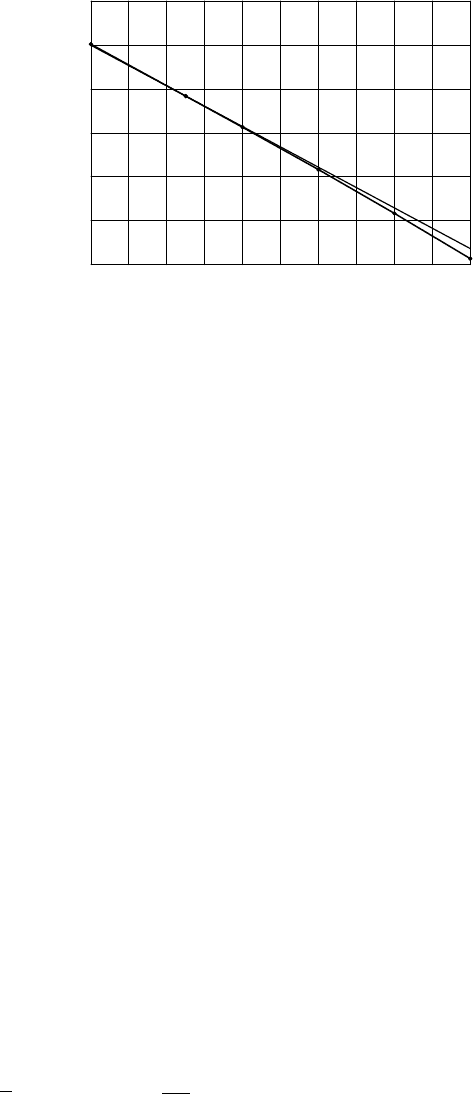
. Figure 3.4 illustrates how well this approximation
works for water when compared to measured values. The approximation with
a reference temperature of 25
◦
C is better than one part in a thousand for tem-
peratures between 0
◦
C and 50
◦
C and better than one part in two hundred for
3.7 TURBULENT ENERGY FLUXES 57
0 102030405060708090100
T (ºC)
2.25
2.30
2.35
2.40
2.45
2.50
2.55
L (10
6
Jkg
− 1
)
FIGURE 3.4 Points: measured latent heat of evaporation for water. Thin line: linear
approximation of Eq. 3.64 with T
0
= 25
◦
C. The other parameters in the linear approx-
imation are L
0
= 2.44 × 10
6
Jkg
−1
,c
pl
= 4180 J kg
−1
K
−1
, and c
pv
= 1865 J kg
−1
K
−1
.
Data from Marsh, K. N., ed. (1987) Recommended reference materials for the realization of
physicochemical properties Blackwell, Oxford.
temperatures up to 100
◦
C. A typical value often used for quick calculations
is
L = 2.5 × 10
6
Jkg
−1
, (3.65)
which is very close to the value of the latent heat of evaporation at 0
◦
C.
The above discussion of evaporation from liquid to vapour can be applied
to the melting from solid to liquid as well; we thus find the so-called enthalpy
of fusion. For water at the melting point of 0
◦
C at standard pressure the
enthalpy of fusion is L
m
= 0.33 × 10
6
Jkg
−1
. Similarly, we find an enthalpy
of sublimation for the transition from solid to vapour; for water (ice) at 0
◦
Cit
is L
ice
= 2.826 × 10
6
Jkg
−1
.
3.7 TURBULENT ENERGY FLUXES
Apart from local sources, the budget of internal energy for any volume of air
is determined by the enthalpy fluxes into and out of the volume. The enthalpy
flux F
h
is given by
F
h
= Uh. (3.66)
It is often convenient to decompose the flux into a time average contribution
and a fluctuation from the time average – a so-called Reynolds decomposition.
So we write
h =
h + h
,U = U + (U)
, (3.67)

58 CH 3 GENERAL APPLICATIONS
with the overbar denoting the time average, and the prime denoting the
fluctuation. This decomposition has the property that the time average of the
fluctuation is zero,
h
= 0, (U)
= 0. (3.68)
Using this property, we can write the enthalpy flux as
Uh =
U h + (U)
h
. (3.69)
The other terms in the expanded product vanish. The first term is called the
mean flux, the second term is called the turbulent flux.
In the planetary boundary layer the turbulent flux dominates. In the turbu-
lent flux, the term associated with the vertical transport of mass and enthalpy
dominates. In this case we find a vertical enthalpy flux F
h
of
F
h
= (w)
h
. (3.70)
A capital H is often used to denote the vertical enthalpy flux, but we will not
use that notation here to avoid confusion with the enthalpy proper.
For dry air we can use the ideal gas expression, h
= c
p
T
. Also, the
density is often replaced by its mean so that only the fluctuating vertical wind
contributes to the fluctuating vertical mass transport; that is, (w)
= w
.
The resulting expression for the vertical enthalpy flux is
22
I F
h
= c
p
w
T
. (3.71)
In this form, the dry-air enthalpy flux is called the sensible heat flux, to dis-
tinguish it from any contribution to the enthalpy flux associated with the
transport of moisture, as discussed below.
Rapidly sampled measurements of vertical wind and temperature allow us
to estimate the sensible heat flux near the surface. Theoretically, we need to
sample at the highest frequency that occurs in the turbulent flow field to find
the sensible heat flux. In practice, we can only sample at a lower frequency
and therefore cannot measure the full sensible heat flux.
Because of the latent heat contributions of phase changes, the turbulent
flux of water vapour is also of importance in assessing the energy budget of
a volume of air. The vapour mass flux F
v
can be written as
F
v
= U
v
= Uq, (3.72)
22
The choice to use the mean density is consistent with the Boussinesq approximation
that is often used in studies of turbulent fluxes. Without this approximation, the general
result for ideal gases is
(w)
h
= c
p
w
T
+ c
p
w
T
+ c
p
w
T
.
The second term is often ignored on setting
w = 0 and the third term vanishes when the
ideal gas law is linearized around the mean.

3.7 TURBULENT ENERGY FLUXES 59
with
v
the vapour density, the total density, and q =
v
/ the specific
humidity of the air. This vapour flux can be associated with an energy flux if
we multiply the vapour flux by the latent heat of evaporation, L. The resulting
energy flux is called the latent heat flux. Using the same approximations as
those leading to Eq. 3.71, we find for the turbulent vertical latent heat flux
F
l
that
I F
l
= L w
q
. (3.73)
Latent heat flux is really a water vapour flux, apart from a proportionality
constant which changes its dimension into an energy flux. However, when
there is a divergence of the latent heat flux (that is, there is condensation
or evaporation of water vapour), there is a local contribution to the heating
field, as expected from a real heat flux.
In Section 5.4 we will show that the variations in specific enthalpy of
moist unsaturated air can be written as variations in the so-called moist static
energy
23
h
v
= c
p
T + Lq. (3.74)
As we can see, the sensible heat flux and the latent heat flux are essentially
the two main contributions to the total enthalpy flux in moist air; that is,
I
w
h
v
= c
p
w
T
+ L w
q
= F
h
+ F
l
. (3.75)
The sensible and latent heat fluxes are contained in the total enthalpy flux
for moist air. To measure the total enthalpy flux we need to know both the
sensible and the latent heat fluxes, but for evaluating energy budgets it makes
little sense to consider them separately.
Over humid surfaces, such as the sea, much of the total enthalpy flux is in
the form of latent heat. Over dry surfaces much of the total enthalpy flux is
in the form of sensible heat. The ratio of the sensible and latent heat fluxes
is called the Bowen ratio ˇ,
I ˇ = F
h
/F
l
. (3.76)
When the latent heat flux is small we often use the evaporative fraction, EF,
which is the fractional contribution of the latent heat flux to the total enthalpy
flux,
EF =
F
l
F
h
+ F
l
. (3.77)
23
The specific heat capacity in this equation is c
p
= (1 −q) c
pd
+qc
pl
, with c
pd
and c
pl
the
specific heat capacities for dry air and water, respectively.
60 CH 3 GENERAL APPLICATIONS
The Bowen ratio (or evaporative fraction) is a diagnostic variable describing
properties of vertical heat exchange. However, the original use of the Bowen
ratio was to estimate the evaporation from surfaces by first estimating the
Bowen ratio using energy constraints and then measuring the sensible heat
flux.
24
3.8 POTENTIAL TEMPERATURE
In atmospheric science it is common usage to map the specific entropy of a
parcel onto a temperature scale called the potential temperature. It is defined
as follows:
The potential temperature is the temperature a fluid parcel would have
if brought at constant entropy to a reference pressure p
0
.
From this definition it follows that the potential temperature is a function
of the specific entropy of the fluid parcel (p
0
is a fixed parameter). Like the
specific entropy, the potential temperature of a fluid parcel is a conserved
quantity for adiabatic (isentropic) transformations.
So by definition, the specific entropies of the parcel at its initial pressure
and at its reference pressure are the same and the temperature at the refer-
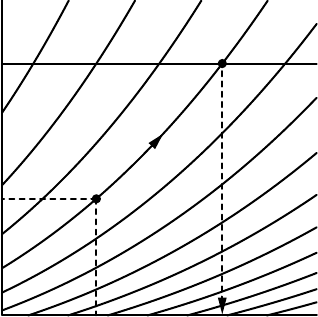
ence pressure defines the potential temperature, see Figure 3.5. Considering
entropy a function of pressure p and temperature T, potential temperature is
implicitly defined by
I s(p, T) = s(p
0
,). (3.78)
p
0
p
T θ
s
FIGURE 3.5 Illustration on a pT diagram of the definition of potential temperature. For
a fixed reference pressure p
0
, the isolines of specific entropy s uniquely map any (p, T)
point onto a (p
0
,) point.
24
See Lewis, J. M. (1995) Bull. Am. Met. Soc. 76, 2433–2443.

3.8 POTENTIAL TEMPERATURE 61
If we know the specific entropy as a function of pressure and temperature we
can invert this equation to find the potential temperature.
Remembering that p
0
is a fixed reference pressure, infinitesimal variations
of Eq. 3.78 satisfy
ds =
∂s
∂T
p
0
d. (3.79)
This can be rewritten as
I ds = c
p
0
d
, (3.80)
where c
p
0
= (∂s/∂T)
p
0
is the specific heat capacity at the reference pressure.
We can write out this equation in terms of variations of pressure and temper-
ature (using the fourth Maxwell relation, Eq. 3.15):
−pv˛
p
dp
p
+ c
p
dT
T
= c
p
0
d
, (3.81)
with the isobaric expansion coefficient ˛
p
defined as
˛
p
=
1
v
∂v
∂T
p
. (3.82)
If the isobaric expansion coefficient and the isobaric heat capacity are known
functions of temperature and pressure, then this equation can be integrated
to calculate the potential temperature.
Let us apply the definition of the potential temperature to an ideal gas. For
an ideal gas the specific entropy is given in Eq. 3.40. The potential tempera-
ture for an ideal gas therefore satisfies
c
p
ln (T/ T
0
) − R ln (p/p
0
) = c
p
ln (/T
0
) − R ln (p
0
/p
0
) (3.83)
and we find for an ideal gas that
I = T
p
0
p
R/c
p
. (3.84)
In the atmosphere, p
0
is usually taken to be 1000 hPa or standard pressure,
1013.25 hPa. In any calculation that leads to measurable results, the constant
p
0
will never occur. In the formula for potential temperature of an ideal gas
we use the ratio R/c
p
; this ratio is often denoted by the greek letter . For