
Ambaum M., Thermal Physics of the Atmosphere
Подождите немного. Документ загружается.


4.2 HYDROSTATIC BALANCE 73
height,
−
dT
dZ
= . (4.17)
So the temperature profile is
T = T
0
− Z, (4.18)
with T
0
the temperature at geopotential height Z = 0. This can be substituted
in the hydrostatic equation and integrated with boundary condition p(Z =
0) = p
0
. The result is
I p = p
0
T
0
− Z
T
0
g
0
/R
. (4.19)
This equation can be related to the result for an isothermal atmosphere by
rewriting as
p = p
0
1 −
R
g
0
Z
H
g
0
/R
with H =
RT
0
g
0
. (4.20)
Using a well-known result in calculus,
lim
q→0
(1 − qx)
1/q
= e
−x
, (4.21)
we see that the Eqs 4.16 and 4.19 become the same when the lapse rate is
much smaller than g
0
/R = 34 K km
−1
.
The US Standard Atmosphere is, in the troposphere, defined to have a con-
stant lapse rate in geopotential height of 6.5Kkm
−1
. When cruising aircraft
report height they actually refer to a pressure level in the US Standard At-
mosphere, where Eq. 4.19 is used to calculate the geopotential height from
the pressure. Equations 4.8 and 4.19 can be used to check the tropospheric
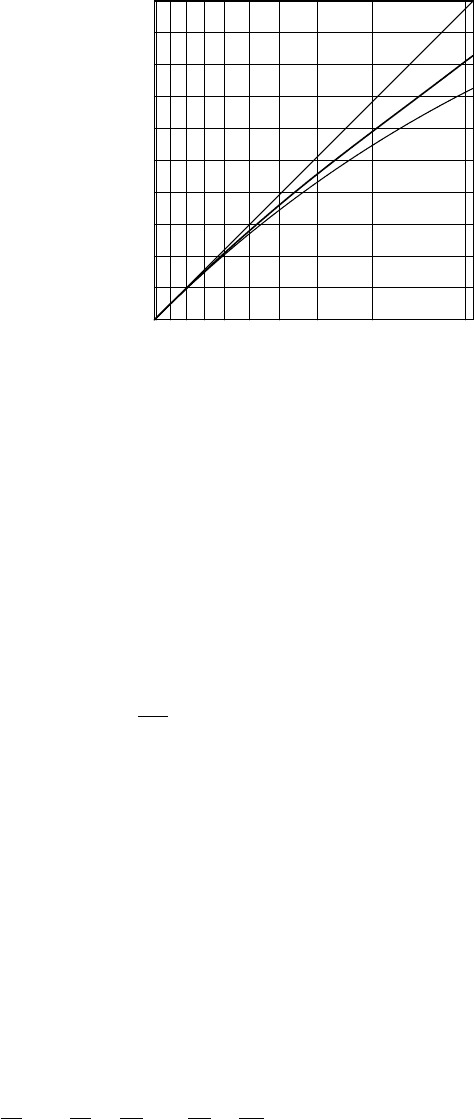
values of Table 4.1. Figure 4.2 shows a graphical comparison of some vertical
pressure profiles.
Integrating the hydrostatic equation between two height levels, we find
that the mass between the two levels is proportional to the pressure differ-
ence. The mass M per unit area between two height levels is
M =
z
1
z
0
dz =
p
0
p
1
dp
g
≈
p
0
− p
1
g
, (4.22)
where we have assumed that g is constant between the two levels. In other
words, equal pressure differences correspond to equal masses.
74 CH 4 THE ATMOSPHERE UNDER GRAVITY
adiabatic
isothermal
0
10
20
Z (km)
1005001000
p (hPa)
FIGURE 4.2 Comparison of the US Standard Atmosphere, 1976 (thick line) with an
isothermal profile and a dry adiabatic profile with constant lapse rate of g
0
/c
p
(thin
lines). Following Eq. 4.15, the slope of each line in this graph is proportional to the
temperature.
Integrating the hydrostatic equation between two pressure levels, we find
a useful expression for the geopotential difference between the two levels,
1
−
0
= g
0
(Z
1
− Z
0
) =−
p
1
p
0
v dp. (4.23)
With the ideal gas law this equation becomes the hypsometric equation,
I Z
1
− Z
0
=
p
0
p
1
RT
g
0
p
dp (4.24)
which relates the geopotential difference between two pressure levels to an
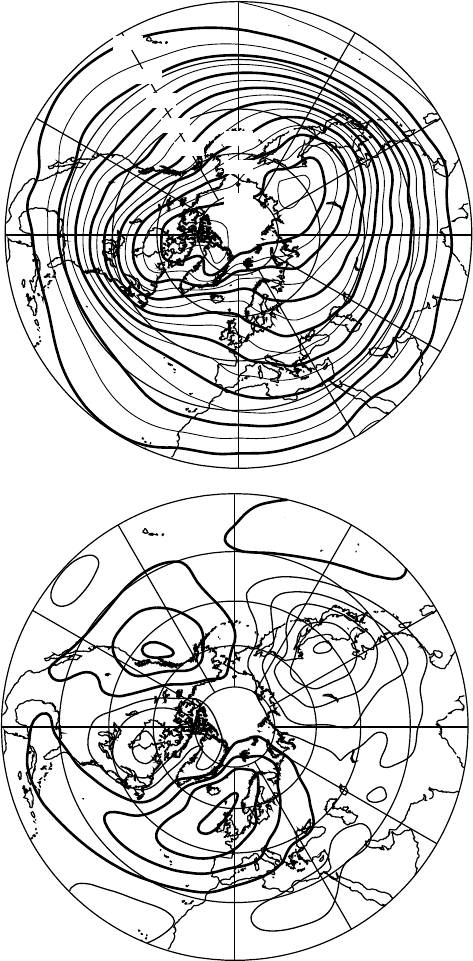
average temperature of the layer. The geopotential thickness, indicated in
geopotential metres or decametres, is a commonly used diagnostic to char-
acterize the temperature of a layer, see Figure 4.3. Remember that in humid
conditions, such as the tropical troposphere, these equations need to be writ-
ten in terms of virtual temperature.
4.3 ADIABATIC LAPSE RATE
The hydrostatic equation can be used to relate the specific entropy profile to
the temperature profile. Considering specific entropy a function of p and T
we find
ds
dz
=
∂s
∂p
T
dp
dz
+
∂s
∂T
p
dT
dz
. (4.25)
4.3 ADIABATIC LAPSE RATE 75
500
510
520
530
540
550
560
570
FIGURE 4.3 Top panel: Mean wintertime geopotential thickness of the 1000–500 hPa layer
in decametres. Bottom panel: Same as top panel but with the longitudinal mean removed
to emphasize the deviations from the dominant pole-to-equator thickness gradient. Thin
contours represent negative values. Contour values are ...,−75, −25, 25, 75,... m. Data
from NCEP Reanalyses, Kalnay et al. (1996). Bull. Amer. Met. Soc. 77, 437–471.

76 CH 4 THE ATMOSPHERE UNDER GRAVITY
Substituting hydrostatic balance and using a Maxwell relation this can be
rewritten as
ds
dz
= g˛
p
+
c
p
T
dT
dz
(4.26)
with the isobaric expansion coefficient ˛
p
and isobaric specific heat capacity
c
p
defined as
˛
p
=
1
v
∂v
∂T
p
,c
p
= T
∂s
∂T
p
. (4.27)
Rearranging gives
I
ds
dz
=
c
p
T
a
+
dT
dz
, (4.28)
where the adiabatic lapse rate,
a
, is defined as
I
a
=
g˛
p
T
c
p
. (4.29)
For an ideal gas ˛
p
= 1/T and the adiabatic lapse rate becomes
I
d
=
g
c
p
. (4.30)
This lapse rate is usually called the dry adiabatic lapse rate, hence the subscript
‘d’. These equations are also valid for lapse rates in geopotential height if g
is replaced by g
0
. The dry adiabatic lapse rate for the Earth’s atmosphere
is about 10 K km
−1
. It is typical for the observed temperature profile when
there is vigorous turbulence, such as in the planetary boundary layer: here
air parcels, carrying their specific entropy, get stirred and the specific entropy
becomes on average constant in the vertical. The dry adiabatic lapse rate is
in practice an upper bound on observed lapse rates because larger lapse rates
are gravitationally unstable.
It is worth emphasizing that Eq. 4.29 for the adiabatic lapse rate is valid for
any substance for which entropy is a function of temperature and pressure
only. Section 6.1 demonstrates its application in finding the adiabatic lapse
rate for moist saturated air, see also Problem 4.4.
The adiabatic lapse rate also describes how the temperature of a parcel
changes with height if it moves adiabatically in the vertical. By definition, an
air parcel moving adiabatically conserves its specific entropy. The Lagrangian
derivative of the temperature, that is the time derivative of the temperature
following the air parcel, can then be written as
DT
Dt
=
∂T
∂s
p
Ds
Dt
+
∂T
∂p
s
Dp
Dt
=
∂T
∂p
s
Dp
Dt
, (4.31)

4.4 BUOYANCY 77
because Ds/Dt = 0 for adiabatic motion. Considering pressure a function of
height only, that is, ignoring variations of pressure in the horizontal and in
time, we can write
Dp
Dt
=
dp
dz
Dz
Dt
=
dp
dz
W (4.32)
with W the vertical velocity. Substituting this in the above equation we find
(see Problem 4.3),
DT
Dt
=
∂T
∂p
s
dp
dz
W =−
a
W . (4.33)
So with these assumptions, we find that the temperature change with height
follows the adiabatic lapse rate. The assumptions on the pressure fields can be
relaxed if we use pressure coordinates: here the vertical coordinate is pressure
rather than geometric height. The vertical velocity in pressure coordinates is
Dp/Dt and the dry adiabatic lapse rate in pressure coordinates is (∂T/∂p)
s
.
The dry adiabatic lapse rate explains the F
¨
ohn effect, where air descends
from a mountain adiabatically; the temperature of that air will increase ac-
cording to the dry adiabatic lapse rate. Because the dry adiabatic lapse rate
is usually larger than the environmental lapse rate, the descending air will
become warmer than the environment. We would still need to explain why
the descending parcel had a higher entropy than the environment from which
it originated on the upstream side of the mountain. Here condensation pro-
cesses play a role: the rising air parcel is dried at relatively high temperature
by condensation and subsequent precipitation on the upstream side of the
mountain.
4.4 BUOYANCY
Vertical stability (or parcel stability) of the atmosphere depends on the weight
of a parcel relative to its environment. If it is warmer and lighter, it will
experience an upward buoyancy force in accordance with Archimedes’ law;
if it is cooler and heavier, it will experience a downward buoyancy force.
According to Archimedes’ law the upward buoy-
ancy force F on a fluid parcel is
F = g(
e
−
p
)V
p
(4.34)
with
p
and
e
the densities of the parcel and en-
vironment, respectively, and V
p
the volume of the
parcel. The specific upward force (the force per
unit mass, that is, acceleration) on the parcel is
called the buoyancy, b
F
V
p
ρ
p
ρ
e
I b =
F
p
V
p
= g
e
−
p
p
= g
v
p
− v
e
v
e
. (4.35)

78 CH 4 THE ATMOSPHERE UNDER GRAVITY
So the buoyancy is due to the relative difference in specific volumes of the
parcel and its environment. For an ideal gas, the buoyancy can be written as
b = g
T
p
− T
e
T
e
= g
p
−
e
e
, (4.36)
where it is used the fact that under hydrostatic balance the parcel pressure
and the environmental pressure are the same. This equation formalizes the
familiar notion that warm air parcels will rise, b>0.
For a moist atmosphere, the temperatures in the expression for buoyancy
need to be replaced by virtual temperatures, and the potential temperatures
need to be replaced by the virtual potential temperatures,
v
, defined as
I
v
= T
v
(p
0
/p)
R/c
p
, (4.37)
where the R and the c
p
are the usual dry air values.
For small differences between the environment and the parcel, we can
derive a linear approximation to the buoyancy:
b = g
v
p
− v
e
v
e
by Eq. 4.35
=
g
v
e
∂v
∂s
p
(s
p
− s
e
) linearization
=−
dp
dz
∂T
∂p
s
(s
p
− s
e
) by Eqs 3.7 and 4.13
=
a
(s
p
− s
e
) by Eq. 4.86 (4.38)
This linearized buoyancy can also be written in terms of potential tempera-
ture:
b = c
p
0
a
p
−
e
e
. (4.39)
This expression for buoyancy generalizes the ideal gas result, Eq. 4.36, to
any simple substance although it is only valid in the linear regime. Note that
moist unsaturated air is not necessarily a simple substance: the buoyancy can
also be a function of the humidity contrast.
If a parcel of specific entropy s
p
is lifted over a (small) distance ız, then
the environment specific entropy s
e
and parcel specific entropy s
p
are related
by
s
e
= s
p
+
ds
e
dz
ız, (4.40)
because s
p
is the entropy of the environment at the departure point. Substi-
tuting this in the linearized buoyancy we find
b =−
a
ds
e
dz
ız. (4.41)
4.4 BUOYANCY 79
θθ
z
z
θ
p
θ
p
θ
e
θ
e
dep. pointdep. point
(a) (b)
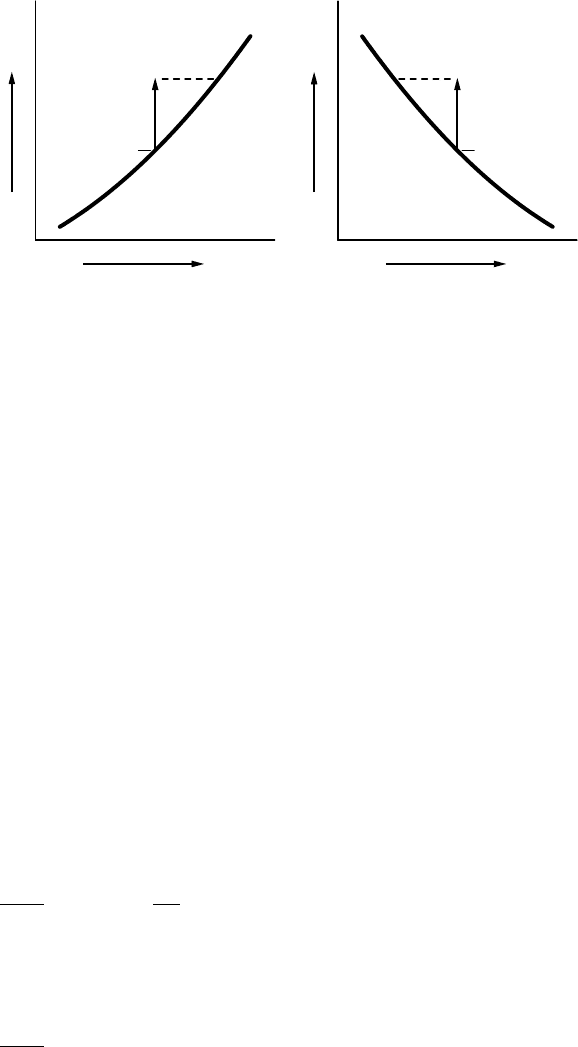
FIGURE 4.4 Illustration of a stable profile (a) and unstable profile (b) of potential tem-
perature versus height (solid line). When lifting a parcel in case (a) the parcel potential
temperature will be lower than that of the environment, and therefore the parcel will
sink. In case (b) the parcel potential temperature will be larger than that of the environ-
ment, and the parcel will rise.
This equation is general for small displacements in any simple hydrostatic
fluid.
In an environment where the specific entropy increases with height,
ds
e
/dz>0, the buoyancy force on a displaced parcel has the opposite sign
to the displacement, bız < 0. This means that the fluid is stable for (small)
parcel displacements: any fluctuation in vertical location is counteracted by
a restoring buoyancy force. In an environment where the specific entropy
decreases with height, ds
e
/dz<0, the buoyancy force on a displaced parcel
has the same sign as its displacement, bız > 0. This means that the fluid is
unstable: any fluctuation in vertical location of the parcel will be enhanced
by its buoyancy force. An equivalent argument is illustrated in Figure 4.4. An
environment with constant specific entropy (so its temperature lapse rate is
the dry adiabatic lapse rate) has neutral stability. A well-mixed boundary
layer is often neutrally stable.
We can give a more dynamic interpretation of parcel stability. According
to Newton’s second law, the acceleration of the fluid parcel satisfies
d
2
ız
dt
2
= b =−
a
ds
e
dz
ız. (4.42)
This equation can be written as
d
2
ız
dt
2
+ N
2
ız = 0. (4.43)
This is an oscillation equation for ız with solutions proportional to cos (Nt +
0
) where the buoyancy frequency N, also called the Brunt–V
¨
ais
¨
al
¨
a frequency,

80 CH 4 THE ATMOSPHERE UNDER GRAVITY
is given by
I N
2
=
a
ds
dz
=
c
p
T
a
a
+
dT
dz
, (4.44)
where the subscript e has been omitted and the vertical profile of entropy
has been written in terms of the temperature profile. Because variations in
specific entropy can be mapped onto variations in potential temperature,
ds = c
p
0
d/, the Brunt–V
¨
ais
¨
al
¨
a frequency can also be written as
N
2
=
c
p
0
a
d
dz
. (4.45)
For ideal gases this gives
I N
2
=
g
d
dz
. (4.46)
This equation is also the appropriate expression for moist unsaturated air if
we replace the potential temperature by the virtual potential temperature.
For stable cases we find a real buoyancy frequency (oscillations of ız), for
unstable cases we find an imaginary buoyancy frequency (exponential growth
of ız), and in neutral cases, a vanishing buoyancy frequency (steady ız). For a
typical tropospheric lapse rate of 6.5Kkm
−1
the buoyancy frequency is about
N = 10
−2
s
−1
, corresponding to a buoyancy period of about 10 minutes.
The instability of profiles with specific entropy decreasing with height
means that such profiles are not normally observed, at least not for periods
longer than the time scale associated with the parcel instability. For example,
the time scale associated with a 11 K km
−1
profile is about 3 minutes. Ob-
served profiles will therefore in practice be stable or neutral. From Eq. 4.28 it
then follows that the adiabatic lapse rate is an upper bound on the observed
lapse rates.
The Brunt–V
¨
ais
¨
al
¨
a frequency should be interpreted as a measure of sta-
bility instead of the precise oscillation frequency of a displaced parcel. The
buoyancy b does not equal the acceleration of the parcel as it underestimates
the inertia of the parcel. The parcel attains a so-called added mass because any
moving parcel also has to displace, and therefore accelerate, the surrounding
fluid, thus increasing the inertia of the parcel. The oscillating parcel we have
just described is not a solution of the full equations of motion of the fluid. A
further caveat is that any real oscillating parcel would exchange matter with
its environment (entrainment) and thus effectively reduce its entropy con-
trast. Both these effects indicate that the Brunt–V
¨
ais
¨
al
¨
a frequency in Eq. 4.44
is an upper bound on observed parcel frequencies.
The Brunt–V
¨
ais
¨
al
¨
a frequency is an important parameter for wave phenom-
ena in a stratified fluid. For example, it can be shown that a fluid with a
constant Brunt–V
¨
ais
¨
al
¨
a frequency N supports linear internal gravity waves

4.5 DRY STATIC ENERGY AND BERNOULLI FUNCTION 81
with a frequency ω equal to
ω
2
=
k
2
N
2
k
2
+ l
2
. (4.47)
Here, k and l are the horizontal and vertical wavenumbers of the wave. This
dispersion relation shows that for such actual solutions of the equations of
motion the Brunt–V
¨
ais
¨
al
¨
a frequency is indeed an upper bound on parcel fre-
quencies: ω<N.
4.5 DRY STATIC ENERGY AND BERNOULLI FUNCTION
For a parcel moving hydrostatically in a geopotential field, the specific en-
thalpy varies according to
dh = T ds + v dp = T ds − d. (4.48)
We can move the differential d to the left-hand side to form the differential
of the combination
I = h + . (4.49)
This expression is called the generalized enthalpy or the static Bernoulli func-
tion. The first order variation in generalized enthalpy is
d = dh + d = T ds. (4.50)
For an ideal gas with isobaric heat capacity c
p
we have dh = c
p
dT,sowecan
integrate the expression for dh + d to
I h
= c
p
T + g
0
Z. (4.51)
Here, h
is called the dry static energy. The dry static energy differs from
the generalized enthalpy for an ideal gas by an integration constant. This
integration constant becomes important in the discussion of mixtures. Note
that dh
/dz = 0 defines the dry adiabatic lapse rate for an ideal gas.
Equation 4.50 is the energy budget for a parcel in an external potential
field: for adiabatic changes, any reduction in potential energy is credited
to the enthalpy of the parcel. Why does a reduction in potential energy not
simply translate into a gain of internal energy? The difference is due to the
macroscopic nature of rearrangements. The displacement of an air parcel
requires flow work, see Section 3.5. So for adiabatic rearrangements, a re-
duction in potential energy is used to boost the sum of internal energy and

82 CH 4 THE ATMOSPHERE UNDER GRAVITY
flow work,
−d = du + d(pv) = dh. (4.52)
Flow work has to be part of the budget because if the potential energy of a
parcel is to change, it has no choice but to change its vertical position.
Equation 4.50 refers to slow, reversible changes. If the change is fast then
the parcel will also gain kinetic energy. The kinetic energy per unit mass is
V
2
/2, with V the macroscopic speed of the air parcel. This then has to be
included in the budget for adiabatic motion. Written as the energy budget of
a fluid parcel, we find Bernoulli’s equation:
D
Dt
h + +
1
2
V
2
= 0, (4.53)
that is, for adiabatic motions the Bernoulli function (the term in brackets) is
constant following a fluid parcel. This budget equation is only true if there
are no other sources of energy for the parcel. We need to exclude diffusion
processes (which may diffuse heat or kinetic energy to or from the parcel and
thus change its specific entropy or kinetic energy) and non-steady conditions
(in which case the budget would not need to be closed). A more familiar form
of Bernoulli’s equation follows for incompressible fluids where the density of
each fluid parcel is constant,
0
, so that dh = dp/
0
. In this case we find
D
Dt
p
0
+ +
1
2
V
2
= 0. (4.54)
Bernoulli’s equation has many applications and the best known is probably the
‘explanation’ of why a plane can fly: the wings are shaped such that the flow
speed over the wing is higher than the flow speed below the wing. Bernoulli’s
equation then states that there has to be a pressure difference between top
and the bottom of the wing, which provides the necessary lift. However,
this is only a consistency argument and not an explanation giving cause and
effect. All that Bernoulli’s equation implies is that in a steady adiabatic flow
changes in pressure and changes in flow speed go hand in hand; we cannot say
that one causes the other. Furthermore, air is compressible, so any argument
needs to be properly phrased in terms of enthalpy rather than pressure, see
also Problem 4.7.
In the dynamic meteorology literature, the generalized enthalpy is usually
called the Montgomery function.
27
Its relevance to dynamics becomes clear
when considering the total specific force on a fluid in the equations of motion
27
Because in dynamic meteorology applications only gradients of the Montgomery func-
tion play a role, we normally use the dry static energy, Eq. 4.51, instead of the generalized
enthalpy to define the Montgomery function for the atmosphere.