
Ambaum M., Thermal Physics of the Atmosphere
Подождите немного. Документ загружается.


62 CH 3 GENERAL APPLICATIONS
a diatomic ideal gas (such as air, approximately) we have, from Eqs. 3.28
and 3.29
=
R
c
p
=
2
7
. (3.85)
A monoatomic gas has = 2/5. Combining the definitions of specific entropy
and potential temperature for an ideal gas we can verify that
I s = c
p
ln (/T
0
), (3.86)
with T
0
a constant temperature that only changes the specific entropy by an
additive constant. From this equation immediately follows the differential
relation, Eq. 3.80, as applied to an ideal gas.
We can combine the definition of potential temperature for an ideal gas
with the ideal gas law to find
p
p
0
=
T
0
, (3.87)
with p
0
=
0
R. From this we can derive the following relationships that
are valid for adiabatic transformations of an ideal gas, sometimes called the
Poisson equations:
I
p
p
0
=
T
c
p
/R
=
0
c
p
/c
v
. (3.88)
So these relationships quantify how pressure and temperature change on adi-
abatic compression and expansion. For example, an adiabatic compression
of air by a factor of 2 leads to an increase in pressure by a factor of 2.6 and
an increase in temperature by a factor of 1.3. Anyone who has ever used a
bicycle pump will be aware of these effects.
Although in atmospheric science it is common usage to map specific entropy
onto potential temperature, this is not without its drawbacks. Because of
its widespread use in atmospheric science we will not avoid it in this text.
But there are no sound physical arguments why we should use potential
temperature instead of specific entropy in any of the applications encountered
here.
Perhaps part of the attraction of using potential temperature is its appar-
ent measurability: it is the temperature a fluid parcel would have if brought
adiabatically to a reference pressure. This is a useful thought experiment
but no one has ever used it as a practical method to measure the potential
temperature of a fluid parcel.
The notion of potential temperature may distract from the more funda-
mental notions of entropy and heat. Derivations using potential temperature
are usually less intuitive than those using entropy. If carelessly applied, they

3.8 POTENTIAL TEMPERATURE 63
give less general results: potential temperature is often read as the ideal gas
potential temperature but, for example, a moist parcel is not an ideal gas.
We are then tempted to introduce such notions as equivalent potential tem-
perature or wet-bulb potential temperature (see Chapter 6), which in fact
are not potential temperatures in the sense of Eq. 3.78. In fact, a proper
definition of potential temperature for a moist parcel requires the precise
definition of how the parcel was brought reversibly to the reference pressure.
In other words, there is no unique local definition of potential temperature.
We can easily avoid any convoluted definitions and derivations by sticking to
the more fundamental notion of entropy.
There is also a more philosophical drawback. Like specific entropy, poten-
tial temperature is an intensive quantity; it does not scale with the size of
the system. However, specific entropy is based on the extensive total en-
tropy. Entropies can be added; subsystems can be joined together and we
can calculate the total entropy of the compound system. No such notion
exists for potential temperature; temperatures cannot be added together.
It appears somewhat illogical to replace a variable based on an extensive
quantity, such as entropy, with a fundamentally intensive quantity such as
temperature.
P
ROBLEMS
3.1. Legendre transforms. Consider a function f of x: f = f (x). Now define
a new variable p by
p =
df
dx
Show that the function g, defined as
g = xp − f
can be seen as a natural function of p (show that dg = x dp). The
function g is called the Legendre transform of function f. In the same
way, show that the function
˜
f defined as
˜
f = xp − g
is a natural function of x. Show that
˜
f is the same as the original f ;in
other words, show that the Legendre transform is its own inverse. Suc-
cessive Legendre transforms of the internal energy define the different
thermodynamic potentials.
3.2. A water molecule H
2
O is made up of two hydrogen atoms attached to a
central oxygen atom at an angle of about 105 degrees (
H
O
H
). Suppose

64 CH 3 GENERAL APPLICATIONS
that at room temperature, the vibrational modes are not excited. What
is the expected specific heat capacity at constant pressure c
p
for water
vapour? (The observed value is 1.87 × 10
3
Jkg
−1
K
−1
.)
3.3. Show that the specific heat capacity at constant volume for moist air can
be written as
c
v(moist)
= (1 + q (a
v
− 1)) c
v(dry)
,
with q the specific humidity and a
v
= c
v(vapour)
/c
v(dry)
≈ 1.96, the ratio
of the heat capacities at constant volume for water vapour and dry air.
Demonstrate the validity of the analogous equation for c
p(moist)
with,
instead of a
v
, an isobaric heat capacity ratio a
p
≈ (20/21)a
v
.
3.4. The isobaric thermal expansivity and the isothermal compressibility are
defined as
˛
p
=
1
v
∂v
∂T
p
,ˇ
T
=−
1
v
∂v
∂p
T
.
Show that the relationship between c
p
and c
v
can be rewritten as
c
p
= c
v
+ vT˛
2
p
/ˇ
T
.
Hint: Use the reciprocity relation for partial derivatives, see Appen-
dix A. Find relevant tabulated values for water to show that the iso-
baric and isovolumetric heat capacities of water are typically less than
1% apart.
3.5. Show that the isentropic compressibility ˇ
s
and the isothermal compress-
ibility ˇ
T
are related through
ˇ
T
= ˇ
s
+ vT˛
2
p
/c
p
and hence ˇ
T
/ˇ
s
= c
p
/c
v
.
Hint: Write the differential of v as a function of p and T and hence
calculate (∂v/∂p)
s
. What is the physical reason why ˇ
T
is larger than ˇ
s
?
3.6. Show that the specific entropy of a solid or liquid with specific heat
capacity c can be approximated as
s = c ln (T/ T
0
).
3.7. Use the equation for the speed of sound in an ideal gas, Eq. 3.45, to
explain why the pitch of your voice goes up after breathing in helium
gas. Show that this equation predicts a pitch change of close to one
octave plus a perfect fifth.

3.8 POTENTIAL TEMPERATURE 65
3.8. Show that the speed of sound in humid air C
h
can be approximated by
C
h
= C (1 + 0.26 q),
with C the speed of sound in dry air at the given temperature and q
the specific humidity. Hint: See Problem 3.3. In light of the above
equation, can we measure temperature in the field by measuring the
speed of sound between two points?
3.9. Show that van der Waals’ equation, Eq. 3.51, can be rewritten as
p = RT
1
1 − b/
−
a
2
RT
,
with the molar mass of the substance, R its specific gas constant, and
a and b its van der Waals coefficients. Hence show that the second and
third virial coefficients for a van der Waals gas are given by Eq. 3.53.
3.10. Concorde used to cruise at a pressure of around 100 hPa, where the typ-
ical air temperature is around −50
◦
C. If the cabin pressure in Concorde
is 850 hPa, what would the consequences be of adiabatic compression
of the outside air to provide ventilation?

4
The atmosphere under
gravity
The gravitational potential energy of an air parcel varies considerably over the
depth of the atmosphere when compared to variations in internal energy. This
means that the gravitational potential energy has to be part of the thermody-
namic energy budget when considering vertical structure in the atmosphere.
Hydrostatic balance is the first manifestation of the gravitational potential
energy in fluid systems. It reflects the fact that the pressure at any point in a
static fluid is determined by the weight of the fluid above it. In this chapter
we give a general thermodynamic derivation of hydrostatic balance.
When the air is in motion, hydrostatic balance is only valid as an approx-
imation. In dynamic terms, hydrostatic balance requires that the vertical ac-
celeration of air parcels is much smaller than the acceleration of gravity. In
thermodynamic terms, hydrostatic balance requires that the kinetic energy
variations are much smaller than potential energy or internal energy vari-
ations. These conditions are essentially equivalent and are usually met in
the atmosphere. Only in strong updrafts or downdrafts is an assumption of
hydrostatic balance expected to be unwarranted.
The rest of the chapter is devoted to exploring what the assumption of
hydrostatic balance implies for the vertical structure of the atmosphere.
The chapter concludes with a discussion of the vertical structure of an
isothermal atmosphere in the context of statistical mechanics. Some key con-
cepts in statistical mechanics are introduced, illustrating the way statistical
mechanics can be used to link the microscopic world of molecules to the
macroscopic world of thermodynamics.
4.1 GEOPOTENTIAL
The acceleration due to gravity is a vector g, which can be written as the
gradient of a geopotential as
I g =−g
ˆ
k =−∇, (4.1)
67
Thermal Physics of the Atmosphere Maarten H. P. Ambaum
© 2010 John Wiley & Sons, Ltd. ISBN: 978-0-470-74515-1

68 CH 4 THE ATMOSPHERE UNDER GRAVITY
with
ˆ
k the unit vector pointing vertically upward and g the magnitude of
the acceleration. The geopotential is in fact used to define the local vertical:
vertically upward means parallel to the gradient of the geopotential. Because
the vertical direction (spanned by the z-coordinate) is defined to be parallel to
the gradient of , the magnitude of the gravitational acceleration can always
be written as
g =
d
dz
. (4.2)
For simplicity, cartesian geometries with fixed g are often used. In this case
= gz, (4.3)
which is a good approximation near the Earth’s surface. The energy required
to lift a parcel of mass M against gravity over some small distance dr equals
−Mg · dr. So to move a parcel from some initial location r
0
to some final
location r
1
requires energy
−
r
1
r
0
Mg ·dr =
r
1
r
0
M∇ ·dr = M((r
1
) − (r
0
)). (4.4)
This demonstrates that geopotential is the same as the specific gravitational
potential energy.
Around a spherical gravitating body, such as the Earth, the geopotential is
(see Problem 4.1)
I = g
0
az
a + z
, (4.5)
with a the radius of the body, z the height above the surface of the body,
and g
0
the acceleration of gravity at the surface of the body. For the Earth,
a = 6371 km and g
0
= 9.8ms
−2
. For small z it is clear that = g
0
z.
Geopotential is often translated into geopotential height Z, which is defined
as
I Z = /g
0
. (4.6)
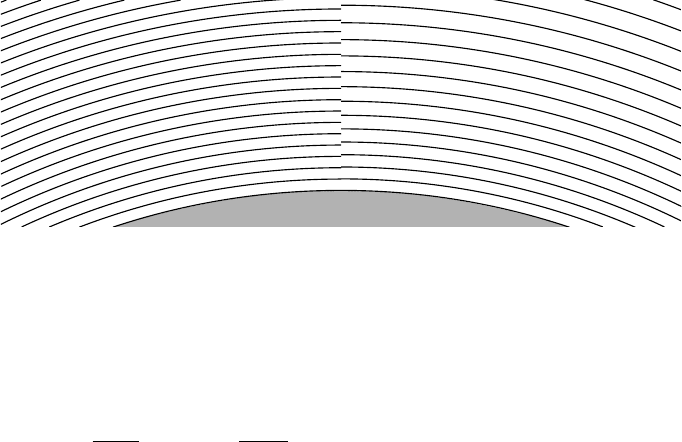
So geopotential height has the units of height but it is in fact a geopoten-
tial. The relationship between Z and z is illustrated in Fig 4.1. The differentials
of Z and z are related by
g
0
dZ = g dz. (4.7)
4.2 HYDROSTATIC BALANCE 69
FIGURE 4.1 Isolines of geometric height z, left, and geopotential height Z, right, around the
Earth’s surface, both drawn every 100 (geopotential) km. Near the surface the geometric
and geopotential heights are nearly the same.
For a spherical gravitating mass the geometric height and the geopotential
height transform into each other by
Z =
az
a + z
and z =
aZ
a − Z
. (4.8)
Near the Earth’s surface the geopotential height is very similar to the ge-
ometric height, with the difference increasing for increasing height. The
geopotential height is smaller than the geometric height at any point in the
atmosphere. Geometric height can have any value larger than zero while
geopotential height has a maximum value of a.
The atmosphere is usually considered in a coordinate frame rotating with
the Earth. In this frame of reference, a fixed centrifugal acceleration will add
to the purely gravitational acceleration. This can be taken into account by
defining an effective gravity and an effective geopotential that include this
centrifugal acceleration, see Problem 4.2. The local vertical in the rotating
frame of reference is now defined by the gradient of the effective geopoten-
tial. From now on, ‘effective’ is omitted and we shall simply refer to geopo-
tential or gravitational acceleration.
The main effect of rotation is that the geopotential surfaces are not spheres
but oblate spheroids. The Earth’s surface is, apart from orographic features,
a geopotential surface. It is an oblate spheroid with a polar radius about
1/300 smaller than its equatorial radius. The transformations in Eq. 4.8 are
therefore only approximate for a rotating planet.
4.2 HYDROSTATIC BALANCE
In a fluid at rest the net force on any fluid parcel has to vanish. So in a
gravitational field the gravitational force has to be balanced by an internal
force due to a decrease of pressure with height. This is called hydrostatic
balance.

70 CH 4 THE ATMOSPHERE UNDER GRAVITY
We can use thermodynamics to calculate the hydrostatic pressure decrease
with height.
25
Think of the geopotential field as made up of thin layers of a
given geopotential. By symmetry, in hydrostatic balance all thermodynamic
variables are functions of the geopotential alone. We now examine the en-
ergy budget when moving a body of fluid from one geopotential to a nearby
geopotential without putting any heat in. If it was possible to generate energy
through such a process then the atmosphere would be unstable: any small
perturbation of the atmosphere could release internal and potential energy
to create kinetic energy.
We can now view the initial geopotential layer (layer 1) and the final
geopotential layer (layer 2) as open systems with matter flowing from one to
the other. From Section 3.5 we know that the change in internal energy ıU
of the whole system on moving the fluid from layer 1 to layer 2 has to equal
the enthalpy gain of layer 2 minus the enthalpy loss of layer 1. The enthalpy
change includes the flow work that is required to move the fluid from layer 1
to layer 2. Because we add no heat to the system, the enthalpy change can
only be due to a pressure change, that is, dH = V dp. We thus find
ıU = H
2
− H
1
=
2
1
V
dp
d
d. (4.9)
The change in potential energy, ıP, is
ıP = M (
2
−
1
) =
2
1
M d, (4.10)
with M the mass of the displaced fluid. At equilibrium, energy variations
must vanish because otherwise we could generate kinetic energy by some
spontaneous rearrangement of the vertical profile. We thus have
0 = ıU + ıP =
2
1
V
dp
d
+ M
d. (4.11)
Because the two geopotential surfaces were chosen randomly, the integrand
has to vanish. We therefore find, after dividing the integrand by V,
I
dp
d
=−. (4.12)
Writing out the geopotential variations in terms of the gravitational acceler-
ation,
I
dp
dz
=−g or
dp
dZ
=−g
0
, (4.13)
25
Ambaum, M. H. P. (2008) Proc. Roy. Soc. A 464, 943–950.

4.2 HYDROSTATIC BALANCE 71
where Eqs. 4.2 and 4.7 have been used. This equation is called the hydrostatic
equation. It is fully general for any fluid system at rest and was first derived
(essentially in its integral form, but using a method based on dynamical ar-
guments) by Newton in his Principia. The above thermodynamic derivation
makes no reference to the geometry of the fluid and is therefore more general
than some shorter derivations that are incomplete due to the implicit use of
a flat geometry.
We have assumed that the fluid in our thought experiment is at rest; that
is, there is no kinetic energy. Indeed, if the fluid is in motion, hydrostatic bal-
ance is not strictly valid any longer. However, the atmosphere is usually very
close to hydrostatic balance, despite the motions in the atmosphere. From a
dynamical point of view, as long as vertical accelerations are substantially
smaller than g, the assumption of hydrostatic balance provides an accurate
representation of the atmosphere. From a thermodynamic point of view, as
long as vertical variations in internal or gravitational potential energy are
substantially larger than variations in kinetic energy, hydrostatic balance is
accurate. This depends on the vertical scale considered. For example, the
variation of specific gravitational potential energy over the depth of the tro-
posphere is about 10
5
Jkg
−1
. The specific kinetic energy is V
2
/2, with V the
flow speed. The variations in specific kinetic energy in the atmosphere are
much smaller than this variation in gravitational potential energy. However,
the variation of specific gravitational potential energy over one metre depth
is about 10 J kg
−1
. This is comparable to observed variations in specific ki-
netic energies, especially in areas of substantial updrafts. So for such scales,
hydrostatic balance is not accurate anymore.
For an ideal gas the hydrostatic relation becomes
1
p
dp
dz
=−
g
RT
or
1
p
dp
d
=−
1
RT
. (4.14)
This means that if the temperature as a function of height is known then the
pressure as a function of height can be found. Often, the above equation is
reversed:
d
dlnp
=−RT. (4.15)
This equation gives a relationship between geopotential and the (logarithm
of) pressure. This equation is useful because radiosondes normally measure
both pressure and temperature; the above equation is then used to calculate
the geopotential height of the radiosonde.
26
26
For moist air, we need to replace the temperature in these equations by the virtual
temperature, see Section 1.3.

72 CH 4 THE ATMOSPHERE UNDER GRAVITY
An interesting application of hydrostatic balance is to assume a constant
temperature T
0
. The hydrostatic equation then integrates to
p = p
0
e
−Z/H
with H =
RT
0
g
0
(4.16)
with p
0
the pressure at Z = 0. This equation is strictly only valid for geopoten-
tial height Z because g varies with height. A typical value for H, the so-called
scale height, for the atmosphere is 8 km. Constant temperature is obviously
not the most accurate approximation in the atmosphere. Nevertheless, the
pressure still decays with height close to exponentially, with a scale height
fairly close to 8 km.
Although the precise height–pressure relationship depends on the temper-
ature profile it is useful to be aware of approximate values. For illustration,
Table 4.1 shows typical values of height, temperature, pressure, and density
for the 1976 US Standard Atmosphere, a fictional atmosphere with ‘typical’
mid-latitude values of the temperature profile.
Another application is to assume a fixed lapse rate. Lapse rate, usually de-
noted , is the negative derivative of temperature with height or geopotential
TABLE 4.1 Selected values from the US Standard Atmosphere, 1976. Here, the 1013.25 hPa
level provides the reference values for potential temperature and specific entropy s.
p (hPa) z (km) T (
◦
C) (kg m
−3
) (K) s (J kg
−1
K
−1
)
1013.25 0.00 15.00 1.225 288.15 0.00
1000 0.11 14.3 1.21 289 1
925 0.76 10.1 1.14 291 9
850 1.5 5.5 1.06 293 17
700 3.0 −4.6 0.91 298 35
600 4.2 −12.3 0.80 303 50
500 5.6 −21.2 0.69 308 68
400 7.2 −31.7 0.58 315 89
300 9.2 −44.6 0.46 324 117
250 10.4 −52.4 0.39 329 134
200 11.8 −56.5 0.32 344 179
150 13.6 −56.5 0.24 374 262
100 16.2 −56.5 0.16 420 378
70 18.5 −56.5 0.11 465 481
50 20.6 −55.9 0.080 513 580
30 23.9 −52.6 0.047 603 741
20 26.6 −50.0 0.031 684 870
10 31.2 −45.5 0.015 852 1089
5 36.0 −33.9 0.0073 1091 1338
2 42.7 −15.3 0.0027 1527 1676
1 48.2 −2.5 0.0013 1954 1924