
Ambaum M., Thermal Physics of the Atmosphere
Подождите немного. Документ загружается.

9.5 RADIATIVE INTENSITY 177
0.2
0.2
0.2
0.2
0.2
0.4
0.4
0.4
0.6
0.6
100
100
200
200
300
300
300
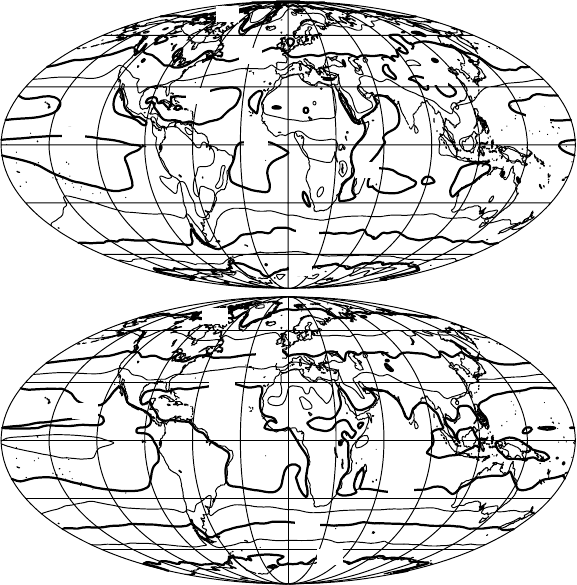
FIGURE 9.5 Annual (1986) mean albedo (top panel) and absorbed short-wave radiation
in W m
−2
(bottom panel), as determined from ERBE satellite measurements. ERBE data
provided by Marc Michelsen, University of Washington.
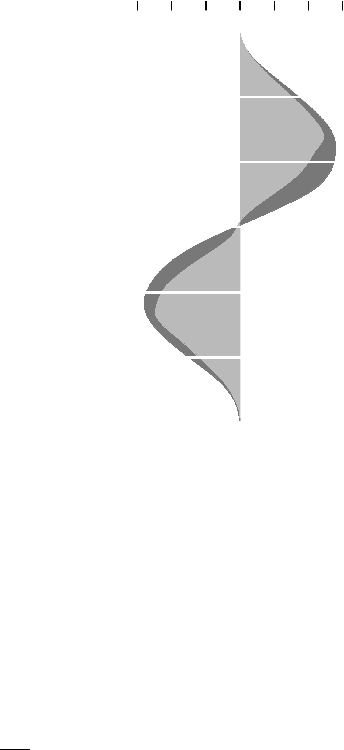
also transport heat poleward. Figure 9.6 shows the observed northward
transport of heat by the atmosphere and oceans as a function of latitude,
averaged over a year. This transport of heat tends to reduce the temperature
contrast between the poles and the equator and releases the generated
potential energy. The overall structure of this transport is called the general
circulation. All motions in the atmosphere ultimately have their origin in the
contrast in absorbed solar radiation between equator and poles.
49
9.5 RADIATIVE INTENSITY
Up to now we have considered systems where radiative properties only vary
in the vertical and we have only been concerned with upward or downward
transport of radiative energy, as given by the radiative flux. However, the
flux through some surface does not contain information on the direction of
the radiation. In general we want to consider the direction of the radiation
as well.
49
For further reading, see James, I. N. (1995) Introduction to circulating atmo-
spheres. Cambridge University Press, Cambridge.
178 CH 9 THERMAL RADIATION
northward heat flux (in PW)
SP
60S
30S
EQ
30N
60N
NP
–6
–4
–2
0
2
4
6
FIGURE 9.6 Annual average northward heat transport, in petawatts, by the atmosphere
(light grey) and oceans plus atmosphere (dark grey) as a function of latitude. After Tren-
berth, K. E. & Caron, J. M. (2001) J. Clim. 14, 3433–3443.
Consider a unit sphere drawn around a fixed point. Any radiation coming
from that point will pass through the unit sphere in a location which can be
identified with the usual zenith angle () and azimuth angle (). If we identify
a small solid angle ı˝ = sin ıı around this direction we can identify a
small part ıF of the radiative flux that passes through this solid angle. The
radiative intensity I is now defined as the flux per unit solid angle in the given
direction. In the limit of ı˝ → 0 this is written as
I =
dF
d˝
. (9.30)
The units of flux, F, are W m
−2
, so the units of intensity, I, are W m
−2
sr
−1
with
solid angles measured in steradians (sr). The intensity is normally a function
of the direction. Isotropic radiation is constant in all directions. Black body
emission is an example of isotropic radiation.
The flux and the intensity are related. Let us calculate the ‘upward’ flux
due to radiation of intensity I(, ); that is, the flux through a surface that
is perpendicular to the upward direction = 0. The upward flux F is the
integral of the upward component of the intensity I over all directions. The
upward component of I(, )isI(, ) cos . The upward flux F therefore is
F =
2
0
/2
0
I(, ) cos sin d d. (9.31)
9.5 RADIATIVE INTENSITY 179
We only integrate over zenith angles up to /2, as larger zenith angles cor-
respond to downward radiation. We can generalize the above expression for
flux in any direction; that is, flux through surfaces with any orientation. For
isotropic radiation, I is not a function of direction and we can readily evaluate
the double integral. We find
F = I. (9.32)
As black body radiation is isotropic, the Planck law, Eq. 9.6, can also be
expressed in terms of radiative intensity. The difference between the expres-
sions for black body intensity and flux is a factor , as above, but remember
that the black body intensity has units of W m
−2
sr
−1
.
The solar constant S
0
can be related to the radiation intensity coming from
the Sun. If the radiative flux at the surface of the Sun is T
4
S
, then its intensity
will be I = T
4
S
/, assuming isotropic radiation. The Sun subtends a solid
angle of about R
2
S
/r
2
E
in the sky. The flux hitting the surface normal to the
solar radiation will therefore be T
4
S
R
2
S
/r
2
E
, which is the definition of the solar
constant S
0
, Eq. 9.18. This calculation is only valid for small values of R
S
/r
E
. A
more accurate calculation demonstrates the equivalent result for finite values
of R
S
/r
E
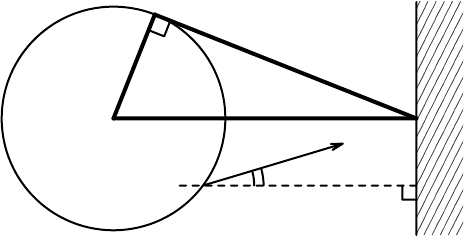
if the radiating sphere is directly overhead. From the geometry in
Fig 9.7 we can see that the flux hitting the surface from isotropic radiation
from a sphere equals
F =
2
0
sin
−1
R
S
/r
E
0
I cos sin d d, (9.33)
where I cos is the intensity component perpendicular to the surface and the
integral is over the solid angle subtended by the sphere. This integral is
F = I R
2
S
/r
2
E
. (9.34)
I
θ
R
S
r
E
FIGURE 9.7 Geometry used to calculate the flux from a radiating sphere of radius R
S
at a
distance r
E
.
180 CH 9 THERMAL RADIATION
For the Sun we have I = T
4
S
so we arrive again at the definition of the solar
constant.
9.6 RADIATIVE TRANSFER
A layer of air will absorb a certain fraction of the incoming radiation. The
rate of absorption will depend on the wavelength. For an infinitesimally thin
layer of air, the change in the intensity of a beam passing through the layer
can be written as
dI
=−I
dı
, (9.35)
where we have introduced the infinitesimal optical depth dı. The optical depth
depends on the wavelength. The right-hand side is negative because the inten-
sity decreases through absorption. This equation can be integrated through a
layer of finite depth to find a relation between the incoming intensity I
in
and
the outgoing intensity I
out
,
I I
out
= I
in
e
−ı
, (9.36)
where ı is the total optical depth of the layer and where subscripts have
been omitted for brevity. Note that optical depth is not a physical ‘depth’ (it
has no units); it defines the fraction of the incoming radiation being absorbed
along a path.
A layer of air will have a density of absorbers
˜
n and each absorber will have
an absorptivity, expressed by its molecular absorption cross-section
. The
absorption cross-section measures the area of an incoming beam of wave-
length that would be taken out by absorption by a single molecule in its
path. The optical depth ı is related to the number density of absorbers and
their absorption cross-section by the Beer–Lambert law which states that
I ı
=
˜
n
l, (9.37)
with l the geometric depth of the layer. It is trivial to extend this law for a
mixture of various absorbing species. This law is strictly only valid for low
densities of absorbers: for higher densities, the absorbing molecules will sit
in each-other’s ‘shade’ and will thus contribute less to the total absorption as
expressed by the optical depth.
In the atmosphere, the number density of absorbers will often be a function
of location. In such situations, the Beer–Lambert law is generalized to
I ı
=
˜
n
dl, (9.38)

9.6 RADIATIVE TRANSFER 181
where the integral is now along the path of the beam. In differential form,
this becomes
dı
=
˜
n
dl. (9.39)
This expression of the Beer–Lambert law can be used to rewrite Eq. 9.35 in
terms of geometric depth; the Beer–Lambert law provides the transformation
between geometric depth and optical depth. Note that this transformation is
different for different wavelengths.
It is of interest to consider a vertically directed beam. First, the number
density
˜
n is rewritten as a concentration by mass c using
c =
˜
nM
1
/, (9.40)
with M
1
the molecular mass of the absorber and the local density of the
air. Substituting this expression in the Beer–Lambert law for a vertically di-
rected beam, for which dl is replaced by dz, we find
ı
=
c
M
dz. (9.41)
Now using hydrostatic balance, dz =−dp/g we find the Beer–Lambert law
for vertical beams
I ı
=
p
1
p
0
c
M
1
g
dp. (9.42)
For beams that come in at a zenith angle from the vertical, we need to divide
this expression by cos – see below. The relevance of the last expression is
that for a well-mixed absorber, c is constant and we find that the optical
thickness along a path is proportional to the pressure difference along the
path.
We typically study the optical depth over a band of wavelengths. Indeed,
we will only discuss rather crude wide-band approximations in this section. In
these situations the width of the individual absorption lines is important to
the total absorption in a layer. The width of an absorption line increases with
pressure due to the collisions between molecules, an effect called pressure
broadening. At increased width, the absorption cross-section decreases in the
centre of the line and increases in the tails of the line. However, for strong
absorption lines the extinction, as expressed by Eq. 9.36, will remain strong
at the centre of the line, while it will appreciably increase in the tails of the
line. The effective optical depth integrated over the wavelength band will
therefore increase with increased line width. A reasonable way to account

182 CH 9 THERMAL RADIATION
for the pressure broadening is to use an effective absorption cross-section
50
=
r
(p/p
r
)
, (9.43)
with sometimes taken equal to 1 but, more accurately, smaller than 1, and
r
the effective absorption cross-section over the wavelength band at reference
pressure p
r
. Using a value of = 1 we can show that the optical thickness
between two pressure levels for a well-mixed absorber can be written as
ı = ı
r
(p
1
− p
0
)(p
1
+ p
0
)/2
p
2
r
, (9.44)
with
ı
r
=
c
r
p
r
M
1
g
. (9.45)
In other words, for small pressure differences the optical thickness is propor-
tional to the pressure difference but for larger pressure differences the optical
thickness increases at a slower rate.
The factor exp (−ı) in Eq. 9.36 is called the transmittance of the layer: it is
the fraction of radiation that is transmitted through the layer and is sometimes
given the symbol ,
51
= exp (−ı). (9.46)
Like the optical depth, transmittance generally depends on the wavelength.
If the radiation traverses two layers of air with transmittances
1
and
2
, the
combined transmittance
1+2
equals
1+2
=
1
2
. (9.47)
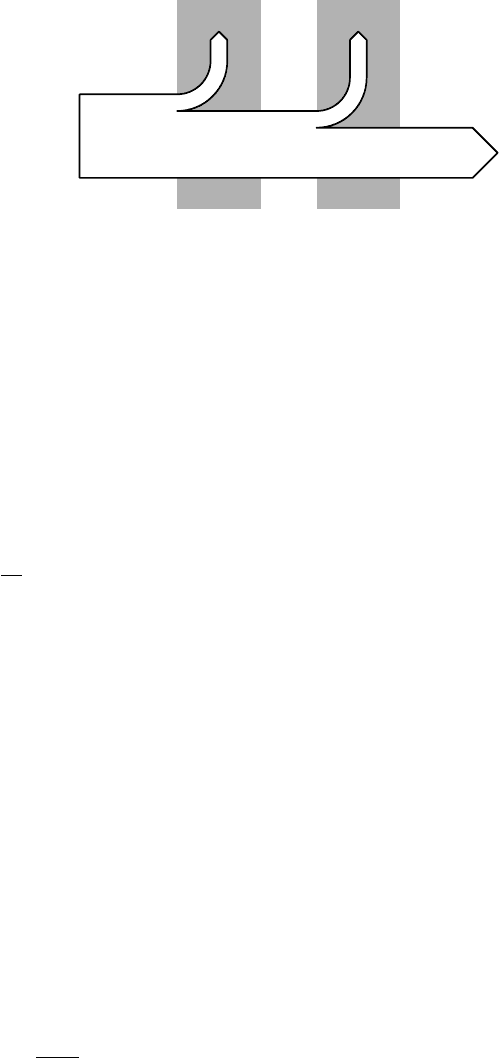
Figure 9.8 illustrates the set up. According to the Beer–Lambert law, the
combined optical depth ı
1+2
of two adjacent layers is the sum of the individual
optical depths of the layers,
ı
1+2
= ı
1
+ ı
2
. (9.48)
This is consistent with the formal relation between transmittance and optical
depth, Eq. 9.46. This property of the transmittance can be used to work out
refined versions of the atmospheric slab models in the previous section, with
several layers of finite transmittance and where the emittance/absorptance
of a layer is the complement of its transmittance = 1 − , as illustrated in
Figure 9.8.
50
See Manabe, S. & Strickler, R. F. (1964) J. Atmos. Sci. 21, 361–385; Manabe, S. &
Wetherald, R. T. (1967) J. Atmos. Sci. 24, 241–259
51
Optical depth is also often given the symbol .
9.6 RADIATIVE TRANSFER 183
I
τ
1
I
τ
2
τ
1
I
(1 − τ
1
) I (1 − τ
2
)τ
1
I
δ
1
δ
2
FIGURE 9.8 Transmittance of radiation through two adjacent layers of optical depths ı
1
and ı
2
. The transmittance of each layer is
i
= exp (−ı
i
).
A parcel of air will also emit long-wave radiation. By Kirchhoff’s law, the
emissivity of air is the same as its absorptivity. This means we can use the
Beer–Lambert law to find that the emissivity along an infinitesimal path dl
equals dı
=
˜
n
dl. So the radiation budget for an infinitesimal path is
dI
= (I
B,
(T) − I
)dı
, (9.49)
with I
B,
the black body intensity for temperature T (remember, I
B
=
B/). The above expression is usually written as the Schwarzschild equation,
I
dI
dı
= I
B
− I, (9.50)
where we have again omitted the subscript for brevity. The formal solution
for the Schwarzschild equation is
I(ı) = I(0) e
−ı
+
ı
0
I
B
(ı − ı
) e
−ı
dı
. (9.51)
The first term on the right-hand side is the transmitted radiation through a
layer of optical depth ı. The integrand in the second term is the contribution
of the black body radiation emitted by the atmosphere at an optical depth ı
away from the present location. This equation can also be written in terms of
physical path length, by using the Beer–Lambert law.
An application of the above formalism is Langley’s method, a method to infer
insolation at the top of the atmosphere by surface measurements only. Con-
sider a horizontally uniform atmosphere with optical depth ı
0
at zero zenith
angle. A beam of intensity I
in
hitting the atmosphere at a zenith angle will
then experience an optical depth of ı with
ı =
ı
0
cos
. (9.52)
The geometry of this situation is illustrated in Figure 9.9.
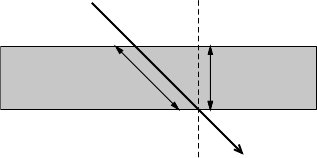
184 CH 9 THERMAL RADIATION
δ
0
δ
θ
I
out
= I
in
exp(−δ )
I
in
FIGURE 9.9 Relationship between path optical depth, ı, layer optical depth, ı
0
, and zenith
angle, .
At the surface we can measure the beam, S
b
, which is the radiative energy
flux incident on a plane normal to the direction of the incident solar radia-
tion. This flux is to be measured in a narrow waveband where we expect the
atmospheric absorption to be more-or-less constant as a function of measured
wavelength. From the geometry in Figure 9.9 (with I
in
replaced by S
0
and I
out
replaced by S
b
) it becomes clear that the measured S
b
is related to the solar
irradiance at the top of the atmosphere S
0
and the optical depth ı by
S
b
= S
0
exp (−ı) = S
0
exp (−ı
0
/ cos ), (9.53)
with, as before, ı
0
the optical thickness of the atmosphere at a zero zenith
angle.
When making surface measurements, we have two unknowns ı
0
and
S
0
. From standard astronomical equations, or even direct measurement, we
can infer the solar zenith angle with great accuracy. If we measure the beam
S
b
at different zenith angles, but at constant normal optical thickness ı
0
,we
can statistically fit the above equation to the measurements and thus esti-
mate both ı
0
and S
0
. Typically, the measurements take place after sunrise or
before sunset on clear days where the optical atmospheric conditions do not
change during the measurement period. For the statistical fit we can divide
the above equation by some fixed reference irradiance S
r
and take the loga-
rithm. The resulting equation can be rearranged to
cos ln (S
b
/S
r
) = cos ln (S
0
/S
r
) − ı
0
(9.54)
If we now plot cos ln (S
b
/S
r
) versus cos we find a straight line with slope
ln (S
0
/S
r
) and intercept −ı
0
.
52
This technique only works accurately in narrow bands where the atmo-
sphere is relatively transparent. For wide-band measurements the absorption
varies substantially with measured wavelength and the dependence of the
52
The value of the reference irradiance S
r
does not modify the outcome of the fit but
does change the graphical representation of the data. The default choice of 1 W m
−2
mis-
represents the scatter in the data; it is better to choose S
r
to be similar to S
0
or typical
values of S
b
.
9.7 RADIATIVE–CONVECTIVE EQUILIBRIUM 185
measured flux on the zenith angle is different for these different absorp-
tions. It is therefore impossible to fit a single optical depth to these measure-
ments. Furthermore, wide-band measurements will usually also measure in
bands where the atmosphere is practically opaque. That means that for these
wavelengths we do not measure any flux and we cannot therefore infer the
incoming flux at the top of the atmosphere.
In the discussion of absorption of radiation we have ignored the effect of
scattering. Scattering is the change of direction of a beam of radiation. Atten-
uation by scattering for a single beam can be modeled largely, like absorption,
with the Beer–Lambert law, and including density of scatterers and the scat-
tering coefficient for a single molecule. Scattering not only attenuates a beam:
the scattered radiation from other beams may contribute to the intensity of
the beam under consideration. Scattering in the atmosphere is the dominant
process of extinction in clouds or aerosol regions.
The physical origins of scattering are manifold. We typically discriminate
between Rayleigh scattering, where the wavelength of the radiation is much
larger than the scatterers and Mie scattering where the wavelength of the
radiation is of comparable size to or smaller than the scatterers.
Rayleigh scattering is due to the electric dipole moment of scatterers inter-
acting with the electromagnetic field. Rayleigh scattering is strongly wave-
length dependent, with the scattering cross-section (the effectivity of the
scattering) typically proportional to
−4
. Molecules can Rayleigh-scatter
visible light. Due to the wavelength dependence of the scattering cross-
section, blue light is scattered more strongly than red light. This is the origin
of the blue colour of the sky, the yellow colour of the Sun, and the orange
colour of the sunset. Cloud drops can Rayleigh-scatter microwaves, which is
the physical basis of cloud radar.
Unlike Rayleigh scattering, Mie scattering is highly directional, with most
radiation being scattered in the forward direction. Scattering of sunlight by
cloud drops is an example of Mie scattering. So Mie scattering is the rea-
son we can actually see clouds. The fact that most scattering is in the for-
ward direction makes the clouds white, unless they are deep. Photons in
clouds typically experience multiple scattering events and in most clouds
photons are backscattered enough to make clouds white when viewed from
the top.
9.7 RADIATIVE–CONVECTIVE EQUILIBRIUM
It is of interest to consider the radiative transfer problem in an atmosphere
which is uniform in the horizontal. We are then only interested in the vertical
flux of radiation in either the upward or downward direction. We will consider
a wide-band approximation, with the long-wave and short-wave fluxes in
separate bands. As a vertical coordinate we will use the effective long-wave
optical depth ı between the surface and some level in the atmosphere. It is

186 CH 9 THERMAL RADIATION
related to the geometrical height z by
dı = e
LW
dz. (9.55)
Here, e
LW
is an effective fractional emissivity in the long-wave part of the
spectrum. So the atmosphere is assumed to be a grey body in the long-wave
part. At the Earth’s surface we have ı = 0 and at the top of the atmosphere
we set ı = ı
TOA
.
The Schwarzschild equations, Eq. 9.50, for the upward long-wave flux L
↑
and the downward long-wave flux L
↓
are
dL
↑
/dı = B − L
↑
, (9.56a)
−dL
↓
/dı = B − L
↓
. (9.56b)
Here B is the usual black body flux, which, for atmospheric temperatures, is
mostly in the long-wave part of the spectrum. The Schwarzschild equations
for the shortwave fluxes S
↑
and S
↓
are
dS
↑
/dı =−(e
SW
/e
LW
) S
↑
, (9.57a)
−dS
↓
/dı =−(e
SW
/e
LW
) S
↓
. (9.57b)
The black body emission by the atmosphere does not contribute to the short-
wave part of the fluxes. The pre-factor e
SW
/e
LW
is ratio of the short-wave
optical depth and the long-wave optical depth, ı.
Radiative equilibrium follows from combining a steady state condition with
the radiative transfer equations. The steady state condition follows by setting
the local heating rate to zero. The local heating is given by the convergence of
the radiative fluxes and any enthalpy fluxes, which we will denote by H. These
enthalpy fluxes are normally associated with convective motion. The steady
state condition then is
d
dz
(L
n
+ S
n
+ H) = 0, (9.58)
where the net upward long-wave L
n
and short-wave S
n
fluxes are
L
n
= L
↑
− L
↓
,S
n
= S
↑
− S
↓
. (9.59)
In a steady state the total upward heat flux L
n
+ S
n
+ H therefore must be
constant. We know that at the top of the atmosphere the upward heat flux
must vanish, so this constant is zero. We therefore find
I L
n
+ S
n
+ H = 0. (9.60)