
Ambaum M., Thermal Physics of the Atmosphere
Подождите немного. Документ загружается.


9.9 DERIVATION OF THE PLANCK LAW 197
where the partition function Z provides the normalization and we have used
the standard notation
ˇ = 1/k
B
T. (9.114)
The density of states g
e
multiplies the Boltzmann factor to account for the fact
that there are g
e
de photon modes corresponding to the given photon energy.
The partition function Z is
Z = g
e
∞
n=0
exp (−ˇne). (9.115)
This summation has the standard form for summation of powers of quantities
a<1,
∞
n=0
a
n
=
1
1 − a
. (9.116)
Using this formula we find that the partition function for photons with energy
e is
Z =
g
e
1 − exp (−ˇe)
. (9.117)
The expectation value for the total energy E
e
, representing photons at energy
e,is
E
e
=
∞
n=0
P
e
(n) ne =
∞
n=0
g
e
ne exp (−ˇne)
Z
. (9.118)
This can be written as
E
e
=−
∂
∂ˇ
ln Z. (9.119)
Using the explicit form of the partition function, Eq. 9.117 we then find the
expectation value for the total energy E
e
of photons of energy e,
I E
e
=
g
e
e
exp (ˇe) − 1
. (9.120)
To derive the Planck law in the form of Eq. 9.6 we express the total energy
expectation value in terms of wavelength instead of photon energy. We intro-
duce a transformed density of states g
in wavelength space which is defined
in terms of the usual density of states g
e
by
g
e
de = g
d. (9.121)

198 CH 9 THERMAL RADIATION
Using Eq. 9.107, we find
g
= 8L
3
/
4
(9.122)
The total energy expressed in terms of wavelength therefore is
E
=
g
e()
exp (ˇe()) − 1
(9.123)
The volumetric energy density
˜
u
is
˜
u
= E
/L
3
. (9.124)
Substituting the explicit expressions for g
and e()wefind
˜
u
=
8hc
5
1
exp
hc
k
B
T
− 1
(9.125)
According to Eq. 9.92 this corresponds to a surface energy flux of B
=
˜
u
c/4,
which is the Planck law in the form of Eq. 9.6.
The fact that we have assumed a cubic vessel instead of a vessel with ar-
bitrary shape is not important. For arbitrary shapes the analogous derivation
becomes technically more challenging but gives the same result. However, it
is easier to use the thermodynamic result of Section 9.1, which states that
at equilibrium the radiative energy density
˜
u
cannot be a function of vessel
shape or size. The radiation law derived for the cubic vessel is therefore valid
for a vessel of any shape.
It is of interest to note that E
e
can be written as the product of the pho-
ton energy e and the expectation value n
e
of the number of photons at this
particular energy. We thus find that
n
e
=
g
e
exp (ˇe) − 1
. (9.126)
This is the Bose–Einstein distribution for a system with zero chemical poten-
tial, such as a photon gas. Note that the argument ˇe equals /, with
the thermal wavelength introduced in Eq. 9.9. For values of shorter than
about /3 the Bose–Einstein distribution becomes indistinguishable from the
Boltzmann distribution, g
e
exp ( − /). In the derivation of the Wien dis-
placement law we found that the Planck function peaks at around ≈ /5.
This means that the Bose–Einstein correction is only important in the long
wavelength part of the black body spectrum; say wavelengths longer than
the peak wavelength. For all other wavelengths the Bose–Einstein distribu-
tion reduces to the Boltzmann approximation
n
e
≈ g
e
exp (−ˇe). (9.127)
9.9 DERIVATION OF THE PLANCK LAW 199
It is not surprising that we find the Boltzmann distribution for short wave-
lengths. The Bose–Einstein distribution follows from adding all the probabil-
ities of finding any number of particles in a given mode. However at short
wavelengths the photon energy e is much larger than the thermal energy k
B
T,
so that each mode of energy e has only a low chance of being occupied. The
chance of multiple occupancy can therefore be ignored and the Bose–Einstein
distribution reduces to the probability of occupying the mode with energy e,
which is the Boltzmann distribution.
At short wavelengths, the Planck law expressed as a function of wavelength
therefore becomes
B
(T) ≈
2hc
2
5
exp
−
hc
k
B
T
. (9.128)
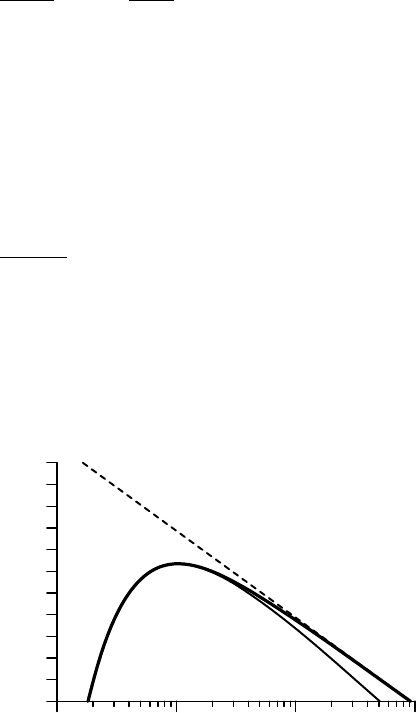
This equation is called Wien’s distribution law, and it is accurate except at
long wavelengths, see Figure 9.12. The spectral peak in Wien’s distribution
law corresponds to a wavelength of
m
= /5, which is very close to that
predicted by the Planck law,
m
= /4.965 ...
The approximate result for long wavelengths follows from a Taylor expan-
sion of the Planck law,
B
(T) ≈
2ck
B
T
4
. (9.129)
This approximation is called the Rayleigh–Jeans law, see Figure 9.12. Like
Wien’s distribution law, the Rayleigh–Jeans law was derived independently
from the Planck law. Both approximations satisfy the thermodynamically pre-
dicted shape of Eq. 9.104.
wavelength
1 µm 10 100 1 mm
emission (W m
−2
m
−1
)
10
3
10
6
10
9
10
12
µm
µm
FIGURE 9.12 Black body emission as a function of wavelength for T = 280 K according
to the Planck law (thick solid line), the Wien distribution law (thin solid line), and the
Rayleigh–Jeans law (thin dashed line).

200 CH 9 THERMAL RADIATION
The Rayleigh–Jeans law is interesting because it is based on purely classical
physics. The derivation starts from the density of modes in wavelength, g
.
Using equipartition of energy we would associate an energy of k
B
T with each
mode: the energy of a mode is proportional to its wavenumber, so we expect
from the generalized equipartition theorem, Eq. 4.85, an amount of k
B
T in
each mode. This leads to a volumetric energy density of g
k
B
T/L
3
. Multiplying
this by c/4 to transform the energy density to an energy flux, we find the
Rayleigh–Jeans law.
The Rayleigh–Jeans law does not permit calculation of the total emitted
power: the integral of the Rayleigh–Jeans B
(T) over is divergent due to the
1/
4
singularity at low wavelengths. This divergence is called the ultraviolet
catastrophe. This was an early indication that classical physics alone could not
account for the behaviour of thermal radiation. (The failure of equipartition
to predict the heat capacity for diatomic gases was another indication of the
problems with classical physics, see Section 3.3.)
P
ROBLEMS
9.1. The eccentricity e of the Earth’s orbit is 0.0167, where eccentricity is
defined by
r
min
r
max
=
1 − e
1 + e
,
and r
min
and r
max
are the minimum and maximum distances between the
Earth and the Sun. Show that for a solar constant S
0
of 1366 W m
−2
, the
eccentricity leads to a variation of the solar irradiance between about
1321 W m
−2
and 1412 W m
−2
.
9.2. Show that the fraction, f, of the total black body emission which is emit-
ted around the peak wavelength
m
can be approximated as
f = 0.66/
m
with the chosen width of the wavenumber band. Hence show that
about 40% of the radiative output of the Sun occurs in the visible part
of the spectrum.
9.3. Radiative balance in the stratosphere. Recall the simple radiative one-
layer black body slab model of the atmosphere discussed in Sec-
tion 9.3. Now put on top of this model another slab with a short wave
emissivity
s
and a longwave emissivity
l
. Show that the equilibrium
temperature T
S
in the stratosphere is given by
l
(2 −
l
) T
4
S
=
S
0
4
1 − ˛(1 −
s
)
2
− (1 − ˛)(1 −
l
)(1 −
s
)
.

9.9 DERIVATION OF THE PLANCK LAW 201
Hence show that, contrary to the troposphere, for small values of
l
the temperature of the stratosphere decreases with increasing
l
. What
is the physical picture for this decrease? Show that for small
l
the
stratospheric temperature is generally higher than the tropospheric
temperature.
9.4. Multilayer atmosphere. Consider an atmosphere made up of N atmo-
spheric layers that are black body (
l
= 1) in the long-wave regime and
completely transparent in the short-wave regime (
s
= 0). The layers are
numbered 1 (nearest to the planet) to N (furthest from the planet). Show
that for the temperature T
i
in layer i we have
T
4
i
= T
4
i+1
+ ıF,
with ıF some fixed energy flux. Show that
T
4
N
= ıF and T
4
N
= (1 − ˛) S
0
/4.
Hence show that
T
4
E
= (N + 1) (1 − ˛) S
0
/4,
with T
E
the surface temperature of the planet. Compare this result to
the continuous atmosphere result of Eq. 9.68.
9.5. Show that for the radiative equilibrium model of Eq. 9.70 the tempera-
ture lapse rate =−dT/dz is given by
=
g
2R
x
1 + x
, with x = ı
TOA
p
2
/p
2
0
.
Hence show that for ı
TOA
> 2R/(c
p
− 2R) the dry atmosphere becomes
convectively unstable.

10
Non-equilibrium processes
For individual, homogeneous volumes of a substance, gas or liquid, in lo-
cal thermodynamic equilibrium, we can apply, by definition, the machinery
of equilibrium thermodynamics. The majority of processes described in this
book fall under this heading. When the substance is non-homogeneous, it is
not in thermodynamic equilibrium and we need to consider non-equilibrium
processes. Clearly, the atmosphere is profoundly non-homogeneous.
The signature of non-equilibrium thermodynamics is the irreversible in-
crease of entropy in a system. The task at hand is to ascribe the irreversible
increase of entropy to specific physical processes.
Remember that for an individual homogeneous parcel we can still de-
scribe entropy changing (diabatic) processes. However, we would consider
such processes reversible as they result from heat exchange with the environ-
ment. This distinction was first described in Chapter 2. Irreversible entropy
change only occurs when the full non-homogeneous system is analyzed.
10.1 ENERGETICS OF MOTION
In continuum mechanics, specific variables (quantities expressed per unit
mass) satisfy equations of the shape
Dc
Dt
= S, (10.1)
where c is some specific variable and S is some source term. Here D/Dt
represents the Lagrangian derivative
D/Dt = ∂/∂t + U ·∇, (10.2)
with U the flow velocity. The Lagrangian derivative is the time derivative
following a fluid parcel. Equation 10.1 expresses how a property c of a fluid
parcel changes through some source term S.
203
Thermal Physics of the Atmosphere Maarten H. P. Ambaum
© 2010 John Wiley & Sons, Ltd. ISBN: 978-0-470-74515-1

204 CH 10 NON-EQUILIBRIUM PROCESSES
An example of such an equation is the continuity equation for the specific
volume v,
Dv
Dt
= v∇·U. (10.3)
This is essentially an expression for conservation of mass: the volume over
which the mass of a parcel is distributed changes due to the expansion of the
parcel, as expressed by the divergence of the velocity field ∇·U. The more
familiar form of the continuity equation is expressed in terms of density,
D
Dt
=−∇·U. (10.4)
We can use the latter form of the continuity equation to transform the equa-
tion for the specific variable c into an equation for the variable per unit volume
c. For example, if c is a concentration by mass, c is a concentration by vol-
ume. We find
∂c
∂t
+∇·(Uc) = S. (10.5)
Here, the local change in the volumetric density is a result of a volumetric
source term S and a flux divergence ∇·(Uc). This form of the equations
will now be used to analyze the energy budget of fluids in motion.
59
First consider the equation for the kinetic energy per unit volume |U|
2
/2.
This follows from the momentum equations. For notational simplicity we will
first consider the equation for one component, say U , the velocity component
in the x-direction. We then complete the other equations by analogy. The
relevant momentum equation for U is
DU
Dt
=−
∂p
∂x
−
∂
∂x
−∇·F
U
, (10.6)
with the first term on the right-hand side the pressure gradient force, the
second term the force due to gravity, or any other body force defined by a
potential , and the third term the viscosity force which is expressed in a
general way as the divergence of a viscous momentum flux.
We have not included any rotation effects in the momentum equation: the
Coriolis force does not feature in the kinetic energy budget as it is perpen-
dicular to the velocity, and the centrifugal force is taken to be part of the
effective geopotential , see Section 4.1.
59
Here we restrict ourselves to atmospheric applications. More general treatments can
be found in De Groot, S. R. & Mazur, P. (1984) Non-equilibrium thermodynamics. Dover,
New York; Woods, L. C. (1975) The thermodynamics of fluid systems. Oxford University
Press, Oxford.

10.1 ENERGETICS OF MOTION 205
Multiply the momentum equation by U to get an equation for the specific
kinetic energy contribution of the speed in the x-direction, U
2
/2,
DU
2
/2
Dt
=−U
∂p
∂x
− U
∂
∂x
− U ∇·F
U
. (10.7)
By analogy we find the corresponding equations for the V and W compo-
nents. Now define the specific kinetic energy k as
k =
U
2
+ V
2
+ W
2
/2. (10.8)
The equation for the specific kinetic energy then is
Dk
Dt
=−U ·∇p − U ·∇ −
i
U
i
∇·F
U
i
(10.9)
where the U
i
with i = 1, 2, 3 represent the three velocity components. Using
the continuity equation we can rewrite this equation in the flux form,
I
∂k
∂t
+∇·(Uk) =−U ·∇p − U ·∇ −
i
U
i
∇·F
U
i
. (10.10)
The first term on the right-hand side represents the loss of kinetic energy due
to motion against the pressure gradient force and the second term represents
the loss of kinetic energy due to motion against gravity. By convention the
latter direction is usually defined to be the z-direction, in which case this term
reduces to −W g. The third term represents the effects of viscosity. This will
be further analyzed in the next section.
Conservation of energy dictates that the energy source terms in the
kinetic energy equation must come from somewhere. They are compensated
by opposite terms in the budget equations for the internal energy and the
geopotential.
Next consider the budget for internal energy. From the first law of thermo-
dynamics in differential form,
du = T ds − p dv, (10.11)
the equation for the specific internal energy u is
Du
Dt
= T
Ds
Dt
− p
Dv
Dt
= T
Ds
Dt
− pv∇·U, (10.12)
where we have used the continuity equation in the form Eq. 10.3. For the
internal energy per unit volume u we now find
∂u
∂t
+∇·(Uu) = T
Ds
Dt
− p∇·U. (10.13)

206 CH 10 NON-EQUILIBRIUM PROCESSES
The first term on the right-hand side is the diabatic heating per unit volume,
as follows from the second law of thermodynamics. The last term in this
equation can be written as a flux and a residual,
p∇·U =∇·(pU) − U ·∇p. (10.14)
Substituting this expression we find
I
∂u
∂t
+∇·(Uh) = T
Ds
Dt
+ U ·∇p, (10.15)
with the specific enthalpy h = u + pv. In this form the second term on the
right-hand side compensates the opposite term in the budget equation for the
kinetic energy per unit volume, Eq. 10.10.
The internal energy flux is given by the advective transport of enthalpy,
not the transport of internal energy. This is consistent with the arguments
in Section 3.5, where it was explained how this difference arises from the
additional flow work required to move matter from one volume to another.
Finally, the equation for the specific potential energy is an expanded
version of the Lagrangian derivative of a field that does not vary in time,
D
Dt
= U ·∇. (10.16)
The equation for the potential energy per unit volume therefore is
I
∂
∂t
+∇·(U) = U ·∇. (10.17)
The right-hand side of this equation compensates for the second source term
in the kinetic energy budget, Eq 10.10.
The compensating terms in the above budget equations are usually called
conversion terms. The energy budget contains two conversion terms. Firstly,
we have the conversion between internal and kinetic energy, −U ·∇p, due
to flow along the pressure gradient. Secondly, we have conversion between
potential and kinetic energy, −U ·∇, due to downward (that is, in the nega-
tive z direction) motion in a gravity field. The conversion terms are reversible:
they can be of either sign.
We can add the three energy equations to find an equation for the total
specific energy e = k + u + ,
I
∂e
∂t
+∇·F
e
= T
Ds
Dt
−
i
U
i
∇·F
U
i
(10.18)
with the total energy flux
I F
e
= U(k + h + ). (10.19)
10.2 ENERGETICS OF MOTION 207
That is, the total energy in some volume can only change by diabatic heating
or viscosity.
In a steady state and in the absence of diabatic effects (heating or viscosity),
the total energy budget reduces to
∇·(U(k + h + )) = U ·∇(k + h + ) = 0, (10.20)
where we have used the steady state form of the continuity equation,
∇·(U) = 0. This equation states that, following the flow, the term be-
tween brackets remains constant. This is Bernoulli’s equation, discussed in
Section 4.5. When kinetic energy is small, this reduces to conservation of the
generalized enthalpy or dry static energy following a fluid parcel.
For a steady flow with closed streamlines (for example, idealized over-
turning circulations), the energy budget, Eq. 10.18, can be integrated along
a closed streamline. The momentum diffusion term on the right-hand side re-
moves energy along this closed streamline, see next section. This means that
the entropy contribution on the right-hand side has to put in energy along
this closed streamline. In equations,
T ds>0, (10.21)
where the contour integration is along the closed streamline. In other words,
to keep a steady state going against dissipation, we need to heat the flow
(ds>0) at higher temperatures than where we cool the flow (ds<0). This
expression becomes particularly interesting when we use the potential tem-
perature definition for an ideal gas, Eqs. 3.80 and 3.84. In this case, the
above contour integral becomes
c
p
(p/p
0
)
d>0. (10.22)
The ideal gas flow needs to be heated at a higher pressure than where it
is cooled. The application of Eq. 10.21 to incompressible fluids leads to the
statement that heating (expansion) needs to occur at higher pressures than
the cooling (contraction). Oceanographers traditionally refer to this as the
Sandstr
¨
om theorem.
60
The atmosphere receives most of its heat near the surface and it loses most
of its heat through long-wave radiation at higher altitudes: heat is received
at pressures higher than those at which it is lost and the atmosphere can
therefore stay in motion against friction. For thermally driven circulations in
the ocean, this is less obvious. The external heat input and output tend to
occur at the same pressure level, and we need diffusion and stirring to deposit
60
See Vallis, G. K. (2006) Atmospheric and oceanic fluid dynamics. Cambridge University
Press, Cambridge; Kuhlbrodt, T. (2008) Tellus 60A, 819–836.