
Ambaum M., Thermal Physics of the Atmosphere
Подождите немного. Документ загружается.


208 CH 10 NON-EQUILIBRIUM PROCESSES
the heat at deeper levels in order to keep the thermally driven circulation
going against dissipation.
10.2 DIABATIC EFFECTS AND THE SECOND LAW
The energy budgets, as described in the previous section, represent the gen-
eralization of the first law of thermodynamics for continuous systems. Next
we will consider the second law.
We will start by analyzing the viscous momentum flux F
U
, see Eq. 10.6,
as it plays a special role in the energy budget. The viscous momentum flux is
always opposite to the momentum gradient, and for incompressible fluids is
usually taken to be linear in the momentum gradient,
F
U
=−∇U , (10.23)
with analogous versions for the other momentum components. The coeffi-
cient is called the shear viscosity.
The contribution of the viscous momentum flux to the energy budget,
Eq. 10.18, can be written as a flux and a residual,
i
U
i
∇·F
U
i
=∇·
i
U
i
F
U
i
−
i
F
U
i
·∇U
i
(10.24)
The first term is the divergence of the viscous kinetic energy flux, F
,
F
=
i
U
i
F
U
i
(10.25)
and the second term is the viscous dissipation rate,
˙
, defined by
˙
=−
i
F
U
i
· (∇U
i
). (10.26)
Because the viscous momentum flux F
U
is always opposite to the momentum
gradient, the viscous dissipation rate is locally always positive (that is, this
term always dissipates kinetic energy). For example, if the viscous momentum
flux is linear in the momentum gradient, as in Eq. 10.23, we find
˙
=
|
∇U
i
|
2
, (10.27)
which is evidently positive definite.
With these definitions the total energy budget, Eq. 10.18, becomes
∂e
∂t
+∇·(F
e
+ F
) = (
˙
q −
˙
) (10.28)

10.2 DIABATIC EFFECTS AND THE SECOND LAW 209
where we have written the local entropy change as a diabatic heating rate
˙
q
defined by
˙
q = T Ds/Dt. (10.29)
The heating rate
˙
q has several contributions. Firstly, the local dissipation of
kinetic energy
˙
is a local source of internal energy. Secondly, the second law
of thermodynamics states that any temperature gradient will locally set up
a heat flux F
q
. Thirdly, the absorption and emission of radiation provides a
non-local source of energy that can be written as the divergence of a radiative
flux F
r
. Finally, there may be energy sources related to phase changes in the
volume, the latent heating
˙
q
L
. In equations,
˙
q =
˙
−∇·F
q
−∇·F
r
+
˙
q
L
. (10.30)
Many numerical models ignore the mechanical dissipation rate
˙
in this equa-
tion. This is entirely unnecessary and leads to small but systematic errors.
Next we will consider how these four contributions to the heating rate
satisfy the second law of thermodynamics. In order to do this we need to
evaluate their contributions to the production of total entropy S in the whole
system under consideration, which is given by
dS
dt
=
V
˙
q
T
dV, (10.31)
with V the volume of the system.
The viscous dissipation of kinetic energy
˙
is a local source of internal
energy. Because it is a conversion from kinetic energy to internal energy, it
cancels in the total energy budget, see Eq. 10.28. Contrary to the kinematic
conversion term, −U ·∇p, the viscous dissipation
˙
can only remove kinetic
energy and produce internal energy. The local change in entropy due to
viscous dissipation equals
Ds/Dt =
˙
/T. (10.32)
Because
˙
is positive definite, the total entropy production due to this process,
Eq. 10.31, is positive. Therefore, the viscous dissipation source satisfies the
second law; it produces an irreversible entropy increase.
The next contribution to consider is the heating due to heat conduction.
The heat flux F
q
is always opposite to the temperature gradient and it is
usually taken to be linear in the gradient,
F
q
=−K∇T, (10.33)
with K the diffusion coefficient or thermal conductivity. For small temperature
gradients this linear approximation is very accurate. Note that the exchange

210 CH 10 NON-EQUILIBRIUM PROCESSES
of sensible heat with the Earth’s surface also has this form and thus no new
effects are introduced at the boundaries. The heat conduction flux leads to a
total entropy source
dS
dt
=−
V
∇·F
q
T
dV =−
V
∇·
F
q
T
+
F
q
·∇T
T
2
dV. (10.34)
Next we use Gauss’ theorem to transform the volume integral of the first
integrand into a surface integral of the area A around the system,
dS
dt
=−
A
F
q
·
ˆ
n
T
dA −
V
F
q
·∇T
T
2
dV, (10.35)
with
ˆ
n the unit normal vector perpendicular to A pointing outward of V.
The first term on the right-hand side is the conduction flux of entropy F
q
/T
through the boundary of the system; it therefore represents the reversible
part of the entropy change due to external input of heat,
d
e
S
dt
=−
A
F
q
·
ˆ
n
T
dA. (10.36)
The second term on the right-hand side is the irreversible internal generation
of entropy due to heat conduction. It is positive definite because the heat flux
is opposite to the temperature gradient,
d
i
S
dt
=−
V
F
q
·∇T
T
2
dV ≥ 0. (10.37)
We thus find that the heat conduction also satisfies the second law.
The above discussion of heat conduction is the continuous system gener-
alization of the system discussed in Section 2.3.
An analogous equation for the radiative flux F
r
, the third contribution in
Eq. 10.30, leads to a radiative flux of entropy through the system bound-
ary and a radiative generation of entropy, consistent with the second law.
For a closed system, the net black body radiation flux will be opposite to
temperature gradients so this again provides a positive definite source of en-
tropy. The Earth’s atmosphere also exchanges radiation with the Sun and
with space, which are taken as being outside the system under considera-
tion, and therefore qualify as reversible entropy changes. The exchange of
radiation with the Sun and with space provides an important constraint on
the total entropy production on the climate system, which will be explored
further in Section 10.4.
The latent heating processes
˙
q
L
, the fourth contribution in Eq. 10.30, re-
quires more careful thought. As explained in Section 6.1, any phase change
in a parcel in local thermodynamic equilibrium is reversible. Such a phase

10.2 DIABATIC EFFECTS AND THE SECOND LAW 211
change does not produce heat, it just transfers heat between the vapour and
the liquid (or ice) phase in the same parcel.
We therefore need to introduce irreversible processes to produce diabatic
heating. The most common processes are the removal of water from the parcel
via precipitation and any disequilibrium between the vapour and the liquid.
Ice processes behave in an analogous fashion.
Precipitation irreversibly heats the parcel from which the liquid water
is removed. Consider a saturated parcel, with no water, moving pseudo-
adiabatically up over height ız. It will reduce its temperature by
s
ız, with
s
the pseudo-adiabatic lapse rate. Some of the water vapour will have con-
densed into liquid water and precipitated out. Now move the parcel down to
the original level; because the parcel is now subsaturated it will follow the
dry adiabat and increase its temperature by
d
ız. In this precipitation process
the parcel will therefore have increased its temperature by (
d
−
s
) ız at the
same pressure. The specific entropy increase is, approximately,
ıs = c
p
(
d
−
s
) ız/T. (10.38)
Because of the precipitation, the heat that is released by condensation to a
liquid is not used to evaporate the same liquid again. This process is irre-
versible and increases the entropy of the parcel. The ultimate source of the
irreversibility is the gravitational separation of liquid water and air parcel.
The entropy production can be best described in terms of the precipitation
rate. The entropy production due to precipitation is approximately
ds
dt
=−
L
T
dq
l
dt
, (10.39)
with −dq
l
/dt the precipitation rate expressed as a reduction in liquid water
concentration by mass.
The other mechanism of irreversible entropy production is a disequilibrium
between the vapour and the liquid. This can have several forms. Firstly, the
liquid and the vapour can have different temperatures. In this case heat con-
duction will occur in the system with the usual consequences for the entropy
budget. Secondly, the vapour can be at a partial pressure different from the
saturation pressure. In this case the specific Gibbs function (or chemical po-
tential) for the vapour and the liquid are different; the difference between
the Gibbs functions for the vapour and the liquid is sometimes called the
affinity of vaporization.
61
On evolution to equilibrium, the chemical poten-
tials become equal and the affinity of vaporization vanishes. This evolution
to equilibrium is an entropy increasing process, see Appendix B.
The above discussion of disequilibrium between vapour and liquid is rather
incomplete. A more comprehensive description would require a precise def-
inition of the processes that lead to the establishment of equilibrium. These
61
See Dutton, J. A (1995) Dynamics of atmospheric motion. Dover, New York.

212 CH 10 NON-EQUILIBRIUM PROCESSES
would include diffusion or advective transport of vapour and heat. In any
case, we find that all diabatic changes in entropy can be written as a diabatic
entropy flux and a diabatic entropy generation that is positive definite. It
may be worth noting that not all entropy generating processes involve dia-
batic heating. An example is the increase in mixing entropy when a tracer
diffuses into a liquid or a gas, see Chapter 8.
As discussed in Chapter 2, a system in thermodynamic equilibrium is de-
fined by maximizing the entropy. Maximization of entropy under different
constraints is discussed in Appendix B. One of the great open challenges of
thermodynamics is to find an analogous formalism for systems out of equi-
librium. Here we will discuss one such formalism.
Consider a system where only the conductive heat flux F
q
plays a role. The
local temperature change in such a system is given by
c ∂T/∂t =−∇·F
q
, (10.40)
with c the local specific heat capacity. Let us assume that the conductive heat
flux is given by
F
q
= ∇(1/T), (10.41)
with >0 and possibly a function of space. For small relative variations in T
this expression becomes equivalent to the more familiar version of Eq. 10.33
(note that has a different dimension to K in Eq. 10.33). Fixing the temper-
ature on the boundary and using the Gauss theorem, the rate of change of
the irreversible entropy production can now be proven to be
d
dt
d
i
S
dt
=
V
2
T
2
∂T
∂t
∇·F
q
dV. (10.42)
From Eq. 10.40 it now becomes clear that the irreversible entropy production
rate d
i
S/dt reduces over time until the local heating rate vanishes. It also
means that the steady state is a state of minimum entropy production. This is
a special instance of the Prigogine theorem, which states that a thermodynamic
system evolves to a state of minimum entropy production if the system has
linear relationships between fluxes and their driving gradients and if it has
fixed boundary conditions.
The Prigogine theorem is sometimes invoked as a possible extremum prin-
ciple that can be used to make non-trivial statements about systems that are
not in equilibrium. However, even for the heat conduction case the general
applicability of the theorem hinges on the precise way the heat conduction
depends on the temperature gradients. It is the lack of generality, even in
the simple heat conduction case, which makes the Prigogine theorem of lim-
ited use in climate science. There are generalizations that are more widely

10.3 THERMODYNAMICS OF FORCED DISSIPATIVE SYSTEMS 213
applicable but that provide only weak constraints on the system. We will not
discuss those generalizations here.
62
10.3 THERMODYNAMICS OF FORCED DISSIPATIVE SYSTEMS
The first law for a volume of fluid is
dU/dt =
˙
Q +
˙
W (10.43)
with U the total internal energy,
˙
Q the heating rate, and
˙
W the work rate (per-
formed on the volume). More specifically, for a volume that only exchanges
heat and pressure work with the environment,
˙
Q =−
A
F
q
·
ˆ
n dA and
˙
W =−
A
pU ·
ˆ
n dA. (10.44)
Here F
q
is the heat flux, U is the local flow velocity, and
ˆ
n the unit nor-
mal vector pointing outward from the area A surrounding the volume. Using
Gauss’ theorem, these surface integrals can be transformed into local energy
budgets as discussed in Section 10.1.
We now write the normal heat flux F
q
·
ˆ
n as the sum of an inward directed
and an outward directed flux, defined as follows:
F
in
=
0ifF
q
·
ˆ
n > 0
−F
q
·
ˆ
n if F
q
·
ˆ
n < 0
F
out
=
F
q
·
ˆ
n if F
q
·
ˆ
n > 0
0ifF
q
·
ˆ
n < 0
(10.45)
Both F
in
and F
out
are positive. We can write the heating rate now as
˙
Q =
A
F
in
dA −
A
F
out
dA. (10.46)
The entropy budget can be written in an analogous fashion. Recall from
the previous section that the change in total entropy S can be written as
dS/dt = d
e
S/dt + d
i
S/dt (10.47)
with
d
e
S
dt
=−
A
F
q
·
ˆ
n
T
dA and
d
i
S
dt
≥ 0. (10.48)
We need not specify the origins of the irreversible entropy production here;
we only use the second law result that it must be non-negative. Using the
62
See Kondepudi, D. & Prigogine, I. (1998) Modern Thermodynamics J. Wiley & Sons,
Chichester.

214 CH 10 NON-EQUILIBRIUM PROCESSES
above definitions for F
in
and F
out
we can write for the reversible entropy
change
d
e
S
dt
=
1
T
in
A
F
in
dA −
1
T
out
A
F
out
dA, (10.49)
where we have defined the temperatures T
in
and T
out
as
1
T
in
=
A
F
in
dA
−1
A
F
in
T
dA, (10.50)
with the analogous equation for T
out
, replacing F
in
by F
out
.SoT
in
is the
weighted harmonic mean
63
temperature where the system receives heat from
the environment, and T
out
is the weighted harmonic mean temperature where
the system loses heat to the environment.
These formulations become particularly useful when considering a system
that, on average, is steady. Its energy will be constant and, because entropy is
a state variable, its entropy will be constant. In this case we have, on average,
˙
L =
˙
Q and d
e
S/dt =−d
i
S/dt, (10.51)
where we have introduced the work output,
˙
L =−
˙
W. Now substituting
Eq. 10.46 for
˙
Q, we can write F
out
in terms of
˙
L and F
in
. Substituting the
ensuing expression for F
out
and Eq. 10.49 in d
e
S/dt, above, we find
I
˙
L =
1 −
T
out
T
in
A
F
in
dA − T
out
d
i
S
dt
. (10.52)
Because dS
i
/dt ≥ 0, the theoretical maximum output of work
˙
L
rev
is achieved
when the system is reversible, and it equals
I
˙
L
rev
=
1 −
T
out
T
in
A
F
in
dA. (10.53)
This is the continuous version of a classical result by Carnot that states that
the work output of a heat engine as a fraction of its heat input has an upper
bound and that this upper bound is achieved for reversible systems.
The factor relating the maximum work output to the heat input is called
the Carnot efficiency, ,
I = 1 − T
out
/T
in
. (10.54)
We encountered it in Chapter 2 in the problem about the Stirling engine.
For simple heat engines, which operate between two fixed temperatures, the
generalized version here reduces to the classical Carnot expression.
63
The harmonic mean c of a set of N numbers a
i
is defined as c
−1
= N
−1
i
a
−1
i
.

10.4 CLIMATE THERMODYNAMICS 215
The difference between the actual work output and the maximum theoret-
ical work output is sometimes called the lost useful work output,
˙
L
lost
. From
the above expressions we have
˙
L
lost
=
˙
L
rev
−
˙
L = T
out
d
i
S/dt ≥ 0. (10.55)
In other words, the system destroys useful work at a rate which is proportional
to its irreversible entropy production. This is the continuous version of the
Guoy–Stodola theorem, see Appendix B.
Because
˙
L
rev
represents an upper bound to the work output, we can see that
the system cannot perform work when T
out
>T
in
. When this is the case, the
system cannot maintain motion against dissipative, irreversible processes. We
conclude that for motion to be maintained in a fluid, such as the atmosphere or
the ocean, it must receive its energy at temperatures higher than those at
which it loses its energy. We have already encountered this property in
Section 10.1.
10.4 CLIMATE THERMODYNAMICS
Ignoring secular climate trends, the Earth system is on average in a steady
state. Because it can only interact with space through radiative heat fluxes,
the steady state condition, Eq. 10.51, reduces to
˙
R
in
=
˙
R
out
and d
e
S/dt =−d
i
S/dt, (10.56)
where we have defined the total radiative heat input and output rates
˙
R
in
=
A
F
in
dA and
˙
R
out
=
A
F
out
dA. (10.57)
The total short-wave radiative heat input rate
˙
R
in
is set by the solar constant
S
0
, the mean albedo ˛, and the area of the Earth disk R
2
E
(R
E
is the Earth’s
radius),
˙
R
in
= (1 − ˛) S
0
R
2
E
= 122 PW, (10.58)
(1 PW = 10
15
W). Per unit area on Earth, this corresponds to 239 W m
−2
. The
long-wave radiative heat output rate
˙
R
out
has the same value, on average.
The irreversible entropy production in the Earth system can be estimated
from the expression for d
e
S/dt, Eq. 10.49. In this case this expression reduces
to
d
i
S
dt
=−
d
e
S
dt
=
˙
R
in
1
T
out
−
1
T
in
. (10.59)
216 CH 10 NON-EQUILIBRIUM PROCESSES
The precise determination of T
in
and T
out
is difficult but we can give estimates.
As a first approximation we can argue that the radiation is absorbed or emit-
ted at either the surface temperature of 288 K or the atmospheric radiation
temperature of 255 K. It turns out that about 1/3 of the incoming short-wave
radiation is absorbed by the atmosphere and 2/3 is absorbed by the surface.
About 1/6 of the outgoing long-wave radiation is emitted by the surface and
the rest is emitted by the atmosphere.
64
These fractions can be used in the
definitions of T
in
and T
out
, Eq. 10.50, to find
T
in
≈ 276 K and T
out
≈ 260 K. (10.60)
The total irreversible entropy production in the Earth system (commonly
expressed per unit area on Earth) is now
d
i
S/dt ≈ 53 mW m
−2
K
−1
. (10.61)
This estimate is in line with much more complex analyses of general circula-
tion models.
65
The irreversible entropy production, above, is also referred to as the ma-
terial entropy production because it refers to the actual energy and entropy
throughput of the material components of the Earth system. However, one
could argue that the short-wave radiation enters the Earth system at the Solar
radiation temperature of 5780 K and leaves it at the Earth’s radiation tem-
perature 255 K. If we use these values for T
in
and T
out
we find an irreversible
entropy production of 896 mW m
−2
K
−1
. The vast majority of this entropy pro-
duction occurs at the point of short-wave absorption in the Earth system. It
has no influence on the material workings of the climate system; the entropy
production resides in the photon field. In fact, this number underestimates
the photon contribution to the entropy production by a factor 4/3, the factor
that relates the energy content and the entropy content of the radiation field,
see Eq. 9.91. Unfortunately, the literature contains much confusing discus-
sion regarding this matter and we will not pursue it further here. Suffice it to
say that the entropy production occurring in the photon field is immaterial
to the workings of the climate engine.
Next we will consider just one process contributing to the irreversible en-
tropy production in the Earth system: the meridional heat flux. As discussed
in Section 9.4, the absorbed radiation in the equatorial regions is substan-
tially larger than that in the polar regions. The region equatorward of 30
degrees north or south spans half the Earth’s surface yet it receives about 2/3
of the incoming absorbed radiation, that is, about 80 PW; the other half of
the Earth’s surface, poleward of 30 degrees latitude, receives about 40 PW.
The total heat input is therefore about 120 PW, as before. Most of this energy
64
See Trenberth, K. E., Fasullo, J. T. and Kiehl, J. (2009) Bull. Amer. Meteor. Soc. 90,
311–324.
65
See Pascale et al., (2010) Clim. Dyn., doi:10.1007/s00382-009-0781-1.
10.4 CLIMATE THERMODYNAMICS 217
is radiated away to space in the same region. However, about 10 PW is first
transported from the equatorial region to the polar regions, see Figure 9.6
(note that the poleward transport occurs in both hemispheres).
If the meridional heat transport were to increase to 20 PW then the equa-
torial region and the polar regions would receive the same amount of en-
ergy, about 60 PW. Their radiation temperature would have to be the same,
about 255 K, to radiate this energy input back to space. For larger merid-
ional heat transports, the radiation temperature in the polar regions would
become higher than in the equatorial region. Assuming that the radiation
temperature is some increasing function of the mean temperature in each
region, the climate engine would then transport heat from lower to higher
temperatures. This is prohibited by the second law. We conclude that the
theoretical maximum meridional heat transport on Earth is about 20 PW.
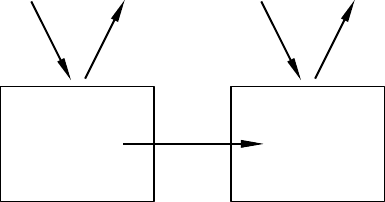
Here we will describe a simple two-box model of the meridional heat trans-
port in the Earth system where the two boxes correspond to the equatorial
region and the polar regions. Figure 10.1 gives a schematic representation of
the two-box model. In order to estimate the entropy production due to the
meridional heat transport, we need to know at what temperature each region
operates. As a crude estimate we will use the mean radiation temperature
for each region. The radiation temperature is set by the balance between ra-
diative heat input and output. The total heat input
˙
Q
in,i
is set by the radiative
input
˙
R
in,i
for each region i and the poleward meridional heat flux J,
˙
Q
in,1
=
˙
R
in,1
− J and
˙
Q
in,2
=
˙
R
in,2
+ J, (10.62)
where region 1 is the equatorial region and region 2 is the polar region. For
the Earth we have
˙
R
in,1
= 80 PW and
˙
R
in,2
= 40 PW. (10.63)
T
1
T
2
J
˙
R
˙
R
˙
R
˙
R
in,1 in,2out
(T
1
)
out
(T
2
)
FIGURE 10.1 Schematic of the two-box model of the meridional heat transport in the
Earth system. The equatorial region is represented by a box at radiation temperature T
1
,
the polar region by a box at radiation temperature T
2
. The incoming radiation
˙
R
in,i
is fixed,
the outgoing radiation
˙
R
out
is a function of the radiation temperature. The meridional heat
transport is represented by a single energy flux J.