
Ambaum M., Thermal Physics of the Atmosphere
Подождите немного. Документ загружается.


42 CH 3 GENERAL APPLICATIONS
Helmholtz free energy
The Helmholtz free energy, or simply free energy, is another thermodynamic
potential. The specific free energy f (in the literature the letter a is also used)
is defined as
I f = u − Ts. (3.8)
Specific free energy is an intensive variable; the free energy F = U − TS is
an extensive variable. Its differential form again follows from the first law
in differential form, analogous to the derivation of the differential of the
enthalpy. We find
df =−s dT − p dv. (3.9)
The free energy has as natural variables the temperature and the volume.
Free energy plays a central role in statistical mechanics
16
where it is natural
to consider systems with a given temperature and volume, so that their free
energy is fixed. In atmospheric science free energy is perhaps used less often.
We find that
s =−
∂f
∂T
v
,p=−
∂f
∂v
T
. (3.10)
The corresponding Maxwell relation is:
I
∂s
∂v
T
=
∂p
∂T
v
. (3.11)
Gibbs function
The Gibbs function is the fourth thermodynamic potential for a simple sub-
stance. The specific Gibbs function (or Gibbs free energy, or sometimes just
the thermodynamic potential) g is defined as
I g = u − Ts + pv. (3.12)
16
A typical technique of statistical mechanics is to maximize the entropy S of a system
(a measure of how probable a particular state is according to the Boltzmann definition
of S) for a fixed total energy U. We then introduce a Lagrange multiplier ˇ so that we
maximize S − ˇU. This can be interpreted as the (negative) free energy if ˇ is interpreted
as the inverse temperature. In this way, the microscopic world of statistical mechanics is
linked to the macroscopic world of thermodynamics; see also Section 4.6.

3.1 THERMODYNAMIC POTENTIALS 43
The specific Gibbs function is an intensive variable; the Gibbs function G =
U − TS + pV is an extensive variable. The differential form follows again by
using the differential form of the first law,
dg =−s dT + v dp. (3.13)
The Gibbs function has as natural variables the temperature and the pres-
sure. The Gibbs function is unique amongst the thermodynamic potentials in
that both its natural variables are intensive. The Gibbs function is used when
describing phase transitions; it turns out that for a substance where two
phases are in contact, such as water vapour over a water surface, the spe-
cific Gibbs function for the two phases is the same; see Sections 3.6 and 5.1.
Chapter 8 describes the role of the Gibbs function in describing substances
with varying composition: the Gibbs function describes the energetic effects
of changing the composition of a substance.
For the first derivatives of the Gibbs function we find
s =−
∂g
∂T
p
,v=
∂g
∂p
T
. (3.14)
The corresponding Maxwell relation is
I
∂s
∂p
T
=−
∂v
∂T
p
. (3.15)
The four thermodynamic potentials and their Maxwell relations can be sum-
marized as:
Internal energy u
du = T ds − p dv
∂T
∂v
s
=−
∂p
∂s
v
Enthalpy h
dh = T ds + v dp
∂T
∂p
s
=
∂v
∂s
p
Helmholtz free energy f
df =−s dT − p dv
∂s
∂v
T
=
∂p
∂T
v
Gibbs function g
dg =−s dT + v dp
∂s
∂p
T
=−
∂v
∂T
p
Although the thermodynamic potentials can be thought of as merely trans-
formed versions of the internal energy of a system, they do find a more phys-
ical justification when considering interactions between the system and its
environment. This is formalized in the analysis of the exergy of a system, see
Appendix B.

44 CH 3 GENERAL APPLICATIONS
3.2 HEAT CAPACITY
We know from experiments that if we put heat into a substance its tem-
perature will usually increase. In fact, this observation is the source of the
confusion of heat and temperature in informal language. Moreover, with the
Boltzmann constant any temperature can be expressed as an energy, so heat
and temperature can both be expressed as energies. The fundamental differ-
ence is that heat represents the microscopic transfer of internal energy from
one substance to another while temperature is a measure of how much en-
ergy is stored as molecular kinetic energy. Temperature measures a state;
heat measures a change of state.
Let us consider a gas: the way we put heat into a gas influences how much
its temperature will increase. For example, if we allow the gas to expand while
we put heat into it, some of the heat energy will be transformed to mechanical
work (by p dV) and therefore less energy will be available to warm up the
gas compared to the situation where we would keep the volume constant.
The amount of heat input ıQ per unit change in temperature ıT is called
the heat capacity and it is denoted by a C (units J K
−1
). We can also divide by
the mass of the system to get the specific heat capacity c (units J kg
−1
K
−1
).
In equations,
C =
ıQ
ıT
= T
dS
dT
,c=
ıq
ıT
= T
ds
dT
, (3.16)
where the limit of small ıQ and ıq is implied. These equations are not meant
to imply a differentiation of Q or q with respect to T, as heat input is not
a state function; entropy is a state function so it can be differentiated with
respect to T.
As noted above, we need to make clear under what constraints the heat
is being put into the system. For example, we expect the heat capacity at
constant volume to be smaller than the heat capacity at constant pressure.
The specific heat capacities at constant volume c
v
and at constant pressure c
p
are defined as
I c
v
= T
∂s
∂T
v
,c
p
= T
∂s
∂T
p
. (3.17)
These two heat capacities are necessarily related: if we heat up a substance
at a constant pressure (while allowing it to expand) then its temperature will
have changed by ıT = ıq/c
p
and its specific volume will have changed by
ıv = (∂v/∂T)
p
ıT or
ıv =
∂v
∂T
p
ıq
c
p
. (3.18)
3.2 HEAT CAPACITY 45
δ q/ c
v
δ q/ c
p
δ T
δ T
′
v
p
T
A
C
B
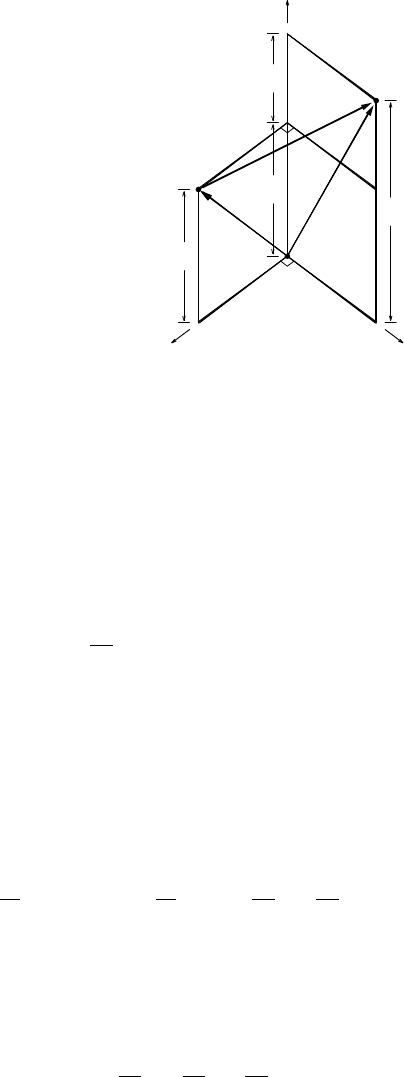
FIGURE 3.1 Illustration on a pvT diagram of the relationship between heat capacities at
constant volume and at constant pressure. Process A→B is isovolumetric, process A→Cis
isobaric, and process C→B is isentropic.
We can now compress the substance isentropically (no further heat is added
to or removed from the substance) until it has returned to its original volume.
This would lead to a further temperature change ıT
, which is related to ıv
by
ıT
=−
∂T
∂v
s
ıv. (3.19)
At the end of this process we have added heat ıq and we are back at the
original (specific) volume. This is illustrated in Figure 3.1: going straight
fromAtoBinthepvT diagram is the same as going from A to B via C. The
total temperature change (going from A to B in the diagram) is therefore by
definition equal to ıq/c
v
and it is equal to ıT + ıT
. So we find that
ıq
c
v
= ıT + ıT
=
ıq
c
p
1 −
∂v
∂T
p
∂T
∂v
s
. (3.20)
Now, multiplying by c
v
c
p
/ıq, substituting c
v
= T(∂s/∂T)
v
, and using the first
Maxwell relation, Eq. 3.3, we find that
c
p
= c
v
+ T
∂v
∂T
p
∂p
∂s
v
∂s
∂T
v
. (3.21)

46 CH 3 GENERAL APPLICATIONS
Combining the two partial derivatives at constant volume we arrive at
c
p
= c
v
+ T
∂v
∂T
p
∂p
∂T
v
. (3.22)
This relationship is valid for any substance. An analogous relationship can
be found for the extensive heat capacities C
V
and C
p
.
A quicker but less intuitive derivation follows from considering s as a func-
tion of T and v. Its first order variations then satisfy
ds =
∂s
∂T
v
dT +
∂s
∂v
T
dv. (3.23)
This leads to
∂s
∂T
p
=
∂s
∂T
v
+
∂s
∂v
T
∂v
∂T
p
, (3.24)
which is equivalent to Eq. 3.22, using the third Maxwell relation, Eq. 3.11.
In the next section we will consider these results as applied to ideal gases.
For liquids or solids, these results can be simplified: under normal circum-
stances (away from the critical point and for pressure variations that are
typical for the atmosphere) the volume changes of a liquid or solid are so
small as to contribute very little to the exchange of work with its environ-
ment. The first law for a liquid or a solid can therefore be approximated as
du = dq. Given that the difference in c
p
and c
v
is due to the exchange of work
with the environment in the isobaric case, the two heat capacities are virtually
the same for liquids or solids. We therefore find for liquids or solids that
c
p
≈ c
v
= c (3.25)
and the internal energy and enthalpy for liquids or solids can be approximated
as
u ≈ h = u
0
+ cT. (3.26)
See Problem 3.6 for an application to the specific entropy for liquids or solids.
The fact that work is not very important to the internal energy budget of liq-
uids or solids does not mean that volume changes are dynamically irrelevant;
all motions in liquids are ultimately driven by volume changes of the liquid –
think of the convective motions in a pan of water heated from below. All that
Eq. 3.26 says is that such volume changes are mainly driven by temperature
changes, not by work performed by or on the liquid.
The definition of the heat capacities, Eq. 3.17, can be used to rewrite the
entropy difference between two states at different temperatures but at fixed

3.3 PROPERTIES OF IDEAL GASES 47
pressure:
S(T) − S(T
0
) =
T
T
0
C
p
T
dT. (3.27)
The quantity C
p
dT is determined experimentally by monitoring the heat input
required to change the temperature by a certain amount. This equation can
then be numerically integrated to find the entropy difference between two
states. In fact, this integration can be done from absolute zero (where entropy
is zero, according to the third law), through the melting point and boiling
point of a substance to find the entropy of a gas. Such experiments have been
used to verify the Sackur–Tetrode equation, which gives the absolute value of
the entropy of an ideal gas from quantum mechanical arguments.
3.3 PROPERTIES OF IDEAL GASES
For an ideal gas we have pv = RT, so that the relationship between the two
heat capacities becomes
I c
p
= c
v
+ R. (3.28)
It is a beautiful result from statistical mechanics that for ideal gases we have
17
c
v
=
3 R/2 for a monoatomic ideal gas,
5 R/2 for a diatomic ideal gas.
(3.29)
The corresponding equations for c
p
can be found from c
p
= c
v
+R. Using the
fact that dry air is predominantly diatomic and that R = 287 J kg
−1
K
−1
we
find that for dry air
c
v
= 717 J kg
−1
K
−1
, (3.30)
c
p
= 1004 J kg
−1
K
−1
. (3.31)
In general, the heat capacity of an ideal gas at constant volume is given by
c
v
= fR/2, (3.32)
with f the number of degrees of freedom per molecule. This is the equipar-
tition theorem, which states that, at equilibrium, all accessible degrees of
freedom store an amount of energy equal to k
B
T/2 per molecule or, equiva-
lently, RT/2 per unit mass; see also Sections 1.2, 2.5, and 4.6. A monoatomic
molecule has three degrees of freedom associated with kinetic energy in the
17
A monoatomic molecule is made of one atom and a diatomic molecule is made of two
atoms.

48 CH 3 GENERAL APPLICATIONS
x, y and z directions. A diatomic molecule would have an additional three
degrees of freedom associated with the rotation about three axes. However,
rotation around the lengthwise axis does not contribute to the energy be-
cause the molecule is symmetric for such rotations, which prevents coupling
between the translational modes and this rotational mode. So we are left with
three translational modes and two rotational modes, f = 5. See Problem 3.2
for an application to water vapour.
All this assumes that the kinetic energy does not couple to the vibrational
energy of the molecule: in quantum theory, there is a discrete minimum
energy required to excite the first vibrational mode above its ground state.
18
It turns out that for atmospheric gases at typical temperatures, this energy is
larger than k
B
T/2; temperatures of thousands of Kelvins are typically required
to significantly excite the vibrational modes. From a classical point of view,
the relative excitation of the vibrational modes is expected to be proportional
to the Boltzmann factor exp (−E/k
B
T) with E the typical excitation energy
of a vibrational mode (see Section 4.6). So with increased temperature the
vibrational degrees of freedom become more occupied. We therefore expect
that the heat capacity will increase with temperature. However, in the range
of temperatures encountered in the atmosphere, the heat capacity of dry air
and most other ideal gases can be considered constant.
The first law in differential form du = T ds − p dv and the definition of
enthalpy in differential form dh = T ds + v dp imply that
c
v
=
∂u
∂T
v
,c
p
=
∂h
∂T
p
. (3.33)
For an ideal gas, the specific heat capacity at constant volume is constant.
This implies that u = u
0
+ c
v
T + f (v) where f is a function of the specific
volume only. We now show that for an ideal gas this function vanishes.
From the first law in differential form it follows that
∂u
∂v
T
= T
∂s
∂v
T
− p = T
∂p
∂T
v
− p, (3.34)
where the third Maxwell relation, Eq. 3.11, is used. This is a general relation-
ship for the variation of the internal energy with volume. Substituting the
ideal gas law in the right-hand side of this expression, we find (∂u/∂v)
T
= 0.
In other words, the internal energy of an ideal gas is a function of tempera-
ture only; this is also known as Joule’s law. In fact, an ideal gas can be defined
as a gas which satisfies Boyle’s law and Joule’s law. We now find for an ideal
18
The vibrational levels of a quantum oscillator are separated by an amount of ¯h
√
(k/M)
with ¯h Planck’s constant, k the stiffness of the molecular bond (the spring constant in
classical mechanics) and M the reduced mass of the constituent atoms. For larger atomic
masses the distance between the vibrational modes reduces and will therefore be more
easily accessible at room temperature.

3.3 PROPERTIES OF IDEAL GASES 49
gas that
I u = c
v
T, (3.35)
where the integration constant u
0
has been set to zero as it has no physical
consequences. A similar argument shows that, for an ideal gas, enthalpy is a
function of temperature only and we find that
h = c
p
T, (3.36)
a result which also follows from the definition of enthalpy h = u +pv applied
to an ideal gas.
We are now in a position to calculate the specific entropy for an ideal gas.
From the fourth Maxwell relation, Eq. 3.15, we have
∂s
∂p
T
=−
∂v
∂T
p
=−
R
p
, (3.37)
where the ideal gas law pv = RT is used to calculate (∂v/∂T)
p
. We also have
∂s
∂T
p
=
c
p
T
. (3.38)
So for an ideal gas we have
ds = c
p
dT
T
− R
dp
p
. (3.39)
Because R and c
p
are constant for an ideal gas we can integrate this expression
to find
I s = c
p
ln (T/ T
0
) − R ln (p/p
0
). (3.40)
The integration constants T
0
and p
0
are arbitrary here as they change the
specific entropy by an additive constant. The entropy constant for an ideal
gas can be fixed using quantum mechanics (the Sackur–Tetrode equation); in
this book we will not encounter situations where the entropy constant plays
a role.
The ideal gas law can now be used to express the specific entropy as a func-
tion of any pairing of variables; the expression for entropy of a monoatomic
gas in terms of temperature and volume has already been derived in
Section 2.3. The specific entropy of an ideal gas as a function of pressure
and density is
s = c
v
ln (p/p
0
) − c
p
ln (/
0
). (3.41)
This particular form is often applied to well-mixed gases.

50 CH 3 GENERAL APPLICATIONS
When an ideal gas is well mixed the specific entropy will be constant
throughout the gas because specific entropy is a particle tracer (we assume
any diabatic processes such as heat diffusion are weak). This may seem coun-
terintuitive but the situation is analogous to stirring paint: suppose we started
off with red and white paint and mix them – the final result is a homogeneous
pink paint. In such situations Eq. 3.41 is valid throughout the gas, with con-
stant values of s,
0
and p
0
. A well-mixed, adiabatic, ideal gas will therefore
have the equation of state
p = k
c
p
/c
v
(3.42)
with k a constant, dependent on the specific entropy and reference pressure.
The ratio c
p
/c
v
is often denoted . For a diatomic ideal gas (such as air,
approximately) we have
=
c
p
c
v
=
7
5
. (3.43)
Monoatomic gases have = 5/3.
The speed of sound C in a compressible fluid is given by
C
2
=
∂p
∂
s
. (3.44)
This partial derivative can be easily found by taking the derivative of Eq. 3.42
with respect to density. We find, using the ideal gas law,
C =
RT. (3.45)
So the speed of sound in an ideal gas is a function of temperature only. For
typical atmospheric values of temperature close to the surface we find values
of C between about 330 and 350 m s
−1
. This leads to the well-known trick
for estimating the distance to a lightning flash: divide the number of seconds
between the flash and the rumble of thunder by three to get the distance in
kilometres.
3.4 VAN DER WAALS’ GASES
An instructive example of the use of thermodynamic potentials is the deriva-
tion of van der Waals’ equation of state, Eq. 1.17. We start from the Helmholtz
free energy, F
ideal
, for a volume of ideal gas and make two modifications to it,
representing the finite size of real molecules and the average attractive force
between real molecules. We then use
p =−
∂F
∂V
T
(3.46)
3.4 VAN DER WAALS’ GASES 51
012345678910
molecular distance (Å)
0
–100
100
energy/ k
B
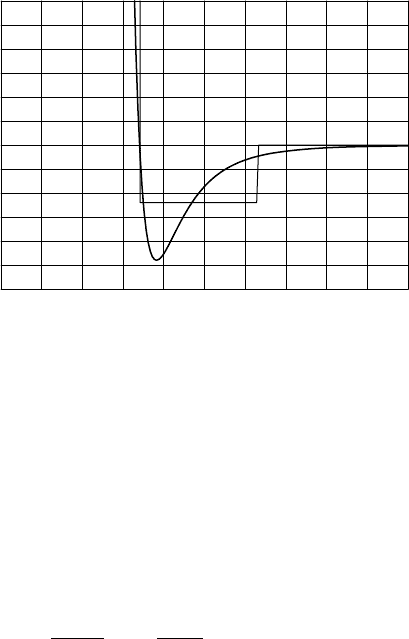
(K)
FIGURE 3.2 Interaction potential between two argon atoms. The interaction energy is ex-
pressed as a temperature (in Kelvin), and the energy in Joules can be found by multiplying
by k
B
. The potential minimum thus corresponds to 1.7 × 10
−21
J. The horizontal distance
is in units of 1
˚
A = 10
−10
m. The interaction potential is fairly similar to that for N
2
and O
2
molecules. The thin line is the approximating square well potential, which is discussed in
the text.
to calculate the pressure for this non-ideal gas. We can explicitly write down
an expression for the free energy of an ideal gas, F
ideal
, but presently we only
require that
p
ideal
(V, T ) =−
∂F
ideal
∂V
T
=
nR
T
V
, (3.47)
which follows from the ideal gas law.
The ideal gas is made up of non-interacting point particles. In a real gas
molecules will have a finite effective size, sometimes called the hard core.
The hard core is a result of the repulsive force at short distance between
two molecules. This repulsive force is equivalent to a strong increase in
the interaction potential when two molecules come close to each other, see
Figure 3.2. The repulsive force becomes so large at small distances that the
molecules effectively cannot come closer than some finite distance, r
c
. Each
molecule therefore has less volume available than the volume V of the gas.
The excluded volume is the total volume of the hard cores of the molecules
and can be written as V
c
N, with V
c
the effective volume of the core and N
the number of molecules. The effective core volume is V
c
= (2/3)r
3
c
.
19
This
19
The effective core volume is half the size of a single core because the first molecule
in a box does not experience any excluded volume, the second molecule is excluded from
(4/3)r
3
c
, the third molecule is excluded from 2 (4/3)r
3
c
, etc. So the Nth molecule is
excluded from (N −1) (4/3)r
3
c
of volume. For large N, the average excluded volume per
molecule is therefore (2/3)r
3
c
.