
Ambaum M., Thermal Physics of the Atmosphere
Подождите немного. Документ загружается.


10 CH 1 IDEAL GASES
more accurately described by van der Waals’ equation,
p + a
n
V
2
(V − nb) = nR
T, (1.17)
with a and b constants that depend on the particular gas. The term −nb
represents the reduction in available volume due to the finite effective size of
the molecules. The term a(n/V)
2
is related to the average interaction energy
between molecules (which is why the term is quadratic in the number density)
and it contributes as an effective pressure; the relation between pressure and
energy density will be explained in Section 2.2, and a derivation of van der
Waals’ equation will be presented in Section 3.4. Van der Waals’ equation is
more accurate for gases at high densities, and approximately describes such
important processes as phase transitions.
Densities of gases in the atmosphere are such that the ideal gas law gives
essentially the same results as van der Waals’ equation, so we stick to the
much simpler ideal gas law. Indeed, for low densities van der Waals’ equation
reduces to the ideal gas law,
Eq. 1.17 → pV = nR
T if n/V → 0. (1.18)
Conversely, for large pressures,
Eq. 1.17 → V = nb if p →∞. (1.19)
So the high pressure, incompressible liquid is also a limiting case of van der
Waals’ equation.
In general, an equation of state is some relationship between the variables
of the system,
f (p, N, V, T, a
1
,a
2
,a
3
,...) = 0, (1.20)
where a
1
,a
2
... represent any other variables that influence the state of the
system, such as humidity in air, or salinity in water. The equation of state is
dependent on the precise nature of the system and results derived using an
equation of state are therefore only valid for that particular system. We will
see that many of the results in this book are derived without reference to an
equation of state and will therefore be valid for any substance.
1.3 IDEAL GAS MIXTURES
Ideal gases are defined as gases where the molecules themselves have negli-
gible volume and have negligible interactions with each other. So if we mix
several ideal gases at the same temperature in a single volume they do not

1.3 IDEAL GAS MIXTURES 11
‘feel’ each other’s presence. This means that each constituent gas contributes
independently to the pressure. The contribution of each constituent to the
total pressure is called the partial pressure.Son
i
mols of constituent i will
have a partial pressure p
i
equal to:
p
i
=
n
i
R
T
V
. (1.21)
The fact that these partial pressures independently make up the total pressure
of the mixture is called Dalton’s law:
p =
i
p
i
. (1.22)
Dalton’s law is only true for ideal gases. For real gases, partial pressures
cannot be easily defined.
From Dalton’s law it follows that
p =
i
n
i
R
T
V
=
i
M
V
n
i
i
M
i
R
T = RT, (1.23)
where
R =
R
e
, (1.24)
with the effective molar mass
e
of the mixture defined as
1
e
=
i
c
i
i
, (1.25)
and c
i
= n
i
i
/M the mass fraction of constituent i – that is, the fraction
constituent i contributes to the total mass. Another way of interpreting this
result is that the specific gas constant R of the mixture is the weighted mean
of the specific gas constant of the pure constituents R
i
= R
/
i
, that is,
I R =
i
c
i
R
i
. (1.26)
Table 1.1 lists the main constituents of air. The dry air constituents are
well mixed and long-lived which means that the bulk composition of dry
air is fixed throughout the atmosphere up to very high altitudes. There is
a long-term upward trend in CO
2
concentration over time due to human
activity but this has only a minor effect on the ideal gas properties of dry
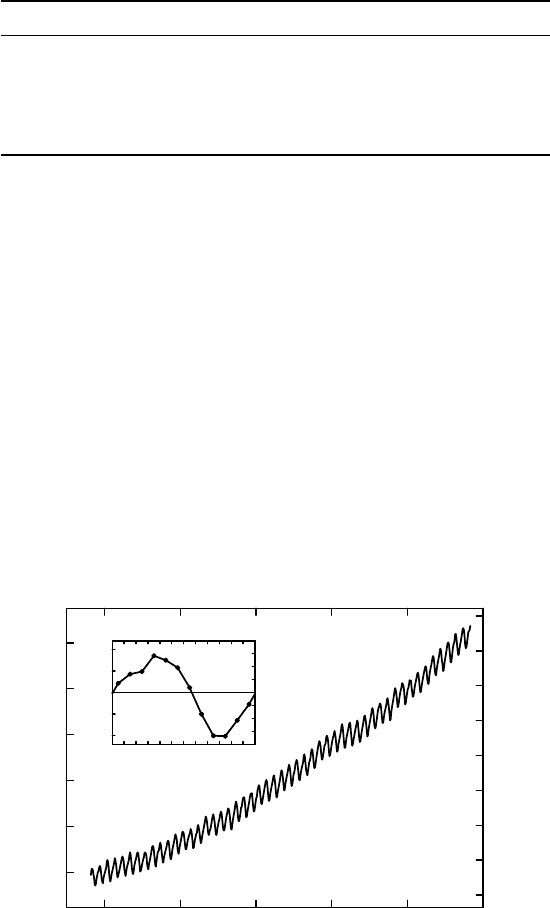
air, see Figure 1.6. However, the CO
2
trend does have a profound effect on
the radiative properties of the air and it is the main agent of human-induced
climate change.
12 CH 1 IDEAL GASES
TABLE 1.1 Main constituents of air.
Constituent Molar mass, (g mol
−1
) Mass fraction, c
N
2
28.02 0.755
O
2
32.00 0.231
Ar 39.93 0.013
CO
2
44.01 ∼ 0.0006
H
2
O 18.02 0 to ∼ 0.03
Using the numbers in Table 1.1 it is straightforward to verify that the
effective molar mass
d
for dry air is
d
= 29.0 g mol
−1
(1.27)
and the specific gas constant R for dry air is
I R = 287 J kg
−1
K
−1
. (1.28)
This value of R can be used in the ideal gas law, Eq. 1.15, which then relates
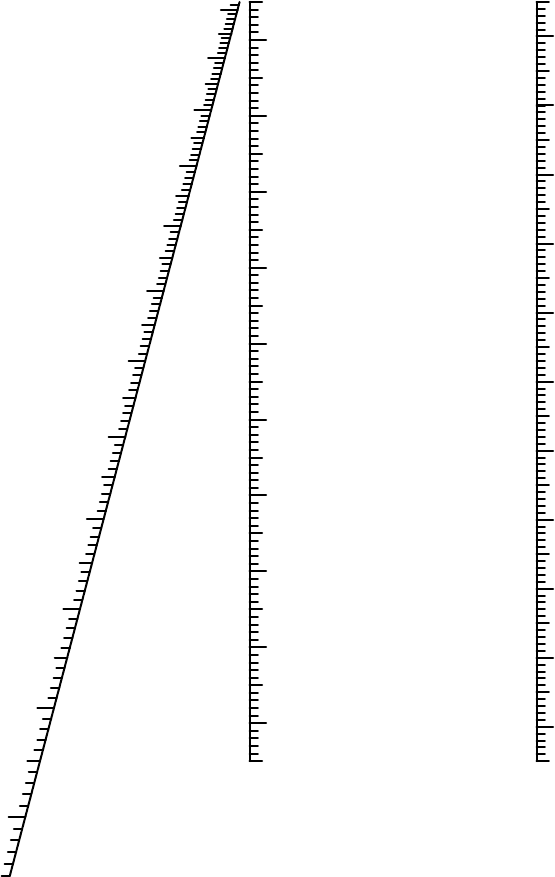
the pressure, density, and temperature for dry air. Figure 1.7 is a nomogram
expressing this relation graphically.
Now we can also calculate the effect of water vapour on the ideal gas
law. The amount of water vapour in the air can be quantified by its mass
201020001990198019701960
480
500
520
540
560
580
310
320
330
340
350
360
370
380
390
JFMAMJJASOND
−5
0
5
−3
−2
−1
0
1
2
3
FIGURE 1.6 Mass fraction (left axis, in parts per million) and molar mixing ratio (right
axis, in parts per million) of CO
2
as measured at Mauna Loa Observatory, Hawaii. In-
set: mean annual cycle of CO
2
, scales as main graph. This annual cycle is dominated
by vegetation growth and resulting CO
2
capture in the Northern Hemisphere summer.
Data from Tans, P. P. Trends in Atmospheric Carbon Dioxide - Mauna Loa. Available from:
www.esrl.noaa.gov/gmd/ccgg/trends/. See also Keeling, C. D. et al. (1976) Tellus 28,
538–551.
1.3 IDEAL GAS MIXTURES 13
100
200
300
400
500
600
700
800
900
1000
–60
–50
–40
–30
–20
–10
0
10
20
30
40
0.1
0.2
0.3
0.4
0.5
0.6
0.7
0.8
0.9
1.0
1.1
1.2
p (hPa) T (ºC)
ρ
(kgm
−3
)
FIGURE 1.7 Nomogram expressing the ideal gas law for dry air,
p = RT (with R = 287 J kg
−1
K
−1
).
The nomogram works by laying any straight index line over the figure so that it crosses all
three scales. The values for , p, and T where the index line then crosses the graduated
scales satisfy the ideal gas law for dry air.

14 CH 1 IDEAL GASES
fraction. For water vapour this mass fraction is called the specific humidity,
usually denoted q. This means that the mass fraction of dry air is 1 −q. From
Eq. 1.26 it then follows that the specific gas constant for the moist air is
(1 − q)
R
d
+ q
R
v
= R
1 +
d
v
− 1
q
, (1.29)
with
d
and
v
the molar masses for dry air and water, respectively, and R the
specific gas constant for dry air, Eq. 1.28. It is common usage to absorb the
factor with the dependency on specific humidity in a redefined temperature,
the virtual temperature, T
v
. So the ideal gas law for moist air is
I pv = RT
v
or p = RT
v
, (1.30)
where the virtual temperature T
v
is defined as
I T
v
=
1 +
d
v
− 1
q
T = (1 + 0.61 q) T, (1.31)
d
/
v
being equal to 1.61. So it turns out that moist air can be treated as
dry air as long as we replace the temperature in the equation of state by the
virtual temperature.
The virtual temperature increases with specific humidity. Over humid trop-
ical areas the specific humidity can be about 30 g kg
−1
, leading to a virtual
temperature that is about 2% above the temperature (about 6
◦
C). Over colder
areas the specific humidity is always much less, so here the virtual tempera-
ture and the temperature are always less than 1
◦
C apart.
P
ROBLEMS
1.1. How many molecules are there in a litre of air at standard pressure and
temperature? What is the volume, in litres, of one mole of ideal gas at
standard pressure and temperature?
1.2. Use the microscopic definition of temperature, Eq. 1.6, to find a typical
root-mean-square molecular velocity for air.
1.3. (i) Calculate the density of dry air at a temperature of 15
◦
C and a
pressure of 1000 hPa (or use the nomogram in Fig 1.7). (ii) Calculate
the density if we now assume that this air has a specific humidity of
3gkg
−1
. (iii) Calculate the density of air at a virtual temperature of
15
◦
C and a pressure of 1000 hPa.
1.4. The proportions by mass of the major constituents of the atmosphere
on Mars are given in the following table. Calculate the effective molar
1.3 IDEAL GAS MIXTURES 15
mass and the specific gas constant for the Martian atmosphere.
CO
2
N
2
Ar
Mars 0.96 0.02 0.02
1.5. Saturn’s largest moon, Titan, has an atmosphere mainly made up of
nitrogen (N
2
). The temperature at Titan’s surface is about −94
◦
C and
the pressure is about 1460 hPa. What is the density at the surface? The
main varying constituent on Titan is methane (which has a molar mass
of 16 g mol
−1
). What is the virtual temperature, with respect to methane,
at the surface if the number concentration of methane is 1.5%?

2
The first and second laws
In this chapter we will discuss the thermodynamic version of the law of con-
servation of energy and the law relating heat to entropy. These laws are called
the first law and the second law of thermodynamics, respectively, and they
are part of the axiomatic framework of thermodynamics.
To make the axiomatic framework of thermodynamics complete we also
need the third law, stating how thermodynamic properties behave near ab-
solute zero. The third law does not play an important role in atmospheric
applications and we will not further expand on it. We also need the zeroth
law, which states that if system A is in thermal equilibrium with system B and
system B is in thermal equilibrium with system C then system A has to be in
thermal equilibrium with system C. The zeroth law makes physical sense and
is usually taken for granted, although in a strictly axiomatic development it
needs to be stated explicitly.
The second law has a particularly profound interpretation in that it
describes the irreversibility of macroscopic systems and thus provides the
direction of time in macroscopic systems. It also provides the link between the
macroscopic world of thermodynamics and the microscopic world of mole-
cular dynamics, in that entropy measures the microscopic uncertainty of a
macroscopic system.
2.1 WORK
From classical mechanics we know that if we exert a force F on a body in
order to displace it over a distance r, we put in an energy W equal to the
inner product of the force and the displacement: W = F · r. This energy
of displacement with a force is called work (units J, Joule). The force may be
a function of location so that it is better to take infinitesimal displacements
dr for which infinitesimal amounts of work dW are required:
dW = F · dr. (2.1)
17
Thermal Physics of the Atmosphere Maarten H. P. Ambaum
© 2010 John Wiley & Sons, Ltd. ISBN: 978-0-470-74515-1
18 CH 2 THE FIRST AND SECOND LAWS
dx
F = pA
dV
A
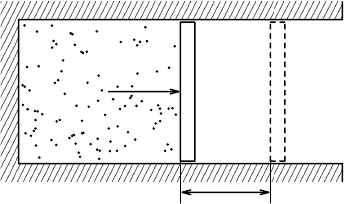
FIGURE 2.1 Work done during expansion of a gas.
So for a finite displacement we find that the total work W required is
W =
r
1
r
0
F · dr, (2.2)
where F can be a function of r.
A similar set up occurs in thermodynamics: if we put a gas in a cylinder with
a piston then the gas exerts a pressure p on the outer walls, see Figure 2.1.
Moving the piston therefore requires a force of magnitude F = pA (positive
when compressing the gas). We assume here that the movement of the piston
is frictionless so no work is required to overcome the friction. The work done
on the gas in compressing the piston over a distance dx is therefore equal to
pA dx. This can be written as the work dW put into the gas,
I dW =−p dV, (2.3)
with dV =−A dx, the change in volume of the gas; note that an expanding
gas (dV>0) performs pressure work on its surroundings and the work input,
dW, is negative. It is again a good idea to use infinitesimal displacements;
Boyle’s law provides an example of how pressure can be a function of the
volume of the gas, just as in Eq. 2.1 the force can be a function of x. Dividing
by the mass M of the system we find the specific form of the above equation,
dw =−p dv. (2.4)
This equality is only true for systems without friction or other dissipative
processes. If there is friction, some of the work dW required to compress a
volume of gas is used to overcome the friction and will therefore be larger
than −p dV; similarly, for expansion, the work delivered by the gas is partly
used to overcome friction and will therefore produce less external work. In
either case we have
I dW ≥−p dV. (2.5)
2.1 WORK 19
This is the generalization of Eq. 2.3 for systems with friction or dissipation; for
frictionless, non-dissipative systems, the above equation reduces to Eq. 2.3.
Below we will discuss this result in the context of the second law of thermo-
dynamics.
The above definition of work done on a gas under pressure is not only true
for gases in a cylinder: an amount of gas (or any substance) in any shape will
experience a certain pressure p on its boundary. Assume its surface A is made
up of different area elements A
i
, which are displaced outward by a distance
dn
i
. The total work performed on the gas equals the sum of work performed
on each individual area element,
dW =−
i
pA
i
dn
i
. (2.6)
But on displacing the area elements by dn
i
, the volume of the gas changes by
dV =
i
A
i
dn
i
. (2.7)
Combining the last two equations we get Eq. 2.3 again.
As an example of pressure work, take an ideal gas at initial volume V
0
and
pressure p
0
. If we change the volume to V
1
while keeping the temperature
constant, the total work done would be
W = p
0
V
0
ln (V
0
/V
1
). (2.8)
This situation can be achieved by keeping the gas in thermal contact with
a heat reservoir, such as a big block of metal, at a given temperature, and
changing the volume slowly so as to allow thermal equilibration between the
gas and the thermal reservoir. Isothermally compressing a litre (10
−3
m
3
)of
gas at atmospheric pressure to half its volume would require about 70 J of
energy; enough to heat a cup of tea up by about 0.15
◦
C or to power a 60 W
lightbulb for about a second.
Change in volume against pressure is not the only form of work a ther-
modynamic system can perform. For example, a body of liquid could change
its surface area by an amount dA (for example, by changing its shape while
conserving its volume or by evaporating liquid into the gas phase). How-
ever, a liquid–gas interface behaves like an elastic membrane that is trying
to contract. The tensile strength of the membrane is measured by the surface
tension . The amount of work dW required to change the surface area dA
against surface tension is
dW = dA. (2.9)
A droplet will tend to minimize the energy associated with its surface tension,
just as a particle will tend to minimize its potential energy. The result of this
is that a droplet at rest will tend to have a minimum surface area given its
20 CH 2 THE FIRST AND SECOND LAWS
volume; this is achieved by assuming a spherical shape. The thermodynamic
effects of surface tension on water droplets are further described in Chapter 7.
Another example is a charged droplet that has an electric surface potential
of V
e
(units V, Volt) which is charged by an amount dQ
e
(units C, Coulomb).
The electrostatic energy required for this charging process requires an energy
dW,
dW = V
e
dQ
e
. (2.10)
In general, the work dW required to produce a particular infinitesimal
change can be written as
dW = y dX, (2.11)
where, inspired by Eq. 2.1, y is called the generalized force and dX is called
the generalized displacement.
Because the infinitesimal variation in work is a compound term, see Eq. 2.3,
it follows that work is not a state variable; that is, it cannot be determined by
making a single measurement of the properties of the gas. This can be readily
understood from a mathematical perspective. Consider a gas for which the
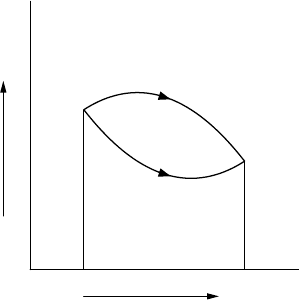
states are plotted on a pV diagram, see Figure 2.2. The temperature can
be deduced from the equation of state. Any state will correspond to a single
point on this diagram. Any transformation of the system – a change in volume,
temperature, pressure, etc. – will move the point around on the diagram. So
on the pV diagram we can think of a process transforming the system from A
to B, but we can choose different routes: we could go via C or via D, or any
other route from A to B. The total work W required to perform such a process
is
W =−
A→B
p dV, (2.12)
V
p
A
B
D
C
FIGURE 2.2 pV diagram for a system changing its state from A to B via ACB or ADB.