
Ambaum M., Thermal Physics of the Atmosphere
Подождите немного. Документ загружается.

2.2 ENERGY CONSERVATION: THE FIRST LAW 21
which is the area under the graph on the pV diagram. The area depends on the
route taken: curve ACB has a larger area, and more negative work is required
(the gas performs more work), than curve ADB. The path ACB performs the
change in volume V
B
−V
A
on average at a larger pressure than the path ADB,
although the pressures at their joint endpoints, A and B, are the same. Going
from A to B, the changes in state variables p, V, T, etc., are well defined,
while the work W depends on the path taken and is therefore not uniquely
determined by the system’s location on the pV diagram. We have to conclude
that work is not a state variable.
2.2 ENERGY CONSERVATION: THE FIRST LAW
If we put energy into a gas under pressure by compressing it (dV<0) where
does the energy dW =−p dV go? If we extract work from a gas by expanding
it (dV>0) where does the energy come from? The energy is stored in
all the internal degrees of freedom, see Section 1.2. The thermodynamic
expression for the sum total of this stored energy is called internal energy U
(units J). Combining the equipartition theorem (all degrees of freedom store
on average an equal amount of energy) and the microscopic definition of
temperature (temperature is proportional to the energy in the translational
degrees of freedom) it follows that, like temperature, the internal energy is
a state variable.
6
If we bring a hot body into contact with a cold body we know from ex-
periments that the hot body will cool down and the cold body will warm
up. If the volume of the bodies does not change much in this process, this
change of temperature of each body has to be associated with a change of
their internal energy. In fact, conservation of energy dictates that the cool
body gains the same amount of energy as the warm body loses. The energy
that flows between bodies of different temperatures in contact is called heat Q
(units J).
7
So if, besides work, we also allow a system to exchange heat dQ with its
environment the law of conservation of energy becomes
I dU = dQ +dW. (2.13)
This is the first law of thermodynamics. It states that the internal energy of
a system can increase by putting in heat or by performing work on it. We
6
Although our argument appears only valid for substances with a fixed number of
degrees of freedom, or a number that only depends on temperature, it turns out to be true
for any substance; the effective number of degrees of freedom can be a complex function
of the state variables. Essentially, we assume that the energy in all the internal degrees of
freedom for a particular state does not depend on the way we arrived at this state.
7
In a more formal treatment of thermodynamics, temperature is defined to be the quan-
tity that indicates the direction of spontaneous heat flow; so heat will flow by defini-
tion from high to low temperatures. See Baierlein, R. (1999) Thermal Physics. Cambridge
University Press, Cambridge.

22 CH 2 THE FIRST AND SECOND LAWS
can divide this equation by the mass of the system to rewrite all extensive
variables as specific variables,
du = dq + dw. (2.14)
We will usually use this specific form of the first law, but the transformation
between the two forms is trivial.
The above form of the first law is valid for systems that only exchange
energy with their environment through heat or work. In this form it excludes
matter exchange. However, in most relevant cases matter exchange can be
dealt with using the concept of enthalpy, see Section 3.5. In its most general
form, the first law also includes terms related to molecule number changes,
and the associated generalized force is called the chemical potential. Chapter 8
provides the necessary background.
The first law is very general; it is the thermodynamic version of the law
of conservation of energy. However, the real meat of the the first law is the
realization that heat is a form of energy. This realization was a major step in
the development of thermodynamics.
Let us now briefly return to our example of isothermal compression of a
litre of air. The isothermal constraint implies that the internal energy of the
gas does not change: dU = 0. The first law then states that a volume change
of dV requires a heat input in the gas of dQ = p dV. In the absence of such
heat input, if, for example, the gas is thermally isolated, the internal energy
would change by an amount dU =−p dV, leading to a change in temperature.
For an insulated system (that is, no heat exchange, dQ = 0) which can
perform pressure work, the first law states that
dU =−p dV. (2.15)
This leads to the interpretation of pressure as a volumetric energy density. If
a system changes volume while there are no other sources of internal energy,
then the volumetric energy density U/ V changes as
d
U
V
=−
U
V
dV
V
− p
dV
V
. (2.16)
The first term on the right-hand side is a purely geometric effect that describes
how the energy density changes if the given energy is redistributed over a
different volume; this term is present for any quantity for which a change in
volumetric density is computed, for example molecule number density. The
second term on the right-hand side is a physical effect that results from the
energy that is produced by performing work on the system. The two effects
can be interpreted as purely geometric contributions if we interpret p as an

2.3 ENTROPY AND THE SECOND LAW 23
additional volumetric energy density,
d
U
V
=−
U
V
+ p
dV
V
. (2.17)
For many physical phenomena it is useful to reverse this argument: if some
physical process implies some additional volumetric energy density then this
is manifested as an effective pressure. For example, let us consider the con-
tribution of the surface tension to the internal energy of a spherical water
drop of volume V = (4/3)r
3
. The volumetric energy density then changes
as (see Eq. 2.9)
d
U
V
=−
U
V
dV
V
+
dA
V
=−
U
V
−
2
r
dV
V
, (2.18)
where it is taken that for a spherical drop 2 dV = r dA. The surface ten-
sion then corresponds to an effective negative pressure (the tension tries to
compress the drop) of magnitude 2/r, the so-called capillary pressure. For a
water drop in dynamic equilibrium, the pressure inside and outside the drop
has to be equal. However, because the surface tension acts as an additional
negative pressure inside the drop, the actual pressure inside the drop has to
be larger by 2/r compared to its environment.
2.3 ENTROPY AND THE SECOND LAW
From the first law we know that the change in internal energy of a system
equals the sum of the heat flow into the system and the work done on the
system, dU = dQ +dW. Because internal energy is a state variable, but work
is not, we need to conclude that heat cannot be a state variable either. It
can be shown that, just like work W, heat input Q can also be written as a
compound variable:
I dQ = T dS, (2.19)
with S the entropy. Entropy is a state variable; the combination T dS is not.
The arguments leading to this important result are beautiful and somewhat
convoluted. There are several ways of demonstrating this important result
but the classical arguments are based on a careful analysis of thermodynamic
cycles, where a system undergoes several well-defined transformations to re-
turn to its original state; most general textbooks on thermodynamics will
provide a version of these arguments.
We can illustrate the definition of entropy in the case of an ideal
monoatomic gas. The only internal degrees of freedom for such a gas are
the translational degrees of freedom. This means that the internal energy

24 CH 2 THE FIRST AND SECOND LAWS
follows from the definition of temperature, Eq. 1.6,
U =
3
2
Nk
B
T. (2.20)
The differential form of the first law for a monoatomic ideal gas therefore
can be written
dQ = dU − dW =
3
2
Nk
B
dT + p dV. (2.21)
From the ideal gas law, pV = Nk
B
T, it then follows that
dS =
dQ
T
=
3
2
Nk
B
dT
T
+ Nk
B
dV
V
. (2.22)
The above equation can be integrated (we introduced an integrating factor
1/T to achieve this) and we find that for an ideal monoatomic gas the entropy
S equals
S =
3
2
Nk
B
ln (T/ T
0
) + Nk
B
ln (V/ V
0
), (2.23)
with T
0
and V
0
integration constants. So entropy S is a state function; we
have an expression of S in terms of other state variables.
We now have two forms of the first law of thermodynamics for simple
systems:
dU = dQ +dW, (2.24a)
dU = T dS − p dV. (2.24b)
Subtracting these equations, we find that
T dS − dQ = p dV + dW. (2.25)
In general, the right-hand side is non-negative, Eq. 2.5, and will only be
zero for non-dissipative systems.
8
If we allow for friction or other dissipative
processes, we have
I dQ ≤ T dS. (2.26)
8
These arguments are often a source of confusion: the dW and the dQ represent the
work and heat put into the full system, e.g. a cylinder with gas. They are, in a sense,
external to the working fluid, the gas. The −p dV and T dS represent the way this work
and heat input change the equilibrium thermodynamic properties of the working fluid and
are thus internal to the working fluid.
2.3 ENTROPY AND THE SECOND LAW 25
gas environmentdiss.
T d
i
S
T d
i
S
− p dV
p dV
d
W
− dW
(a)
(b)
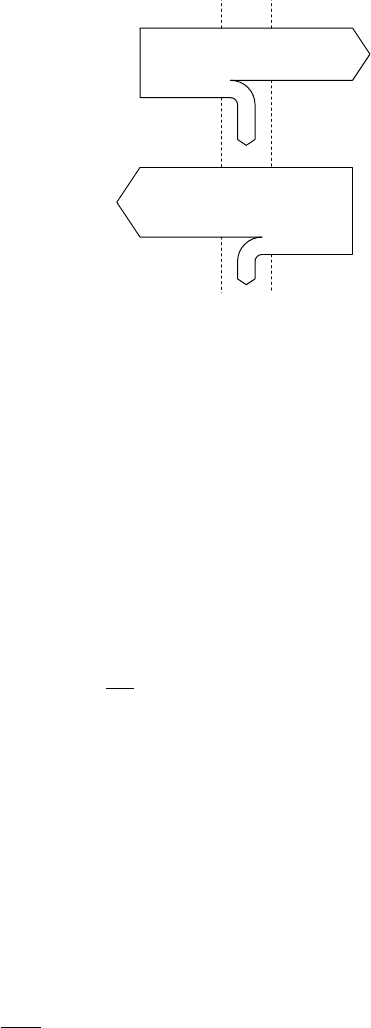
FIGURE 2.3 Compression (a) and expansion (b) of a system with friction. In both cases
we find dW +p dV = T d
i
S>0 with dW the work done on the environment and p dV the
work done by the gas.
The difference T dS−dQ is called uncompensated heat and it is always positive.
For thermally isolated systems (dQ = 0) we find that
dS ≥ 0, (2.27)
that is, for thermally isolated systems the entropy will never decrease.
In general, we can write the entropy change dS as the sum of a reversible
(external) change d
e
S, due to heat flow (and possibly matter flow), and an
irreversible change d
i
S, due to uncompensated heat:
9
I dS = d
e
S + d
i
S =
dQ
T
+ d
i
S. (2.28)
The irreversible entropy change is always positive. This is the second law of
thermodynamics.
Now we will consider a couple of further examples of the use of these
equations. Firstly, consider again the system of a gas in a cylinder, which
is kept at constant temperature but which now has a piston moving under
friction, see Figure 2.3. The work put into the gas equals −p dV, but because
the piston moves under friction we need to put more work into the system of
gas and cylinder. To keep the gas at constant temperature we need to flux
heat between the gas and its environment such that dQ = p dV, from which
it follows that
d
e
S =
p dV
T
. (2.29)
9
See also Kondepudi, D. & Prigogine, I. (1998) Modern Thermodynamics. J. Wiley &
Sons, Chichester.

26 CH 2 THE FIRST AND SECOND LAWS
We can now use Eqs. 2.25 and 2.28 to deduce that
d
i
S =
dW + p dV
T
, (2.30)
which is positive if the cylinder moves under friction, Eq. 2.5. In fact, we could
write the work put into the system as dW =−p
piston
dV, where on compres-
sion (dV<0), the piston pressure p
piston
is larger than the gas pressure p to
overcome the friction. Under those circumstances we have
d
i
S =
(p − p
piston
)dV
T
> 0. (2.31)
For an expanding gas, dV>0, in a cylinder with friction we would find
p
piston
<p,so that again d
i
S>0.
Another instructive example is the spontaneous flow of heat between two
bodies initially at different temperatures. Suppose we have two bodies at
different temperatures T
1
and T
2
with T
1
>T
2
and that these are briefly put
into contact so that a small amount of heat dQ is exchanged between them,
see Figure 2.4. For simplicity, we assume that any volume changes are in-
significant in this process.
Heat will flow spontaneously from the hot body to the cold body. The hot
body therefore changes its entropy by an amount dS
1
=−dQ/T
1
and the cool
body changes its entropy by an amount dS
2
= dQ/T
2
. The total change of
entropy of the two bodies together is therefore (remember that entropy is an
extensive quantity)
dS = dS
1
+ dS
2
= dQ
1
T
2
−
1
T
1
> 0. (2.32)
Each subsystem changes its entropy according to dS = dQ/T, which would
qualify as a reversible entropy change, but the system as a whole does not
exchange heat with its environment and the entropy change of the whole
system is therefore irreversible. The second law states that the irreversible
entropy change must be positive. For our system this means that we must
have T
1
>T
2
if dQ>0. In other words, the heat will not spontaneously flow
from lower to higher temperatures, something we are well aware of from
everyday experience.
T
1
, S
1
T
2
, S
2
dQ
FIGURE 2.4 Exchange of heat between two bodies at different temperatures.
2.4 BOLTZMANN ENTROPY 27
The fact that heat will spontaneously flow from higher to lower tem-
peratures is made precise in another formulation of the second law, called
Clausius’ postulate:
A closed system cannot have as sole result the transfer of heat from a body
at lower temperature to a body at higher temperature.
Clausius’ postulate is valid for any thermodynamic system, not just a heat
conduction system. There are several equivalent formulations of the second
law of thermodynamics. The textbook by Fermi
10
gives an overview of these
different formulations and why they must be considered equivalent. Clausius’
postulate is probably the most intuitive of them.
An important class of processes are those reversible (d
i
S = 0) processes
for which the system does not exchange heat with the environment, that is
dQ = T d
e
S = 0. Such processes are called isentropic processes or adiabatic
processes. Many flows in the atmosphere (and nearly all flows in the interior
oceans) are, to a large extent, adiabatic. Any fluid parcel undergoing adia-
batic transformations conserves its specific entropy. Processes that do change
the specific entropy of a parcel are called diabatic.
2.4 BOLTZMANN ENTROPY
The microscopic world of molecules is thought to be reversible. If we could
reverse the direction of all molecules at once, the world would run backwards.
Planets would rotate the other way around, mixed paint would un-mix, can-
dles would go out with the flame retreating into the matchstick, and our
thoughts would run backwards – whatever that may mean. Clearly, this is
not consistent with experience. The macroscopic world is not reversible; it
satisfies the second law of thermodynamics, Eq. 2.27. Entropy is Nature’s
arrow of time.
11
How can the second law be made consistent with microscopic reversibility?
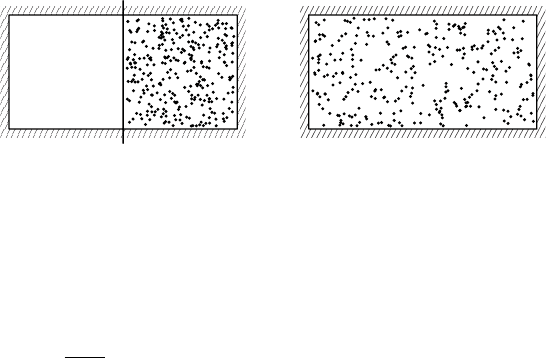
Consider an ideal gas in a thermally isolated cylinder with a wall in the middle,
such that the gas is initially located on one side of this wall, see Figure 2.5a.
We will now consider what happens if we remove this separating wall.
When the separating wall is removed, the gas will expand to fill the whole
cylinder, see Figure 2.5b. The gas expands into the vacuum and therefore will
not encounter any inhibition to its expansion; it does not perform any work.
Because the cylinder is thermally isolated it too will not exchange any heat in
the process of expansion. We conclude from the first law of thermodynamics
that the internal energy of the gas does not change on expansion into a
vacuum.
10
Fermi, E. (1956) Thermodynamics. Dover, New York.
11
A popular account is in Ruelle, D. (1991) Chance and Chaos. Princeton University Press,
Princeton.
28 CH 2 THE FIRST AND SECOND LAWS
(a) (b)
FIGURE 2.5 Expansion of a gas into vacuum. In panel (a) the gas is confined to one side
of the thermally isolated cylinder by a separating wall; in panel (b) the separating wall is
removed and the gas expands to fill the whole cylinder.
From the first law in the form of Eq. 2.24b we can now calculate the entropy
change during expansion into a vacuum as
12
S =
V
1
V
0
p dV
T
, (2.33)
with V
0
the initial volume and V
1
the final volume. The ideal gas law states
that pV = Nk
B
T, with N the number of molecules and k
B
Boltzmann’s con-
stant. With the ideal gas law we can perform the integration explicitly and
deduce that for an ideal gas expanding into a vacuum
S = k
B
ln (V
1
/V
0
)
N
. (2.34)
Because there is no heat flow to or from the system, this entropy change
must be irreversible; it is the result of the gas occupying a larger volume and
because the occupied volume increases (V
1
>V
0
) we find that the entropy
change is positive.
The statement of the second law – that the irreversible entropy change for
any system always has to be positive – corresponds in the present setup to
V
1
>V
0
. In other words, the gas will not spontaneously occupy a smaller
volume, something we are well aware of from everyday experience. If the
second law stopped working we would all die of asphyxiation.
Suppose a gas is confined to the cylinder of volume V
1
. What is the prob-
ability that all N molecules spontaneously reside in sub-volume V
0
?Ifthe
molecules move in a random fashion through volume V
1
then the chance
of finding a particular molecule in sub-volume V
0
is V
0
/V
1
. If the molecules
move independently, then the chance of finding all N molecules at the same
time in sub-volume V
0
is (V
0
/V
1
)
N
. For realistic values of N this number is
unimaginably small, but more importantly, we see that the entropy change
in Eq. 2.34 is proportional to the logarithm of the relative probability of the
two states.
12
Although the expansion is not a reversible process, we can in principle link the initial
and final state with a reversible process and thus calculate the change in state variables
between the initial and final states.
2.4 BOLTZMANN ENTROPY 29
Boltzmann realized that this observation is more general: he posited that
the entropy of a given system at equilibrium would equal
I S = k
B
ln W , (2.35)
where W is the total number of microscopic states that are consistent with
the macroscopic constraints on the system. For example, let us say that the
gas in the cylinder of volume V
1
has W
1
microscopic states. We need not
be concerned here with the details of how to get the precise number of
microstates.
13
It now readily follows that, all other things being equal, the
number of states corresponding to having all particles in volume V
0
will be
W
0
= W
1
(V
0
/V
1
)
N
; each molecule now has access to a fraction V
0
/V
1
of the
original states, namely those states where the molecule resided in volume
V
0
. According to the Boltzmann formula, the difference in entropy between
those states equals
S = k
B
(lnW
1
− ln W
0
) = k
B
ln (V
1
/V
0
)
N
, (2.36)
which is the same as Eq. 2.34.
The Boltzmann definition implies that entropy is an extensive quantity.
Suppose we have two systems, A and B, with W
A
and W
B
microstates respec-
tively. For each single state of system A, system B can be in W
B
different
states. That means that the total number of states of the combined system
(A, B)isW
A
× W
B
. The Boltzmann definition of entropy for the combined
system then gives
S
(A,B)
= k
B
ln (W
A
W
B
) = k
B
ln W
A
+ k
B
ln W
B
= S
A
+ S
B
, (2.37)
proving that the Boltzmann S is extensive. In fact, the logarithm in the Boltz-
mann definition of entropy is the only possible function of the number of
microstates for which S is extensive, see Problem 2.1.
The entropy is a measure of the probability of a particular state. Suppose
there are W microstates consistent with the macroscopic constraints. Now
consider some macroscopic state i that is consistent with the original macro-
scopic constraints (for example, defined by some local density field for a given
mean density) and suppose there are W
i
microstates that correspond to this
particular macrostate. If all microstates are equally probable, then the prob-
ability P
i
of a particular macrostate i will be P
i
= W
i
/W . But according to
Boltzmann’s entropy definition this probability can therefore be written as
I P
i
= P
0
exp (S
i
/k
B
), (2.38)
13
This problem is solved in quantum mechanics, where the phase space available to
molecules is made up of elementary volumes with a size equal to Planck’s constant, h.
30 CH 2 THE FIRST AND SECOND LAWS
where S
i
is the entropy of the chosen macrostate and P
0
is fixed to ensure
that the sum of probabilities over all possible macrostates add up to 1,
P
0
i
exp (S
i
/k
B
) = 1. (2.39)
So we find that the probability of a particular macrostate is an increasing
function of its entropy. Typically, the probability distribution is very sharply
peaked around the observed macrostate and any out-of-equilibrium system
(such as illustrated in Figs 2.4 and 2.5) will evolve towards a state of max-
imum entropy because this state is vastly more probable. In this sense the
maximum entropy state defines the observed macroscopic state. It also ex-
plains why observed macroscopic states are stable: according to the second
law, a system can only increase its entropy if left to its own devices. But then
a state of maximum entropy cannot evolve any further.
The fact that Boltzmann’s microscopic definition of entropy corresponds
to the independently derived thermodynamic definition of entropy of
Section 2.3 is one of the great triumphs in the history of physics. We will
not develop the many beautiful and deep results associated with entropy
much further as this is not central to the rest of this book. However, we will
return to the equivalence of the microscopic and macroscopic entropies in
Section 4.6.
2.5 ENTROPY AND PROBABILITY: A MACROSCOPIC EXAMPLE
Here we present an explicit example of how entropy can be used to distin-
guish different states of a system and how maximization of entropy selects the
thermodynamically stable state. This example illustrates the various connec-
tions between entropy, probability, and fluctuations in the thermodynamic
state variables.
First consider a system that cannot change its volume, so it cannot exchange
work with its environment. A block of metal or a gas in a solid container will
be a useful mental picture. Each system has a fixed heat capacity C; that is,
for any heat input dQ the system changes its temperature by
dT = dQ/C. (2.40)
We can use this relationship to calculate the entropy change in the system
when it receives a finite amount of heat Q. For an infinitesimal transfer of
heat, the entropy of the system changes as
dS = dQ/T = C dT/ T. (2.41)
This can be integrated to find the total change in entropy when the system
changes its temperature from T
a
to T
b
,
I S
a→b
= C ln (T
b
/T
a
). (2.42)