
Baker K.R. Optimization Modeling with Spreadsheets
Подождите немного. Документ загружается.

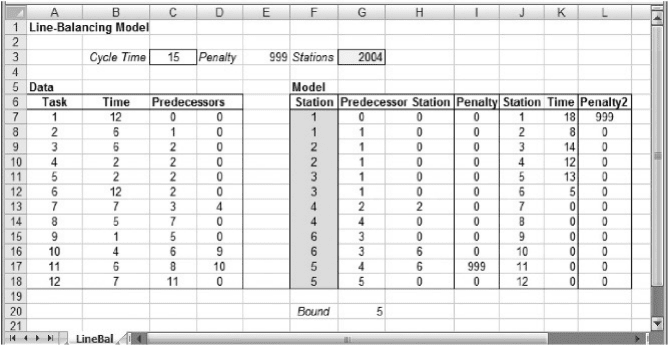
Figure 9.9 shows a spreadsheet model, with the given information reproduced in
columns A–D. The optimization model occupies columns F –L. Row 3 contains the
desired cycle time, a penalty, and the objective function. The penalty, shown in this
example as the value 999, must be a large number, adjusted to the scale of the data
in the problem.
The range F7:F18 contains the decision variables of the model. These are the
station numbers assigned to the tasks. These variables must be integers starting at 1
and increasing to the number of stations in the solution. Although we don’t know
that number in advance, we can make a conservative guess and use this guess as an
upper bound when we specify the problem. The solution in column F of Figure 9.9
arbitrarily assigns two tasks to each station, proceeding roughly in order of the
tasks. Columns G and H reference the predecessors in columns C and D and look
up their stations using the INDEX function. The two columns allocated to the prede-
cessor list in the given data (columns C and D) and the two columns allocated to the
predecessor-station list in the model (columns G and H) are used because no task in the
problem has more than two predecessors. Obviously, this layout would have to be
modified for problems with more than two predecessors for some tasks.
Column I contains a feasibility check to see whether each task is assigned a station
number at least as large as that of its predecessors. If not, the penalty from cell E2 is
assigned. In the solution of Figure 9.9, task 10 is assigned to station 6 and task 11 to
station 5. But task 10 is a predecessor to task 11, so those assignments are out of pre-
cedence order. Hence the penalty in cell I17.
Columns J, K, and L represent a table that examines the solution station by station.
(This table may actually not need the same number of rows as the rest of the model, but
extra rows can simply be assigned zeros.) Column K shows the total time assigned to
each station, using the SUMIF (see Box 9.2) function. Finally, column L contains
Figure 9.9. Spreadsheet model for Example 9.2.
356 Chapter 9 Heuristic Solutions with the Evolutionary Solver

another feasibility check and assigns a penalty to any station assigned a total time that
exceeds the desired cycle time in cell C3.
Finally, cell G3 is the objective function. It contains the maximum value among
the decision variables (the assigned station numbers), augmented by the total of the
penalties. The use of penalties thus substitutes for explicit feasibility constraints.
The only constraints that need to be specified for Solver are the upper and lower
limits on the station assignments. As mentioned earlier, the lower limit is obviously
one, but the upper limit requires an educated guess. In the worst case, each task
would be assigned its own station, so we can always use the number of tasks as an
upper limit. We specify the problem as follows.
Objective: G3 (minimize)
Variables: F7:F18
Constraints: F7:F18 12
F7:F18 1
F7:F18 ¼ integer
One last step is helpful in the line-balancing model. As we use the evolutionary
solver to search among solutions, it is helpful to know a lower bound on the minimum
possible number of stations. This lower bound can be calculated by taking the sum of
the task times, dividing by the desired cycle time, and rounding up to the next larger
BOX 9.2
Excel Mini-Lesson: The SUMIF Function
The familiar SUM function in Excel computes the total value in the cells of a specified
range. The SUMIF function is similar, in that it totals the values in a range of cells
(called the sum range), but it includes only those items in the range for which a specified
criterion is met. To satisfy the criterion, a specified condition must be met in a specified
range. The form of the function is the following.
¼ SUMIF(Specified range, Criterion, Sum range)
In Example 9.2, we have
Specified range: F7:F18 (the list of station assignments)
Criterion: a reference to a cell in column J (that is, a station number)
Sum range: B7:B18 (the list of task times).
Thus, in cell K10 we have the formula
¼ SUMIF($F$7:$F$18 ,J10,$B$7:$B$18).
This function scans the list in column F to see if any entries match the contents of cell
J10 (which is station number 4), and if so, the corresponding entry in column B is included
in the sum. When the entire list has been scanned, the function returns the sum of the task
times assigned to station 4, which in this case is 12.
9.6. Line Balancing
357
integer. This bound follows from the observation that if the tasks were packed into
stations with perfect efficiency, the sum of the task times at each station would
equal the desired cycle time, and the total sum of the task times divided by the
cycle time would give the number of stations. In Example 9.2, the sum of the task
times divided by the desired cycle time yields the value 4.67, which rounds up to 5.
This calculation appears in cell G20. It allows us to stop searching if we see that
the evolutionary solver has located a solution with this value. However, it is important
to keep in mind that the lower bound may not be achievable; the optimal solution may
lie above the lower bound, so we will not always be able to tell whether our searching
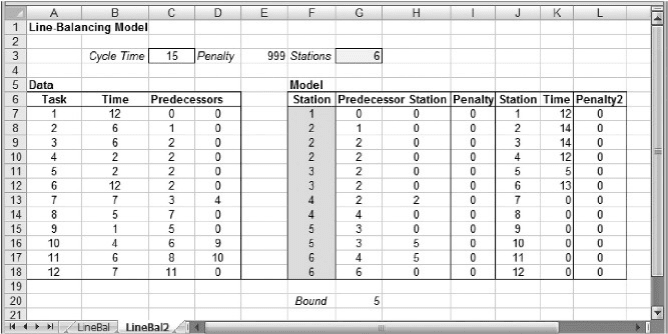
should be terminated. In Example 9.2, the evolutionary solver leads us repeatedly to a
solution with 6 stations, but we cannot be sure whether an improvement to five is poss-
ible. Figure 9.10 shows one of those solutions. In this solution, task 1 alone is assigned
to station 1; tasks 2–4 are assigned to station 2; and then tasks are assigned in numeri-
cal order, two to a station. From this solution, however, we cannot know whether a
five-station solution exists, but Munoz still has a reasonably efficient set of station
assignments for its assembly line.
9.7. GROUP ASSIGNMENT
In several different application areas, a common problem involves the organization
of items or people into groups. Often, the goal is to place similar items in the same
group, as in cellular manufacturing (where we try to group similar parts together)
or in positioning analysis (where we try to group similar products together).
Sometimes, the goal is the opposite: to place different items in the same group. A fam-
iliar example in educational programs involves the formation of diverse student teams
(where we try to form groups of students with dissimilar backgrounds for the purposes
Figure 9.10. Final solution for Example 9.2.
358 Chapter 9 Heuristic Solutions with the Evolutionary Solver

of carrying out a particular group task). Business applications of the same type of
model arise when consultants are assigned to different project teams or trainees are
assigned to discussion groups. An example of forming student groups arises in a
typical course project.
EXAMPLE 9.3
Oxbridge College’s Accounting Department
Each term, the Accounting Department at Oxbridge assigns students to teams for the purposes of
a simulated audit engagement. In this problem, we are given a description of each student on
various dimensions, expressed with a set of zeros and ones. In particular, the Department has
recorded the following information for each student.
†
Majored in accounting as an undergraduate (1 ¼ yes, 0 ¼ no).
†
Previously worked for an accounting firm (1 ¼ yes, 0 ¼ no).
†
Gender (1¼ male, 0 ¼ female).
†
International background (1 ¼ yes, 0 ¼ no).
This term, 20 students will be participating in the exercise, and there will be five 4-person
teams. For the purposes of this exercise, the Department’s goal is to achieve diversity in its
assignment of students to teams.
B
In Example 9.3, each student is described by a string of four binary digits. For
example, a male student from the US who had not majored in accounting but
had worked for an accounting firm would be represented by the string {0, 1, 1, 0}.
A natural definition of decision variables for this problem is the following
x
jk
¼ 1 if student j is assigned to group k, and 0 otherwise.
Suppose now that we want to form five teams of four students each. We can
express the essential constraints in the problem as follows
X
j
x
jk
¼ 4 for k ¼ 1to5
X
k
x
jk
¼ 1 for j ¼ 1to20
The first set of these constraints fixes the size of each group; the second set ensures
that each student is assigned to a unique group. If we model the decisions this way,
the problem contains 25 constraints and 100 variables. This is too large a pair of
numbers to expect the evolutionary solver to perform effectively.
The usual approach to an objective function builds on a metric that, for each attri-
bute, calculates the sum of squared differences from the population average. Suppose,
for example, that there are 10 accounting majors in the group of 20. Then the average
number per group is two. Suppose that the number of accounting majors assigned to
9.7. Group Assignment 359
the respective groups follows the profile {1, 2, 2, 3, 2}. Then the calculation of the
performance measure is as follows.
(1 2)
2
þ (2 2)
2
þ (2 2)
2
þ (3 2)
2
þ (2 2)
2
¼ 2
If the profile is {1, 0, 2, 3, 4}, then the metric is 10. Clearly, the ideal distribution
of accounting majors among the groups would generate a metric of zero. For an objec-
tive function, we usually calculate the metric for each attribute and then sum over the
attributes. This objective function can thus be expressed as a nonlinear function of the
decision variables x
jk
.
Although this is a natural formulation of the problem, it creates difficulties for two
types of solution approaches. First, a direct formulation as an optimization problem
leads to a nonlinear programming model with integer variables. As we pointed out
in Chapter 8, this class of problems is poorly suited to the nonlinear solver. Instead,
it makes sense to tackle the problem with the evolutionary solver. However, the natural
formulation is also poorly suited to the evolutionary solver because it has many con-
straints and variables.
An alternative formulation of the problem can take advantage of the alldifferent
constraint. Here, we let
y
i
¼ student number assigned to position i
where there are 20 positions: four corresponding to the first group, four for the second
group, and so on. The assignment of students to positions is equivalent to an assign-
ment of students to groups. In our example, the y
i
values need to satisfy the alldifferent
constraint for the integers from 1 to 20. From that definition, we can build a spread-
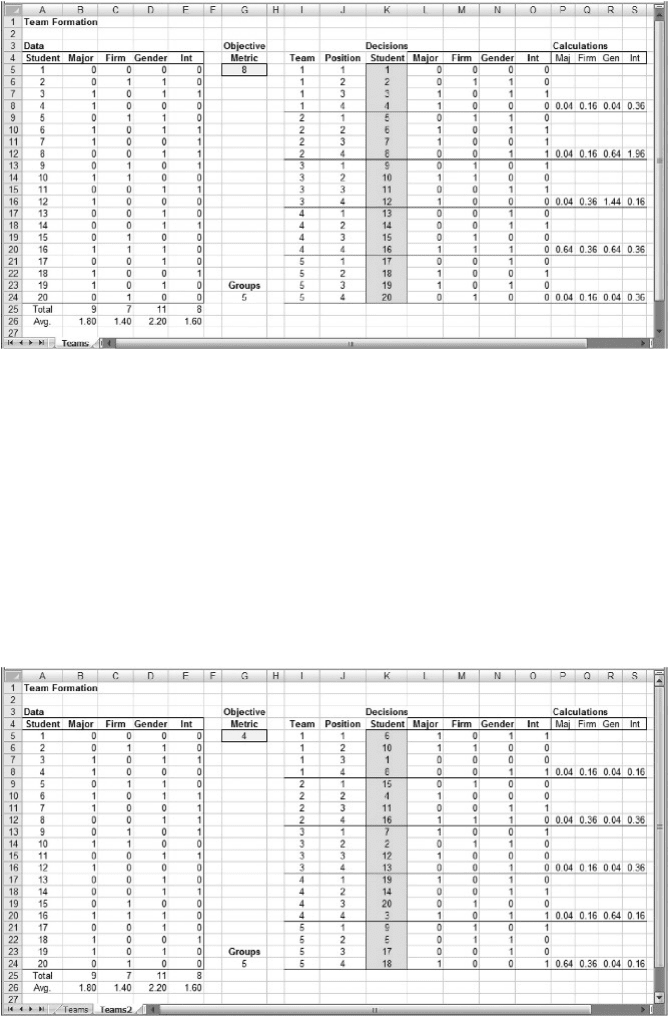
sheet model well suited to the evolutionary solver. Figure 9.11 shows the model.
The problem data occupy columns A – E, with a four-element string for each student.
The solution is described in columns I–K, where the shaded decision cells give the
assignment of student numbers to groups and positions. The squared differences
between each group’s attribute count and the population mean are calculated in col-
umns P–S, and their sum appears in cell G5 as the objective function. Although
this may seem to be a complicated way of computing the objective, it is nevertheless
suitable for the evolutionary solver.
We specify the problem as follows.
Objective: G5 (minimize)
Variables: K5:K24
Constraints: K5:K24 ¼ alldifferent
Again, the alldifferent constraint is sufficient to capture the constraints of the model.
Starting with different assignments, the evolutionary solver takes us in most cases to a
solution with a metric of 4 quite quickly (see Figure 9.12), suggesting, perhaps, that
this is likely to be the optimal value. Alternative starting points and modifications
of the options do not seem to produce any improvement. Again, this is stronger evi-
dence that we might have found the optimum, although the evidence is not conclusive.
360
Chapter 9 Heuristic Solutions with the Evolutionary Solver
By using the evolutionary solver, administrators at the Accounting Department can
achieve their assignment goals where other methods, such as nonlinear integer pro-
gramming, would likely have failed.
The group assignment problem illustrates the fact that there may be creative
ways of formulating models to take advantage of the alldifferent constraint.
This means that we may want to think beyond the typical structures of linear and
nonlinear programming models, but no standard templates have been developed in
this regard.
Figure 9.12. Final solution for Example 9.3.
Figure 9.11. Spreadsheet model for Example 9.3.
9.7. Group Assignment 361
SUMMARY
The evolutionary solver contains an algorithm that complements the linear solver, the nonlinear
solver, and the branch-and-bound procedure. Unlike those algorithms, however, it does not
explicitly seek a local optimum or a global optimum. Nevertheless, it can often find optimal sol-
utions to very difficult problems, and it may be the only effective procedure we can apply when a
nonsmooth function exists in the model.
The considerations influencing the building of models for the evolutionary solver are
different from those for linear and nonlinear programs. Because nonsmooth functions are per-
mitted, we have great flexibility in drawing on Excel’s various built-in functions if we wish to
calculate complex results in convenient ways. Also, experience suggests that the evolutionary
solver performs best if the number of variables and the number of constraints is not large. To
avoid constraints, we can often impose a numerical penalty when a condition is violated and
include the penalty in the objective function instead of entering the constraint explicitly.
Having built a model this way, it is helpful if we can start with an initial solution that satisfies
all constraints—that is, a solution without penalties. Otherwise, the evolutionary solver may not
be effective at finding feasible solutions (those without penalties) in models that contain penalty
terms in the objective.
The evolutionary solver is not likely to be trapped by local optima, as is the case with the
nonlinear solver. This feature is advantageous in searching for good solutions to problems con-
taining nonsmooth functions, especially nonlinear problems with integer variables. On the other
hand, we must realize that the search procedure is both random (subject to probabilistic vari-
ation) and heuristic (not guaranteed to find an optimum). For that reason, we usually reserve
the use of the evolutionary solver for only the most difficult problems.
The evolutionary solver works with a set of specialized parameters. Although we offered
default settings, these settings are merely a starting point. Different choices might be suitable
for different problem types. In addition, we may want to use one set of choices at the start
and then other settings in subsequent runs, while we look for improvements. As compared
to arbitrary settings, the intelligent selection of these parameters can enhance the performance
of the evolutionary solver considerably. Aside from the guidelines given here, practice
and experience using the evolutionary solver are the key ingredients in effective parameter
selection.
EXERCISES
9.1. Sequencing Jobs A fundamental model in scheduling contains a set of jobs that are
waiting to be processed by a machine or processor. The machine is capable of handling
only one job at a time, so the jobs must be processed in sequence. The problem is to find
the best sequence for a given objective function.
For example, the processor might be an integrated machining center that performs a
number of metal-cutting operations on components for complex assemblies. Ten different
components have reached the center and are awaiting processing. These jobs and their
processing times (expressed in hours) are described in the following table. In addition,
each job has a corresponding due date that has been calculated by the production control
system. As a result of the sequence chosen, each job will either be on time or late. If it is
late, the amount of time by which it misses its due date is called its tardiness. The objec-
tive is to minimize the total tardiness in the schedule.
362 Chapter 9 Heuristic Solutions with the Evolutionary Solver
Job 123 4 567 8910
Processing time 6 1 2 5 9 8 12 3 9 7
Due date 17 5 25 15 20 8 44 24 50 20
What is the minimum total tardiness and the sequence that achieves it?
9.2. Scheduling a Shop Midwest Parts Supply (MPS) is a fabricator of small steel parts
that are sold as components to manufacturers of electronic appliances and medical equip-
ment. In the MPS fabrication department, steel sheets are subjected to a series of three
main operations—cutting, trimming, and polishing. Each job must have the operations
completed in this order, and each machine sees the same job order, so it is sufficient to
specify a single job sequence in order to describe a schedule. No machine can process
more than one job at a time.
This morning, 10 jobs have been released to the shop by the ERP system, and the
production manager is interested in minimizing the time it takes to complete the entire
schedule, usually referred to as the schedule makespan. The following table gives the
number of hours required for each operation.
Job 12345678910
Cutting time 1 5 3 7 9 7 8 8 3 6
Trimming time 2 9 2 10 7 6 9 9 1 1
Polishing time 9 7 3 4 7 8 9 4 1 3
What sequence achieves the minimum makespan and what is the minimum length of a
schedule?
9.3. Planning a Tour Recent graduate and amateur world traveler Alastair Bor is planning
a European trip. His preferences are influenced by his curiosity about urban culture in
Europe and by his extensive study of international relations while he was in school.
Accordingly, he has decided to make one stop in each of 12 European capitals in
the time he has available. He wants to find a sequence of the cities that involves the
least total mileage. He has calculated inter-city distances using published data on latitude
and longitude, and applying the geometry for arcs of great circles. These distances are
shown below.
Ams. Ath. Ber. Brus. Cope. Dub. Lis. Lon. Lux. Mad. Par. Rom.
From
Amsterdam – 2166 577 175 622 712 1889 339 319 1462 430 1297
Athens 2166 – 1806 2092 2132 2817 2899 2377 1905 2313 2100 1053
Berlin 577 1806 – 653 348 1273 2345 912 598 1836 878 1184
Brussels 175 2092 653 – 768 732 1738 300 190 1293 262 1173
Copenhagen 622 2132 348 768 – 1203 2505 942 797 2046 1027 1527
Dublin 712 2817 1273 732 1203 – 1656 440 914 1452 743 1849
Lisbon 1889 2899 2345 1738 2505 1656 – 1616 1747 600 1482 1907
London 339 2377 912 300 942 440 1616 – 475 1259 331 1419
Luxembourg 319 1905 598 190 797 914 1747 475 – 1254 293 987
Madrid 1462 2313 1836 1293 2046 1452 600 1259 1254 – 1033 1308
Paris 430 2100 78 262 1027 743 1482 331 293 1033 – 1108
Rome 1297 1053 1184 1173 1527 1849 1907 1419 987 1308 1108 –
What sequence achieves a minimum-distance tour for Alastair, starting in Brussels,
and what is the minimum tour length?
Exercises 363
9.4. Cutting Stock Poly Products sells packaging tape to industrial customers. All tape is
sold in 100-foot rolls that are cut in various widths from a master roll, which is 15
inches wide. The product line consists of the following widths: 2
00
,3
00
,5
00
,7
00
, and 11
00
.
These can be cut in different combinations from a 15-inch master roll. For example,
one combination might consist of three cuts of 5
00
each. Another combination might con-
sist of two 2
00
cuts and an 11
00
cut. Both of these combinations use the entire 15-inch roll
without any waste, but other combinations are also possible. For example, another com-
bination might consist of two 7
00
cuts. This combination creates one inch of waste for
every roll cut this way.
Each week, Poly Products collects demands from its customers and distributors
and must figure out how to configure the cuts in its master rolls. To do so, the production
manager lists all possible combinations of cuts and tries to fit them together so that waste
is minimized while demand is met. (In particular, demand must be met exactly, because
Poly Products does not keep inventories of its tape.) This week’s demands are shown
in the table.
Size 2
00
3
00
5
00
7
00
11
00
Demand 60 50 40 30 20
(a) How many combinations can be cut from a 15-inch master roll so that there is less
than two inches of waste (i.e. the smallest quantity that can be sold) left on the roll?
(b) Find a set of combinations that meets demand exactly and generates the minimum
amount of waste. (Stated another way, the requirement is to meet or exceed
demand for each size, but any excess must be counted as waste.) What is the optimal
set of combinations and the minimum amount of waste?
9.5. Locating Warehouses Southeastern Foods has hired you to analyze their distribution
system design. The company has 11 distribution centers, with monthly volumes as
listed below. Seven of these sites can support warehouses, in terms of the infrastructure
available, and are designated by (W).
Center Volume Center Volume
Atlanta (W) 5000 Memphis (W) 7800
Birmingham (W) 3000 Miami 4400
Columbia (W) 1400 Nashville (W) 6800
Jackson 2200 New Orleans 5800
Jacksonville 8800 Orlando (W) 2200
Louisville (W) 3000
The monthly fixed cost for operating one of these warehouses is estimated at
$3600, although there is no capacity limit in their design. Southeastern could build ware-
houses at any of the designated locations, but its criterion is to minimize the total of
fixed operating costs and variable shipment costs. Information has been compiled show-
ing the cost per carton of shipping from any potential warehouse location to any distri-
bution center.
364 Chapter 9 Heuristic Solutions with the Evolutionary Solver

Atl Bir Col Jac Jvl Lvl Mem Mia Nash NewO Orl
Atlanta 0.00 0.15 0.21 0.40 0.31 0.42 0.38 0.66 0.25 0.48 0.43
Birmingham 0.15 0.00 0.36 0.25 0.46 0.36 0.26 0.75 0.19 0.35 0.55
Columbia 0.21 0.36 0.00 0.60 0.30 0.50 0.62 0.64 0.44 0.69 0.44
Louisville 0.42 0.36 0.50 0.59 0.73 0.00 0.38 1.09 0.17 0.70 0.86
Memphis 0.38 0.26 0.62 0.21 0.69 0.38 0.00 1.00 0.21 0.41 0.78
Nashville 0.25 0.19 0.44 0.41 0.56 0.17 0.21 0.91 0.00 0.53 0.69
Orlando 0.43 0.55 0.44 0.70 0.14 0.86 0.78 0.23 0.69 0.65 0.00
(a) What is the minimum total cost?
(b) To achieve the cost in (a), which warehouse locations should be used?
9.6. Locating Emergency Centers After the damage caused in Florida by a series of
severe hurricanes, the governor ordered the Florida Emergency Management Agency
(FLEMA) to design a systematic plan for emergency services following severe
weather events. The state has 11 emergency offices, and it would be possible to build a
warehouse next to each of the offices to store emergency equipment. As a consultant to
FLEMA, you were asked to determine how many centers would be needed to ensure
that there would be a warehouse within 50 miles of any emergency office. After studying
your recommendation, however, FLEMA’s Director decided that the cost of the plan
would be prohibitive, so a revised formulation was developed. This one requires building
just four warehouses.
With this standard in mind, you have obtained the distances between the eleven
offices (identified by their cities).
DB Ft L Ft M Gain Mia Nap Orl St P Sara Talla Tam
Daytona
Beach
0 229 207 98 251 241 54 159 186 234 139
Ft Lauderdale 229 0 133 312 22 105 209 234 202 444 234
Ft Myers 207 133 0 230 141 34 153 110 71 356 123
Gainesville 98 312 230 0 331 264 109 143 179 144 128
Miami 251 22 141 331 0 107 228 251 214 463 245
Naples 241 105 34 264 107 0 187 143 107 389 156
Orlando 54 209 153 109 228 187 0 105 132 242 85
St Petersburg 159 234 110 143 251 143 105 0 39 250 20
Sarasota 186 202 71 179 214 107 132 39 0 286 53
Tallahassee 234 444 356 144 463 389 242 250 286 0 239
Tampa 139 234 123 128 245 156 85 20 53 239 0
FLEMA would like to ensure that there will be a warehouse center within x miles of any
office. What is the minimum value of x that can be achieved when there are four ware-
houses in the system?
9.7. Touring the Agents Professor Moonlight runs a fund of funds in order to supplement
his academic salary. Every winter, he pays a visit to each of the fund managers with whom
he works. These visits are all made in one trip, during which he visits investment agents in
nine cities. Prof. Moonlight doesn’t mind flying, but he dislikes long flights. For this trip,
he wants to find a route through the various cities starting and ending in San Antonio, and
he wants the longest leg of the trip (measured in miles) to be as short as possible. The pair-
wise distances in miles are shown below.
Exercises 365