
Baker K.R. Optimization Modeling with Spreadsheets
Подождите немного. Документ загружается.

decision variables C, D, and T, are all considered to be nonnegative. (We assume
throughout that all variables are nonnegative.)
We also express the objective function in a parallel form, with variables on the
LHS and a number on the RHS. We include the slack variables in the following
expression, but thereafter we leave out variables with zero coefficients.
z 16C 20D 14T þ 0u þ 0v þ 0w ¼ 0
In their rewritten form, the model’s constraints and objective function have two impor-
tant features. First, the constraints are expressed as equations. Equations are easier to
manipulate than inequalities, and we can apply procedures for solving systems of
equations. In other words, we’ll rely on the ability to solve three equations in three
unknowns. (If we had m constraints, we’d want to solve m equations in m unknowns.)
The second feature of our constraints, with the slack variables added, is that the
constraint equations appear in canonical form. This means that each constraint
equation contains one variable with a coefficient of 1 that does not appear in the
other equations. These variables are called basic variables; the other variables are
called nonbasic. Canonical form includes the objective function, which we express
in terms of the nonbasic variables. Put another way, the basic variables have zero coef-
ficients in the objective function when we display canonical form of the problem.
When the problem is displayed in canonical form, we can find a solutio n to the
system of equations by inspection. We simply set the nonbasic variables to zero and
read the solution from what remains. In our example, the solution is as follows.
u ¼ 2000
v ¼ 2000
w ¼ 1440
In terms of our original decision variables, this solution corresponds to the values C ¼
0, D ¼ 0, and T ¼ 0, for which z ¼ 0. Thus, in our initial canonical form, the slack
variables are the basic variables and the decision variables are nonbasic and zero. A
set of basic variables is said to constitute a basic feasible solution whenever the
values of all variables are nonnegative.
To test whether this basic feasible solution is optimal, we examine the objective
function equation, written here with all of the variables
z 16C 20D 14T ¼ 0 (A3:1)
The value on the right-hand side represents the current value of the objective function,
which is consistent with the solution C
¼ 0, D ¼ 0, and T ¼ 0.
Next, we ask whether making any of the nonbasic variables positive would
improve the value of the objective function. All else equal, if we could increase C,
D,orT, then the value of the objective function would increase. When we are faced
with a choice of this sort, we select the variable for which the objective function
will increase the fastest, on a per-unit basis. Here, that means choosing D.
386
Appendix 3 The Simplex Method
The variable D is called the entering variable, referring to the fact that it is about
to enter the set of basic variables. As D enters, the value of z increases by 20 for each
unit of D; thus we wish to make D as large as possible. To determine how large D
can become, we return to the three equations of the first canonical form (Set 1) and
trace the implications for the other positive variables.
Consider equation (A3.1), and ignore the nonbasic variables because they are
zero. We obtain the following relationship between u and D.
u ¼ 2000 6D
This relationship implies that u decreases as D increases and that the ceiling on D is
2000/6 ¼ 333.3. Values of D greater than 333.3 would drive u negative. Now,
consider equation (A3.2)
v ¼ 2000 8D (A3:2)
This equation implies a ceiling on D of 2000/8 ¼ 250. Equation (A3.3) is
w ¼ 1440 6D (A3:3)
This equation implies a ceiling of 1440/6 ¼ 240.
The idea is to make D as large as possible without driving any of the existing vari-
ables negative, which means that D can increase to 240, the minimum of the ratios. At
that point, the variable w drops to zero and becomes a nonbasic variable. Thus, there
has been a change in the set of basic variables, from the set {u, v, w} to the set {u, v,
D}. The entering variable
D was selected because it had the most negative coefficient
in the objective function equation. The leaving variable w was then chosen because it
was the first variable driven to zero by increasing D. The choice of w and the entering
value of D can be determined by calculating the ratios of RHS constants to coefficients
of the entering variable in each row and identifying the smallest ratio. The minimum
ratio corresponds to the equation in which the leaving variable appears, referred to as
the pivot equation.
To reconstruct canonical form with respect to the new set of basic variables, we
must rewrite the equations so th at the basic variables each appear in just one equation,
and appear with a coefficient of 1. This means that the variable D must appear in the
third equation, because u and v already appear in the other two equations. Moreover, D
must appear with a coefficient of zero in those two equations. To rewrite the equations,
we perform elementary row operations.
There are two types of elementary row operations. First, we can multiply an
equation by a constant. Multiplication by a constant does not affect the s et of values
that satisfy the equation. In effect, it makes only a cosmetic change in the equation,
altering its appearance but not its information content. Second, we can add to any
equation some multiple of another equation. Addition of another equation also does
not affect the set of values that satisfy the equations.
A3.1. An Example 387

Thus, the first step is to divide equation (A3.3) by six. (This value, the coefficient
of the entering variable in the pivot equation, is called the pivot value.) This division
gives D a coefficient of 1
3
2
C þ D þ
2
3
T þ
1
6
w ¼ 240 (A3:3b)
Next, we subtract six times this equation from equation (A3.1), thus eliminating D
from the equation. Similarly, we subtract eight times this equation from equation
(A3.2). Finally, for the objective function, we add 20 times this equation. In summary,
the elementary row operations are
(A3:3b) ¼ (A3:3)=6
(A3:1b) ¼ (A3:1) 6(A3:3b)
(A3:2b) ¼ (A3:2) 8(A3:3b)
(A3:0b) ¼ (A3:0) þ 20(A3:3b)
The second set of equations, indicated by a (b), then takes the following form.
Set 2 : 5C 2T þu 1w ¼ 560 (A3:1b)
9C þ
2
3
T þ v
4
3
w ¼ 80 (A3:2b)
3
2
C þD þ
2
3
T þ
1
6
w ¼ 240 (A3:3b)
z þ 14C
2
3
T þ
10
3
w ¼ 4800 (A3:0b)
From equations (A3.1b) –(A3.3b) we can immediately read the values of the basic
variables (u ¼ 560, v ¼ 80, and D ¼ 240.) From equation (A3.0b) we can read the
new value of the objective function (z ¼ 4800), and as a check, we can confirm that
this value corresponds to the set of decision variables (C ¼ 0, D ¼ 240, and T ¼ 0.)
Finally, we can see that there is potential for improvement in the objective function,
as signified by the negative coefficient for T. If we increase T from this point, we
will increase the value of z.
The next iteration follows the procedure outlined above. Given that there is room
for improvement, we must identify an entering variable and a leaving variable, and
then update the canonical equations accordingly. The steps in the procedure are out-
lined in Box A3.1.
In Step 1, we observe that not all coefficients in equation (A3.0b) are positive, and
in Step 2, we note the negative coefficient of T. This value indicates that an improve-
ment is possible and that the improvement can come from increasing the value of T,
which is currently nonbasic. Because no other variable has a negative coefficient in
equation (A3.0b), T becomes the entering variable.
In Step 3, we compute two ratios, skipping equation (A3.1b) because its coeffi-
cient for T is negative. The ratios are 80/0.667 ¼ 120 in equation (A3.2b) and 240/
0.667 ¼ 360 in equation (A3.3b). The minimum thus occurs for equation (A3.2b),
388
Appendix 3 The Simplex Method

which becomes the pivot equation. This calculation indicates that T can become as
large as 120 without driving any of the current basic variables negative.
In Step 4, we create the new canonical equations with the following elementary
row operations.
(A3:2c) ¼ (A3:2b)=(2=3)
(A3:1c) ¼ (A3:1) þ 2(A3:2c)
(A3:3c) ¼ (A3:3) (2=3)(A3:2c)
(A3:0c) ¼ (A3:0) þ (2=3)(A3:2c)
These calculations yield the third set of canonical equations.
Set 3 : 32C þu þ3v 5w ¼ 800 (A3:1c)
27
2
C þT þ
3
2
v 2w ¼ 120 (A3:2c)
21
2
C þD 2w ¼ 160 (A3:3c)
z þ 5C þ1v þ2w ¼ 4880 (A3:0c)
When we return to Step 1, we find that the optimality conditions hold: No negative
coefficients appear in equation (A3.0c). The set of basic variables at this stage is {u, D,
T}, and the solution corresponds to D ¼ 160 and T ¼ 120. We can also read the value
of the slack variable, u ¼ 800. This value is consistent with the solution of C ¼ 0, D ¼
160, and T ¼ 120, which uses only 1200 of the 2000 available hours in the fabrication
BOX A3.1.
Outline of the Simplex Method
Basic Steps in Maximization (starting from a basic feasible solution).
1. Test the current solution for optimality. If all coefficients in the objective function
are nonnegative, then stop; the solution is optimal.
2. Select the entering variable. Identify the most negative objective function coeffi-
cient, breaking ties arbitrarily. The corresponding variable is the entering variable.
3. Select the leaving variable. For each equation, calculate the ratio of right-hand side
constant to coefficient of the leaving variable, performing this calculation only for
coefficients that are positive. Identify the equation for which this ratio is minimal,
breaking ties arbitrarily. This is the pivot equation. The coefficient of the entering
variable in this equation is the pivot value.
4. Update the canonical equations. First, update the equation corresponding to the
leaving variable. Divide it through by the pivot value. Next, eliminate the entering
variable from each other equation. To do so, subtract a multiple of the new pivot
equation equal to the coefficient of the entering variable.
5. Return to Step 1.
A3.1. An Example
389
department. Thus, the algorithm terminates with an optimal solution, which attains an
objective function value of $4880.
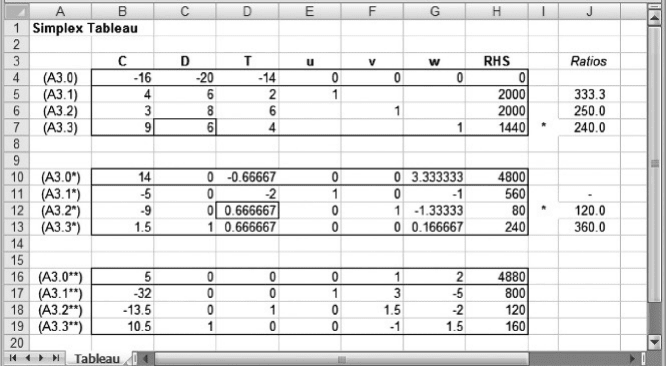
The calculations required by the simplex method are normally organized in tab-
ular form, as illustrated in Figure A3.1 for our example. This layout is known as a sim-
plex tableau, and in our example, the tableau consists of four rows for each iteration,
each row corresponding to an equation of canonical form. The columns of the tableau
correspond to the decision variables, the slack variables, and the RHS constants. The
body of the tableau contains the coefficients of the equations used in the algorithm. To
the right of the tableau, in column J, we display the ratio calculations of Step 3, with
the minimum ratio flagged in column I. The figure shows all three iterations of the
procedure as an alternative representation of the three canonical equation sets: set 1,
set 2, and set 3.
A3.2. VARIATIONS OF THE ALGORITHM
The simplex method as illustrated here works for maximization problems, given that
we start with a basic feasible solution. From the starting solution, the procedure moves
inexorably toward an optimal solution because each basic feasible solution encoun-
tered is better than the previous one. The relevant theory confirms that an optimum
can be found by examining only basic feasible solutions and that improvement (suit-
ably defined) occurs at each iteration. The details of the theory, however, are beyond
the scope of this appendix (1,2).
For minimization problems, the steps would be the same, except that the
optimality condition would require that all coefficients in the objective function
must be nonpositive. The selection of the entry variable relates to the direction of
Figure A3.1. Simplex tableau.
390 Appendix 3 The Simplex Method
optimization: Negative coefficients signal the potential for improvement in a maximi-
zation problem, and positive coefficients signal the potential for improvement in a
minimization problem. The selection of the leaving variable relates only to feasibility:
The minimum ratio identifies the equation containing the leaving variable, thereby
assuring that the new set of basic variables remains nonnegative. Therefore, the selec-
tion criterion is the same for minimization and maximization. One additional feature is
worth noting. When no positive coefficients appear in the column for the entering vari-
able (that is, when there are no ratios to be formed), this pattern indicates that the sol-
ution is unbounded. In other words, by making the entering variable positive—and as
large as we wish—we generate a value of the objective function as large as we wish.
Therefore, the objective is unbounded. If Solver encounters no positive coefficients in
the column for the entering variable, it reports that the objective function is unbounded.
As described in Box A3.1, the simplex method produces an optimal solution,
provided that we can initiate it with a basic feasible solution. This is not a difficult
task when all the constraints are LT constraints and their right-hand sides are positive,
as demonstrated in the example. A slack variable is added to each constraint in order to
convert the inequality to an equation, and then all variables other than the slack vari-
ables are set equal to zero. The slack variables appear one in each constraint, and each
with a coefficient of 1, so they form a natural starting basic feasible solution. But what
happens when the problem does not come with LT constraints?
Suppose instead we have a linear programming problem in which all constraints
are equations in the original model, and in which all constraint constants are non-
negative. Now we add one variable to each equation with a coefficient of 1. These
are called artificial variables. They resemble slack variables in that they allow us
to form an initial basic feasible solution. They differ from slack variables in one
important way: Whereas slack variables may remain positive throughout the
various iterations of the simplex algorithm, and even in the optimal solution, artificial
variables must all be driven to zero to feasibly satisfy the original constraints. This
feature allows the simplex method to be implemented in two phases. In phase I,
as it is called, the objective is to minimize the sum of the artificial variables. At
the end of this phase, the solution on hand must be a basic feasible solution for the
original problem. From that solution, we enter phase II, returning to the original objec-
tive function and following the steps outlined in Box A3.1 in order to reach an
optimum.
The so-called two-phase simplex method has another feature. If phase I cannot
reach an objective function with value zero—that is, if it is impossible to drive all arti-
ficial variables to zero, then we know that no feasible solution exists. Thus, a failure of
phase I prompts Solver to display the message that it could not find a feasible solution;
it is a systematic procedure for detecting inconsistency among the constraints of a
model.
Having addressed EQ constraints, suppose now we have a problem in which all
constraints are GT constraints with RHS constants that are nonnegative. We handle
GT constraints by converting them to equations and inserting two variables, an artifi-
cial variable and a surplus variable. Just as a slack variable converts an LT constraint to
an equality by measuring the amount by which right-hand side exceeds left-hand side,
A3.2. Variations of the Algorithm 391
a surplus variable converts a GT constraint to an equality by measuring the amount by
which left-hand side exceeds right-hand side. In phase I of the algorithm, we start by
using the artificial variables to make up a basic feasible solution, and we attempt
to dri ve them all to zero. Assuming we succeed, we may find that we have surplus
variables at positive amounts throughout phase II, wherever GT constraints are not
binding.
For example, suppose our original model contains the following GT constraints.
A1 þ B1 þ C1 þ D1 þ E1 þ F1 1
A2 þ B2 þ C2 þ D2 þ E2 þ F2 1
A3 þ B3 þ C3 þ D3 þ E3 þ F3 1
A4 þ B4 þ C4 þ D4 þ E4 þ F4 1
A5 þ B5 þ C5 þ D5 þ E5 þ F5 1
A6 þ B6 þ C6 þ D6 þ E6 þ F6 1
Because there are six GT constraints, we must insert six artificial variables (a
1
– a
6
)
and six surplus variables (s
1
– s
6
). The equations take the following form.
A1 þ B1 þ C1 þ D1 þ E1 þ F1 þ a
1
s
1
¼ 1
A2 þ B2 þ C2 þ D2 þ E2 þ F2 þ a
2
s
2
¼ 1
A3 þ B3 þ C3 þ D3 þ E3 þ F3 þ a
3
s
3
¼ 1
A4 þ B4 þ C4 þ D4 þ E4 þ F4 þ a
4
s
4
¼ 1
A5 þ B5 þ C5 þ D5 þ E5 þ F5 þ a
5
s
5
¼ 1
A6 þ B6 þ C6 þ D6 þ E6 þ F6 þ a
6
s
6
¼ 1
The first basic feasible solution contains all of the artificial variables a
1
¼ a
2
¼
...
¼ a
6
¼ 1. This solution is sufficient to initiate phase I. From that point on, we
can use iterations of the simplex method, as outlined in Box A3.1, to find an optimum
if one exists, or to prove that there is no feasible solution.
Although we have discussed cases in which all constraints were LT or all were EQ
or all were GT, the principles apply to the constraints individually. Thus, in any linear
programming model, we convert the constraints to equations suitable for the simplex
method by
†
inserting a slack variable into each LT constraint,
†
inserting an artificial variable into each EQ constraint,
†
inserting an artificial variable and a surplus variable into each GT constraint.
Before doing so, we want to make sure that each constraint has a RHS value that is
nonnegative. Thus, if any constraint in the original model has a negative RHS
value, we first multiply through by – 1 (and if it is an inequality, change the direction
of the inequality) before converting it to an equation.
392
Appendix 3 The Simplex Method
In summary, the variations within the simplex algorithm allow for systematic
treatment of all linear programming models. Phase I can detect infeasible sets of con-
straints, and phase II can detect unbounded objective functions. If those conditions
fail, the algorithm proceeds to an optimal solution.
REFERENCES
1. WINSTON, W.L. and VENKATARAMANAN,M.Introduction to Mathematical Programming. Brooks/Cole,
Pacific Grove, CA, 2003.
2. R
ARDIN,R.Optimization in Operations Research. Prentice-Hall, Upper Saddle River, NJ, 1998.
References 393

Appendix 4
Stochastic Programming
For the most part, the optimization problems covered in this book are deterministic.
In other words, parameters are assumed known, and nothing about the problem is
subject to uncertainty. In practice, problems may come to us with uncertain elements,
but we often suppress the randomness when we build an optimization model. Quite
often, this simplification is justified because the random elements in the model are
not as critical as the main optimization structure. However, it is important to know
that the techniques we develop are not limited to deterministic applications. Here,
we show how to extend the concepts of linear programming to decision problems
that are inherently probabilistic. This class of problems is generally called stochastic
programming.
A4.1. ONE-STAGE DECISIONS WITH UNCERTAINTY
We can think of stochastic programming models as generalizations of the deterministic
case. To demonstrate the relevant concepts, we examine probabilistic variations of a
simple allocation problem.
EXAMPLE A4.1
General Appliance Company
General Appliance Company (GAC) manufactures two refrigerator models. Each refrigerator
requires a specified amount of work to be done in three departments, and each department
has limited capacity. The Standard refrigerator model is sold nationwide to several retailers
who place their orders each month. In a given month, demand for the Standard model is subject
to random variation. Demand for the Deluxe model comes from a single, large retail chain which
requires delivery of 25 units each month but is willing to take more refrigerators if more can be
delivered. At current prices, the unit profit contribution is $50 for each Standard model and $30
for each Deluxe model. The data shown below summarize the parameters of the problem.
Optimization Modeling with Spreadsheets, Second Edition. Kenneth R. Baker
# 2011 John Wiley & Sons, Inc. Published 2011 by John Wiley & Sons, Inc.
395