
Bernatz R. Fourier Series and Numerical Methods for Partial Differential Equations
Подождите немного. Документ загружается.

72 STURM-LIOUVILLE PROBLEMS
3.3.1 Eigenfunction Orthogonality
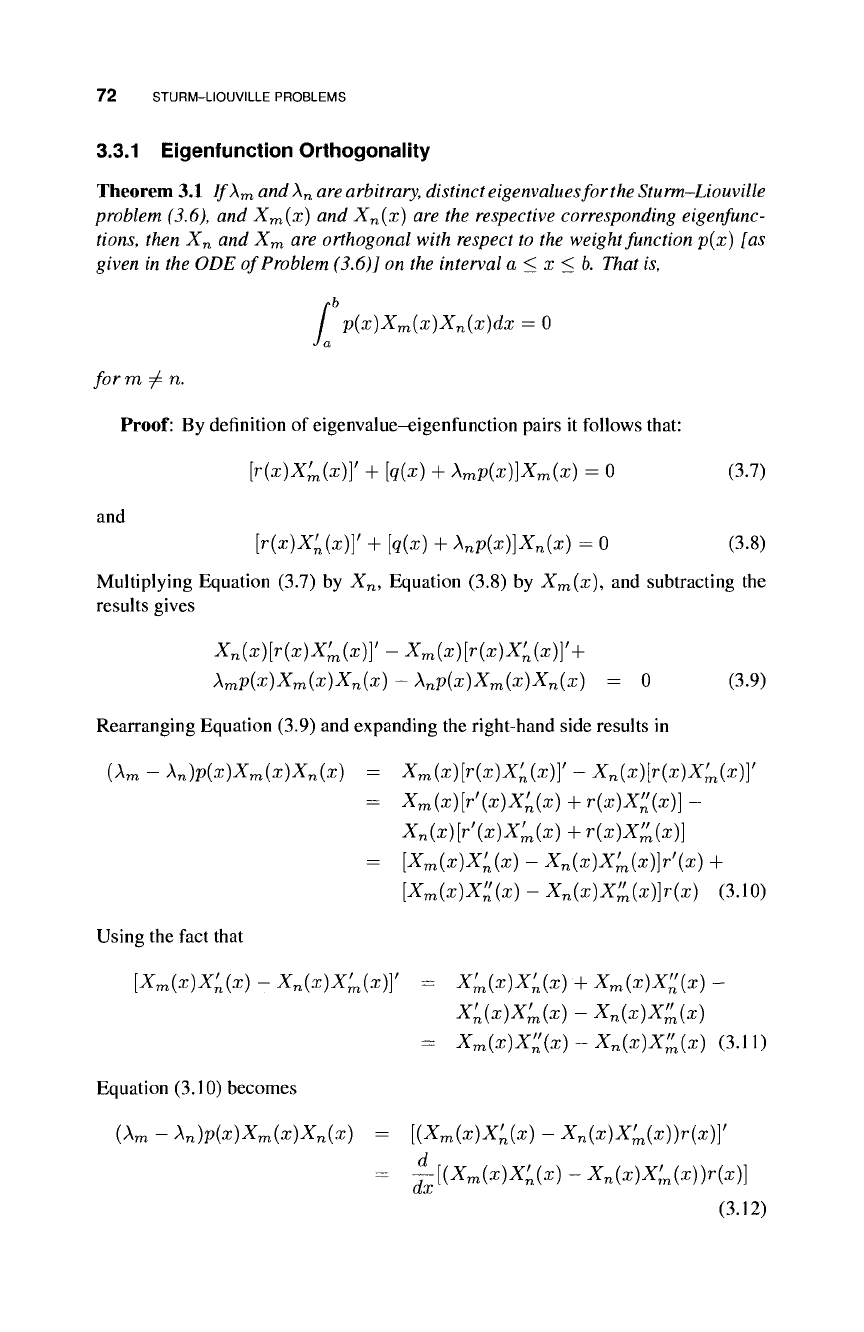
Theorem 3.1
IfX
m
and X
n
are
arbitrary,
distinct eigenvalues for
the
Sturm-Liouville
problem
(3.6),
and X
m
(x) and X
n
(x) are the respective corresponding eigenfunc-
tions, then X
n
and X
m
are orthogonal with respect to the weight function p(x) [as
given in the ODE of Problem (3.6)] on the interval a < x < b. That is,
/ p(x)X
rn
(x)X
n
(x)dx = 0
Ja
for m φ η.
Proof:
By definition of eigenvalue-eigenfunction pairs it follows that:
[r(x)X'
m
(x)]
f
+ [q(x) + X
m
p(x)]X
m
(x) = 0 (3.7)
and
[r(x)X'
n
(x)Y + \q(x) + X
n
p(x)]X
n
(x) = 0 (3.8)
Multiplying Equation (3.7) by X
n
, Equation (3.8) by
X
m
(x),
and subtracting the
results gives
X
n
{x)[r{x)X'
m
{x))'
- X
m
(x)[r(x)X'
n
(x)}'+
X
m
p(x)X
m
(x)X
n
(x) - \
n
p(x)X
m
(x)X
n
(x) = 0 (3.9)
Rearranging Equation (3.9) and expanding the right-hand side results in
(Xm - X„)p(x)X
m
(x)Xn(x) = X
m
{x)[r{x)X'
n
{x)]' - Xn{x)[r{x)X'
m
(x)]'
= X
m
(x)[r'(x)X'
n
(x) + r(x)X';(x)} -
X
n
(x)[r'(x)X'
m
(x) + r(x)X'^(x)}
= \X
m
(x)X'
n
(x) - Xn(x)X
m
(x)V(x) +
[X
m
(x)X'¿(x) - Xn(x)X
m
(x)]r(x) (3.10)
Using the fact that
[X
m
(x)X'
n
(x) - X
n
{x)X'
m
{x)]' = X
m
(x)X'
n
(x) + X
m
(x)Xn(x) -
x'
n
(x)x'
m
(x)
-
Xn(x)x
m
(x)
= X
m
(x)X'¿(x) - X
n
(x)X^(x) (3.11)
Equation (3.10) becomes
(Xm - X
n
)p(x)X
m
(x)X
n
(x) = [(Xm(x)X'
n
(x) ~ X
n
(x)X'
m
(x))r(x)}'
= ~[(X
m
(x)X'
n
(x) - X
n
(x)X'
m
(x))r(x)}
(3.12)
PROPERTIES 73
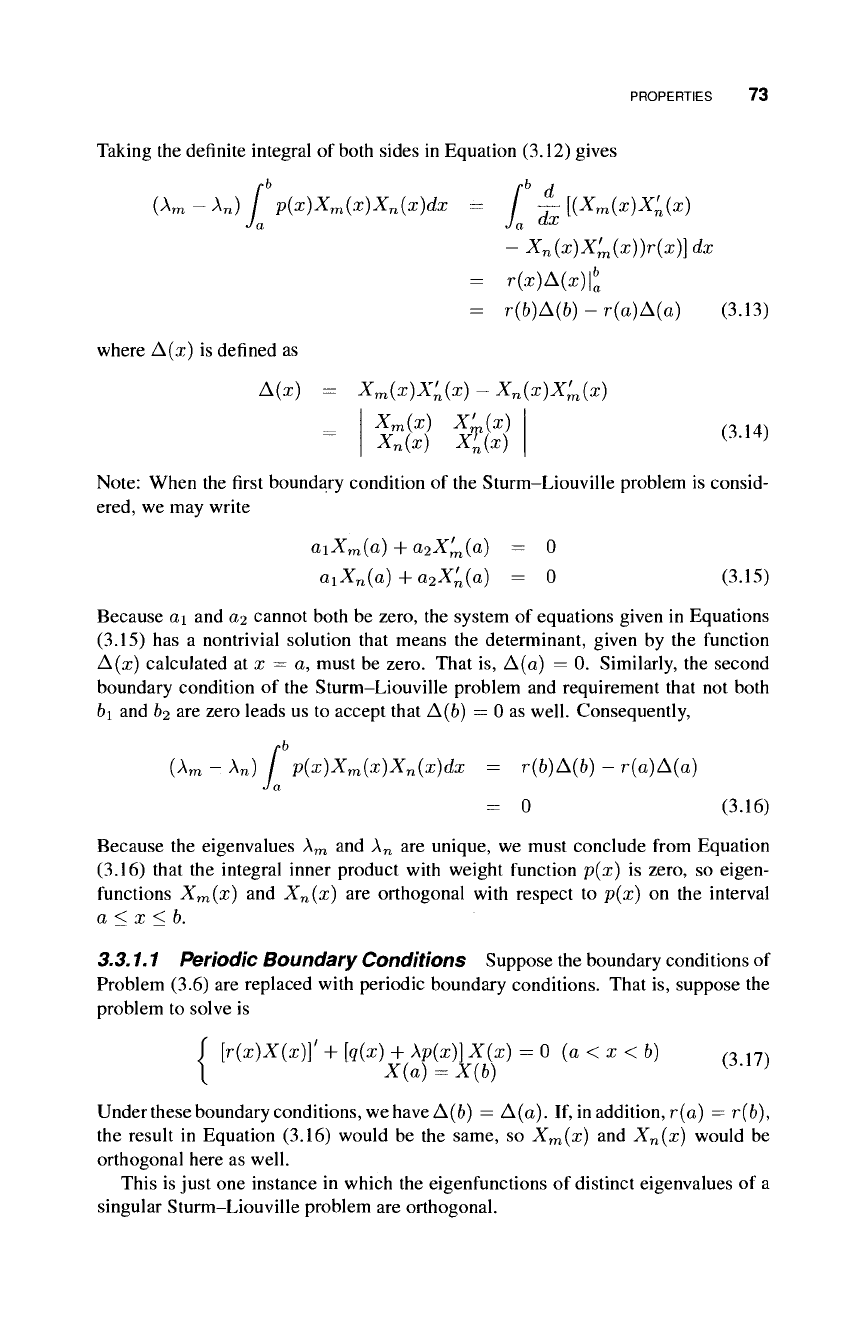
Taking the definite integral of both sides in Equation (3.12) gives
(Xm-K)J p(x)X
m
(x)Xn(x)dx = j ^ [(X
m
(x)X'
n
(x)
-X
n
(x)X
f
m
(x))r(x)}dx
r(x)A(x)\
b
a
r(b)A{b)-r(a)A{a) (3.13)
where A(x) is defined as
A(x) = X
rn
{x)X'
n
(x) - X
n
{x)X'
rn
{x)
X
m
(x)
XUx)
X
n
(x)
xZ(x)
(3.14)
Note: When the first boundary condition of the Sturm-Liouville problem is consid-
ered, we may write
aiX
m
(a) + a
2
X'
m
(a) = 0
a
1
X
n
(a)+a
2
XM = 0
(
3
·
15
)
Because a\ and a
2
cannot both be zero, the system of equations given in Equations
(3.15) has a nontrivial solution that means the determinant, given by the function
A(x) calculated at x = a, must be zero. That is, Δ(α) = 0. Similarly, the second
boundary condition of the Sturm-Liouville problem and requirement that not both
bi and b
2
are zero leads us to accept that A(b)
—
0 as well. Consequently,
(A
m
- A
n
) / p(x)X
m
(x)X
n
(x)dx = r(b)A(b) - r(a)A(a)
Ja
= 0 (3.16)
Because the eigenvalues A
m
and λ
η
are unique, we must conclude from Equation
(3.16) that the integral inner product with weight function p(x) is zero, so eigen-
functions X
m
(x) and X
n
(x) are orthogonal with respect to p(x) on the interval
a < x < b.
3.3.1.1 Periodic Boundary Conditions Suppose the boundary conditions of
Problem (3.6) are replaced with periodic boundary conditions. That is, suppose the
problem to solve is
Í [r(x)X(x)]
f
+ [q(x) + Xp(x)} X(x) = 0 (a < x < b)
(3 {J)
\ X(a) = X{b) ^'
U)
Under these boundary conditions,
we
have Δ(b) = Δ(α). If, in addition, r(a) = r(b),
the result in Equation (3.16) would be the same, so X
m
(x) and X
n
(x) would be
orthogonal here as well.
This is just one instance in which the eigenfunctions of distinct eigenvalues of a
singular Sturm-Liouville problem are orthogonal.
74 STURM-LIOUVILLE PROBLEMS
3.3.2 Real Eigenvalues
Now we show that eigenvalues of Problem (3.6) are real numbers. First, a formal
statement of the result is given.
Corollary 3.1 If X is an eigenvalue of the Sturm-Liouville problem
(3.6),
then X is a
real number.
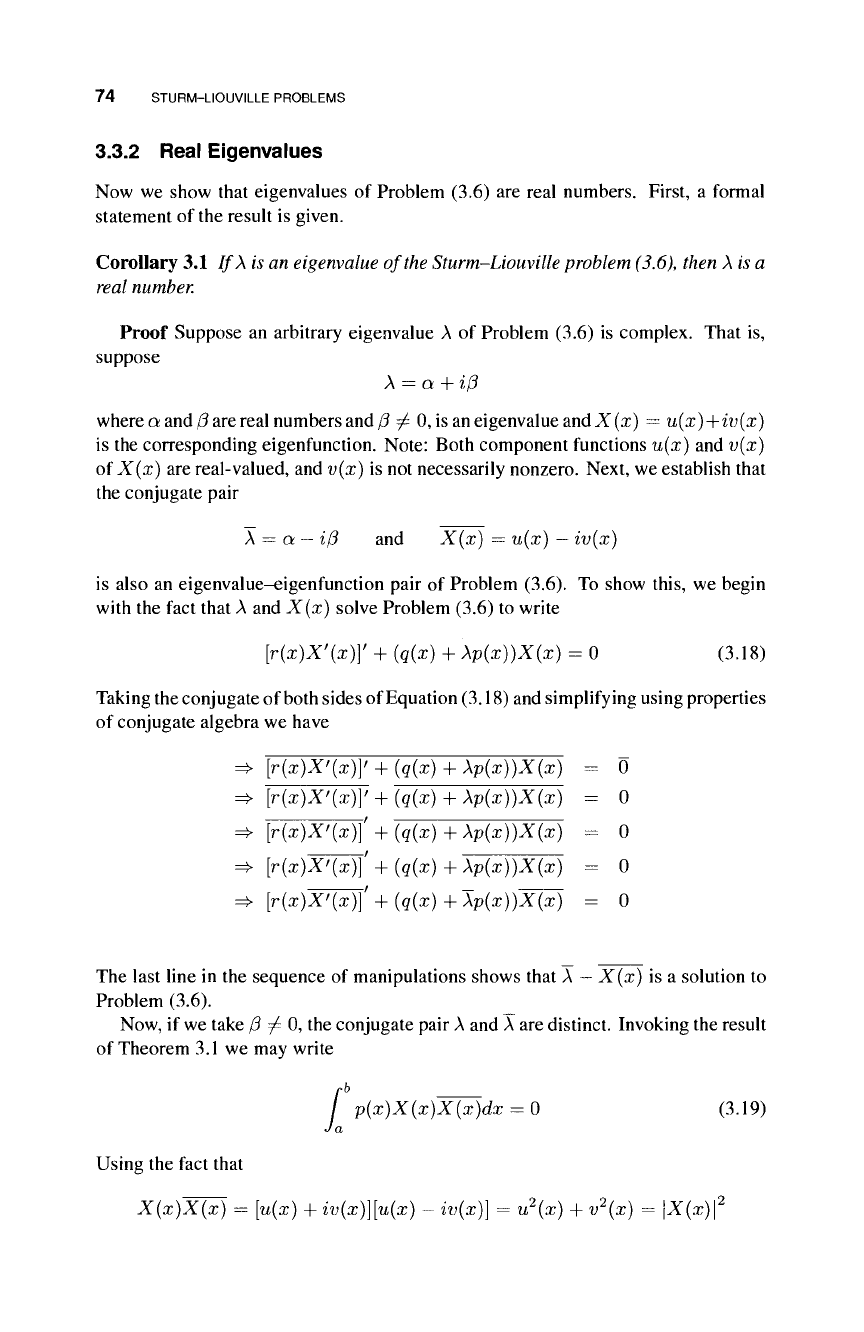
Proof Suppose an arbitrary eigenvalue λ of Problem (3.6) is complex. That is,
suppose
A
= a + iß
where a and ß
are
real numbers and β φ 0, is an eigenvalue and X(x)
—
u(x)+iv(x)
is the corresponding eigenfunction. Note: Both component functions u(x) and v(x)
of X(x) are real-valued, and v(x) is not necessarily nonzero. Next, we establish that
the conjugate pair
λ = a
—
iß and X(x) = u(x)
—
iv(x)
is also an eigenvalue-eigenfunction pair of Problem (3.6). To show this, we begin
with the fact that λ and X(x) solve Problem (3.6) to write
[r(x)X'(x)Y + (q(x) + '\p(x))X(x) = 0 (3.18)
Taking the conjugate of both sides of Equation (3.18) and simplifying using properties
of conjugate algebra we have
=^>
r(x)X'(x)]' + (q(x) + Xp(x))X{x) = 0
r{x)X'(x)Y + (q{x) + Xp(x))X(x) = 0
r(x)X'(x)] +{q{x) + Xp(x))X(x) = 0
r(x)X'(x)} + (q(x) + Xp{x))X(x) = 0
r{x)X
f
(x)} +(q(x) + \p(x))X(x) = 0
The last line in the sequence of manipulations shows that λ
—
X(x) is a solution to
Problem (3.6).
Now, if
we
take β φ 0, the conjugate pair λ and λ are distinct. Invoking the result
of Theorem 3.1 we may write
Ja
p(x)X(x)X(x)dx = 0 (3.19)
Ja
Using the fact that
X(x)X(x) = [u(x) + iv(x)][u(x) - iv(x)} = u
2
(x) + v
2
(x) = \X(x)
PROPERTIES
75
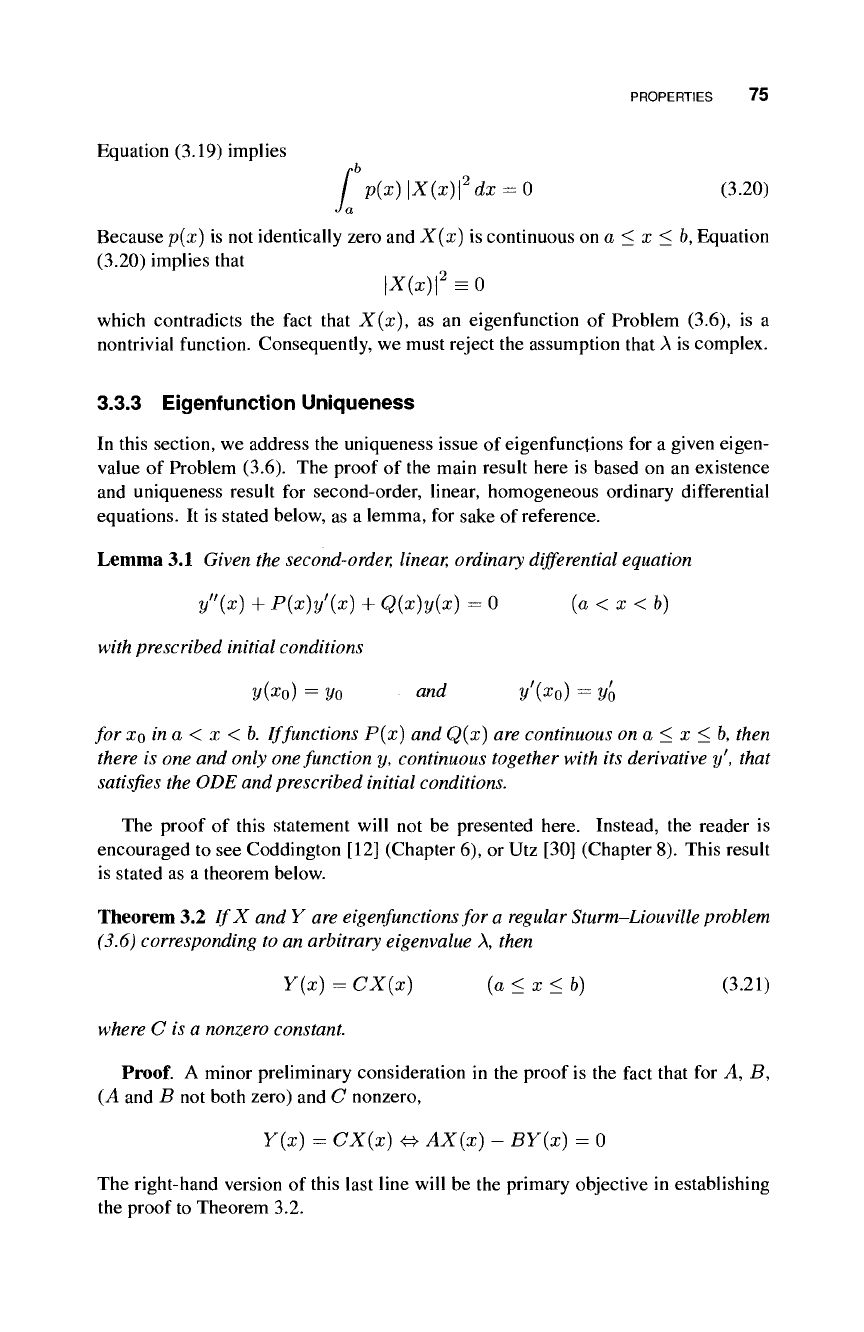
Equation (3.19) implies
b
p(x)\X(x)\
2
dx
= 0
(3.20)
Because p{x) is not identically zero and
X(x)
is continuous on a
< x <
b,
Equation
(3.20) implies that
|X(Z)|
2
EEO
which contradicts the fact that
X(x)
9
as an
eigenfunction
of
Problem (3.6),
is a
nontrivial function. Consequently, we must reject the assumption that
λ
is complex.
3.3.3 Eigenfunction Uniqueness
In this section, we address the uniqueness issue of eigenfunctions for a given eigen-
value of Problem (3.6). The proof of the main result here is based on an existence
and uniqueness result
for
second-order, linear, homogeneous ordinary differential
equations. It is stated below, as a lemma, for sake of reference.
Lemma 3.1 Given the
second-order,
linear,
ordinary differential equation
y"(x)
+
P{x)y'(x)
+
Q(x)y(x)
= 0 (a < x <
b)
with
prescribed initial conditions
y{xo)
=
yo
and
y'(xo)
=
y'o
for xo in a
< x <
b. If functions
P(x)
and Q(x) are continuous on
a
<
x <b,
then
there is one and only one function y, continuous together with its derivative y', that
satisfies the ODE and prescribed initial conditions.
The proof
of
this statement will not be presented here. Instead, the reader
is
encouraged to see Coddington [12] (Chapter 6), or Utz [30] (Chapter 8). This result
is stated as a theorem below.
Theorem 3.2
IfX
and
Y
are eigenfunctions for a regular Sturm-Liouville problem
(3.6) corresponding to an arbitrary eigenvalue λ, then
Y(x)
= CX{x)
(a<x<b) (3.21)
where
C
is a nonzero constant.
Proof.
A minor preliminary consideration in the proof is the fact that for
A, B,
(A and
B
not both zero) and
C
nonzero,
Y(x) = CX(x) & AX{x) - BY(x) = 0
The right-hand version of this last line will be the primary objective in establishing
the proof to Theorem 3.2.
/
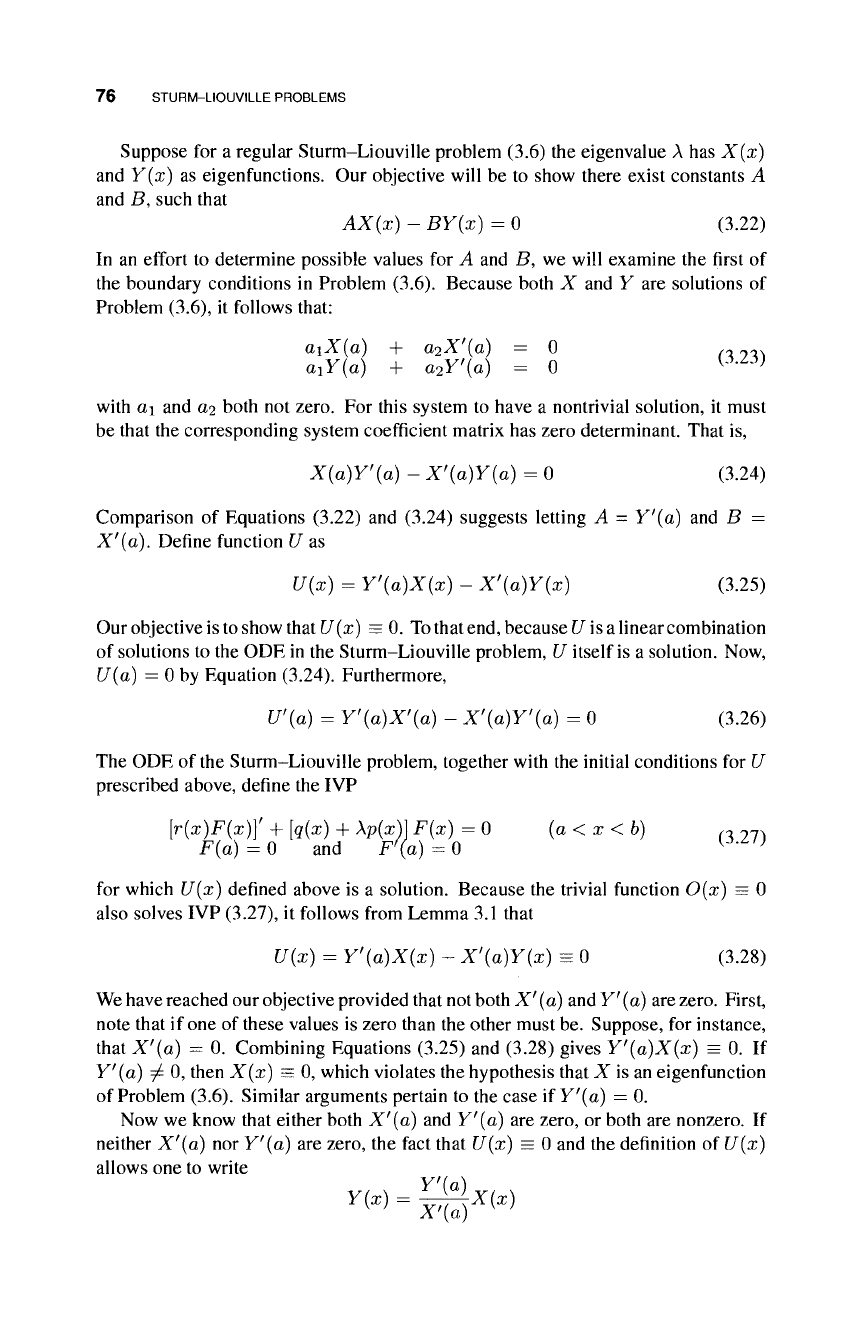
76 STURM-LIOUVILLE PROBLEMS
Suppose for a regular Sturm-Liouville problem (3.6) the eigenvalue λ has X(x)
and Y(x) as eigenfunctions. Our objective will be to show there exist constants A
and B, such that
AX(x) - BY(x) = 0 (3.22)
In an effort to determine possible values for A and B, we will examine the first of
the boundary conditions in Problem (3.6). Because both X and Y are solutions of
Problem (3.6), it follows that:
αχΧ(α) 4- a
2
X'{a) = 0
a{Y(a) 4- a
2
Y\a) = 0
(3.23)
with ai and a
2
both not zero. For this system to have a nontrivial solution, it must
be that the corresponding system coefficient matrix has zero determinant. That is,
X(a)Y'(a) - X'{a)Y(a) = 0 (3.24)
Comparison of Equations (3.22) and (3.24) suggests letting A = Y'{a) and B =
X'{a).
Define function U as
U(x) =
Y'{a)X{x)
- X'{a)Y{x) (3.25)
Our objective is to show that U(x) = 0.
To
that
end,
because U is
a
linear combination
of solutions to the ODE in the Sturm-Liouville problem, U itself
is
a solution. Now,
U(a)
—
0 by Equation (3.24). Furthermore,
U'(a) =
Y'(a)X'(a)
- X'{a)Y'{a) = 0 (3.26)
The ODE of the Sturm-Liouville problem, together with the initial conditions for U
prescribed above, define the IVP
[r(x)F(x)]' + [q(x) 4- λρ(χ)1 F(x) =0 (a < x < b)
n 9T
>
F(o) = 0 and F'(a) = 0 ^
,z/;
for which U{x) defined above is a solution. Because the trivial function O(x) Ξ 0
also solves IVP (3.27), it follows from Lemma 3.1 that
U(x) =
Y'(a)X(x)
- X'(a)Y{x) = 0 (3.28)
We have reached our objective provided that not both X'(a) and Y'(a) are
zero.
First,
note that if one of these values is zero than the other must be. Suppose, for instance,
that X'(a) = 0. Combining Equations (3.25) and (3.28) gives
Y
f
(a)X{x)
= 0. If
Y'(a) φ 0, then X(x) = 0, which violates the hypothesis that X is an eigenfunction
of Problem (3.6). Similar arguments pertain to the case if Y'(a)
—
0.
Now we know that either both X'{a) and Y'(a) are zero, or both are nonzero. If
neither X'(a) nor Y'{a) are zero, the fact that U(x) = 0 and the definition of U(x)
allows one to write
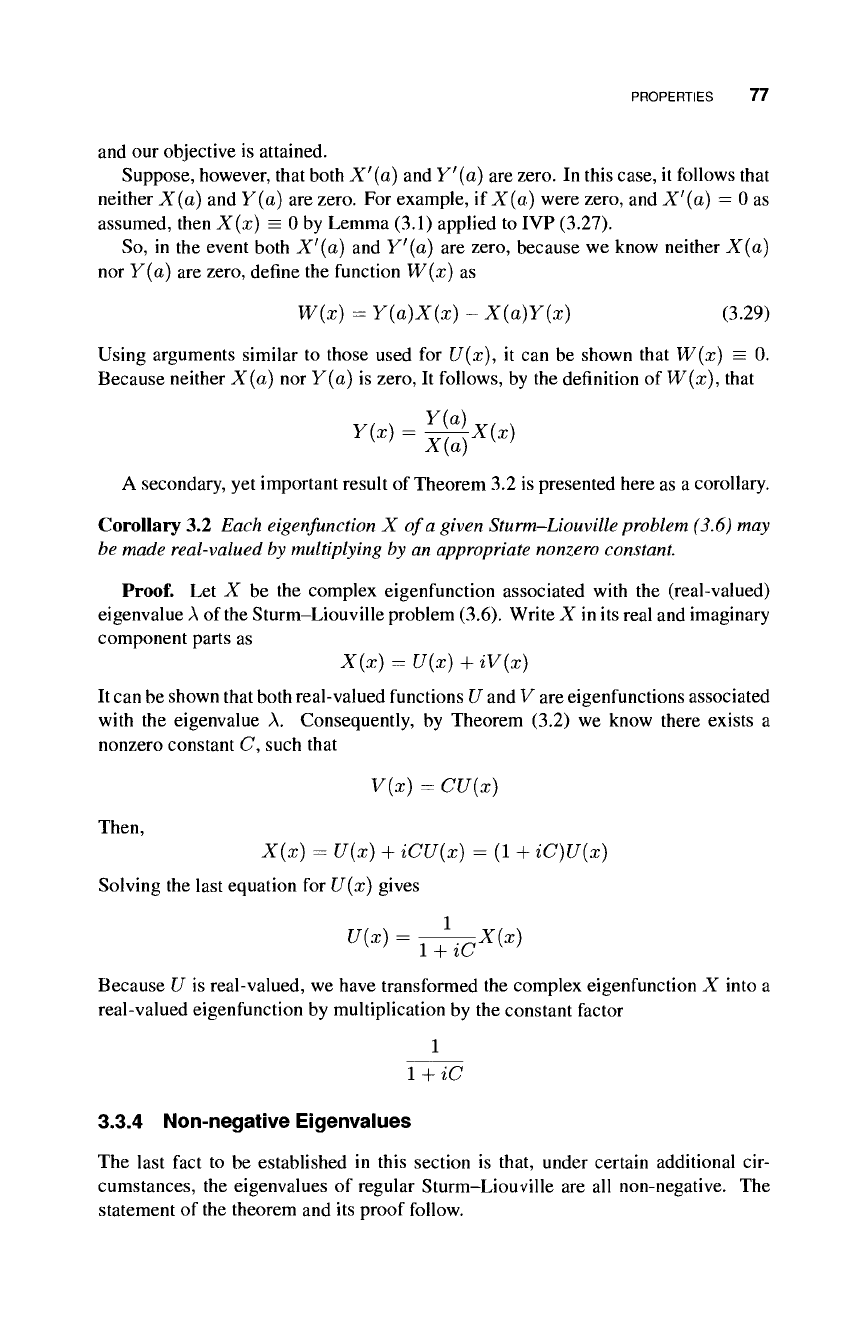
PROPERTIES 77
and our objective is attained.
Suppose, however, that both X'(a) and Y
f
(a) are zero. In this case, it follows that
neither X(a) and Y (a) are zero. For example, ΊίΧ(ά) were zero, and X'(a)
—
0 as
assumed, then X(x) = 0 by Lemma (3.1) applied to IVP (3.27).
So,
in the event both X'(a) and Y'{a) are zero, because we know neither X(a)
nor Y (a) are zero, define the function W(x) as
W(x) = Y(a)X(x) - X(a)Y(x) (3.29)
Using arguments similar to those used for U(x), it can be shown that W(x) = 0.
Because neither X(a) nor Y (a) is zero, It follows, by the definition of W(x), that
X{a)
A secondary, yet important result of Theorem 3.2 is presented here as a corollary.
Corollary 3.2 Each eigenfunction X of a given Sturm-Liouville problem (3.6) may
be made real-valued by multiplying by an appropriate nonzero constant.
Proof.
Let X be the complex eigenfunction associated with the (real-valued)
eigenvalue λ of the Sturm-Liouville problem (3.6). Write X in its real and imaginary
component parts as
X(x) = U(x) + iV(x)
It can be shown that both real-valued functions U and V are eigenfunctions associated
with the eigenvalue λ. Consequently, by Theorem (3.2) we know there exists a
nonzero constant C, such that
V(x) = CU(x)
Then,
X(x) = U(x) + iCU(x) = (1 4- iC)U(x)
Solving the last equation for U(x) gives
u
v
=
rhc
x{x)
Because U is real-valued, we have transformed the complex eigenfunction X into a
real-valued eigenfunction by multiplication by the constant factor
1
1 + iC
3.3.4 Non-negative Eigenvalues
The last fact to be established in this section is that, under certain additional cir-
cumstances, the eigenvalues of regular Sturm-Liouville are all non-negative. The
statement of the theorem and its proof follow.
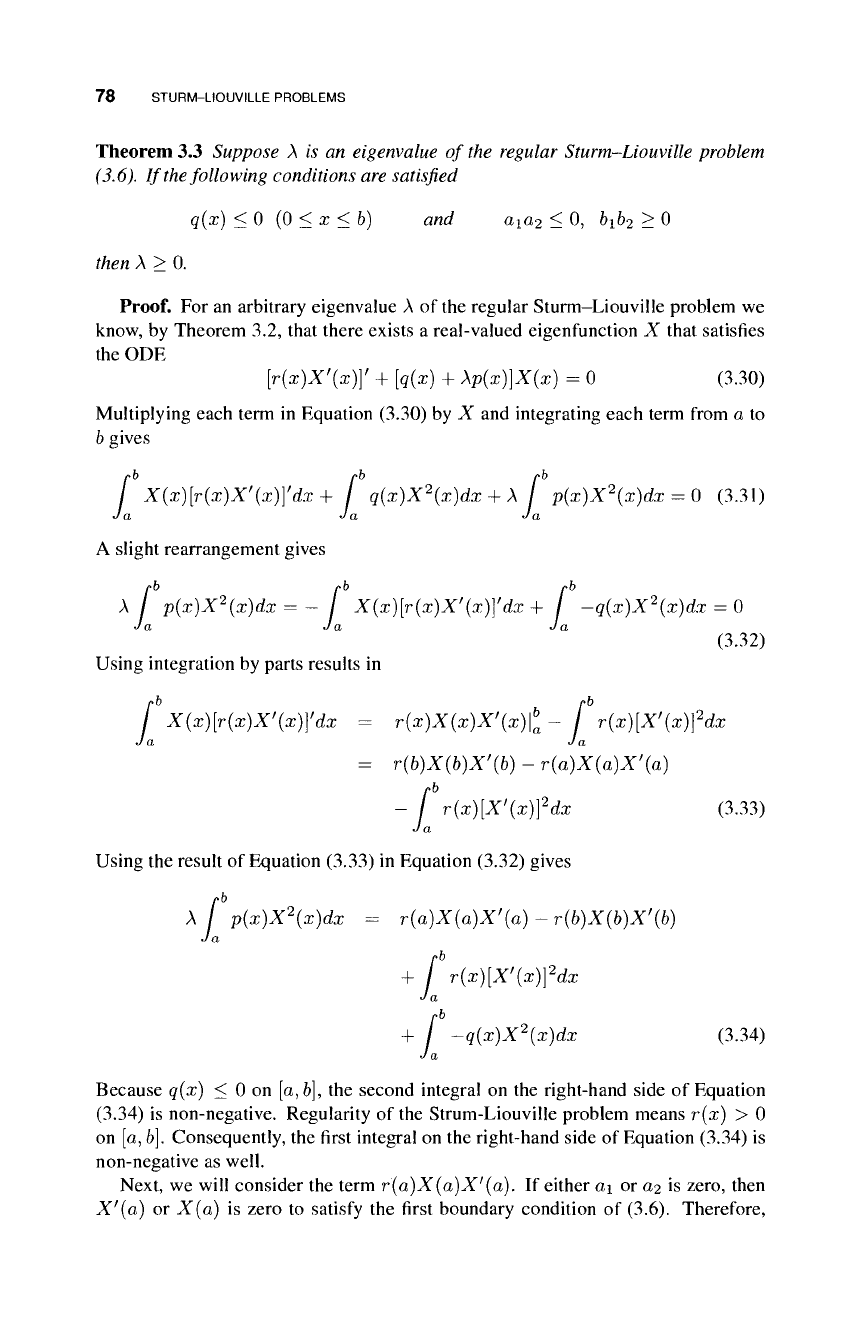
78 STURM-LIOUVILLE PROBLEMS
Theorem 3.3 Suppose λ is an eigenvalue of the regular Sturm-Liouville problem
(3.6).
If the following conditions are satisfied
q(x) < 0 (0 < x < b) and a
x
a
2
< 0, 6
Χ
6
2
> 0
then λ > 0.
Proof.
For an arbitrary eigenvalue λ of the regular Sturm-Liouville problem we
know, by Theorem 3.2, that there exists a real-valued eigenfunction X that satisfies
the ODE
[r(x)X'(x)]' + [q(x) + Xp(x)]X(x) = 0 (3.30)
Multiplying each term in Equation (3.30) by X and integrating each term from a to
b gives
pb pb pb
I X(x)[r(x)X'(x)}'dx+ q(x)X
2
(x)dx + \ p(x)X
2
(x)dx = 0 (3.31)
Ja Ja Ja
A slight rearrangement gives
pb pb pb
X p(x)X
2
(x)dx = - X(x)[r(x)X'(x)}'dx+ -q(x)X
2
(x)dx = 0
Ja Ja Ja
(3.32)
Using integration by parts results in
/ X(x)[r{x)X\x)]
,
dx = r{x)X(x)X'(x)\
b
a
- Í r(x)[X'(x)]
2
dx
Ja Ja
= r(b)X(b)X'(b) - r(a)X(a)X'{a)
r
b
r(x)[X'(x)}
2
dx (3.33)
/
Ja
Using the result of Equation (3.33) in Equation (3.32) gives
f
b
X p(x)X
2
(x)dx = r{a)X{a)X'{a)-r{b)X{b)X'{b)
Ja
+ [ r(x)\X'(x)Ydx
■
/ r(x)[X'(x)Y
Ja
,6
+ / -q(x)X
2
(x)dx (3.34)
Ja
Because q(x) < 0 on [a,
b],
the second integral on the right-hand side of Equation
(3.34) is non-negative. Regularity of the Strum-Liouville problem means r(x) > 0
on [a,
b].
Consequently, the first integral on the right-hand side of Equation (3.34) is
non-negative as well.
Next, we will consider the term r(a)X(a)X'(a). If either a\ or a
2
is zero, then
X'(a)
or X(a) is zero to satisfy the first boundary condition of (3.6). Therefore,
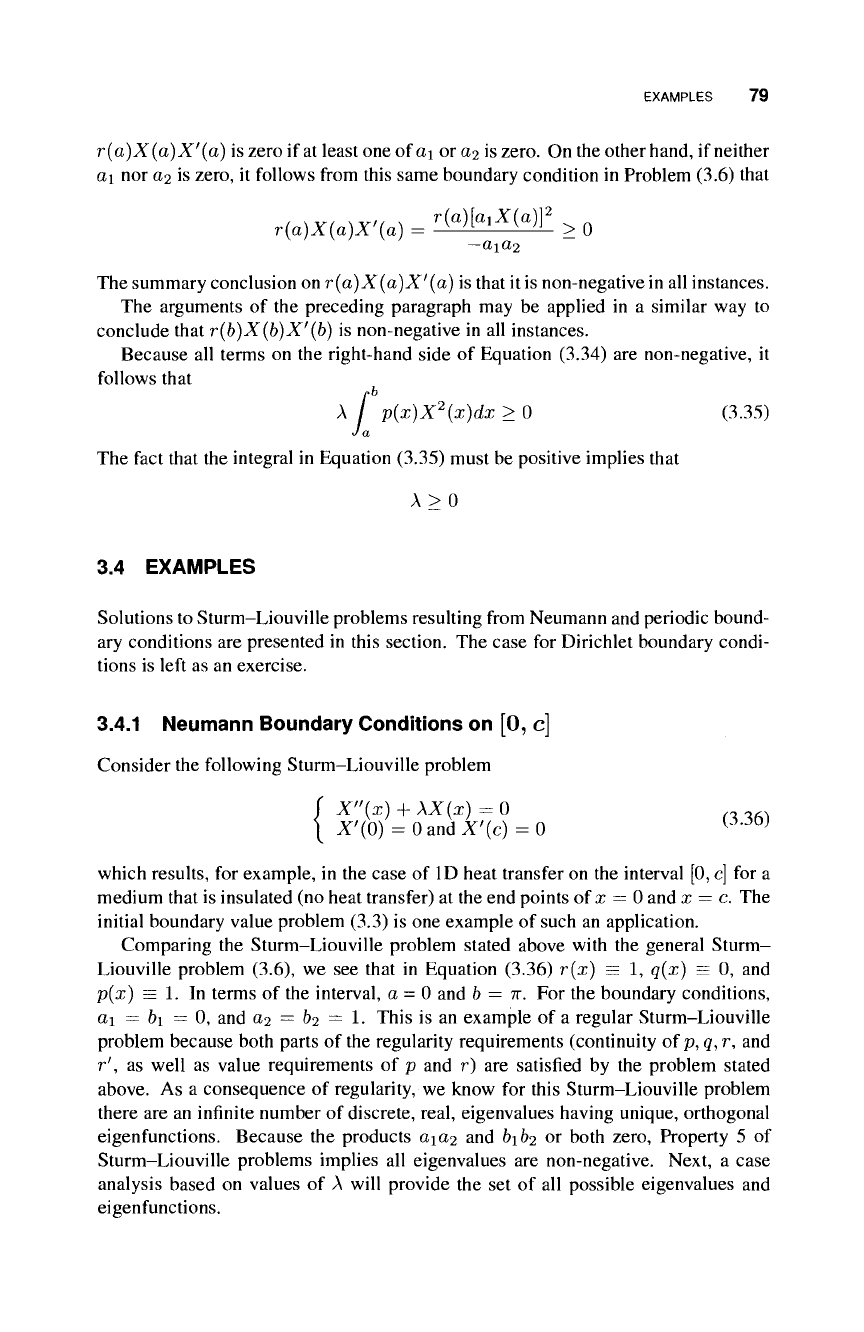
EXAMPLES 79
r(a)X(a)X'(a) is zero if at least one of a\ or a^ is zero. On the other hand, if neither
a\ nor
Ü2
is zero, it follows from this same boundary condition in Problem (3.6) that
r(a)X(a)X'(a) =
f
(«)[«i*(«)]
a
>
0
—α\(ΐ2
The summary conclusion on r(a)X(a)X'(a) is that it is non-negative in all instances.
The arguments of the preceding paragraph may be applied in a similar way to
conclude that r{b)X{b)X
f
{b) is non-negative in all instances.
Because all terms on the right-hand side of Equation (3.34) are non-negative, it
follows that
r
b
λ / p(x)X
2
(x)dx > 0 (3.35)
Ja
The fact that the integral in Equation (3.35) must be positive implies that
λ>0
3.4 EXAMPLES
Solutions to Sturm-Liouville problems resulting from Neumann and periodic bound-
ary conditions are presented in this section. The case for Dirichlet boundary condi-
tions is left as an exercise.
3.4.1 Neumann Boundary Conditions on [0, c]
Consider the following Sturm-Liouville problem
/ X"(x) + XX(x) =0
n
~
M
\ X'(0) = 0*ndX'(c) = 0
(3
'
36)
which results, for example, in the case of ID heat transfer on the interval
[0,
c]
for a
medium that is insulated (no heat transfer) at the end points of x = 0 and x
—
c. The
initial boundary value problem (3.3) is one example of such an application.
Comparing the Sturm-Liouville problem stated above with the general Sturm-
Liouville problem (3.6), we see that in Equation (3.36) r(x) = 1, q(x) = 0, and
p(x) Ξ 1. In terms of the interval, a = 0 and b — π. For the boundary conditions,
α,ι = bi = 0, and
a<i
— &2 = 1· This is an example of a regular Sturm-Liouville
problem because both parts of the regularity requirements (continuity of p,
<?,
r, and
r', as well as value requirements of p and r) are satisfied by the problem stated
above. As a consequence of regularity, we know for this Sturm-Liouville problem
there are an infinite number of discrete, real, eigenvalues having unique, orthogonal
eigenf unctions. Because the products α\α,2 and &1&2 or both zero, Property 5 of
Sturm-Liouville problems implies all eigenvalues are non-negative. Next, a case
analysis based on values of λ will provide the set of all possible eigenvalues and
eigenfunctions.
80 STURM-LIOUVILLE PROBLEMS
Case
Λ
= 0
For λ = 0, we have X"{x) = 0, which means X(x) = A-\-Bx represents the general
solution to the ODE. Applying the boundary conditions gives X'(0) — B · 0 = 0
and X'{c) = B · 1 = 0 => B — 0. These conditions give no restrictions on A,
so Xo(x) = 1 is the simplest eigenfunction corresponding to λ =. Any other eigen-
f unction corresponding to the eigenvalue of 0 is just
a
constant multiple of Xo (x) = 1.
Case
Λ
> 0
If λ > 0, then let
A
= k
2
(k > 0) and the ODE becomes
X"(x)
+ k
2
X(x) = 0,
which, as a second order, linear, homogeneous ODE, has the general solution
X(x) = A cos kx + B sin kx
Now, X'{x) = —kA sin kx + kB cos kx. Invoking the boundary conditions give
X'(0)
= 0=> -kAsink-0 + kBcosk-0 = 0=ïB = 0
and
X\c)
=0=> -kAsmk = 0
For nontrivial solutions (i.e., A φ. 0), it must be that
Tí
7T
sin k = 0 => fc
n
= —, n = 1,2,3,...
c
So,
A
n
= fc^ = (^
1
)
2
, n = 1,2,3,... are eigenvalues for this case with corre-
sponding eigenfunctions X
n
(x) = cos (^^F) , n = 1,2,3,...
In summary, the eigenvalues for this problem are A
n
= (^)
2
, n
—
0,1,2,...
with corresponding eigenfunctions XQ{X) — 1 and X
n
(x) = cos(
zlÄ
^) , n =
1,2,3,...
3.4.2 Robin and Neumann BCs
The are some heat transfer applications in which energy is allowed to move across the
boundary. The resulting boundary condition involves both the boundary temperature
and its normal derivative (see Section 4.2 for details). The resulting Regular Sturm-
Liouville problem is solved for this case to determine the resulting eigenvalues and
associated eigenfunctions.
The Sturm-Liouville problem under consideration is
X"{x)
+ \X{x) = 0 (3.37)
ftX(0) - X'(0) = 0 and X'(c) = 0 (3.38)
EXAMPLES 81
As with the two previous cases already considered, we determine eigenvalues and
eigenfunctions using case analysis on λ. In the regular Sturm-Liouville problem
presented in Equations (3.38), q(x) — 0, a\a
2
— — h < 0, and &162 = 0, so that
Property 5 assures us that all eigenvalues for this example are non-negative.
Case
Λ
= 0
For λ = 0, we have X"(x)
—
0, which means X(x) = A+Bx represents the general
solution to the ODE. Applying the boundary condition at x = c gives X'{c) = 0 =>
B — 0. Applying the boundary condition at x — 0 gives hX(0)
—
X'(0) = 0 =>
h A
— 0
= 0
=>
A = 0. Consequently, this not a nontrivial solution for the case λ = 0
Case
Λ
> 0
If λ > 0, then let λ = k
2
(k > 0), and the ODE becomes
X"{x)
+ k
2
X(x) = 0
which, as a second-order, linear, homogeneous ODE, has the general solution
X(x) = A cos kx + B sin kx
Invoking the boundary condition at x
—
0 first gives
hX(0) -X'(0) = 0 =¿> h(Acosk0 + Bsink0) -
(-kAsinkO
+ kB cos
kO)
= 0
=> hA - kB = 0
h_B_
^ k~~Ä
Next, the boundary condition at x = c gives
X'(c)
= 0 => -&.AsinA;c + kB cos kc = 0
=> A:( — A sin kc-\- B cos
fee)
= 0
sin fcc 5
cos kc A
B
tan kc— —
A
Combining the results of the boundary conditions gives
h
tan kc—
—
k
So the eigenvalues for this case are given by the x locations for which the graphs of
y = tan ex and y — ^ intersect, as shown in Figure 3.1. Therefore, the eigenvalues