
Bernatz R. Fourier Series and Numerical Methods for Partial Differential Equations
Подождите немного. Документ загружается.

62 FOURIER SERIES
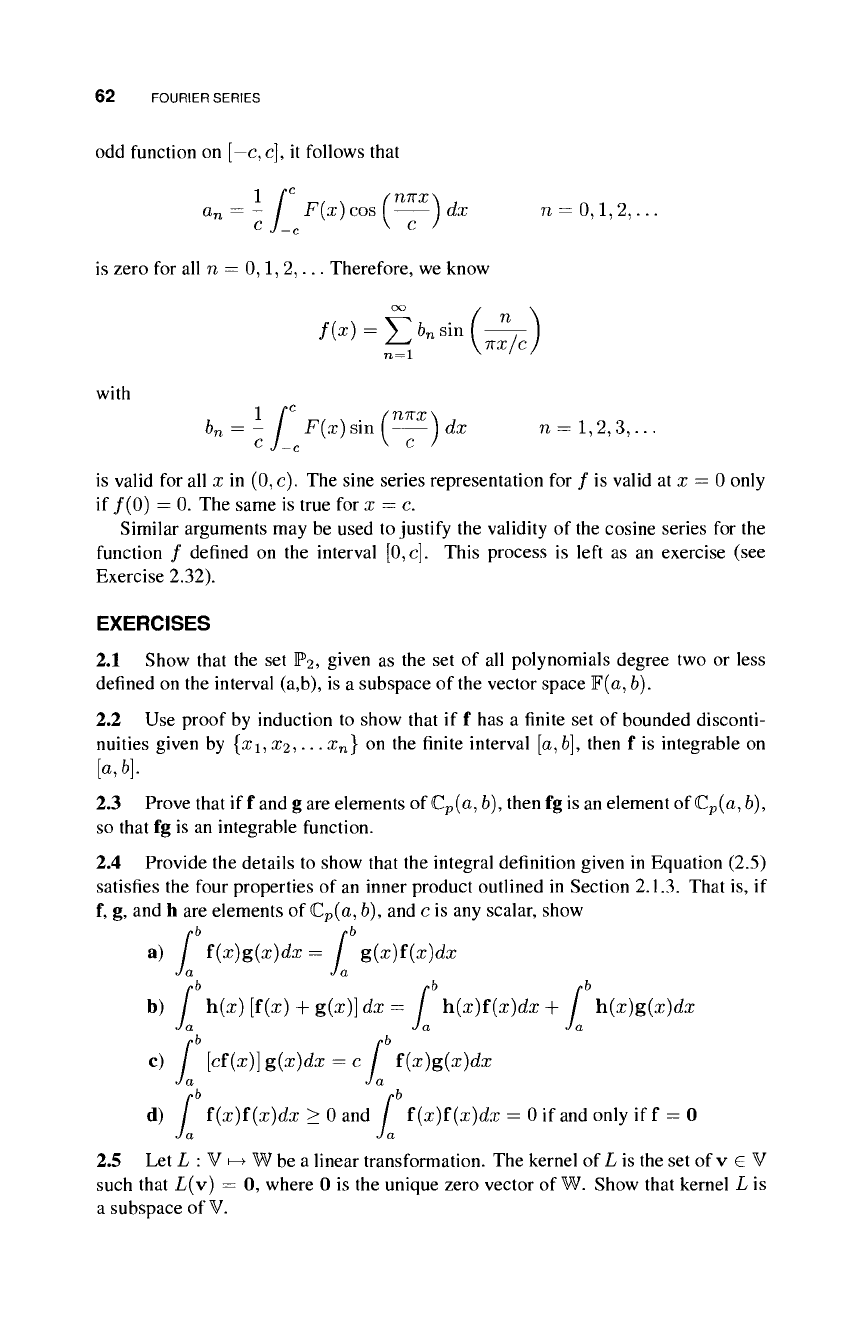
odd function on [—c,
c],
it follows that
1
/*
C
/ ΤίΊΤΧ \
a
n
= - / F(x)cos( J dx n = 0,1,2,...
c J_
c
\ c /
is zero for all n = 0,1,2,... Therefore, we know
f(
X
) = Yl
b
n
Sin
f —T I
¿-^
\ΈΧ C J
n=l
v
'
7
with
1
/*
C
/717ΓΧ\
b
n
= - F(x)sini jdx n = 1,2,3,...
is valid for all x in (0,
c).
The sine series representation for / is valid at x = 0 only
if /(0) = 0. The same is true for x
—
c.
Similar arguments may be used to justify the validity of the cosine series for the
function / defined on the interval
[0,
c].
This process is left as an exercise (see
Exercise 2.32).
EXERCISES
2.1 Show that the set P2, given as the set of all polynomials degree two or less
defined on the interval (a,b), is a subspace of the vector space F(a, b).
2.2 Use proof by induction to show that if f has a finite set of bounded disconti-
nuities given by {χχ, χ<ι,.. .x
n
} on the finite interval [a,
6],
then f is integrable on
[a,b].
2.3 Prove that if f and g are elements of C
p
(a, b), then fg is an element of C
p
(o, 6),
so that fg is an integrable function.
2.4 Provide the details to show that the integral definition given in Equation (2.5)
satisfies the four properties of an inner product outlined in Section
2.1.3.
That is, if
f, g, and h are elements of C
p
(o, 6), and c is any scalar, show
pb pb
a) / f(x)g(x)dx = / g(x)f(x)dx
Ja Ja
rb nb pb
b) / h(x) [f(x) + g(x)} dx= h(x)f(x)dx + / h(x)g(x)dx
Ja Ja Ja
pb pb
c) / [cf (x)] g(x)dx = c / f(x)g(x)dx
Ja Ja
pb pb
d) / f(x)f(x)dx > 0 and / f(x)f(x)dx = 0 if and only if f = 0
Ja Ja
2.5 Let L
:
V
1—>·
W be a linear transformation. The kernel of L is the set of v
G
V
such that L(v) = 0, where 0 is the unique zero vector of W. Show that kernel L is
a subspace of V.
EXERCISES
63
2.6 Suppose
f(x) is a
non-negative function with domain
Df
that may,
or
may
not, be continuous. Let x* G
Df
be such that
f(x*) < f(x) for
all
x
G
Df.
Prove
that
y/f(x*)
<
y/f(x)
for all
x
G J9/. Prove the converse as well.
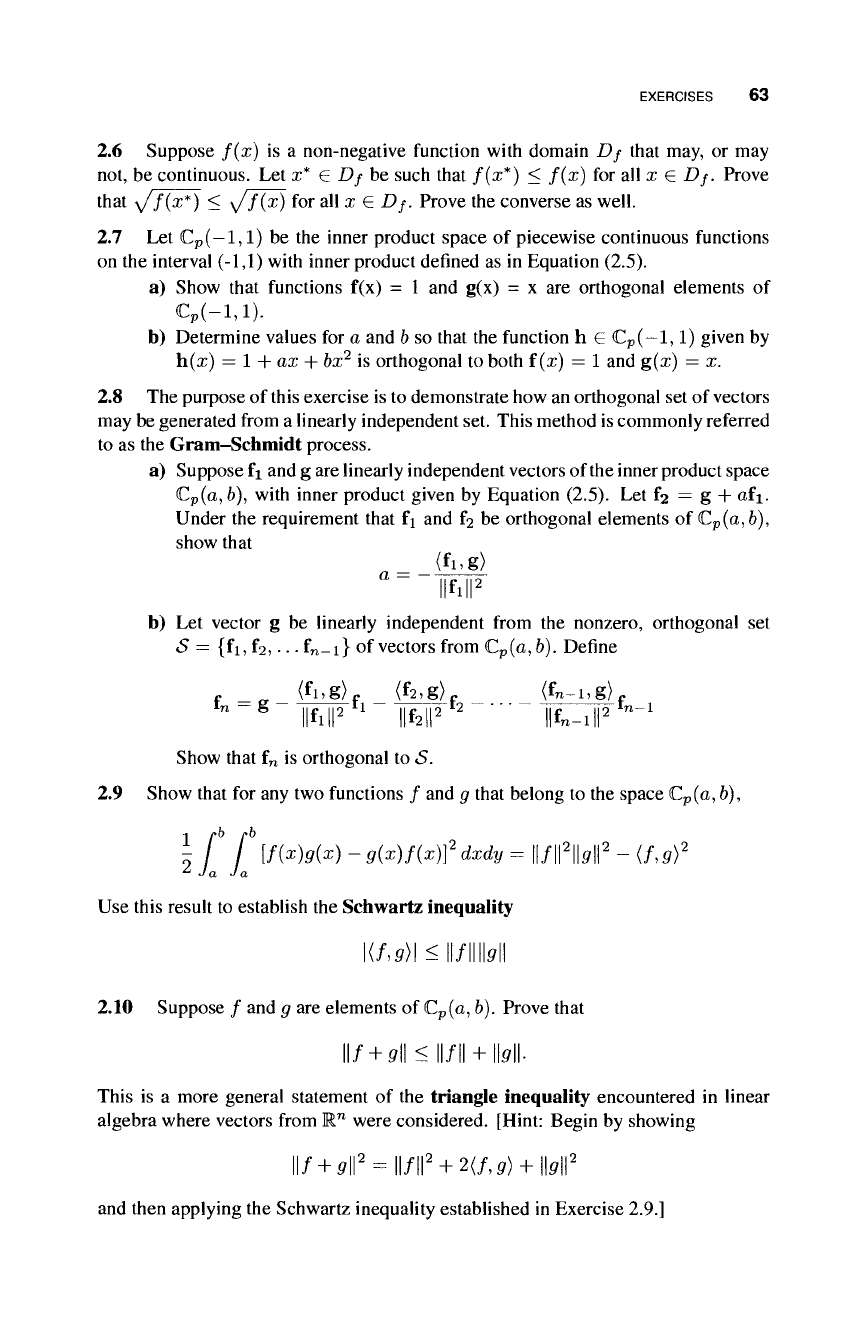
2.7 Let Cp(—1,1)
be
the inner product space
of
piecewise continuous functions
on the interval
(-1,1)
with inner product defined as in Equation (2.5).
a) Show that functions
f(x) = 1 and
g(x)
= x are
orthogonal elements
of
M-i,i).
b) Determine values for
a
and b so that the function
h
G C
p
(—1,1) given by
h(x)
=
1 4-
ax + bx
2
is orthogonal to both
f(x) =
1 and
g(x) = x.
2.8 The purpose of
this
exercise is to demonstrate how an orthogonal set of vectors
may be generated from a linearly independent set. This method is commonly referred
to as the Gram-Schmidt process.
a) Suppose
fi
and g are linearly independent vectors of the inner product space
C
p
(a, 6), with inner product given by Equation (2.5). Let
f
2
= g + aî\.
Under the requirement that
f\
and Î2
be
orthogonal elements
of
C
p
(a, b),
show that
<fi,g>
a
=
Ifil
b)
Let
vector
g be
linearly independent from
the
nonzero, orthogonal
set
S
=
{fi, Î2,
■.
■
fn-i} of vectors from C
p
(a, b). Define
f
=tr
(
f
l»g)
f
(
f
2>ë)
f
(fn-l,g)
f
In
g
pip
11
||f
2
p
12
···
Hf^iP
1
"
-1
Show that
f
n
is orthogonal to
S.
2.9 Show that for any two functions
/
and g that belong to the space C
p
(a, b),
Iff
2 lf(
x
)9(
x
)
-
9(
χ
)Ι(
χ
)Ϋ
dxd
y =
Use this result to establish the Schwartz inequality
K/,0>l<
'\\g\\-(f,9Y
2.10 Suppose
/
and g are elements of C
p
(a, b). Prove that
ΙΙ/
+
ί/ΙΙ<ΙΙ/ΙΙ
+ ΙΙί/ΙΙ·
This
is a
more general statement
of
the triangle inequality encountered
in
linear
algebra where vectors from
R
n
were considered. [Hint: Begin by showing
ll/
+
9ll
2
=
ll/ll
2
+
2(/,9)
+
lli7ll
2
and then applying the Schwartz inequality established in Exercise 2.9.]
64 FOURIER SERIES
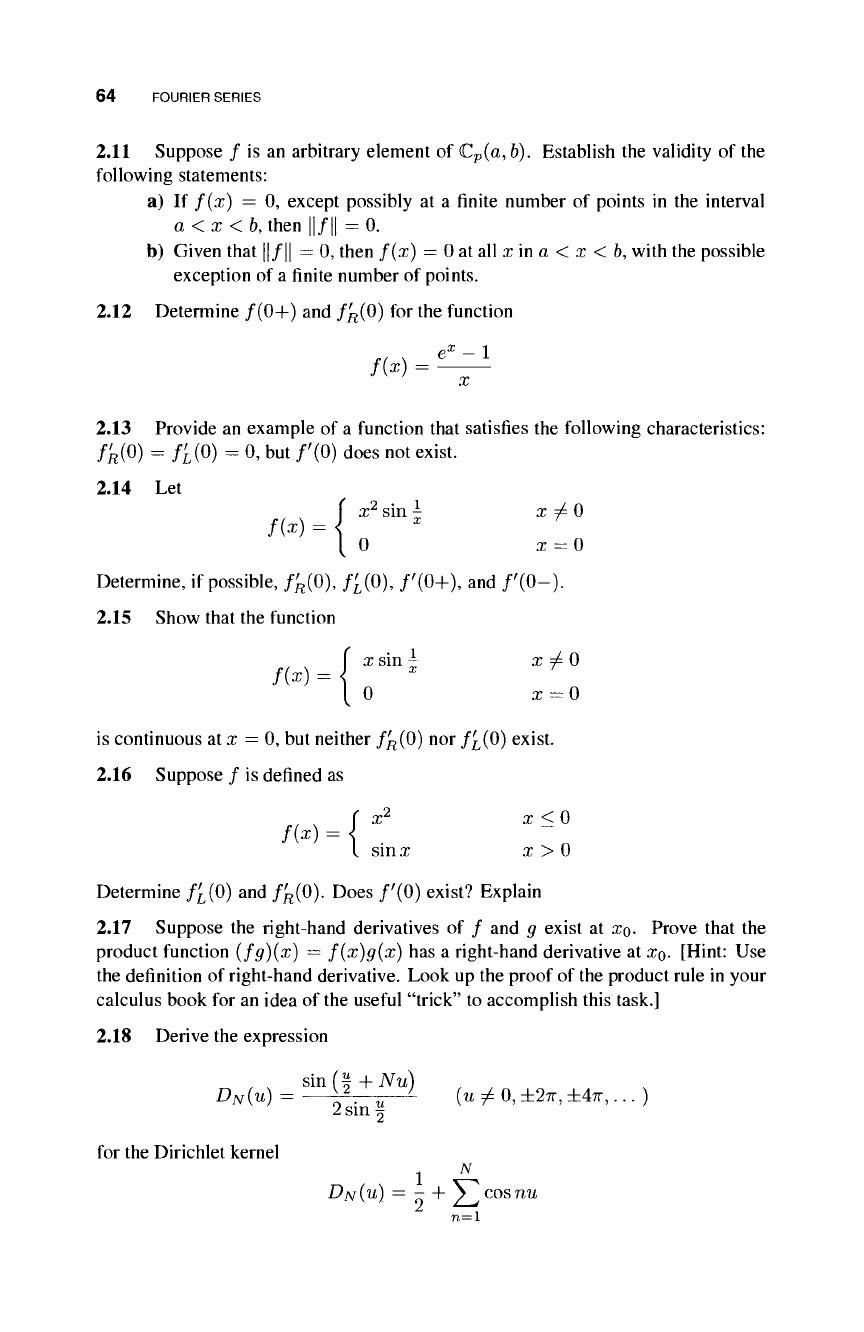
2.11 Suppose / is an arbitrary element of C
p
(a, b). Establish the validity of the
following statements:
a) If f(x) = 0, except possibly at a finite number of points in the interval
a<x<6,then ||/|| =0.
b) Given that ||/|| =0, then f(x) = 0 at all x in a < x <
b,
with the possible
exception of a finite number of points.
2.12 Determine /(0+) and
f'
R
(Q)
for the function
e
x
- 1
m - V
2.13 Provide an example of a function that satisfies the following characteristics:
f'
R
(0)
=
f'
L
(0)
= 0, but f'(0) does not exist.
2.14 Let
Í
x
2
sin - x φ 0
0 x = 0
Determine, if possible,
f'
R
(0),
/¿(0), /'(()+), and /'(O-).
2.15 Show that the function
Í
x sin - x Φ 0
0 x = 0
is continuous at x = 0, but neither
f'
R
(Q)
nor /¿(0) exist.
2.16 Suppose / is defined as
x
2
x <0
L sinx x > 0
Determine f
L
(0) and /¿(0). Does /
;
(0) exist? Explain
2.17 Suppose the right-hand derivatives of / and g exist at xo. Prove that the
product function (fg)(x) = f(x)g(x) has a right-hand derivative at x
0
. [Hint: Use
the definition of right-hand derivative. Look up the proof of the product rule in your
calculus book for an idea of the useful "trick" to accomplish this task.]
2.18 Derive the expression
D
N
(u)
= ^
2
sinI
,
;
(u φ 0, ±2π, ±4π,... )
for the Dirichlet kernel
N
DN(U) =
\
+
¿
cosrm
n=l
EXERCISES 65
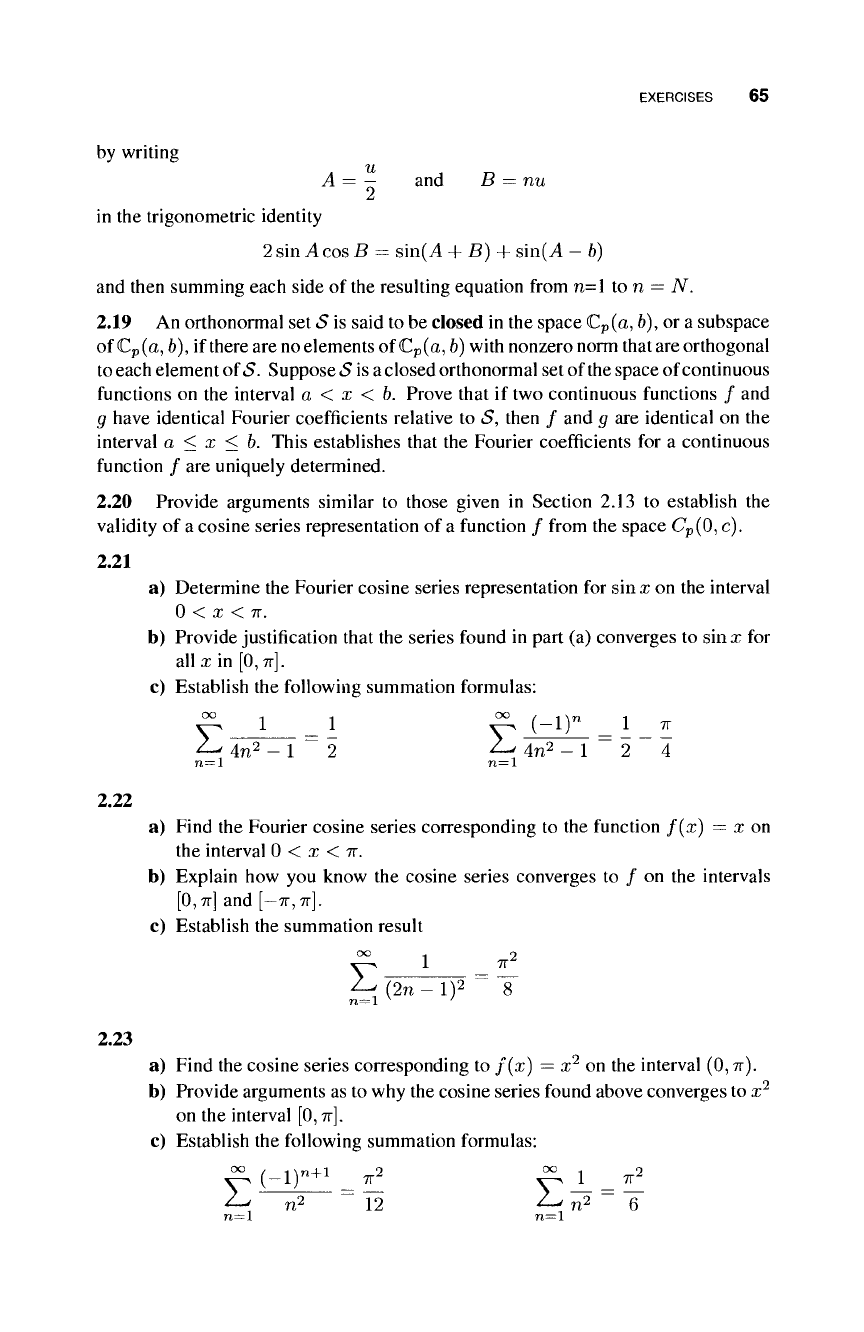
by writing
A = - and B = nu
2
in the trigonometric identity
2
sin A cos B = $m{A + B) + sin(A - b)
and then summing each side of the resulting equation from n=\ to n = N.
2.19 An orthonormal set
«5
is said to be closed in the space C
p
(a, 6), or a subspace
of C
p
(o, 6), if there are no elements of C
p
(a, 6) with nonzero norm that are orthogonal
to each element of S. Suppose S is
a
closed orthonormal set of the space of continuous
functions on the interval a < x < b. Prove that if two continuous functions / and
g have identical Fourier coefficients relative to S, then / and g are identical on the
interval a < x < b. This establishes that the Fourier coefficients for a continuous
function / are uniquely determined.
2.20 Provide arguments similar to those given in Section 2.13 to establish the
validity of a cosine series representation of a function / from the space C
p
(0, c).
2.21
a) Determine the Fourier cosine series representation for sin x on the interval
0 < X < 7Γ.
b) Provide justification that the series found in part (a) converges to sinx for
all x in
[0,
π].
c) Establish the following summation formulas:
(-l)
n
_ 1 π
2.22
2.23
oo
1 1
oo
y
x
=1 v
^ An
2
-1 2 ^ An
2
-1 2 4
n=l n=l
a) Find the Fourier cosine series corresponding to the function f(x) = x on
the interval 0 < x < π.
b) Explain how you know the cosine series converges to / on the intervals
[0,
π]
and [—π, π].
c) Establish the summation result
00
-i 2
Σ
1 _ 7T
Λ
(2n - l)
2 =
~8
71=1
V
/
a) Find the cosine series corresponding to f(x) = x
2
on the interval (0, π).
b) Provide arguments as to why the cosine series found above converges to x
2
on the interval
[0,
π],
c) Establish the following summation formulas:
y, (-1)"
+1
_ 7Γ
2
V— - —
^ n
2
" 12 ^ n
2
~ 6
n=l n=l
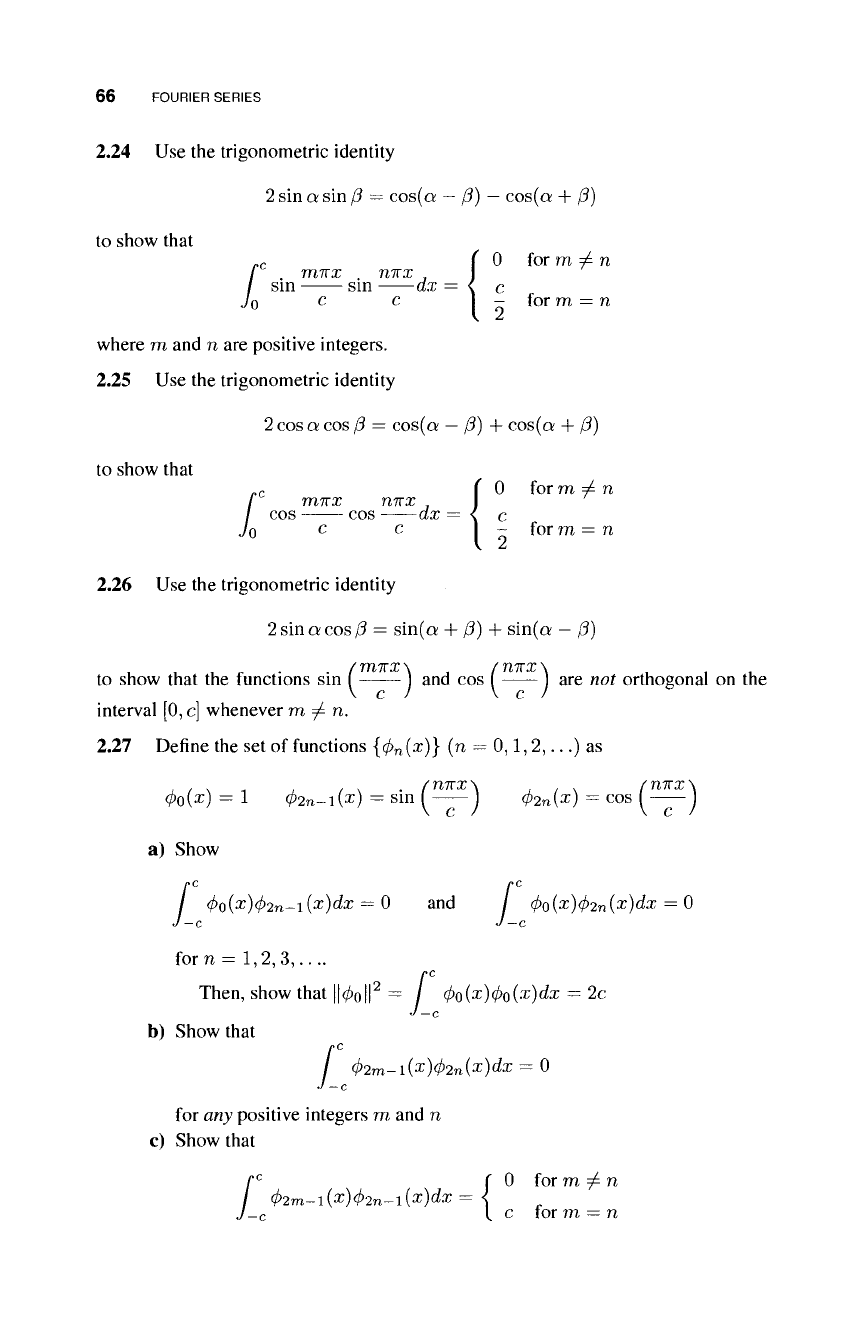
66 FOURIER SERIES
2.24 Use the trigonometric identity
2 sin a sin ß
—
cos(a;
—
ß)
—
cos(a + ß)
to show that
/
Jo
0 for m Φ
n
.
πιπχ . ηπχ
1
I
sin
sin
ax =
\ c
c
c I -
for m =
n
2
where m and n are positive integers.
2.25 Use the trigonometric identity
2 cos a cos β
=
cos(a
—
/?) + cos(a + )9)
to show that
/
Jo
0 for m Φ
n
πιπχ ηπχ '
cos
cos
ax =
\ c
c
c -
for m
—
n
2
2.26 Use the trigonometric identity
2 sin a cos β
—
sin(a + β) 4- sin(a;
—
/?)
to show that the functions sin Í
J
and cos Í 1 are not orthogonal on the
interval
[0,
c]
whenever τηφη.
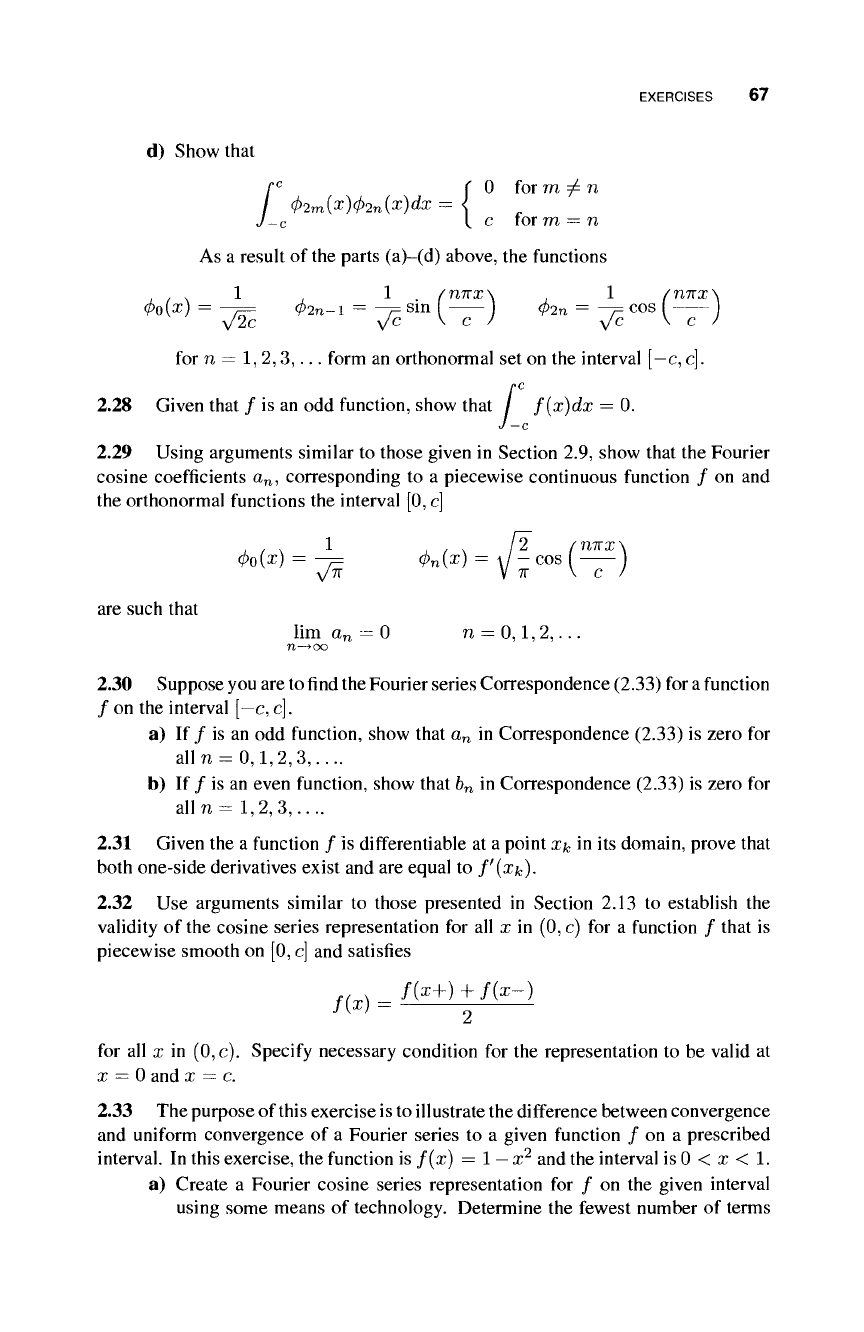
2.27 Define the set of functions {φ
η
(χ)} (n
=
0,1,2,...) as
φο(χ)
=
1 φ2η-ι{χ) = sin
( J
φ
2η
(x) = cos ^
j
a) Show
/ φο(χ)φ2η-ι{χ)άχ
=
0
and /
φ
0
(χ)φ2η(χ)άχ = 0
J —c */ —c
forn
=
1,2,3,....
Then, show that
\\φο\\
2
=
/
φ$(χ)φ$(χ)(1χ = 2c
J — c
-c
b) Show that
/:
*2m-l(^)02n(iP)d^
=
O
for anj positive integers m and n
c) Show that
/
φ2πι-ΐ(χ)Φ2η-ΐ(χ)άχ =
<
0 f or m
φ η
c f or m
=
n
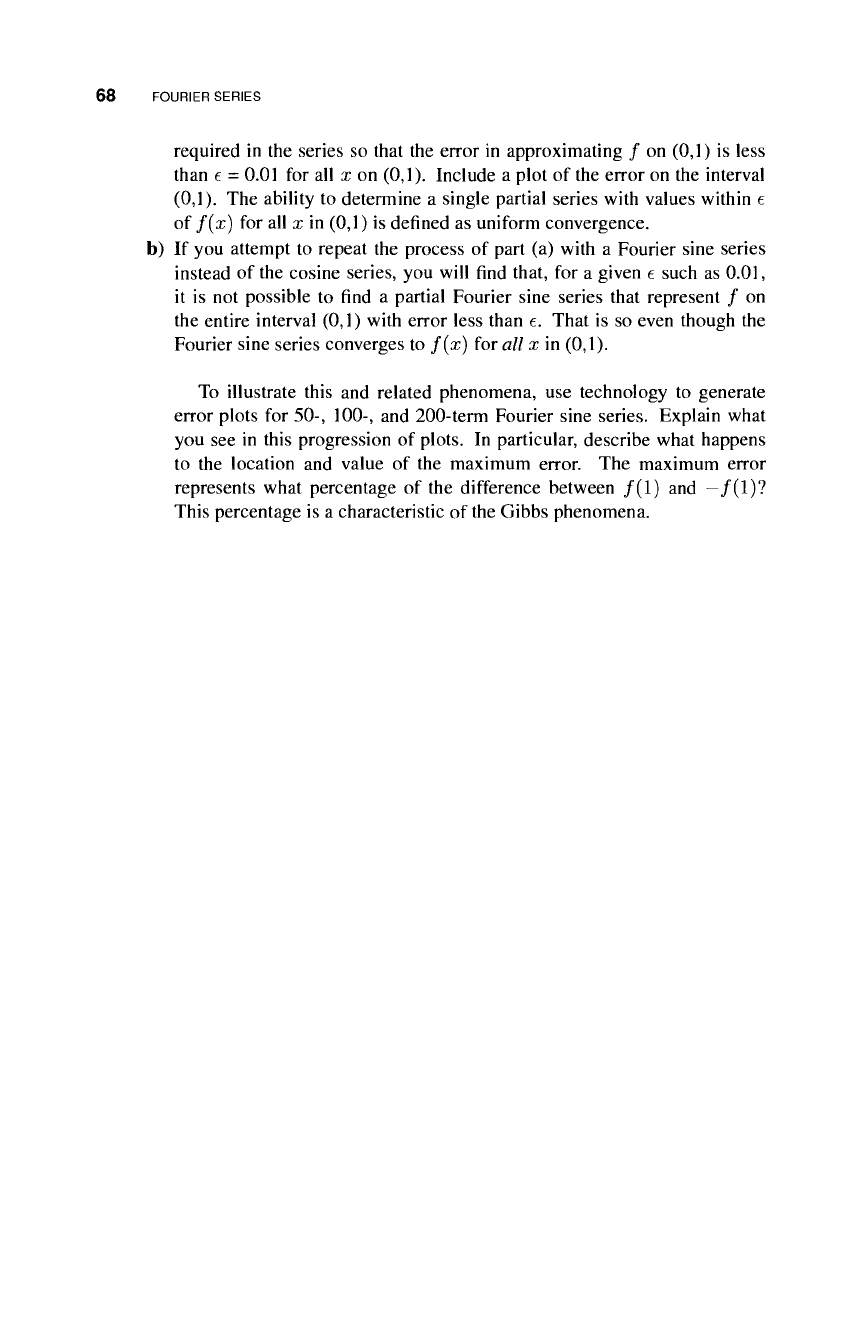
EXERCISES 67
/ φ2πι(χ)Φ2η{χ)άχ = <
d) Show that
0 for m φ η
c for ra
—
n
As a result of the parts (a)-(d) above, the functions
.
x
1 . 1 /ηπχ\ , 1 /ηπχ\
θ(
Χ
)
=
~7K= <P2n-l =
—¡F
Sin 1 02n = "^ COS Í
\/2c x/c \ c / Jc \ c J
/2C V
C V C J
y/C \ C
for n = 1,
2,3,...
form an orthonormal set on the interval [—c, c].
2.28 Given that / is an odd function, show that / f(x)dx = 0.
2.29 Using arguments similar to those given in Section 2.9, show that the Fourier
cosine coefficients a
n
, corresponding to a piecewise continuous function / on and
the orthonormal functions the interval
[0,
c]
φ
0
(χ) = —7= Φη{ζ) = \ - COS ( )
are such that
lim a
n
—
0 n =
0,1,
2,...
n—>oo
2.30 Suppose you are to
find
the Fourier series Correspondence (2.33) for
a
function
/ on the interval [—c, c].
a) If / is an odd function, show that a
n
in Correspondence (2.33) is zero for
alln = 0,1,2,3,....
b) If / is an even function, show that b
n
in Correspondence (2.33) is zero for
alln = 1,2,3,....
2.31 Given the a function / is differentiable at a point Xk in its domain, prove that
both one-side derivatives exist and are equal to
f'(xk).
2.32 Use arguments similar to those presented in Section 2.13 to establish the
validity of the cosine series representation for all x in (0, c) for a function / that is
piecewise smooth on
[0,
c]
and satisfies
/(x,
= Λ£±1±Λΐ=)
for all x in (0, c). Specify necessary condition for the representation to be valid at
x = 0 and x
—
c.
2.33 The purpose of this exercise is to illustrate the difference between convergence
and uniform convergence of a Fourier series to a given function /ona prescribed
interval. In this exercise, the function is f(x) =
1 —
x
2
and the interval is 0 < x < 1.
a) Create a Fourier cosine series representation for / on the given interval
using some means of technology. Determine the fewest number of terms
68 FOURIER SERIES
required in the series so that the error in approximating / on
(0,1 )
is less
than e = 0.01 for all x on (0,1). Include a plot of the error on the interval
(0,1).
The ability to determine a single partial series with values within e
of f(x) for all x in (0,1) is defined as uniform convergence.
b) If you attempt to repeat the process of part (a) with a Fourier sine series
instead of the cosine series, you will find that, for a given e such as 0.01,
it is not possible to find a partial Fourier sine series that represent / on
the entire interval (0,1) with error less than e. That is so even though the
Fourier sine series converges to f(x) for all x in (0,1).
To illustrate this and related phenomena, use technology to generate
error plots for 50-, 100-, and 200-term Fourier sine series. Explain what
you see in this progression of plots. In particular, describe what happens
to the location and value of the maximum error. The maximum error
represents what percentage of the difference between /(l) and —/(l)?
This percentage is a characteristic of the Gibbs phenomena.
CHAPTER 3
STURM-LIOUVILLE PROBLEMS
This chapter focuses on the general Sturm-Liouville problem that arises in sepa-
ration of variable techniques in boundary value problems. The section begins by
identifying three basic IBVPs from which Sturm-Liouville problems result. Next,
Regular Strum-Liouville problems are defined, and several important properties are
established. The section concludes with solution examples for certain cases.
3.1 BASIC EXAMPLES
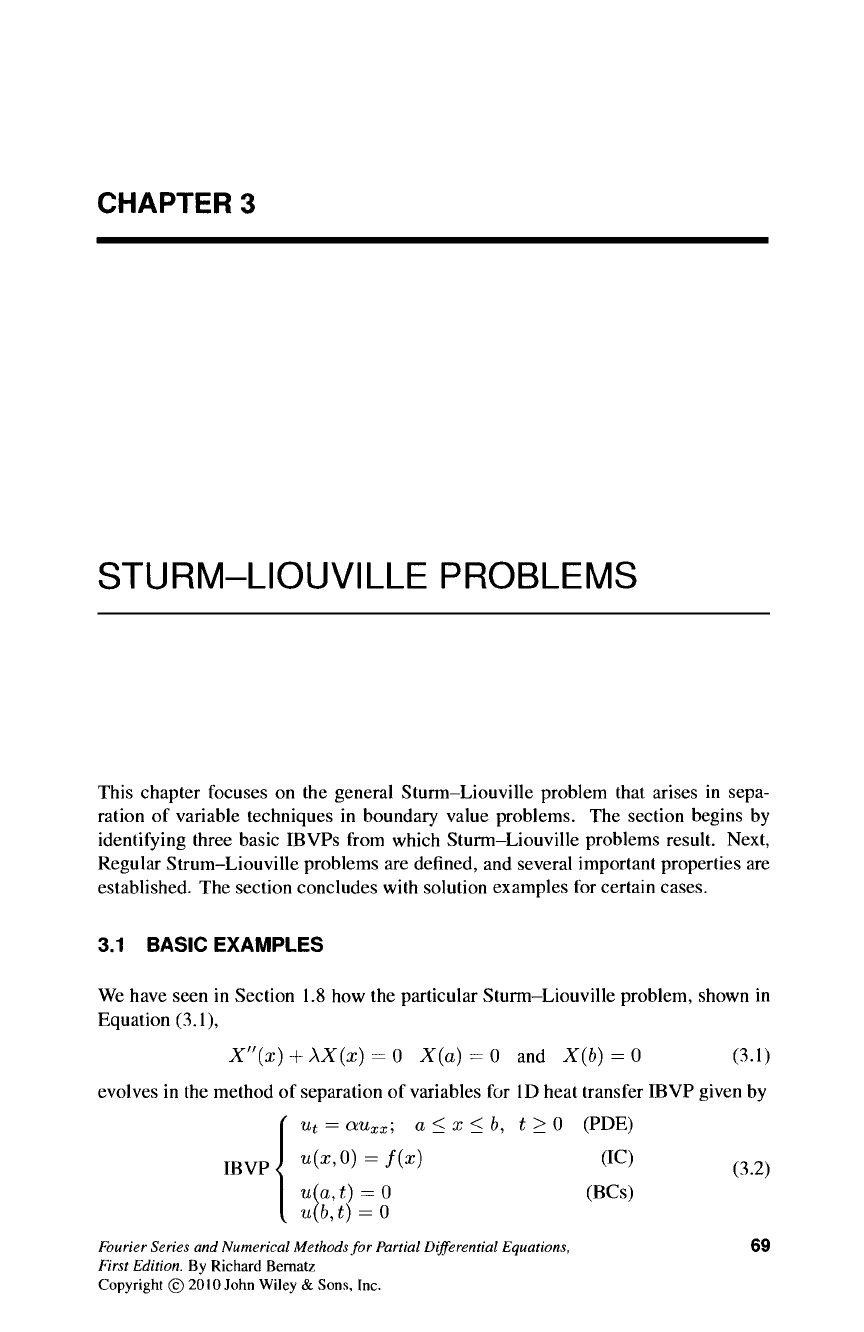
We have seen in Section 1.8 how the particular Sturm-Liouville problem, shown in
Equation (3.1),
X"(x)
+ \X(x) = 0 X{a) = 0 and X(b)=0 (3.1)
evolves in the method of separation of variables for ID heat transfer IBVP given by
Ut — OLU
XX
\ a < x < b, t >0 (PDE)
IBVP {
u
(
x
i°) = f(
x
) (
IC
) (3.2)
u(a, t) = 0 (BCs)
[ u(b,t) = 0
Fourier Series and Numerical Methods for Partial Differential Equations, 69
First Edition. By Richard Bernatz
Copyright © 2010 John Wiley & Sons, Inc.
70 STURM-LIOUVILLE PROBLEMS
The problem stated in Equation (3.1) is more general than that presented previously
because the left- and right-hand boundaries are located at x = a and x — b (a < b),
respectively. Prescribed boundary values for the dependent variable u, as in this
example, are referred to as "Dirichlet" conditions.
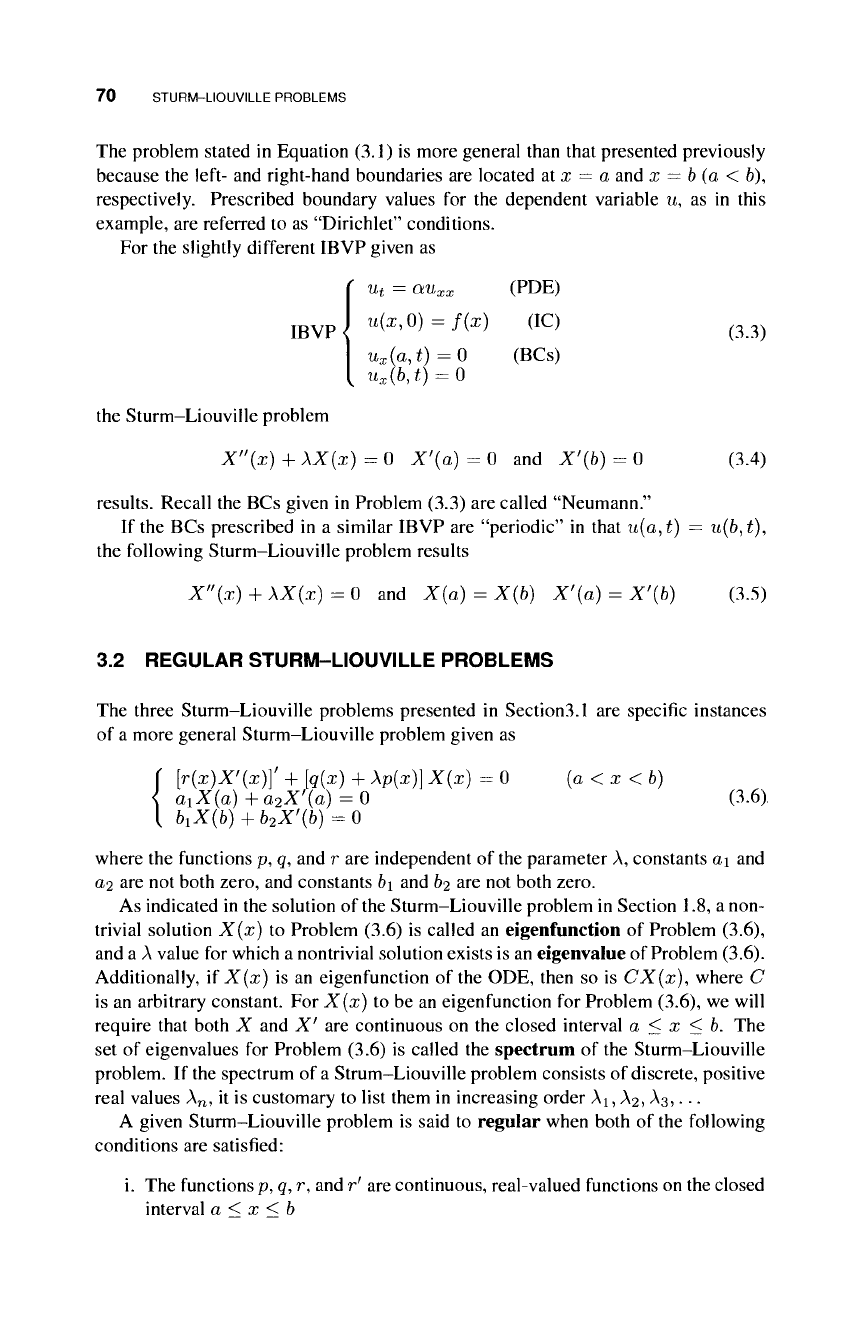
For the slightly different IBVP given as
IBVP<
ut = OLU
XX
(PDE)
u(x,0)=f(x) (IC)
u
x
(a,t) = 0 (BCs)
(3.3)
the Sturm-Liouville problem
X"(x)
+ XX (x) = 0 X'(a) = 0 and X\b) = 0 (3.4)
results. Recall the BCs given in Problem (3.3) are called "Neumann."
If the BCs prescribed in a similar IBVP are "periodic" in that u(a, t) = u(b, t),
the following Sturm-Liouville problem results
X"{x)
+ XX(x) = 0 and X(a) = X(b) X'(a) = X
f
(b) (3.5)
3.2 REGULAR STURM-LIOUVILLE PROBLEMS
The three Sturm-Liouville problems presented in Section3.1 are specific instances
of a more general Sturm-Liouville problem given as
f [r(x)X'(x)]' + [q(x) 4- Xp(x)] X{x) =0 (a < x < b)
< a
1
X(a)+a
2
X'(a) = 0 (3.6),
{ hX(b) + b
2
X'{b) = 0
where the functions p, q, and r are independent of the parameter λ, constants a\ and
Ü2
are not both zero, and constants b\ and b
2
are not both zero.
As indicated in the solution of
the
Sturm-Liouville problem in Section 1.8, a non-
trivial solution X(x) to Problem (3.6) is called an eigenfunction of Problem (3.6),
and a λ value for which a nontrivial solution exists is an eigenvalue of Problem (3.6).
Additionally, if X(x) is an eigenfunction of the ODE, then so is CX(x), where C
is an arbitrary constant. For X(x) to be an eigenfunction for Problem (3.6), we will
require that both X and X' are continuous on the closed interval a < x < b. The
set of eigenvalues for Problem (3.6) is called the spectrum of the Sturm-Liouville
problem. If the spectrum of a Strum-Liouville problem consists of
discrete,
positive
real values λ
η
, it is customary to list them in increasing order λχ, X
2
,
A3,...
A given Sturm-Liouville problem is said to regular when both of the following
conditions are satisfied:
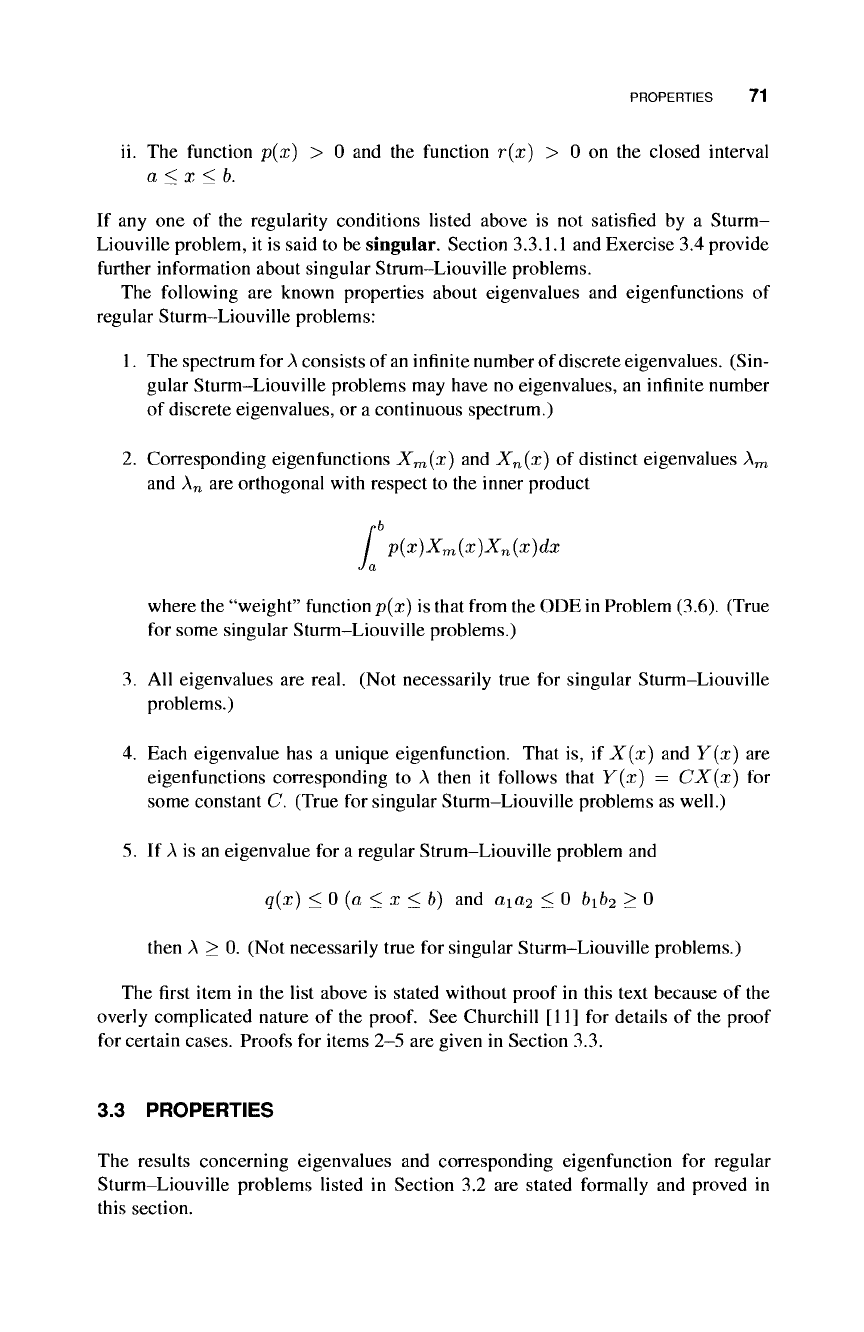
i. The functions
p,
q, r, and r' are continuous, real-valued functions on the closed
interval a < x < b
PROPERTIES 71
ii.
The function p(x) > 0 and the function r(x) > 0 on the closed interval
a < x < b.
If any one of the regularity conditions listed above is not satisfied by a Sturm-
Liouville problem, it is said to be singular. Section 3.3.1.1 and Exercise 3.4 provide
further information about singular Strum-Liouville problems.
The following are known properties about eigenvalues and eigenfunctions of
regular Sturm-Liouville problems:
1.
The spectrum for λ consists of an infinite number of discrete eigenvalues. (Sin-
gular Sturm-Liouville problems may have no eigenvalues, an infinite number
of discrete eigenvalues, or a continuous spectrum.)
2.
Corresponding eigenfunctions X
m
(x) and X
n
(x) of distinct eigenvalues X
m
and λ
η
are orthogonal with respect to the inner product
b
p(x)Xm(x)X
n
(x)dx
where the "weight" function p(x) is that from the ODE in Problem (3.6). (True
for some singular Sturm-Liouville problems.)
3.
All eigenvalues are real. (Not necessarily true for singular Sturm-Liouville
problems.)
4.
Each eigenvalue has a unique eigenfunction. That is, if X(x) and Y(x) are
eigenfunctions corresponding to λ then it follows that Y(x) — CX(x) for
some constant C. (True for singular Sturm-Liouville problems as well.)
5.
If λ is an eigenvalue for a regular Strum-Liouville problem and
q(x) <0(a<x<b) and a\ü2 < 0 b\b2 > 0
then λ > 0. (Not necessarily true for singular Sturm-Liouville problems.)
The first item in the list above is stated without proof in this text because of the
overly complicated nature of the
proof.
See Churchill [11] for details of the proof
for certain cases. Proofs for items 2-5 are given in Section 3.3.
3.3 PROPERTIES
The results concerning eigenvalues and corresponding eigenfunction for regular
Sturm-Liouville problems listed in Section 3.2 are stated formally and proved in
this section.
/